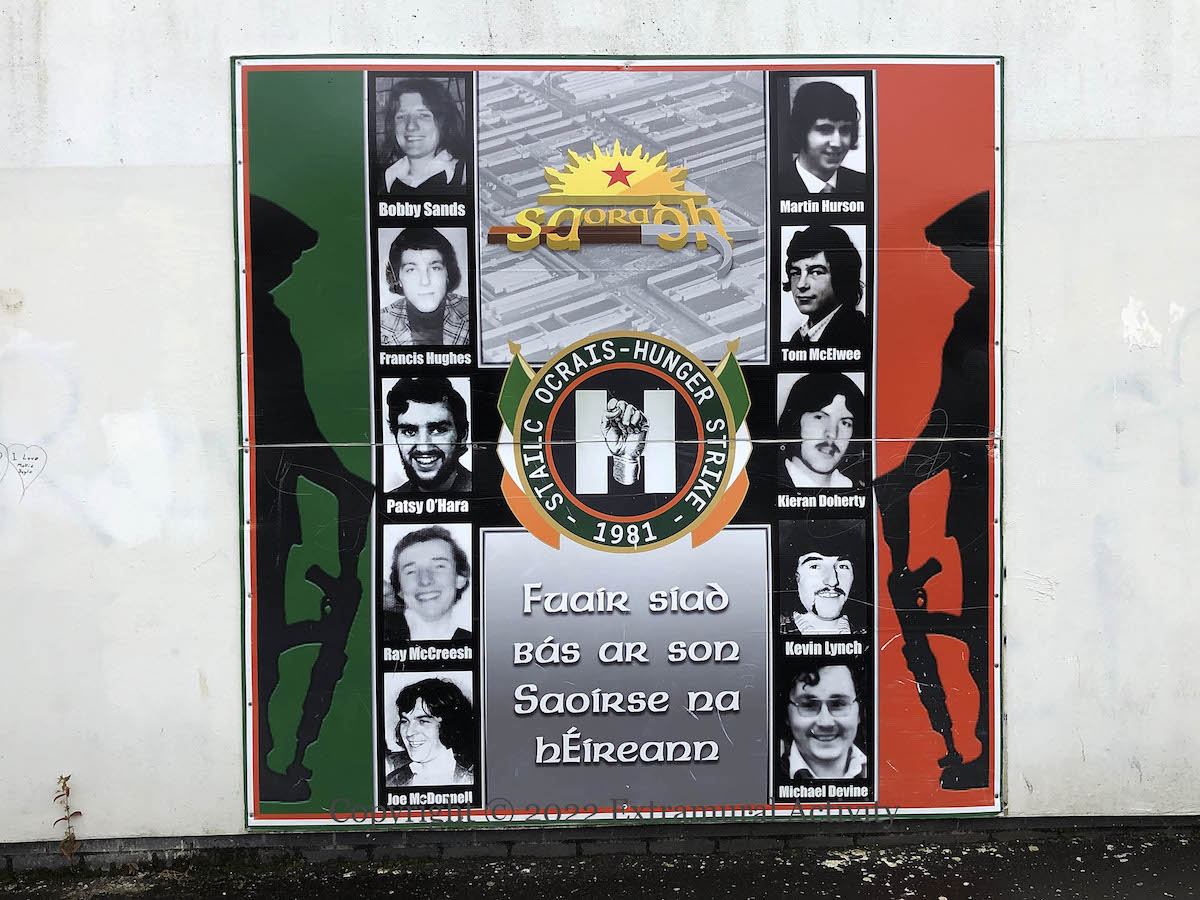
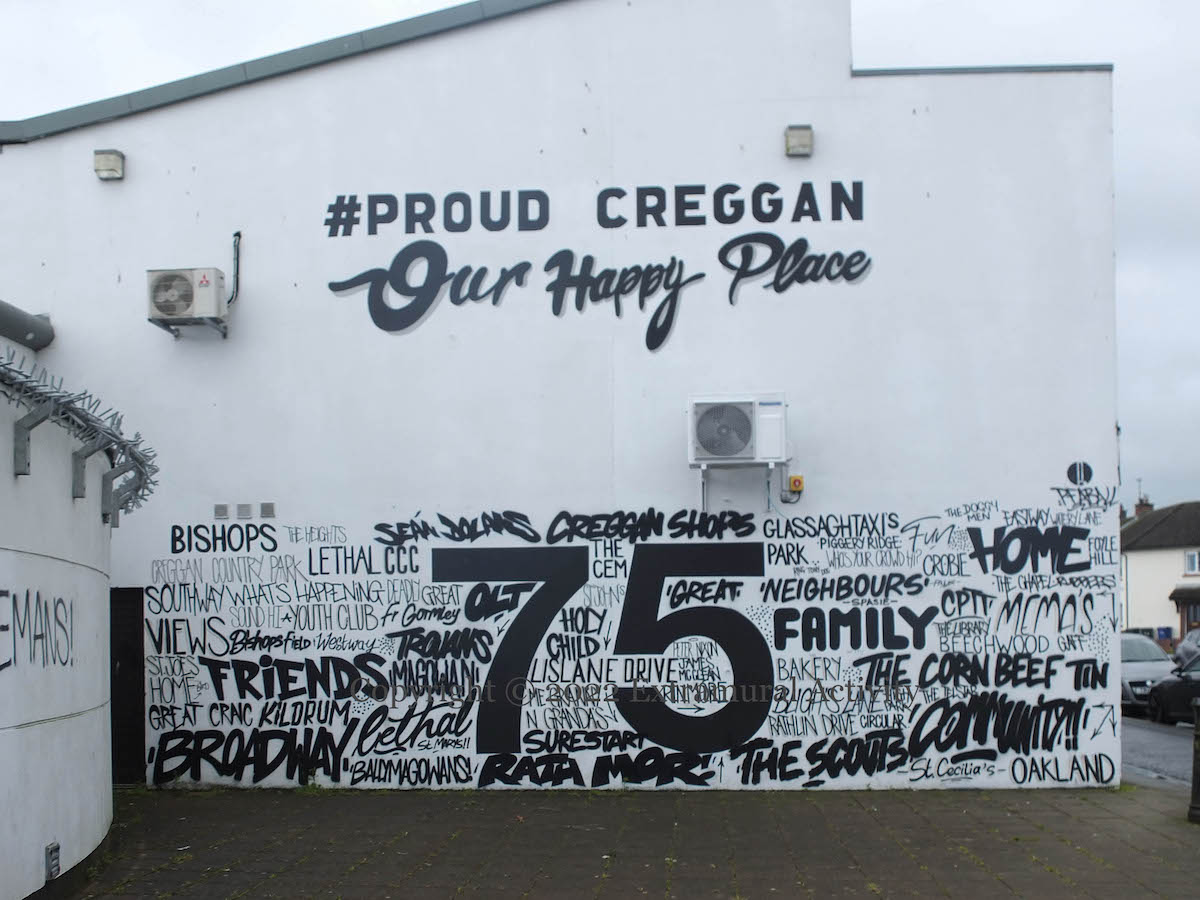
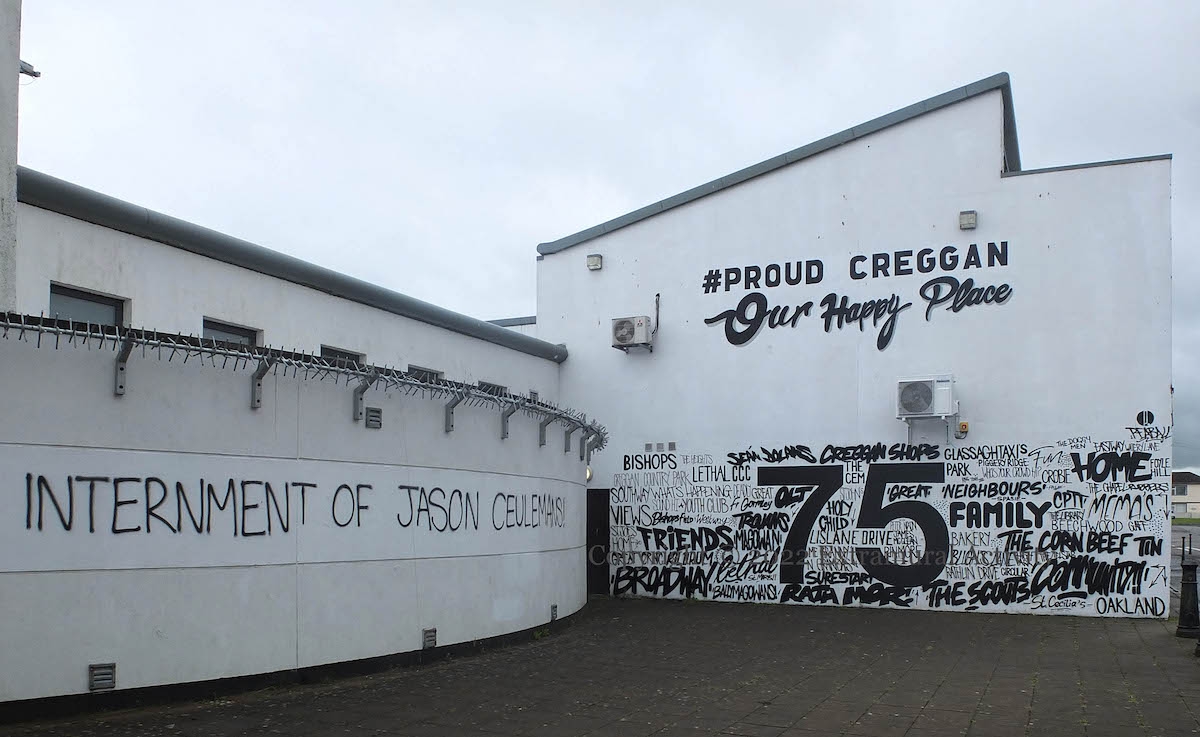
Creggan sports centre opened in October 2009 (Leisure Opportunities) and part of the architecture was to cover the brick exterior with five plain-white panels along Central Drive. These have been taken over by Saoradh/IRPWA, this year to protest the extradition, internment, and treatment of republican prisoners, commemorate the 1981 hunger strikers, support Palestine, and threaten drug dealers.
Construction of Creggan estate was begun in 1947, to house a burgeoning Bogside population while keeping them all in the South ward. At its height, there were 15,000 residents in the area. (McGuinness & Downey | An Phoblacht)
It celebrated its 75th anniversary this year (2022) with a parade, a stage play called A Green Hill Far Away, and a new mural by Peaball (ig) and Vents (ig) along with children from local schools (Derry Journal).
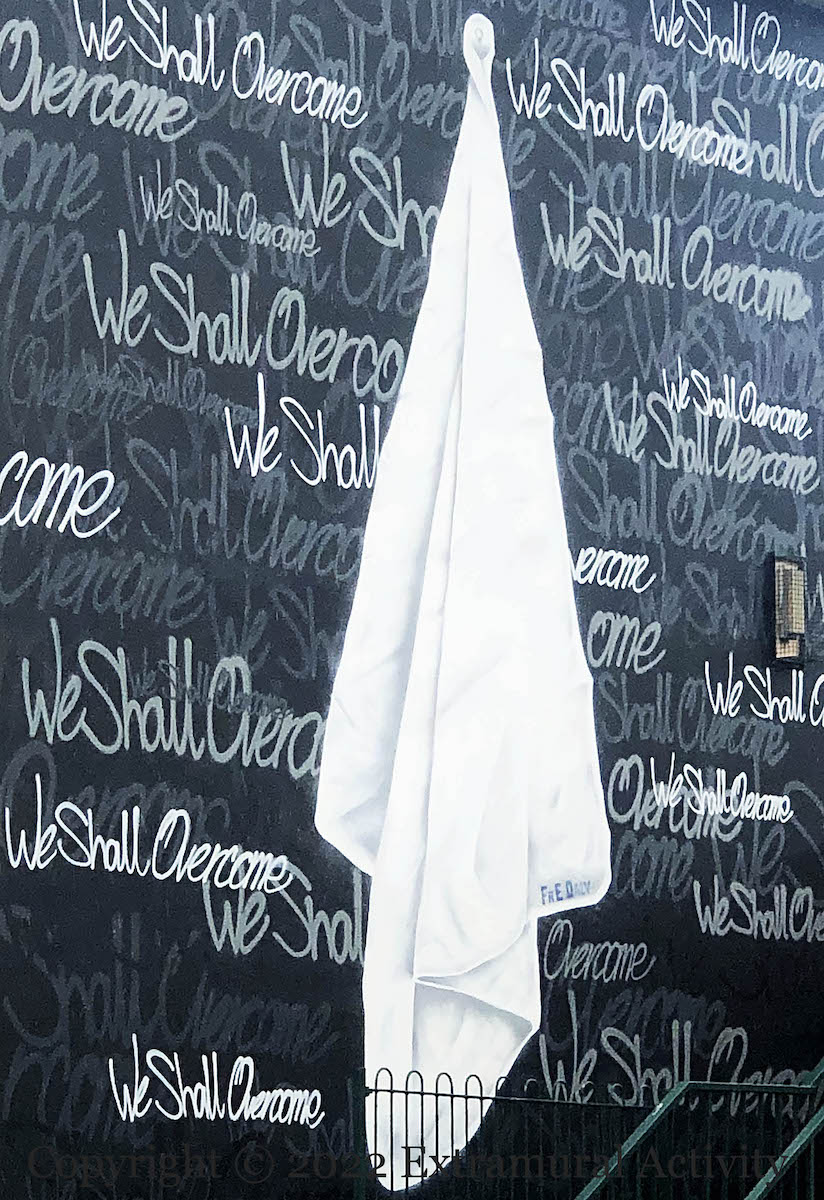
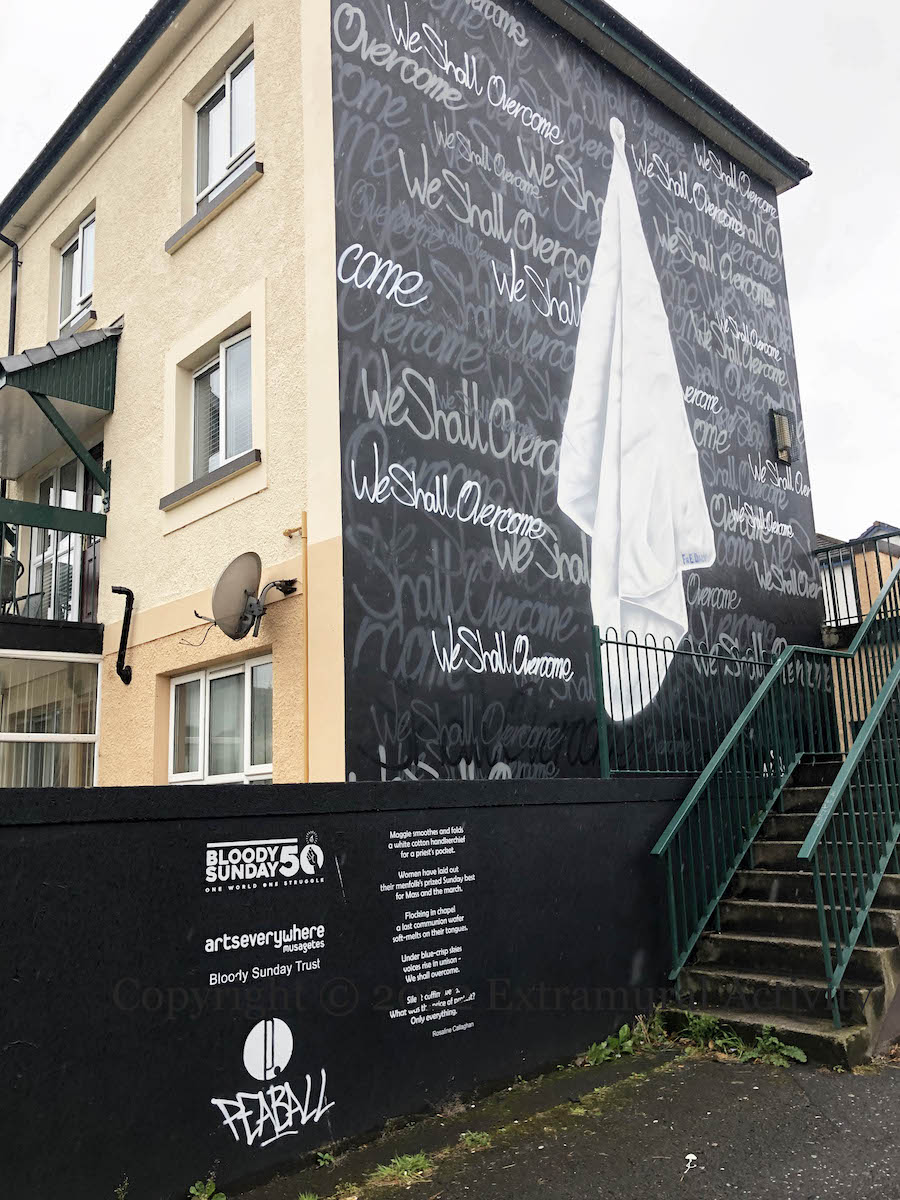
RTÉ has video of James Callaghan touring the Bogside (9m 40s onwards) in August 1969, during which the crowd sings We Shall Overcome, originally a hymn in the US but by 1969 the anthem of the civil rights movements around the world. The white handkerchief waved by Edward Daly ahead of four men carrying the body of Jackie Duddy on Bloody Sunday has become emblematic of the day, as it was shown on televsion coverage and in the Fulvio Grimaldi photograph that was used for the Bloody Sunday/Civil Rights mural next to Free Derry Corner.
“Maggie smoothes and folds/A white cotton handkerchief/For a priest’s pocket.//Women have laid out/Their menfolk’s prized Sunday best/For Mass and the march.//Flocking in chapel/A last communion wafer/Soft-melts on their tongues.//Under blue-crisp skies/Voices rise in unison – /We shall overcome.//Silent coffins weep/What was the price of protest?/Only everything – Rosaline Callaghan”
Painted by Peaball (Fb) in Rossville Street, Derry.
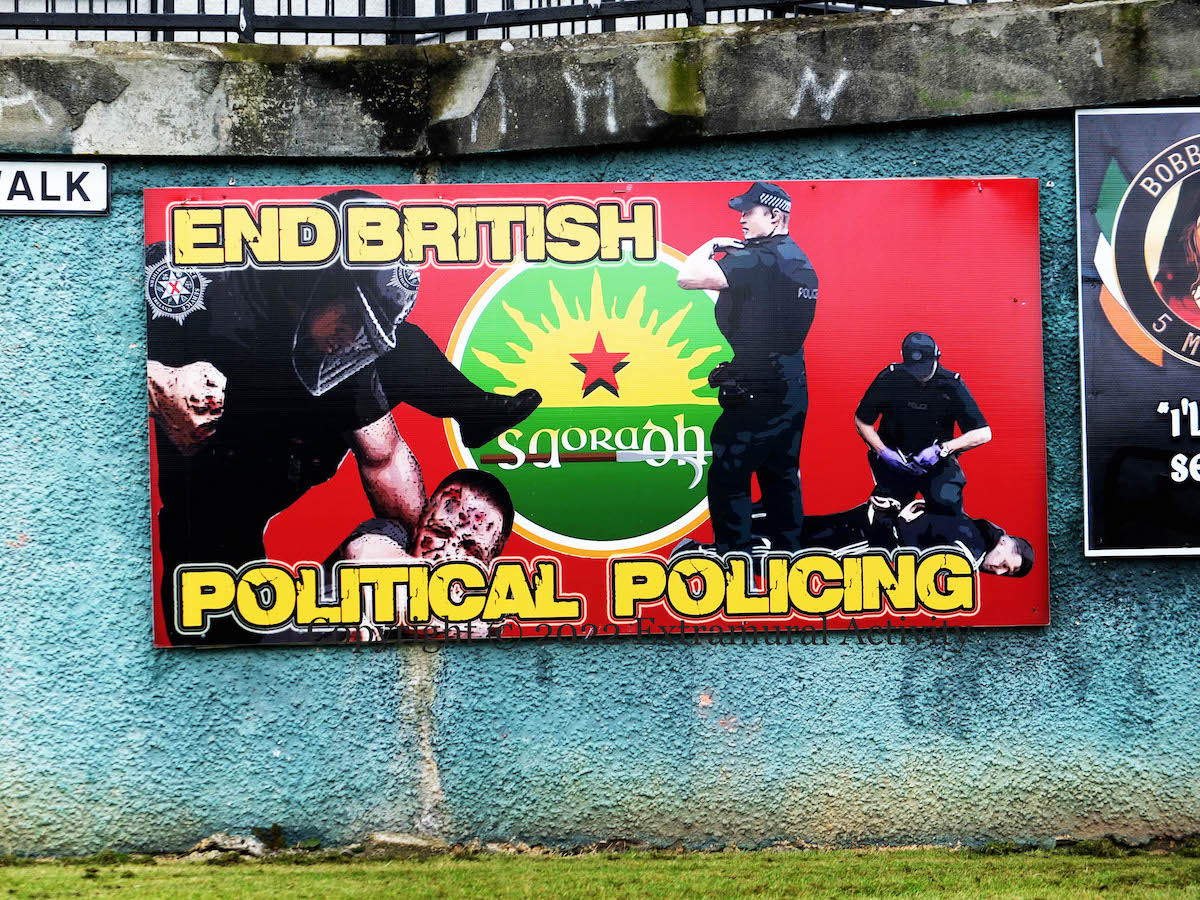
No Amnesty For British State Forces: “Democide is the murder of any person or people by a government, including genocide, politicide and mass murder. Democide is not necessarily the elimination of entire cultural groups but rather groups within the country that the government feels needs to be eradicated for political reasons and due to claimed future threats. – No amnesty for British state forces”
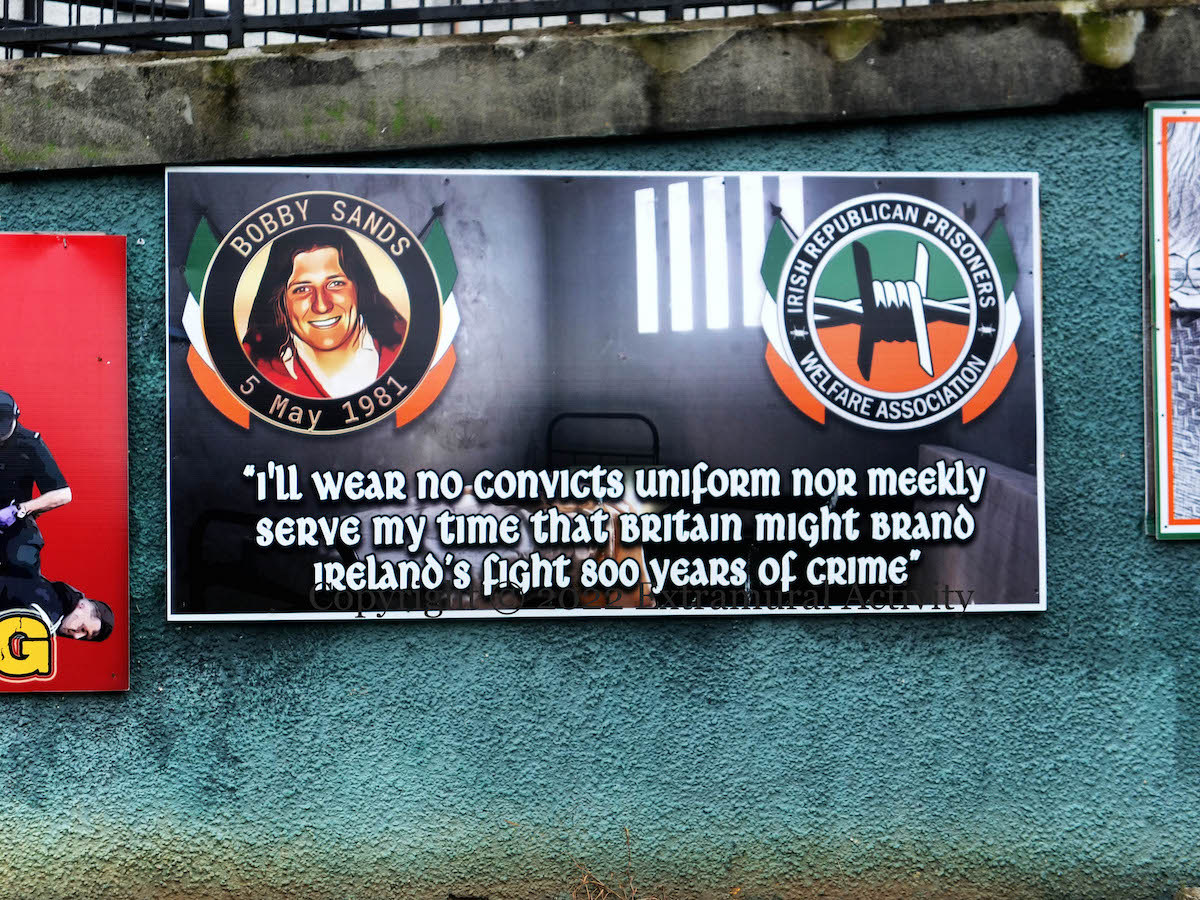
Bobby Sands/IRPWA: “I’ll wear no convict’s uniform/Nor meekly serve my time/That Britain might brand Ireland’s fight/800 years of crime” [Francie Brolly song] (IRPWA (web))
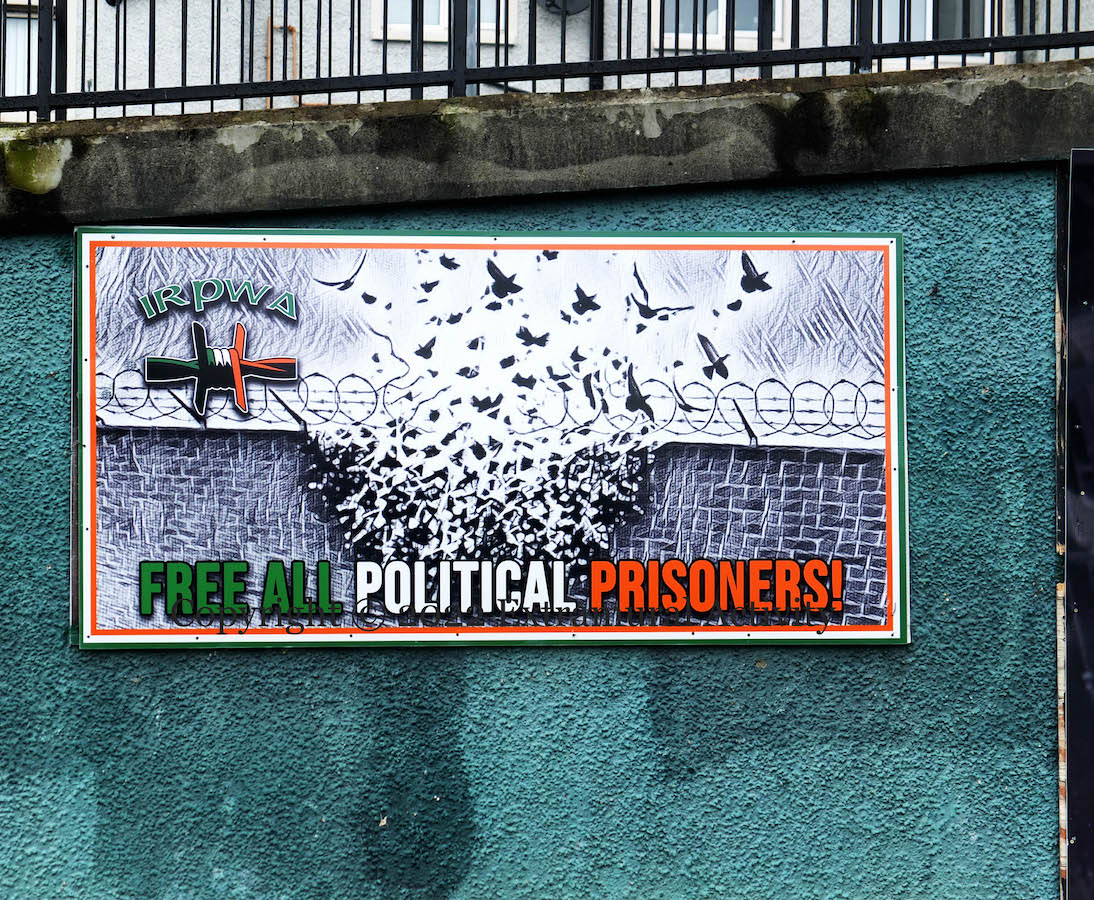
Free All Political Prisoners! (IRPWA)
1981: 1981: “I am a political prisoner. I am a political prisoner because I am a casualty of a perennial war that is being fought between the oppressed Irish people and an alien, oppressive, unwanted regime that refuses to withdraw from our land.” [Bobby Sands’s diary, day 1] (IRPWA)
Unity Referendum Now!: “British occupation has been a disaster for the people of Ireland. A united Ireland is the way forward for all the people of Ireland.” (IRSP.ie)
40th anniversary of the 1981 hunger strike: described previously in For A Socialist Republic (IRSM/IRSP)
The re-painted mural to plastic-bullet victim Julie Livingstone was rededicated this past Saturday (October 15th). For the previous mural, see 2010. “The Stolen Child – Come away, O human child/To the waters and the wild/With a faery hand in hand/For the world’s more full of weeping/Than you can understand… – WB Yeats.”
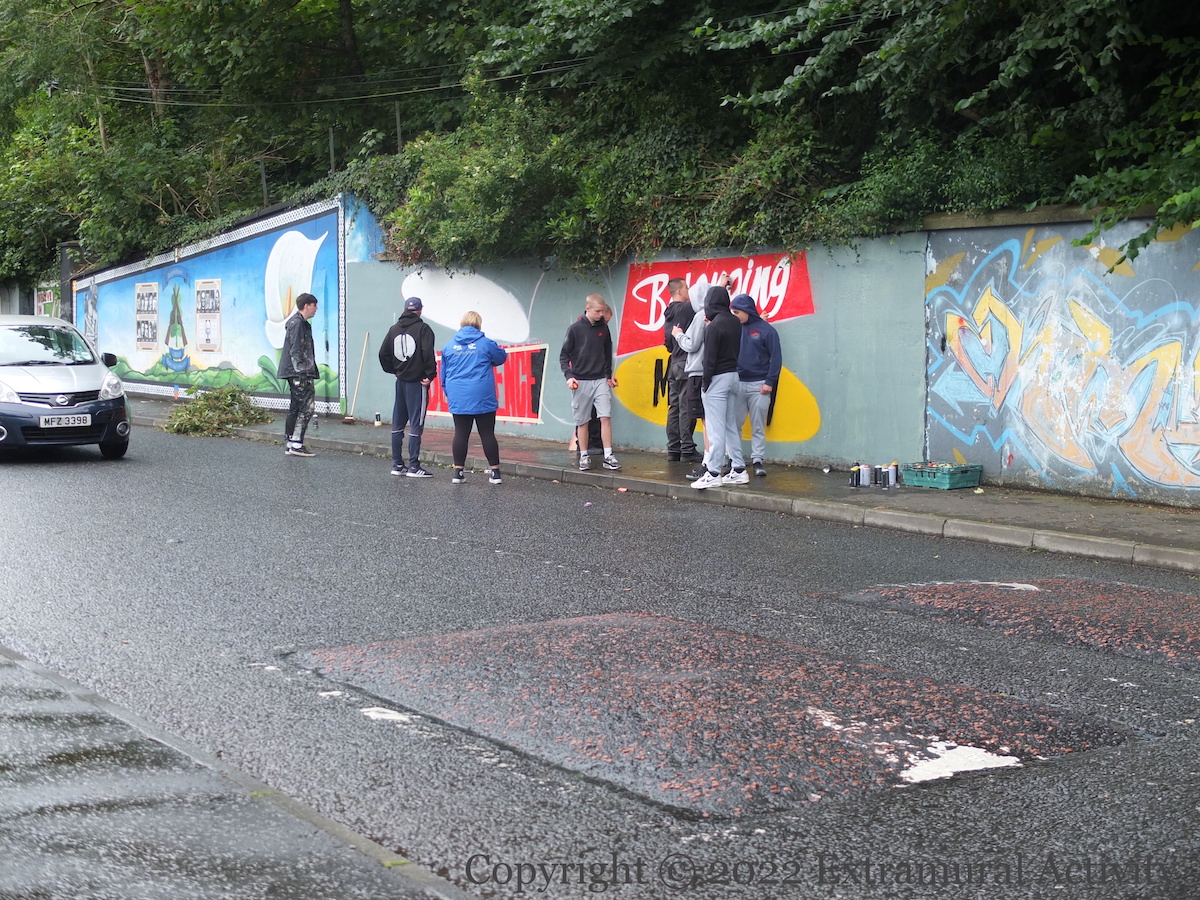
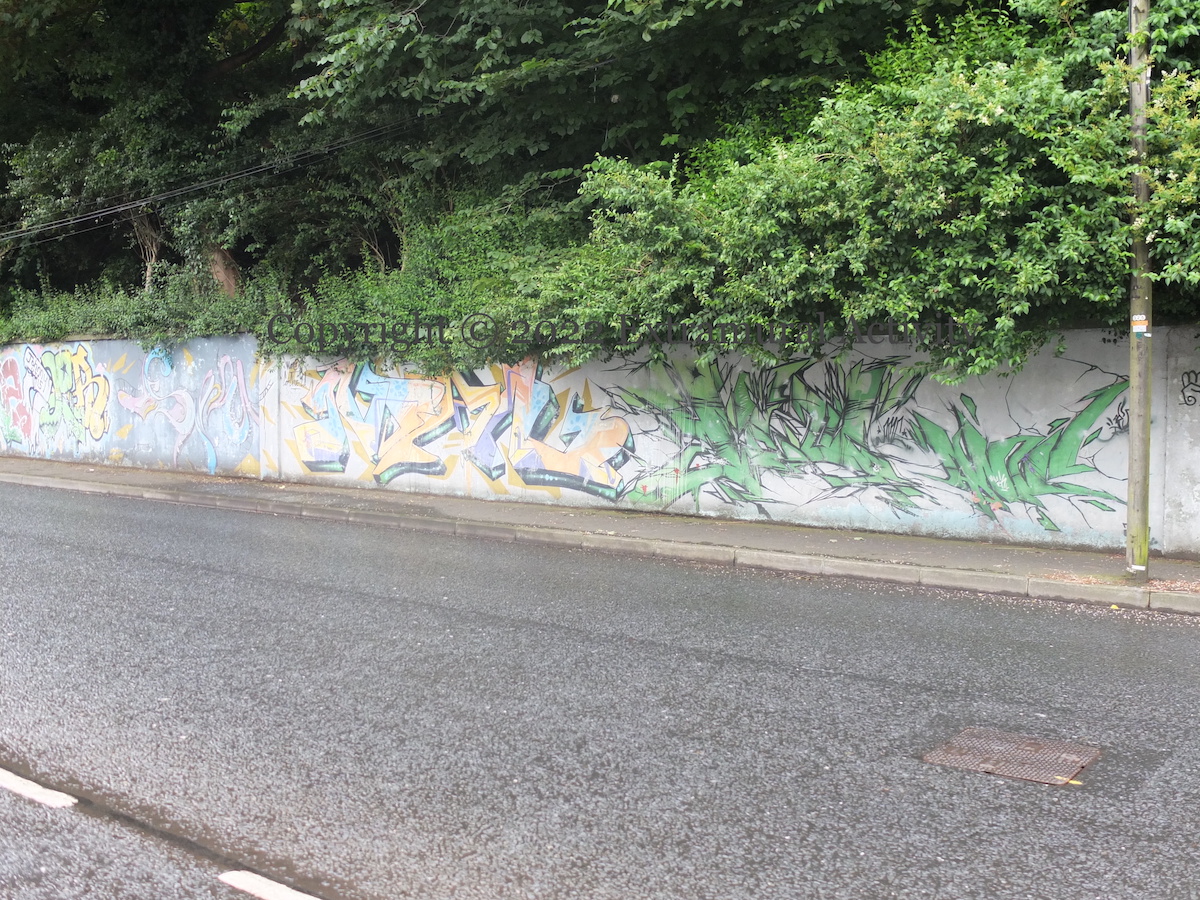
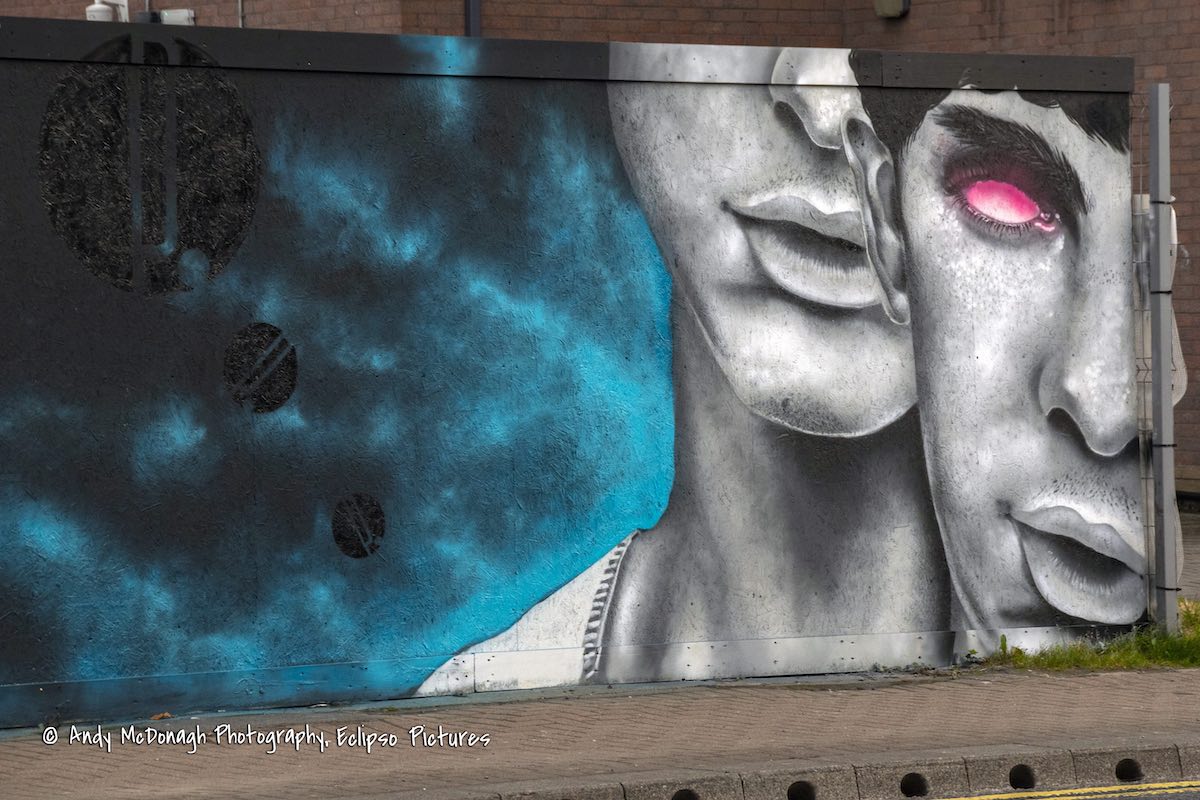
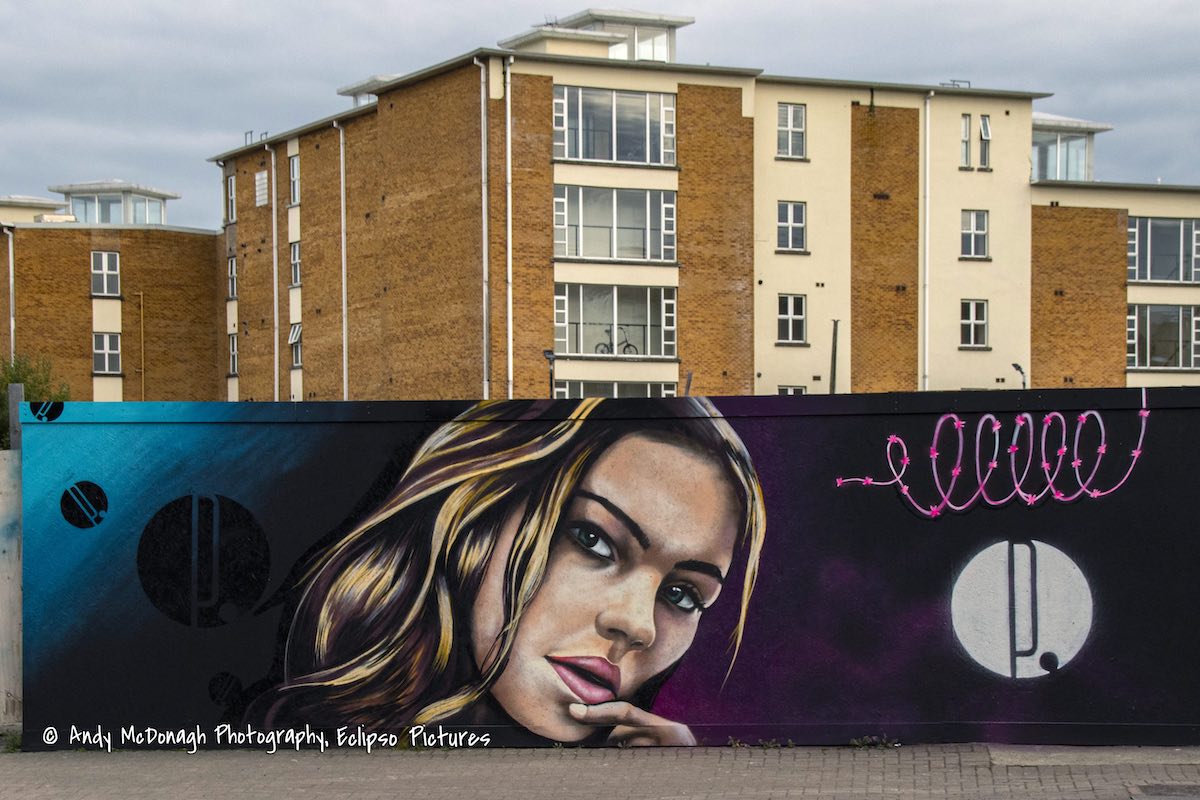
Here is a complete set of images from the Bogside end of the Brandywell. From left to right: “Nasc” by NOYS (ig) for Gasyard Féıle 2022, Long Tower Community Centre (see Brandywell Past And Present), a new “Brandywell” stencil by Peaball (ig), the Ryan McBride Foundation (tw), a new version of the Derry Brigade IRA mural (see previously Brıogáıd Dhoıre), Peaball and local youth at work, various pieces of wild-style writing and graffiti in support of Jason Ceulemans.
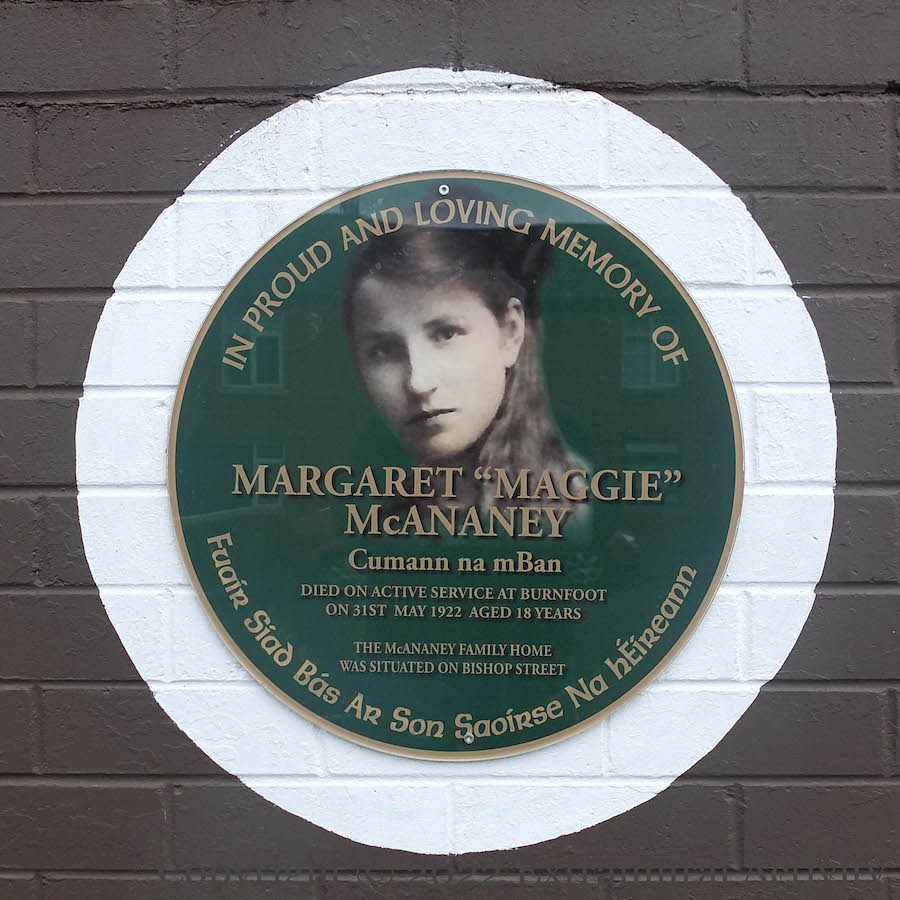
A plaque was mounted this (2022) summer to Maggie McAnaney, who died when a gun went off at an IRA checkpoint near Burnfoot, Co. Donegal, a month before the Civil War began (Derry Journal). This is an unusual use of the phrase “active service”, as McAnaney was travelling to a picnic at the time, rather than on exercises or preparing munitions; the phrase would later come to be associated primarily with a premature bomb explosion.
“In proud and loving memory of Margaret “Maggie” McAnaney, Cumann na mBan, died on active service at Burnfoot on 31st May 1922, aged 18 years. The McAnaney family home was situated on Bishop Street. Fuaır sıad bás ar son saoırse na hÉıreann.”
“Either ballot or gun, our day will come – PIRA.” This graffiti dates back to at least 1998 (see C01268) and probably to the breakdown of the ceasefire in 1996; the same slogan was present in Wall St (Carrick Hill) in 1996. It is still visible on the Falls Road in 2022.
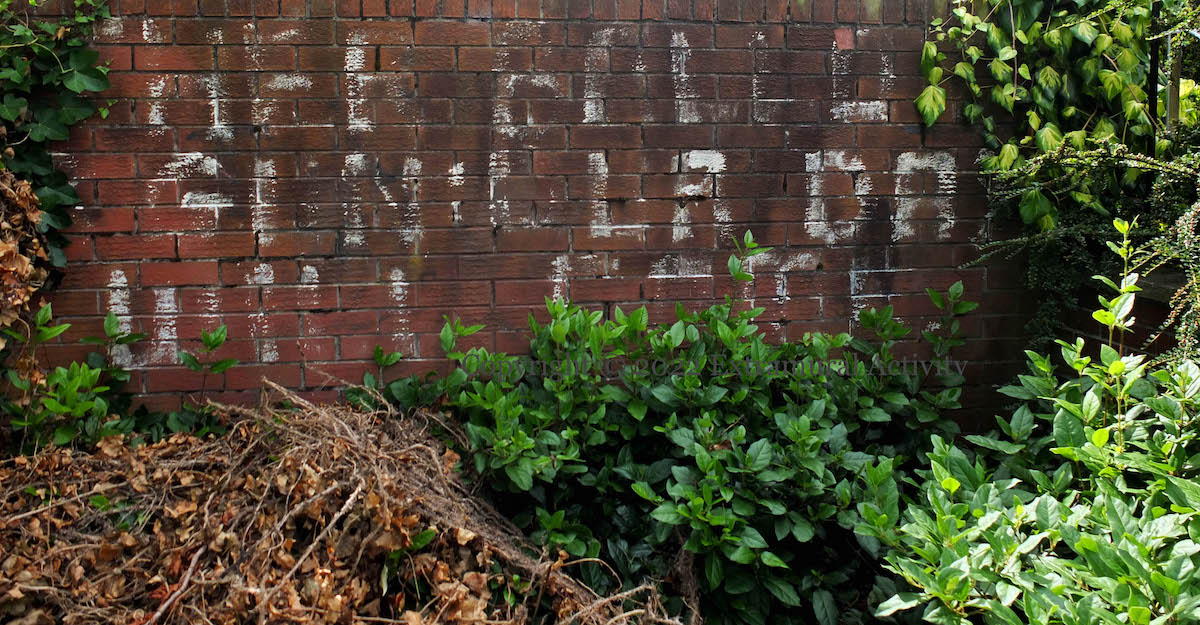
“I gcuımhne na nÓglach a fuaır bás ar son saoırse [in memory of the volunteers who died for freedom].” The “22” are the familiar 12 deceased Troubles-era hunger-strikers, plus 10 from 1917 to 1946: Thomas Ashe, Terence McSwiney, Michael Fitzgerald, Joseph Murphy, Joe Witty, Dennis Barry, Andy O’Sullivan, Tony Darcy, Jack McNeela, Sean McCaughey.
“‘A Letter To The 22: You have not gone away. You are in the hearts/and on the lips of your people./The old speak of you with knowing tongue. The middle/aged, as those who walked beside you./The young men and women with a passion not unlike your own./Your names can be heard on the wind taken from the mouths/of men who tend their flocks on Slieve Gullion, Cnoc Phádraıg, Glenshane./They echo in small graveyards in/Cork, Kerry, Galway, Mayo, Tyrone, Antrim, Derry and Armagh./They are heard among your people at the mass gate on/Sunday, in the crowd at the hurling game, around the hearth when/the bottle is cracked and song in sung. Your image can be seen/on the faces of happy smiling children for whose freedom you gave your all./You are in our prayers, you have not gone away, you never will’ – Colum Mac Gıolla Bhéın“















 Extramural Activity