Introduction
Most political parties don’t use posters and hoardings to advertise themselves; they advertise their candidates. Provisional Sınn Féın (which we will refer to simply as “Sınn Féın”) is different in that the idea of voting for Sınn Féın (in any election) was a somewhat unfamiliar one to republicans in the early years of the troubles. Since the split in 1970 (into Provisional and Official Sınn Féın), Sınn Féın had existed to support the cause of (Provisional) IRA, organising marches and seeking publicity (such as through the new newspaper Republican News), and running advice and incident centres, but it did not emphasize electoral participation and maintained a policy of abstentionism, that is, of not participating in governance even when seats were won.
In 1981, during the second hunger strike, Bobby Sands was put up as a candidate for the Fermanagh & South Tyrone seat in the (UK’s) Westminster elections, in order to disprove the claim that the paramilitary campaign and the campaign for political status of prisoners had no support. Sands won the seat, and Kieran Doherty was also elected as TD for Cavan-Monaghan in June’s Dáil elections (in the Republic Of Ireland). The possibility of electoral power in addition to the military campaign was apparent: at the Ard Fheıs in November, 1981, Danny Morrison famously declared, “Who here really believes we can win the war through the ballot box? But will anyone here object if, with a ballot paper in this hand and an Armalite in the other, we take power in Ireland?”
Sınn Féın ran candidates in the 1982 Assembly elections in October and won five seats (of 78). The five were Gerry Adams, Danny Morrison, Martin McGuinness, Jim McAllister, and Owen Carron, who had been Sands’s election agent and won the (Westminster) seat in 1981 after Sands’s death.
In 1983, Alex Maskey was the first SF member to be elected to Belfast City Council and Gerry Adams was elected to Westminster in the general election. Adams became leader of the party later in 1983 and continued promoting the increased political engagement that he had been lobbying for the blanket protest. Sınn Féın from that point on put forward candidates for all types of election in the North: European, Westminster, Forum/Assembly, local councils.
Candidates are usually advertised to the public by posters and hoardings. Both are of a fairly temporary nature since they become irrelevant after polling day. Sınn Féın and its supporters, however, have also used graffiti and murals. The murals vary in their sophistication, as they, like the graffiti, are being produced by amateurs. Painted work is, though, longer-lasting than an election poster and so, perhaps both for this reason and because of Sınn Féın’s novelty as an electoral party, many of the murals below are not for a specific candidate but for the party itself.
This page describes Sınn Féın murals and graffiti from 1983 to the early 2000s, when banners and boards (and not just small paper posters) of reproductive photography appear. The few known unionist electoral murals are also included. The page ends with a few recent alternatives to Sınn Féın.
Images
The earliest electoral mural on record is the 1983 mural “For A New Ireland/Vote Sınn Féın”. Although it asks people to vote for Sınn Féın and was presumably painted in time for the 1983 Westminster election, this mural is tied to the various components of republicanism, from “Brits out”, to jobs and houses, to culture.

[From the 1984 European election: “Vote Morrison” in Beechmount. See C00409.]
The early murals and graffiti often appear alongside militaristic messages. This one, in in Bishop Street, Derry, is on a low wall which only two years earlier had sported about ten panels, which quickly deteriorated. The Sınn Féın logo – the island of Ireland with the letters “SF” or the words “Sınn Féın” – was painted over one of the old panels alongside a few other new one and some old ones, including a memorial to Derry Brigade IRA and a volunteer aiming an assault rifle.

Likewise, this appeal to “Vote Sınn Féın” appears alongside graffiti urging “Brits thugs out”, “Join Na Fıanna Eıreann now “, and a board demanding political status. Eastway, Derry

The board underneath is more permanent than the posters for the candidate, in this case Harry Fitzsimmons in the 1985 elections for Belfast City Council (ARK).

An old hunger strike mural in Oakman Street is painted over with “Vote Sınn Féın” and “Tıocfaidh Ár Lá”. The original mural was a copy of a poster sent in support of the hunger strikers by the Iranian Ayatollah Khomeini, which featured the head of Bobby Sands against a backdrop of skeletal bodies, one of which can still be seen in the top middle of the wall. Somewhat ironically, the original mural also included the quote to the right: “The Irish Republican Army is right: the British government does not listen to the ballot box in Ireland and the only thing they will listen to in Ireland is what they listened to in other colonies: agitation, rebellion, and armed forces”.

Also from this period: a 1986 mural in Hawthorn Street shows the “SF” logo next to the paramilitary slogan “Tıocfaidh ár lá” (Our day will come). (1986 M00335)
This is a gable-width wall with the SF logo in the middle of a Tricolour and the name of the party in block lettering. The logo (and the fada over the “e”) would be removed in the 1987 repaint, but the words “Sınn Féın” would remain.

The 1987, Gerry Adams attempted to retain his Westminster seat. Adams had taken the seat in 1983 from the SDLP’s Joe Hendron and the contest was expected to be close, given that Gerry Fitt would not be running (as an Independent, splitting the SDLP vote).

Republican painters were out in force, especially in the Whiterock/Ballymurphy/Springhill-Westrock area. This is the wall on the upper side of the intersection of the Whiterock and Springfield Roads, just below “Say No to Dr. Joe”: “Vote Sınn Féın” and “Adams MP” flank a volunteer aiming a rocket propelled grenade.

The inclusion of “peace” in the “Freedom – justice – peace” posters above the RPG and in this next two images (and in the 1989 Strabane mural below) could just mean “Vote for Sınn Féın so that the additional political power can result in peace in the form of the British out and a united Ireland” but its appearance at this time (and not before) suggests war-weariness.
“Freedom Justice Peace” and “Vote Sınn Féın” on the Falls Road at Fallswater.

The next nine images are from Springhill-Westrock.
Sınn Féın posters [for] freedom – justice – peace/saoirse – ceart – síocháın next to IRA and Fıanna flags on pikes, with hand-written “tıocfıádh [sic] ár lá” below.


Sınn Féın/Adams next to the Tricolour (here standing for the IRA) and An Gal Gréıne (sunburst, representing the junior IRA or Fıanna Éıreann).


Sınn Féın/Adams immediately below a paramilitary mural.


Sınn Féın flanking “IRA”

This final Springhill/Westrock image is of a painted portrait of Gerry Adams, probably the first living republican to be portrayed.

The mural above was Gerard ‘Mo Chara’ Kelly‘s first solo mural – he had painted earlier at the Bunscoıl with Bob Corrigan. A few week later, he painted a second portrait, this time at the Whiterock/Springfield junction.

Coming down the Whiterock, the long wall along the cemetery was painted with “Vote Sınn Féın” and “The west has the best”.
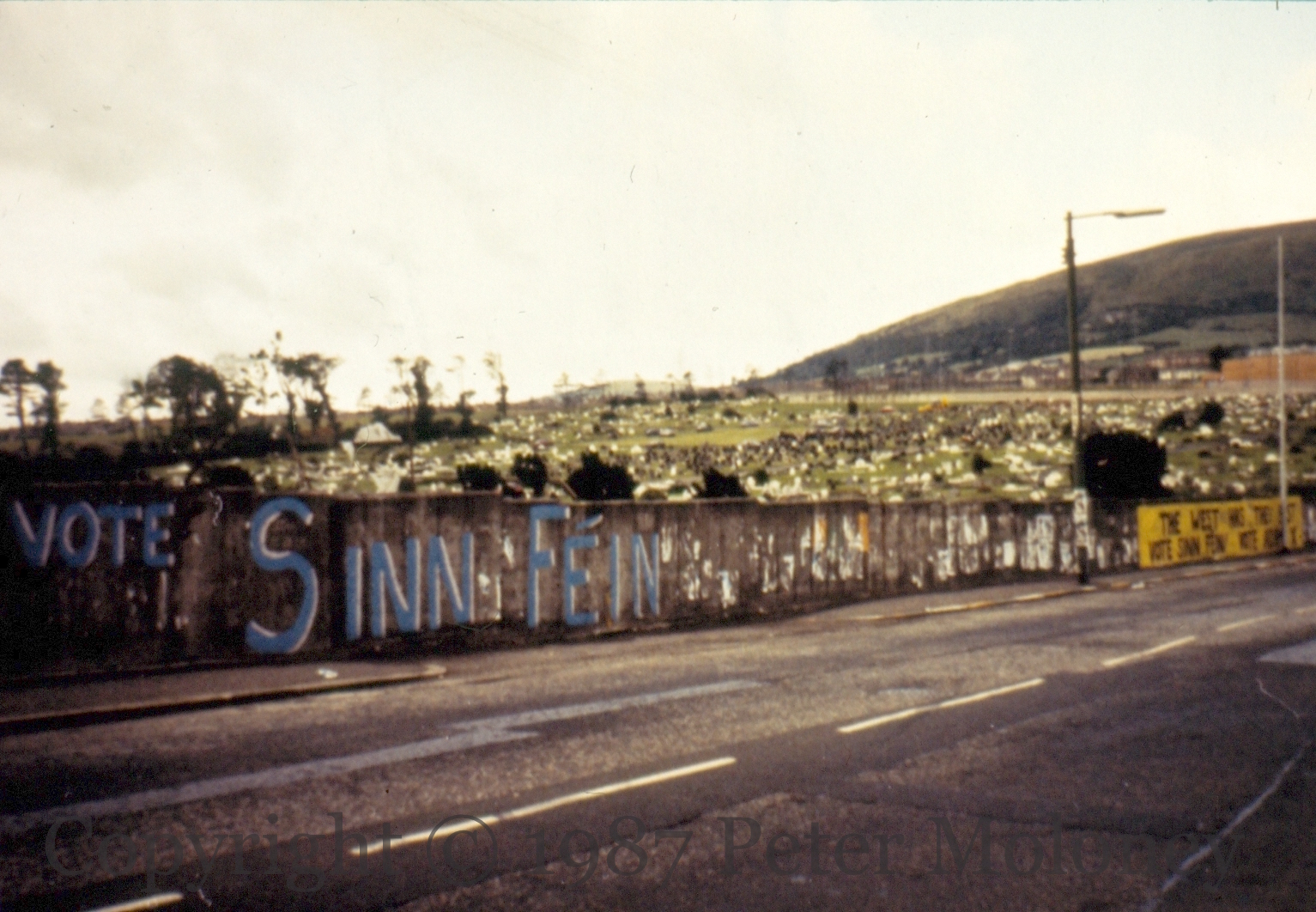
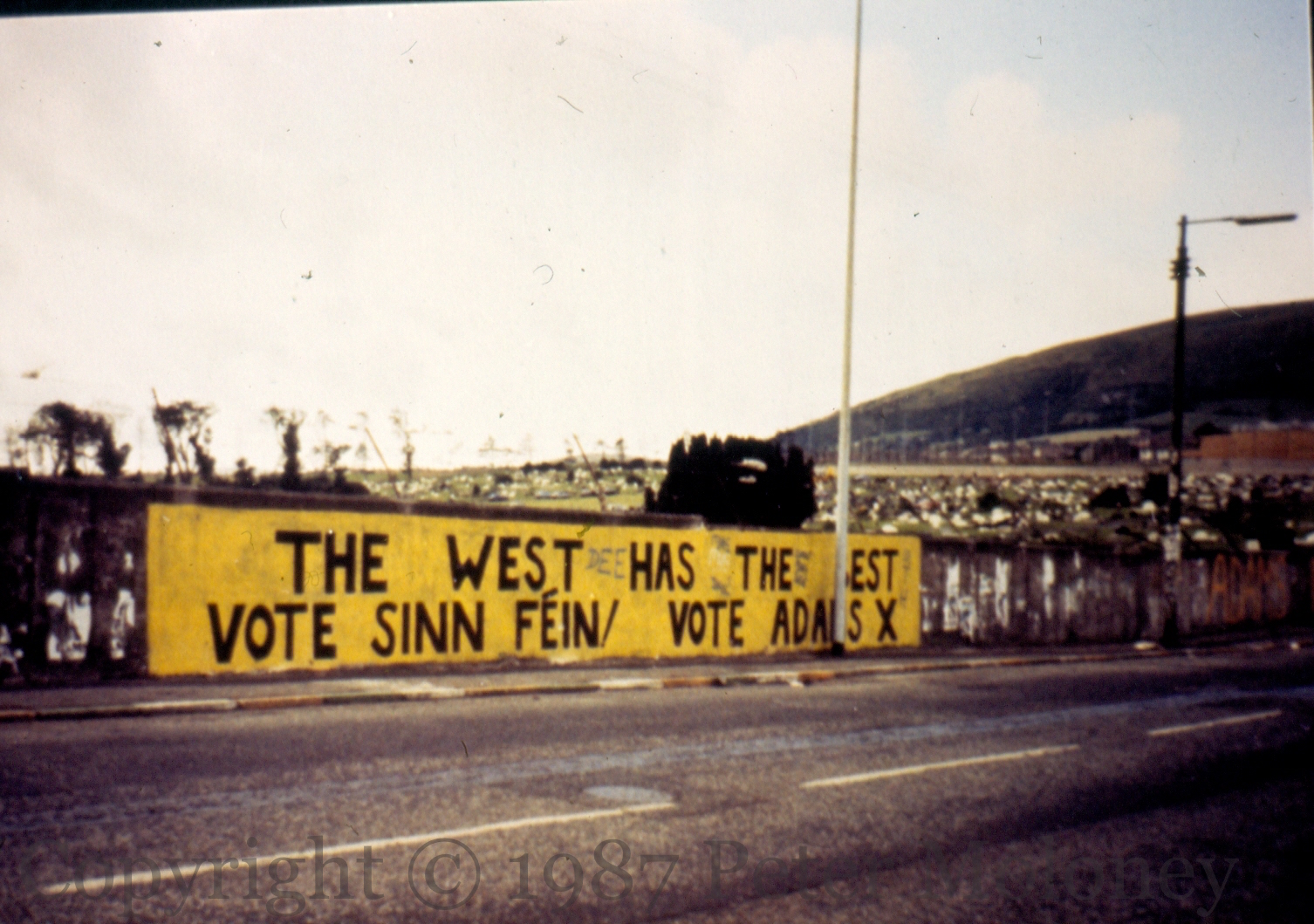
Off Divis Street, posters themselves were used as the material to spell out their message in large letters.

[Also from 1987, the Khomeini wall in Beechmount (see above) is replaced with “Vótáıl Sınn Féın – Adams” in extremely large letters (M00504).]
Hendron increased his tally by ~3,700 votes but Adams held the seat, winning by 2,221 votes. (Hendron would take it back, for one last time, in 1992, by fewer than 600 votes.)
There were no elections in 1988. 1989 saw Council elections in May and European elections in June. This mural in Ballycolman, Strabane makes the case for the under-representation of Sınn Féın in UK and local government: 1 MP, 40[%] nationalist elec[torate?], 56 [city/district] council[lors]. The SDLP’s typical three Westminster seats and 100+ council seats are omitted.

Another 1989 Ballycolman mural includes a dove in addition to the word “peace”.

For the 1989 Belfast City Council election: “Vote Richard May”

“Fight Back”. A ballot box lands on the head of a Paratrooper. One way to resist the British Army is by voting for Sınn Féın.

Andersonstown, west Belfast, graffiti encouraging participation in the European vote.

[Also from the European election, a painted “Vote Sınn Féın – Morrison No 1” in Owenvarragh Park, Andersonstown (M00740).]
Adams lost his, and the only, Sınn Féın seat in Westminster in 1992.
1992 DS2 057 “Vote with your feet” on Kells Walk.
Council elections took place in May, 1993.
“Give Them That Screamin’ Feeling”

The People’s Voice


First stencils? In the Lecky Road underpass, Derry.


“Use your brain – vote Sınn Feın” on the side of the Falls library.

Building a new Ireland

“Make change, make peace”

Loyalists were also moving into politics to some extent. The UDA, which had long had a policy wing in the form of New Ulster Political Research Group, dating back to 1978, which then became the Ulster Loyalist Democratic Party (in 1981) and then the Ulster Democratic Party (in 1989). This mural is from 1998 and makes reference to the 1987 policy document ‘Common Sense’. The party dissolved in 2001.

This mural is for the PUP, the Progressive Unionist Party, associated with the UVF. It was formed in 1979 and still exists (in 2018). The side-wall of a mural in Kenilworth Place was also for the PUP (C00952) and a large PUP tarp was hung in Sugarfield Street in 2014 – Google Street View.

“Your winning team” – the first photographic-style election banner in the Peter Moloney Collection.

However, amateur pieces are still being produced. This Cromac Street advertising hoarding was repurposed: “Vote Sınn Féın – Maskey No 1”


“Vote” for RSF candidate Tommy Crossan by spoiling your vote.

McCann’s The Man


“Revolution.” The logo of Ógra Shınn Féın [Young Sınn Féın] is typically a Molotov cocktail but here it is given a street art star.


In 2011, Éırígí contested a local election for the first time, fielding candidates in two Belfast areas. Pádraıc Mac Coıtır received 1,415 first preference votes (more than 10%) in Upper Falls and John McCusker 647 in Lower Falls. Neither was successful (WP).

NI21 was an unionist but cross-community, progressive, and pro-European party that existed from 2013 to 2016. In 2014 it stood candidates in the local and European elections. The hoarding below uses the Irish language to recruit support in west Belfast.

People Before Profit is a pro-nationalist but cross-community left-wing party providing an alternative to Sınn Féın for disaffected voters. This placard for candidate Gerry Carroll is on the (loyalist) Shankill Road. Both Carroll and long-time candidate Eamonn McCann would be elected.

In these boards, Sınn Féın (including an ill Martin McGuinness) use the issue of Brexit to strike back at People Before Profit.

Use the ‘electoral’ category on Extramural and the Peter Moloney Collection – Murals for later electoral murals and boards.
References in parentheses to mural collections:
C = Tony Crowley Collection
D = squire93@hotmail.com collection
J = Jonathan McCormick Collection
M = Peter Moloney Collection – Murals
S = anonymous collection
T = Paddy Duffy Collection
X = Seosamh Mac Coılle Collection
Back to the index of Visual History pages.
Written material copyright © 2017-2024 Extramural Activity. Images are copyright of their respective photographers.
 Extramural Activity