The “Rockland Street” or “Village” King Billy dates back to roughly 1932. It was touched up frequently and repainted on several occasions, as described here.
The earliest image or description available is of the 1954 repainting.
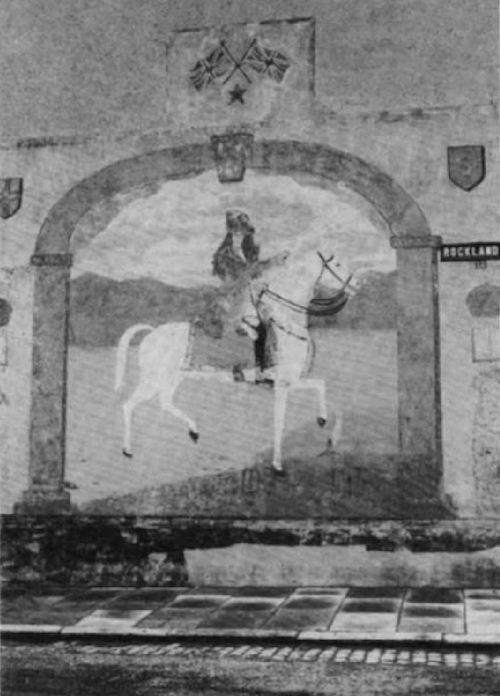
The mural shows …
- a round Royal arch (itself a symbol of the Orange Order), with a keystone reading “1690” and capitals reading “Derry” and “Aughrim”,
- a broader surround, with flags above, shields to either side, and Orange symbols to either side (in this case, the crown and Bible),
- within the arch, King Billy on a horse that is standing in water and stepping onto a river bank in the foreground, with hills and sky in the background.
As the images and descriptions in the rest of this page make clear, the three broad elements (arch, surround, King Billy on horseback crossing the Boyne) would be preserved throughout the decades, though with some variation in detail.
Kerr 1957 (p. 15) reports that this version of the mural had been repainted in 1954 by a Mr Beattie who lived in the street; the Lord Mayor came to unveil it. Beattie followed the previous design but Kerr attributes the textured sky, in particular, to Beattie. (A photograph of the mural also appears in Kerr’s book.)
The News Letter in 1968 reported that when the mural was “repainted by the Dowie Brothers in 1968, it was redesigned for the first time in 39 years (BNL 12-7-1968)” (Jarman 1995 p. 117). Note that this would give 1929 as the date of creation.
The images we have of the wall from the early 1970s – which might show this 1968 repainting – show various changes. All the attention has gone to the main panel: rocks or marshy ground have been added in the foreground, and two scrolls have been added at the bottom, reading “King William III” and “Prince of Orange”. In the surround, the crossed flags and the Orange symbols have gone, perhaps simply by fading away; the shields are still barely visible. In the arch, the keystone and capitals have been removed – the arch is a solid line without any architectural articulation.
See 1970 (Alamy AK2RDM), 1971 (Bellisario/Getty 457329488). There is also an image from 1972 in the Belfast Telegraph (X12578).
The unattributed image just below (possibly related to this 1975 Conrad Atkinson) includes Orange symbols in the surround and”No surrender” in the cross-bar; in the arch, the keystone returns, now with “REM 1690/1969”; the capitals will never return.
The mural is in great disrepair. According to Loftus (1982 p. 60), the damage to the plaster on the right was due to a 1974 bonfire. Much of the detail has gone from the marshy foreground – this might be due to the fire or to a repaint – but otherwise the main panel appears to be the same as before.

The damage extended vertically along the entire right-hand side of the mural (not visible in the image above). The photograph by Martin Nangle (Alamy JWKGY1) from 1976 appears to show the same mural as above but with paint over the damaged areas. Nangle’s image also shows a painted side-wall, with Union Flag and Ulster Banner on either side of a six-pointed star.
Loftus’s 1979 photograph shows three distinct patches of cloud and much flatter sky, hills, river, and land. The crossed Union Flags remain above but “No surrender” and the “REM” keystone have gone, along with the Orange symbols along the sides.
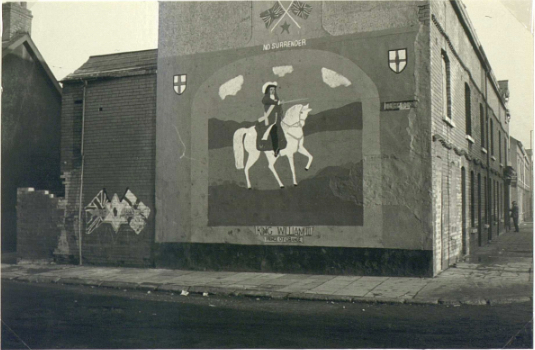
Sykes’s photograph from “1985” (Alamy A8FKD7) must in fact be from between 1979 and 1983, perhaps 1981, as the bed for the now-missing street-sign is unpainted. It shows the mural freshly re-painted, with crossed Union Flags above but no star, no Orange symbols on the sides, and a single scroll along the bottom which reads “William/the/III/1690/Prince/of/Orange”. The main panel has been repainted without any significant changes.
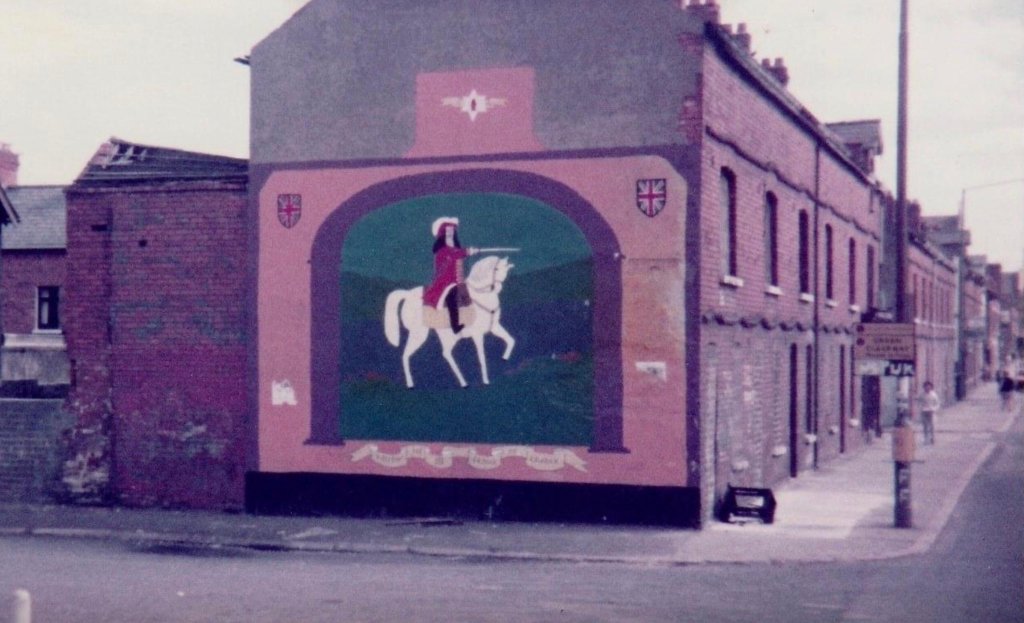
In this image (below) from ~1983, the crossed Union Flags have become a red hand on a six-pointed, white, star, while the shields on either side are Union-Flag. The three clouds are gone. The bed for the absent street-sign has been painted over. The small mural on the left is barely visible.
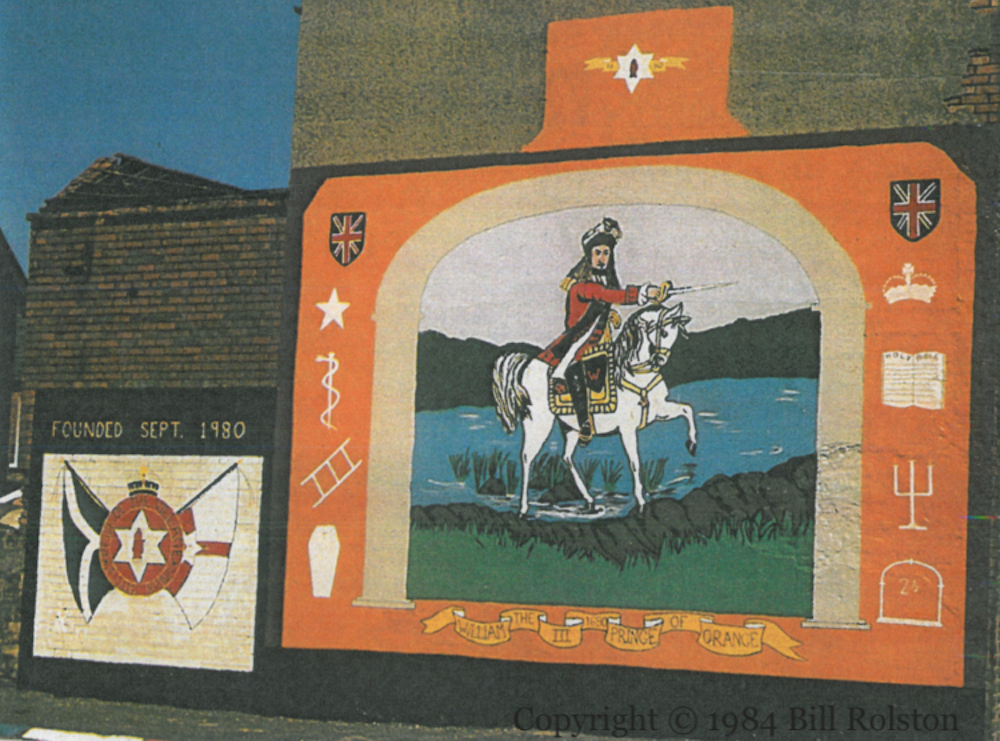
The version above survived into 1984, when the wall was repainted. (Treaftis 2002 and Lumsden 1994 both have images from 1984 of the 1983 version.) Rolston gives 1984 as the date of the repainted mural below: Orange symbols have been added and King Billy given more detail; a Pride Of The Village (flute band) “Founded Sept. 1980” mural has been added to the left-hand wall.
The mural from 1986 is uncluttered by the Orange symbols or the scroll along the bottom. The most significant change is perhaps that the horse has been drawn rearing up (and so King Billy no longer points the way with his sword). Above, “VILLAGE” has been written in large letters on an arc above the white star. The Red Hand Command[o] mural on the left lacks the title “Founded Sept. 1980”.
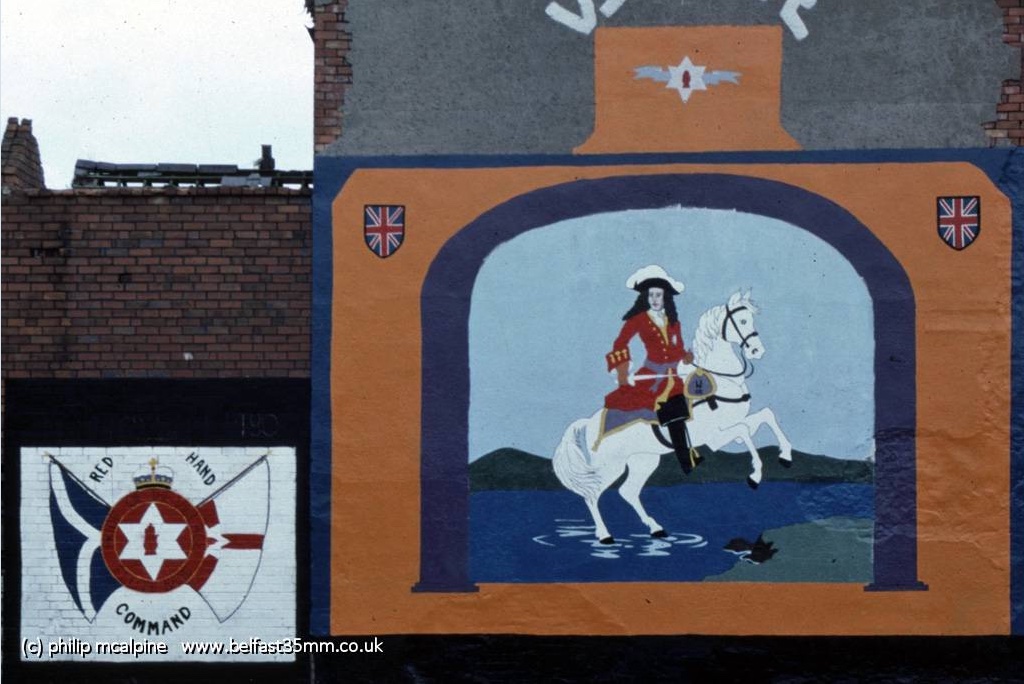
In 1986, this mural was paint-bombed (X05522 Alan Rutherford). The image below (from c. 1989) shows the same mural as in McAlpine’s 1986 but with a pale blue arch in place of the previous purple.

Jarman 1995 writes (p. 305) that the mural was repainted in both 1990 and 1991. This 1990-07 image from the Paddy Duffy Collection shows Orange symbols on the side, only a few ripples around the horse’s hind hooves, the white star above is gone, and a four-flag Red Hand Commando mural on the side.

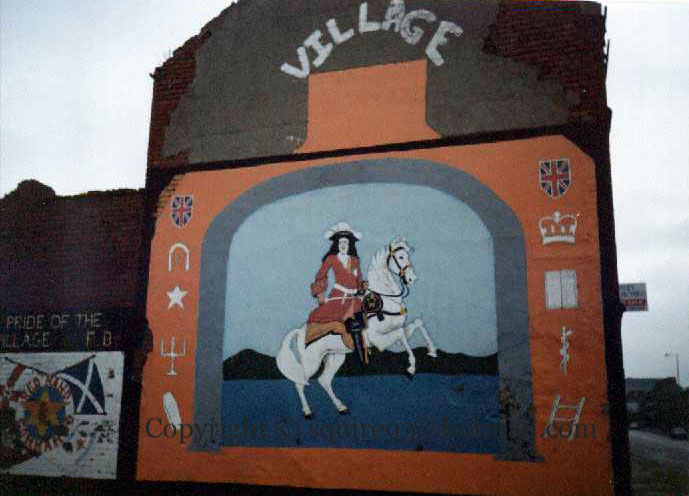
In September or October of 1994, the mural was repainted for the final time. Orange symbols are included, and the detail accorded King Billy and horse sharply contrast with a completely flat Boyne – the horse appears to be skating on the surface – and absent foreground. The RHC mural on the side wall has been given the title “Pride Of The Village FB”.
References in parentheses to mural collections:
A = Alain Miossec Collection
C = Tony Crowley Collection
J = Jonathan McCormick Collection
M = Peter Moloney Collection – Murals
T = Paddy Duffy Collection
X = Seosamh Mac Coılle Collection
Back to the index of Visual History pages.
Written material copyright © 2017-2026 Extramural Activity. Images are copyright of their respective photographers.
 Extramural Activity