Introduction (Click here or scroll down for Images | click here for the Appendix)
History
The civil rights movement began in the mid-1960s. The civil rights movement protested the oppression and discrimination experienced by Catholics in Northern Ireland. At the formation of Northern Ireland in 1921, only one third of the population was Catholic. The new parliament in its capital city, Belfast, declared for itself “Special Powers” (1922) to control the minority element, including the power to ban marches, literature, and organisations, to prohibit the flying of the (Irish) Tricolour, to impose curfews, and to intern indefinitely, all enforced by the UK’s only armed police force, the Royal Ulster Constabulary (RUC) and reservists (B Specials). In the 1960s, the RUC was only 12% Catholic and the Specials were entirely Protestant. Housing allocation in Northern Ireland was not means tested but in the hands of local councils, which, due to the Protestant majority and gerrymandering, were controlled by Unionists. Since only householders could vote in local elections, councillors had great incentive to discriminate in favour of Protestants when it came to housing. The same dynamic held for government jobs and general unemployment was three times as high for Catholic men as for Protestant – 17.3% to 6.6% in 1971 (WP). (Graham Gudgin’s chapter on ‘Discrimination In Housing And Employment Under The Stormont Administration’ is available at CAIN.)
The ban on CNR symbols was updated in the 1954 “Flags And Emblems” act, which outlawed the display of a flag or emblem in a way likely to cause a disturbance. The Union flag, however, was exempted – its display could never cause a disturbance, no matter the place or context – making it clear that the Act was primarily directed at nationalists. (See the reference to ‘The Tricolour Riots’ of 1964 in M04900.)
As a result, there were very few CNR murals painted before 1954 – two are listed below – and none at all are recorded in the period between 1954 and the civil rights movement.
The Northern Ireland Civil Rights Association was officially formed in April 1967, inspired by the protests by African-Americans in the United States which led to the Civil Rights Act (1964), Voting Rights Act (1965), and Fair Housing Act (1968), and was buoyed by Catholic students who had benefitted from free university education, one of the social programmes introduced by the Labour government during the period of post-World War II affluence.
In August 1968, the civil rights movement had begun conducting marches, and in October 1968 and January 1969 marches in Derry were attacked by the RUC. “You are now entering Free Derry”, on the northern gable of Lecky Road – later known as “Free Derry Corner” – was first painted in January 1969 and has existed continuously since then. (Free Derry Corner has its own Visual History page.) The Battle Of The Bogside took place in August 1969 and on the 14th, after two days of rioting, the British Army were brought into Northern Ireland.
In response to the civil rights movement the Ulster Volunteer Force (UVF), a loyalist paramilitary organisation, formed in 1966, fearing that the protests would reactivate the Irish Republican Army (IRA). And, in response to violence against Catholics in 1968 and 1969, the Provisional IRA split from what then became known as the “Official” IRA. Graffiti in support of the Provisionals, as opposed to the Officials, would make that clear by adding a “P” in front of “IRA”.
The power of internment without trial was used in August 1971 in Operation Demetrius. 342 people were arrested, all of them from the CNR community. On January 31, 1972 – Bloody Sunday – 13 people at an anti-internment protest were killed by British Army Paratroopers and a 14th would later die of his injuries. A memorial was raised to the victims of Bloody Sunday in 1974.
A Northern Ireland Assembly and Council of Ireland were established in 1974, sharing power between PUL and CNR representatives, but direct British rule was reinstated after a 14-day strike orchestrated by the Ulster Workers Council and Ulster Army Council.
Special Category (political prisoner) Status was suspended in March 1976 and prisoners began the “blanket” protest in September, eventually leading to the hunger strikes of 1980 and 1981. (These will be discussed in more detail in Visual History 03 – The Prison Protests.)
To repeat the opening paragraphs, despite all of the 60s’ cultural, political, and (into the 70s) paramilitary activity, there was little republican muraling of any type (and few loyalist murals in support of the paramilitaries) prior to 1980, even though there was plenty of graffiti. Murals describing conditions under the sectarian state generally had to wait until the hunger strike before being painted. A few pieces of republican public art from partition to the 1960s are recorded below and more again from 1969 to 1976; a few from 1976 to 1981 that do not concern the prison protests are also included on this page. The Appendix attempts a list of all republican painting (up to 1981 but not including paramilitary images from 1981).
Muraling
CNR muraling does not begin in earnest until 1981, 70 years after the first PUL mural. An intuitive thought is that CNR muraling could have begun at various earlier points: in 1921 with partition, in the 1960s with the civil rights movement, in 1971 with internment, in 1972 after Bloody Sunday, in 1976 after the loss of POW status. But none of these events led – in artistic terms – to much more than a Tricolour or shamrock being added to graffiti. It is only with the second hunger strike, twelve years into the period commonly known as “The Troubles”, that CNR muraling takes off.
CNR murals are inspired not by “fine-art” murals or the early PUL murals, though like the early PUL murals they have a territorial function and serve to politicise the community. Rather, CNR murals seem to build on the graffiti and posters of the Troubles and the earlier trickle of murals that is surveyed on this page. This page reflects that long gestation; this is the Visual History page with the fewest visuals.
Images
We prioritize here items with some pictorial element. Notice that the “murals” in this page and the next (Visual History 03) are single emblems or figures painted on an wall that is unpainted or has a one-colour background, rather than depicting a complete scene, as the murals of King Billy do (in Visual History 01). We call these “proto-murals”, as compared with the “classic” mural described in What Is A Mural?
“Frequent” Imagery:
To repeat, the point of this page is that there is no frequent imagery. As will be seen in the images below and in the Appendix, the only symbol that can claim any prevalence (on the CNR side) is the Tricolour, appended to graffiti in support of the Provisionals; the IRA has no flag or emblem of its own and the Tricolour is used instead, with the Gal Gréıne (sunburst) being used for the junior IRA. The Easter lily also appears with some frequency, perhaps because it can also be painted with the same colours as the Tricolour. IRA volunteers are shown standing to attention and ?never? in this period in ‘action’ poses.
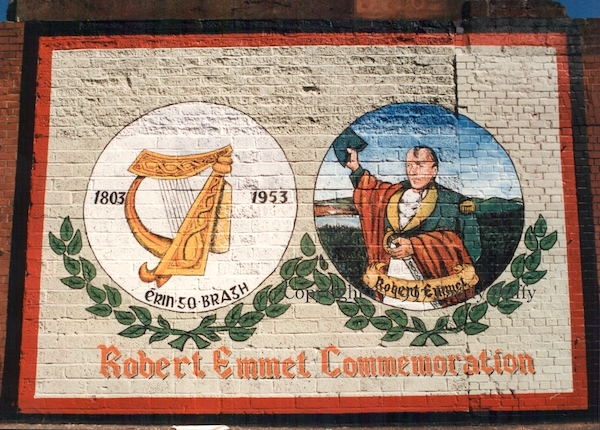
There is one mural below of Robert Emmet, from the Rebellions of 1798 and 1803. (Later, portraits of Wolfe Tone and imagery of pikemen and pikes, and of the distinctive emblem – a ‘Maid Of Erin’ harp with a ‘liberty cap’ (a Phrygian cap) on a ‘liberty pole’ – employed by the Society of United Irishmen, would also appear.)
There is one image below of James Connolly, from the 1916 Rising; the Starry Plough and Easter Lily also appear as symbols. Later, the portrait and words of Pearse, and images of the GPO would also appear.
Graffiti and imagery about Partition, the War Of Independence, and the Civil War are ?never? seen.
Two other historical events of British oppression and maltreatment – The Penal Laws and the Great Hunger – would appear in later murals.
A variety of pre-historic symbols is available but would not be much used until later:
the shamrock provides an easily-drawn addition to graffiti (The Pathé film “Belfast Slogans 1971” shows only one shamrock alongside CNR graffiti (as well as a Union Flag alongside some PUL graffiti).
the harp
the Irish language – there are a few examples of the old style of Gaelic lettering
the Celtic cross is ?never? found in this period
Celtic knotwork is ?never? found in this period
the four provinces and the island of Ireland, are ?never? found in this period
Celtic mythology and heroes such as Cú Chulaınn are ?never? found in this period
Gaelic games (football, hurling, camogie) and festivals (fleadh, féıle) are ?never? found in this period
The Tricolour, shamrock, and Easter lily are the easiest to draw, whereas other symbols and portraits take more time and effort to render successfully – compare the harp and portrait of Emmet in the image below with the images of ‘enhanced graffiti’ that follow it. As the Appendix notes, a greater number of these symbols do appear in handicrafts coming out of the prisons.
The earliest reported mural is from 1932 in Ardoyne: “During the Eucharistic Congress in 1932 the district was adorned with murals painted by Danny McCarthy; other artists including Robbie Kane in 1953 have added each chapter to the ever changing story of Ardoyne’s history over the century.” (Paul McCann) Forker & McCormick (2009) likewise attribute Kane with painting “religious icons, poets, and patriots around 1953” and present an image (X05654) from Ardoyne that might be one of Kane’s 1953 murals, showing a crowd of children next to a cross with the word “Hail Christ our king” above and “God save our Pope” below.
A Crumlin Street, Ardoyne, mural was painted in 1953 for the Robert Emmet sesquicentennial (X09236 | X05656). Although Emmet is the main focus, above the two medallions are a cross and the words “Hail / Christ / our king”. Kerr (1957 p. 24) sketches the two together, suggesting that they were originally painted together. Loftus (1982) reports that the mural was lost c. 1982 when the area was redeveloped.
Jumping forward for a moment … The Emmet part of the mural was reproduced c. 1997, in Havana Way/Flax Street.
“You are now entering Free Derry” was originally painted free-hand in January 1969. It was redone in August of that year in block lettering when Home Secretary James Callaghan visited the city two weeks after the Battle Of The Bogside. This is a 1972 image. (Free Derry Corner has its own Visual History page.)

There is a lot of graffiti from the summer of 1969 (the start of “The Troubles”) onwards, in both CNR and PUL communities. The former often called for locals to “Join the IRA” and for the “Brits” or RUC to get out; the latter cried “No surrender” and “Remember 1690” as well as averring “No pope here” and supporting Ian Paisley (see Visual History 01). Graffiti on a barrier on the CNR Falls Road, asserted”This is Free Belfast”, mocking “Clarke [James Chichester-Clark] the mad major” and alleging “RUC SS”. (An Phoblacht (X09237). A colour shot appears in this collection at Flashbak X05767 | X09108 | X09109)
A collection of CNR posters from the period can be found at CAIN.
A mural of James Connolly appeared in Fairfield Street, Ardoyne, north Belfast, in the early 1970s. (See Irish Liberation Press 2.3 (1971) p. 4 in the Irish Left Archive – thanks to Jason McLean for this pointer. There is a colour version of the mural in the Steven collection at BAP..
Easter Rising anniversary and Tricolour with “Provisionals for freedom” on the right. The same was painted in the Brandywell. Notice that the mural here is simply an emblem (in this case the Tricolour) painted onto a bare wall. The street (that the mural is on) is perhaps the old Howard Street, now Orchard Row.

“Army Keep Out – Keep your children indoors, British marauders on the loose!” Derry.

“Support the Provisionals” with a Tricolour, in Derry’s Bogside.

“Join your local IRA” and other graffiti in Shantallow, Derry. Some use of (white) backgrounding on the left (“What about Sergeant Whitelock”) and right (“Join the army and murder”), possibly from earlier graffiti painted over.

Bloody Sunday Memorial, erected 1974. “NICRA” stands for “Northern Ireland Civil Rights Association”. Bogside, Derry.

A list of the Bloody Sunday victims with a Christian cross, below Rossville flats.

The scene outside the Bogside Inn (at the junction of Westland Street and Lecky Road, Derry): Tricolours, Starry Plough, and Sunburst flags, “PIRA Provos” and “Easter 1975”

Easter lily (symbol of the 1916 Rising) and Tricolour in Stanley’s Walk, Derry. Below these are a crude depiction of a soldier or RUC man with shield and the words “resist oppression”.

The letter “P” appears in parentheses ahead of “IRA”. Also visible are a volunteer, Tricolours and Starry Ploughs, and the Easter lily. Iniscarn Crescent, Derry

Cumann Na gCaılíní (youth division of Cumann Na mBan) graffiti in Frederick Street, Derry. “If you think that can beat us/we’d like to tell [you] that you are wrong/cause we’re the fighters and we are strong/we are the 1st Batt. of the Cuman [sic] Na gCaılını [sic] girls!”

“Easter 1916” with volunteer standing at ease. Westland St, Derry.

In 1980, during the first hunger strike, there was a prominent display in Drumleck Drive, Shantallow, Derry. One board read “Victory To The Hunger Strikers”, below portraits of (l-r) Sean McKenna, Tom McFeeley, John Nixon (INLA), Ray McCartney, Tommy McKearney, Leo Green, Brendan Hughes. Below that was a square board showing a sitting (female?) striker next to the words “Victory To The Hunger Strikers” (X05270).
Finally, here are some pieces of simple graffiti, a lot of which was painted in republican areas from 1969 onwards.
“Fuck the RUC” and “RUC bastards keep out” – simple graffiti in Abercorn Street, Derry.

“Brits beware of the M60” Simple graffiti above Bishop Street, Derry.

“Fight for jobs, fight for socialism” Simple graffiti in Moyard, Belfast.

On to Visual History 03 – The Prison Protests …
Appendix
This page (and the previous) gathers together all of the references to early murals. Republican murals (and graffiti) are listed on this page. If you know of, or have images of, additional murals (and graffiti), please e-mail extramuralactivity@gmail.com. Dates should generally be understood as ‘floruit’ rather than precise dates of creation.
- 1920 Irish and USA flags “Ireland Over All” with a poem “Little Tin Of Tar”, concluding “Bun eaters lie down – Up Dublin 1916, Up Derry 1920” on the wall of Watt’s Distillery in Abbey Street, Derry (for image, see Cooper 2015 p. 35 | for the story of the mural and the poem, see witness statement by Liam Brady at BMH).
- 1953 A Robert Emmet 150th anniversary mural in Crumlin, Street, Ardoyne (Loftus 1982 ill. 37 | Rolston 1991 p. 72)
- 1950s “God bless our pope” (Forker & McCormick 2009)
- 1953 “An Ṗoblaċt Abú” [Up the republic] in old Gaelic script. The election posters are for the NI Parliament election of October 22nd, 1953. Since both Central and Falls boroughs are mentioned, the location is perhaps Divis/lower Falls. (X05705)
- 1969-01 “You are now entering free Derry” Lecky Road, Derry (see above)
- 1969 “Disarm all B-Specials” (McMonagle)
- 1969 “IRA” on a shamrock, Belfast (David Hodgson – Mary Evans 10145380)
- 1970 Tricolour and “Ireland unfree …” in Annadale Street, Belfast (Jarman 1995 p. 330)
- Early 1970s An Ardoyne mural of James Connolly, Fairfield Street, Belfast
- 1971 “Resist British bully boys” Stanley’s Walk, Derry (X09208, possibly by Eamon Melaugh)
- 1971 “No tea for Dad’s Army” on the New Lodge Road, Belfast (X05704). The graffitist got six months (Feehan 1983 p. 55).
- 1971 British Pathé film of “Belfast Slogans”
- 1972 “Easter 1916-72” Howard St, Derry (see above)
- 1972 “Easter 1916-72” Lecky Rd, Derry (later becomes 1916-74 and 1916-74-5 – see below, 1974)
- 1972 “Internment out” Spinner Street, Belfast (Le Garsmeur – Alamy EEB2YY)
- 1972 “Army Keep Out – Keep your children indoors, British marauders on the loose!” Stanley’s Walk, Derry (see above)
- 1972 “SAS Murderers – Cyprus, Aden, Ireland – REM 1916” Grosvenor Road, Belfast (Alex Bowie – Getty)
- 1972 “Touts will be shot” and “We know you so watch” lower Falls Road, Belfast (Alex Bowie – Getty)
- Le Garsmeur’s collection at Alamy contains many examples of prison arts and crafts from 1972, including replica Celtic harps and crosses, the heroes of 1916, and even a few replica weapons (Thompson guns).
- 1973 “Support the Provisionals” with a Tricolour, Lecky Road, Derry (see above)
- 1973 Crossed Tricolours and Easter lily, Belfast (Conrad Atkinson – Tate)
- 1973 Crossed Tricolour and Starry Plough with the word “Ireland” in the Brandywell, Derry (Loftus 1982 p. 121)
- 1973 “A Nation Once Again”, featuring the Sunburst and Starry Plough flags, an Easter lily, and “IRA” (Le Garsmeur – Alamy EEC7D6)
- 1974 “Join your local IRA” etc. Drumleck Gdns, Shantallow, Derry
repainted as “Long live the Provisionals”, “Easter 1916-1974”, etc (Alamy D0JY29 X05379) - 1974 “Easter 1916-74-5” with Easter Lily and Tricolour, Stanley’s Walk, Derry (see above)
- 1974 “Easter 1916” with volunteer standing at ease, Westland St, Derry (see above)
- 1975 “Easter 1916-75 (P)IRA”, Iniscarn Cr, Derry (see above)
- 1975 “PIRA Provos” and “Easter 1975” Westland St, Derry (see above)
- 1975 “REM. 98” with Tricolour, Belfast (Homer Sykes – Alamy AABH6E)
- c. 1974 “SS RUC Out” in Upper Meadow St, Belfast (Conrad Atkinson – Tate)
- c. 1975 “IRA 75” Lecky Road, Derry (Conrad Atkinson – Tate)
- c. 1975 “Easter 75” ?Lecky Road, Derry? (Conrad Atkinson – Tate)
- c. 1975 Easter 1916-1975 (Conrad Atkinson – Tate)
- c. 1975 “British” pig (Conrad Atkinson – Tate)
- 1976 “Murdered by paratroopers” Rossville St, Derry (see above)
- 1976 “Brits Out” with Tricolour on pike, faded “No to EEC” also Tricolour high up, Ardoyne, Belfast (Alex Bowie – Getty and Getty)
- 1976 “IRA 8, British 0” Ardoyne, Belfast (Alex Bowie – Getty)
- 1976 “Paras out”, “Touts will be shot dead” and “IRA” Ballyclare Street, Ardoyne, Belfast (Alex Bowie – Getty)
- 1976 “Join Official IRA” Ardoyne, Belfast (Alex Bowie – Getty)
- 1976 “Sectarianism kills workers” Belfast (Alex Bowie – Getty)
- c. 1978 “Free Derry” and “Join the IRA” Westland Street, Derry (Conrad Atkinson – Tate)
- c. 1978 “Go home” pig (Conrad Atkinson – Tate)
- c. 1978 “Dad’s Army” (Conrad Atkinson – Tate)
- c. 1978 “Free Andersonstown” with tricolour (C00673)
- 1980 “RUC bastards keep out” Abercorn Street, Derry (see above)
- 1980 “Brits beware of the M60” Corporation St, Derry (see above)
- 1980 “Don’t be a fireside republican, be a fighting one” Lenadoon Avenue (Rolston 1991 p.73)
- 1980 “Victory To The [1980 H-BLock] Hunger Strikers” and “Victory To The [1980 Armagh] Hunger Strikers” Drumleck Drive, Shantallow, Derry (X05270) (described above)
- 1980 “Bris Bloc H”, “Stádas Polaıt[ı]úıl Anoıs”, “Na Fıanna Éıreann” and “Éıre Óg” with sunburst flag in Divis Flats (X05631)
- 1981 “Fight for jobs, fight for socialism” Moyard, Belfast (see above)
On to Visual History 03 – The Prison Protests
References in parentheses to mural collections:
D = squire93@hotmail.com collection
M = Peter Moloney Collection – Murals
T = Paddy Duffy Collection
X = Seosamh Mac Coılle Collection
Back to the index of Visual History pages.
Written material copyright © 2017-2025 Extramural Activity. Images are copyright of their respective photographers.
 Extramural Activity