Introduction (Click here or scroll down for Images)
History / Muraling (see also Visual History 03)
The loyalist paramilitary group the Ulster Volunteer Force (UVF) was formed in 1966 and the Ulster Defence Association (UDA) in 1971 (and it began using the cover name “Ulster Freedom Fighters” in May 1973). At first, loyalist murals generally employed symbols – especially the red hand of de Burgh/O’Neill and flags of the Union and of Northern Ireland. A few loyalist paramilitary murals from the early 80s are mentioned and shown in Rolston 1991. These are listed at the end of Visual History 01 in its appendix. The total number of loyalist paramilitary murals from 1966 to 1982 appears to be approximately 20. Loyalist paramilitary murals appear in greater numbers in the mid- and particularly the late-1980s.
Given the exceedingly small number of loyalist paramilitary murals, this page of ‘paramilitary murals’ presents republican paramilitary murals from 1981 and 1982, of which there are many. (All of the images on this page are located in CNR communities.)
The (republican) Provisional Irish Republican Army (IRA) was formed in 1969 and the Irish National Liberation Army (INLA) in 1974. Some (not many) simple murals in support of these groups appeared in the years immediately after their foundings. Graffiti is somewhat more common, of slogans such as “IRA” and “Join your local slua”. But, as with murals of oppression and resistance, it is with the 1981 hunger strike that paramilitary murals are painted in great numbers.
As with the other themes (prison protests, oppression & resistance) some of the work is writing only and most involve simple drawings (symbols or portraits) on a single-colour background.
Images
Frequent Imagery
Paramilitary imagery: (anonymous and often masked by balaclavas or sunglasses and scarves) IRA and INLA volunteers, weapons (especially assault rifles but also RPG and even SAM), symbols of the organisations (including Starry Plough and Sunburst flags), memorials (including funeral volleys) to volunteers
The goal of the armed campaign is a united Ireland, and so we see the traditional symbols alongside military depictions: Tricolour, Celtic heroes, Celtic knotwork, Celtic crosses, harp, (occasionally) shamrock
The history of previous struggles are the 1798 and 1803 Rebellions and the 1916 Rising, from which come the following images: the pike, the emblem of the United Irishmen, Wolfe Tone, Robert Emmet, Starry Plough, Sunburst, Pearse, Connolly, GPO.
The phoenix, a symbol of the Provisional IRA, makes its first (known) appearance in 1981.
“The Provos [Provisional IRA] are the people, the people are the Provos”. (Whiterock Road)
“This is Provo land – éıríodh muíd [sic] arís [let us rise again]” (Odessa Street)

“An réabhlóıd abú” [Up the revolution!] (Bishop Street, Derry)

A message for British soldiers: “Your name is engraved on the freedom-fighter’s bullet!” (Lenadoon Avenue)

This image of an open-throated (but anonymous) volunteer with assault rifle would be painted many times, as would the slogan of Black Panther leader Fred Hampton: “They may kill the revolutionary, but never the revolution.” As always, the Tricolour is on a (1798) pike. (Painted by Con in Rockdale Street.)

“Violence is the voice of an oppressed people” – Martin Luther King is used to justify armed rebellion. What King actually wrote is “I could never again raise my voice against the violence of the oppressed in the ghettos without having first spoken clearly to the greatest purveyor of violence in the world today – my own government.” Beyond Vietnam (Gransha Avenue)

“Political power stems from the barrel of a gun”, the gun being an AR-18 or AK-47 assault rifle. (Turf Lodge)

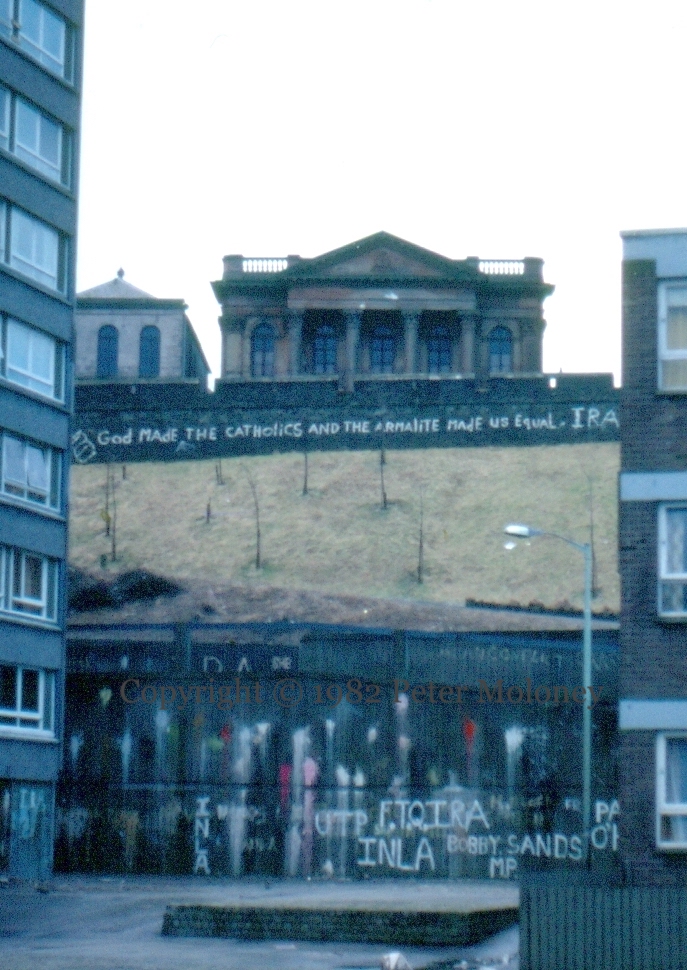
“God made the Catholics and the Armalite made us equal. IRA.” on the walls of Derry, as viewed from the front of Rossville flats. With FTQ, IRA, INLA, UTP, and “Bobby Sands MP” graffiti below.
Three IRA volunteers with various weapons, copied from a photograph – click the reference link below the image to see the photograph. (Shaws Road)

Incident At Narrow Water. The Narrow Water mural might be unique in depicting a specific IRA operation and as such is perhaps a high-water mark in terms of militarism in a mural, though still not approaching the level of some very explicit, gloating graffiti (M00047 M00312 M00400 M00298 M00322 M00328) and even here the guns don’t aim at anything or anyone, and the site of the activity is in the distance, not close enough to allow us to see the victims.
This mural (painted by Con) is perhaps the first “classic” republican mural, in the sense of “classic” described in What Is A Mural?: the background is not a simple colour but a detailed depiction of a scene. Compare this mural to proto-murals such as the one immediately below (The Last Post), which does not take up the whole wall, uses a solid black background, and presents its elements in somewhat unconnected fashion. (Rockville Street)

The Last Post. Republican heroes from after the Easter Rising to the Civil War. This is the earliest ‘roll of honour’ mural that we know of. (Falls Road)

Derry Brigade roll of honour, descendants of Cú Chulaınn. The last two names – George McBrearty and Charles Maguire – are of volunteers killed in 1981. (Rossville Street, Derry)

The oldest continuously surviving (unpainted) mural is this one in Derry’s Brandywell, with a mix of traditional and paramilitary symbols. For other record-holders, see the page of “oldest” murals.

IRA Rule Derry, with 5 Demands, on Westend Hall, Westland Street, Derry

This mural dates the origin of the IRA (Óglaıgh Na hÉıreann) to the army of the revolutionary Dáıl and the War Of Independence. The “1919” on the left would later be changed to “1916”, evoking the Easter Rising instead. (Islandbawn Street)

PLO-IRA. PLO = Palestine Liberation Organization. Ariel Sharon became Israeli Minister of defence in 1981 and in 1982 Israel invaded Lebanon. Note that “RPG Avenue” is on this side of the street (Beechmount Avenue); it is gone by 1986’s ANC mural.
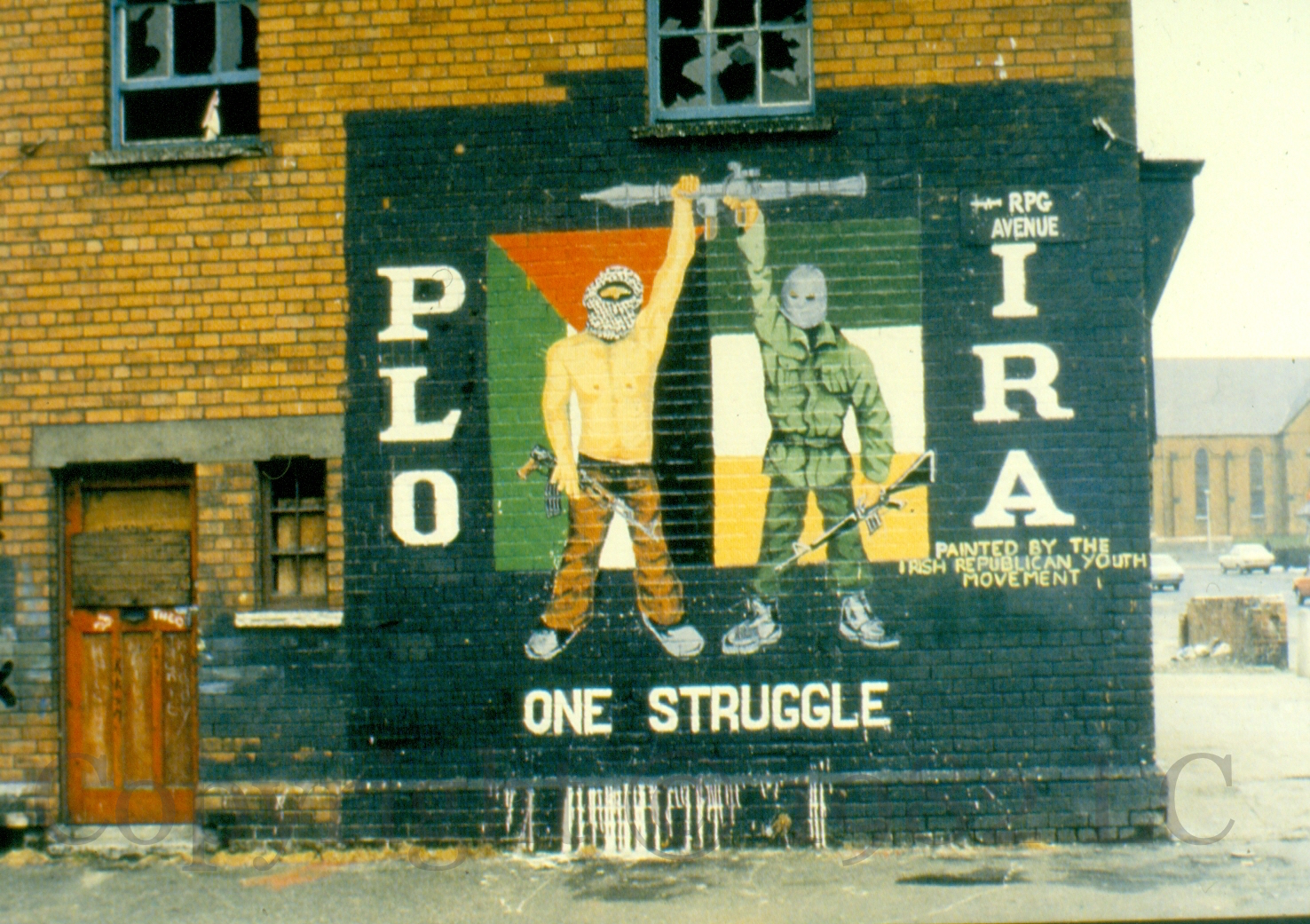
This the first (known) mural expressing solidarity with another national struggle; there is a separate Visual History page presenting the murals of International Solidarity.
Gallery of all the 1981 CNR murals, both ‘prison protests’ and ‘paramilitary’
On to Visual History 05
References in parentheses to mural collections:
M = Peter Moloney Collection – Murals
X = Seosamh Mac Coılle Collection
Back to the index of Visual History pages.
Copyright © 2017-2024 Extramural Activity. Images are copyright of their respective photographers.
 Extramural Activity