Introduction
The most famous mural in Belfast is probably the Bobby Sands mural on the side of the Sınn Féın office and Sıopa Na hEalaıne at the corner of the Falls Road and Sevastopol Street. As the plaque to the left-hand side of the 2015 mural says,
“Ag sráıd Sevastopol cuımhnıtear ar Bobby Sands ı múrmhaısıú a aıthnıtear ar fud an domhaın. … Here at Sevastopol Street Bobby Sands is remembered in a mural which has become world-renowned.”
The renown of the mural is due to the nature of hunger-striking as a form of resistance and the specific depiction of Sands.
The first four murals on the wall, prior to Sands’s first appearance in 1989, all included hooded IRA gunmen. In contrast with armed insurrection, the hunger-strikes of 1980 and 1981 were a non-violent means of conveying the political status of the struggle, and allowed (to a greater extent than previously) those who were uncomfortable with violence to identify with the republican cause. The hunger-strikes, and the eventual deaths of ten deceased 1981 hunger-strikers, changed the message from “we are willing to kill in pursuit of a politcal goal” to “we are willing to die (to kill ourselves) in pursuit of a political goal” and made them martyrs of the cause.
The leader of the 1981 strike was Bobby Sands. Sands was a (Provisional) IRA volunteer who served three years’ imprisonment in the cages of Long Kesh in the mid-70s before being sentenced to 14 years in 1977. He became OC in the H-Blocks when Brendan Hughes went on the first (1980) hunger-strike, and was the first of the prisoners to begin fasting in 1981. During his fast, Sands was elected to the UK parliament. When he died, after 66 days, 100,000 people attended his funeral. Both indicated that there was support for the republican cause, especially in this non-violent form.
In October 1981, however, the hunger-strike ended and there seemed be a resumption of “normal” activity as the violence continued throughout the 1980s. The first four murals on the side of the Sınn Féın office reflect this, portrayed masked and armed volunteers and presenting An Phoblacht/Republican News’s status as the “offical organ” of the IRA’s armed campaign. The paper included a section entitled “War News”. (Many editions of AP, RN, and AP/RN are now available on-line.)
The decision in 1989 to put Bobby Sands on the wall, and elevate him as figurehead of the republican struggle, indicated a de-emphasis of the armed campaign and an attempt to re-capture some of the non-violent messaging inherent in hunger-striking. It fits with Sınn Féın’s increasing engagement in electoral politics throughout the 1980s and presages the eventual cease-fire in 1994. (There was also a mural featuring Sands and Che in Derry in 1988 and a mural of Sands in Strabane in 1989. The most militaristic presentation of Sands was a 1991 mural in Beechmount, for the 75th anniversary of 1916.)
The specific depiction of Sands also makes it easy to identify with republicanism. The murals employ an image of Sands from the Long Kesh days, in which he is wearing civilian clothes, is bare-faced and clean-shaven, and is smiling. There are images of Sands from the time of the second arrest and imprisonement in the H-Blocks; these all show a more serious Sands, and in some instances wearing a very bushy beard.

When portraits of Kieran Doherty and Joe McDonnell were added (in 2015, replacing the crest of the United Irishmen which AP/RN also used) they too presented the men in civilian clothes and smiling. The face of republicanism is not the balaclava and the assault-rifle, but friendly and non-threatening people who look just like the viewer.
The first Sands mural was painted in 1989. The mural of Sands now familiar to millions was painted in 2000 and has been repainted with minor modifications a number of times since then.
Images
The first mural (painted in 1981 or 1982) shows workers reading the “official organ of the republican movement”, the front page of which is reproduced behind them, and which includes a (modern) volunteer firing a salute in memory of the 1916 Rising.

The next mural, from 1989, (on-line at Flickr/Sláınte) bears the title “Óglaıgh Na hÉıreann” and presents four IRA masked volunteers with assault-rifles and a machine-gun. There is a similar image on the side wall, featuring two volunteers with the wording “Fıche blian ag streachaılt – bua do mhuıntır na hÉıreann”.
The third mural (also 1989) replaced the title with a row of armed people in silhouette and reduced the armed men in the main panel to a single volunteer presented in outline. (The side wall remained as before.)
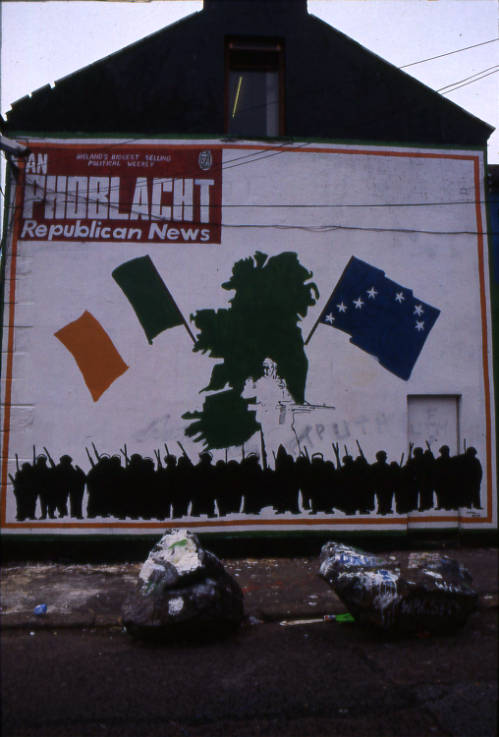
“20 Years Of Resistance” (1989) contained images of resistance – including several of armed volunteers – inside a large “2” and “0”. (For an image, see Rolston Drawing Support plate 73.)
The first mural of Bobby Sands was painted in 1989 by Gerard ‘Mo Chara’ Kelly. It shows a smiling Sands with open-throated shirt.

Sands blue (1990-1996) (by Mo Chara, Danny Devenny, and Marty Lyons)

The familiar mural was painted on the rebuilt Sınn Féın office in 2000 by DD and ML. The long-standing “everyone has their part to play” quote on the left is joined by the softer and more forward-looking quote on the right: “Our revenge will be the laughter of our children”.

(This version of the mural was used in a WBTA mural on the International Wall in 2006: )

Bobby Sands “MP” – this is the previous mural touched up for the 25th anniversary of the hunger-strike in 2006.

French street-artist Jef Aerosol painted an Accordion Player on the side wall in 2011.

The 2015 version reclaimed Bobby Sands an “IRA Volunteer” and added Kieran Doherty, Joe McDonnell, and Sean McCaughey.
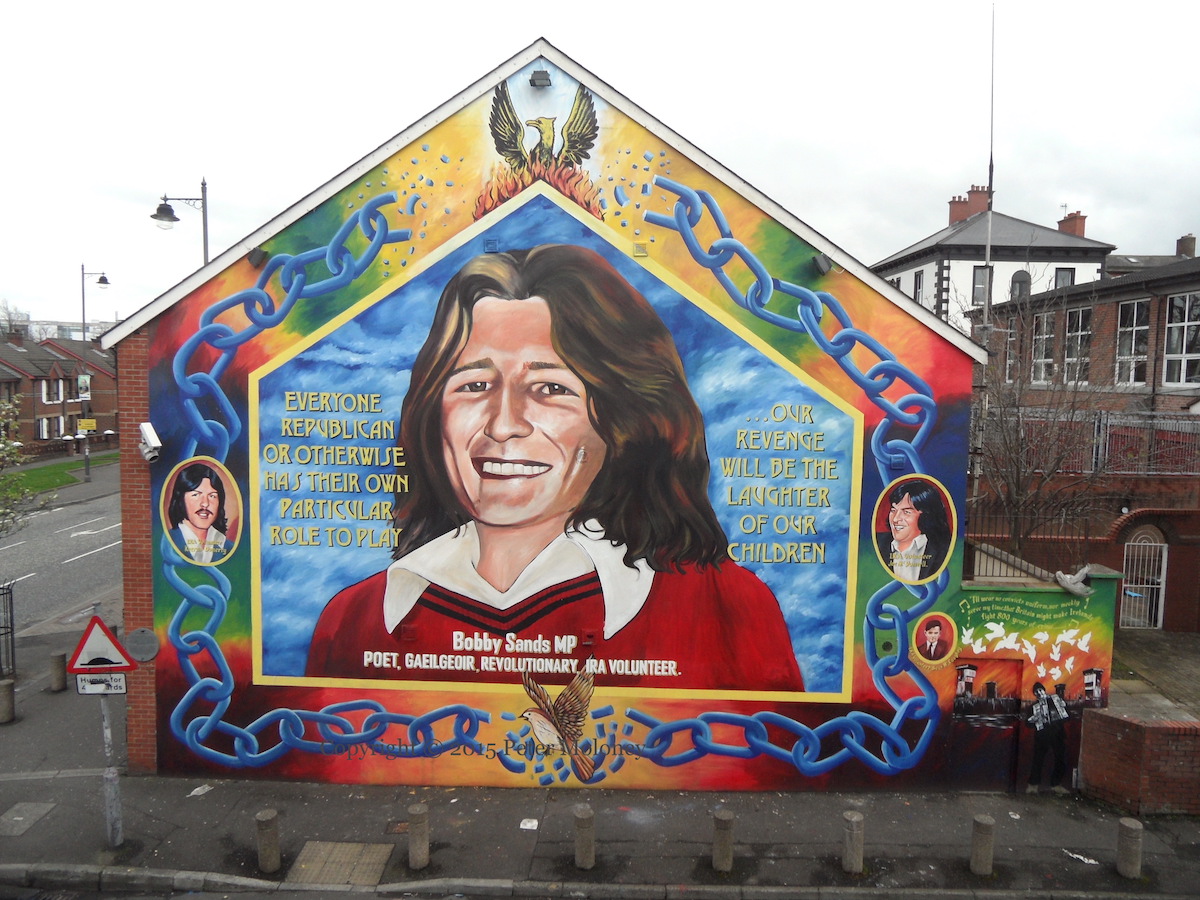
Aerosol’s accordion player was preserved and integrated into the mural – he is playing The H-Block Song (youtube). There are twelve doves, one for each of the dead hunger-strikers of the Troubles era.


The main wall was touched up in 2025-08:

References in parentheses to mural collections:
M = Peter Moloney Collection – Murals
T = Paddy Duffy Collection
X = Seosamh Mac Coılle Collection
Written material copyright © 2017-2025 Extramural Activity. Images are copyright of their respective photographers.
Back to the index of Visual History pages.
 Extramural Activity