“Saoırse don Phalaıstín [freedom for Palestine]/فلسطين حرة [free Palestine]” and “Ireland stands with Palestine/ايرلندا تقف مع فلسطين” – CYM [Connolly Youth Movement (web)] sticker with a mash-up of the Palestinian and Irish flags and a key that represents the keys that about 700,000 Palestinian householders took with them when they fled their homes in the Nakba of 1948.
The Clements coffee shops in Belfast city centre closed in October, leaving only the two at Queen’s and UUJ (BelTel).
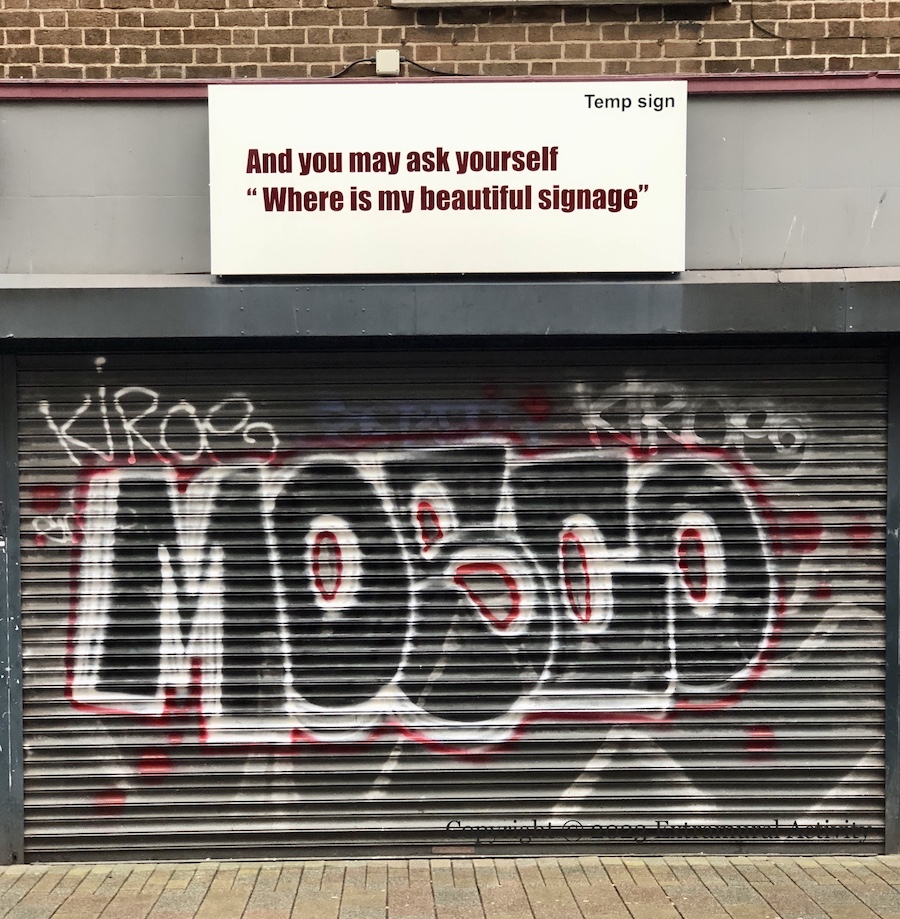
The abandonment of the Rosemary Street shop provides a space for art (see Visual History 11 on the rise of street art); replacing the Clements signage there is a “temp sign”: “And you may ask yourself, “Where is my beautiful signage[?]””.
Is this a plea for the return of Clements – a local chain – or investment in the city centre and a new business? Or perhaps it is meant ironically, as a protest against capitalism – the line is a modification of a lyric from the Talking Heads song ‘Once In A Lifetime’ (Stop Making Sense | Remain In Light), which describes a moment of awakening for the middle-aged and middle-classed: “How did I get here?”
On the permanently-closed shutters is a different kind of beautiful signage, a MOSCO throw-up.
“When it comes to punk, New York has the haircuts, London has the trousers, but Belfast has the reason.” – Terri Hooley in 2012’s Good Vibrations (IMDb).
The final incarnation of Hooley’s Good Vibrations record shop (Fb) closed in North Street in 2015 (BelTel). It began in October 1976 at 102 Great Victoria Street (Spit Records | Louder Than War | Spit Records) — the shop and Hooley are included, along with footage of the Undertones, Outcasts, Stiff Little Fingers, and many others — in the 1979 documentary Shellshock Rock (UK viewers can watch at BFI | Spit Records has a great write-up of events surrounding the film’s launch).
The new mural is close to the shop’s second location (from roughly 1984-1993), on the other side of the road, at 121 Great Victoria Street, which itself has had “Good Vibrations” signage reinstated by Zippy (ig) – one of the new pieces around the corner on 127 Great Victoria Street that can be seen in the entry in the Paddy Duffy collection.
Big Time Punk is in Stroud Street, painted by Peaball, specifically RAZER (ig) and NOYS (ig).
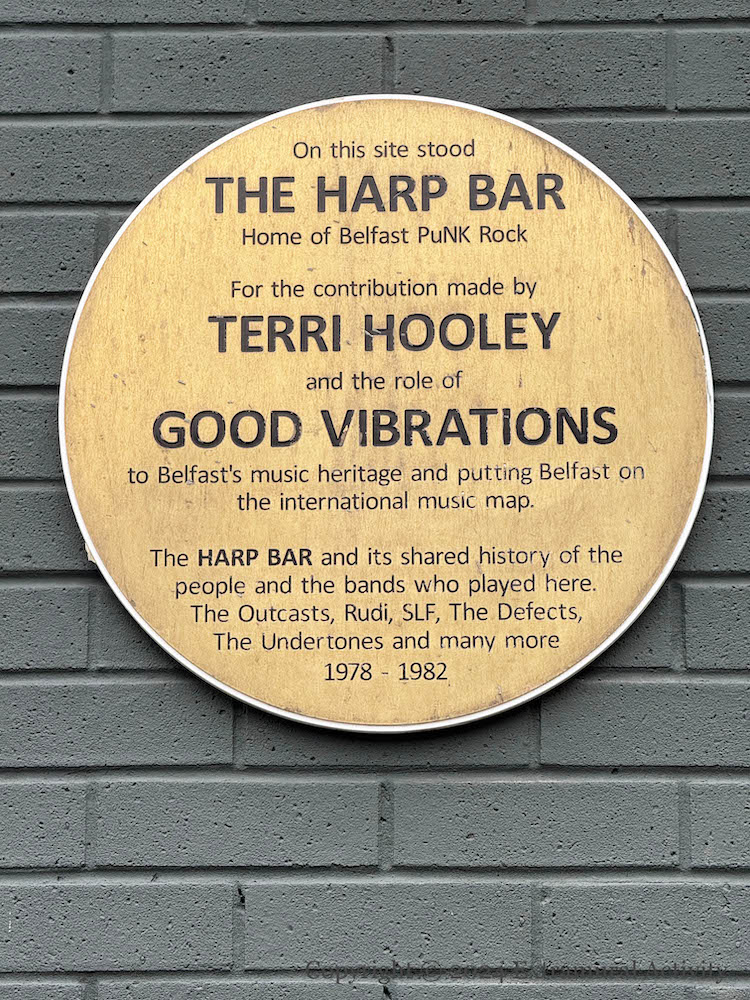
The plaque (final image) outside the Harp Bar (in Hill Street) reads, “For the contribution made by Terri Hooley and the role of Good Vibrations to Belfast’s music heritage and putting Belfast on the international music map. The Harp Bar and its shared history of the people and bands who played here. The Outcasts, Rudi, SLF, The Defects, The Undertones and many more 1978-1982.”
Saturday’s protest (BBC | Irish Times | in September there was also a wake BelTel) against the cyanobacteria in Lough Neagh (map) included the hand-drawn banner shown above, which is based on a Soviet poster ‘Be vigilant’, probably via its use in internet memes (Google Images | 2014 Irish version). In this case, the “thief” is the Earl Of Shaftesbury, the owner of the bed and soil of Lough Neagh who is open to selling it but not to transferring ownership gratis (BBC).
There is a similarity between this style of image and the earlier one seen in republican muraling, such as Stad Maggie Anoıs (1986) and England Get Out Of Ireland (1989) (and which was also recently used by Kneecap in Hawthorn Street). It would appear that both slogans “Put it back, thief” and “England, get out of Ireland” were used with this (latter) style of image – see Stad Maggie for links.
The Roof is the rooftop bar of the Union Street Bar. “The Roof” is by Visual Waste (ig) on the Little Donegall Street side of the bar. The photo was taken from the junction of Stephen and Library streets.
The Ru Paul mural in the space below — seen in Sashay Away — has been blacked out.
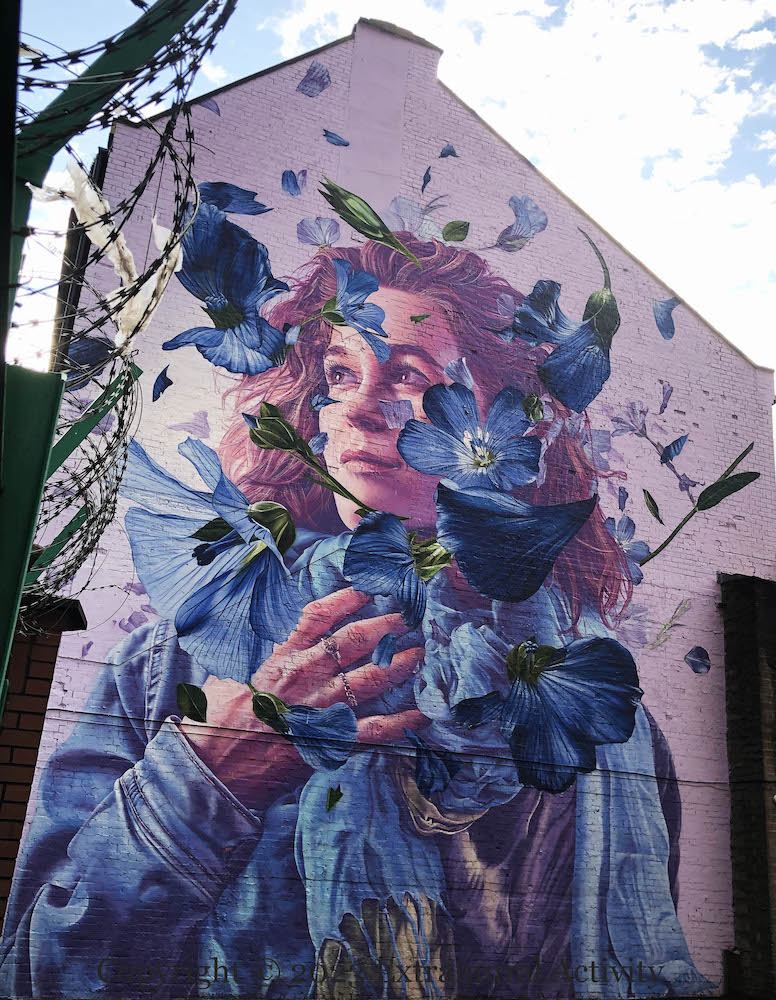
Flax flowers on the side of by Dutch street artists Studio Giftig (ig) in James’ Street South. Various linen and handkerchief manufacturers have occupied the building during its history.
The Seal Folk or Selkies are shape-shifting creatures in island mythologies from Man to Ireland to the Scottish isles to the Faroes to Iceland. Seals in water, they can take off their skins and become (beautiful) humans on land. Without their skins, they cannot return, and so they can be captured by humans who hide their skins. A few tales can be found at Scotland’s Stories.








 Extramural Activity