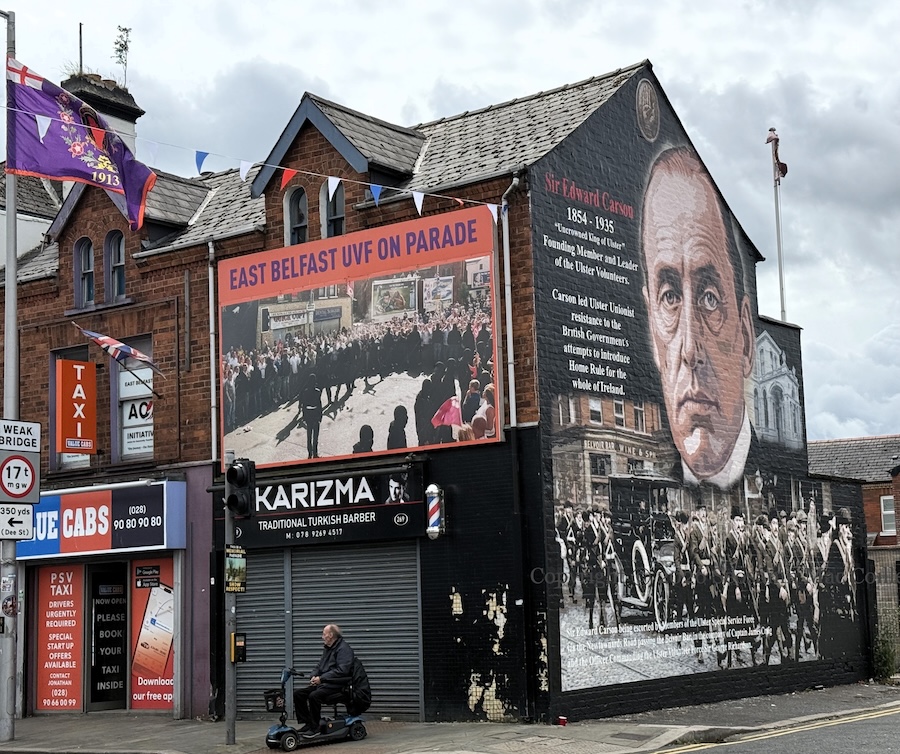
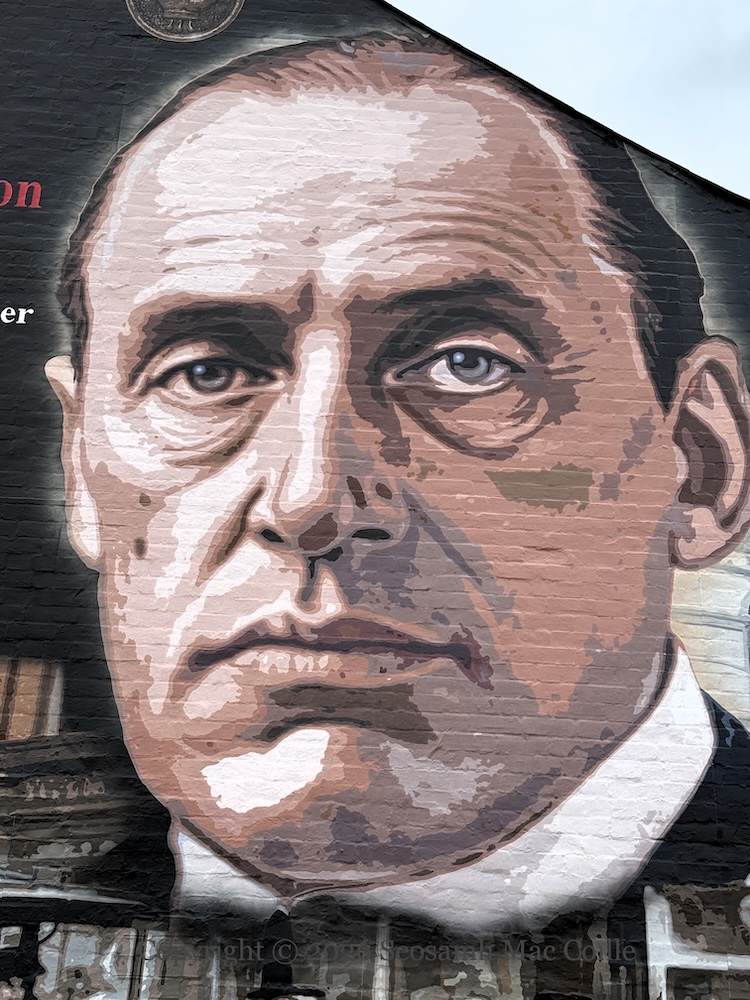
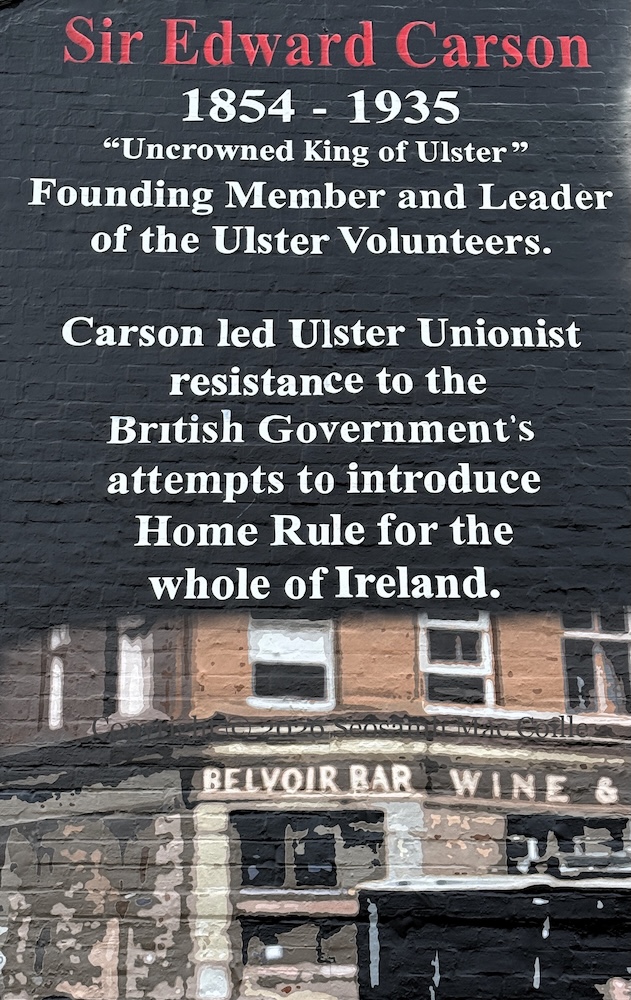
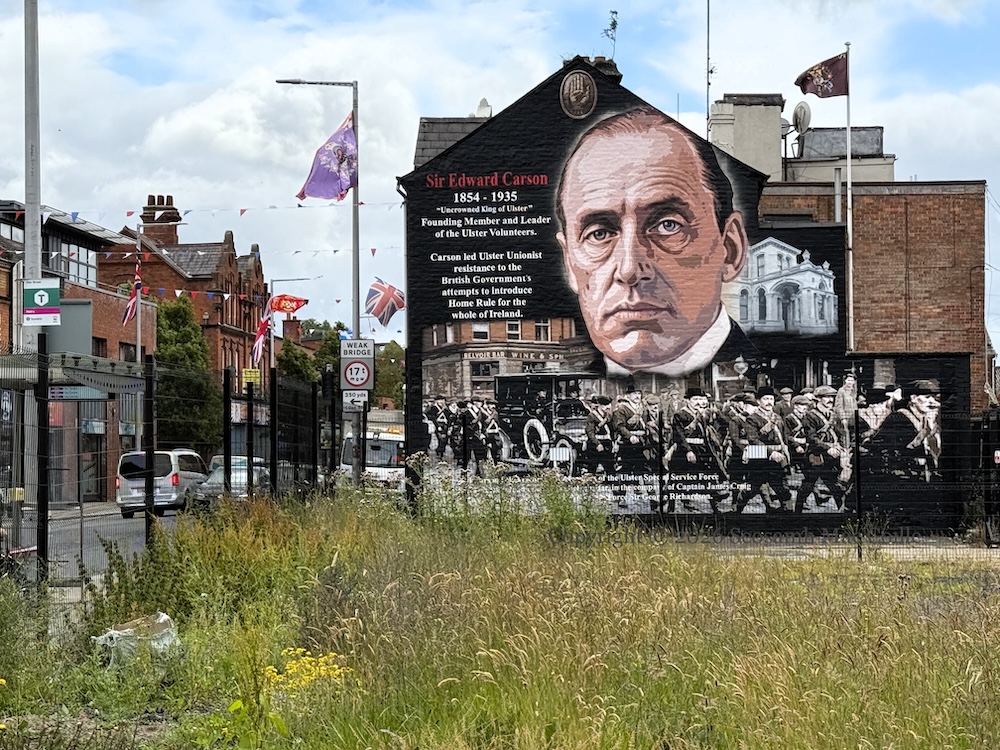
Text above: “Sir Edward Carson 1854 – 1935 “Uncrowned King of Ulster” Founding member and leader of the Ulster Volunteers. Carson led Ulster Unionist resistance to the British Government’s attempts to introduce Home Rule for the whole of Ireland.”
The epithet “uncrowned King” seems to be generally used of Carson and not attributable to any one source. Here is a September 1912 newspaper article that calls Carson the “uncrowned King of the North” and relays criticisms of a Carson reception in Portadown as “a parody upon a royal reception” and “an insult to the King”. A May 1914 review of (the book) The Reign Of Edward Carson refers to “King Carson”.
The phrase is an echo of and response to the phrase “uncrowned king of Ireland”, which was used of both O’Connell and Parnell. Here is an 1847 article describing both O’Connell and the Napoleonic Governor-General of Algeria (WP) as “uncrowned monarch[s]”. According to WP, the epithet was first applied to Parnell in 1880, because he was so popular during a tour of the United States and Canada. At the end of James Joyce’s story ‘Ivy Day In The Committee Room’ a character recites a poem about Parnell, beginning “He is dead. Our uncrowned king is dead” (archive.com).
The wording “the British government’s attempts to introduce Home Rule” is more forthright than we are used to. Typically the resistance is simply to “Home Rule”. This wording makes clear that the Ulster Volunteers were a private militia preparing for the possibility of fighting the regular British Army and Navy. By being so explicit, this wording suggests that we are currently living through a time in which loyalists consider the “British government” to be insufficiently British, just as was the case in 1912.
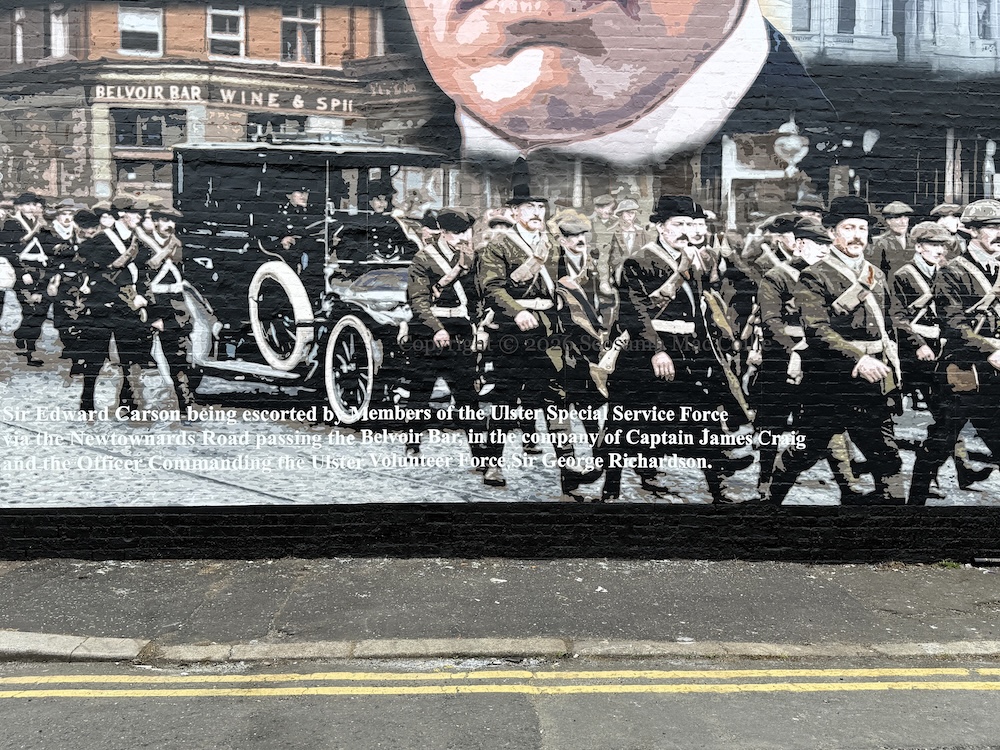
Text below: “Sir Edward Carson being escorted by members of the Ulster Special Service Force on the Newtownards Road passing the Belvoir Bar in the company of Captain James Craig and the Officer Commanding of the Ulster Volunteer Force Sir George Richardson.”
According to a Regimental Band Fb post, “Sir Edward Carson was speaking at the Reform Club in Royal Avenue. There was an opinion that the British Government were going to try and arrest him so he was escorted to the safety of Craigavon House [shown on the right of the mural]. This photo was taken on the 20th March, 1914.” This October 1913 article, in addition to calling Carson “Ulster’s Uncrowned King”, notes that he travelled with a detective and carried a revolver.
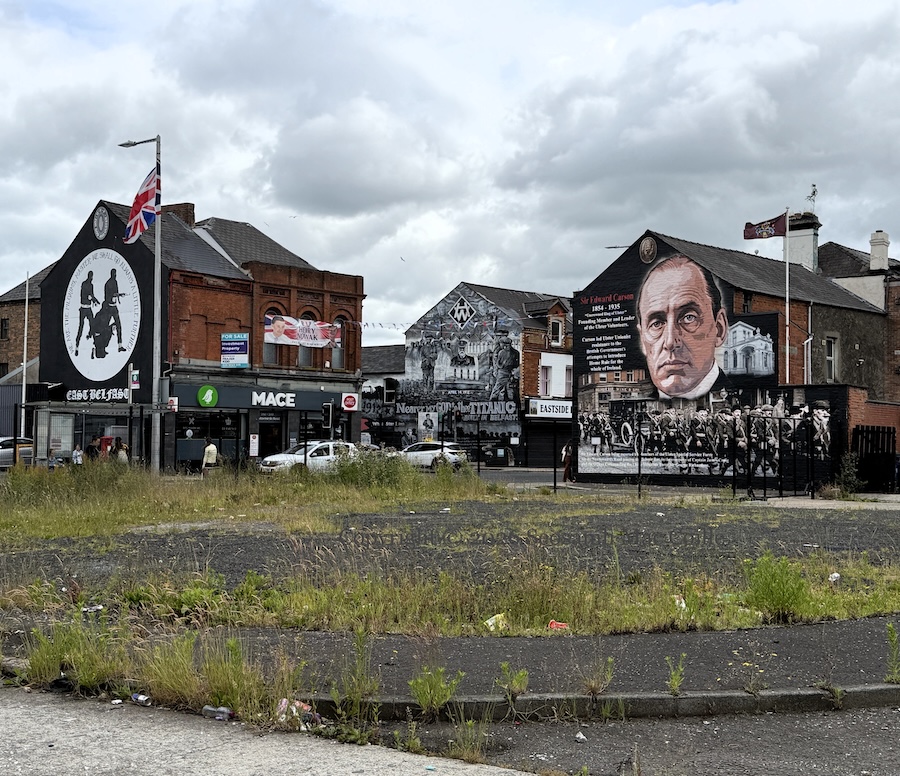
By Dee Craig (Fb), presumably, replacing his hooded gunmen mural The Right To Defend Yourself, on the Newtownards Road at (the former) Bright Street.
The other two murals (visible in the wide shot) are We Are The Pilgrims and Nearer My God To Thee. The “UVF on parade” board next to the taxi office was previously across the street. For the banner above the Mace, see Henry Nowak.
Click image to enlarge
Copyright © 2026 Seosamh Mac Coılle
X16226 [X16227] X16228 X16229 X16230 X16231 [X16232] [X16233] [X16234] X16235
 Extramural Activity