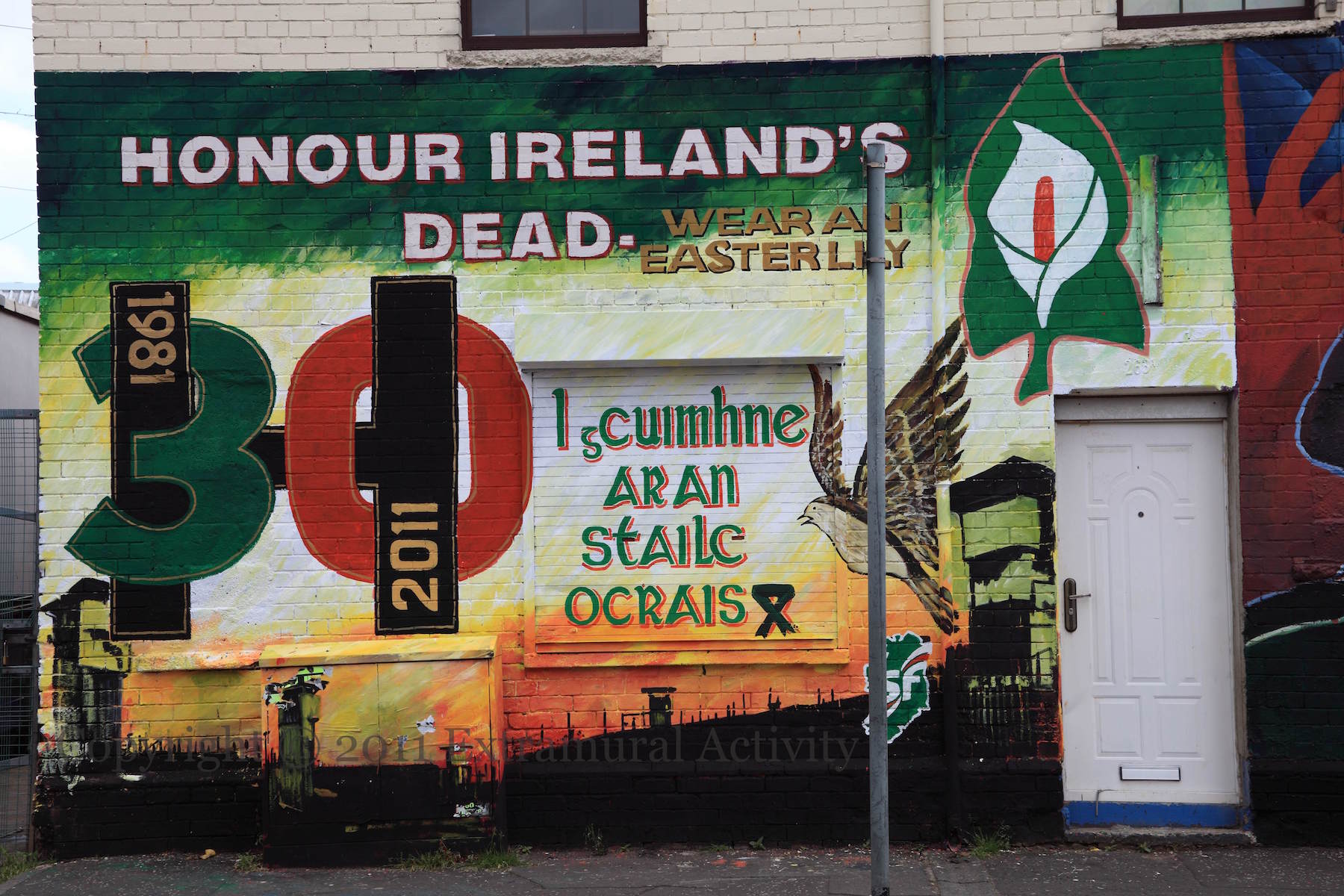
Mural in Beechmount Avenue/Ascaıll Ard na bhFeá commemorating the 30th anniversary of the hunger strike. The watchtowers of Long Kesh provide a lower border, joined by symbols of republican prisoners the lark and the green ribbon, as well as the Easter lily and Sınn Féın logo. “Honour Ireland’s dead – wear an Easter lily”. “I gcuımhne ar an staılc ocráıs. [In memory of the hunger strike.]” Replaces the previous Honour Ireland’s Dead which did not feature the hunger strike.
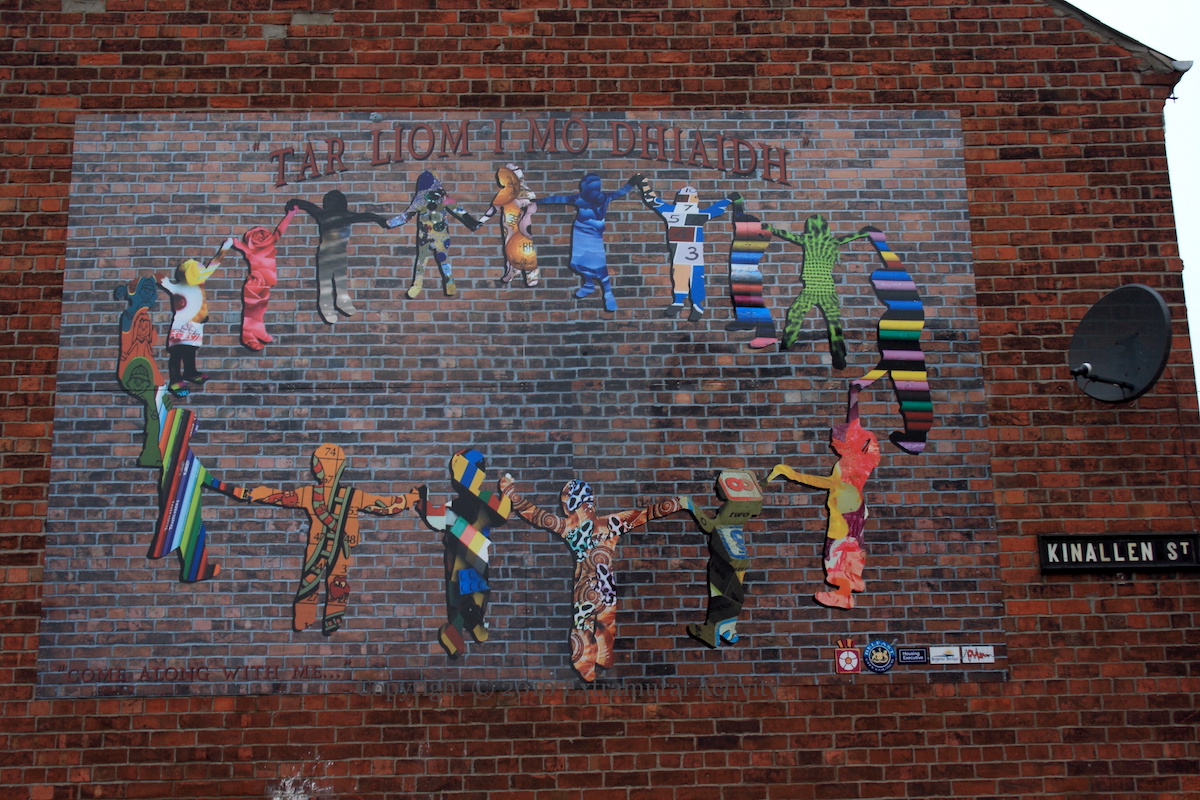
In 1607 – “400 blıaın” after the Anglo-Norman invasion of Ireland – 50 years of newly-asserted English control, most recently at the hands of Charles Blount – who defeated the pair in the Nine Years’ War – and Arthur Chichester – who, as O’Donnell is shown reading, was “appointed Lord Deputy in Ireland” in 1605 – compelled Earls Hugh O’Neill of Tyrone and Rory O’Donnell of Tyrconnell to depart Ireland on a ship bound for Spain in order to petition for Spanish support in reclaiming the lands and status they were losing under English rule. They ended up in Rome instead and never returned, ending the period of Gaelic chiefs’ rule in Ireland and making way for the plantation of Ulster.
The pair of plaques on the left indicate that the mural was painted as part of the Re-Imaging Communities Programme’ (top) and launched by President Mary McAleese on June 19th (bottom). Even though the subject was historical, the state funding for the project required the removal of a sword from O’Neill’s right hand; he is shown instead clutching the collar of his cloak. For more on the re-imaging programme, see Visual History 10.
“Imeacht na nIarlaí. I ndıadh 400 blıaın … that the eternal values of liberty and democracy have prevailed and the sons and daughters of the planter and the Gael have found a way to share the land of their birth and live together in peace.”
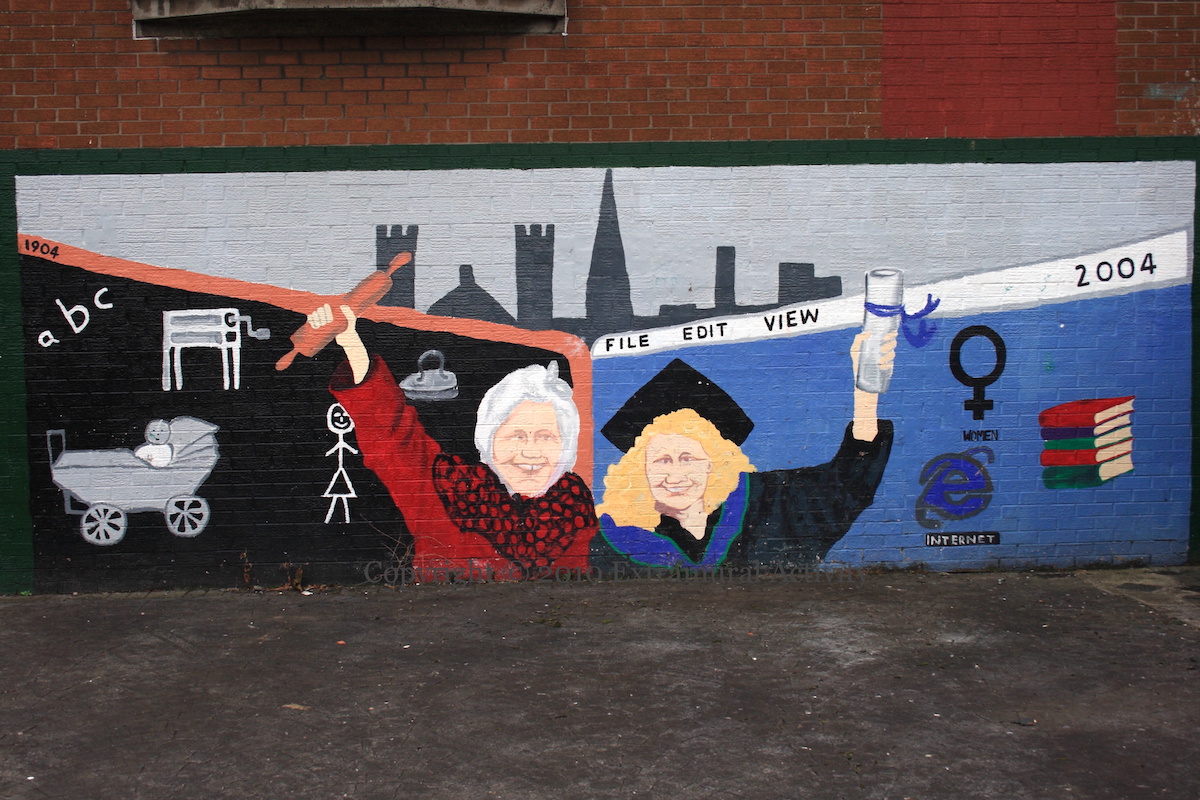
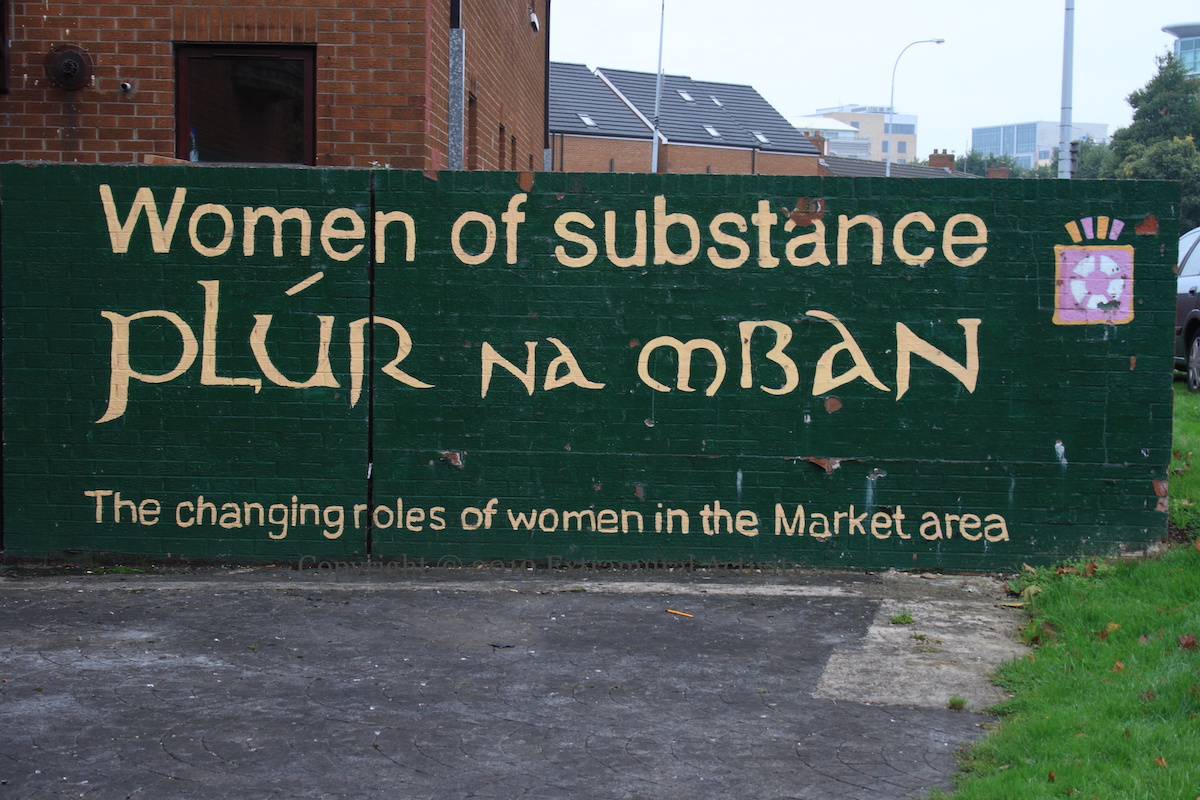
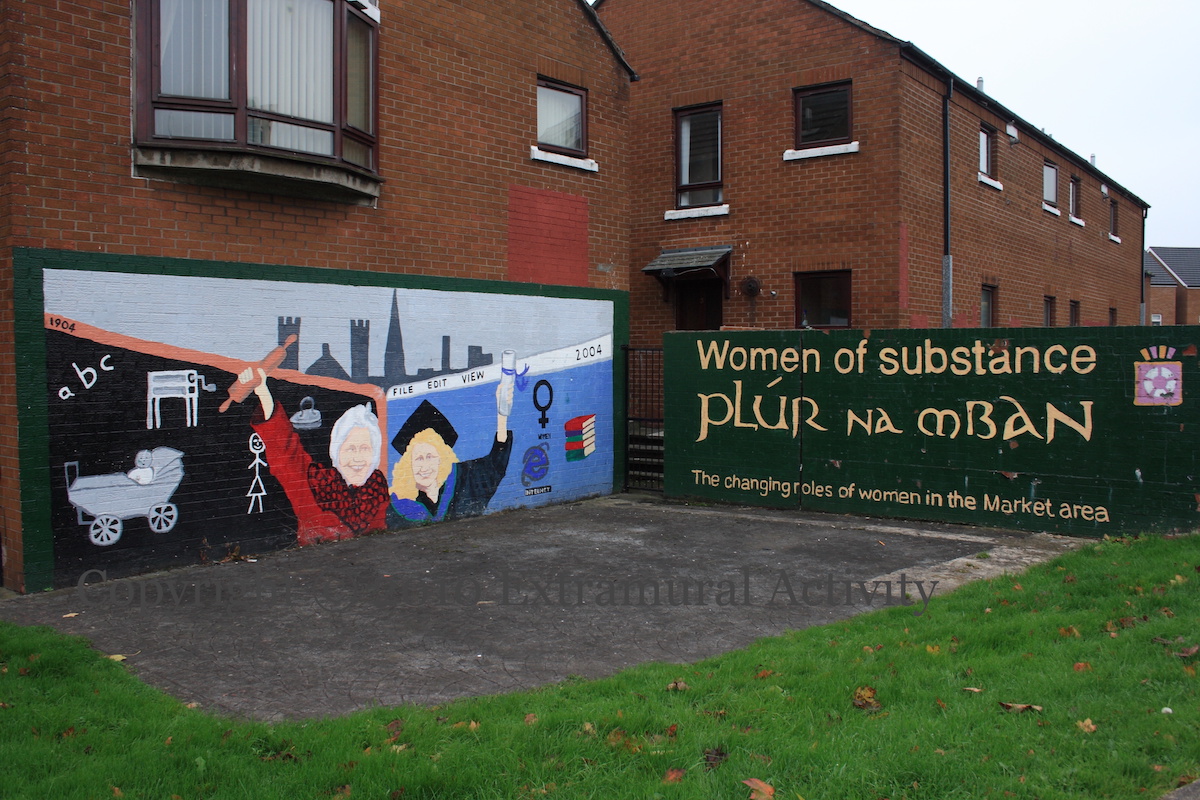
“Women of substance – plúr na mban. The changing role of women the in Market area.” A century of women’s work, from cooking, child-care, and hand-wringing the washing in 1904 to using computers, reading books, and graduating from university in 2004. The pink symbol in the corner is the emblem of the New Belfast Community Arts Initiative.
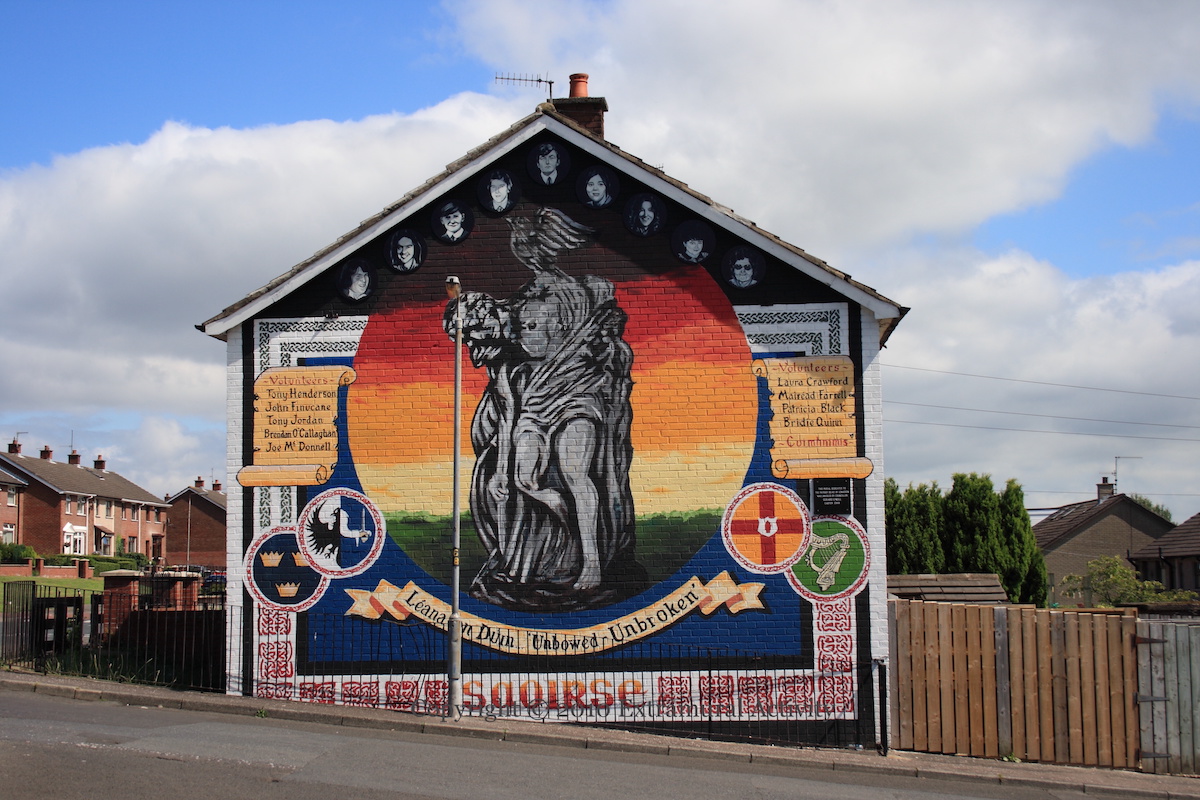
The main Lenadoon mural is refreshed and more portraits and a plaque added (on the right). The dying Cú Chulainn (as portrayed in bronze by Oliver Sheppard, in a statue installed in the GPO in 1935) is used as a symbol for the locals from Lenadoon (including IRA volunteers) who fought for freedom (“saoırse”). They are listed on the scrolls to each side and in the portraits in the apex: Tony Henderson, John Finucane, Brendan O’Callaghan, Joe McDonnell, Laura Crawford, Maıréad Farrell, Patricia Black, Bridie Quinn (previously listed as Bridie O’Neill).
For the previous version (though without the three faces it initially had, of O’Callaghan, McDonnell, and Farrell) see M01934.
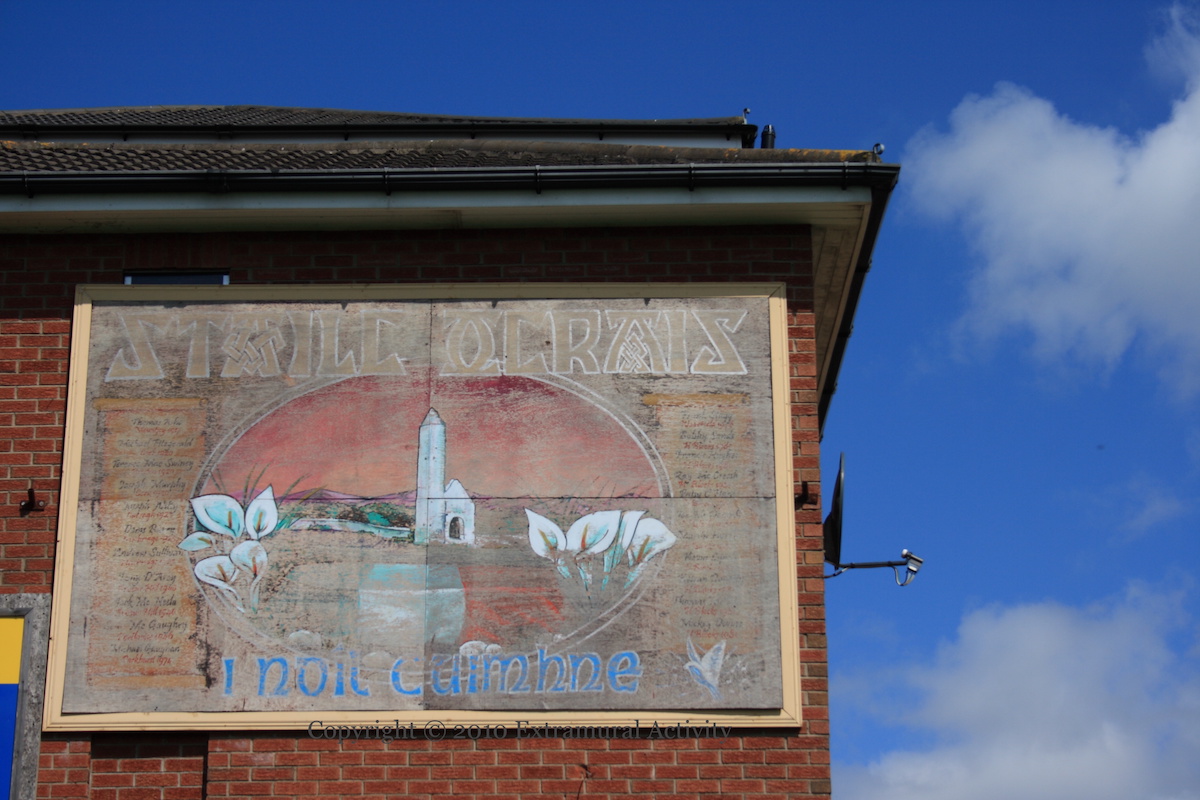
Twelve hunger strikers prior to the 1981 strike are included in this Shaws Road board: on the left: Thomas Ashe, Mountjoy 1917; Michael Fitzgerald, Cork 1920; Terence McSwiney, Brixton 1920; Joseph Murphy, Cork 1920; Joseph Witty, Curragh 1923; Denis Barry, Newbridge 1923; Andrew Sullivan, Newbridge 1923; Tony D’Arcy, Arbour Hill 1940; Jack McNeela, Arbour Hill 1940; Seán McCaughey, Portlaoise 1946; Michael Gaughan, Parkhurst 1974; plus on the right: Frank Stagg, Wakefield 1976.
“Ballymurphy unbowed, unbroken” with images of Ballymurphy including the mural of McCrudden-O’Rawe–Jordan and memorial garden on Divismore Way (left) and Springhill (right). The male figures in the foreground are unnamed but the four in jackets are presumably Stone, McWilliams, McCracken, and Dougal after their mural in Springhill Drive was blanked; the female activists on the left of Cú Chulaınn are Mary Austin, Kathleen Clarke, Annie McWilliams. “This mural was unveiled by Gerry Adams MP 2nd May 2010.”
“Ní thıg leat Éıre a chloígh, ní thıg leat fonn saoırse mhuıntır na hÉıreann a mhúc[h]adh.” [“You cannot subdue Ireland; you cannot extinguish the desire for the freedom of the Irish people.”]
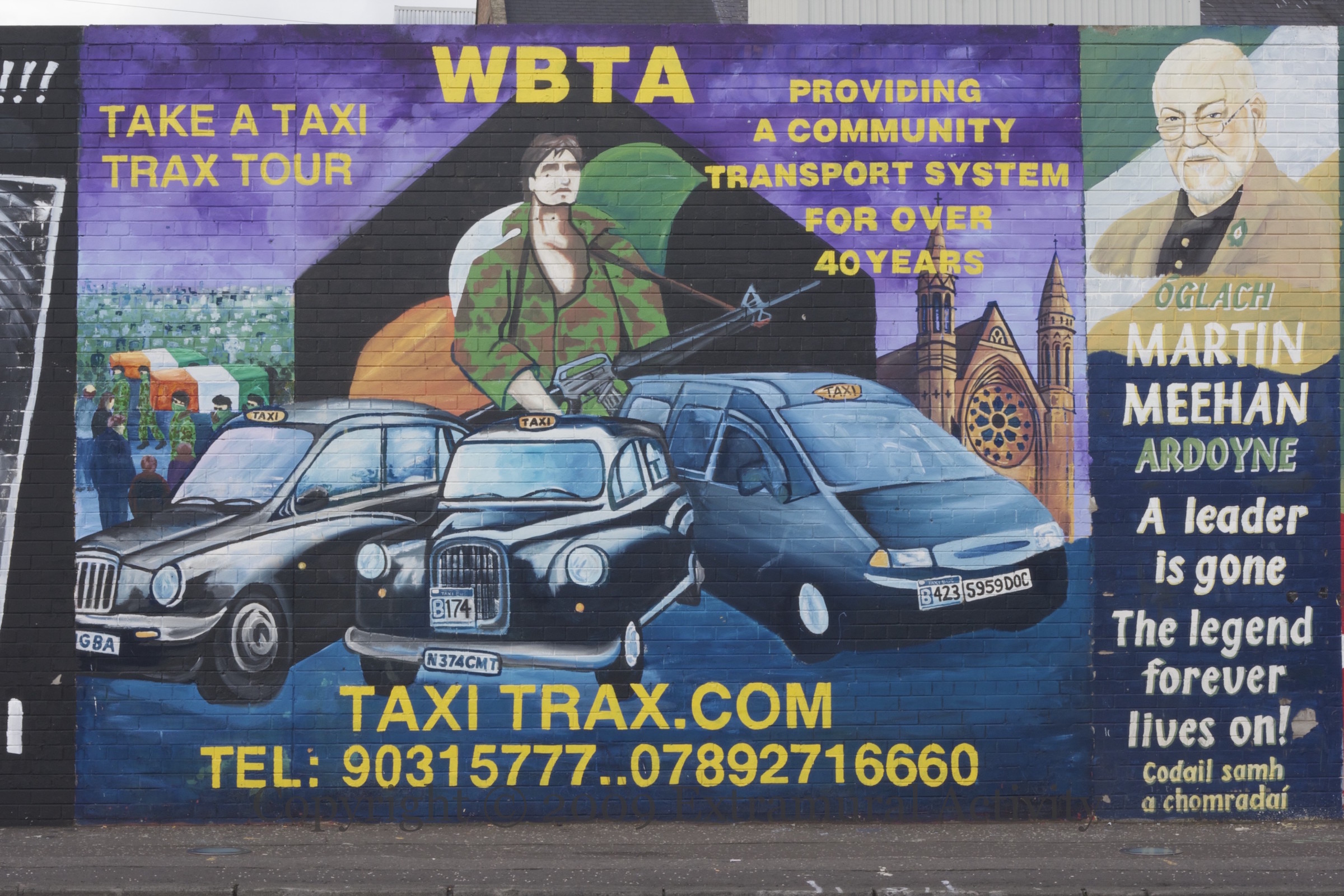
“Providing a community transport system for over 40 years.” The West Belfast Taxi Association (WBTA) have had a mural on the International Wall since at least 2006, offering tours of west Belfast and the murals in particular. Martin Meehan was originally OIRA but switched to the Provisionals after the split. He was the first person convicted of membership of the PIRA and spent 18 years in prison during the Troubles (WP). “Codaıl samh a chomradaí.”
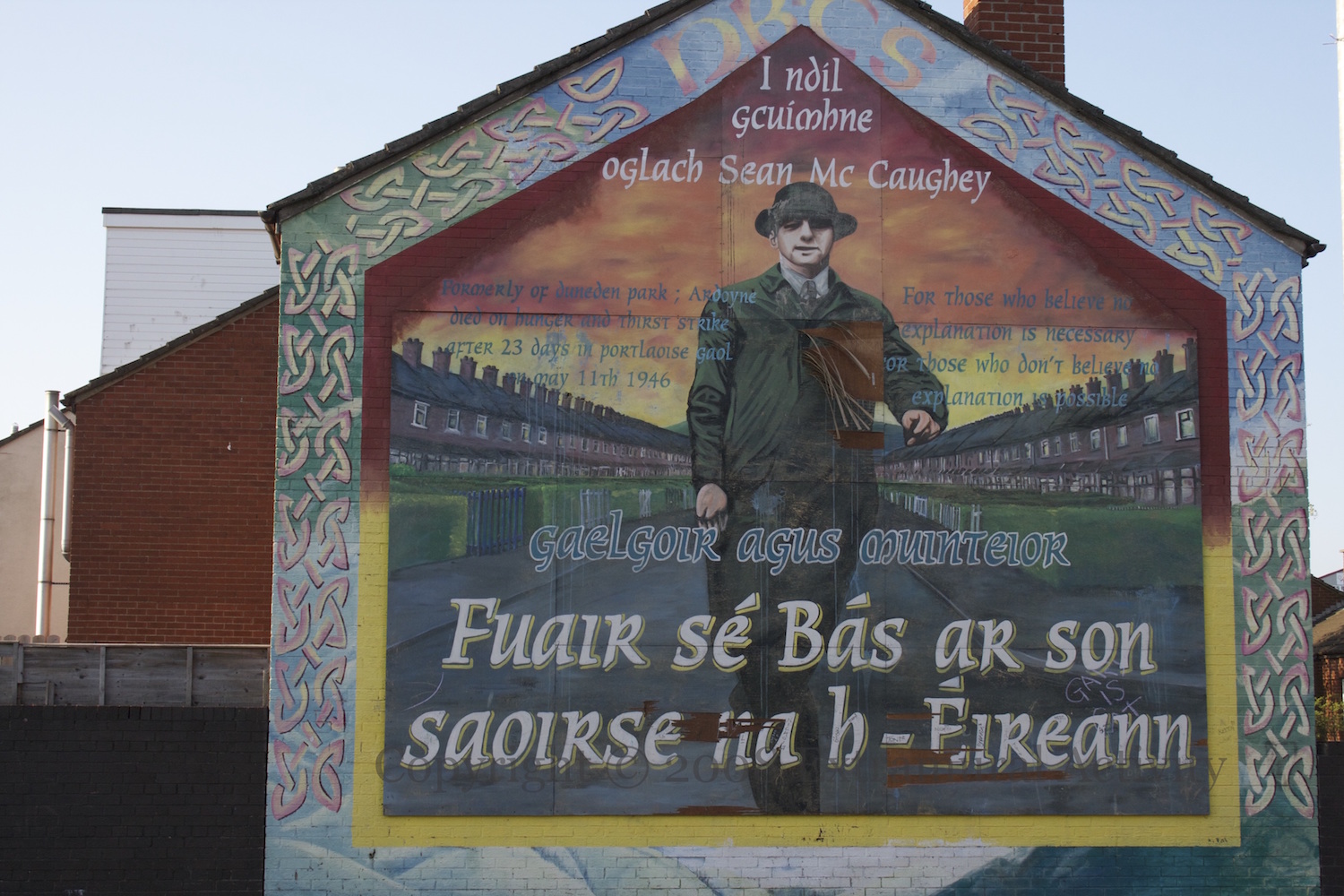
“I ndıl gcuımhne oglach [sic] Sean McCaughey, Gaelgoır [sic] agus muınteıor [sic] [Irish-speaker and teacher]. Fuaır sé bás ar son saoırse na hÉıreann.” “Formerly of Duneden Park, Ardoyne. Died on hunger and thirst strike after 23 days in Portlaoise gaol on May 11th 1946.” “For those who believe no explanation is necessary; for those who don’t believe no explanation is possible.”
McCaughey was convicted of kidnapping and torturing IRA chief of staff Sean Hayes, who was suspected of treason. His hunger and thirst strike was preceded by five years on the blanket.



 Extramural Activity