Kelly’s Bar

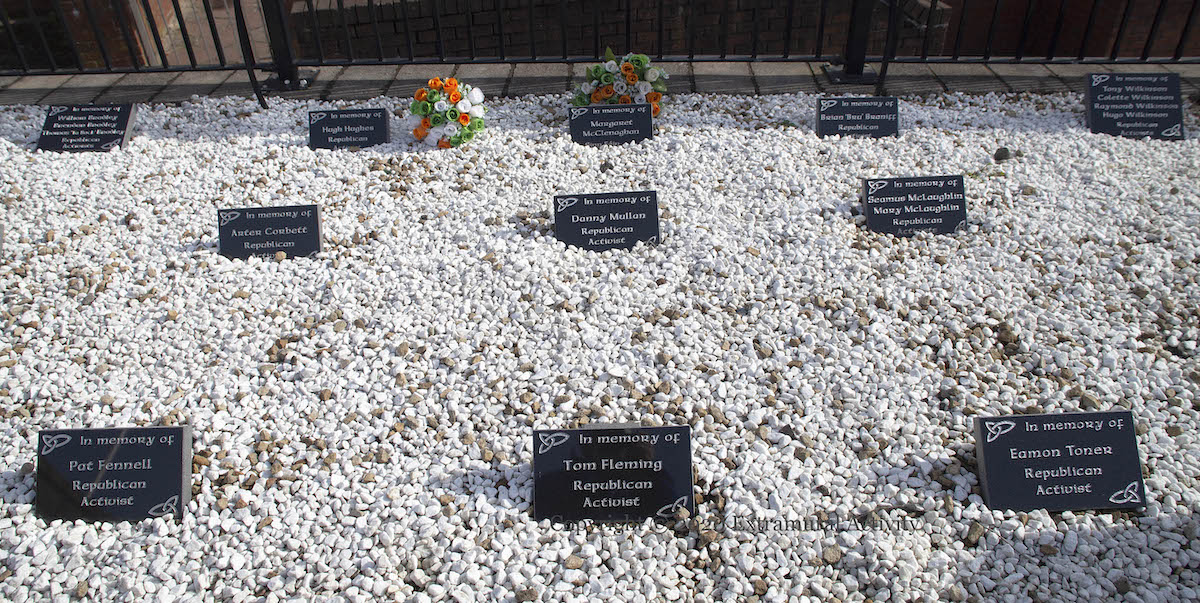
Kelly’s Bar at the top of the Rock was packed with punters watching a World Cup match between England and West Germany when a car bomb went off outside shortly after 5 p.m.. The bombing was followed by two nights of gun-battles, with loyalists firing from Springmartin, republicans (both PIRA and OIRA) from Ballymurphy, and British Army soldiers (the King’s Own and 1 Para) from Henry Taggart and other mobile locations. Within three hours following the explosion, barman Tommy McIlroy was killed in the gunfire from Springmartin as he helped with clean-up from the bomb, Alan Buckley of the King’s Own was killed by IRA fire, Michael Magee of Na Fıanna was killed by friendly fire, and Robert McMullan was killed by British Army fire. The next night (May 14th), John Pedlow was killed by British Army fire and Martha Campbell was shot by UVF fire from Springmartin (see her memorial plaque). (Lost Lives 352, 353, 354, 355, 358, 359 | Battle At Springmartin (WP))

As with the bombing of McGurk’s bar in north Belfast (see most recently Justice Delayed Is Justice Denied), the bombing was initially spun by the UK forces and government as an IRA attempt to stir up loyalists (An Phoblacht | Lost Lives 352). An inquest into Moran’s death (and thus into how the bombing was carried out) has been opened (BeTel | Independent).

The plaque dates back to 2004 (see M02243); the tarp was added for the 50th anniversary in 2022; the small mural is more recent.

Click image to enlarge
Copyright © 2023 Seosamh Mac Coılle
X12572 X12571 X12570
“This plaque marks the spot where Kellys Bar once stood and where on 13th May 1972 a no warning loyalist car bomb exploded. As a result 66 people were injured and three innocent members of staff of Kellys Bar lost their lives. They were Tommy McIlroy Died 13th May 1972; John Moran Died from his injuries 23rd May 1972; Gerard Clarke Died from his injuries 6th September 1989. Ar dheıs de go raıbh a namacha.”
Saoırse Go Deo

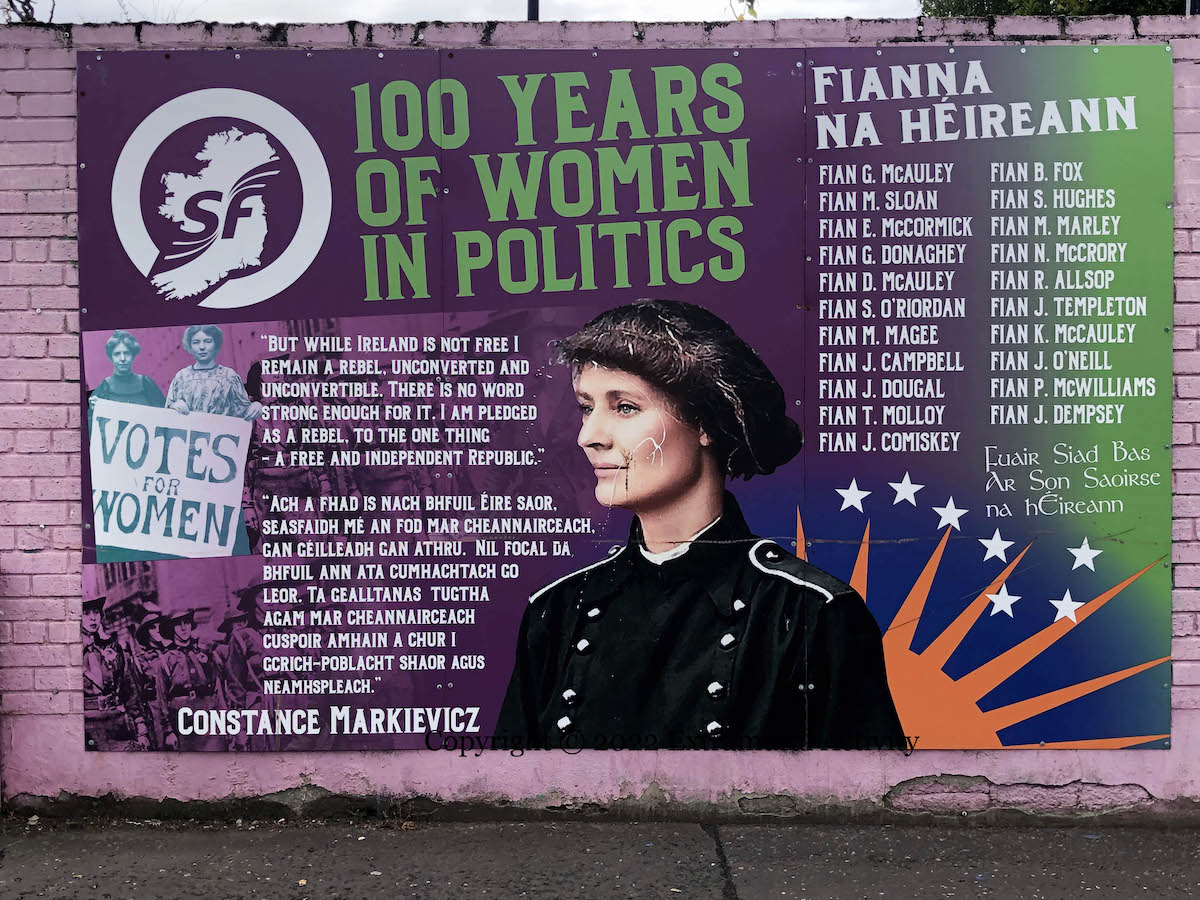
The 1918 ‘Representation Of The People’ act gave 8.4 million women in the United Kingdom the right to vote (WP). (For the two women on the left holding the ‘Votes For Women’ sign, see Women’s Hall And Cost-Price Restaurant.) In that same year, Countess Constance Markievicz was the first woman elected to Westminster and became Sınn Féın Minister For Labour in the first Dáıl Éıreann that was established as an alternative. Ten years earlier, she had co-founded Na Fıanna Éıreann with Bulmer Hobson. The names of Derry fianna are listed on the right. “Fuaır sıad bás ar son saoırse na hÉıreann.” (This board replaces the former Fianna mural that celebrated the centenary in 2009.)

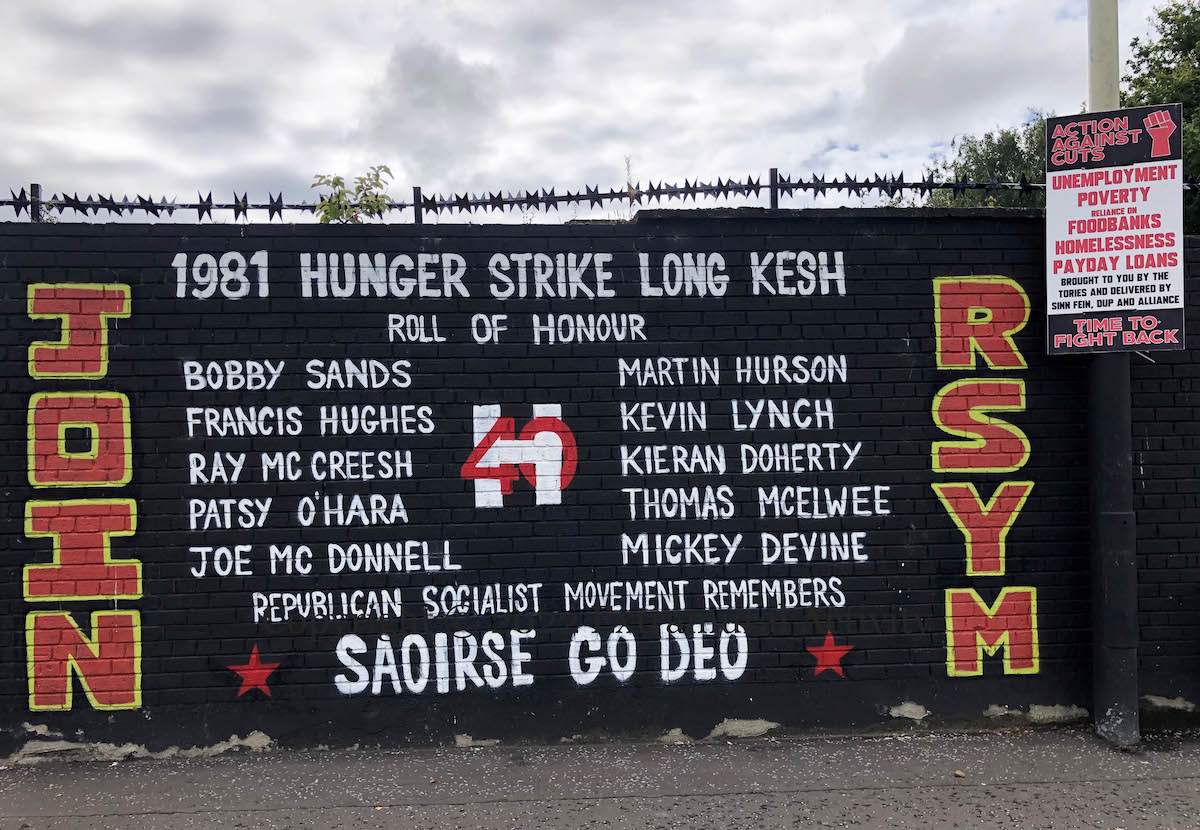
To the left is a “Join RSYM” stencil with the names of the ten deceased 1981 hunger strikers; to the right is a picture of the memorial across the street to the dead of the 3rd battalion of the Doıre Brigade Óglaıgh na hÉıreann.

“But while Ireland is not free I remain a rebel, unconverted and unconvertible. There is no word strong enough for it. I am pledged as a rebel to the one thing – a free and independent republic.”

“Ach a fhad is nach bhfuıl Éıre saor, seasfaıdh mé an fód mar cheannaırceach, gan géılleadh, gan athrú. Níl focal dá bhfuıl atá chumhachtach go leor. Tá gealltanas tugtha agam mar cheannaırceach, cuspóır amháın a chur ı gcrích – poblacht shaor agus neamhspleach.”

Click image to enlarge
Copyright © 2022 Seosamh Mac Coılle
X10980 X10981 X10979 X10982 racecourse rd

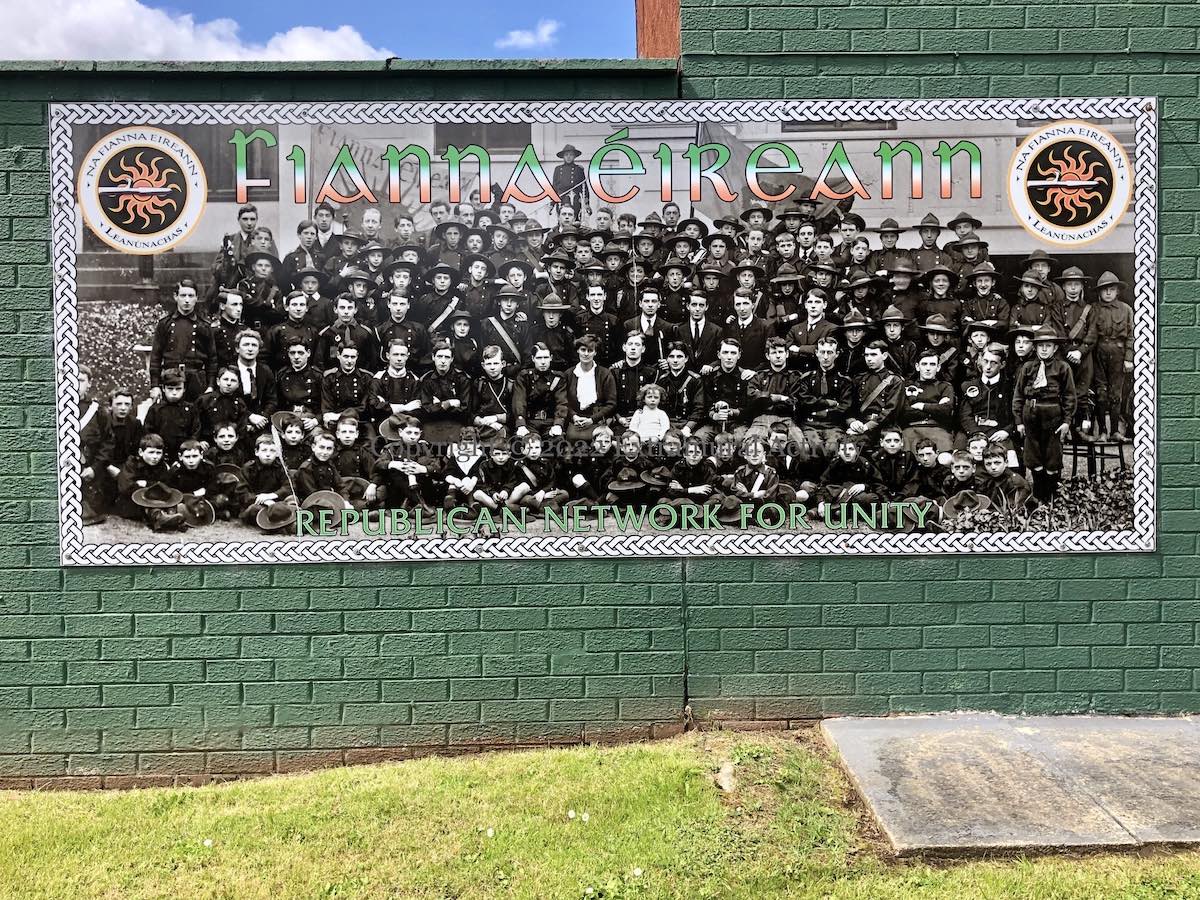
Na Fıanna Éıreann Leanúnachas

“The Continuity Fıanna”. The Irish National Boy Scouts or “junior IRA” were founded in 1909 by Bulmer Hobson and Countess Markievicz, who is at the centre of this photograph. The Fıanna followed the Provisionals in 1969 and Republican Sınn Féın (and the Continuity IRA) in 1986 (Fianna History blog | Irish Examiner), while Provisional Fianna became Ógra Shınn Féın and then Sınn Féın Republican Youth (An Sionnach Fionn).

For the previous stencilling in this spot, see In The Cause Of Irish Freedom. For the plaque and old (single bugler) tarp (to Josh Campbell, Davy McAuley, Bernard Fox, and Joseph McComiskey), see Purity In Our Hearts.

Click image to enlarge
Copyright © 2022 Seosamh Mac Coılle
X10429 X10428 Berwick Road ardoyne

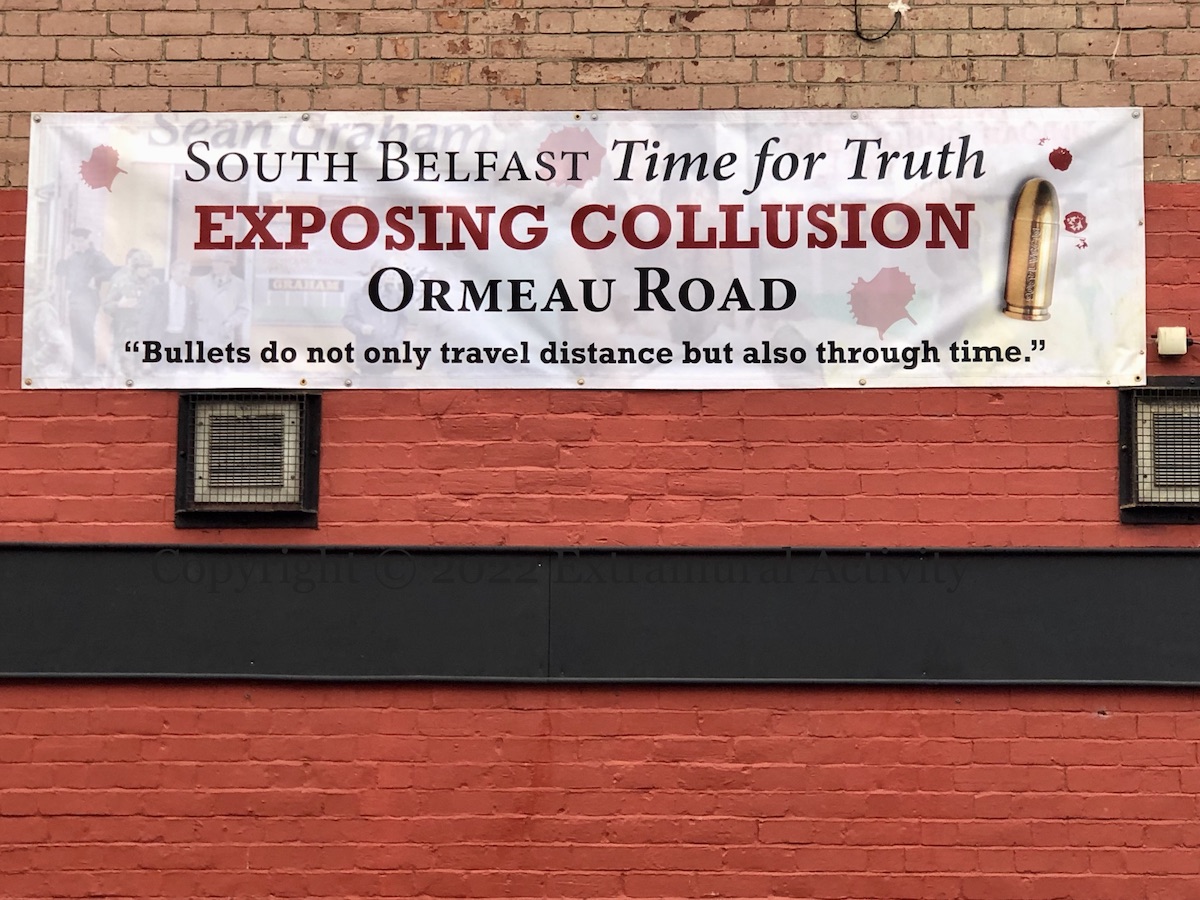
Bullets Travel Also Through Time

“South Belfast – time for truth – exposing collusion – Ormeau Road – ‘Bullets do not only travel distance but also through time'” [Based on a quote by James Kennedy’s father: “The bullets that killed James didn’t just travel in distance, they travelled in time. Some of those bullets never stop travelling.” (Irish Times)]

Police Ombudsman Marie Andersons’s report into various murders and attempted murders in south Belfast was released yesterday (February 7th, 2022) and presented a list of “collusive behaviours” between the RUC and loyalist paramilitaries. Among the incidents investigated was the killing of five people “murdered for their faith” at the Sean Graham bookies’ office on the Ormeau Road in February 5th, 1992; the report found that one of the two UDA gunmen was a Special Branch informant and that a Browning pistol used in the attack had been supplied by the RUC (as had previously been revealed in the 2010 HET Inquiry report) and that records relating to the weapon had been withheld from investigators (Irish Times | Belfast Live). For the 30th anniversary, relatives of the five men killed and of five more who were injured displayed their portraits next to the small memorial garden, which itself was updated to mark the third decade since their deaths: “1992-2022” (Belfast Live).

The plaque on the far left is to Charles Jospeh McGrillen, shot by the UDA/UFF in 1988 at his work in Dunne’s on the Annadale embankment (Sutton). Next to the bookies’ parlour is a plaque to Fian Jim Templeton.

Click image to enlarge
Copyright © 2022 Seosamh Mac Coılle
X09015 X09014 X09013 X09012 hatfield st go ndéana Dıa trócaıre ar a n-anamacha

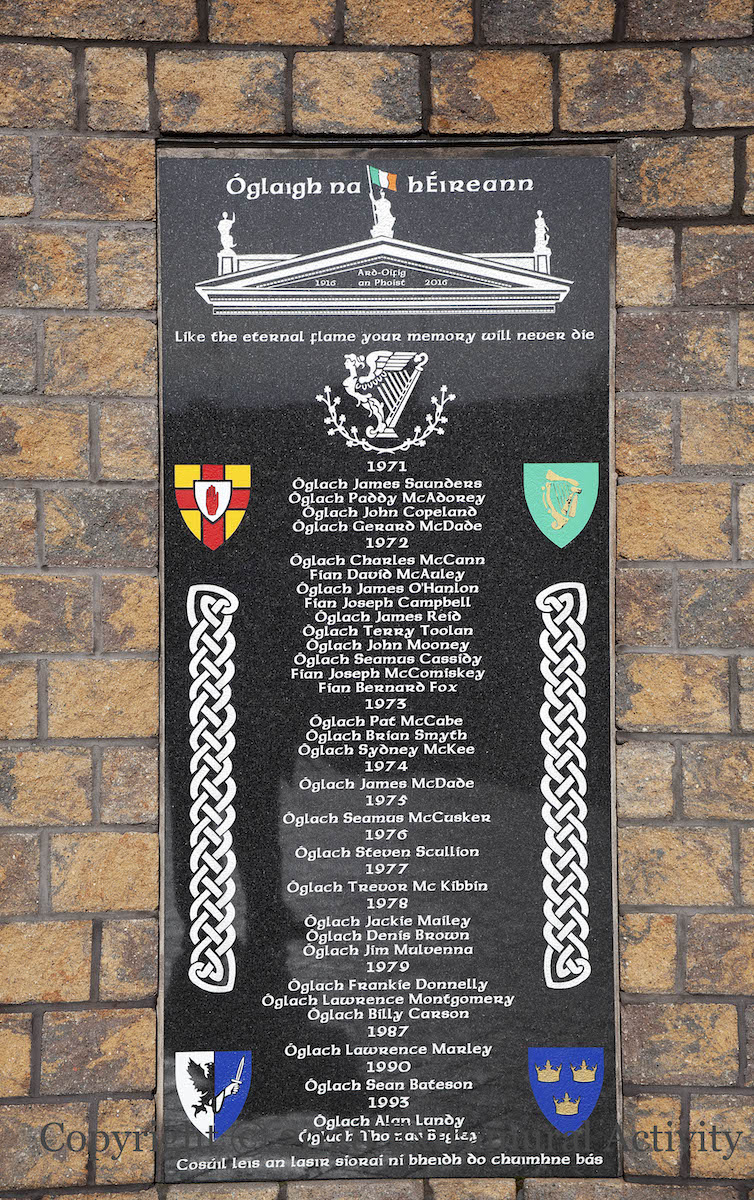
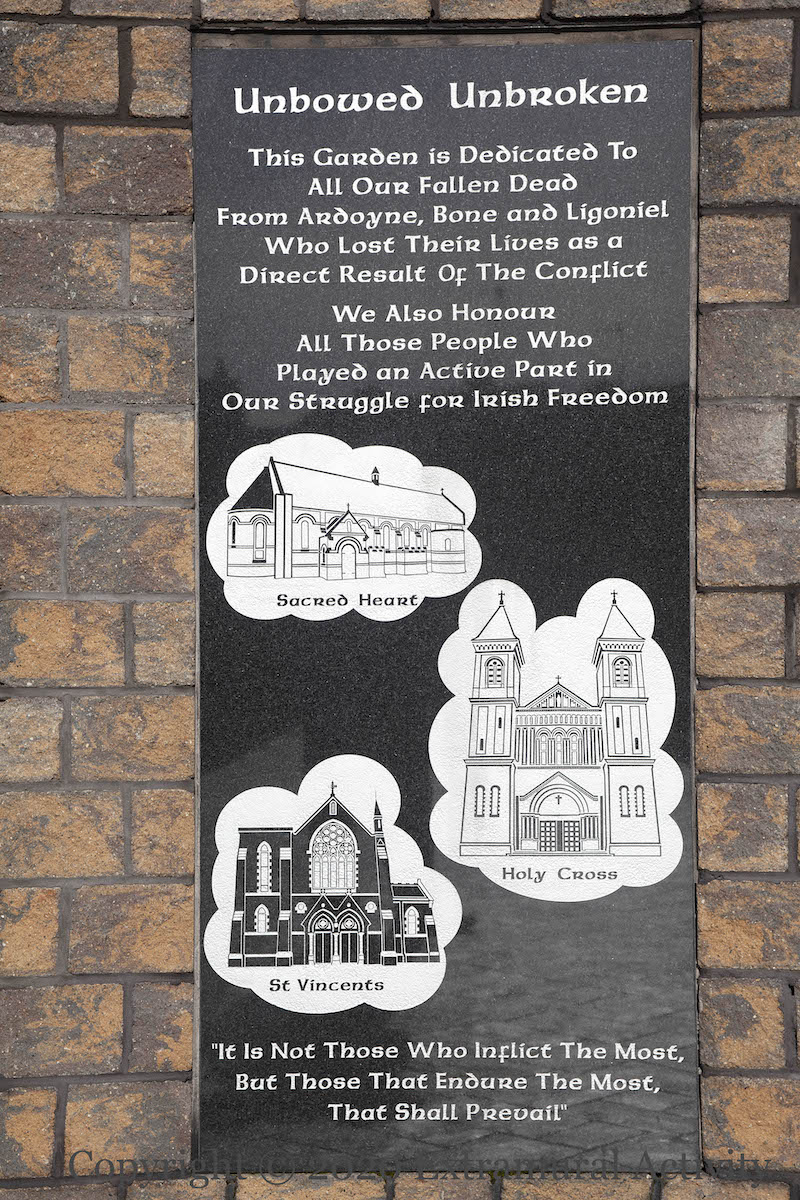
Like The Eternal Flame

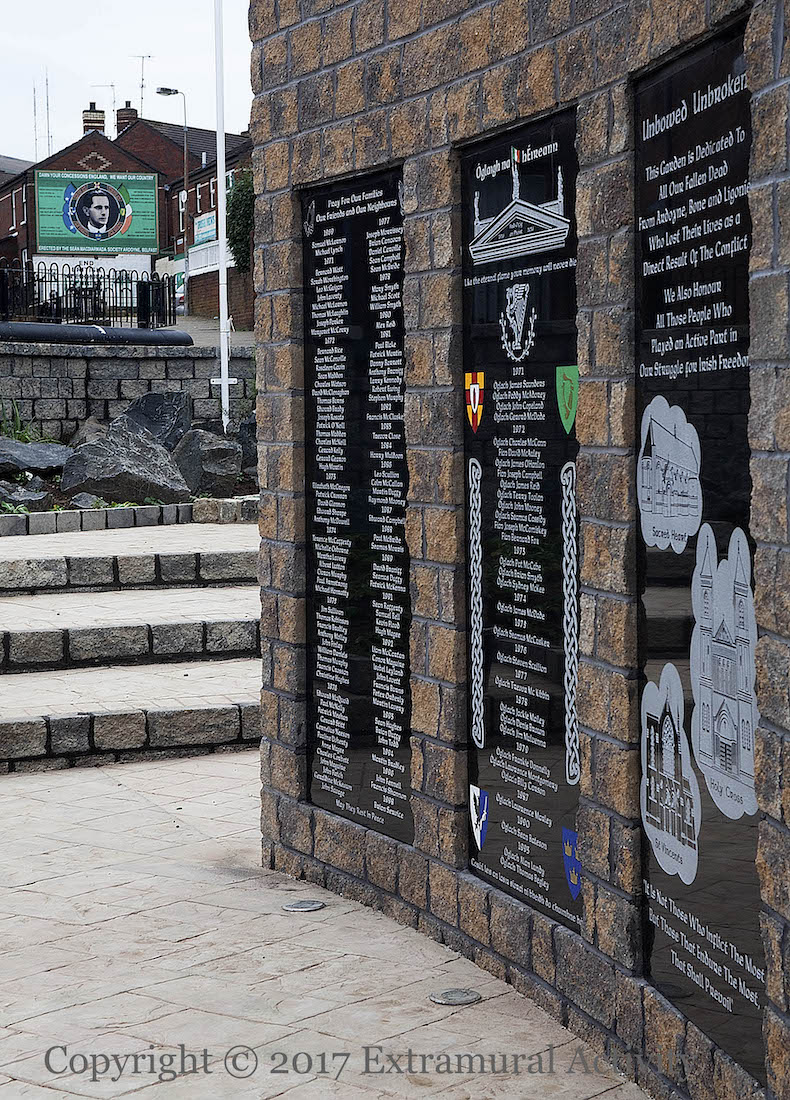
“Like the eternal flame your memory will never die.” “Unbowed, unbroken – this garden is dedicated to all our fallen dead from Ardoyne, Bone, and Ligoniel who lost their lives as a direct result of the conflict. We also honour all those people who played an active part in our struggle for Irish freedom. ‘It is not those who inflict the most, but those that endure the most, that shall prevail’ [Terence McSwiney]”. The central plaque shows the pediment and statues on “ard-oıfıg an phoıst” (the GPO in Dublin, 1916) and the Maid Of Erin harp (of 1798). The celtic cross was previously in the memorial garden at the corner of Berwick Road – see Freedom Hath Arisen.

In the distance of the final image is the Sean Mac Dıarmada mural.

Click image to enlarge
Copyright © 2017 Seosamh Mac Coılle
X07649 [X05375] X07650 X07651 X07652 [X07653] X07654 X07655 X07656 X05376 Butler Pl

Continuing Their Legacy

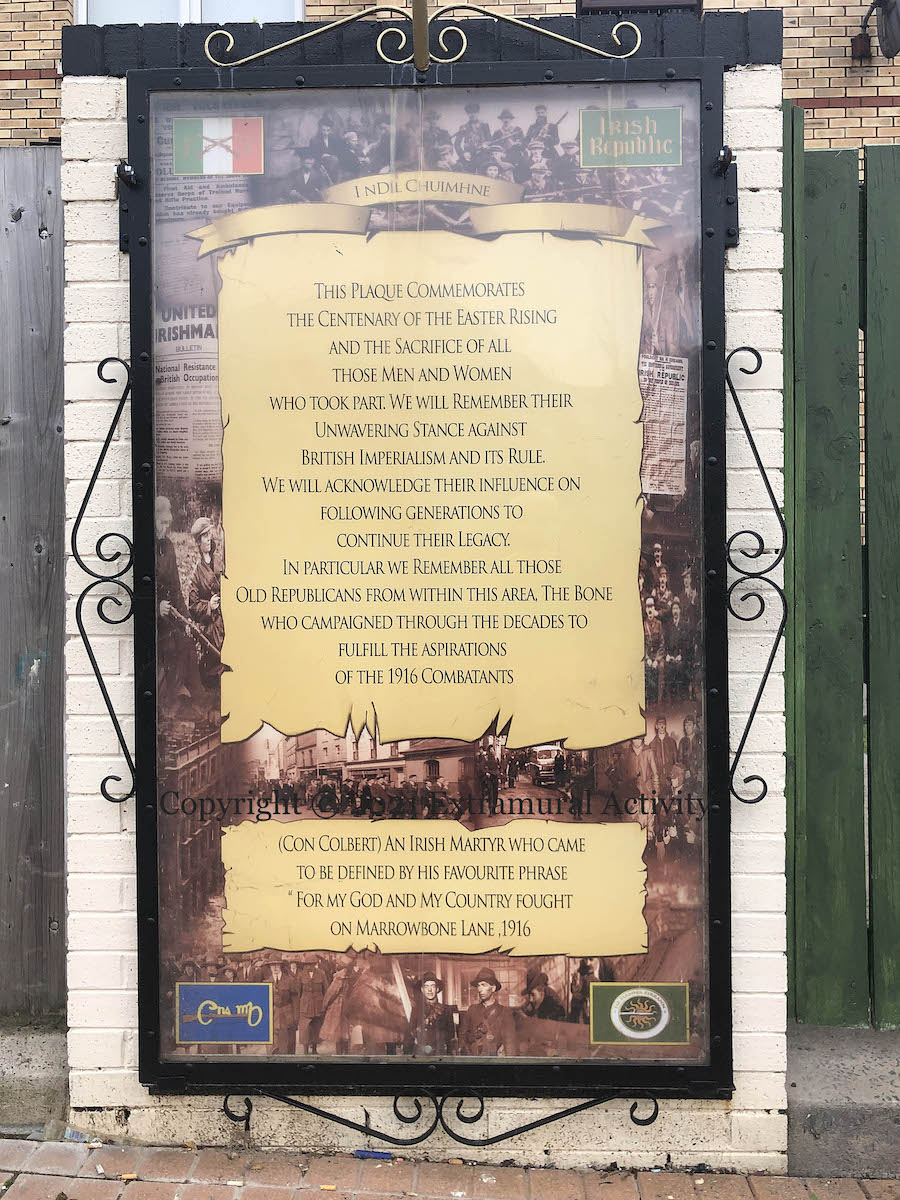
“This plaque commemorates the centenary of the Easter Rising and the sacrifice of all those men and women who took part. We will remember their unwavering stance against British imperialism and its rule. We will acknowledge their influence on following generations to continue their legacy. In particular we remember all those old republicans from within this area, the Bone, who campaigned through the decades to fulfill the aspirations of the 1916 combatants. (Con Colbert) An Irish martyr who came to be defined by his favourite phrase “For my God and my country” fought on Marrowbone Lane [Dublin], 1916″.

Click image to enlarge
Copyright © 2021 Seosamh Mac Coılle
X08361

Na Fıanna Ard Eoın

Above is the plaque on Berwick Road/Paráıd An Ardghleanna to four teenaged members of Na Fıanna Éıreann who died in 1972 – Davy McAuley, Josh [Joseph] Campbell, Josie McComiskey and Bernard Fox – all four from Ardoyne/Ard Eoın. McAuley died of a gunshot wound, perhaps at a Louth training camp (Nelson McCausland). Campbell was shot in Eksdale Street in a gun battle with the British Army; McComiskey was shot in Flax Street in a gun battle with the British Army; Fox was shot by British Army in Brompton Street. For the tarp, see Purity In Our Hearts; for the 2016 lily, see In The Cause Of Irish Freedom.

Click image to enlarge
Copyright © 2018 Seosamh Mac Coılle
X04791 X04790

Child Soldiers

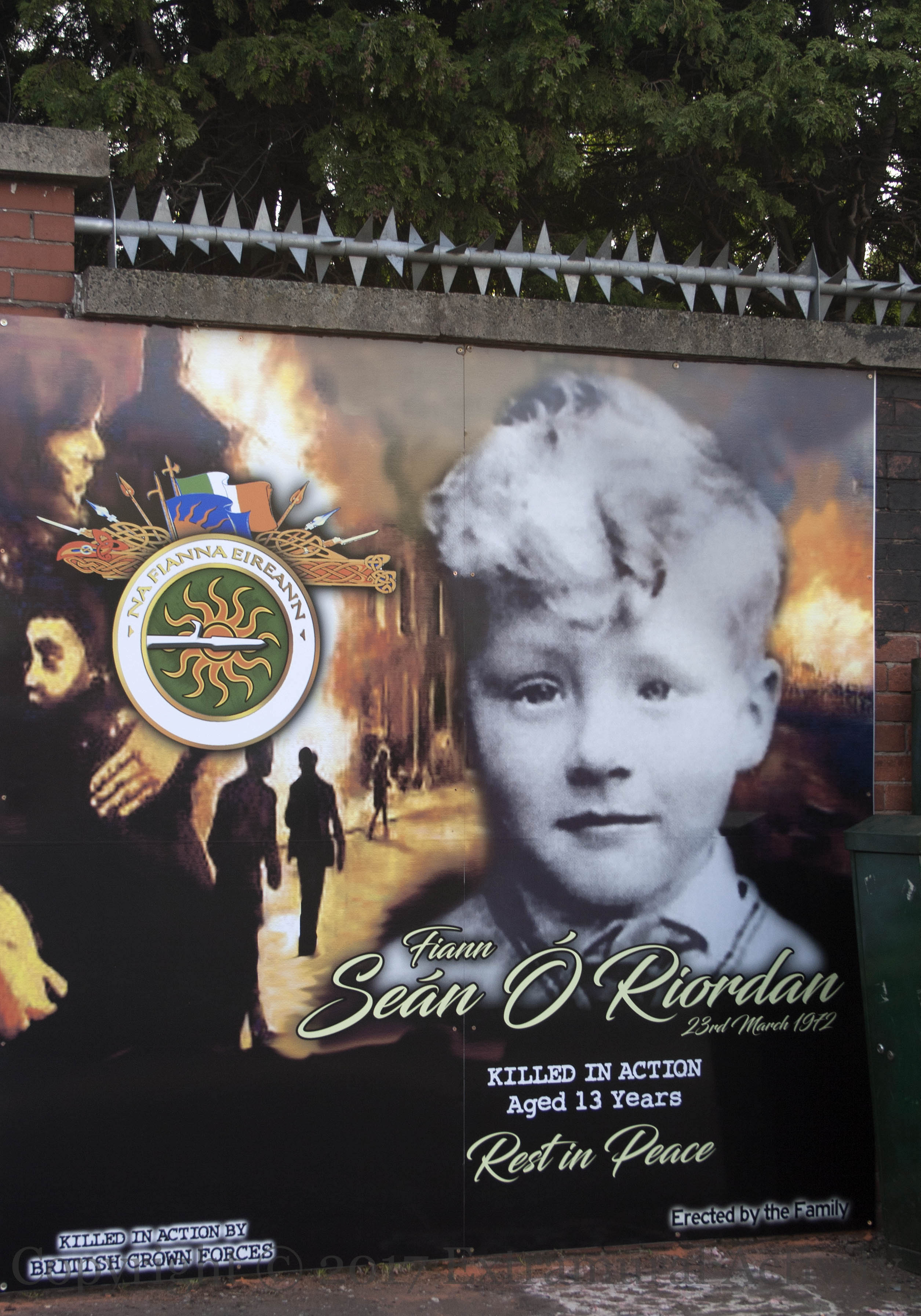
Seán Ó Rıordan was aged 13 when “killed in action by British crown forces” on Cawnpore Street on 23rd March 1972 (Sutton) and he is buried in Milltown cemetery. The 1977 Protocol I of the Geneva Convention would later prohibit conscription of children younger than 15 but allow for their voluntary participation. It is thus notable that this new board to “Fıann [sic] Seán Ó Rıordan” was “erected by the family”.

Ascaıll Ard Na bhFeá/Beechmount Avenue, west Belfast.

Click image to enlarge
Copyright © 2017 Seosamh Mac Coılle
X04142

James ‘Pavlo’ O’Neill

“Fıann [sic] James ‘Pavlo’ O’Neill died close to this spot while on active service, aged 17. Born 21st December 1958 – died 12th February 1976. Fuaır sé bás ar son na hÉıreann. 1958-1976”. Jim O’Neill was killed in during an IRA arson attack on a furniture warehouse on the Antrim Road near the New Lodge – Gerry Fitt’s house next door might have been the ultimate target (Belfast Child). The local flute band is in part named after him – see O’Neill-Allsopp Memorial Flute Band.

Dawson Street, New Lodge, north Belfast.

Click image to enlarge
Copyright © 2016 Seosamh Mac Coılle
X05374

Na Fıanna Ard Eoın

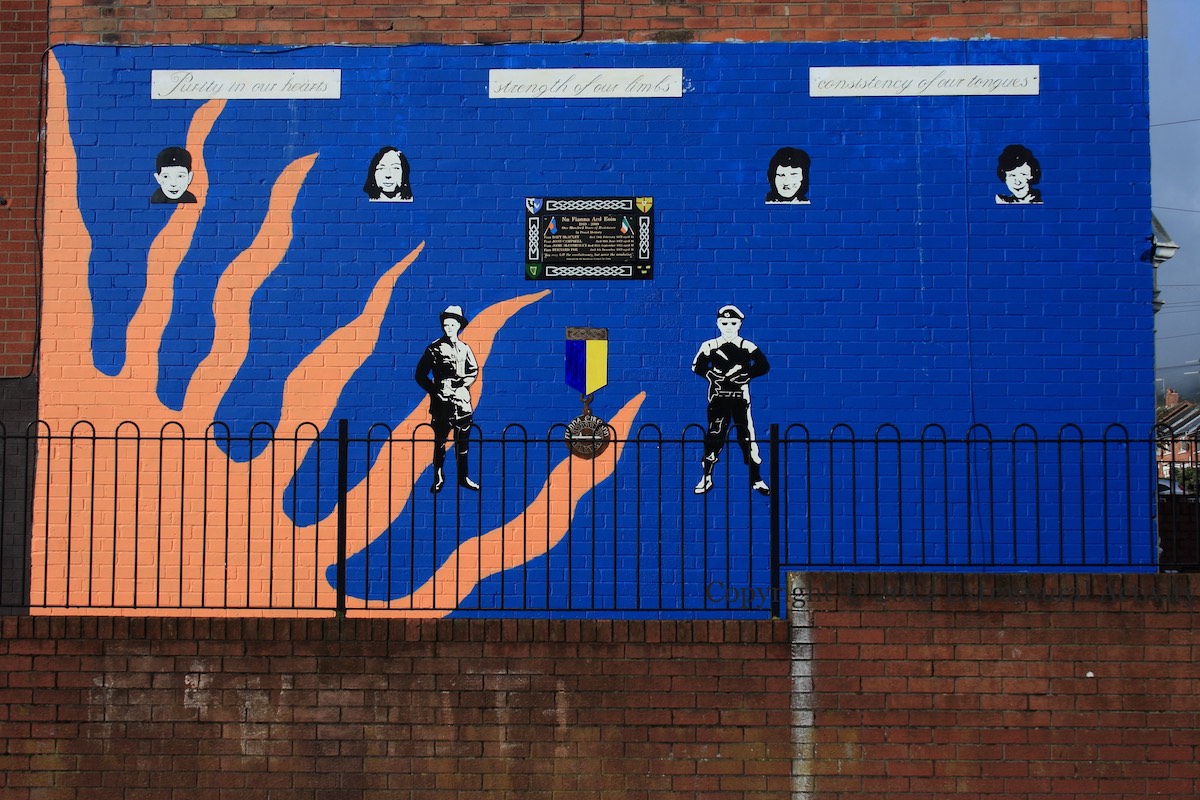
The Fıanna plaque at the top of Berwick Road gets a sunburst background and cut-out portraits of the four Fıanna named on the plaque which dates back to 2009, commemorating “one hundred years of resistance” (1909-2009): Davy McAuley, Josh Campbell, Josie McComiskey, and Bernard Fox, all of whom died in 1972. The vintage Fıan on the left is perhaps Christy Lucey. The medal pictured is the Golden Jubilee medal.

“You may kill the revolutionary, but never the revolution.” “Dedicated by the Republican Network For Unity.” “Strength in our hearts, strength of our limbs, consistency of our tongues.”

For close-up of the plaque, see M06728.

Click image to enlarge
Copyright © 2012 Seosamh Mac Coılle
X05185 [X05183] X05184 [X01561]