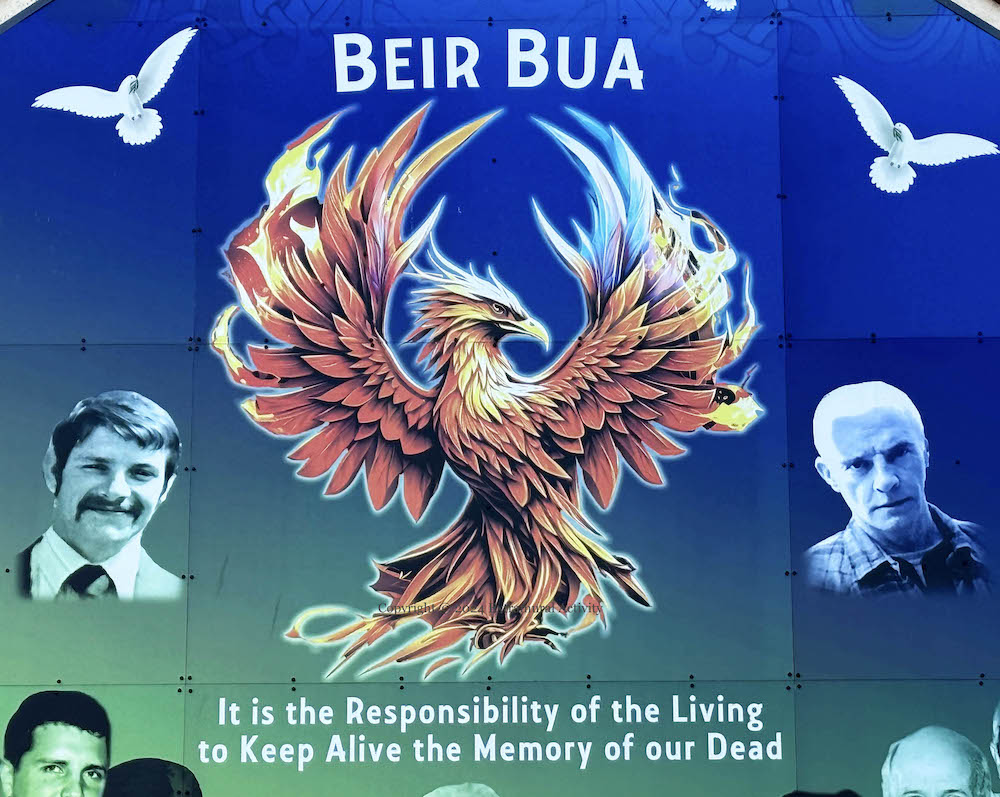
“Beır bua – It is the responsibility of the living to keep alive the memory of the dead.” This is the second ‘Working Class Heroes’ piece in Ballymurphy. The other, from 2014, features Tommy “Toddler” Tolan, who appears here to the left of the phoenix.
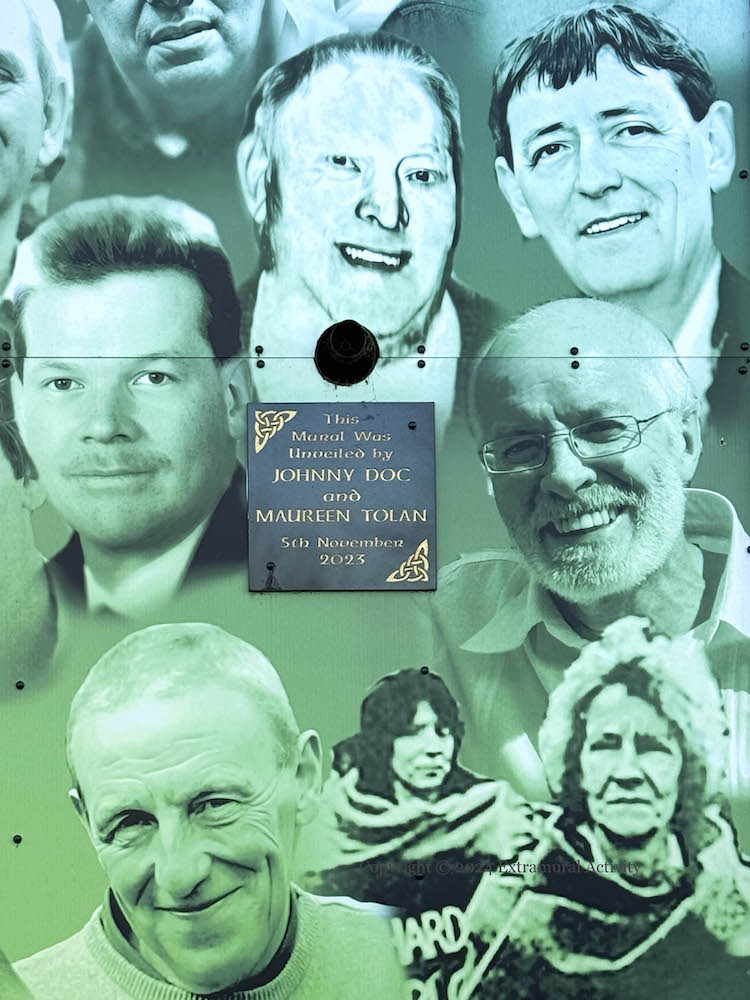
The plaque on the right reads “This mural was unveiled by Johnny Doc and Maureen Tolan, 5th November, 2023.” There is video of the launch on Facebook, which contains a reading of the names of all the people pictured from the 1m 57s mark onwards.
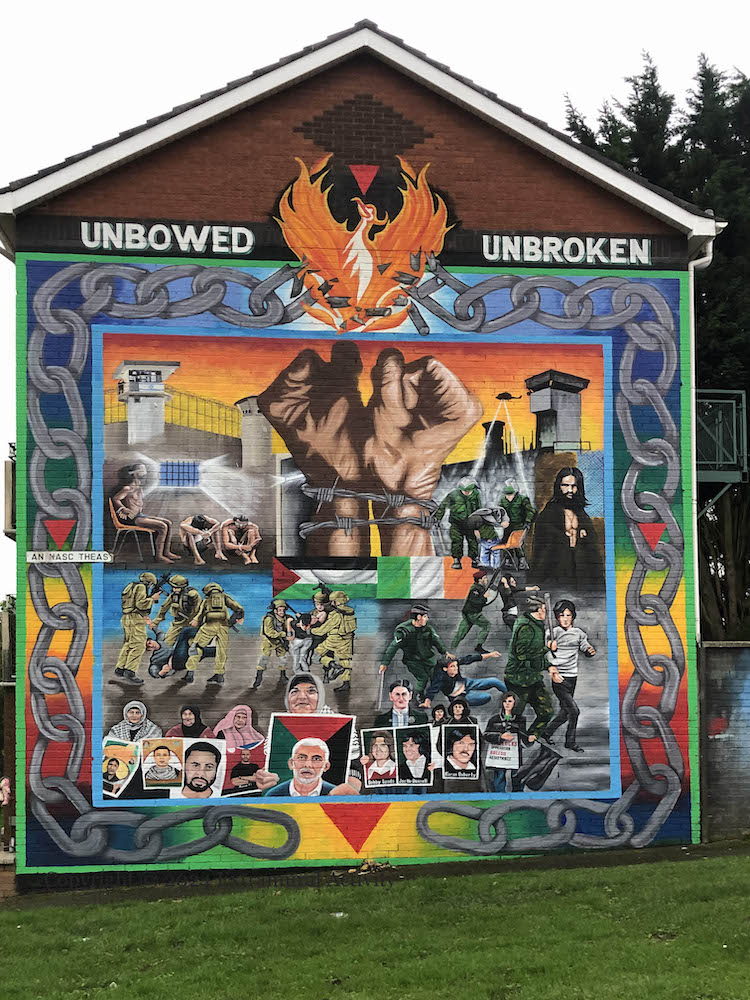
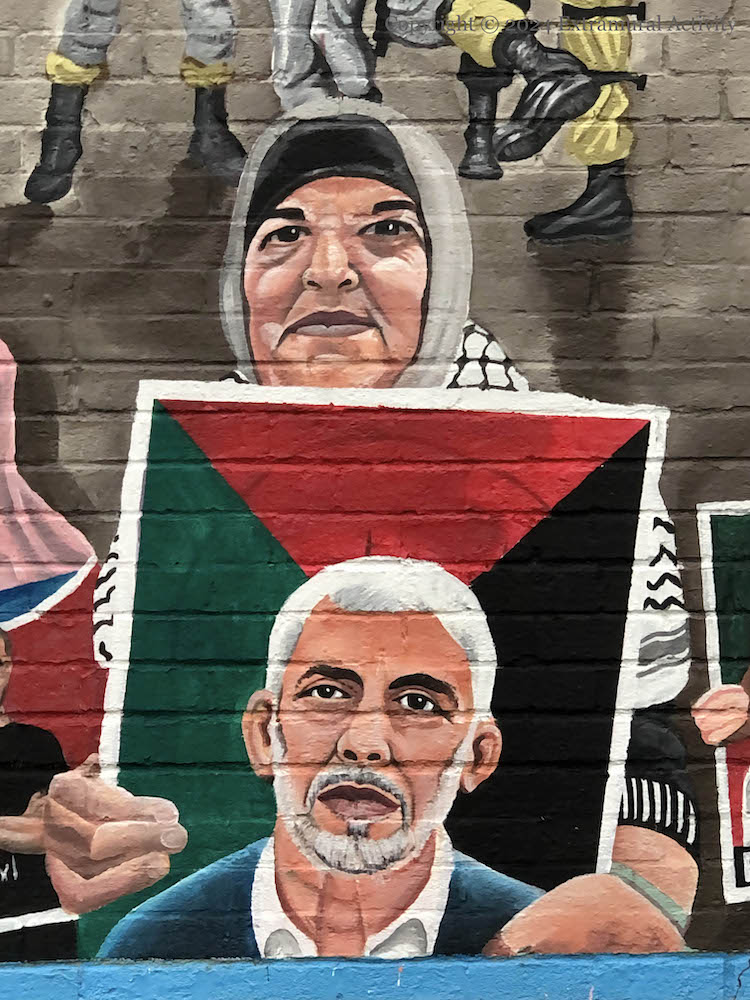
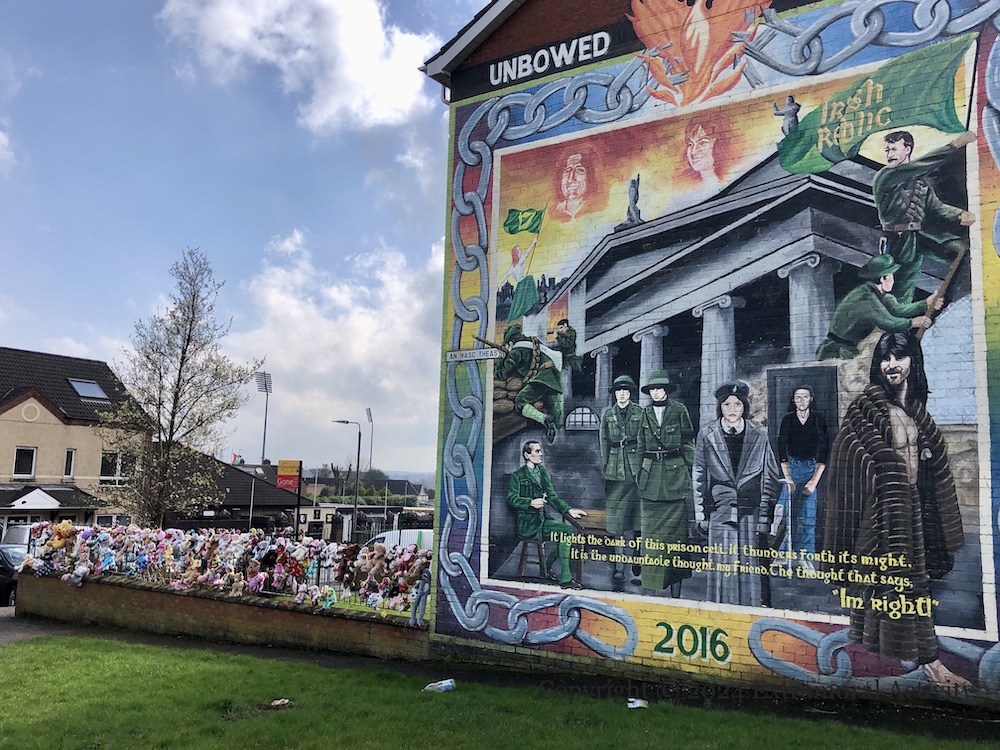
The 1916 centenary mural in Andersonstown has been repurposed and repainted to express solidarity with the people of Palestine.
From the frame of the previous mural – see The Undauntable Thought – the title, phoenix, and chains have been preserved but two instances of the inverted red triangle have been added at the top and bottom – see Resist! (and My Kite You Made).
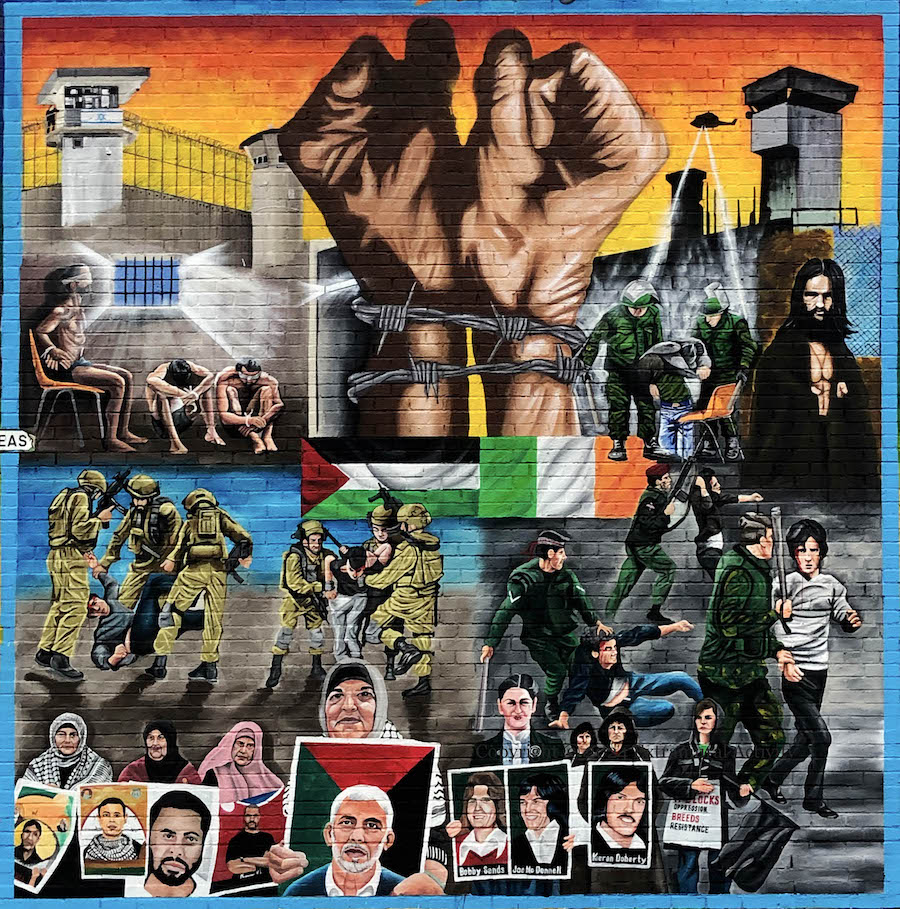
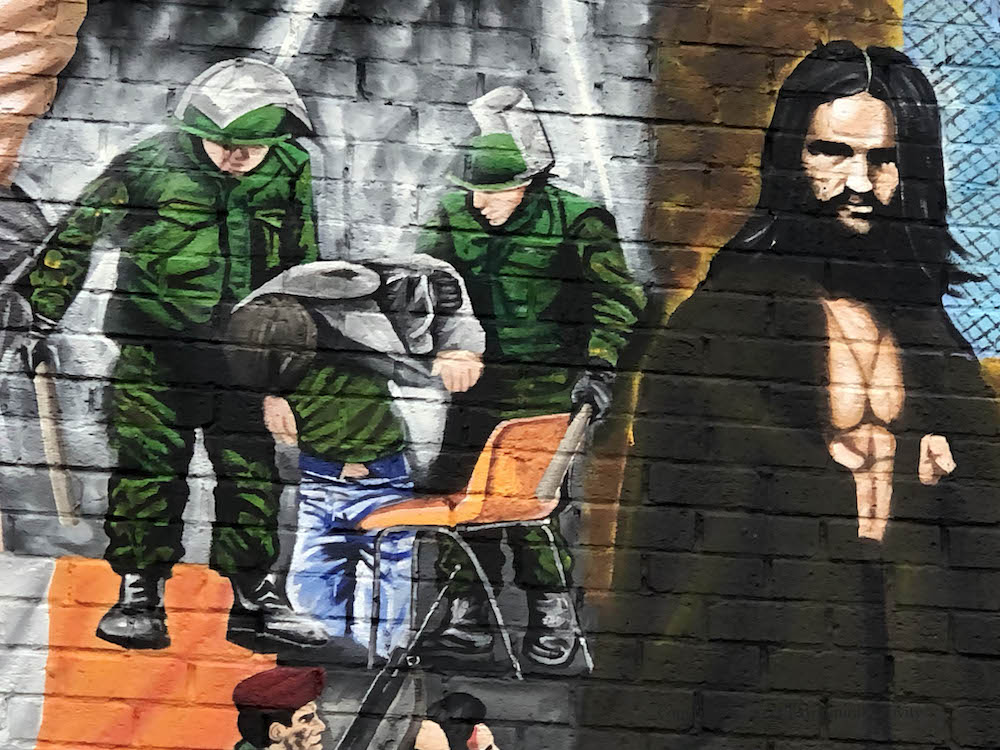
The main panel puts the struggles in Palestine and Northern Ireland in parallel, showing (from top to bottom on each side) political prisoners, violence against protesters, and relatives carrying portraits.
On the left, Palestinian prisoners languish in Israeli jails (based on a photo of Hamza Abu Halima and on this Reuters photograph of prisoners sitting in the street, both from December 2023) and IDF soldiers make violent arrests – the one on the left is from 2016 (CCUN) and the one on the right is perhaps based on this Reuters photograph.
On the right: British soldiers restore order after the Burning Of Long Kesh (see Operation Pagoda), next to blanket-man Hugh Rooney, above three arrests made by British Army soldiers – their caps indicates that they are from the Argyll & Sutherland Highlanders (left) and the Paratroop regiment (centre). (For two of the original photos, see BBC | Getty.)
Along the bottom of both sides, marchers hold portraits of the dead, including the recently-killed leader of Hamas Yahya Sinwar (BBC).
In 2000, during the Second Intifada, Palestinian teenager Faris Odeh was photographed by an AP photographer in the act of throwing a stone at an Israeli tank. He was shot and killed a few days later and the image became a symbol of resistance. (A mural of the photograph was painted in Springhill: see David And Goliath.) The iconic image is updated here for Israel’s current invasion of Gaza, showing a young girl with a soft toy standing in front of a tank that is bedecked with the flags of the European Union, France, the USA, the UK, and Germany.
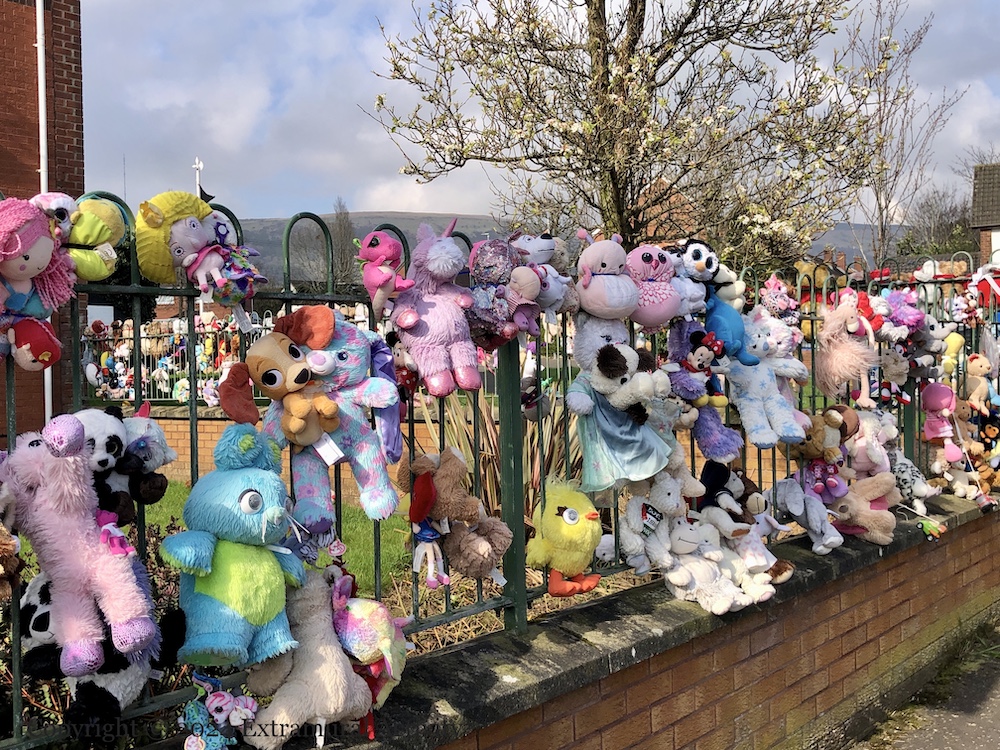
The F-16 jets and rubble and child with teddy-bear are the same as in the We Stand With Palestine mural in Ardoyne.
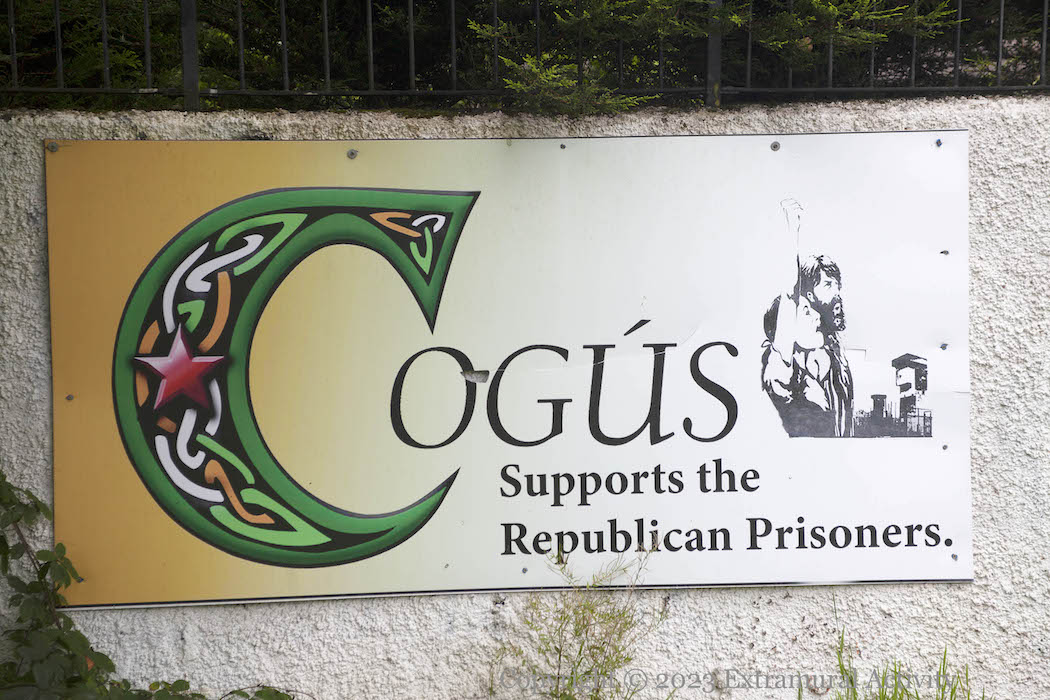
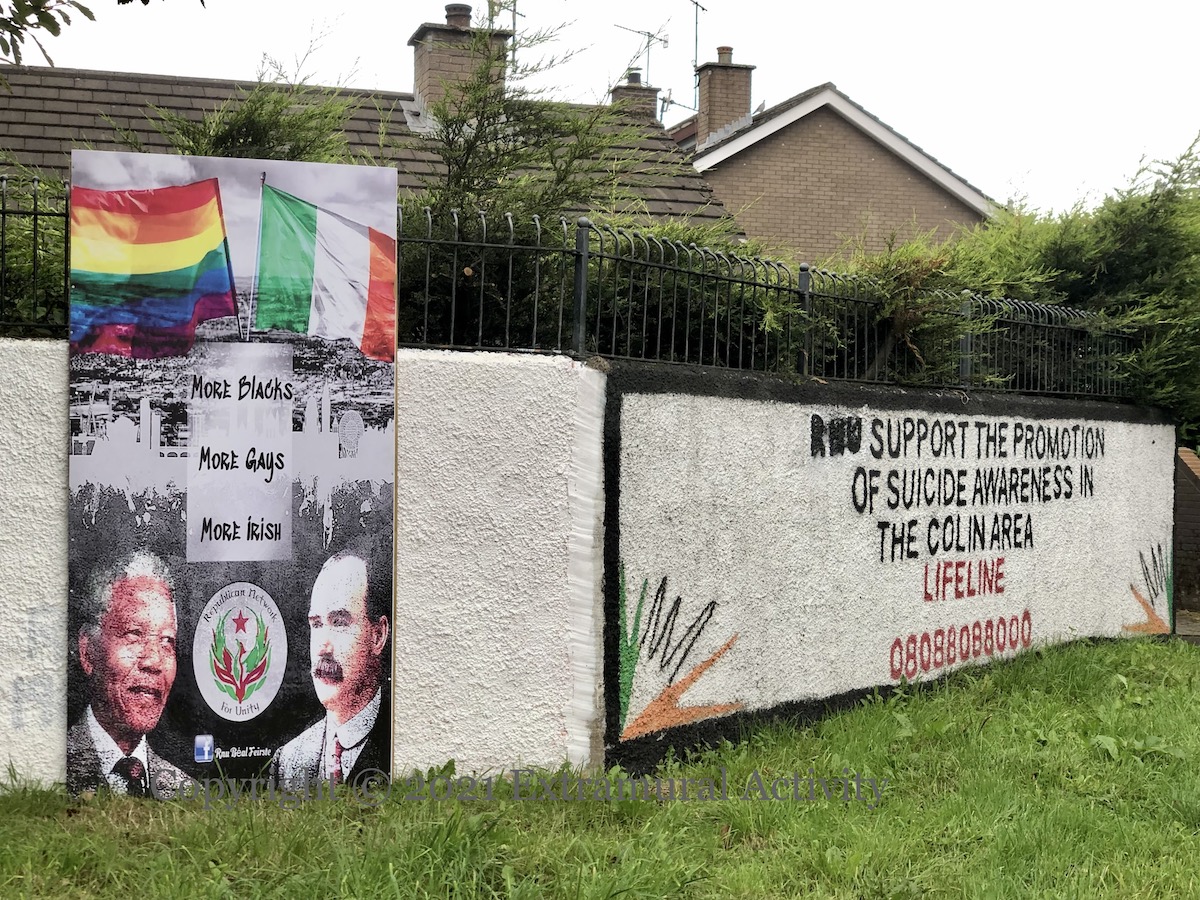
“Cogús supports the republican prisoners”. Cogús (Fb) is (was?) the prisoners’ welfare arm of the RNU. The board above — using a vintage illustration going back to 1981’s I’ll Wear No Convict’s Uniform — replaced More Blacks, More Gays, More Irish on Pantridge Road, Dunmurry, joining the “Join RNU” and mental health boards shown below.
The “Craigavon 2” are Brendan McConville and John-Paul Wootton; they were convicted of the 2009 murder of PSNI constable Stephen Carroll. The “set up by MI5” and/or “appeals sabotaged” on the RNU board shown above is a reference to the claim that MI5 agent Dennis McFadden had infiltrated the campaign for justice for Brendan McConville (Irish News). Also at this site are graffiti about Noah Donohoe and an anti-drug-dealer board from Saoradh.
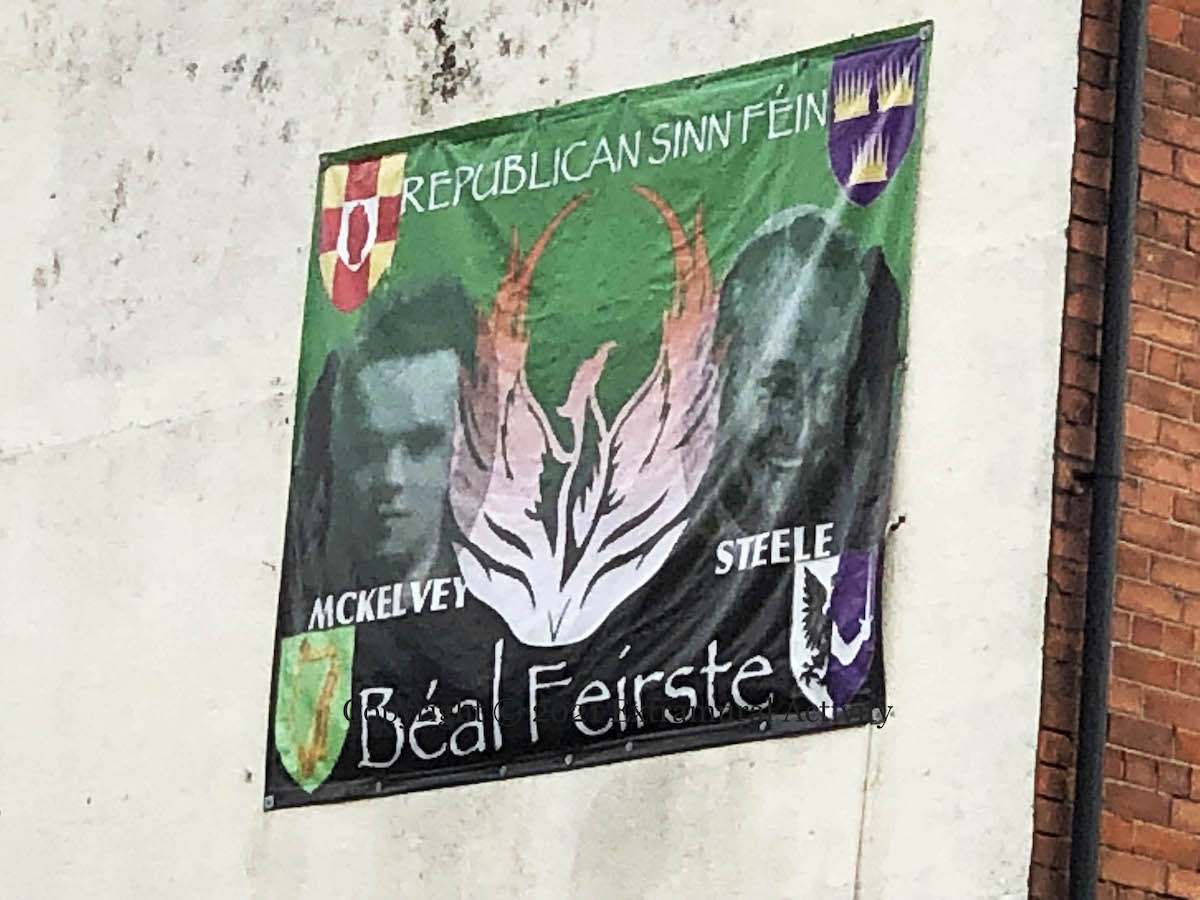
This tarp, above the office of Sınn Féın Poblachtach and the Happy House on the Falls Road, celebrates two previous generations of IRA leadership. Joe McKelvey was commander of the Belfast Brigade of the IRA in the War Of Independence but against the Treaty; he was executed in December, 1922, for occupying the Four Courts in June (WP). Jimmy Steele was a leader in the Belfast IRA from the 1920s to 1960s and the first editor of Republican News; he died shortly after the split (WP).
The old shop-window sign of the Irish experience in England “No blacks, no Irish, [no dogs]” is repurposed and reclaimed positively by the RNU in the Colin area, with the rainbow flag, Irish tricolour, and Nelson Mandela (alongside James Connolly) below the skyline of Belfast. For the original, see previously Oppose Racism | No Dogs, No POWs
Earl Street and Sussex Street used to be sandwiched between wings of the largest tobacco factory in the world, Gallahers, which took up seven acres between York Street and North Queen Street. The factory was partially demolished in 1990 and became Yorkgate shopping centre and the two streets are roughly now the back and front entrances to the Tesco supermarket. These two plaques (both on North Queen Street) are to former residents. William Campbell, a H&W joiner, might have witnessed the construction of Gallahers (in 1897 – Look Again) before dying on Titanic in 1914. Francis Liggett, an IRA volunteer, was shot and killed by British forces during an attempted robbery of the Royal. (He is also remembered in a mural in St James’s near the site of his death and home – see Liggett & Brady.)
Although originally from Clonard in west Belfast, at the time he was shot by the SAS in Gibraltar (along with Maıréad Farrell and Sean Savage) IRA volunteer Dan McCann was living in the New Lodge, site of this recently-added plaque in his memory. (He was previously included in a 3rd battalion Belfast Brigade mural on New Lodge Road.)
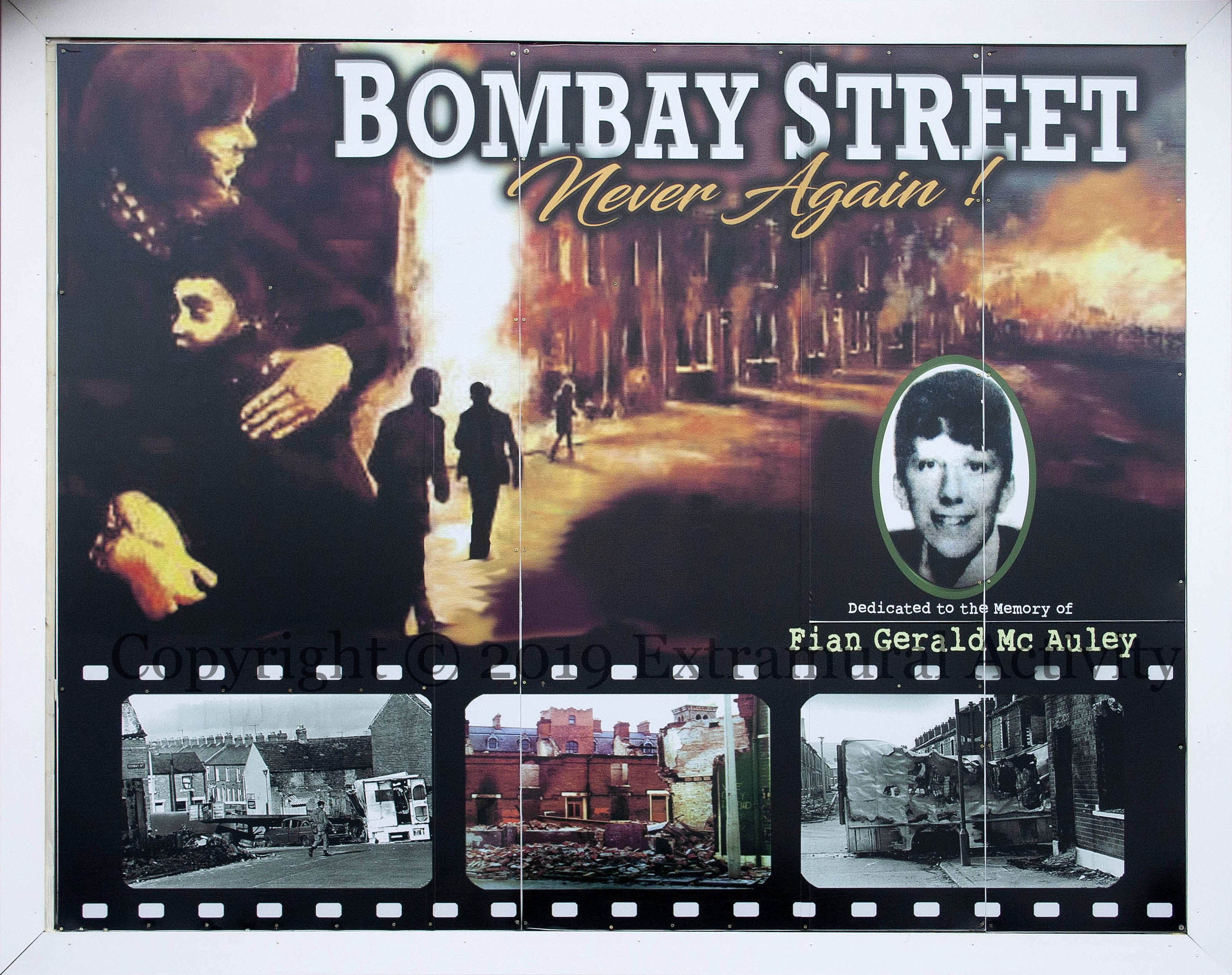
15 year-old Fıan Gerald McAuley was the first member of the IRA to die in the Troubles. He was shot in Waterville Street by a loyalist sniper while helping people move from burned-out homes in Bombay Street, along which the “peace” line separating the Falls and Shankill now runs, overlooking the Clonard Memorial Garden, site of the service for the 50th anniversary of McAuley’s death. In the windows of a nearby house we also see a poster in support of Palestine and a Bobby Sands-Che Guevara hurl.










 Extramural Activity