Derry is well-known as “doire”, an oak grove, and the oak leaf and acorn are used as symbols by many civic and county organisations. Friz’s (ig) piece for Derry Féile combines Derry’s oaky background with the dryads (tree spirits) of Greek mythology.
This is Shane O’Driscoll’s (ig) abstract take on the distinctively Antrim-coast foods dulse (a seaweed) and yellowman (a honeycomb confection) on Castle Street, Ballycastle.
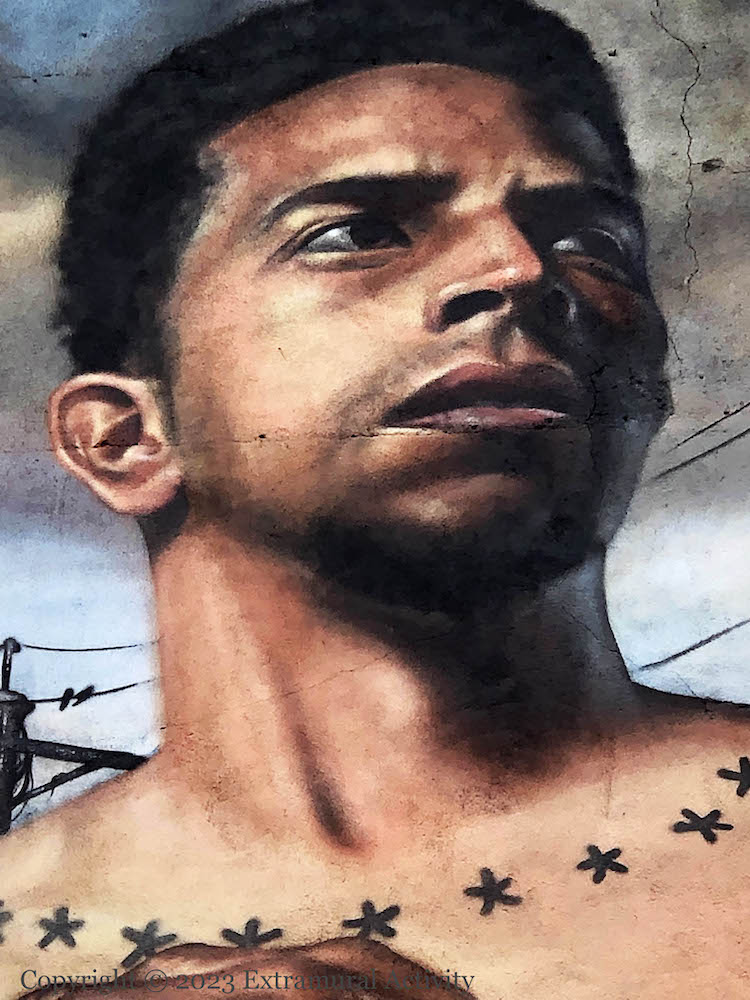
Ireland’s most famous export is not its music – including Fontaines D.C. (web) – or its stout – including Guinness – but its people, about 10 million of them since 1800 (WP). The youngster in this new mural by Dublin artist ACHES (ig) is torn in different directions.
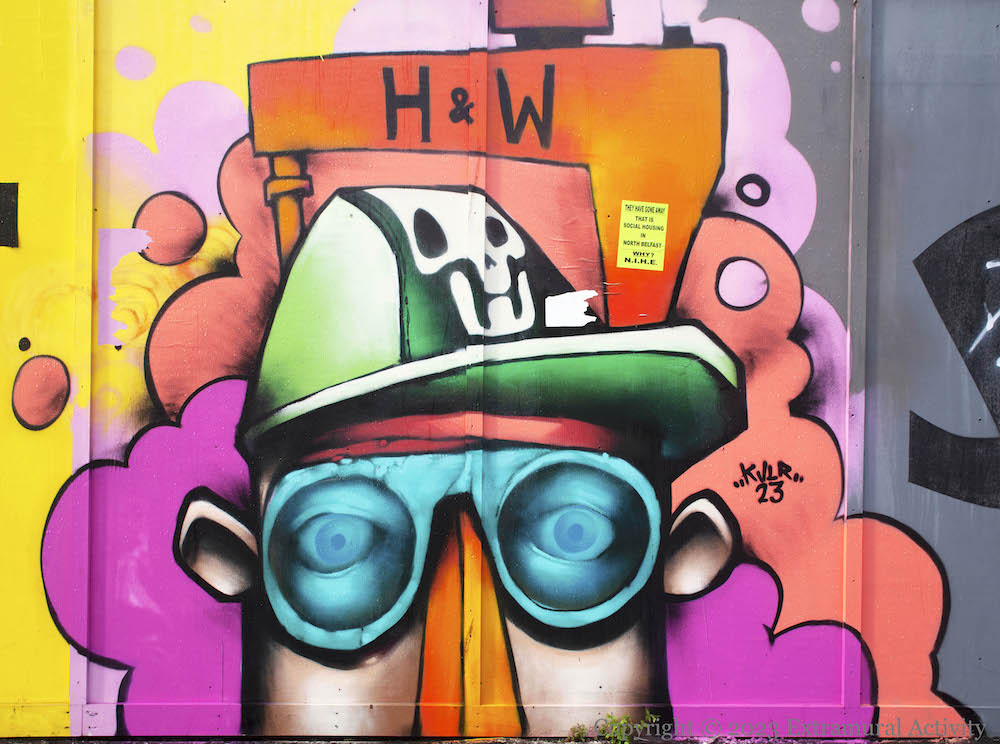
How’s about ye?! FGB (ig), Leo Boyd (ig), and KVLR (ig) added three pieces at the end of April to what is now the “Belfast Stories” construction hoarding. FGB’s piece, shown above, was inspired by the fact that the northern branch of North Street was called “Goose Lane” (tw) at the time of (Chichester’s) Belfast Castle, as herders headed through the north gate (see the map at Lennon Wylie). There is a “Goose Lane” plaque on just the other side of Royal Avenue; it is included below.
“One of the earliest streets in the city, North Street was known as Goose Lane, along which geese were driven to feed on the fields outside the town. That 17th century street consisted of single-storey houses and the old city wall bisected it at what is now Royal Avenue – Belfast City Council.”
“Wherever life plants you, bloom with grace.” When the Shankill Women’s Centre was first formed, in 1987, it was located in The Hummingbird on the lower Shankill (SWC). (When the Wellbeing Centre was built on that site, the Women’s Centre moved further up the Shankill to its current location in the Hammer.) A hummingbird features in one of the paintings on the hoarding around the construction site of a new “Shankill Shared Women’s Centre” on Lanark Way, a 6.5 million euro project funded by PEACE IV (Belfast CC).
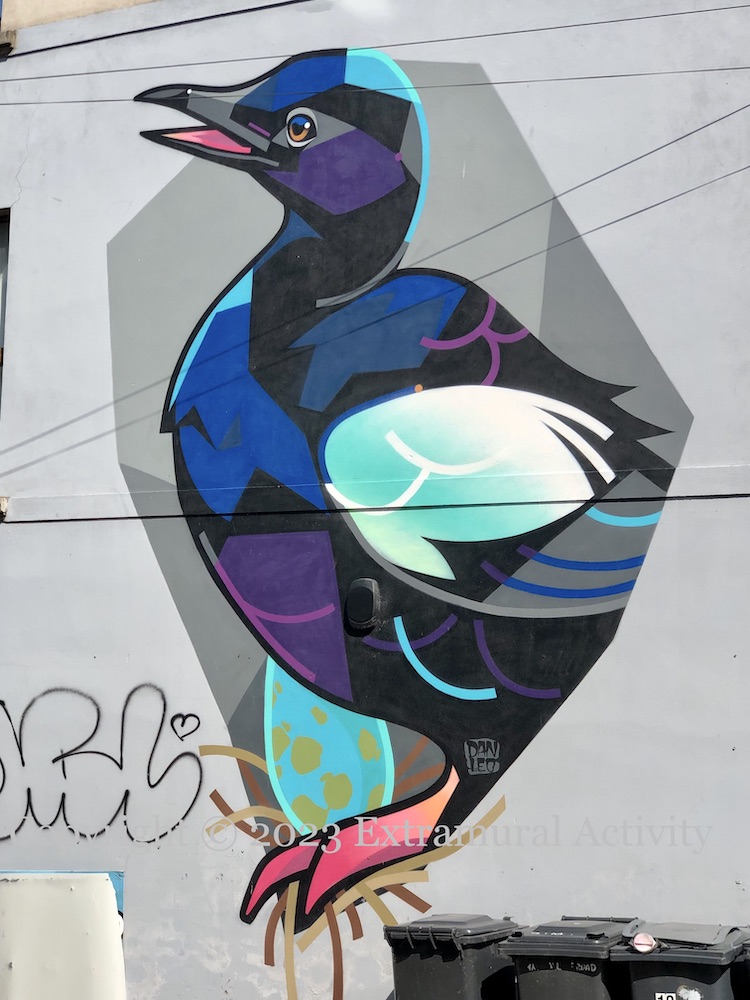
The guillemot is distinctive for its red “gape” (inside of mouth). It spends most of its time on and around water but nests on cliff ledges and other remote spaces in May (BirdWatchIreland). The pointed shape of the egg makes it less likely to fall off cliffs (British Birds). They have been nesting in Bangor since at least 1911 (Geograph). If you can’t spot any at the marina, you can check out this mural by Dan Leo (ig) in nearby Victoria Road.
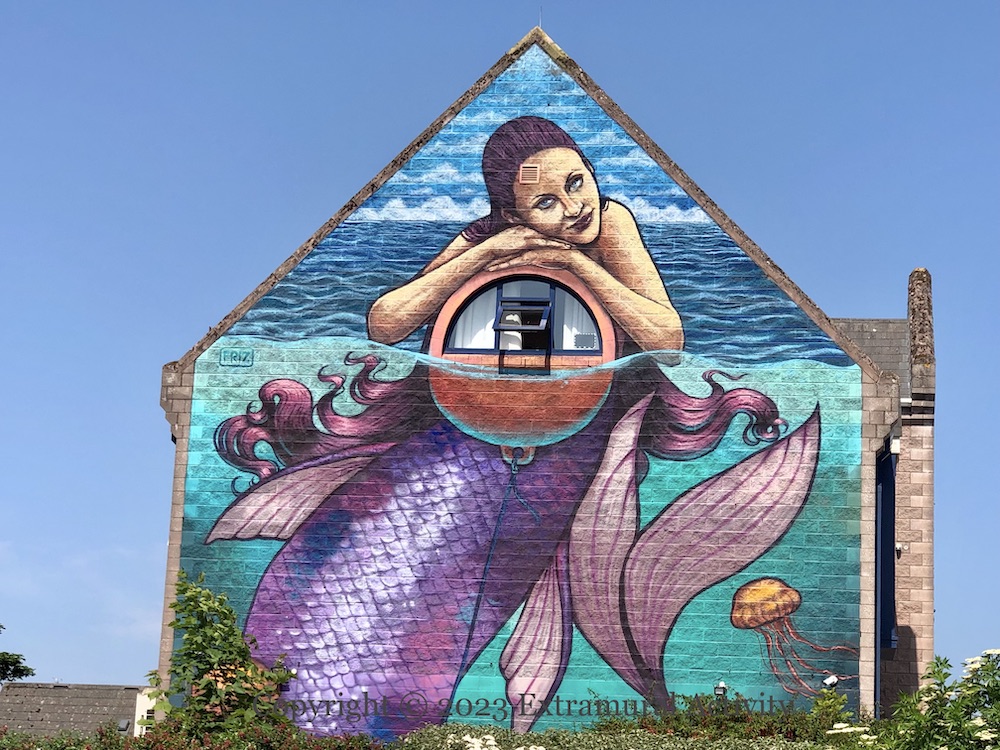
Lí Ban became a mermaid – half-human, half-salmon – after a year spent living in an underwater bower, taking shelter from the family’s uncovered spring that overnight formed Lough Neagh. Three hundred years later (circa 558 A.D.) she told an envoy of Saint Comgall’s who was on his way to Rome, that she would come ashore at Larne a year later. She forwent another 300 years of sea life in favour of being baptised and dying immediately. She was baptised by Comgall, the abbot of Bangor, and christened “Muirgen” (sea-born) and was buried in the Lough Derg (Donegal) abbey (O’Grady | WP). Muirgen’s feast-day is January 27th (Sacred Sisters).
Painted by Friz (ig) for the Bangor Seaside Revival Festival, with support from Seedhead Arts (ig).
For a different style of presentation of Lí Ban, see Shaped By Sea And Stone in Larne. The end of the story is similar to the fate of the children of Lear, who spend 900 years as swans before a monk hears their song, puts them (willingly) in chains, but in protecting them from others touches them, which restores them to human form only for (baptism and) death to follow immediately. (See The Children Of Lear.)









 Extramural Activity