Ulster’s American Connection

The United States Of America celebrates the 250th anniversary of its adoption of the Declaration Of Independence today, July 4th, 2026. In the Declaration, delegates from the thirteen (former) colonies set out their reasons for voting to overthrow British rule on July 2nd, noting twenty-seven grievances against the reigning monarch, George III of Great Britain And Ireland. At the time, the American Revolution was ongoing, and the Continental Congress meeting this time in Philadelphia was soon compelled to move to Baltimore, Maryland; the permanent Congress was not established until 1781.

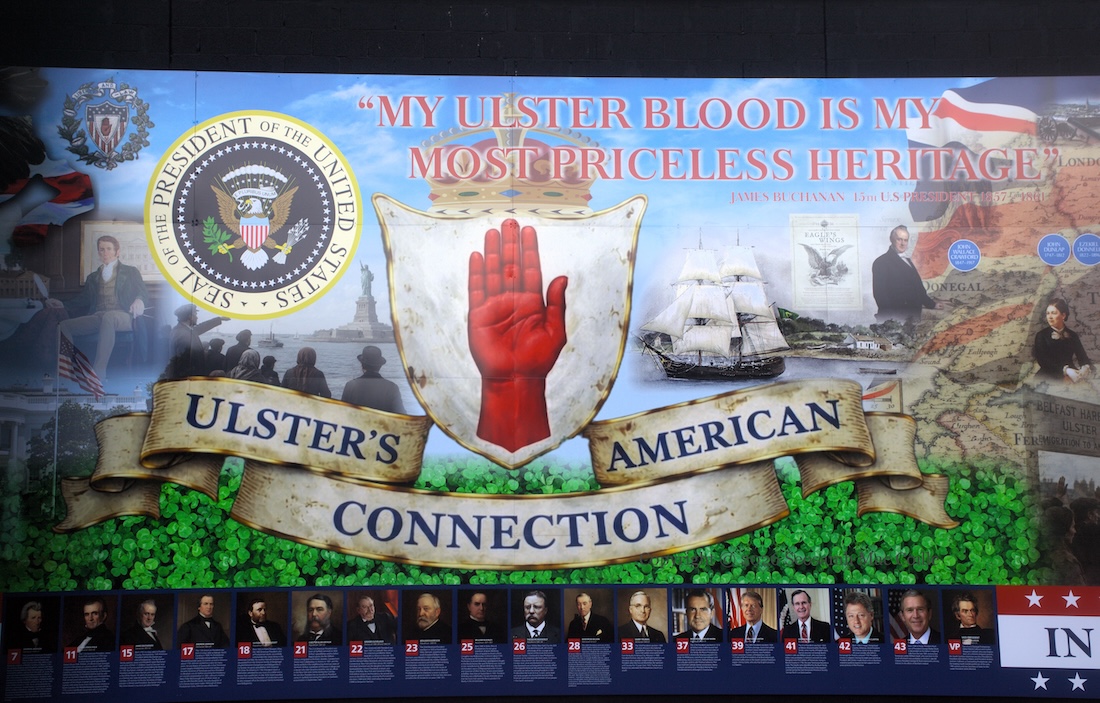
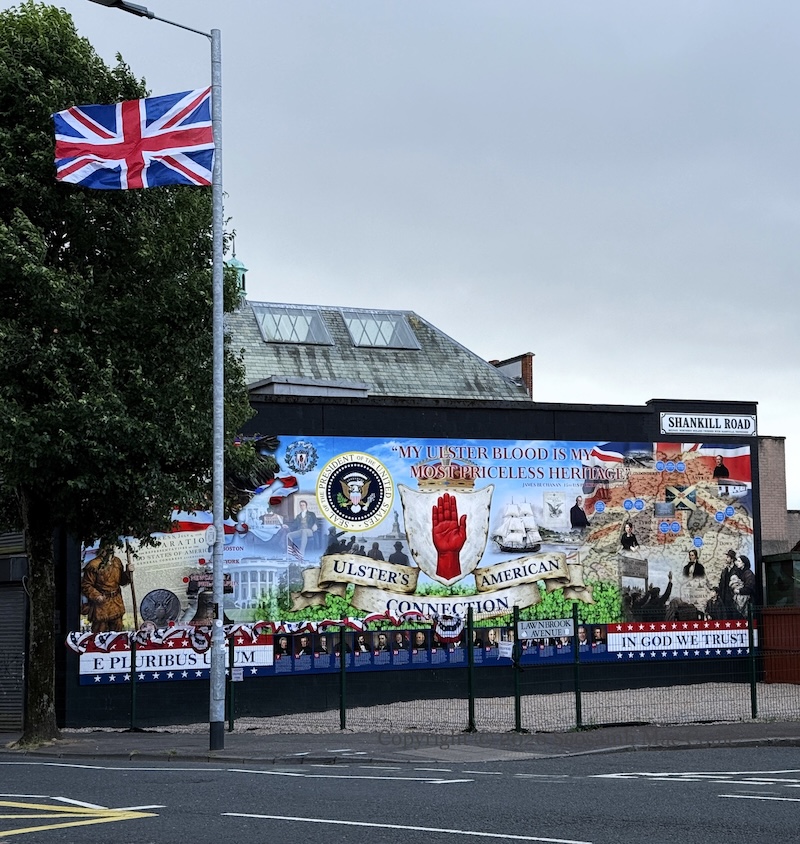
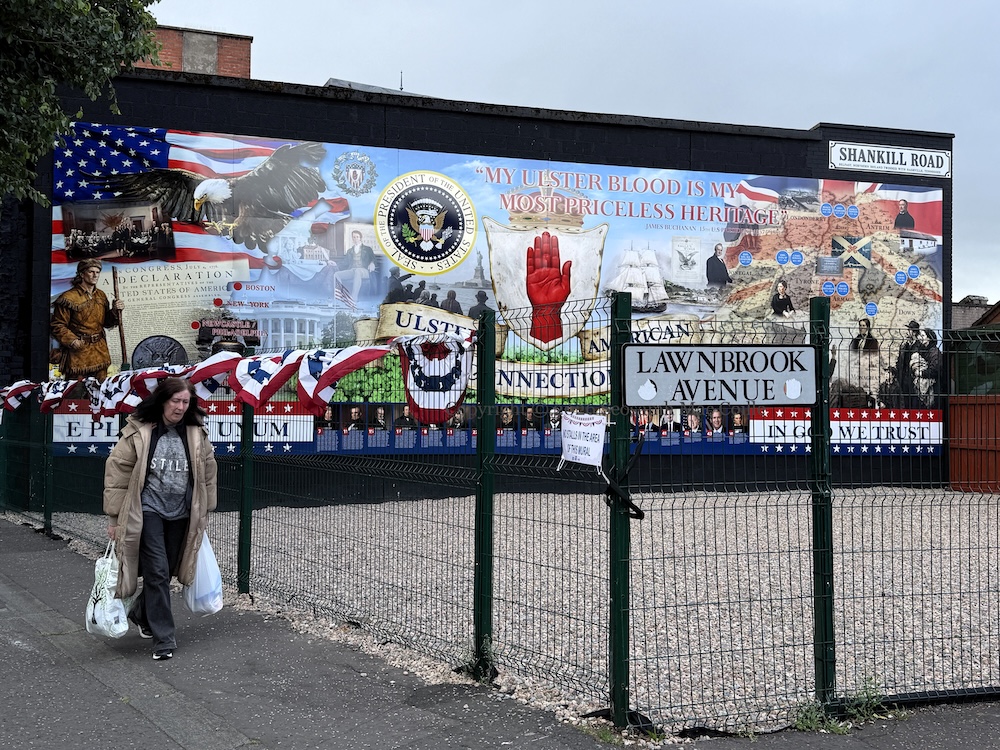
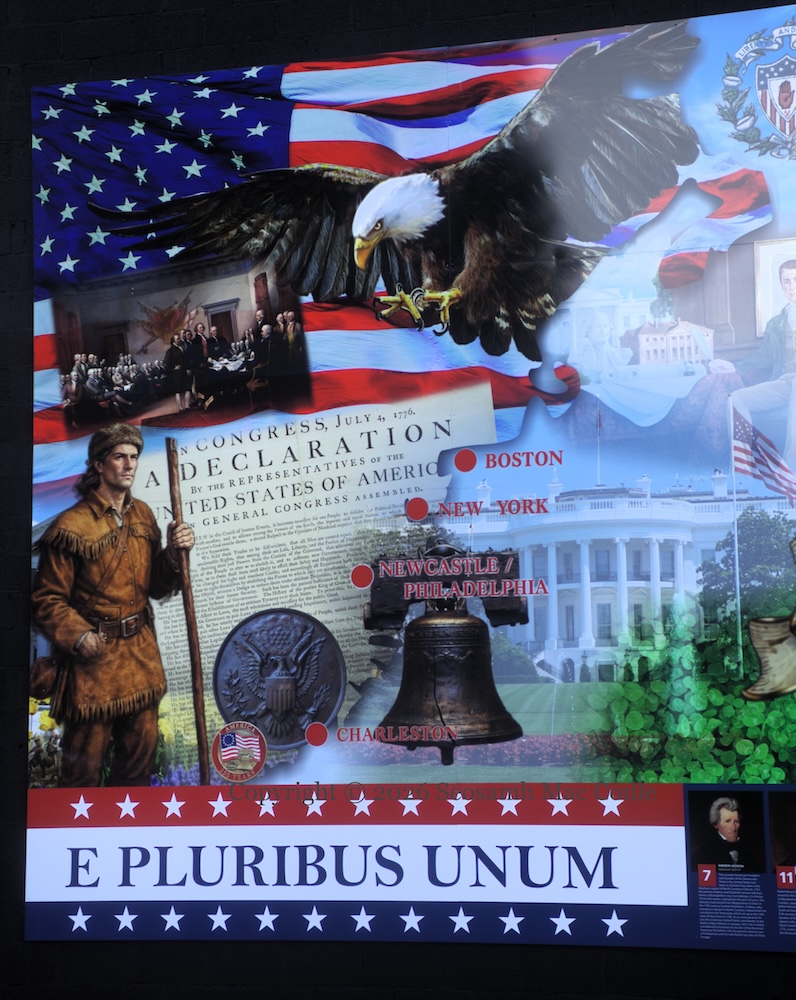
On the left of the board, various symbols of the eventual United States Of America – John Trumbull’s painting ‘Declaration Of Independence’ (image at WP) and a bald eagle upon a Stars And Stripes formed by an outline of the eastern sea-board (which for an unknown reason lists New Castle (not “Newcastle”) alongside Philadelphia), the Liberty Bell, an “America 250 years” pin, the Seal, the Declaration, and a trapper or frontiersman who represents the westward expansion of European Americans – including the Scotch-Irish (Ulster Sails West) – across the continent.

The “liberty and law” emblem, with the red hand against the stars and stripes, surrounded by a garland of thistle and shamrock, is unknown.

The seated gentleman is James Hoban, a Catholic from Co Kilkenny, who studied architecture in Dublin and (after emigrating in 1878) designed the White House – a three-storey model (later reduced to two) is on the desk behind his quill – and (in the framed picture behind him) the Charleston (South Carolina) court-house.

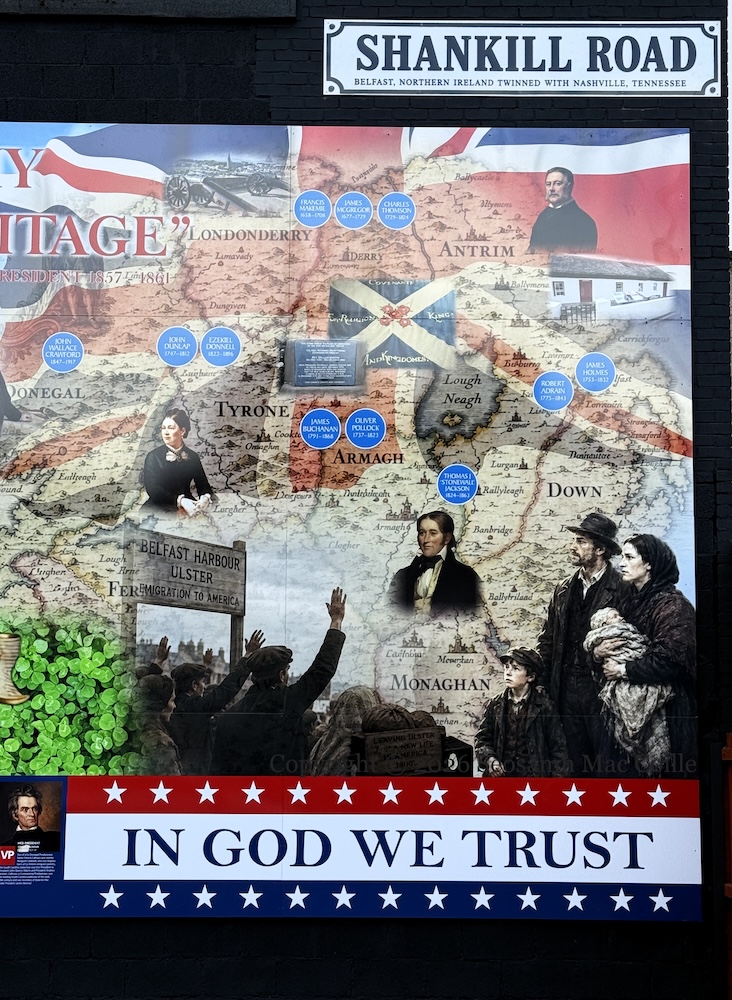
In the centre is a quote attributed to James Buchanan, “My Ulster blood is my most priceless heritage”; for confusion over the quote see James Buchanan. Buchanan is also pictured (next to the word “Donegal”). The Great Seal was designed by Charles Thomson, originally from Maghera. He was also a signatory to the Declaration.

The crown above the red hand is probably the Tudor Crown, destroyed in 1649 (WP). A bed of shamrock supports the title banner.

The Ulster-Scots lineage of seventeen presidents (plus vice-president Andrew Calhoun) is presented along the bottom between the mottos “E pluribus unum” and “In God we trust”. (The Ulster-Scots Agency has a pdf of the Presidents.)

On the right, the poster marked “Eagle’s Wings”, under the Buchanan quote, also appears to come from the Ulster-Scots Agency. It is actually about the Eagle Wing, the ship pictured to the poster’s left (as imagined by water-colour painter Dan Parsons) that undertook the first voyage of Scots-Irish to North America in 1636. The journey was not a success: the roughly 140 dissenters returned to Ireland and some went to Scotland to avoid continued persecution (Presbyterian History.)

The ‘Blue Plaques’ of various notable figures are superimposed upon a period map: John Wallace Crawford, Francis Makemie, James McGregor, Charles Thomson, John Dunlap, Ezekiel Donnell, James Buchanan, Oliver Pollock, Thomas J ‘Stonewall’ Jackson, Robert Adrain, James Holmes. The portraits are of James Buchanan, Teddy Roosevelt (above Andrew Jackson’s ancestral cottage in Carrickfergus), Davey Crockett, and an unknown female figure (comment/get in touch if you can identify her).

The gravestone is to the Rev William Martin, a Reformed Presbyterian (Covenanter) minister, who led a contingent of 1,000 people in five ships in 1772 to Charlestown, South Carolina (Reformation History | History Ireland). The flag is the flag of the Covenanters (WP).

See also the Visual History page on Ulster-Scots Murals

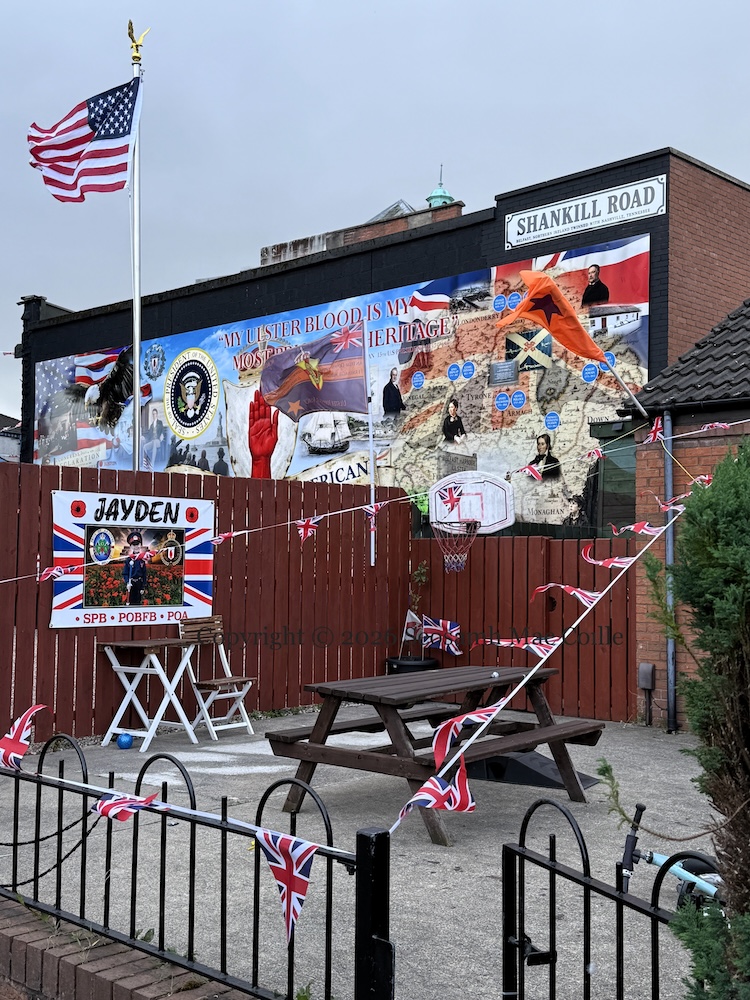
Lawnbrook Avenue, upper Shankill, west Belfast. “Shankill Road, Belfast, Northern Ireland. Twinned with Nashville, Tennessee.”

For Jayden in the adjacent yard, see Leader Of The Band.

For two other celebrations of USA 250, see the Visual History page on Ulster-Scots Murals.
Click image to enlarge
Copyright © 2026 Seosamh Mac Coılle
X16250 X16256 X16257 X16258
X16259
X16255 X16251 [X16252] [X16253]
X16259 [X16260] X16261
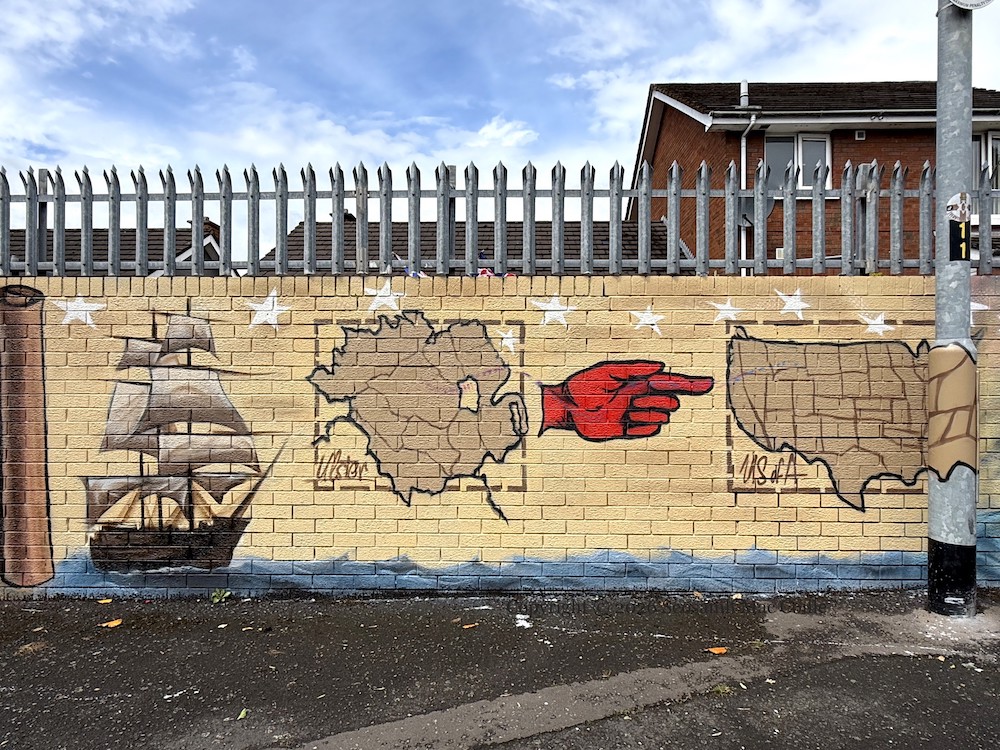
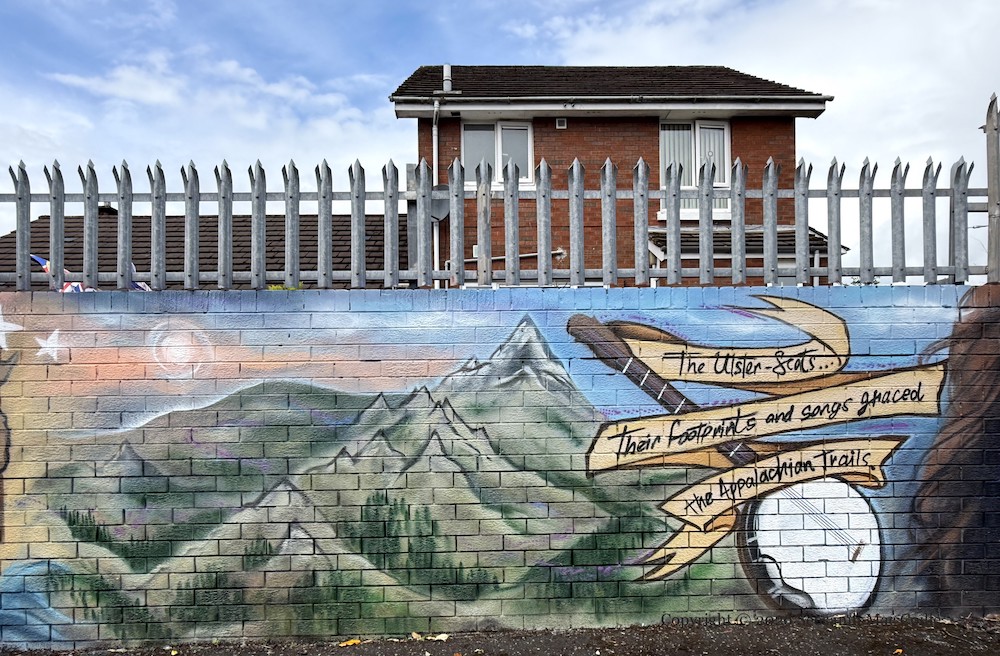
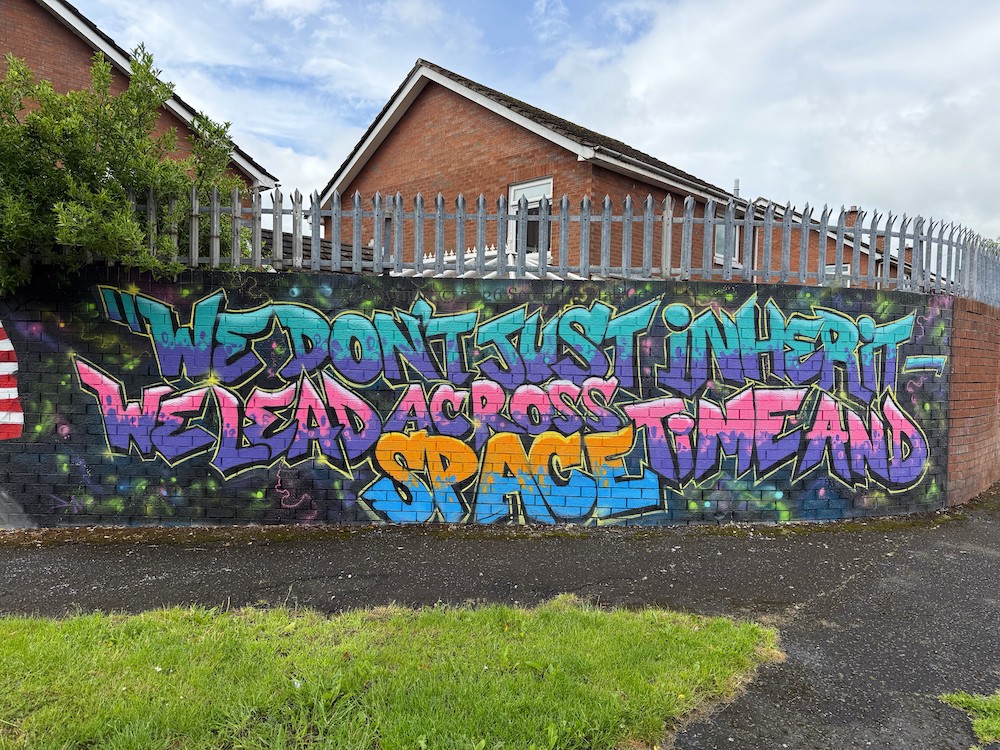
We Lead Across Time And Space

“Echoes of the Ulster-Scots across the United States Of America”, “The Ulster-Scots … their footprints and songs graced the Appalachian Trails”, “We don’t just inherit, we lead across time and space.”

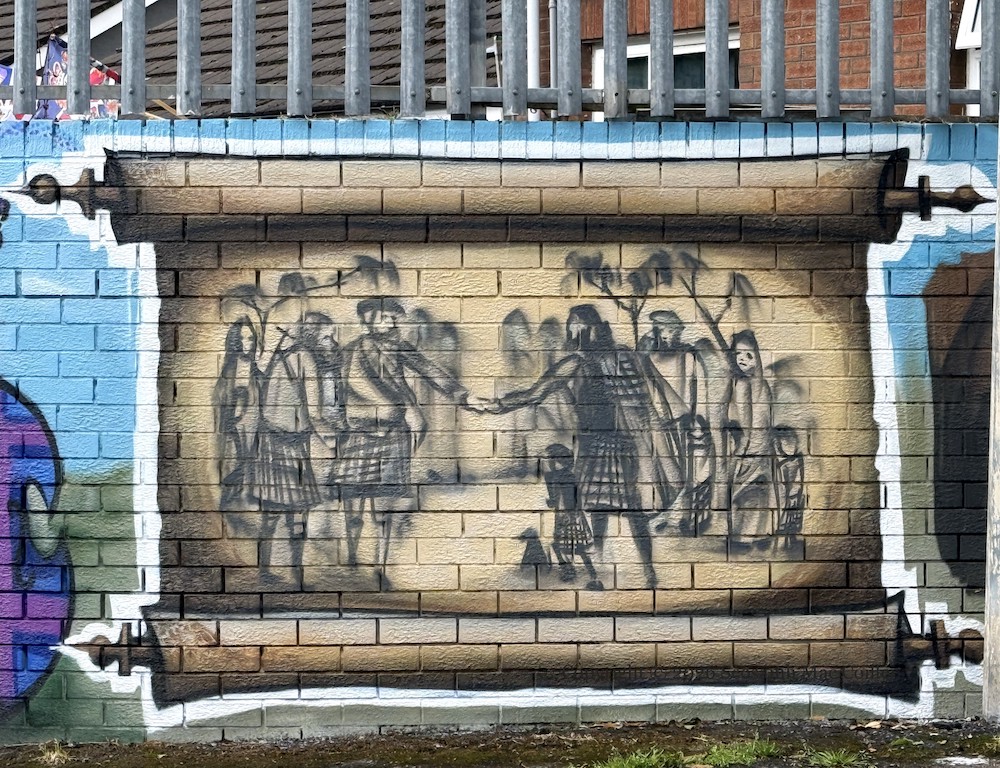
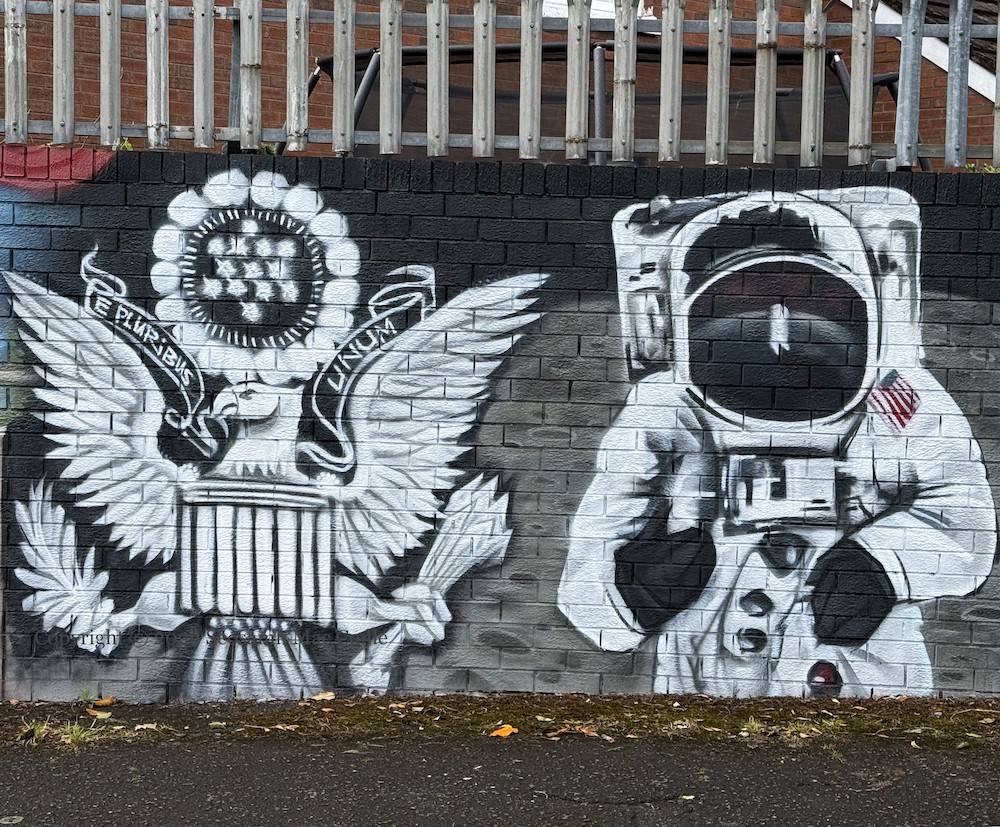
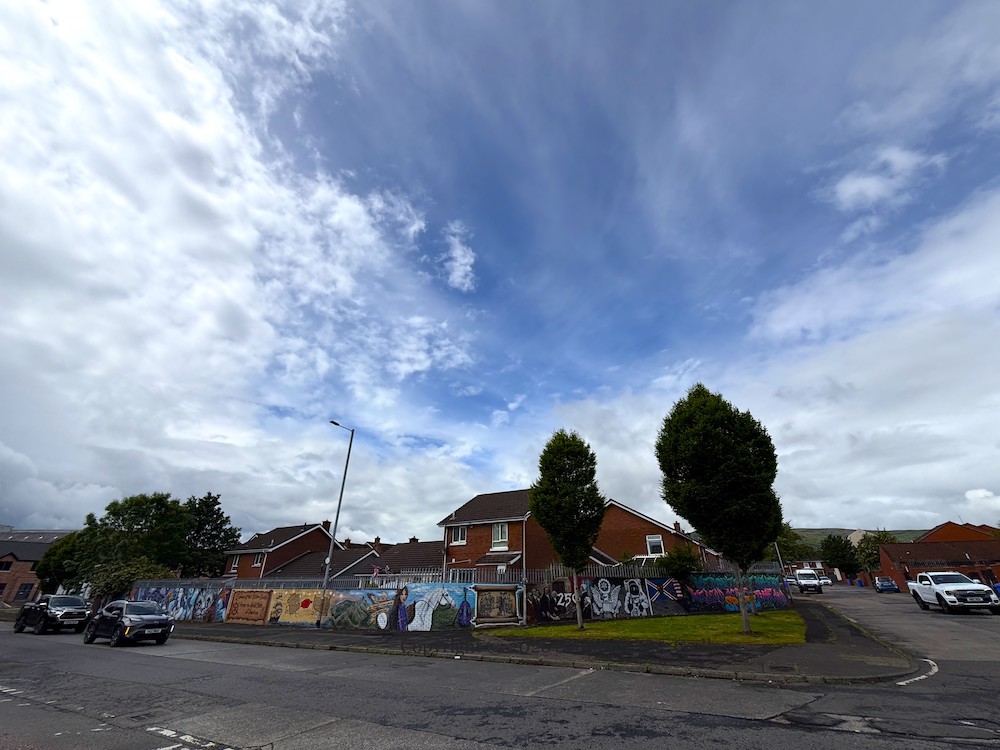
This is a new Ulster-Scots (Visual History) mural on Ulster-Scots (or, Scotch-Irish) emigration in the 1700s to the British colonies that in time became the United States, painted in North Howard Street and Fifth Street.

Upon arrival at eastern sea-ports, many of the Scotch-Irish headed west across the Allegheny mountains and down into the Appalachians. By 1790, it is estimated, 6% of the population (or almost 200,000 people) of the recently-created United States Of America were (ultimately) from (nine-county) Ulster, a combination of Scotch-Irish, Celtic-Irish, and English-Irish (American Historical Association).

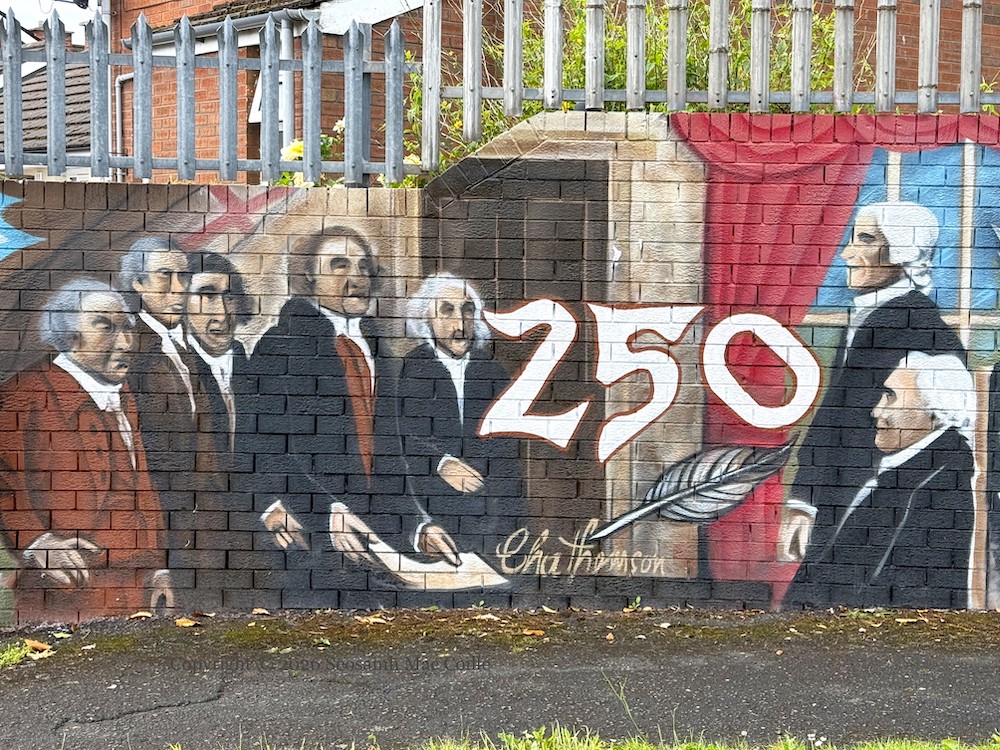
The remaining panels bring us from the founding of the United States in 1776 to the space age. The portrait is a rendition of John Trumbull’s painting ‘Declaration Of Independence’ (image at WP) along with (below the “250”) the signature of “Cha[rles] Thomson”, who was born in Maghera, served as Secretary of the Continental Congress, designed the Great Seal Of The United States (which appears next to the right), and signed the Declaration (Ulster Scots Agency pdf). The person third from the left is Robert R. Livingston, one of the Committee Of Five that prepared the Declaration; he also negotiated the Louisiana Purchase in 1803 (Discover Ulster Scots).

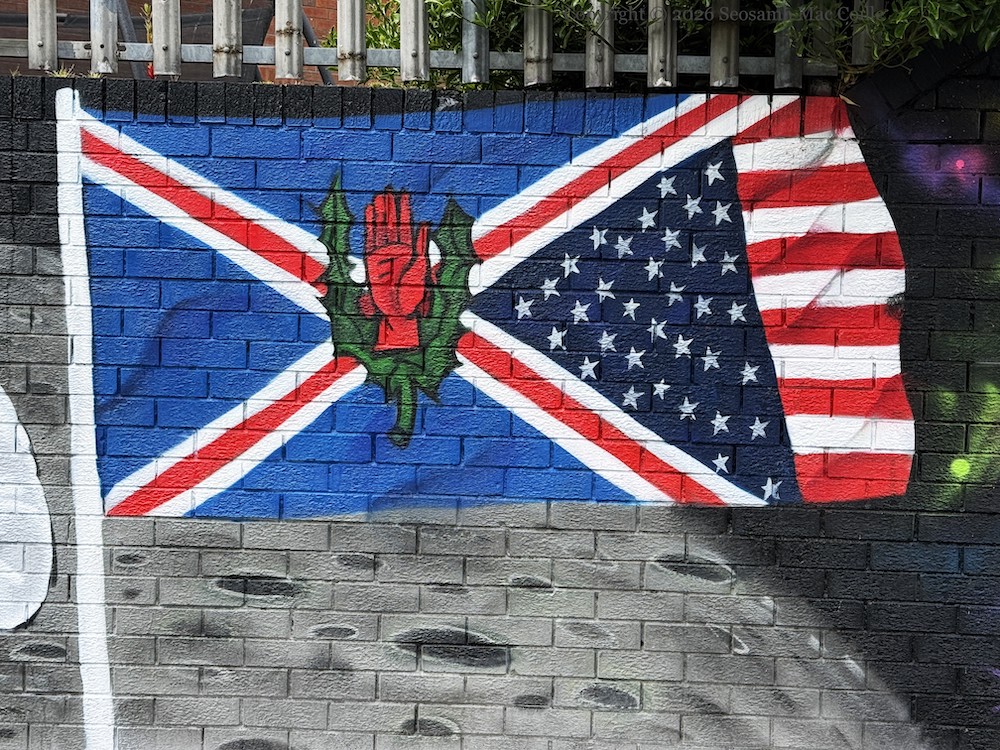
The flag is a combination of a proposed Ulster Scots flag and the Stars And Stripes of the United States.

North Howard Street/Fifth Street, west Belfast

Click image to enlarge
Copyright © 2026 Seosamh Mac Coılle
X15962 X15963 X15964 X15965 X15966 X15967 X15968
X15960 [X15961]

A Better Place

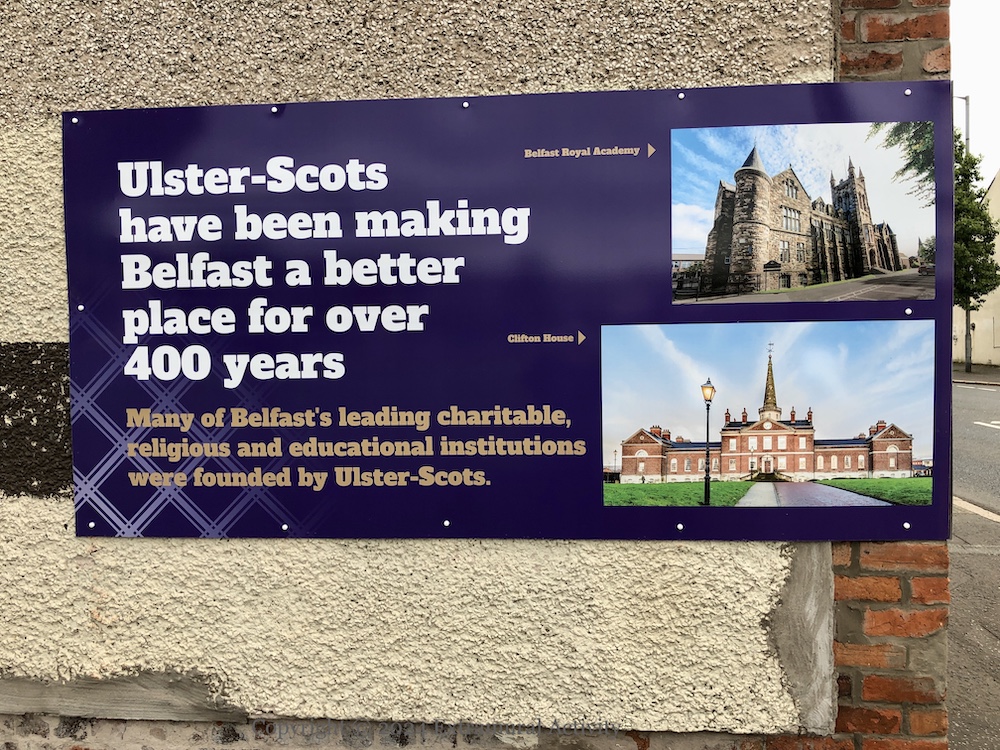
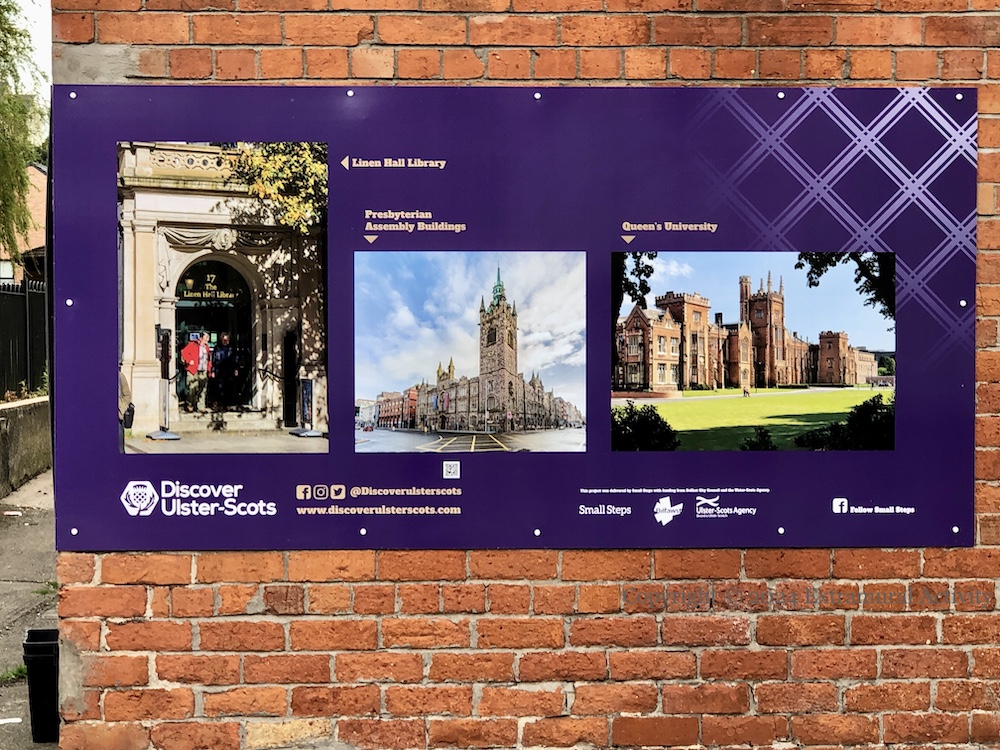
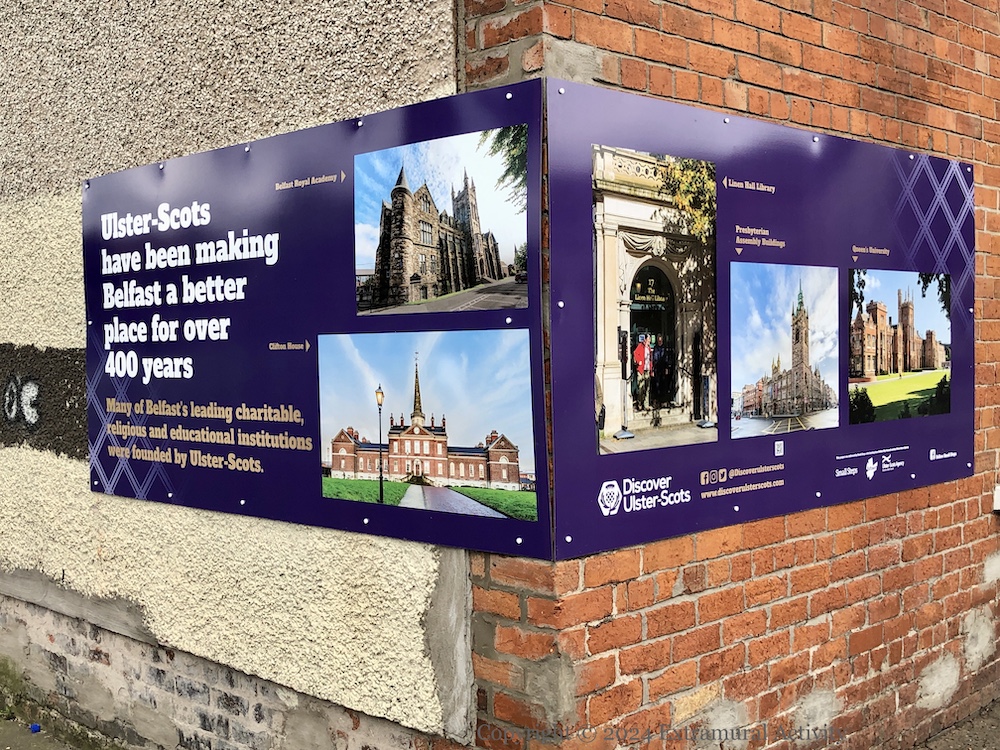
Discover Ulster-Scots (web) has added some more boards in north Belfast, joining the recent gallery of famous figures at Mountcollyer Avenue (see The Scots In Ulster).

The boards shown here are in North Queen St: “Ulster-Scots have been making Belfast a better place for over 400 years. Many of Belfast’s leading charitable, religious and educational institutions were founded by Ulster-Scots.” with images of BRA (James Crombie), Clifton House (possibly William Tennant is intended), the Linen Hall Library (a list of founders can be found on page 11 of this History), the Assembly buildings (of the Presbyterian church), and Queen’s (John Mowat).

Additional new boards, concerning soda farls and potato bread, and brown lemonade, can be seen in the Paddy Duffy Collection: The Ulster Fry.

See also: the Visual History page on Ulster-Scots murals.

Click image to enlarge
Copyright © 2024 Seosamh Mac Coılle
X15072 X15073 X15071

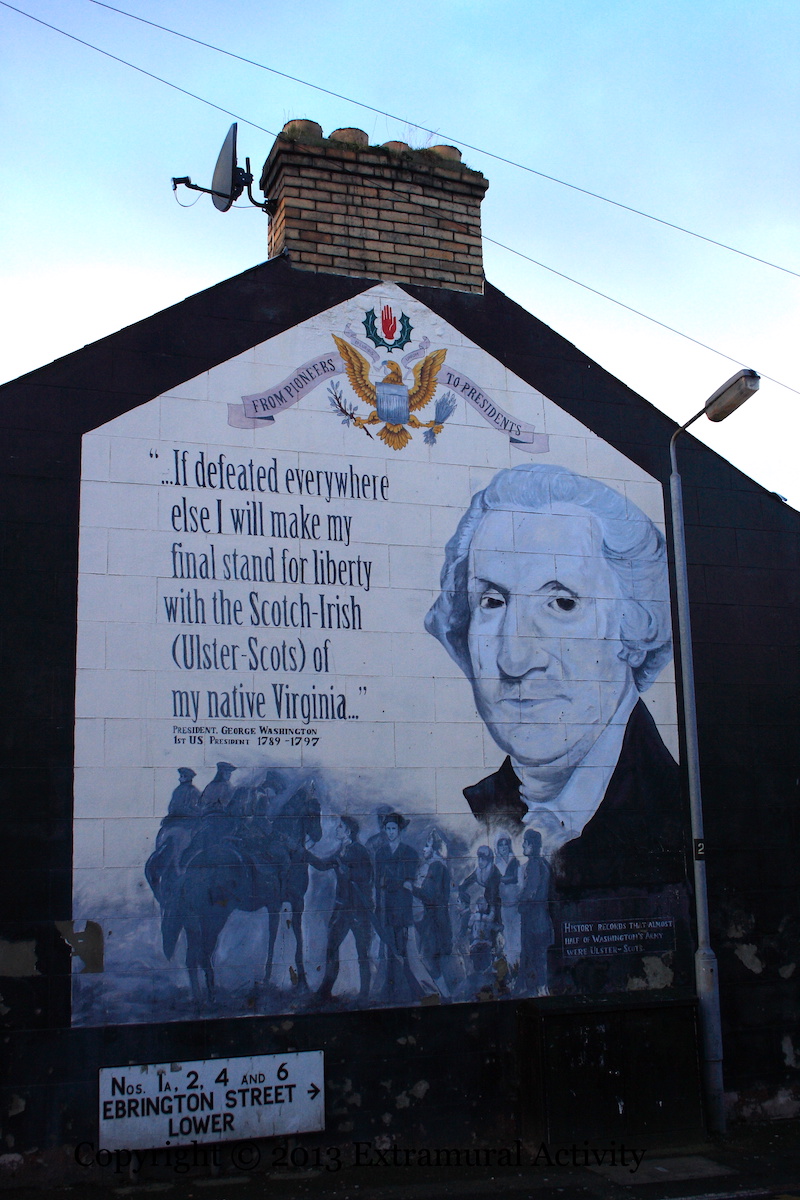
The Scotch-Irish Of My Native Virginia

“If defeated everywhere else I will make my final stand for liberty with the Scotch-Irish (Ulster-Scots) of my native Virginia.” George Washington commanded the Continental Army during the revolution and served as the first president of the United States beginning in 1789. His ancestry was English and the quote is undocumented, the closest being this statement from McKinley. The note in the corner reads “History records that almost half of Washington’s army were Ulster-Scots”; the basis for this claim might be General (Charles?) Lee’s report that “half the rebel Continental Army were from Ireland.” (See Chapter 2 of Bagenal, The American Irish and their Influence on Irish Politics.)

Click image to enlarge
Copyright © 2013 Seosamh Mac Coılle
X01548

The War Of Northern Aggression

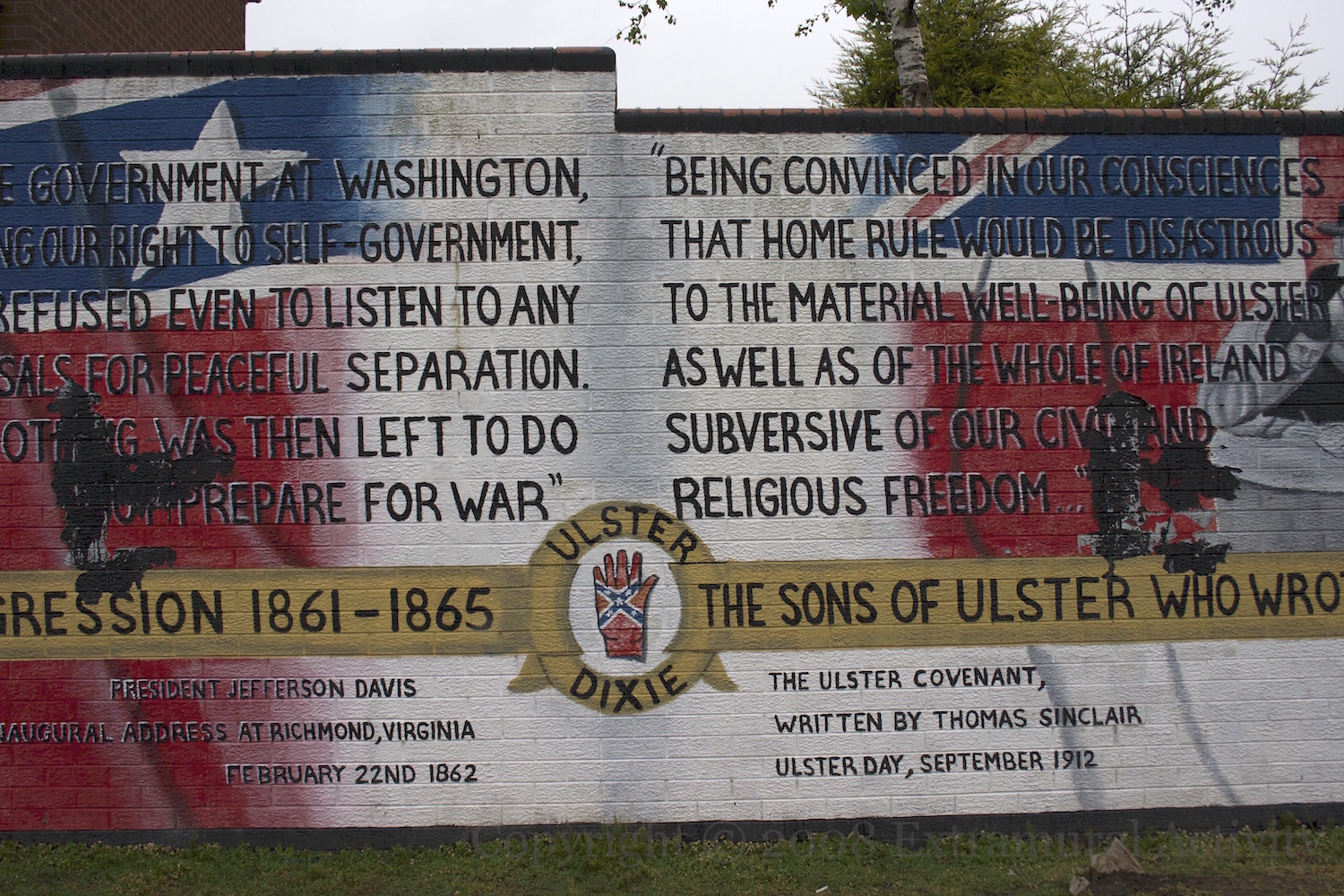
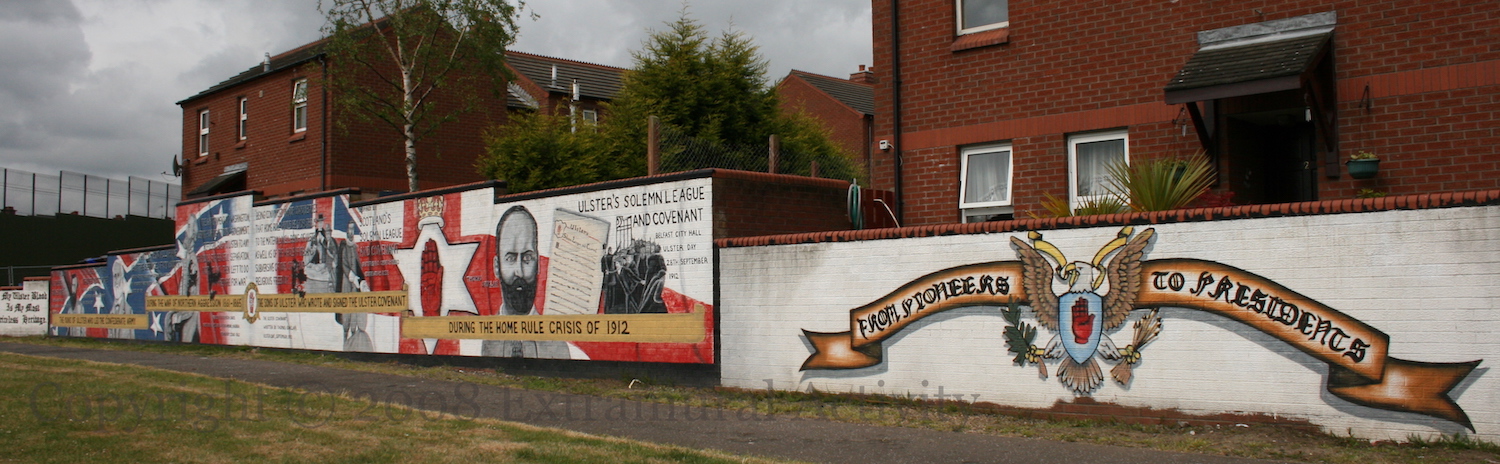
The confederate attempt to secede from the United States is here put in parallel with loyalist resistance to Home Rule. The page on Ulster-Scots Murals contains an attempt to understand the logic of this mural.

Various “sons of Ulster who led the confederate army” “during the War of Northern Aggression” [a.k.a. the Civil War] are quoted in the mural:

  • “Do your duty as I have done mine – General [James Ewell Brown] Jeb Stuart”
  • “It is history that teaches us to hope – General Robert E Lee”
  • “All that I am and all that I have is at the service of my country – General Thomas Jonathan Stonewall Jackson”
  • “The government at Washington denying our right to self-government, refused even to listen to any proposals for peaceful separation. Nothing was then left to do but prepare for war – President Jefferson Davis, inaugural address at Richmond, Virginia, February 22nd 1862”.
  • “My Ulster blood is my most priceless heritage” on the left-most panel is from James Buchanan.

The sons of Ulster who wrote and signed the Ulster Covenant during the Home Rule crisis of 1912 are described in this quote:

“Being convinced in our consciences that Home Rule would be disastrous to the material well-being of Ulster as well as the whole of Ireland, subversive of our civil and religious freedom … – The Ulster Covenant, written by Thomas Sinclair, Ulster Day, September 1912 inspired by Scotland’s Solemn League and Covenant, Greyfriar’s Churchyard, Edinburgh 1638.”

The right-most panel reads, “From pioneers to Presidents”. Murals under this theme – including two of Buchanan – were painted in 1999 (Belfast | Londonderry). This mural dates back to 2005 and perhaps earlier, part of a second wave of Ulster Scots murals that included Davy Crockett in Ballymena (2002), a gallery of famous famous faces in Newtownards (2005), and Andrew Jackson in the Shankill (c. 2007). See Visual History 08.

See also: the Confederate flag flying in Cluan Place | a confederate battle flag in Ballymacarett.

Click image to enlarge
Copyright © 2008 Seosamh Mac Coılle
X00257 X00258 X00259

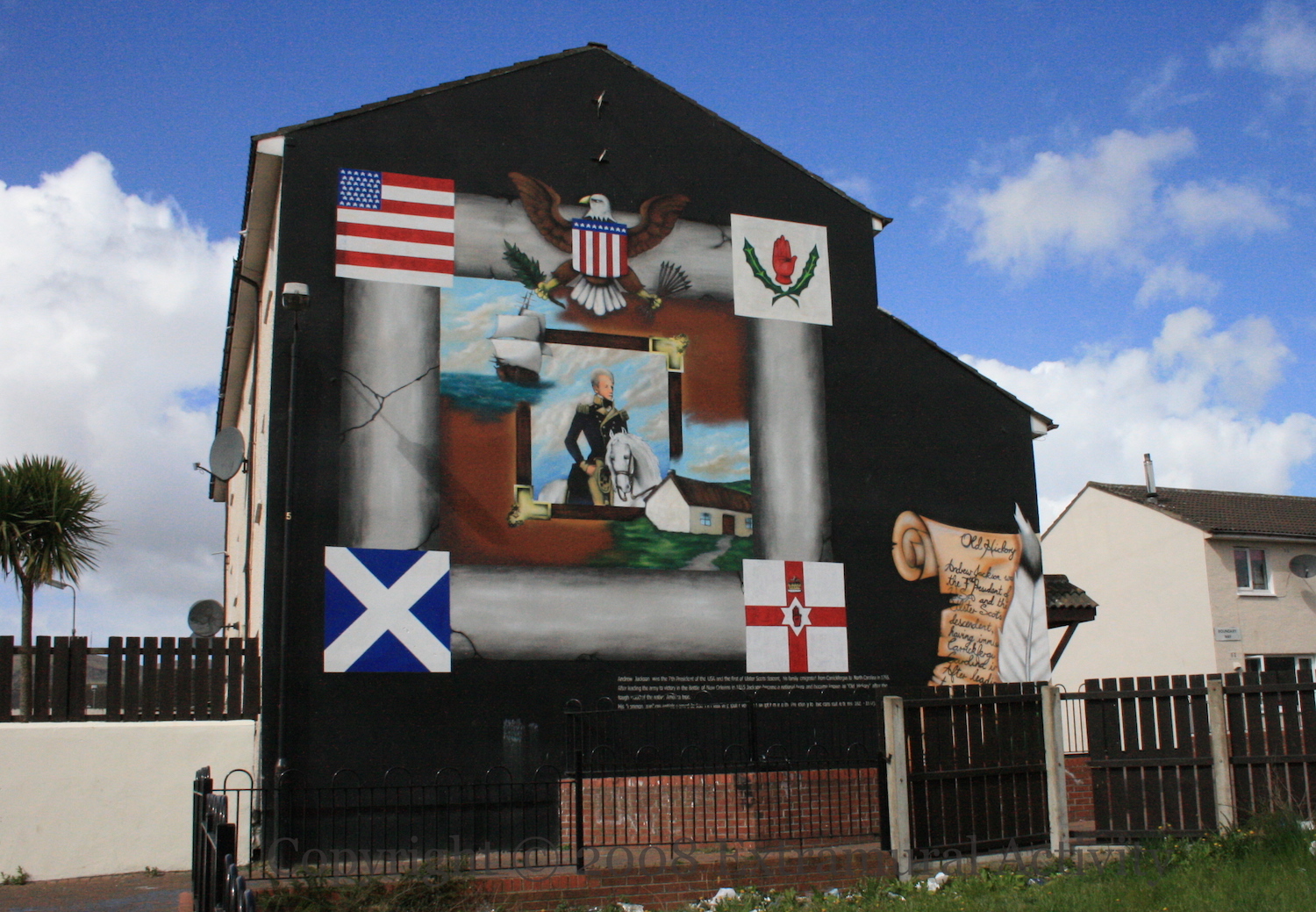
Andrew Jackson

“Andrew Jackson was the 7th President of the USA and the first of Ulster-Scots descent, his family emigrated from Carrickfergus to North Carolina in 1765. After leading the army to victory in the Battle Of New Orleans in 1815 Jackson became a national hero and became known as “Old Hickory” after the tough wood of the native American tree. His “common man” credentials earned Jackson a massive popular vote and swept him into the Presidency for two consecutive terms (1829-1837).” He also hated the British, owned slaves, and signed the Indian Removal Act of 1830, which led to the infamous “Trail of Tears” (Irish Times).

See also the Visual History page on Ulster-Scots murals.

Click image to enlarge
Copyright © 2008 Seosamh Mac Coılle
X00285