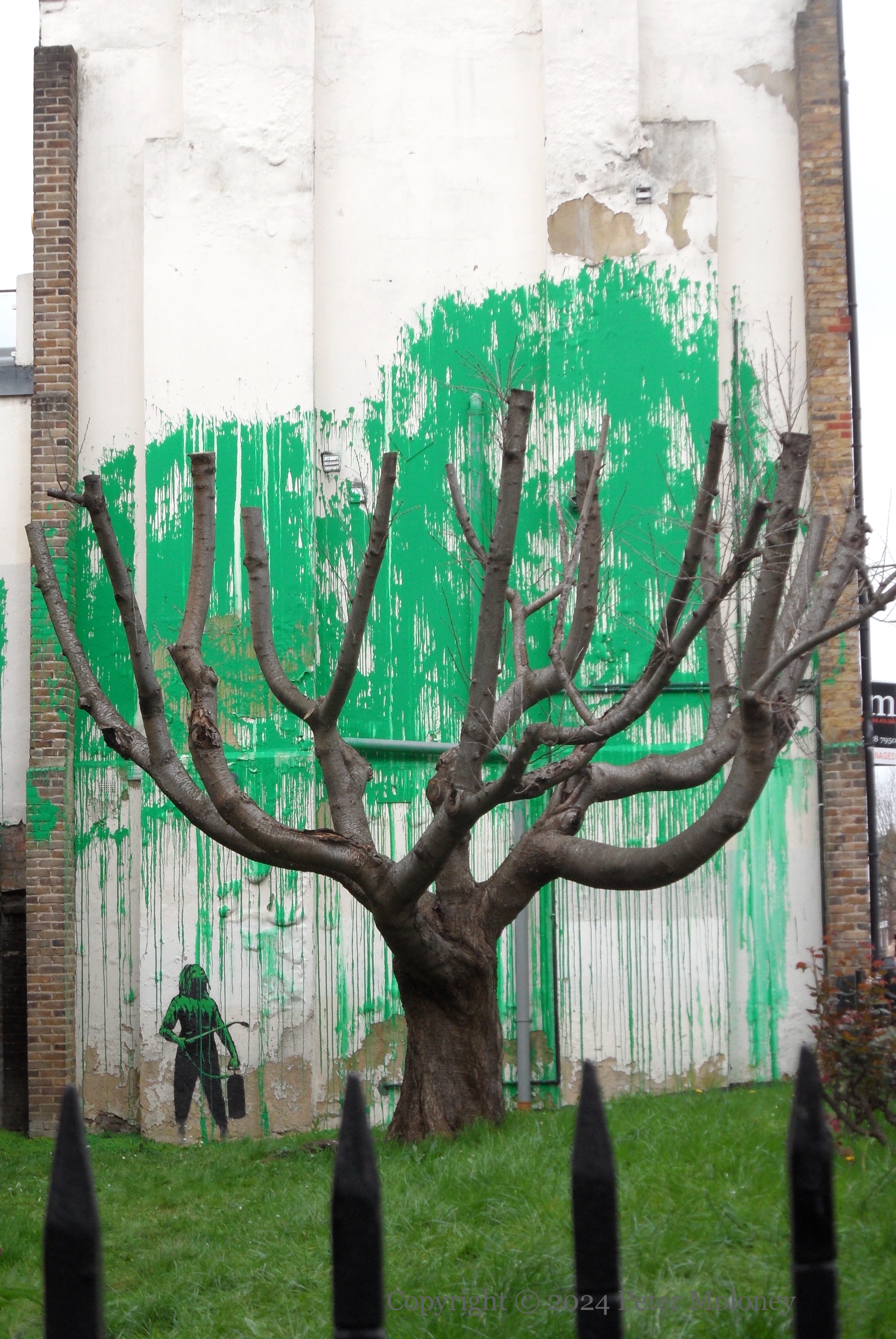
Here is a bonus post, thanks to our London correspondent, of the latest offering from Banksy, showing “foliage” added to the wall behind a pruned-back cherry tree (BBC) by a youth with a canister sprayer. The piece perhaps indicates a desire for more greenery in the area – Finsbury Park in north London; it has already been vandalised with white paint (Guardian).
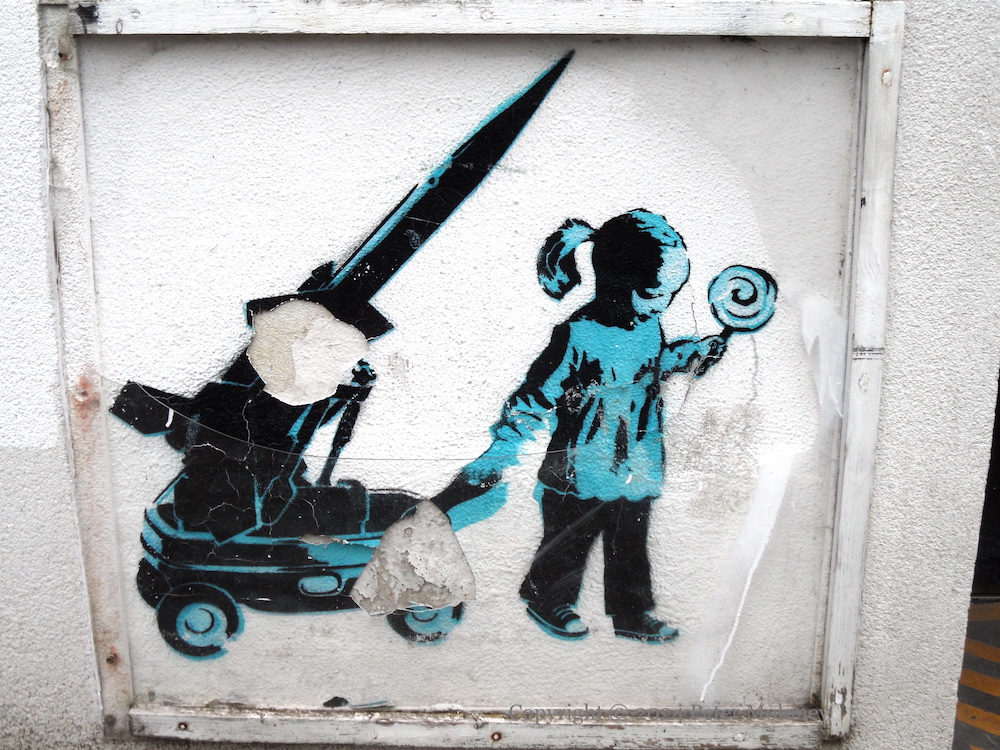
The final image below is of a 2012 Banksy (Artlyst) that is still hanging on in Kentish town, of a girl with a large lollipop pulling a kiddie-wagon containing a rocket.
Previously on Extramural: Banksy-style art in Belfast and Bundoran.
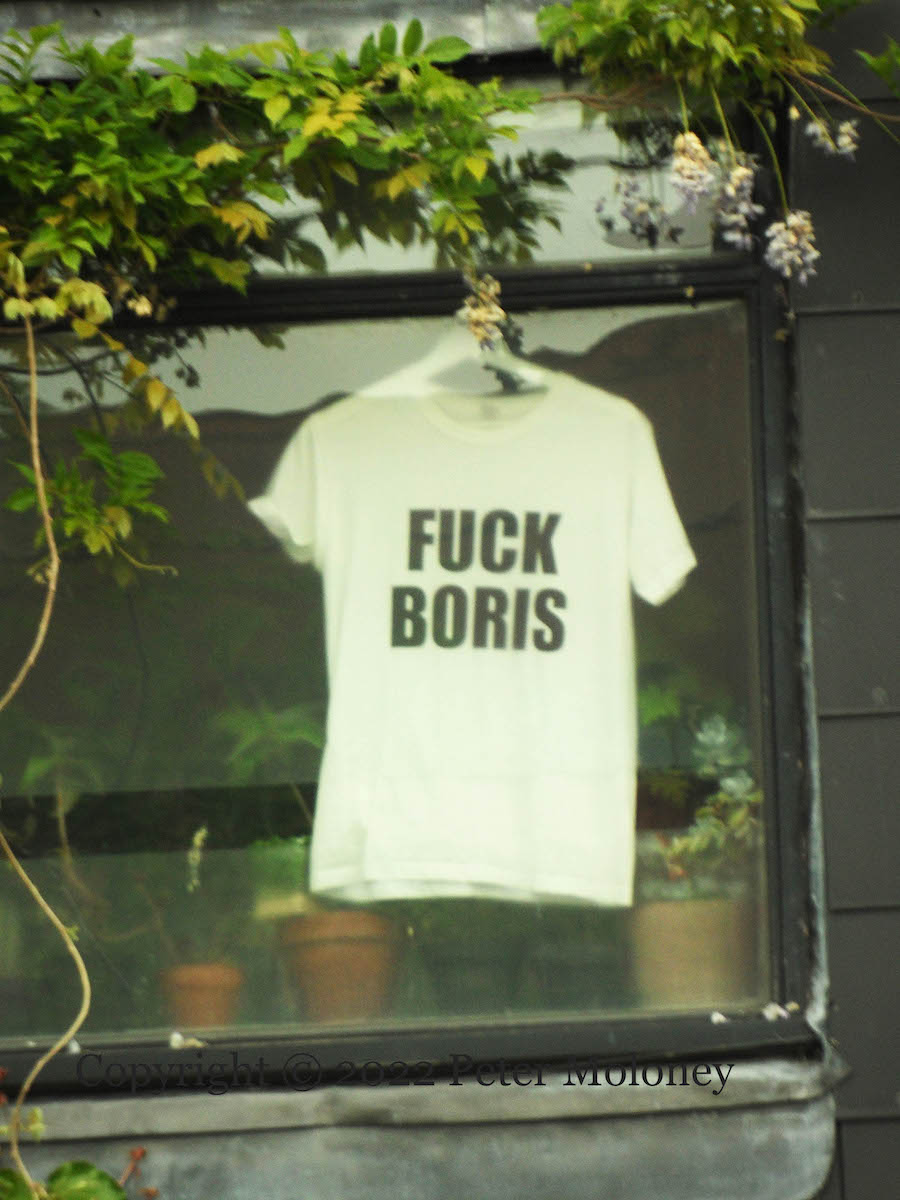
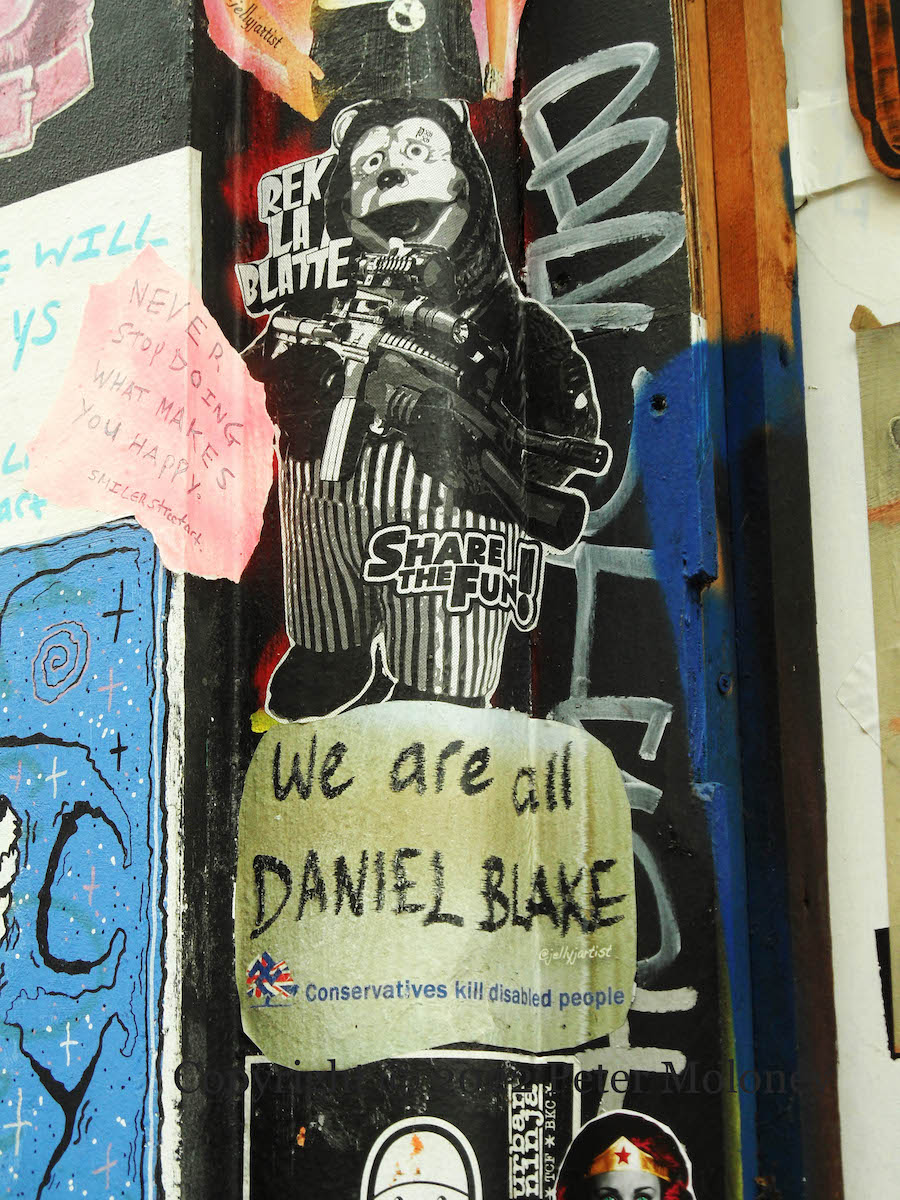
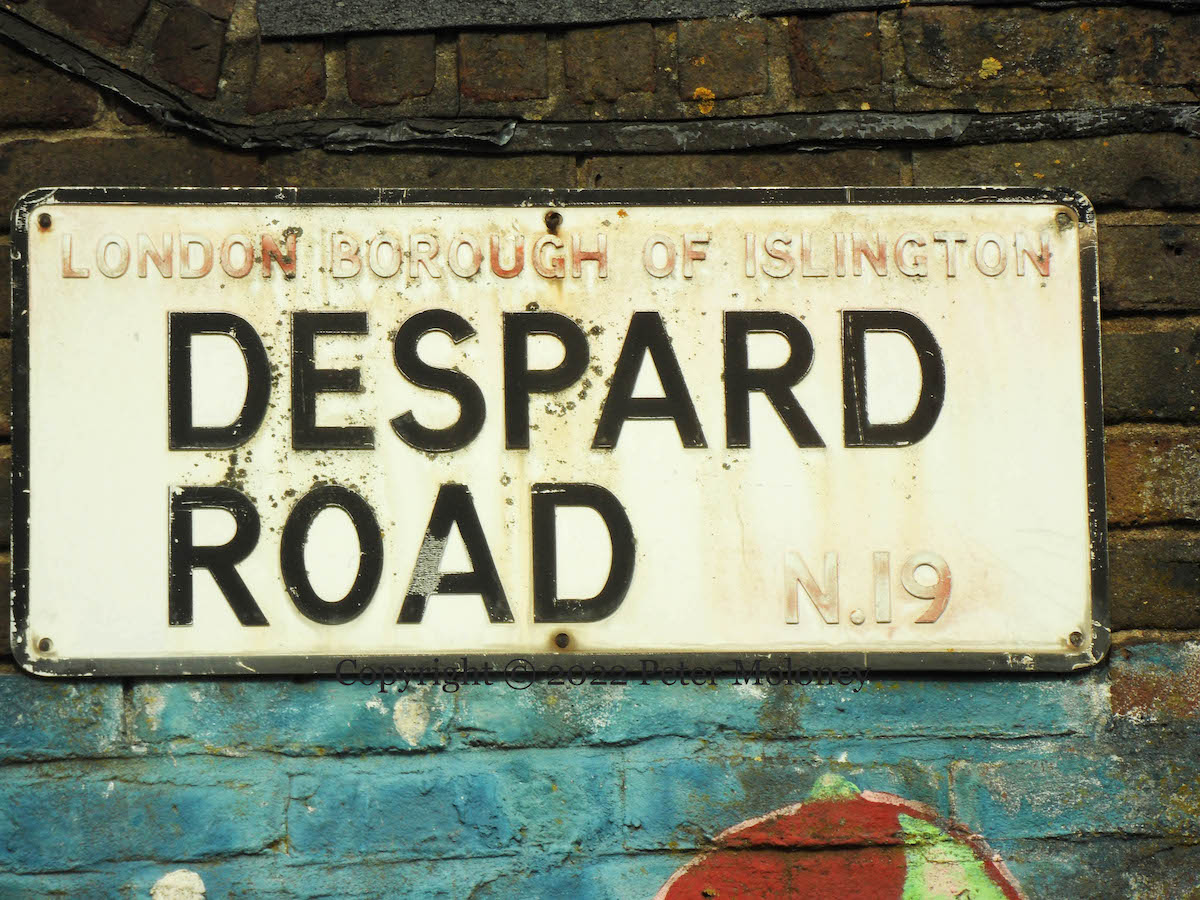
Here are four pieces of political commentary from Deptford and Rochester in London. “BoJo must go” – hounded by the Metropolitan Police over violating Covid lockdown, “Fuck Boris”, “We are all Daniel Blake – Conservatives kill disabled people” (by jellyjartist), and “Brexit is childish” graffiti on top of a portrait of artist Billy Childish.
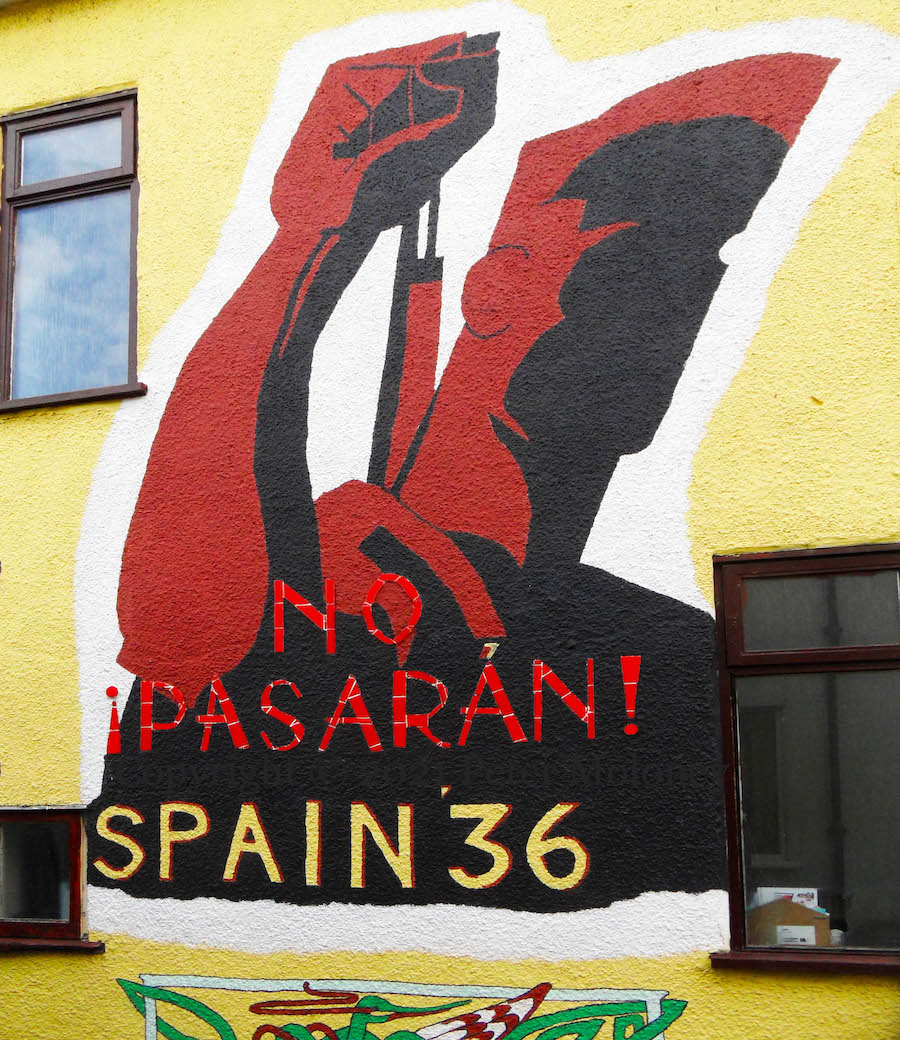
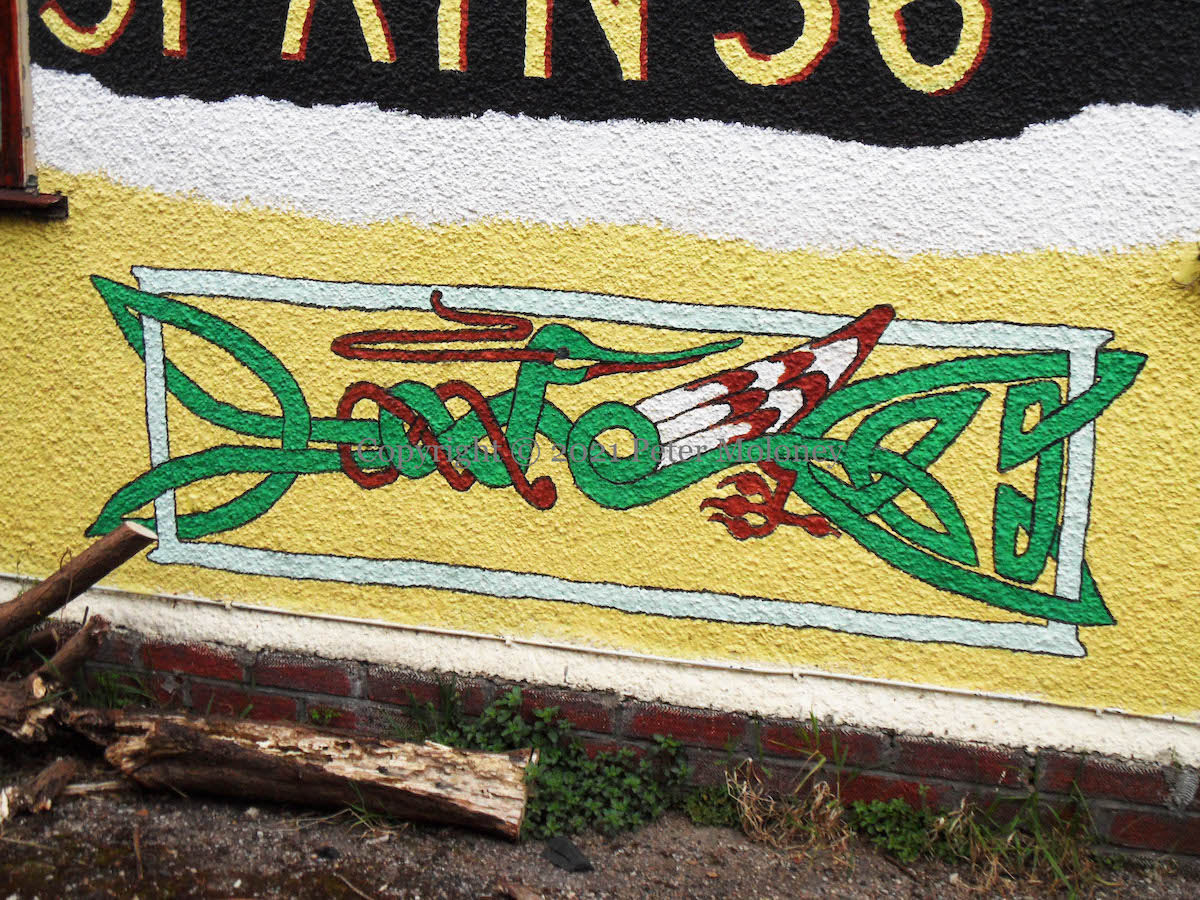
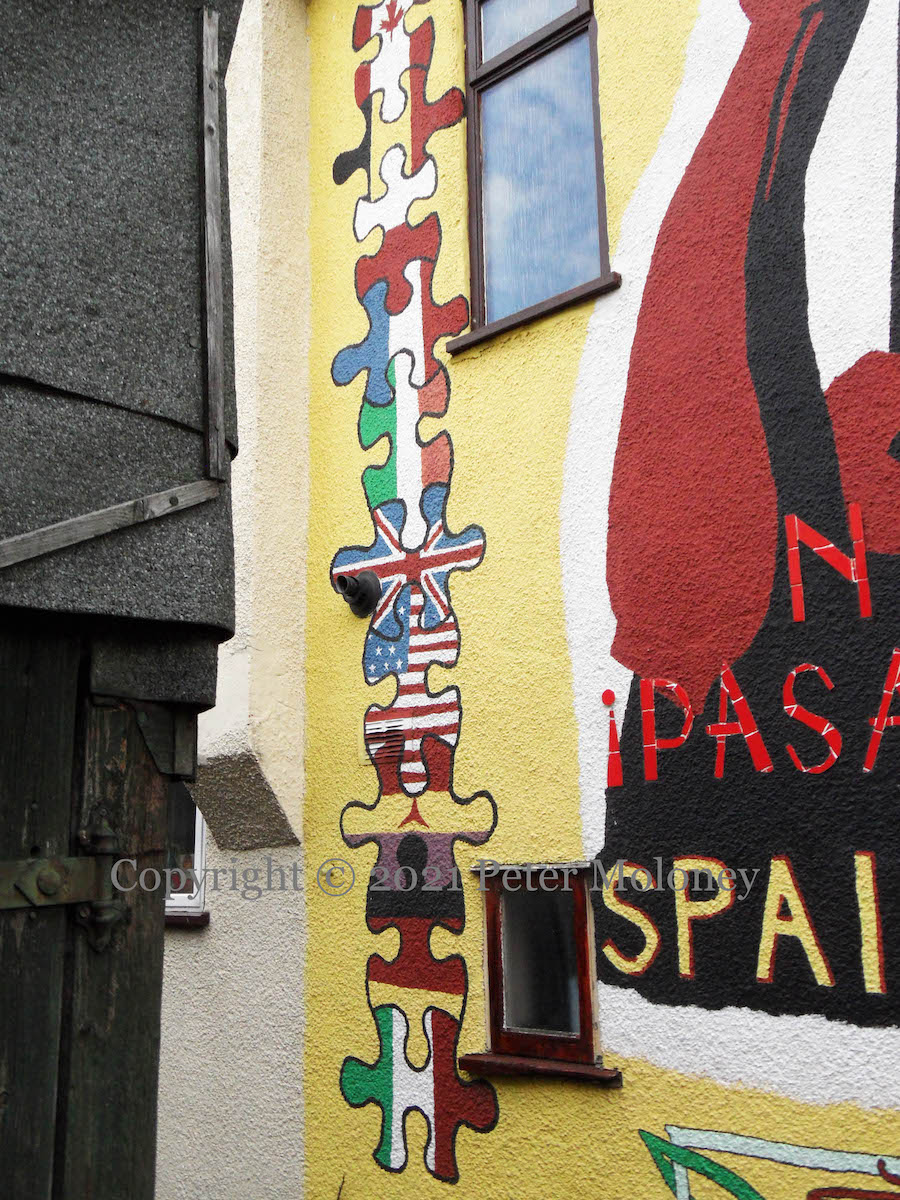
More than 35,000 from more than 80 countries people – see the jigsaw pieces on the left of this mural – joined the International Brigades in the Spanish Civil War, including 2,300 from Britain and Ireland (Guardian). The slogan “¡No pasarán!” [They shall not pass] comes from a speech by Dolores Ibárruri (“La Pasionaria”) in July 1936: “The Communist Party calls you to arms. We especially call upon you, workers, farmers, intellectuals to assume your positions in the fight to finally smash the enemies of the Republic and of the popular liberties. Long live the Popular Front! Long live the union of all anti-fascists! Long live the Republic of the people! The Fascists shall not pass! They shall not pass!” (WP)
It would also be used in October that year at the Battle Of Cable Street in London’s East End, when approximately 100,000 anti-fascists clashed with police protecting a British Union Of Fascists (“blackshirts”) march (WP).
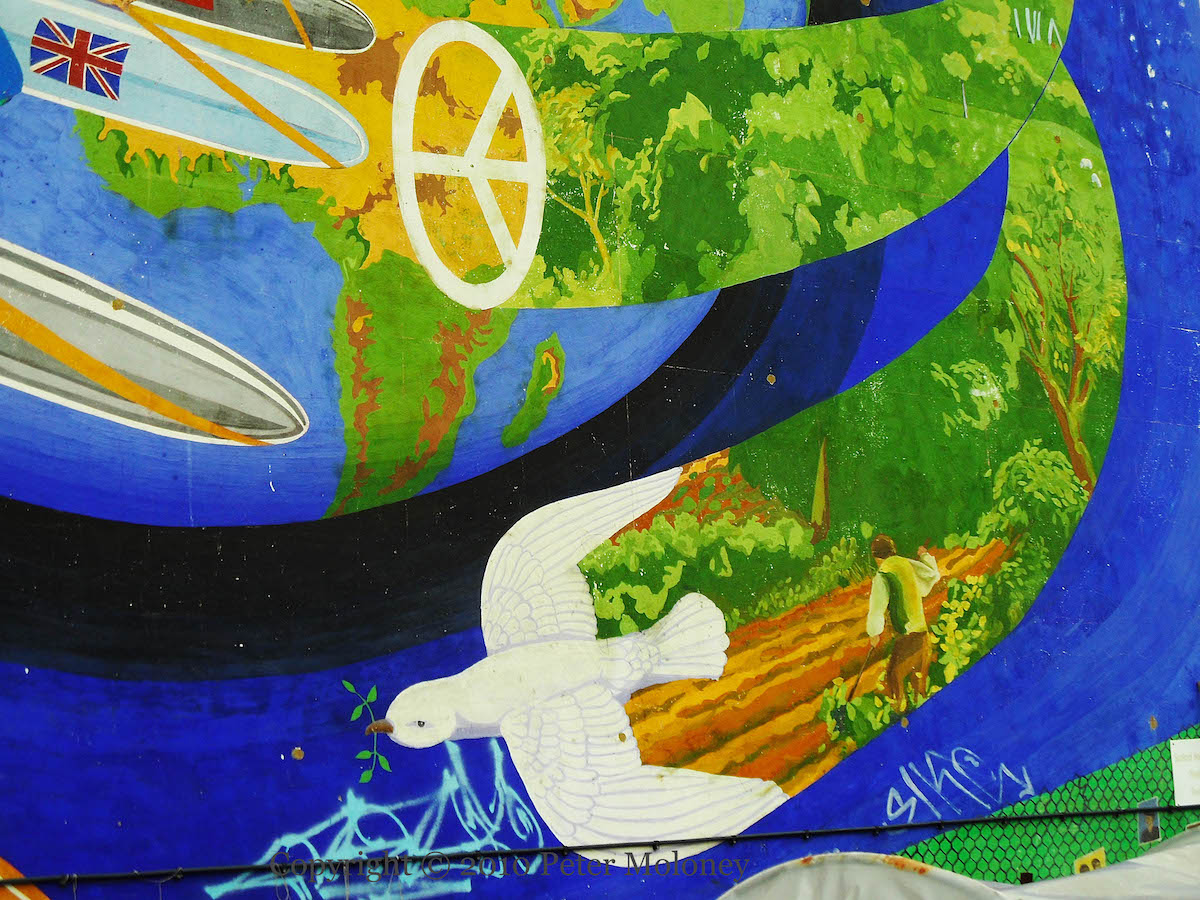
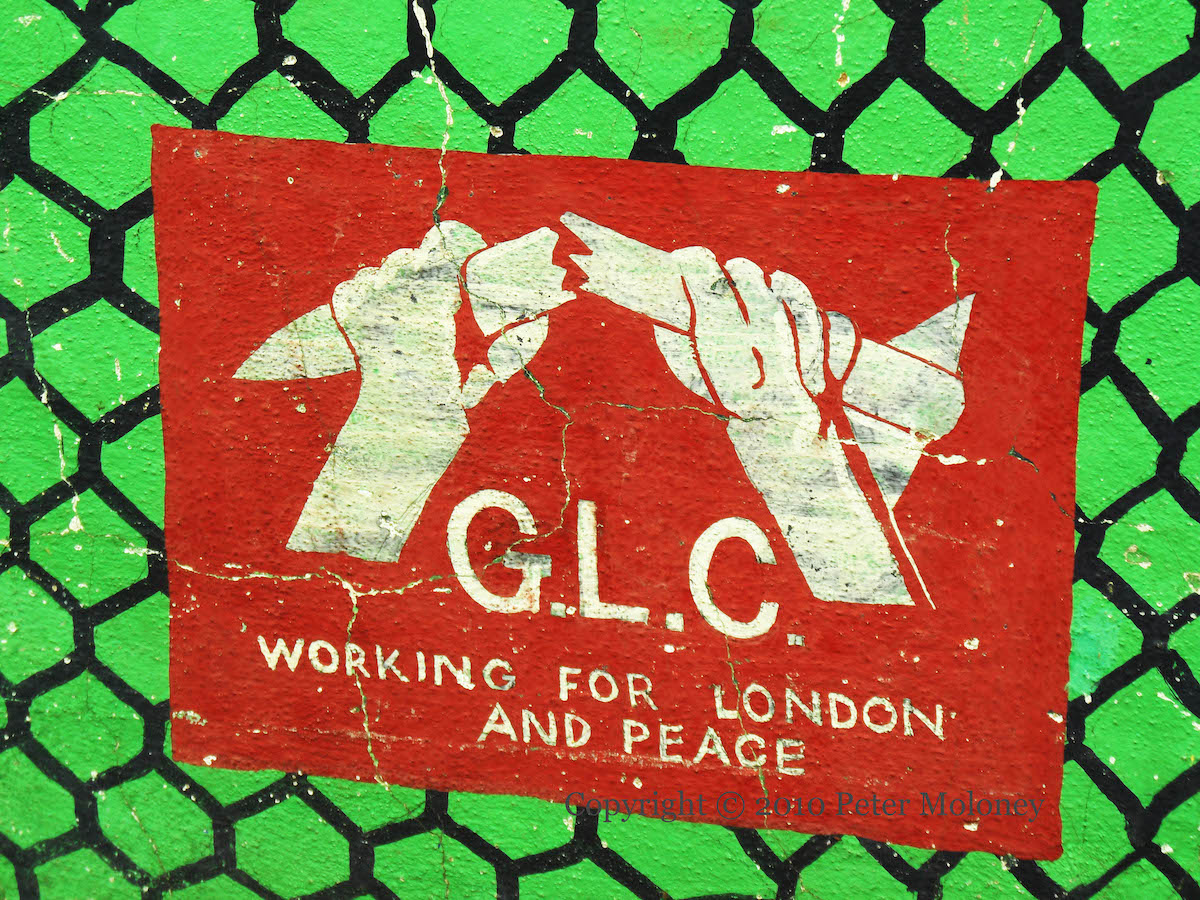
Yuri Andropov, Michael Heseltine, Margaret Thatcher, and a sari-wrapped Ronald Regan are the four riders of the nuclear apocalypse, riding on rockets fueled by rubles, pounds, and dollars, facing off for the fate of the planet against the dove and CND/anti-nuclear symbol as harbingers of peace.
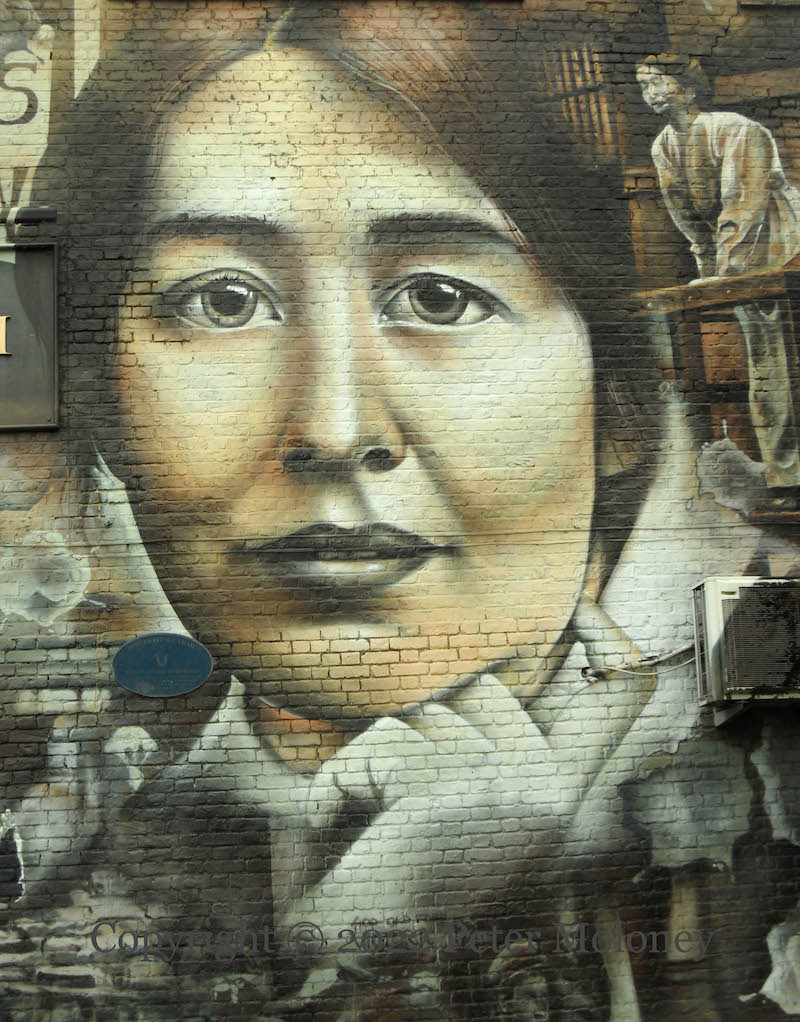
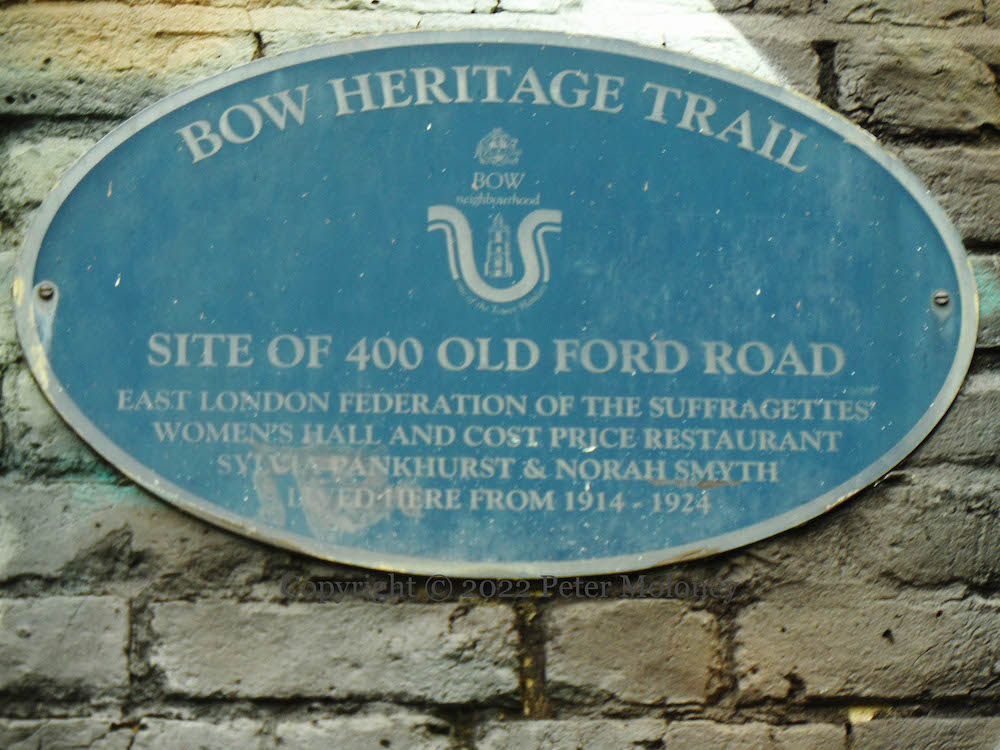
Eight-time hunger-striker Sylvia Pankhurst and the East London Federation Of The Suffragettes [ELFS] provided a cost-price restaurant to provide meals to the poor in the “Women’s Hall” at the back of the house at 400 Old Ford Road in response to the inflation in food prices at the onset of WWI (Inspiring City | East End Women’s Museum).
In the top left, with the “Votes For Women” sign, is Christabel Pankhurst, one of Sylvia’s sisters, a co-founder of the Women’s Social And Political Union – motto “Deeds, not words” – and editor of The Suffragette. (Charlotte Despard – featured previously – was also a member of the WSPU.)
(The third sister, Adela, was founder of the WSPU’s yet more radical sub-group the ‘Young Hot Bloods’ (WP). Their mother was Emmeline Pankhurst, who had founded the WSPU in 1903 (WP); she is featured in a mural on Belfast’s Donegall Road bridge – see Those Days Are Over.)
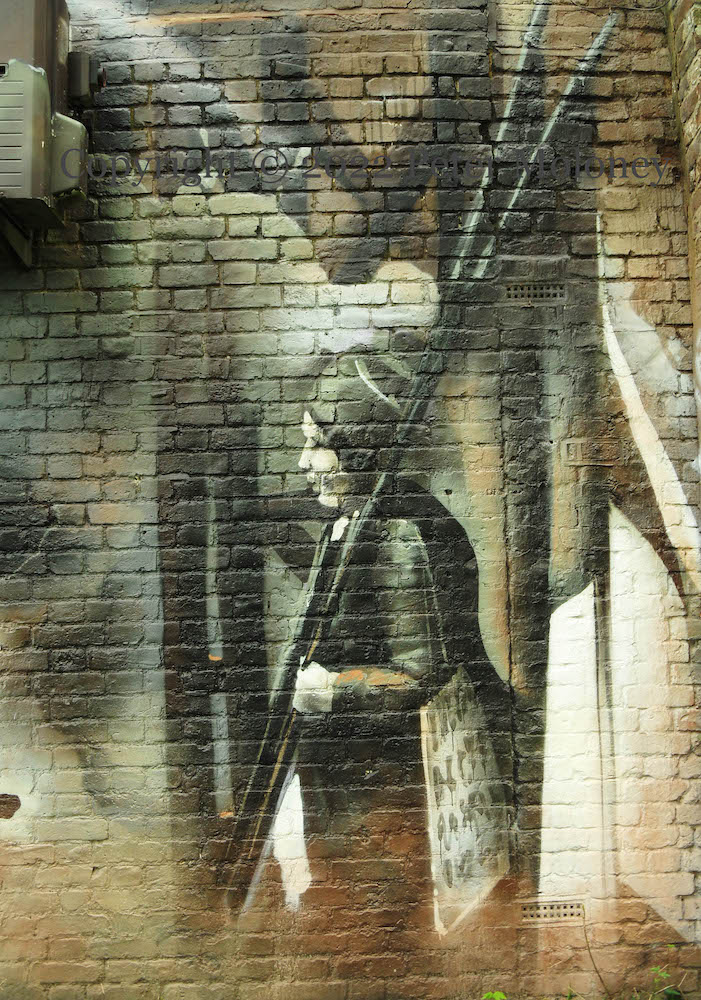
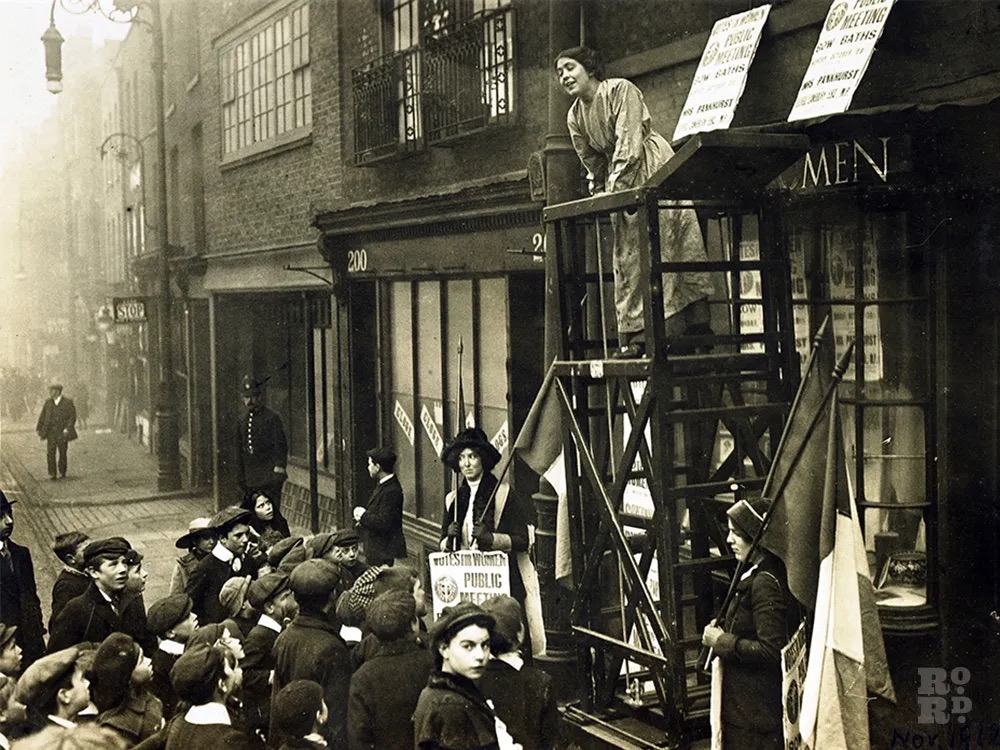
In the top right (shown in close-up in the third image), Sylvia speaks in 1912 from a small platform outside the WPSU office in Bow Road, before the WSPU and ELFS split in 1914.
The mural is by Ketones6000 (ig) in 2018 on the side of the Lord Morpeth pub which was frequented by Pankhurst and the east London suffragettes (web). The pub is at 402 Old Ford Road and the mural thus overlooks the site of the women’s hall.
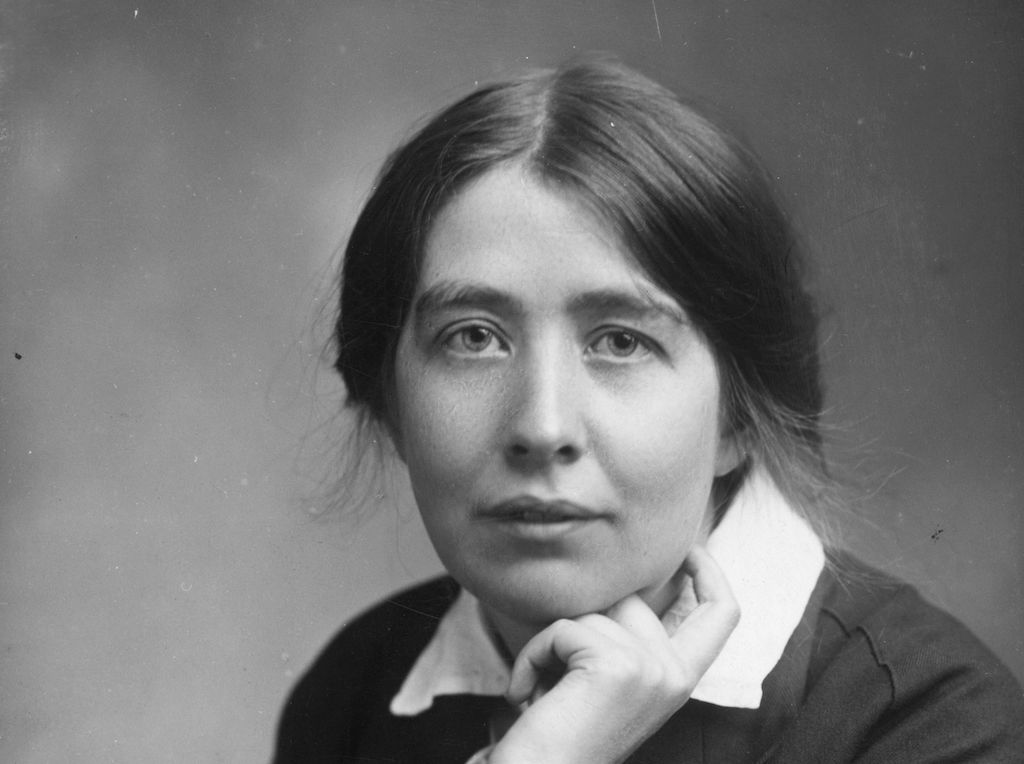
Today’s images come from London but there is an Irish and a Belfast connection. Charlotte Despard was a novelist, suffragist, socialist, pacifist, vegetarian, and Sınn Féın advocate in the years around the Lock Out, the Rising, and the War Of Independence.
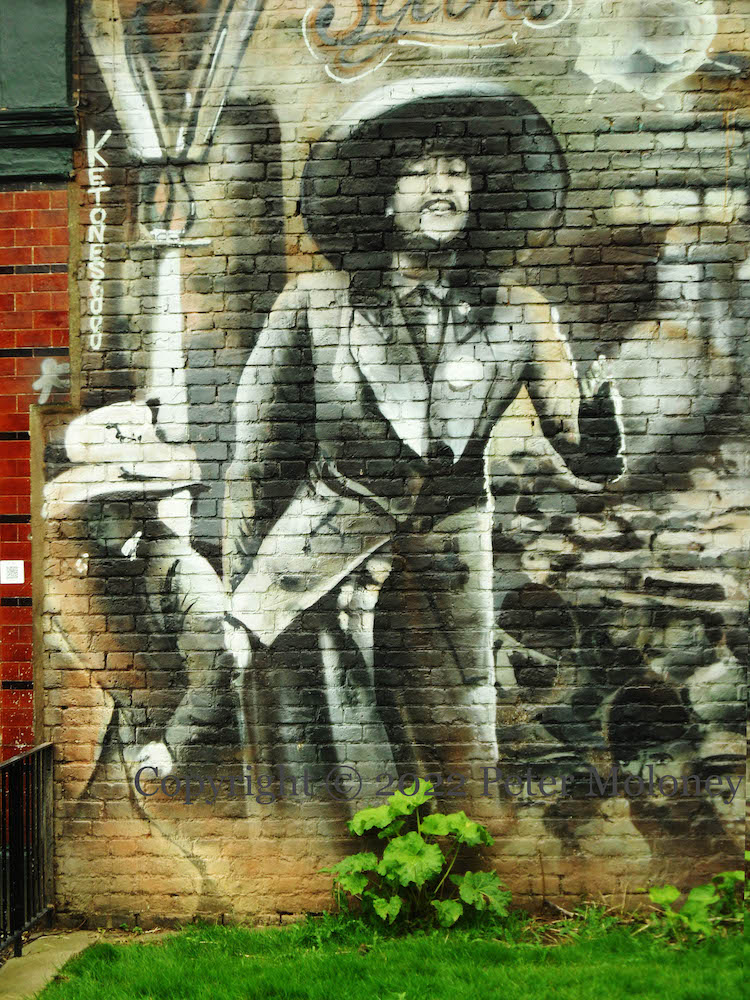
She moved from London – where she worked to alleviate poverty among the children of the Battersea area – to Dublin after WWI and was classed as a “dangerous subversive” by the Irish Free State. The image above (which is a panel from a mural celebrating political radicals of Battersea, below) reproduces a photograph of Despard addressing the crowd at an anti-fascist/Communist rally in Trafalgar Square on June 11th, 1933 – four days before her 89th birthday.
At the end of a very long of activism, she moved to Whitehead, County Antrim, where she died in 1939, and was buried in Glasnevin (WP).
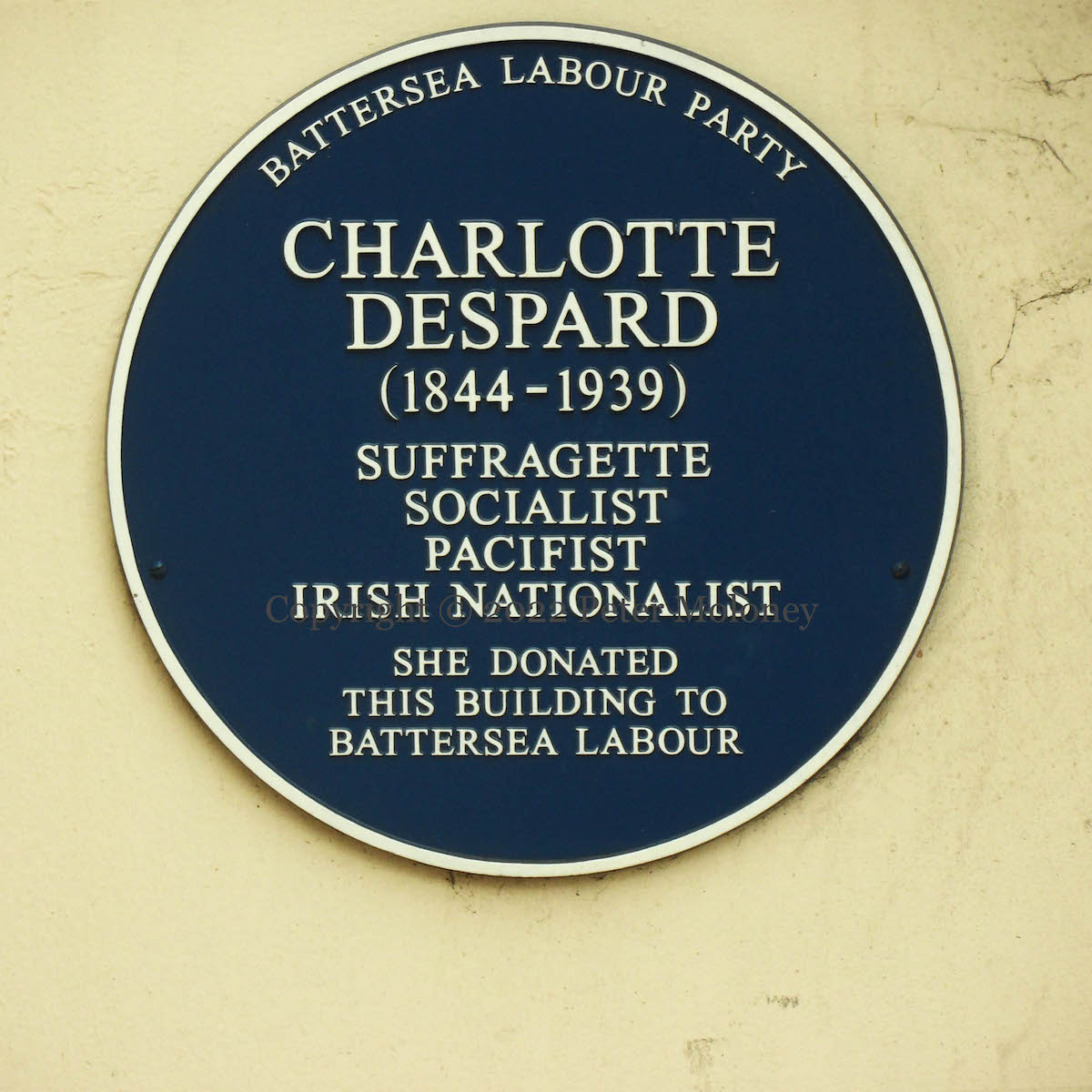
A Battersea street is named after her – Charlotte Despard Avenue; the plaque is at 177 Lavender Hill – the offices of the Labour Party in Battersea.
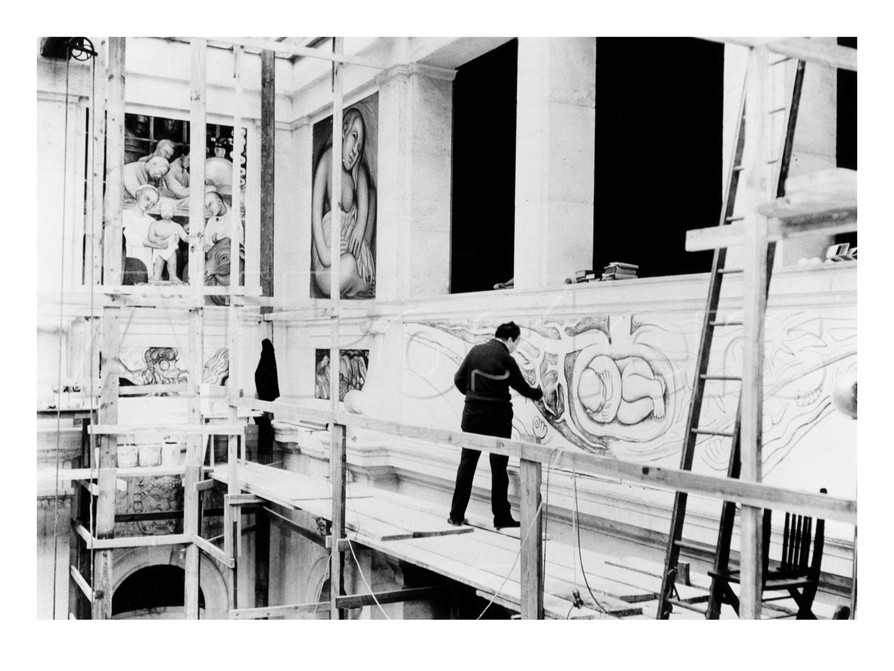
Here is the central portion of the east wall of Diego Rivera’s Detroit Industry frescoes in the Detroit Institute of Arts. Rivera’s wife, Frida Kahlo, had a miscarriage during their time in Detroit and the infant in the image is a tribute to that loss.
Rivera, a communist, was invited to paint the frescoes by Edsel Ford, of the Ford motor company. He painted four walls of a great hall in 1932-1933, celebrating industrial and medical progress while also portraying its deadly uses, and mixing Aztec, Mexican and Christian imagery. The east wall is the first in viewing order, just as in church liturgies.
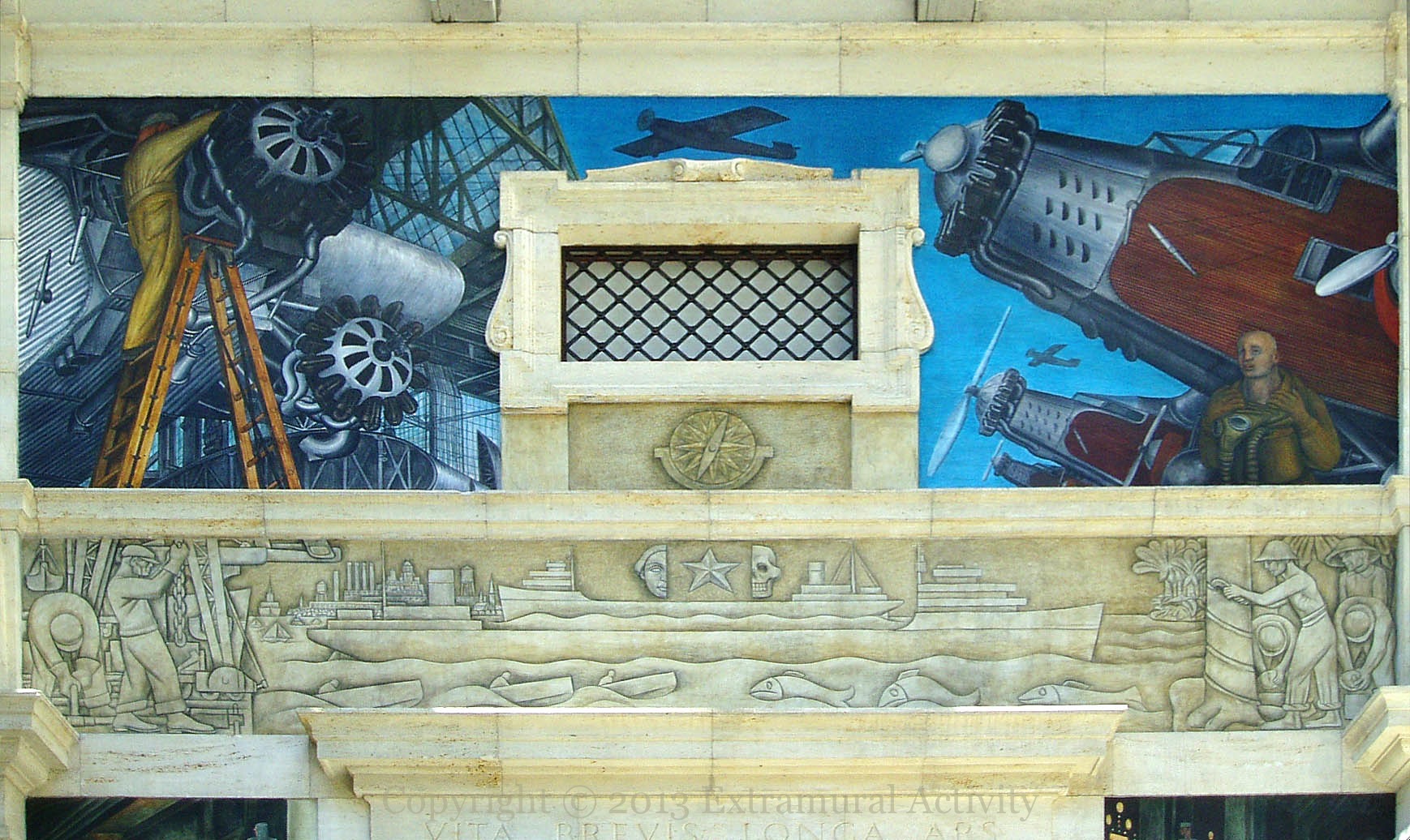
Above is a striking panel from the west wall of the Diego Rivera ‘Detroit Industry’ hall in the Detroit Institute of Arts. One of Rivera’s main themes was the dual use of technology, for both good and bad, and here he represents aviation both commercial and military. The bottom panel shows worldwide shipping and the extraction of natural resources by developed countries (on the right, you can see rubber trees being tapped).














 Extramural Activity