Republican graffiti in Fahan Street, Derry, adjacent to the Che Guevara Lynch mural. Any specific reference is unknown; in 2019 there was controversy over signs threatening informers in relation to the killing of Lyra McKee (e.g. extra).
Henri Cartier-Bresson said of Che Guevara’s eyes that they “glow; they coax, entice and mesmerize.” (WaPo), and (in a special feature ‘This Is Castro’s Cuba Seen Face To Face‘ that he shot for Life magazine) described Che as “an impetuous man with burning eyes and profound intelligence who seems born to make revolution”. The descriptions seem to fit the iconic “Guerrillero Heroico” photo by Alberto Korda, which Jim Fitzpatrick took as the basis for his two-tone poster version, but raised the eyes even more (WP).
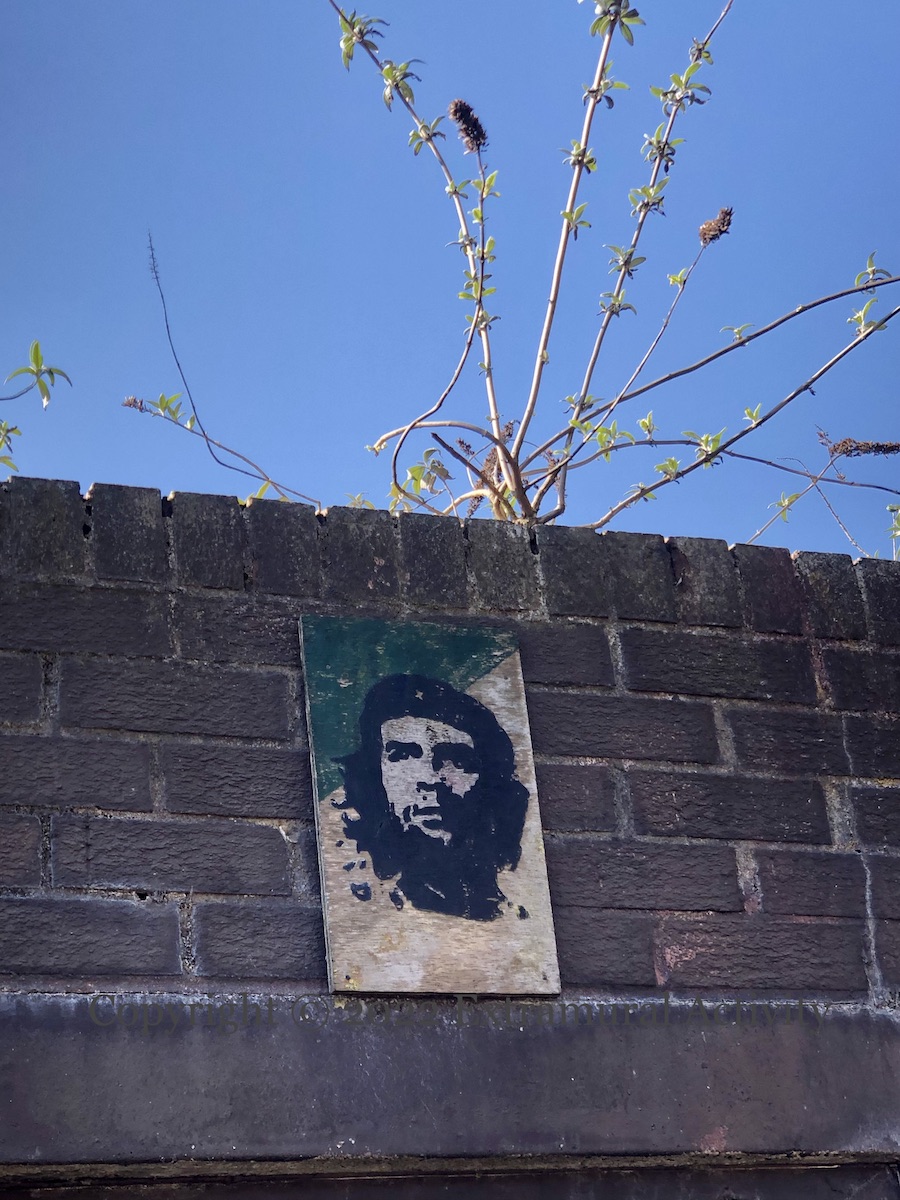
This small Che board is in the alley between Ross Road and the Falls Road, near You’re Never Alone, over the back door to someone’s yard. It dates back to at least 2016.
“Miguel Díaz-Canel Bermudez … President of the Republic Of Cuba 11.6.2021. ‘Irish friends and Cubans living in Ireland have placed a Cuban flag on a mountain in the city of Belfast. The flag is 46 by 23 metres, the largest in the world. With the flag [is] the giant slogan and it’s [sic] demand to #UnblockCuba. [This is a] Moving and beautiful gesture from the “solidarious” children of an admirable people, [a] dignified and patriotic gesture of Cubans who are far away. Thank you for your unshakable solidarity …”
(Originally in Spanish: “Amigos irlandeses y cubanos residentes, han colocado en una colina visible desde la ciudad de Belfast, una bandera de Cuba, de 46 por 23 metros, la más grande en el mundo. La acompaña un letrero también gigante, demandando #UnblockCuba. Bello y conmovedor gesto de los solidarios hijos de un pueblo admirable, digno y de patriotas que están lejos. Gracias por la solidaridad invariable.” #LetCubaLive
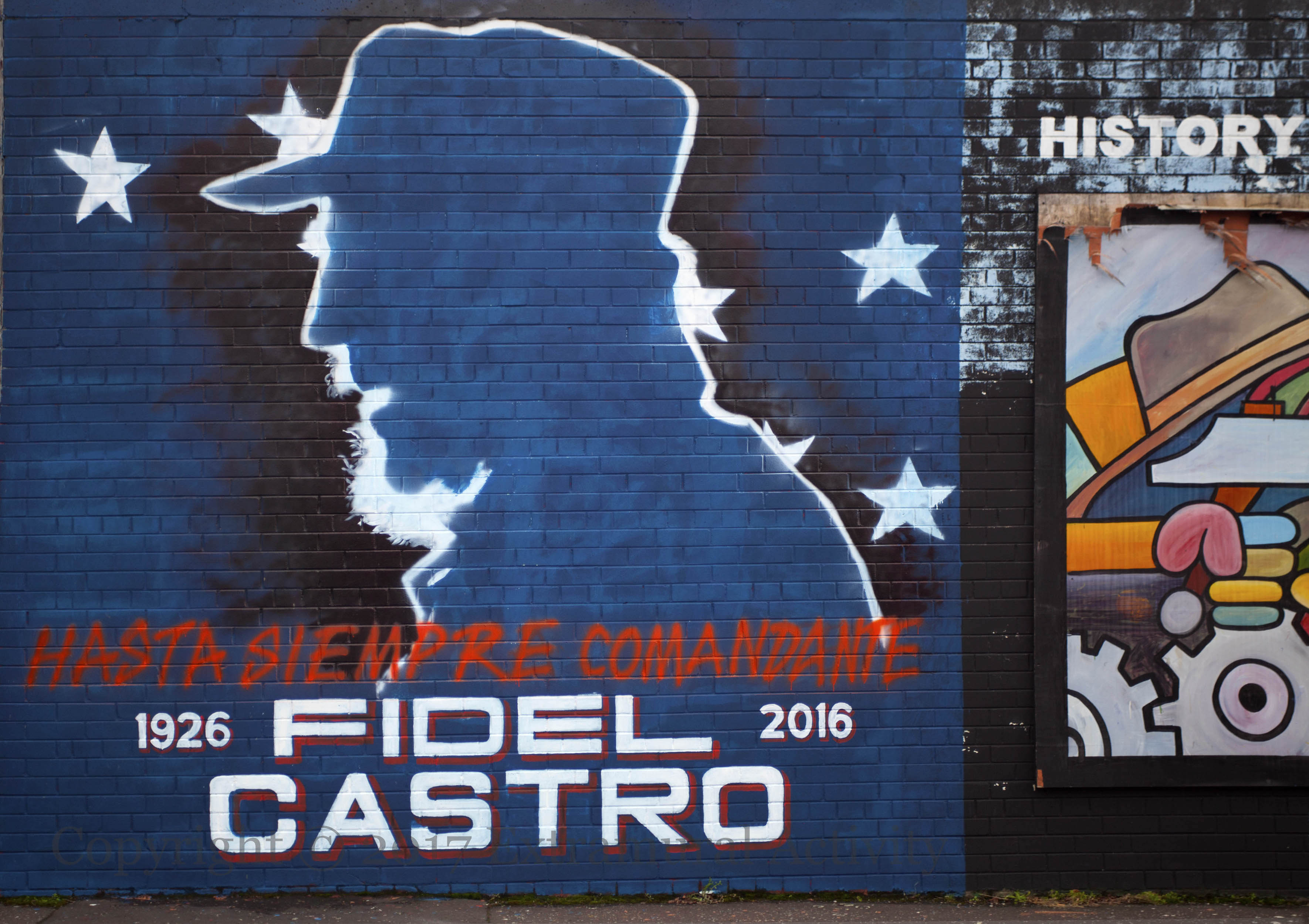
“Hasta siempre, Comandante” is a 1956 song celebrating the life of Che Guevara, with Fidel Castro appearing in the final verse to join the Cuban people in saying “Hasta siempre, Comandante” to Che as he departs Cuba for the Simba Rebellion in Congo. The slogan is here applied to Fidel himself on the occasion of his death in November 2016 at the age of 90.
Here is French singer Nathalie Cardone’s version on the song, which reached #2 in France and #1 in Belgium in 1997:
The Castro mural is next to one for fellow Marxist Salvadore Allende of Chile: see La Historia Es Nuestra.
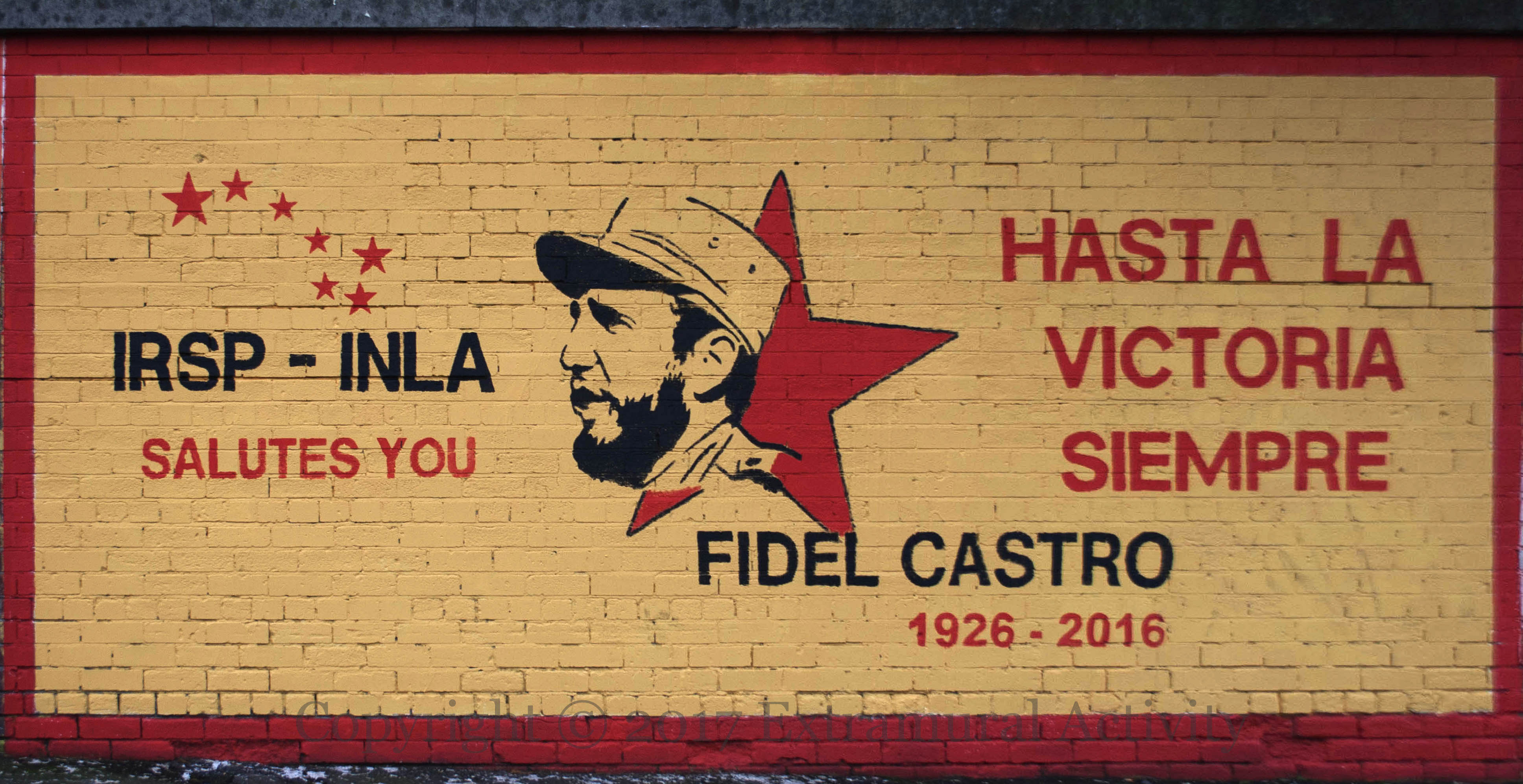
“¡Hasta la victoria siempre!” (“Ever onward to victory!”) was a saying of Che Guevara’s. It is used in this mural as a valediction to Che comrade and long-time Cuban leader Fidel Castro, who died at the end of November (2016). The portrait of Castro is perhaps this Korda image of Castro entering Havana after the deposition of Batista in 1959.
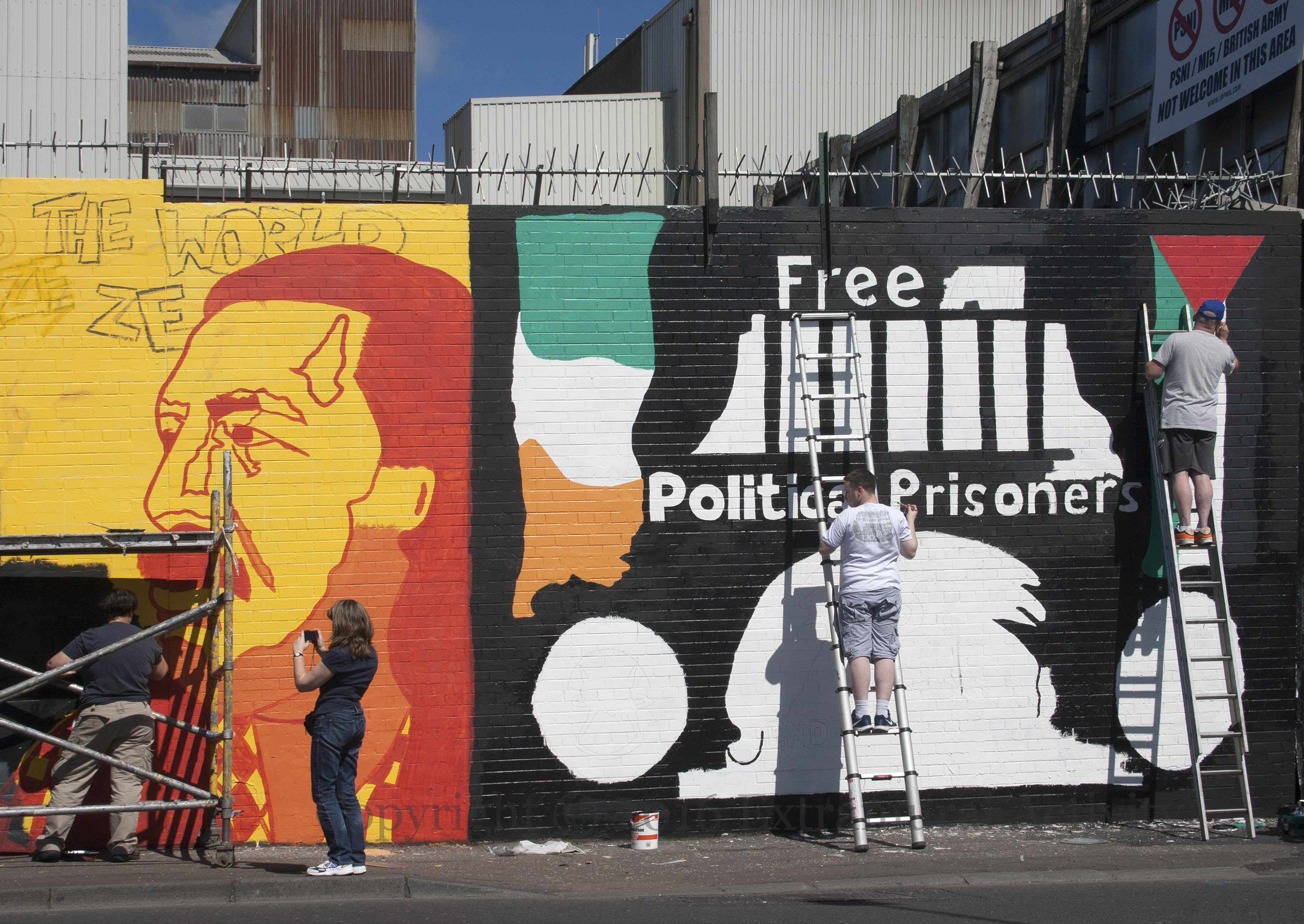
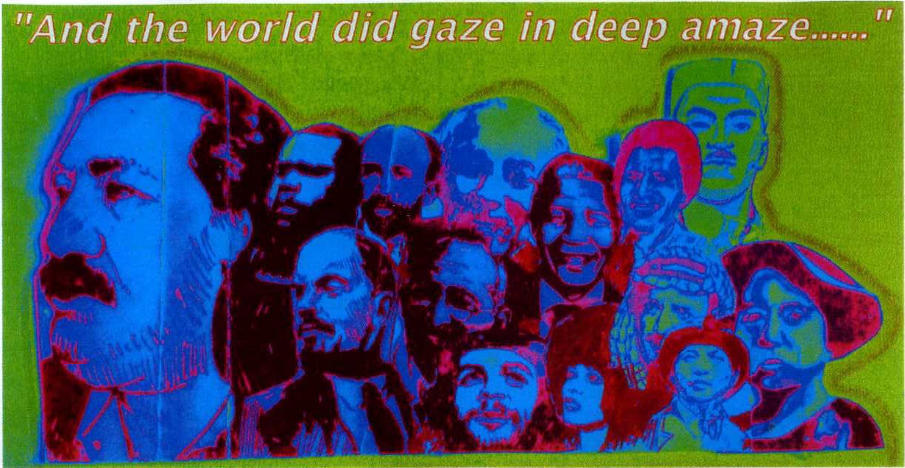
Towards the end of July, the IRPWA began painting a POW mural for the right end of the wall, space that the historical painters hoped to use for a gallery of international figures inspired by Irish resistance — Leonard Peltier, Marcus Garvey, V.I. Lenin,W.E.B. DuBois, Mahatma Gandhi, Ho Chi Minh, Che Guevara, Nelson Mandela, Angela Davis, Muammar Gaddafi, Yassar Arafat, General Giap, and Sukhdev Thapar (see the final image, below) — under the title “And the world did gaze with deep amaze” (a line from the song The Foggy Dew).
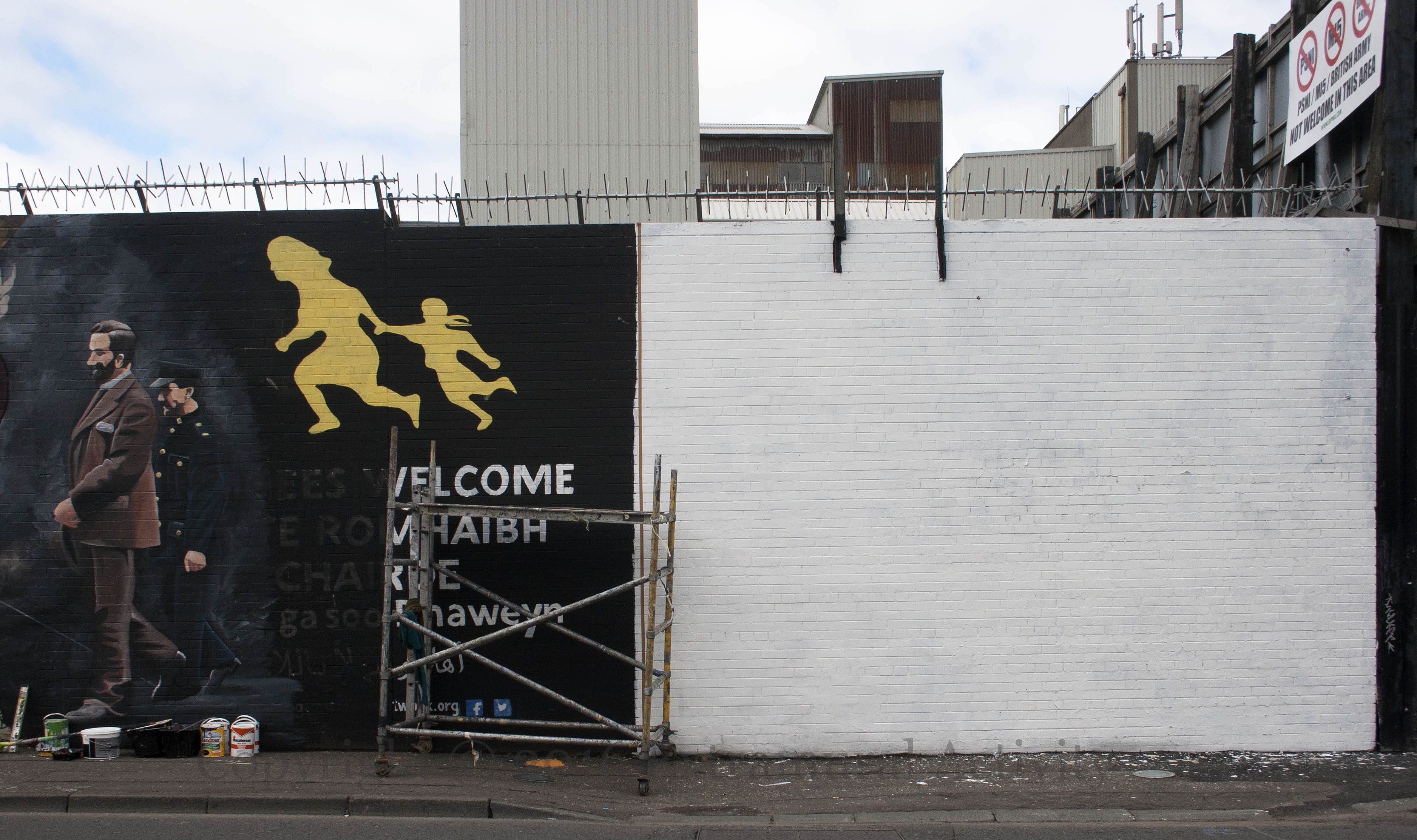
This would have provided a book-end to the mural similar to the gallery of early nationalist figures at the left-hand end. The IRPWA whitewashed the end of the wall (see the third image, below) and commenced work on a POW mural (leading to two sets of painters working at the wall in late July (second image)). In the end, only Leonard Peltier was painted, in the same style as Wolfe Tone. And later, Seany McVeigh’s Pearse Surrenders To The Developers was added (see the fourth image).
On a headstone in City Cemetery: Che Guevara, the Virgin Mary, a guitar, a pair of football boots, and an invocation of St. Dympna, “patron saint of the nervous, emotionally disturbed, mentally ill, and those who suffer neurological disorders – and, consequently, of psychologists, psychiatrists, and neurologists” according to her WP page.
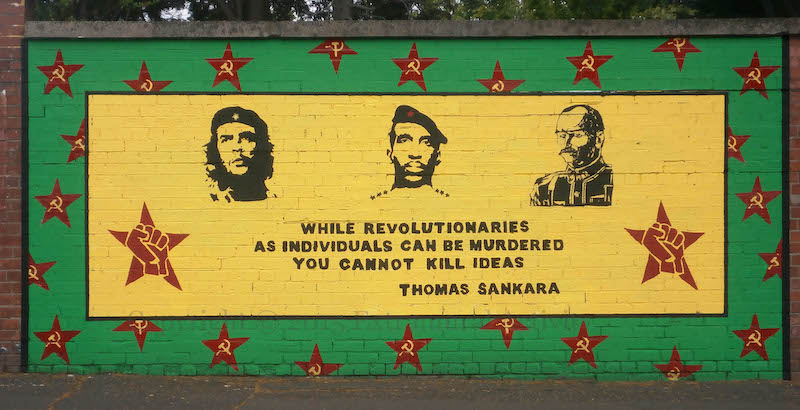
A week before he was assassinated and his government overthrown, Burkina Faso president Thomas Sankara asserted: “While revolutionaries as individuals can be murdered, you cannot kill ideas.” Sankara gained power of Burkina Faso (then Upper Volta) in a 1983 coup and launched an ambitious programme of literacy, feminism, public health, and agricultural self-sufficiency, in addition to launching a drive against corruption and of nationalizing natural resources. He attempted this all without the assistance of foreign aid or the IMF or World Bank. However, he wielded power outside the jurisdiction of the courts and controlled the press. He and twelve colleagues were killed in October 1987.
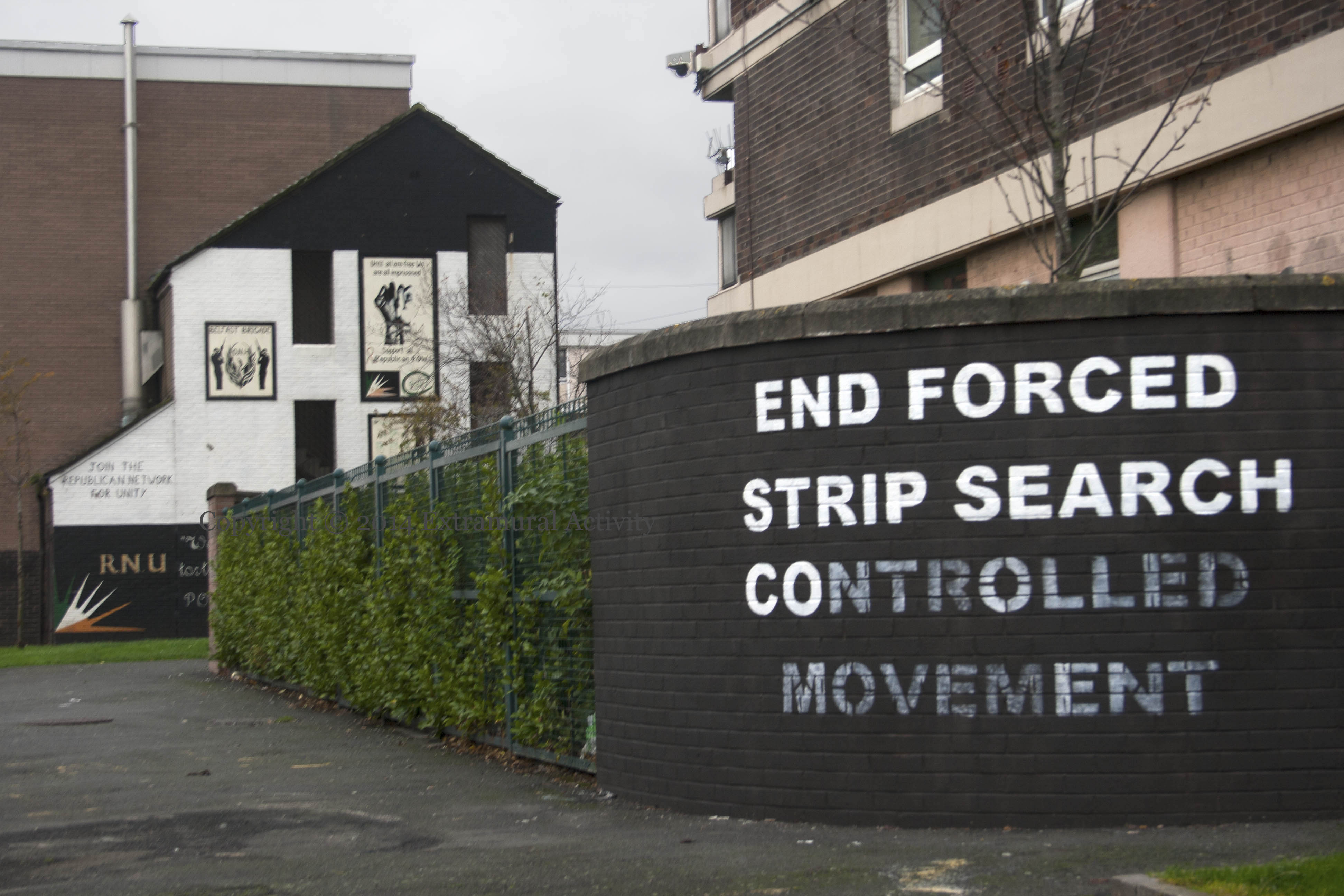
Above, “End forced strip search, controlled movement” RNU/Cogús (web) stencil (“End forced strip search, controlled movement”) in front of a gallery of RNU/Cogús boards (see Until All Are Free We Are All Imprisoned).
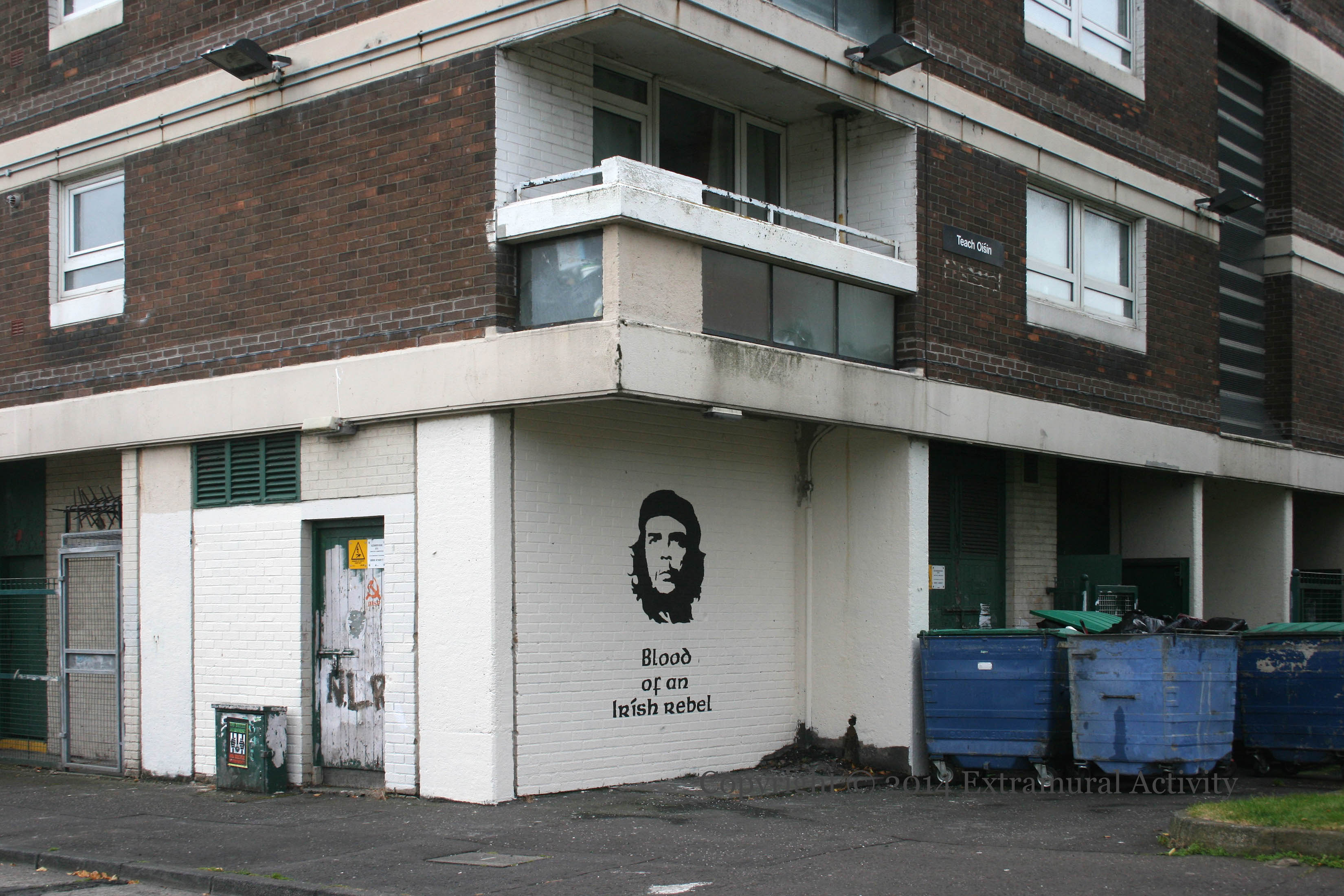
Below, stencil of the iconic Che over his father’s words: “[In my son’s veins flowed the] Blood of an Irish rebel”. (See previously: Che Guevara Lynch)
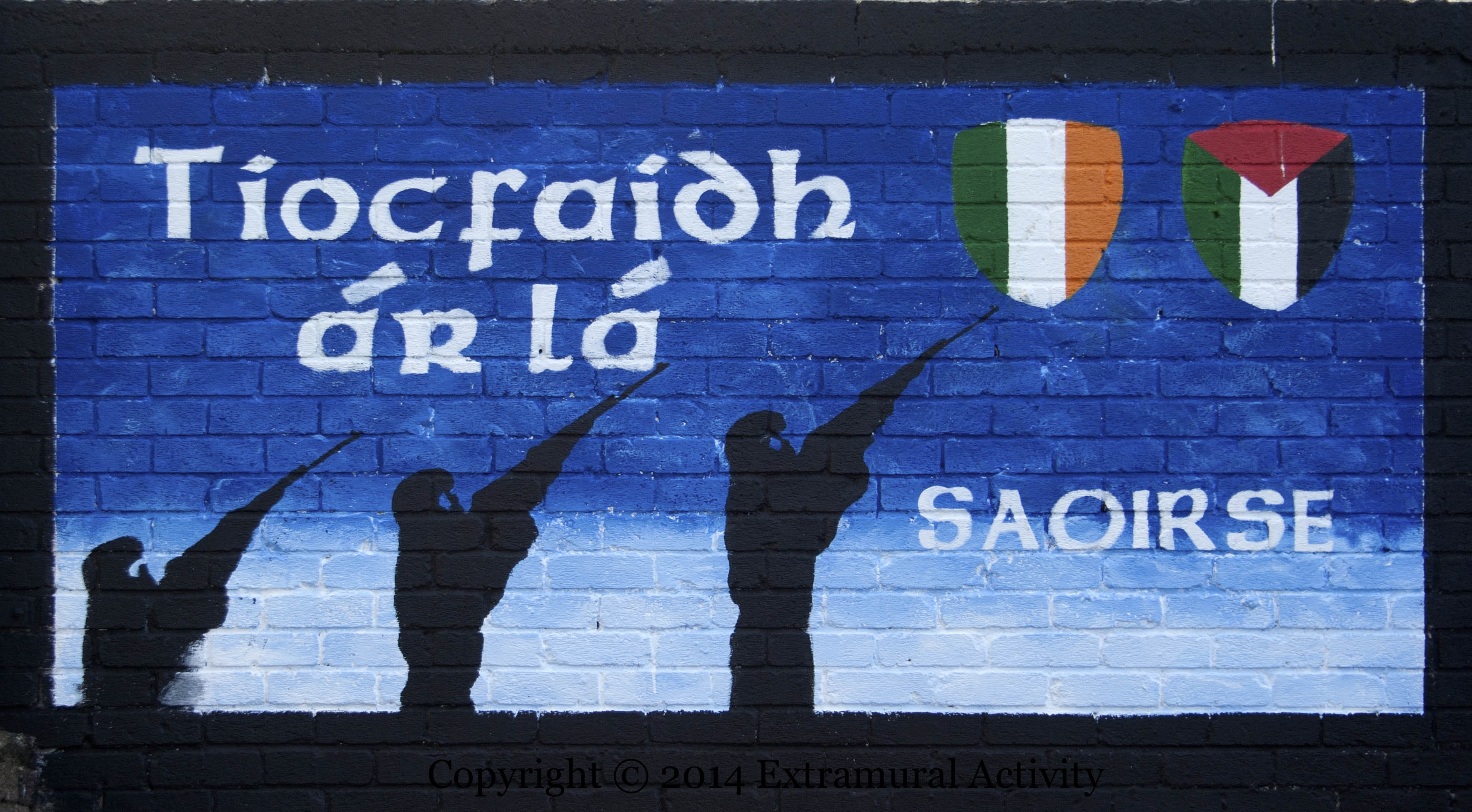
A Che Guevara quote – “I don’t care if I fall as long as someone else picks up my gun and keeps on shooting” – unifies two panels bearing masked men firing funeral volleys, Irish and Palestinian shields, and “Our day will come” in both Irish and Arabic.









 Extramural Activity