The mural above pairs the emblem of Celtic – a Scottish team – with a former emblem of the FAI – the governing body for the Republic’s national team (and, at the time this mural was painted (2002 according to CAIN), league football in the South). Celtic shoulders the footballing dreams of many Northern Ireland nationalists, which is perhaps why, below the flags of Scotland and Ireland, what should be “Albain agus Éıre” is in fact “Albaın agus eıre”: Scotland and a burden.
As reported at the time, after the Nugent/Hughes mural at the corner of Divis and Northumberland Streets (see Belfast’s Infamous Prison) was painted out to make way for a pro-Catalonia vote mural (see Votes About Votes), Kieran Nugent was added to the hunger-strikers mural further down the international wall, along with Mairéad Farrell, who was the second person, after Nugent, to refuse to wear a prison uniform. A blanketed Brendan Hughes has also been added, above the declaration of independence.
Below is a progress shot (previously posted in Votes About Votes); the original version of the hunger-strikers mural is in Peace With Justice.
“End British Internment – End Maghaberry Torture – Strip searches, isolation, controlled movement”. The board above at the top of Havana Street, Ardoyne, shows a a prison guard in Union colours beating a prisoner in the Tricolour’s green, white, and orange. On the left is the barbed wire symbol of the Irish Republican Prisoners Welfare Association (IRPWA) and on the right the emblems of the PSNI, the RUC, and MI5 are crossed out under a swastika. A wide shot, showing the CLG/GAA mural in the background, is below.
Religion and politics mix in this image of the Blessed Virgin Mary gazing at a recent mural at the bottom of Teach Na bhFıann/Fianna House (formerly Dill House) in the New Lodge. “Cumann Na mBan” in Irish is “the women’s organization/council/society” in English. The organization in question is the republican paramilitary group which was founded on April 2, 1914 and celebrates its 100th anniversary this year.
Last Saturday (2014-11-08) saw the launch of a new mural in Ballymurphy Crescent, celebrating local IRA volunteers and community workers.
The doves at the top of the mural are in the style of Robert Ballagh’s “Legacy Of The Hunger Strikes” though there are 12 doves here rather than 10. Marty Lyons holds a copy of Ballagh’s piece in an image below, along with an image on which the halberd and pistol around the beret and gloves in the bottom of the mural are based – the rifles of the original are absent. (Possibly by Patrick Magee, the Brighton bomber (WP) – please confirm by e-mail or comment.)
Left-hand portraits (counter-clockwise from top): Eileen Gray, Margaret Campbell, Annie Adams, Kathleen Moore, Lizzie McGivern, Joe Reid, Rosaleen Russell, Mary Armstrong, Agnes Robinson, Eileen Reid.
Standing (l-r): Fra Toner, Gerry Campbell, Liam Mulholland, Paddy Tier, Sean Connolly, Michael Kane, Liam McParland, Sean Doyle, Cllr. Sean Keenan, Pat McGeown.
Squatting/Kneeling (l-r): Jim McGrillen, Francis Toner, Jr., Jimmy Duffy, Tony McAlister, Billy Carson, Cormac McArt.
The main figure is (and remains from the previous mural) Tommy “Toddler” Tolan, who escaped from the Maidstone in 1972 and served time in the cages at Long Kesh. (See Lost Lives entry #1956 and An Phoblacht.) In the original (2001) version of the ‘Safe House’ mural, he was dressed in fatigues (image at CAIN), but this was changed within 18 months to a brown suit (image at CAIN | detail at ExtrAct), similar to the way he is portrayed here.
The mural took some time to complete — the fifth image, below, shows one of the artists on a scaffold with #stoptorycuts on Slıabh Dubh in mid-October — partly because more and more figures were added.
Update 2014-11-26: In an unusual move, the launch of the mural was advertised by a board (rather than flyers), in this case at Dorothy Maguire Corner on the Whiterock Road – see the final image, below.
Yesterday’s symbolic vote on Catalonian independence (for more background see Votes About Votes) showed 81% in favour of separation from Spain. Here are three shots of the encouragement on Slıabh Dubh (Black Mountain), the second with the Ballymurphy Easter Rising mural in the foreground, the third with the wall of superheroes in Slıabh Dubh estate (see Wallbusters | The Walls, Unbroken | Red-Eye | Cartoon World).
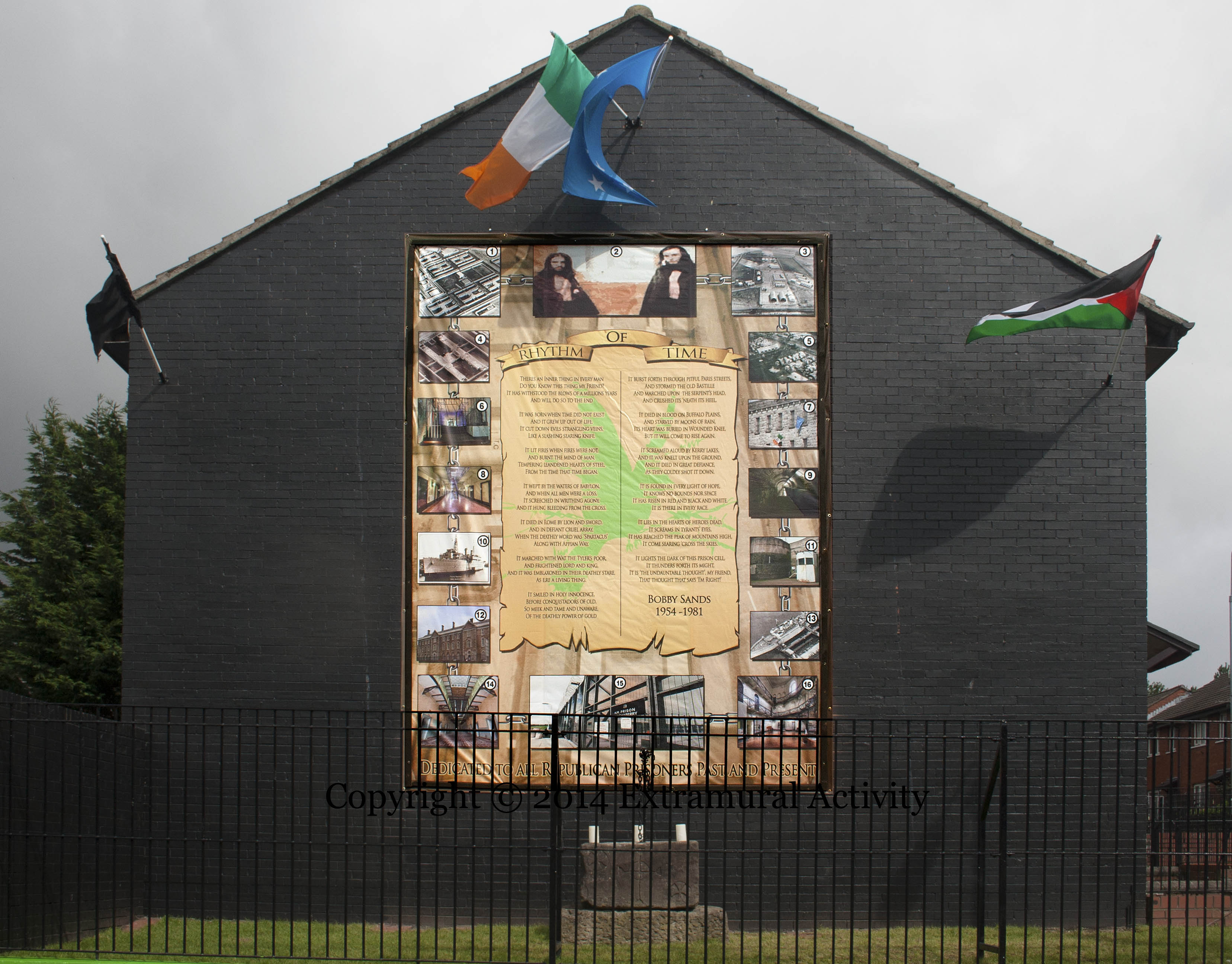
Bobby Sands’s poem The Rhythm Of Time, published in 1981 as part of Prison Poems, is printed in full along with images of Long Kesh and other prisons in which republican prisoners were held.
The work was launched 2014-08-10, to coincide with the anniversary of the introduction of interment in 1971 (see e.g. this BBC news report).
Here are two details from the Ardoyne, Bone, Ligoniel mural featured yesterday, as well as a shot of bouquets of flowers in front of the plaque on the stone put in place in 2003. The first reproduces a photograph of Maıréad Farrell during the “no-wash” or “dirty” protest in Armagh Women’s Prison. (See the middle of this 1989 Frontline documentary.) The second shows the walls and guard-towers of the H-Blocks (featured previously in You Know Where). The frames and photographs of 40 locals are printed, not painted.
26 volunteers and 14 others from the Ardoyne, Bone, and Ligoniel areas are commemorated in a new (2014-10-05) mural. The images below show artist Mickey Doherty, himself an ex-prisoner, at the start of the process – with the grid-work visible – and shooting an “action” shot for VICE TV.
The previous mural also commemorated local volunteers (34 painted portraits rather than a printed board), but this mural adds a Celtic cross, funeral volley, and images of Armagh women’s prison, the cages at Long Kesh, and the H-blocks, as well as (an inverted image of) blanketman Hugh Rooney – detailed images can be seen in Prison Walls.