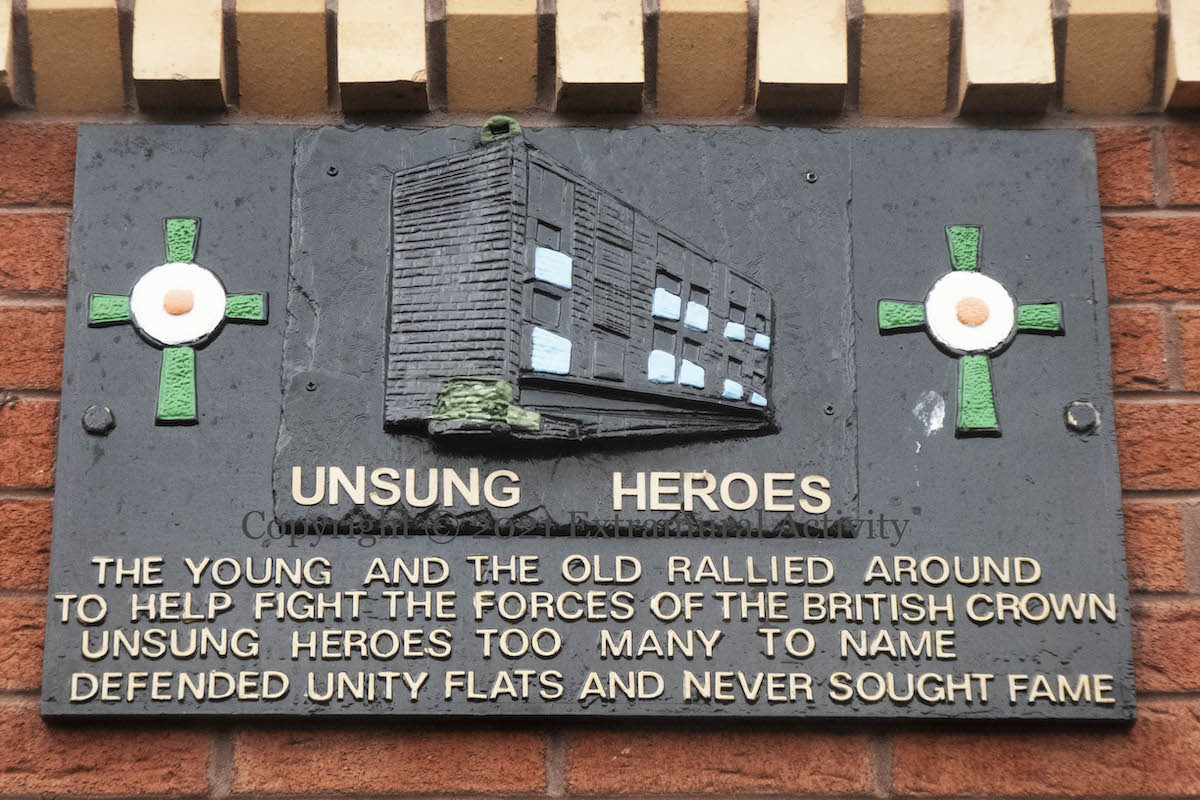
“The young and the old rallied around/To help fight the forces of the British crown/Unsung heroes too many to name/Defended Unity flats and never sought fame”. Unity flats were built in 1968 to replace the old Carrick Hill but immediately came under repeated attack by loyalists from the nearby Peter’s Hill and Shankill; by 1987 their demolition had been approved but because of difficulty in rehousing residents (Hansard), the new Carrick Hill was not completed until 2009 (BelTel). The flats have a Facebook page, Growing Up In Unity Flats. The plaques shown today are on the side of the newsagents in the new Carrick Hill.
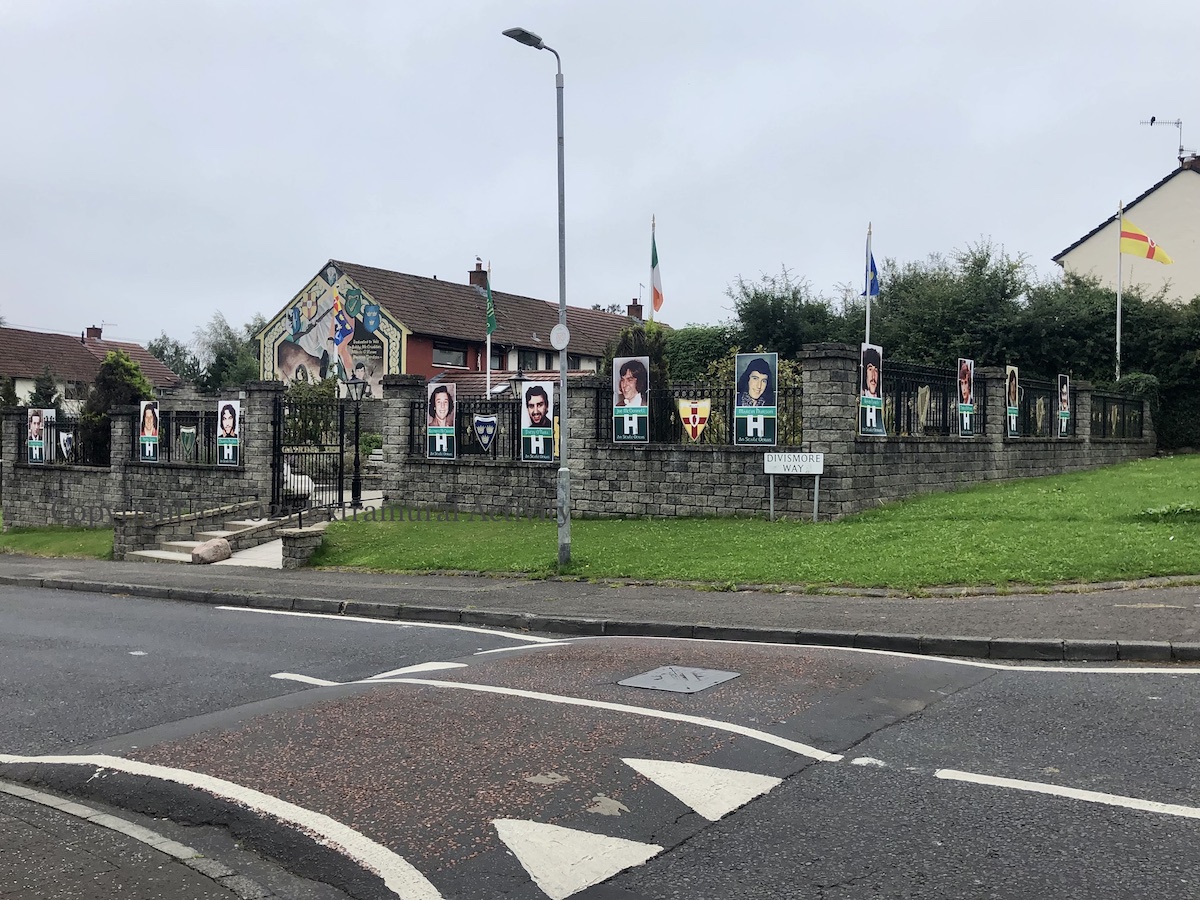
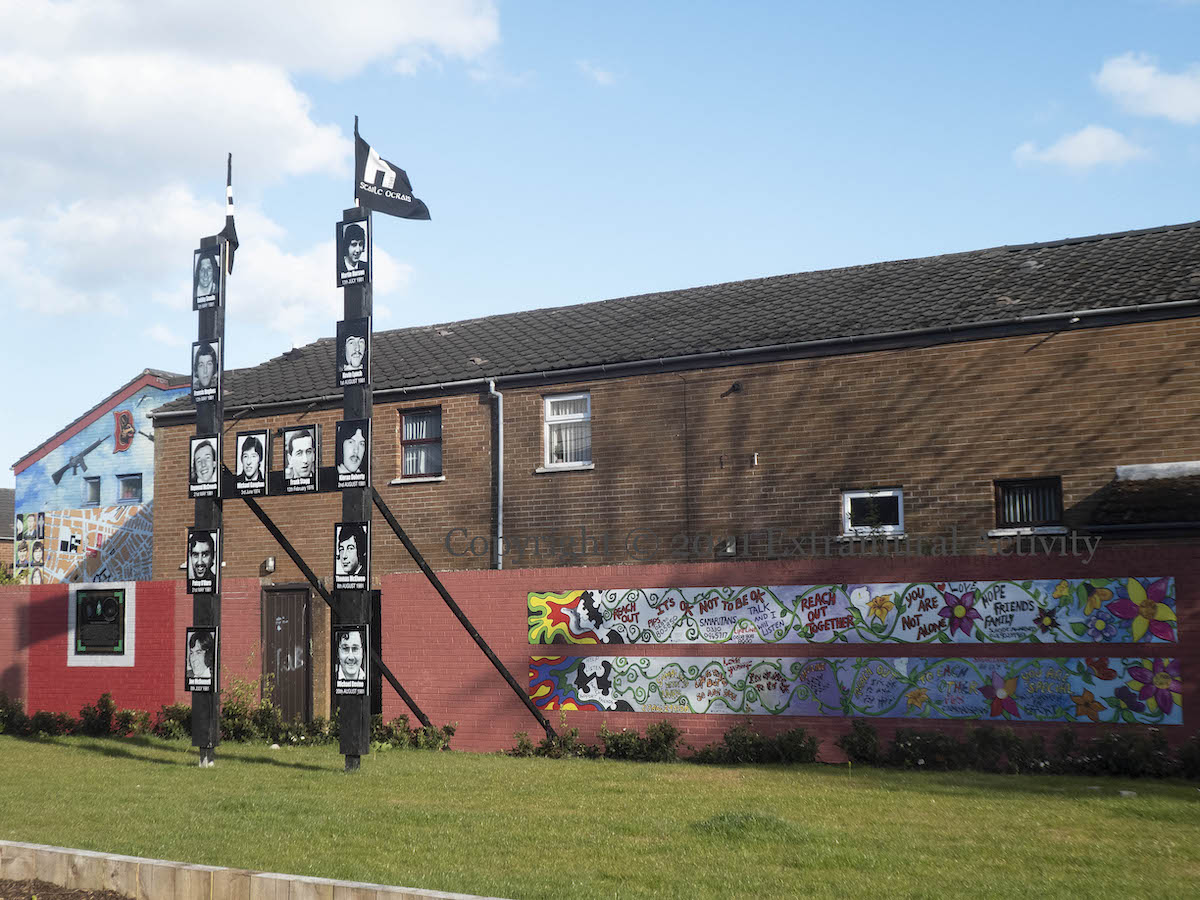
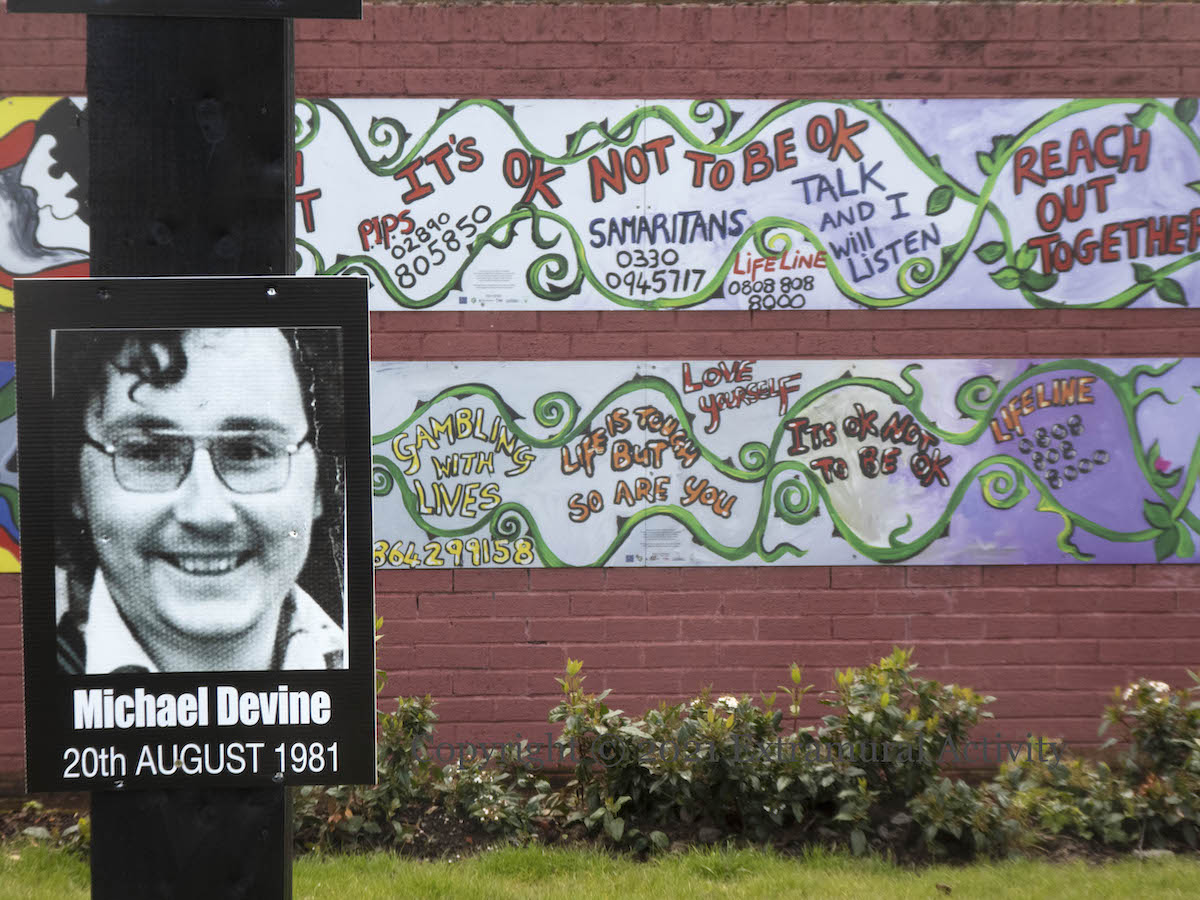
For the 40th anniversary of the 1981 Hunger Strike, portraits of the deceased ten (plus Frank Stagg and Michael Gaughan from the 1970s) were placed on the railings of the Ballymurphy memorial garden. There is a new (compared to 2006 and 2008) set of plaques, erected in 2017:
“A Letter To The 22: You have not gone away, you are in the hearts and on the lips of your people. The old speak of you with knowing tongue. The middle aged, as those who worked beside you. The young men and women with a passion not unlike your own. Your names can be heard on the wind taken from the mouths of men who tend their flocks on Slieve Gullion, Cnoc Phadraıg, Glenshane. They echo in the small graveyards in Cork, Kerry, Galway, Mayo, Tyrone, Antrim, Derry and Armagh. They are heard among your people at the mass gate on Sunday in the crowd at the hurling game, around the hearth when the bottle is cracked and song is sung. Your image can be seen on the faces of happy smiling children for whose freedom you gave your all. You are in our prayers you have not gone away, you never will. Mıse le meas Colm Mac Gıolla Bheın 2006. This monument was erected by the Ballymurphy Ex POWs in memory of the 22 hunger strikers who died for the cause of Irish freedom. It was unveiled on the hundredth anniversary of Thomas Ash[e] who was the first republican to die on hunger strike in 1917. He died after five days while being force fed. Thomas Ash[e] an these 21 brave Irish men stood by their beliefs and refused to be criminalised. Fuaır sıad bás ar son shaoırse na hÉıreann. I measc laochra na nGael go raıbh sıad.”
Six weeks after the first four deaths, the 1981 hunger strike’s long summer of mourning resumed with the death of Joe McDonnell, who died on July 8th, 1981. The “H” (for “H Blocks”) is on the Falls Road, next to the D company IRA memorial garden.
“History of the death of Sean McCartney. This memorial was placed here on Saturday 8th May 2021 to mark the 100th anniversary of the death of Vol Sean “Johnny” McCartney of no. 55 Norfolk Street, Falls Road, Belfast. Sean was a volunteer of “D” Company 1st battalion Belfast Brigade Oglaigh na hEireann, when he was killed in action, aged 23 years old. He died while on active service with the 3rd Northern Division, 3rd County Cavan Brigade flying column during the Irish Republican War of Independence. He was shot twice during an ambush and gun battle with the British Army RIC and Black and Tans on Sunday 8th May 1921 on Croghan Mountain at the Lappanbane stretch of the Lappanduff Mountain, Co. Cavan. His body was then mutilated by the Black and Tans. Sean’s body was kicked, stamped on, danced on and tied by the ankles and feet to a Crossley Tender military vehicle and dragged along mountain lanes in an attempt to instill fear in the local Co. Cavan community. The 32 county Irish republic based on the self determination of the Irish people which Sean and many others fought and died for has yet to be achieved. Sean will always be proudly remembered by his extended family circle in Ireland and Canada.” McCartney is buried in Milltown cemetery.
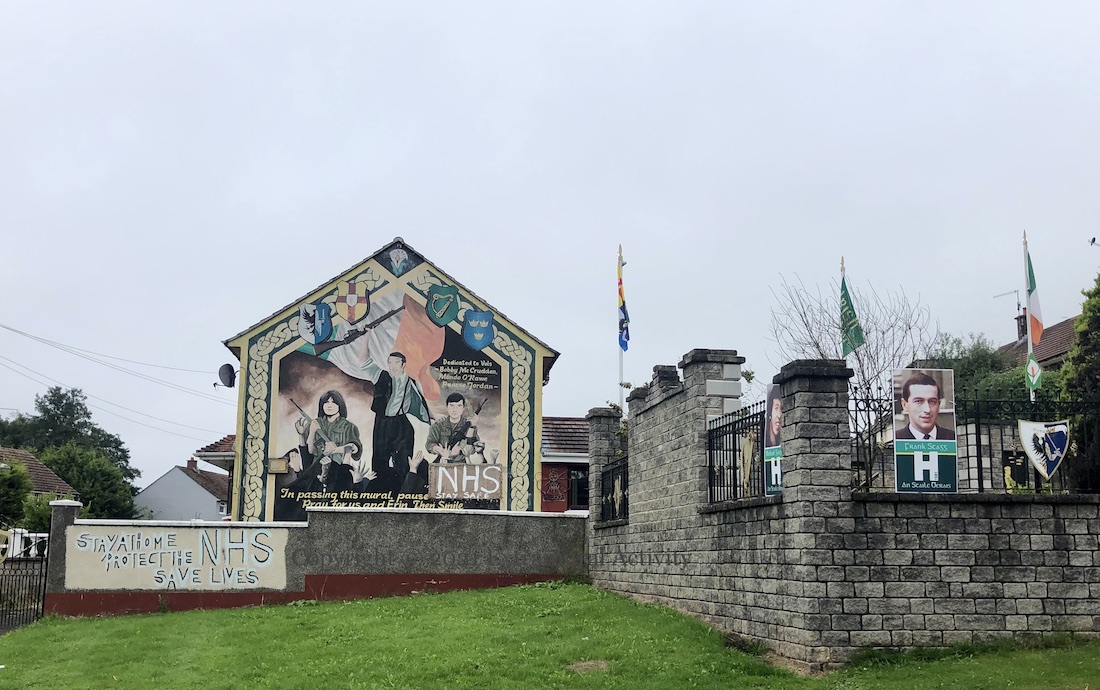
A home-made sign on cardboard “NHS – stay safe” has been attached to the mural to IRA volunteers Bobby McCrudden, Mundo O’Rawe, and Pearse Jordan, and the wall below it painted with the message “Stay home – Protect the NHS – Save lives”.
“Big Lily” is a giant (~40′ x 30′) Manchester United flag created by Whitehead man Keith Norris in 1999 as a gesture of friendship towards a fellow United fan from Belfast from the ‘other side’, Martin ‘Faceman’ Cleary. It has subsequently travelled the world – the flags shown are of Catalonia, Japan, Australia, England, the United States, Italy, Northern Ireland, Ireland, Germany, Poland, Scotland, Russia, Brazil, Spain – uniting United fans and being used to raise funds for anti-racism charity Kick It Out and Unicef. The mural is situated in no-man’s land on Northumberland Street and features the Orange lily of unionism and the Easter lily of nationalism. (Carrickfergus Times | Belfast Live | SignBigLily.com)
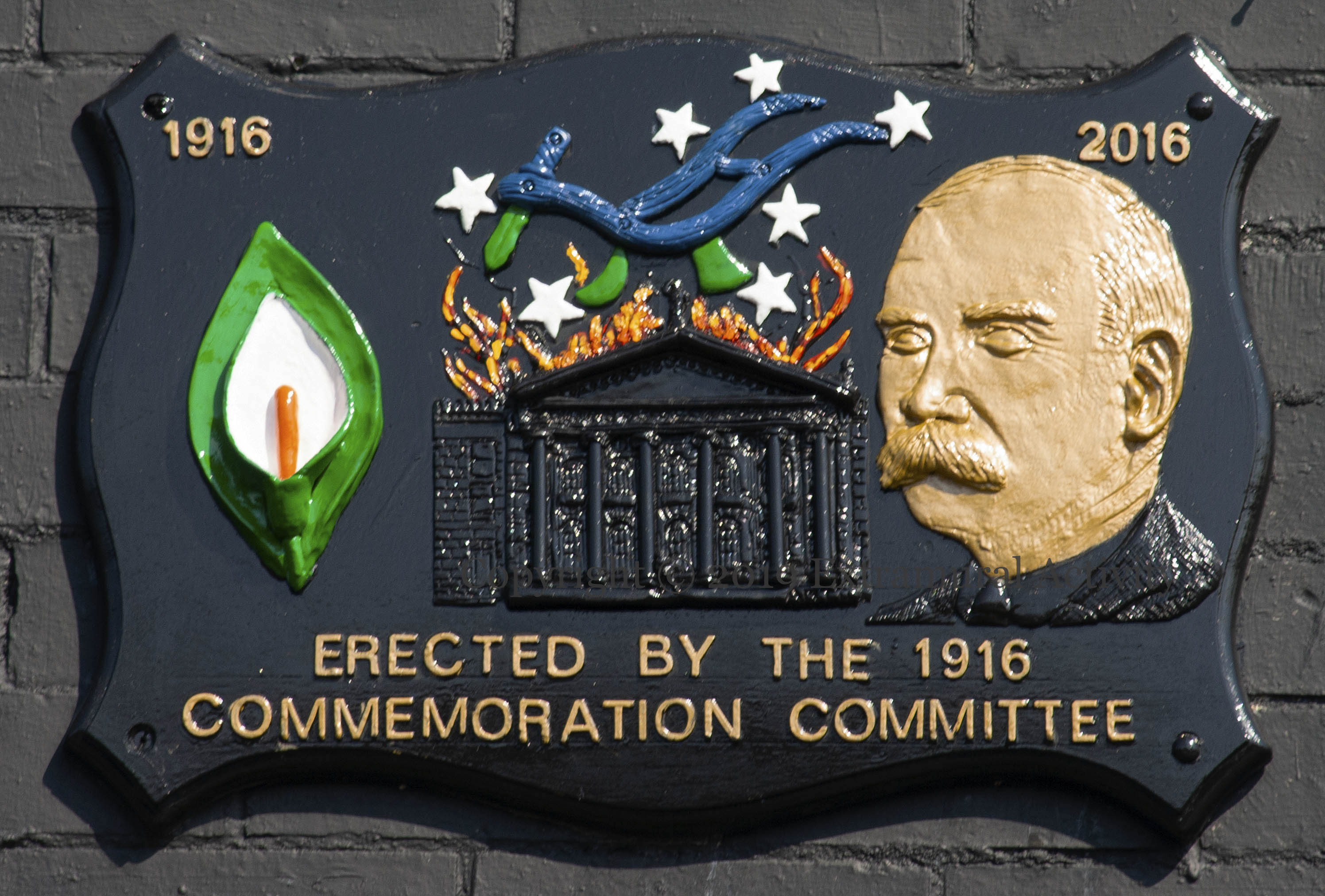
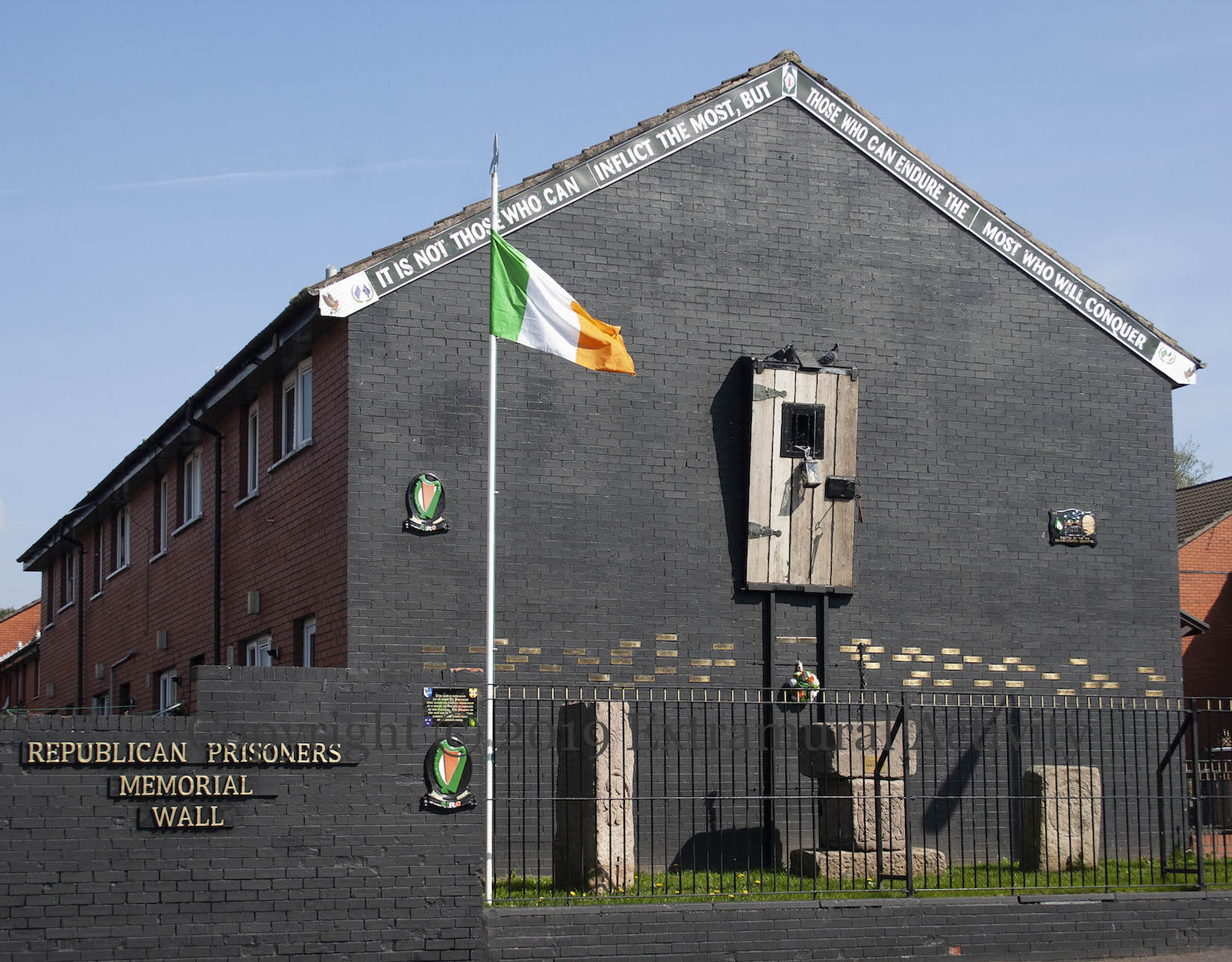
James Connolly was executed on May 12th, 1916. Both the (freshly painted) Connolly plaque shown above and the Martin Meehan mural on the adjacent wall paint the struggle of the republican prisoners and the Provisionals of the ‘Troubles’ as descendants of 1916’s Easter Rising. Several name-plaques have been added to (what is now officially titled) the ‘Republican Prisoners Memorial Wall’ compared to the number seen in September.
For close-ups of the door and sculptured rocks, see Father Time.
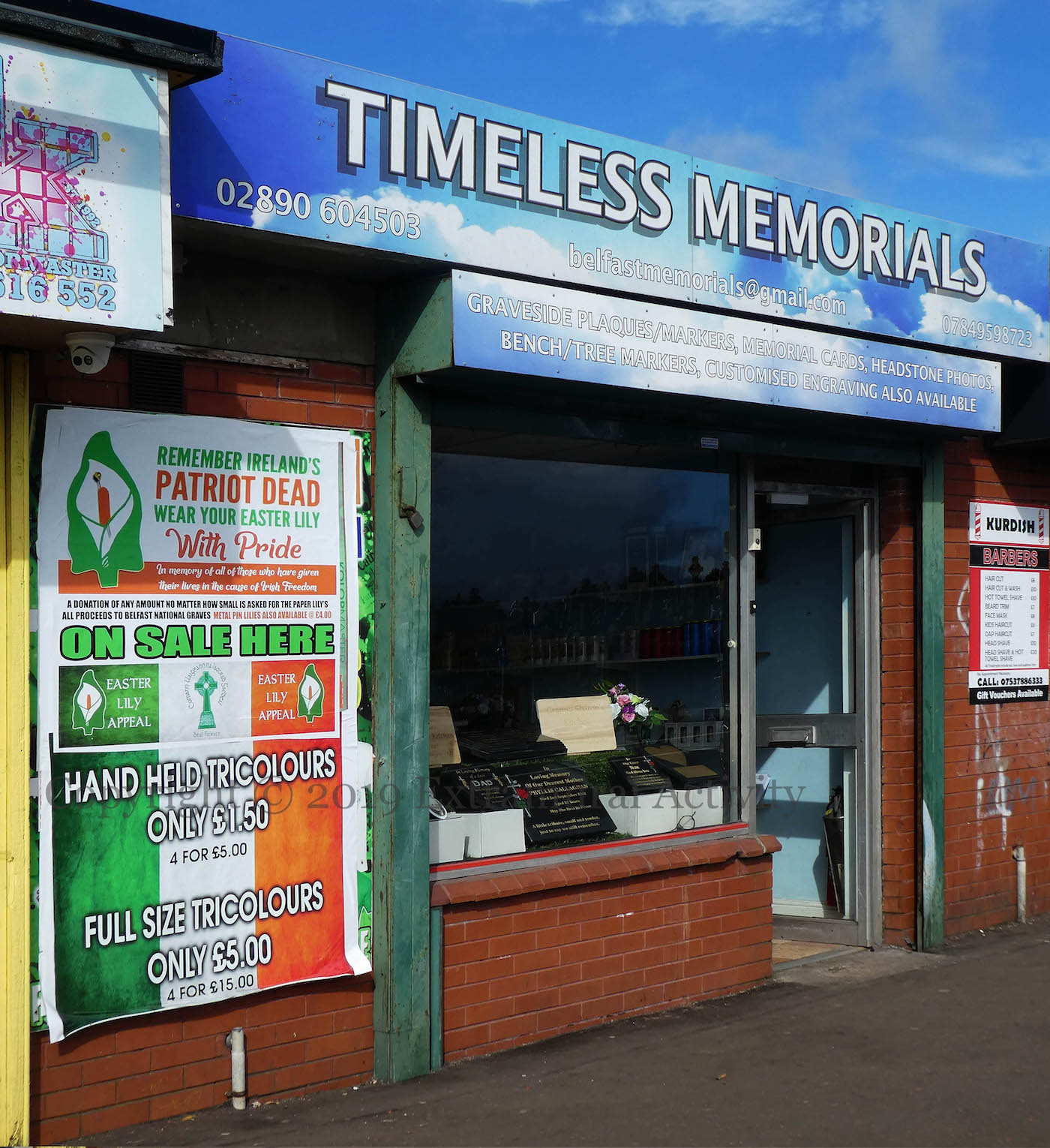
Discounts on hand-held and full-size Tricolours “in memory of all of those who have given their lives in the cause of Irish freedom” from the Milltown engravers – next to the Kurdish barbers – on the Falls Road.
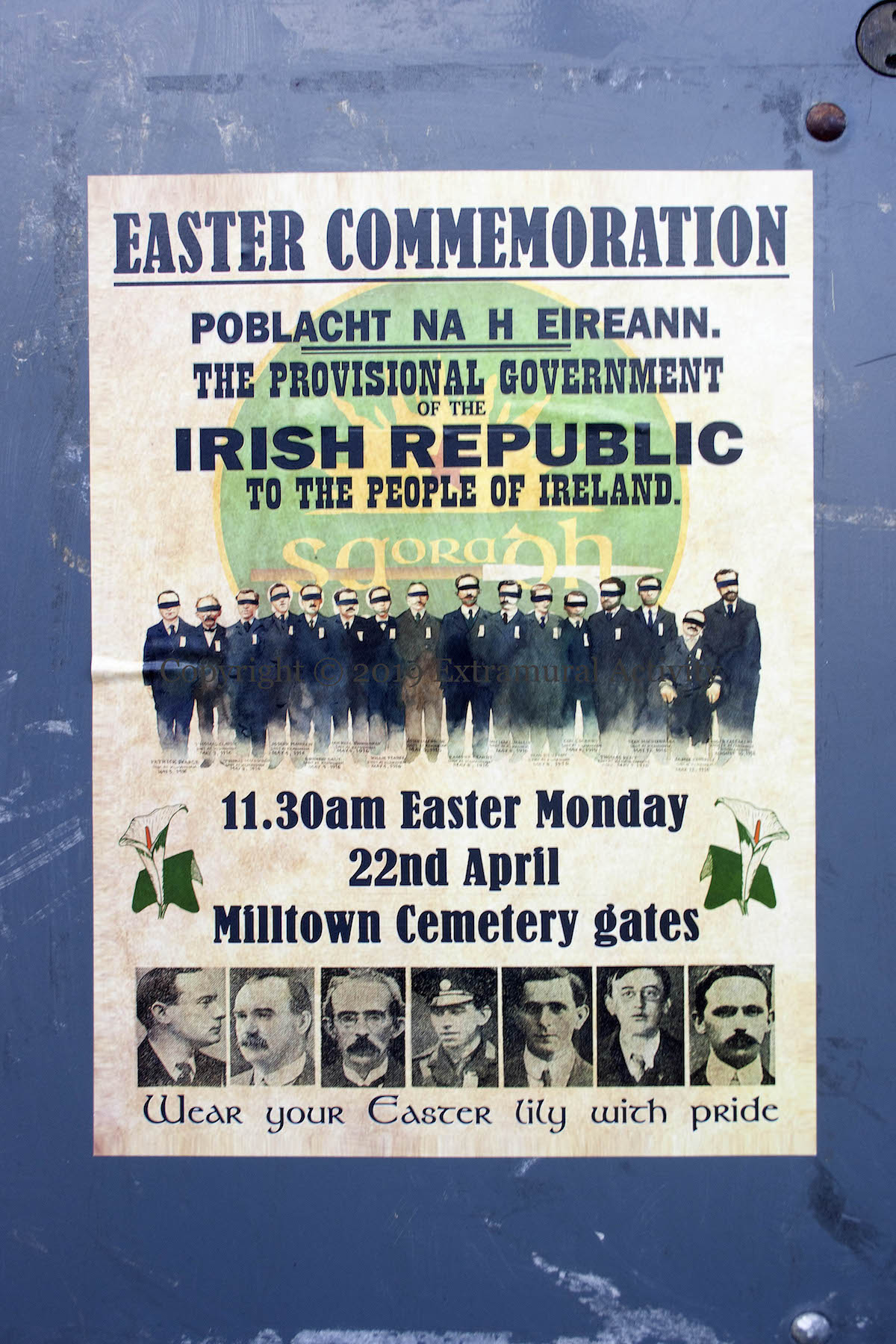
16 republicans, the seven signatories of the Proclamation among them, were executed in the wake of the Easter Rising, 14 of them in Dublin in a 10-day period from May 3rd to 12th. They are depicted in this Saoradh (web | tw) poster blindfolded and wearing suits: (from left to right) Patrick Pearse, Thomas Clarke, Thomas MacDonagh, Joseph Plunkett, Edward Daly, William Pearse, Michael O’Hanrahan, John MacBride, Éamonn Ceannt, Michael Mallin, Seán Heuston, Con Colbert, James Connolly, Seán MacDiarmada, Thomas Kent, and Roger Casement. Their deaths and the Rising are commemorated in Belfast each Easter with a parade








 Extramural Activity