Play and physical activity are promoted as aiding with mental health among Twinbrook children.
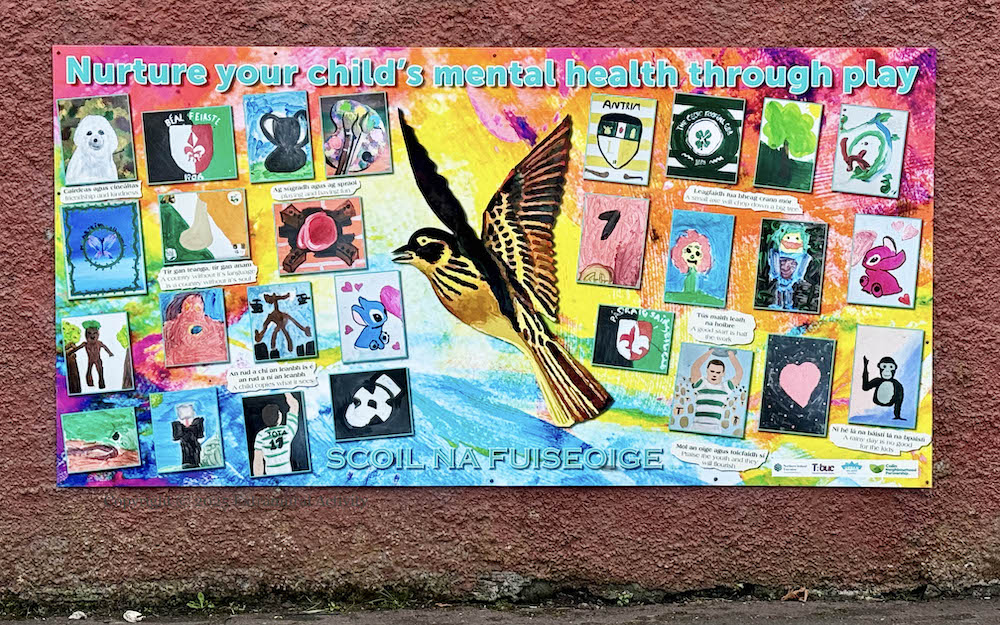
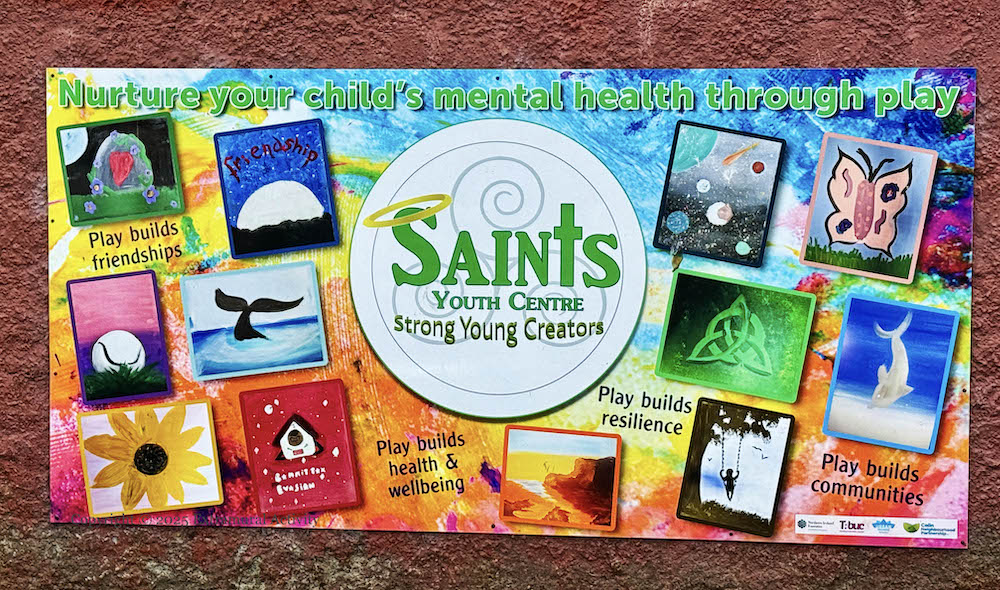
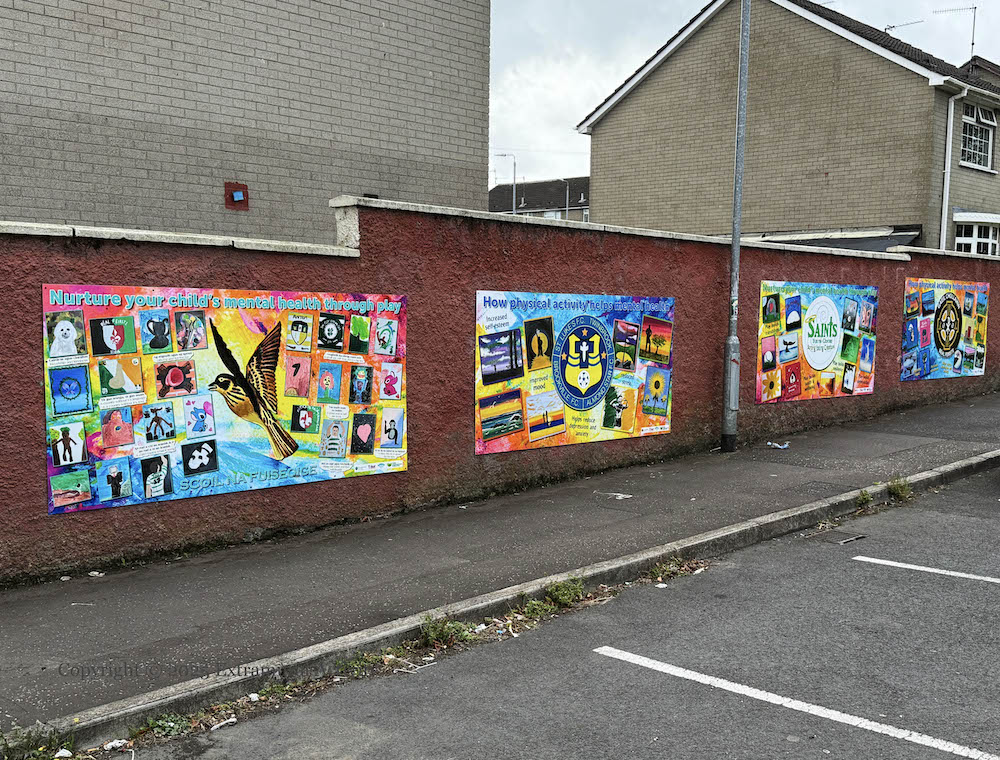
“Nurture your child’s mental health through play” at Scoıl Na Fuıseoıge and Sands Youth Centre – “play builds friendships, health & wellbeing, resilience, communities.
“How physical activity – at St Luke’s/Brookville/Almond Star FC (Fb) and Gaeıl Chollaınn CLG – helps mental health” by producing increasing self-esteem, improved mood, reduced depression, anxiety, and stress.
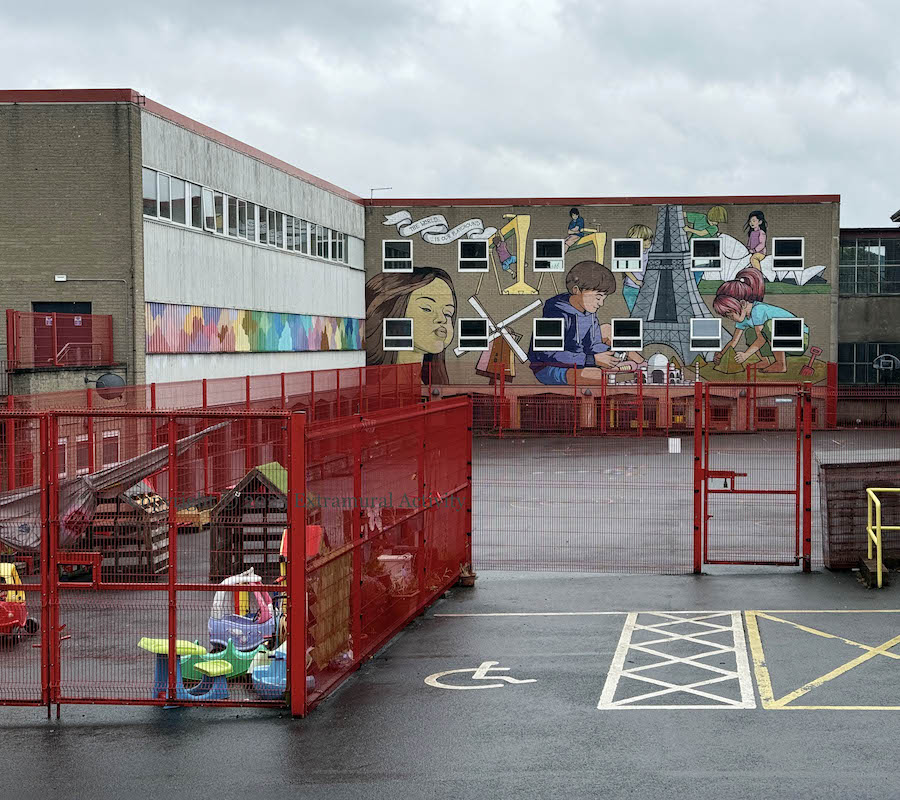
Children play among and with the landmarks of the world – riding the Sydney opera house, building the pyramids out of sand, climbing the Eiffel Tower, building the Taj Mahal from blocks, blowing on a windmill, and swinging from Samson and Goliath.
This is an old (2016) piece by Friz (web), still in excellent shape on the wall of Currie Primary school, off the Limestone Road in north Belfast.
In the post of the new Sam Rockett mural in Woodvale – Essence And Space – we said that the “peace” line separating Wyndham Street from the rest of Torrens had been taken down as the area was redeveloped from roughly 2008-2012. As can be seen from this gallery of images, however, some of the infrastructure remains, particularly the school building (former site of Naíscoil Bheann Mhadaigáin (Belfast Media profile)) and the adjacent waste-ground in Torrens Crescent, which remain undeveloped. The alley to Cliftonville is gated at both ends.
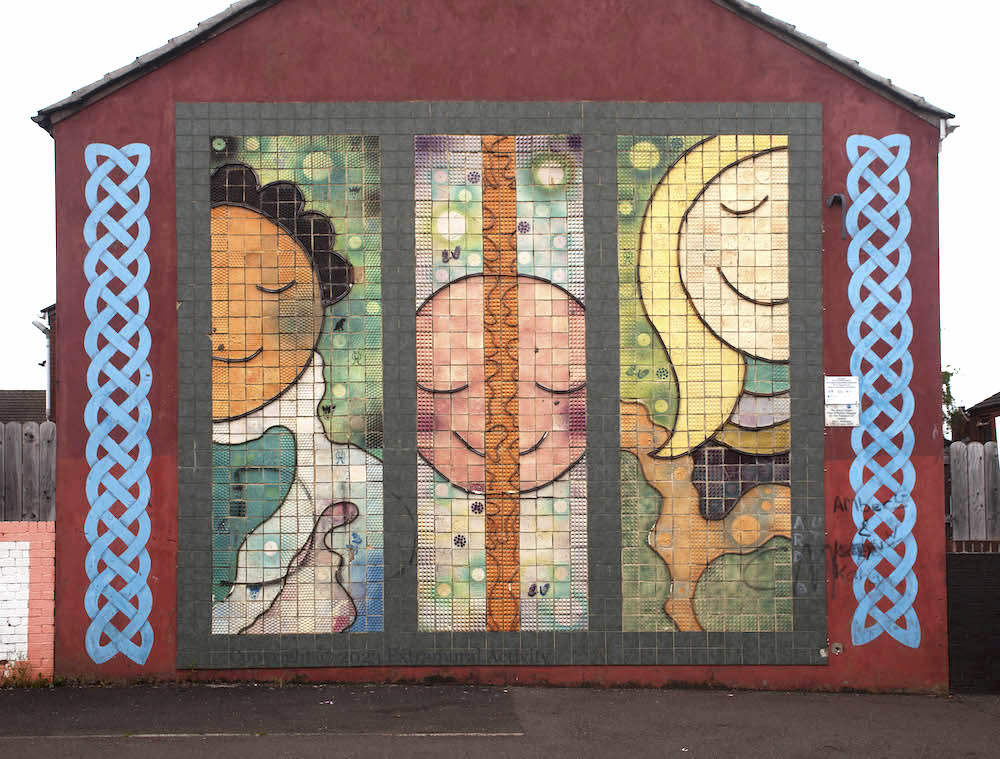
The faces of local children are rendered in ceramic tiles by Clare McComish (web), replacing a Sean McCaughey mural in Brompton Park, Ardoyne, as part of the 2009 Re-Imaging Communities project (see Visual History 10).
“Fáılte go dtí Marrowbone youth club [club óıge Mhachaıre Bothaın (Fb)] – better our community by working together.” The verbiage is a mix of Irish and English and the imagery is a mix of youth activities and … a minion.
The previous mural – which included Cliftonville (soccer) and Antrim (GAA) emblems – was seen previously in 2013 and in 2021.
“Wherever life plants you, bloom with grace.” When the Shankill Women’s Centre was first formed, in 1987, it was located in The Hummingbird on the lower Shankill (SWC). (When the Wellbeing Centre was built on that site, the Women’s Centre moved further up the Shankill to its current location in the Hammer.) A hummingbird features in one of the paintings on the hoarding around the construction site of a new “Shankill Shared Women’s Centre” on Lanark Way, a 6.5 million euro project funded by PEACE IV (Belfast CC).
This is a new mural on the Ballysillan Road by MWAK/Pigment Space (ig) close to the Boys’ Model and featuring a student at the centre of symbols of learning – a film camera in the top left; Hokusai’s Great Wave in the top right, for art; Titanic (for engineering?) and a thermometer (for chemistry? or global warming?) on the right; musical notes in the bottom right; sports in the bottom left. The dates on the left are obscure. “1971” is perahps for the year the school won the Schools’ Cup in rugby (News Letter); there is a soccer ball next to “1996” but no similar victory can be found – get in touch if you can supply a meaning.
“Pobal ag foghlaım, pobal ag forbaırt, pobal ag fás” [a community learning, developing, growing]
Students from “Naíscoıl & Gaelscoıl An Lonnáın (Fb) bun[aithe] 1999″ [Nursery-school and Irish-language [primary] school of the loney, founded 1999] are shown playing Gaelic games, Irish dancing, and playing traditional instruments (and the guitar). On the left are representations from Irish mythology: the Children Of Lear and Setanta killing Culann’s hound (and taking the name Cú Chulaınn in taking its place), along with hedge-row school (see Hedge Row School).
The origin of the name is unclear; the nearest loney [lane] was the “Pound” loney, so-called because of the animal pen just outside Barrack Street, used to store livestock before moving on to the markets the following day (Rushlight | Uachtar Na bhFál). (The Pound Loney is included in the mural in Durham Street – see Et In Arcadia Ego.)
The other well-known loney in Belfast is the “buttermilk loney” which was either/both what is now Ballysillan Park (that is, connecting Olpark with the horsehoe bend) or the top part of the loney that connected Wheatfield (the top of Ardoyne) to the Ligoniel junction and on towards the old Ligoneil House (there are a mixture of usages in this Belfast Forum thread); this image from the 1930s might show the lane in (what was still at the time) the hills above Oldpark; a new housing-development towards the top of the Ballysillan Park is euphemistically called “Buttermilk Loney”. (It is also said to have been a prior name of Skegoniell Avenue (Belfast History).)
(The Uachtar Na bhFál page also mentions “Turf” loney, “Mountain” loney, and “Killoney”.)
The history of the Irish word “lonnán” is unclear. Uachtar na bhFál says the word is of Scots origin (perhaps as “loanin”). (See this BelTel article on the opening of the Ulster-Scots centre in 2014.) Spelled “lonnen”, it is also a Geordie word (Heslop’s Northumberland Words | wiktionary). The Irish News and Belfast Live, working from the same (uncited) press-release about Páırc An Lonnáın (which is along the Westlink below Raıdıó Fáılte), state that “loney” comes from the English word “loaning”. The Irish word “lonnán” does not appear in Dinneen 1904; Dinneen 1953 defines it (hyper-specifically) as “a grassy recess running up into high basaltic cliffs”.
“Our revenge will be the laughter of our children” – The words of Bobby Sands are illustrated on an electrical box on the Whiterock Road, Belfast, with silhouettes of children at play in nature.







 Extramural Activity