A trio of international causes aimed at the visiting Joe Biden, president of the United States, from Gael Force Art and People Before Profit. What’s new here is the “No 2 NATO” under the Irish Tricolour. The other two parts have been on the mountain previously: the Cuban flag with “unblock Cuba” reprises the maassive Cuban flag on the mountain in 2021, which was depicted in the La Solidaridad Invariable mural onDivis St, and the Palestinian flag with “BDS” [Boycott, Divestment, Sanctions] in 2018’s #BDS.
“Joe Biden, globalist. Not welcome in Ireland.” Joe Biden landed in Belfast yesterday and was greeted by Prime Minister Rishi Sunak (Bel Tel | Reuters). This morning, he will deliver at the Belfast campus of UU, before heading south to Louth, Dublin, and Mayo (Journal).
This is an Ógra Shinn Féin (ig | web – youth division of Sinn Féin Poblachtach) sticker in Divis Street; they also have a “Joe Biden, warmonger” version (tw).
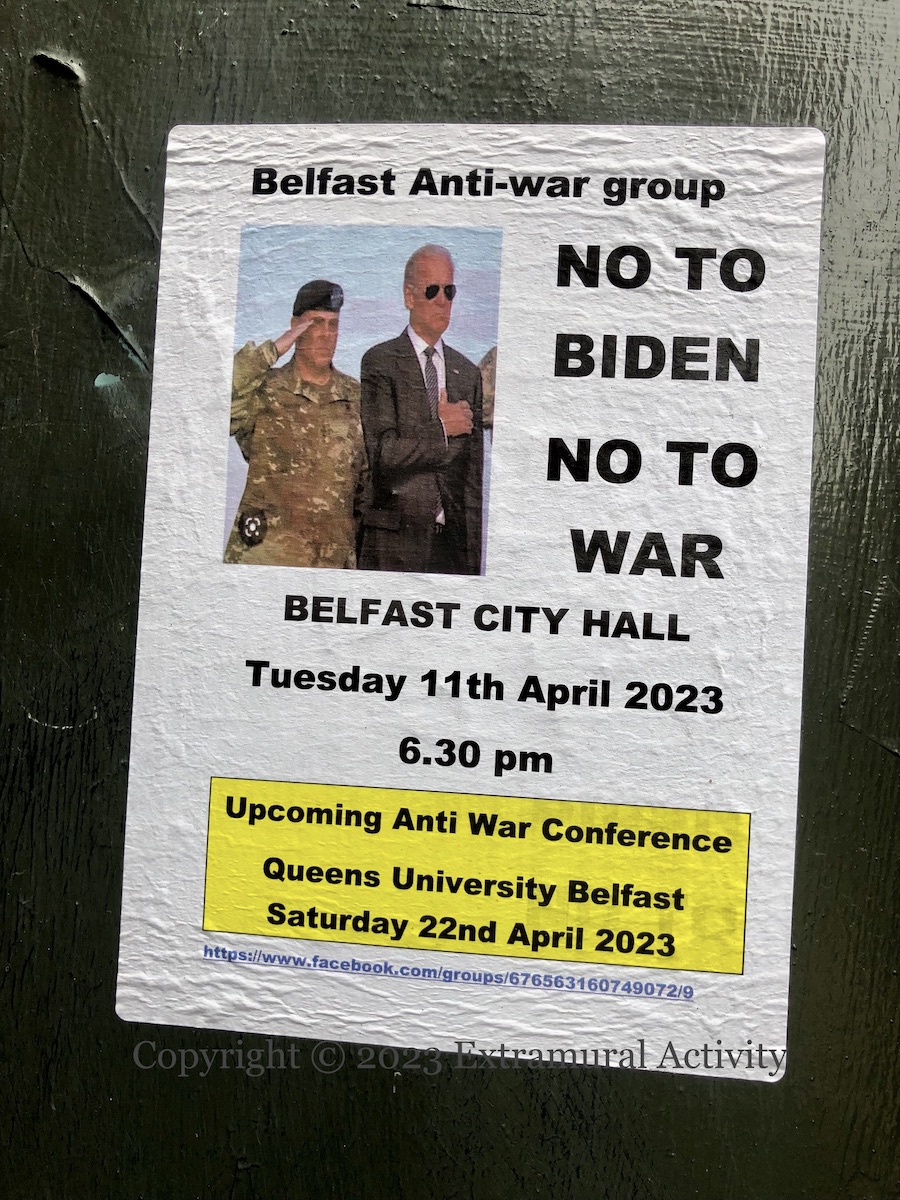
In the same vein is the poster below from the “Belfast Anti-war group” advertising rally outside city hall and an upcoming conference at Queen’s: “No to Biden, no to war”
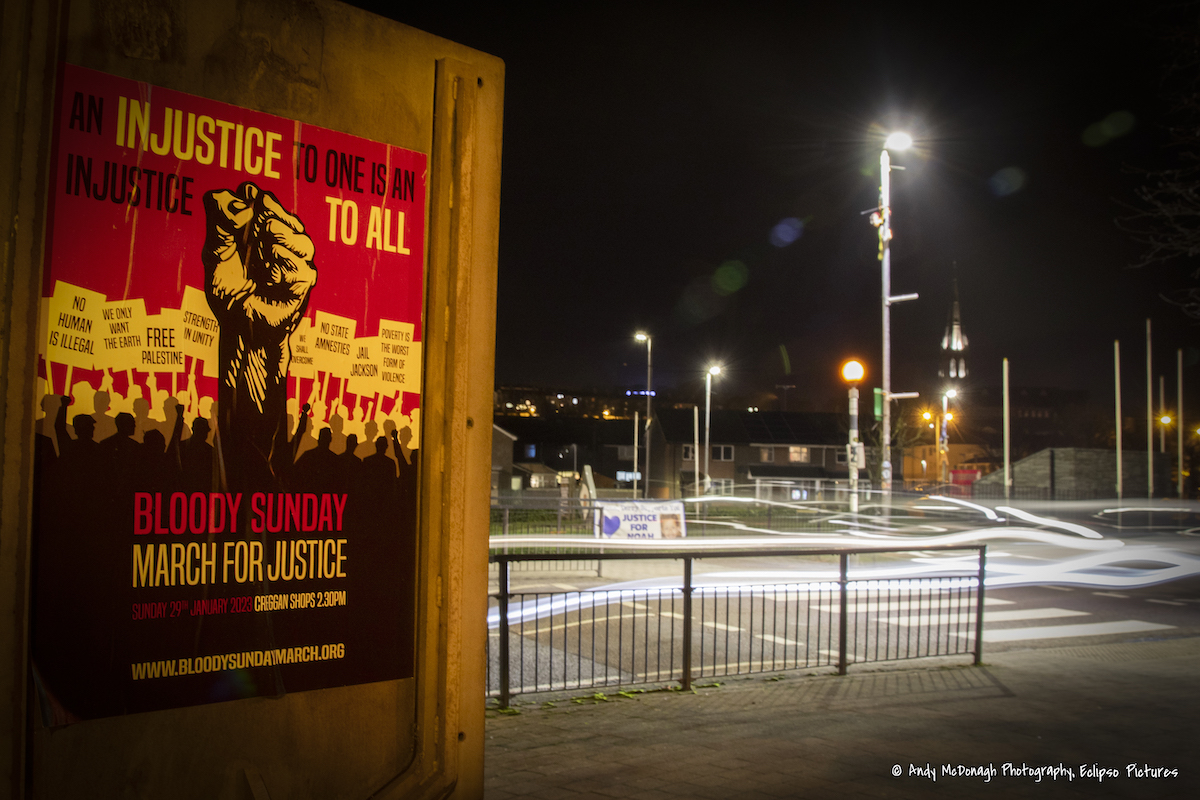
In his Letter From A Birmingham Jail, Martin Luther King Jr wrote, “I am cognizant of the interrelatedness of all communities and states. I cannot sit idly by in Atlanta and not be concerned about what happens in Birmingham. Injustice anywhere is a threat to justice everywhere.” The marchers portrayed in the poster above carry placards supporting immigrants (“No human is illegal”), the poor (“Poverty is the worst form of violence”) and Palestine. The poster calls for participants in the annual march, which retraces the route taken on the fateful day in 1972, beginning at Creggan shops and proceeding to Free Derry Corner. Yesterday’s march concluded a week of talks and other commemorative events. Today – January 30th – is the fifty-first anniversary of Bloody Sunday in Derry.
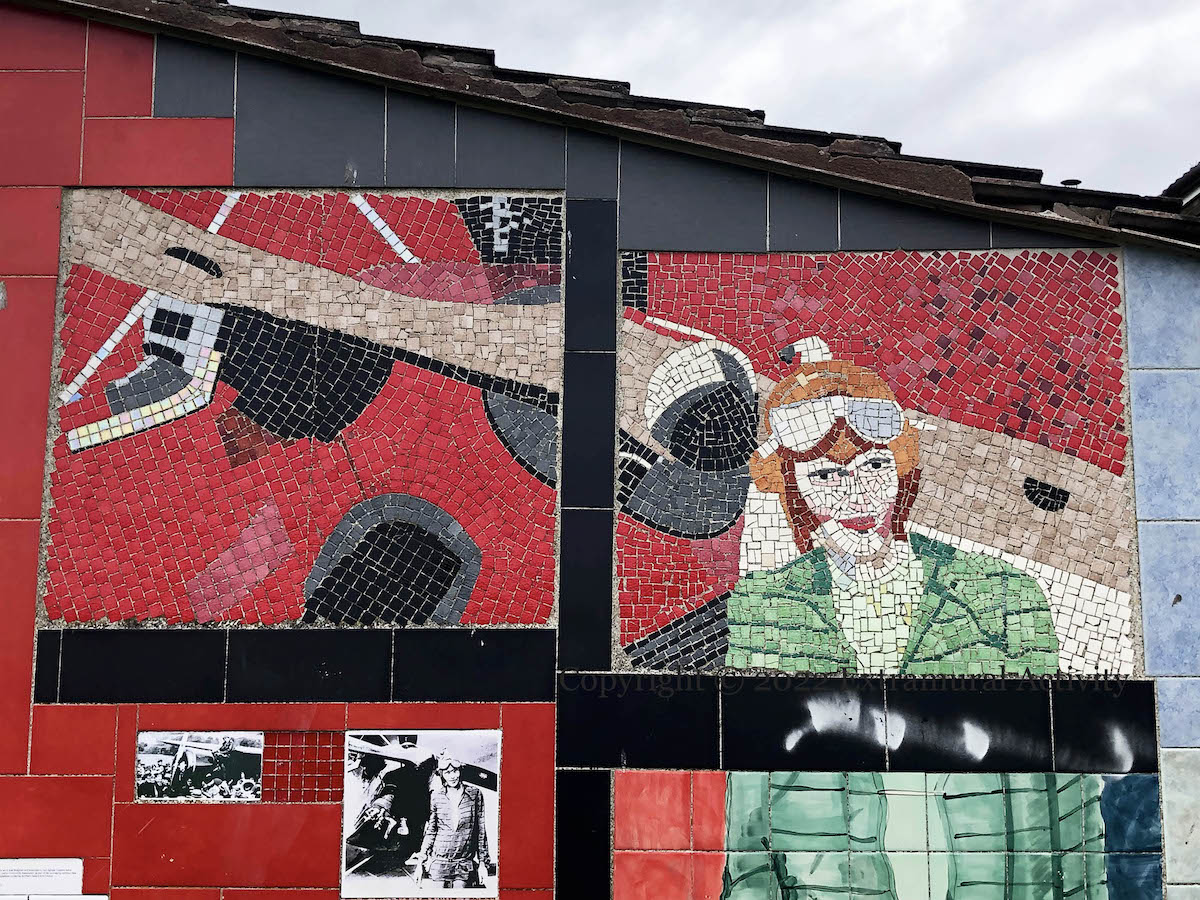
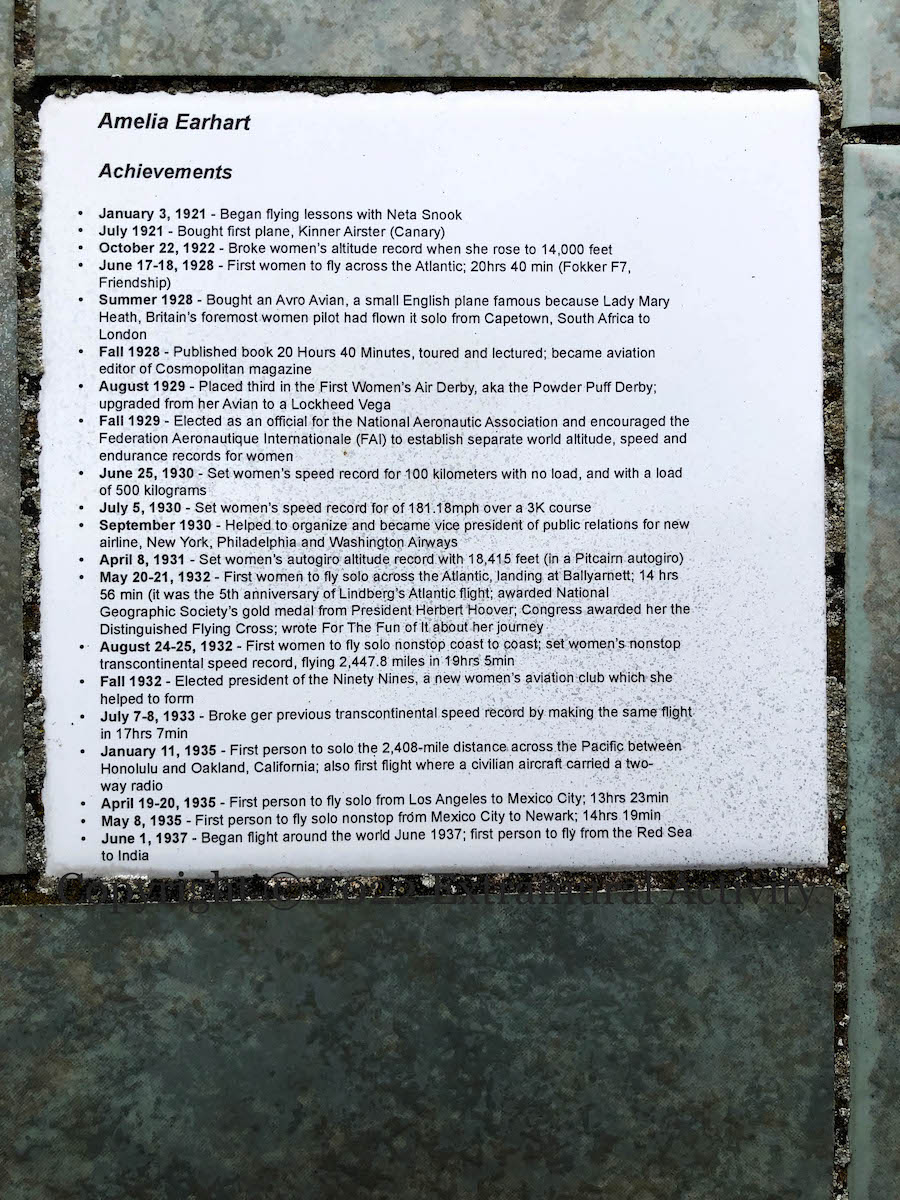
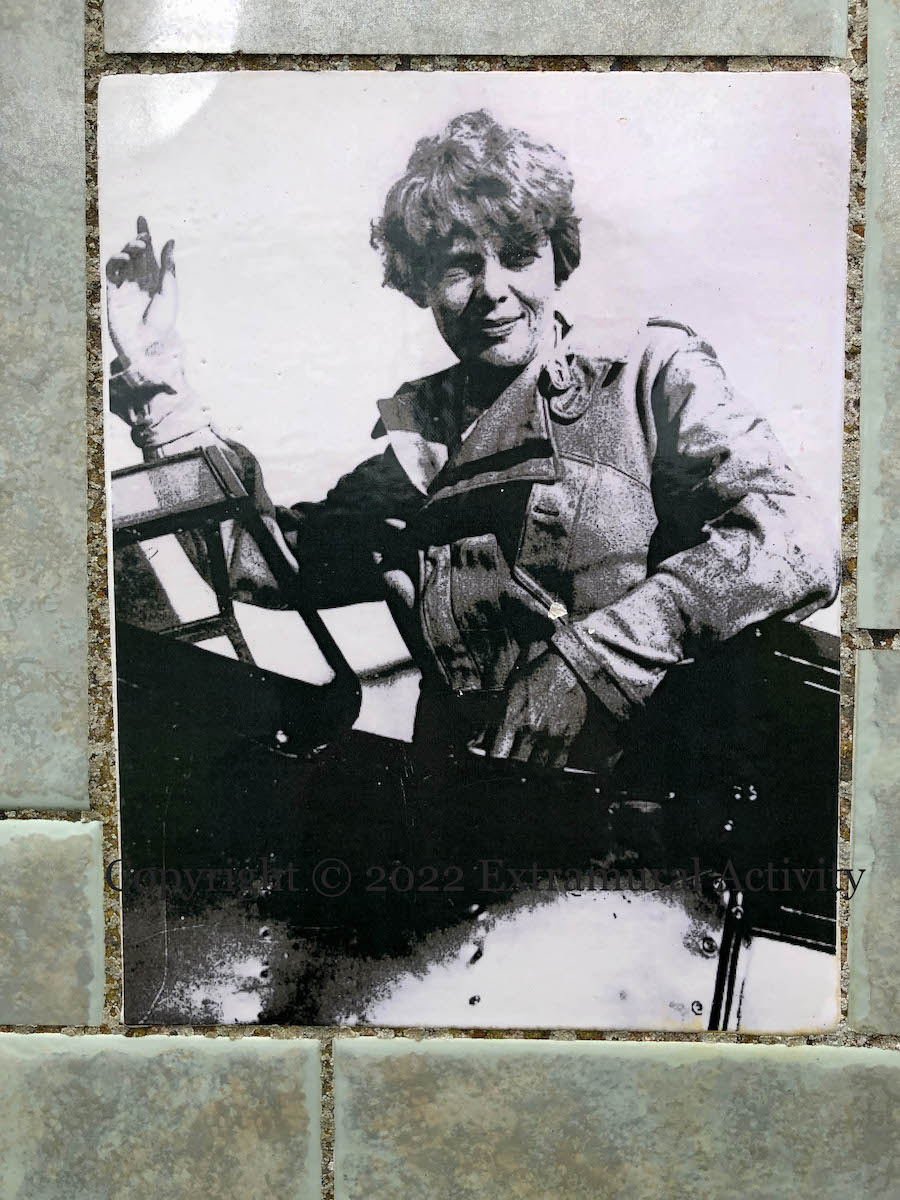
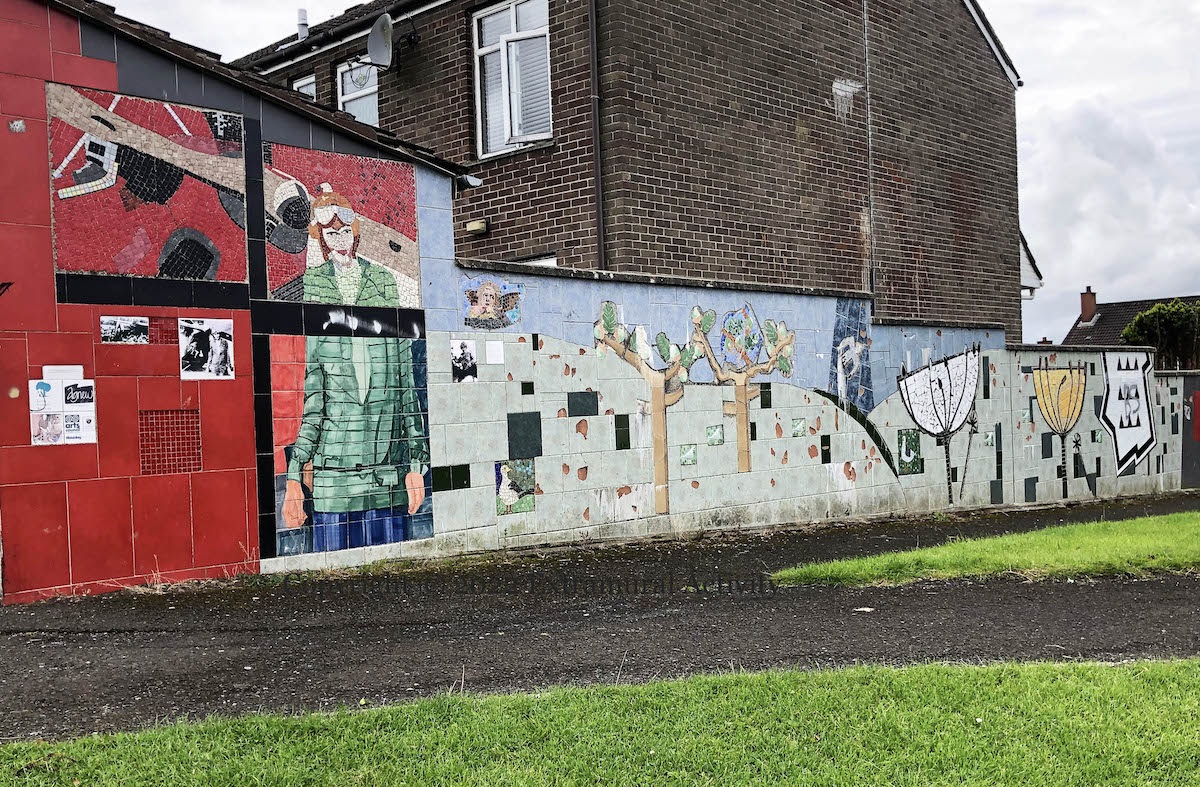
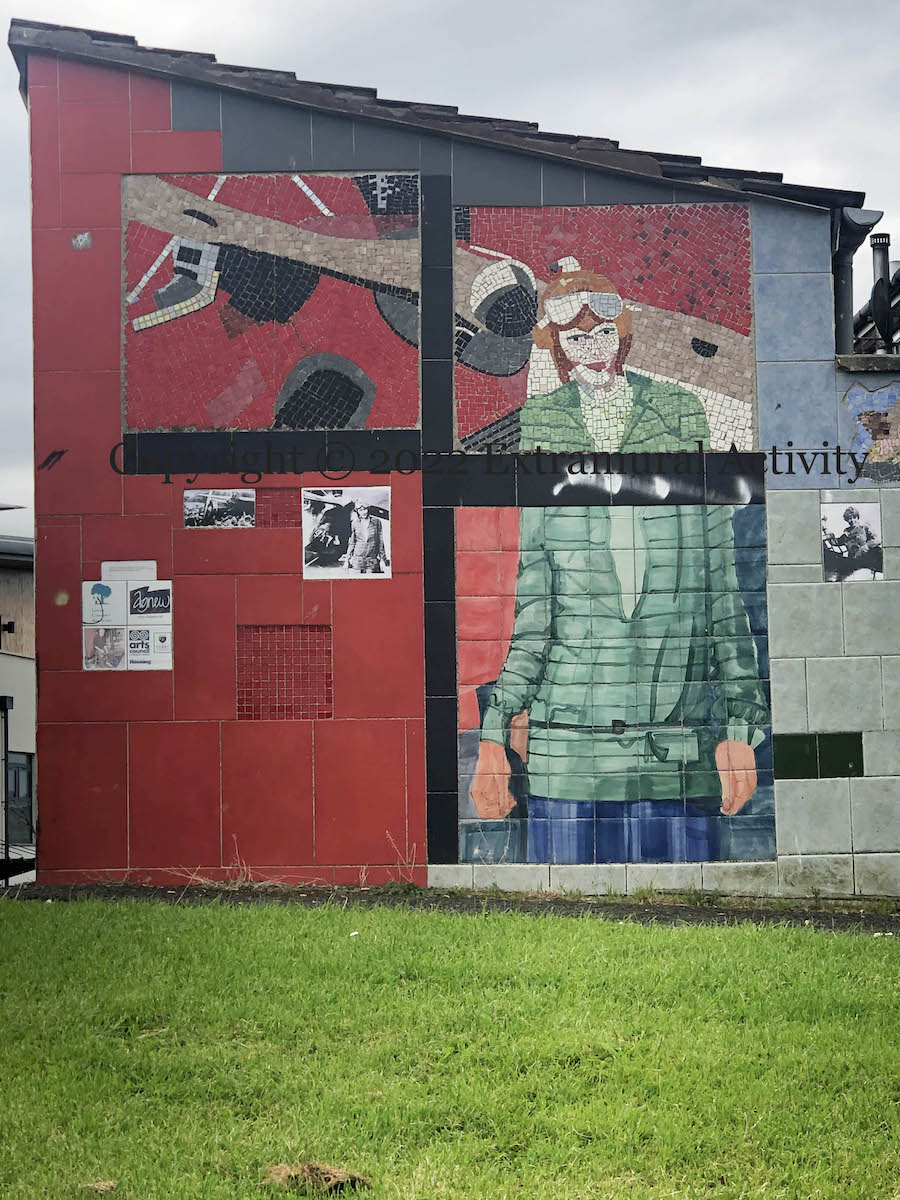
On May 20th, 1932, Amelia Earhart took off from Harbour Grace in Newfoundland hoping to be the first woman to fly single-handedly across the Atlantic and make it to Paris. It didn’t go entirely to plan. Fifteen hours later, however, she landed in Robert Gallagher’s farm in Ballyarnett, forced down by bad weather and technical problems. The farmer’s wife recorded her recollections of the event, three years later (youtube).
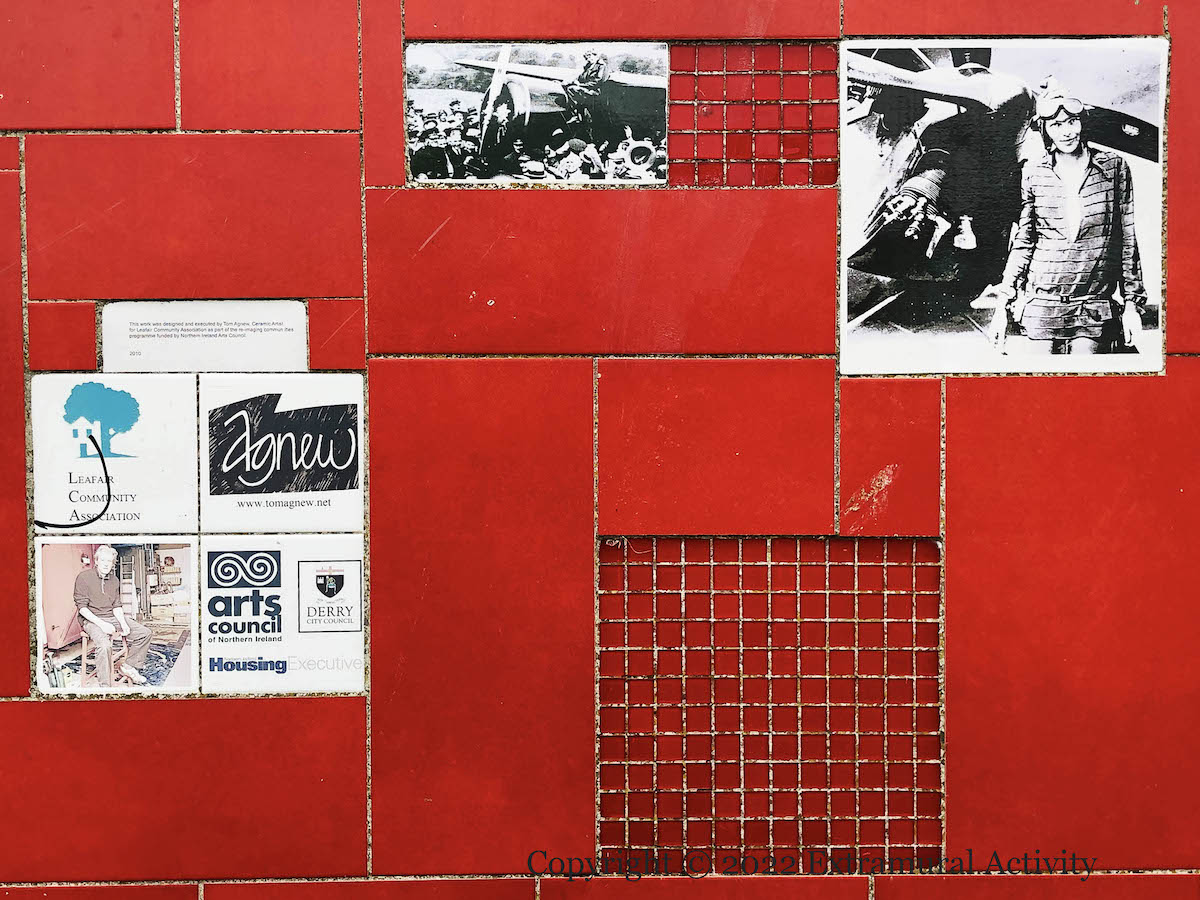
“This work was designed and executed by Tom Agnew, Ceramic Artist, for Leafair Community Association (Fb) as part of the re-imaging communities programme funded by the Northern Ireland Arts Council – 2010.”
Here are various IRPWA (tw)/Saoradh (web)/Éıstıgí (Fb) statements in Derry’s Creggan and Bogside.
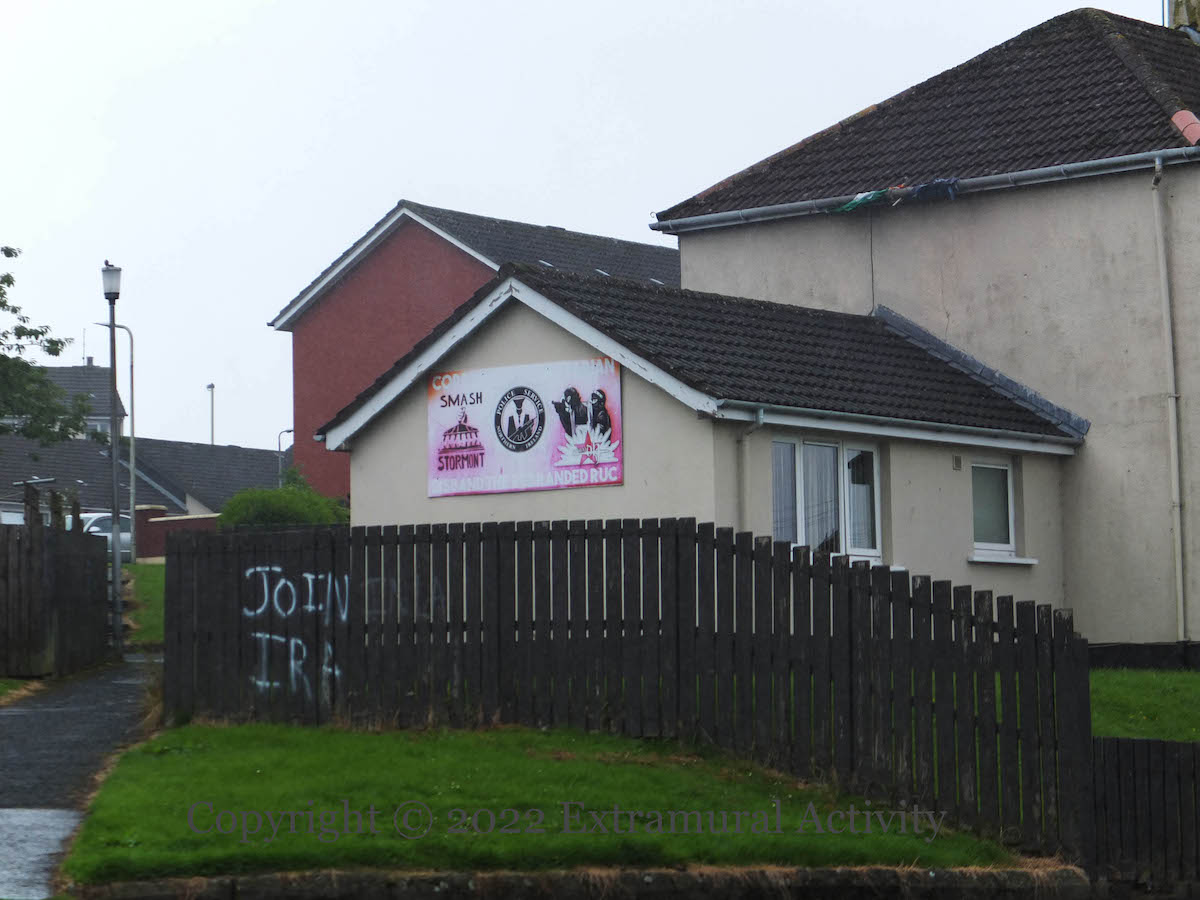
Above, in Iniscarn Road, “Irish republican prisoners still interned within British Gaols in Ireland”. Below that, two from Central Drive, “Support our hunger strikers in Ireland” (explained in Are You On The Side Of The 2020 Hunger Strikers?) and an aging “Disband the rebranded RUC” (seen previously in 2019).
And at the bottom, two from Westland Street, “Irish republican solidarity with Palestine” (described in a north Belfast appearance) and “Salute the men and women of violence” (for which see Her Old Tradition Of Nationhood) and one from the gaggle of boards next to Free Derry Corner: “Support republican prisoner”.
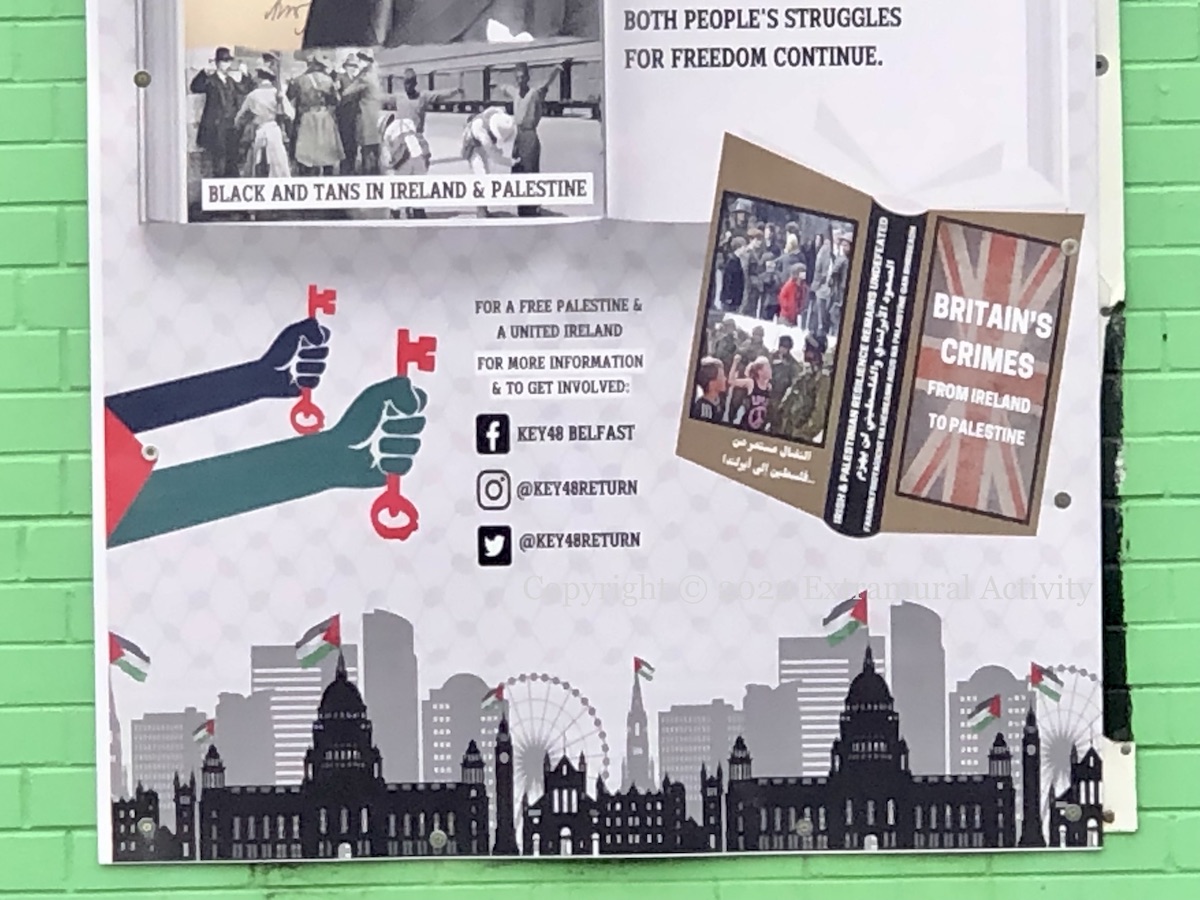
“Britain in Palestine & Ireland” The Balfour Declaration of November 1917 is seen as a pivotal moment in the history leading to the what is formally known as the State Of Israel, as it made the UK the first major government to endorse the idea of a homeland for Jews (WP).
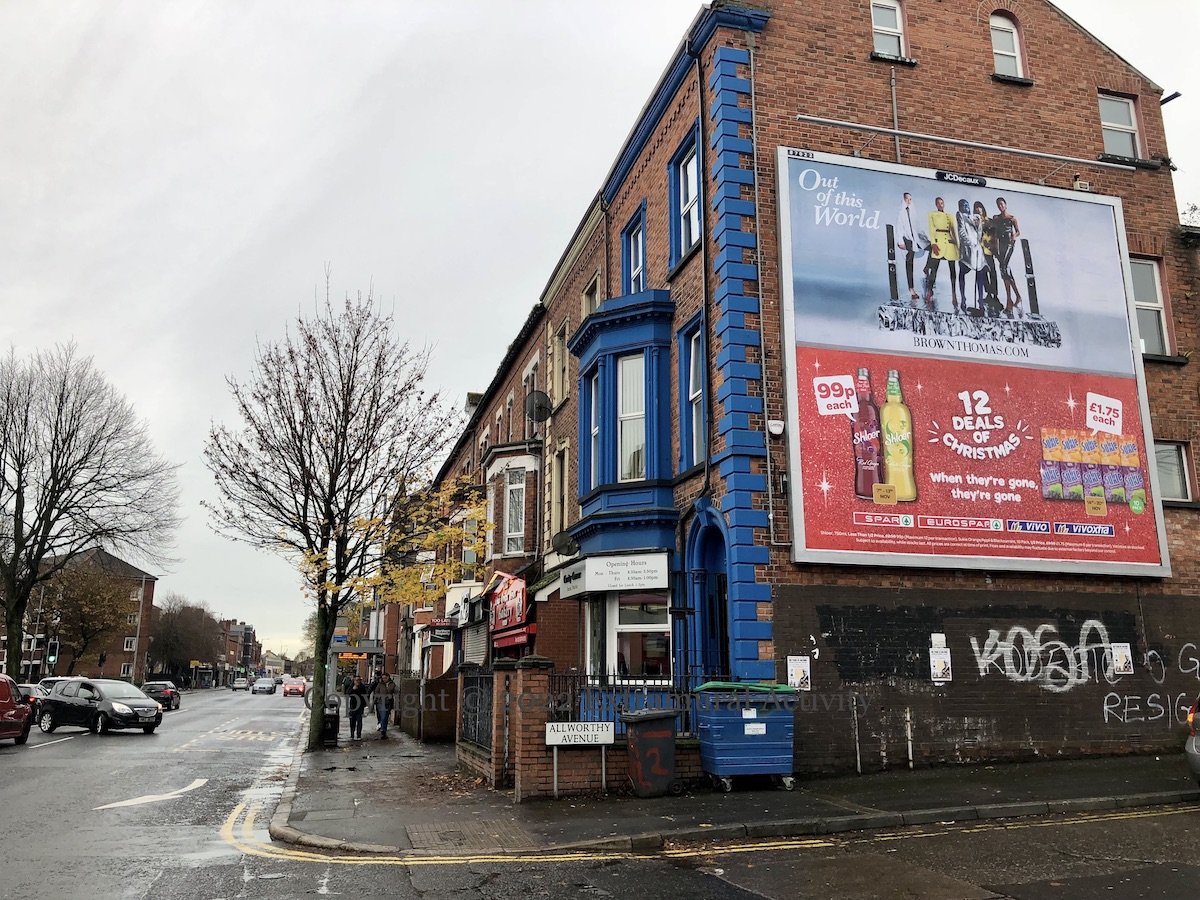
The poster (for a talk in Cultúrlann) is in Allworthy Avenue; the board is on Northumberland Street. The latter draws parallels between Ireland and Palestine: homelands partitioned for British imperialist interests, struggles for freedom met with British barbarism … forbidden from speaking their native tongue, faiths outlawed … . About 650 former RIC members were recruited to the “British Gendarmarie” that would police what was called “Mandatory Palestine” (Palestine Studies | Irish History) after WWI.
The League Of Nations mandate putting the UK in change of the Palestinian territory was replaced (in 1947) by a UN plan for partition, which triggered an internal war between Jews and Arabs, and when the UK ended the mandate and evacuated from Palestine in May 1948, Israel declared independence and neighbouring Arab states entered the conflict. About 700,000 Arabs were displaced during the fighting. Key48 (tw) advocates for the right of return and uses as a symbol the keys that householders took with them when they fled.
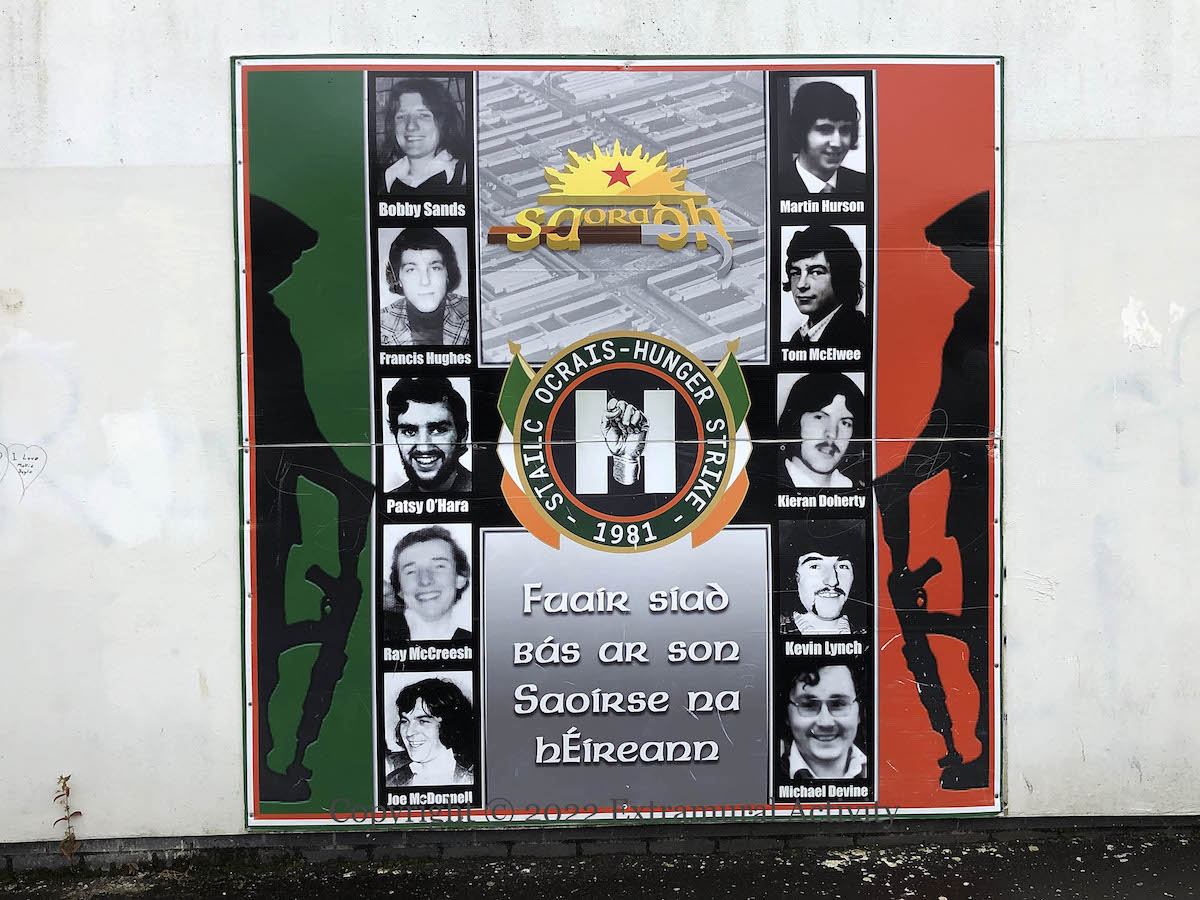
Creggan sports centre opened in October 2009 (Leisure Opportunities) and part of the architecture was to cover the brick exterior with five plain-white panels along Central Drive. These have been taken over by Saoradh/IRPWA, this year to protest the extradition, internment, and treatment of republican prisoners, commemorate the 1981 hunger strikers, support Palestine, and threaten drug dealers.
Here are two tree-plantings around Free Derry Corner. First (above) is the olive tree representing solidarity with Palestine. March 30th, 2022 was the 46th anniversary of Land Day, a day of general strikes and protests against an Israeli plan to confiscate about 5,000 acres of land in the Galilee, in order to settle Israelis there and alter the demographics in the area. In the rioting that broke out, six people were killed by IDF and police. (WP) “This olive tree was planted on the 30th March 2022 to commemorate Land Day in Palestine and the shared struggle between Ireland & Palestine” (Derry Journal report on the day’s events.)
Second (below) Crann Na Saoırse is a Sınn Féın initiative (tw | e.g. Fb) to plant trees that will “grow tall in a free United Ireland”.
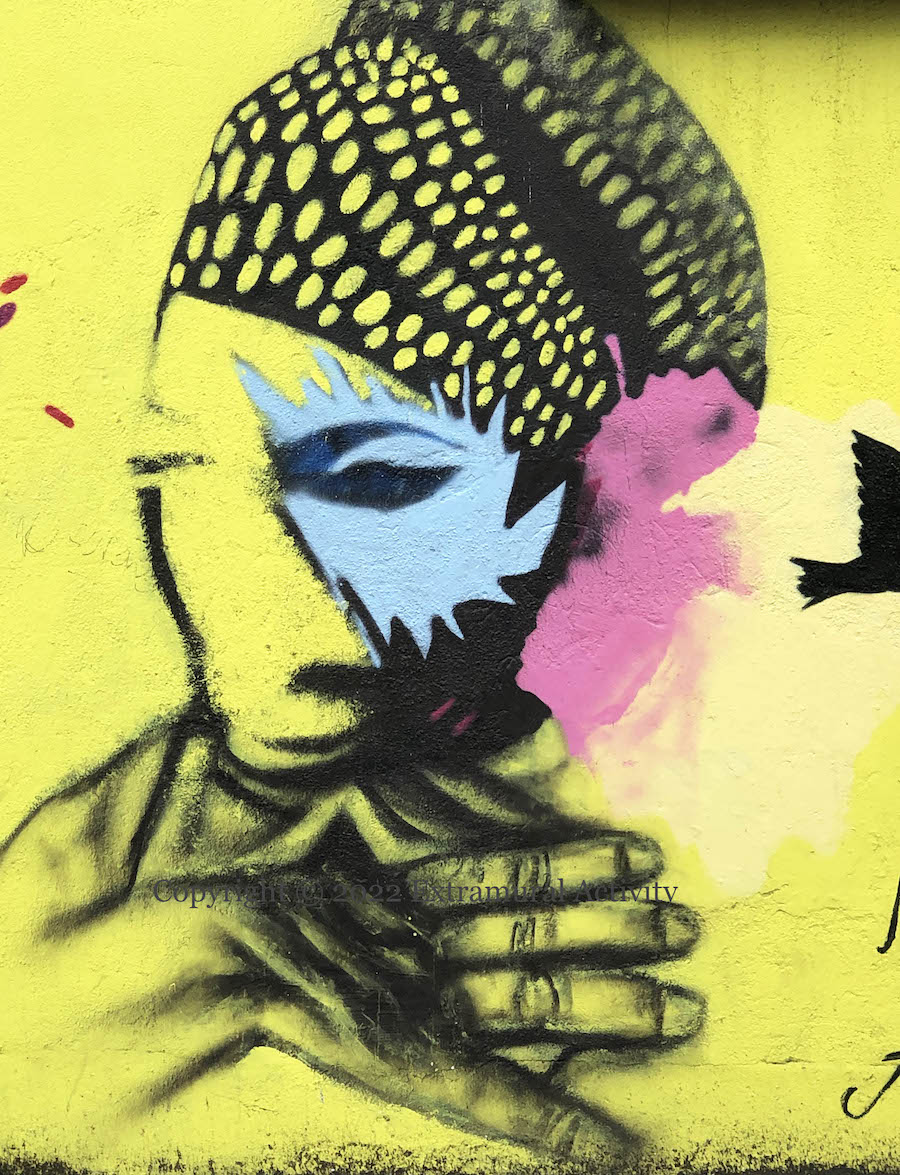
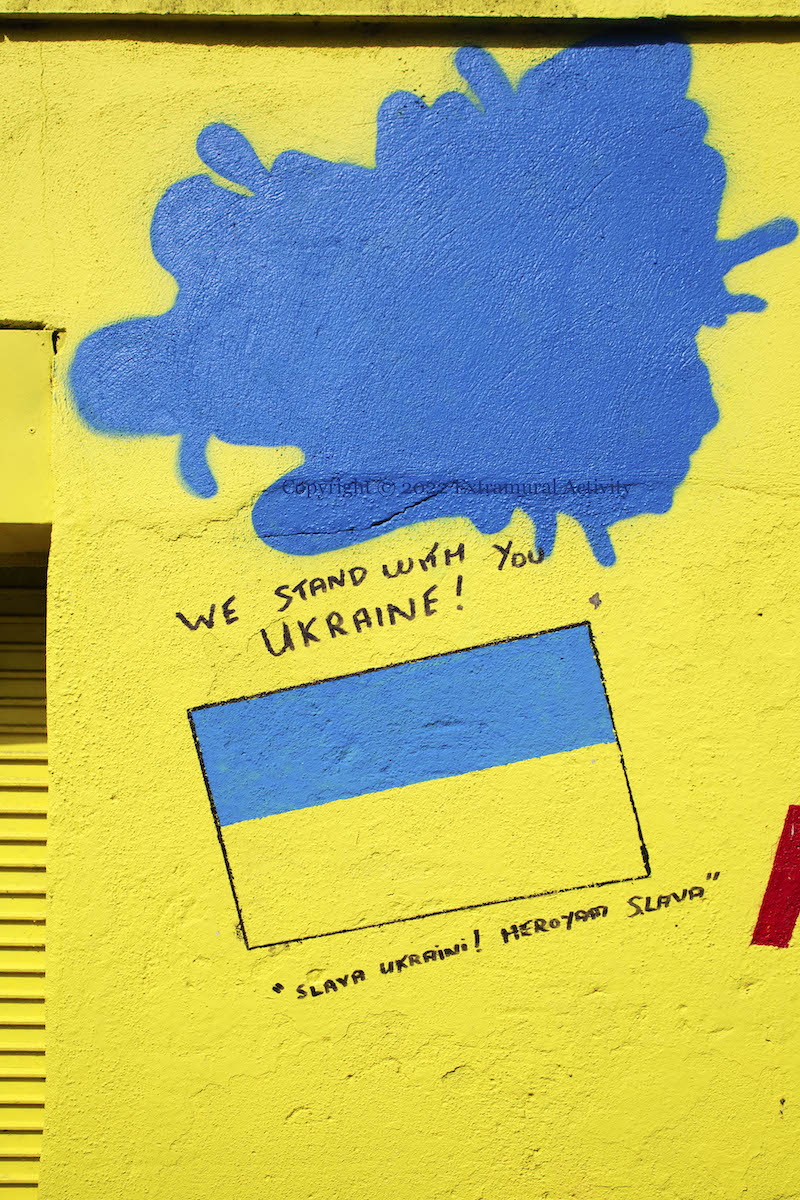
“… but we must not be defeated.” Racists graffiti was added to the Maya Angelou mural in Dundela Avenue shortly after it was painted last July (Belfast Live). The repairs got rid of the graffiti and restored the lettering but the face was not restored to its original condition. The mural has remained intact since then and the yellow background provides an ideal surface for the Ukrainian flag and words of support: “We stand with you, Ukraine!” and “Slava Ukraïni – heroyam slava! [Glory to Ukraine – to the heroes, glory!]”
The quote is attributed solely to Angelou and appears to come from her personal writings (Order Out Of Chaos); she died in 2014 (Independent).
Commissioned by David Holmes, designed by Jody Hackett and painted by Glenn Molloy in 2021.















 Extramural Activity