The image above of Long Kesh/HMP Maze is by Michael Mullen. The piece is paint on board; the autographs of all of Mullen’s fellow inmates in Cage 18 are on the reverse. The work is in the Eileen Hickey Republican Museum on Conway Street.
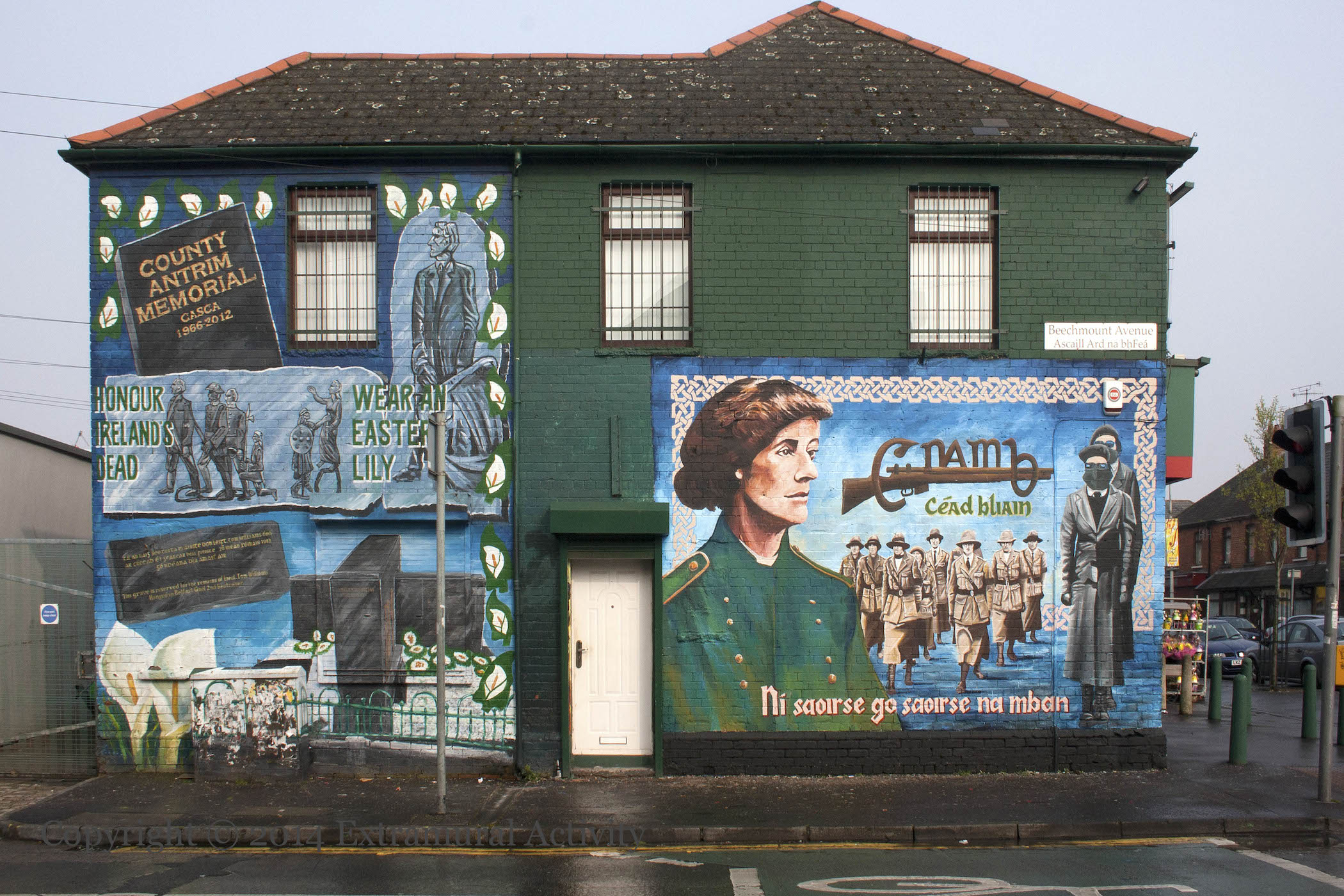
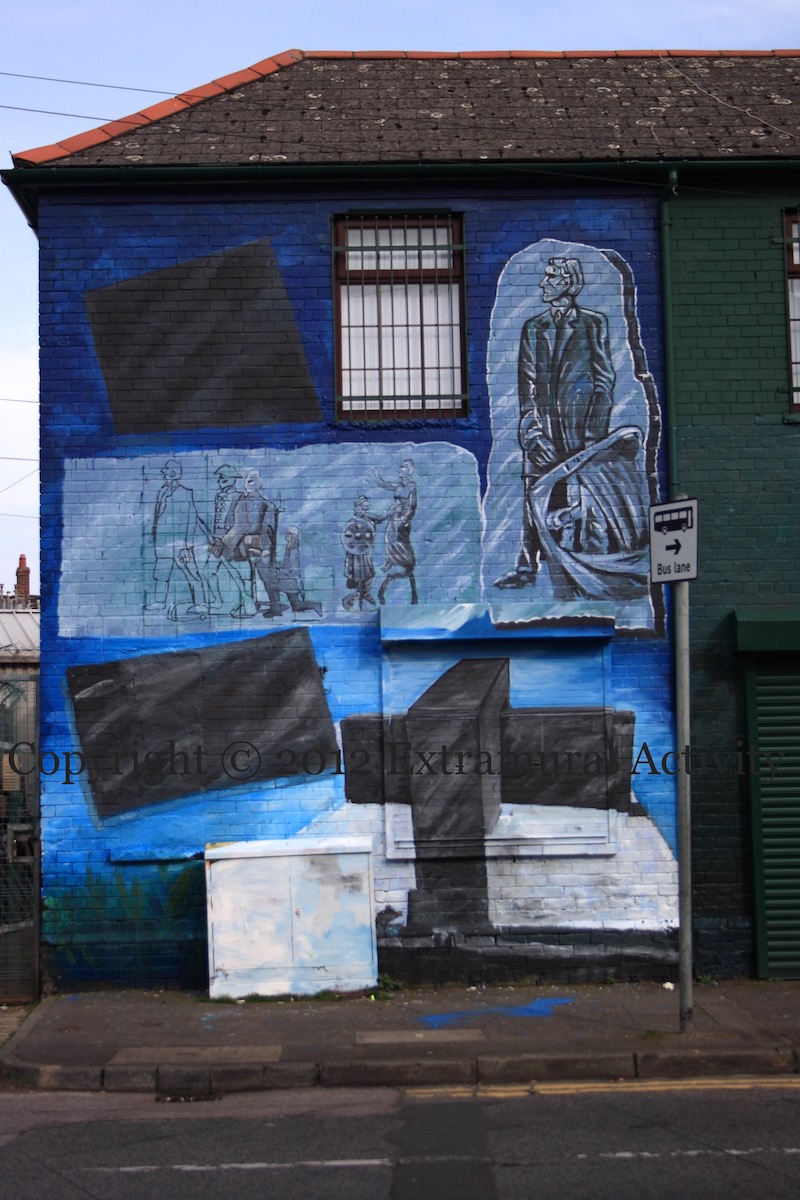
April 24th, 1916 is the date of the commencement of the Easter Rising. The left-hand side of the building on the eastern corner of the Falls Road and Ascaıll Ard Na bhFeá (Beechmount Avenue) is a memorial to Republicans from County Antrim from 1798 to 1966 – when the ‘County Antrim Memorial’ was raised in Milltown on the 50th anniversary of the Easter Rising – and beyond; it is pictured in the lower right, a large cross-shaped monument. Tom Williams (WP), an IRA volunteer who was executed during the Northern Campaign (during the second world war) and is buried in the plot, is mentioned specifically on the headstone in the lower left.
The right-hand side – the Cumman Na mBan centenary – was featured previously.
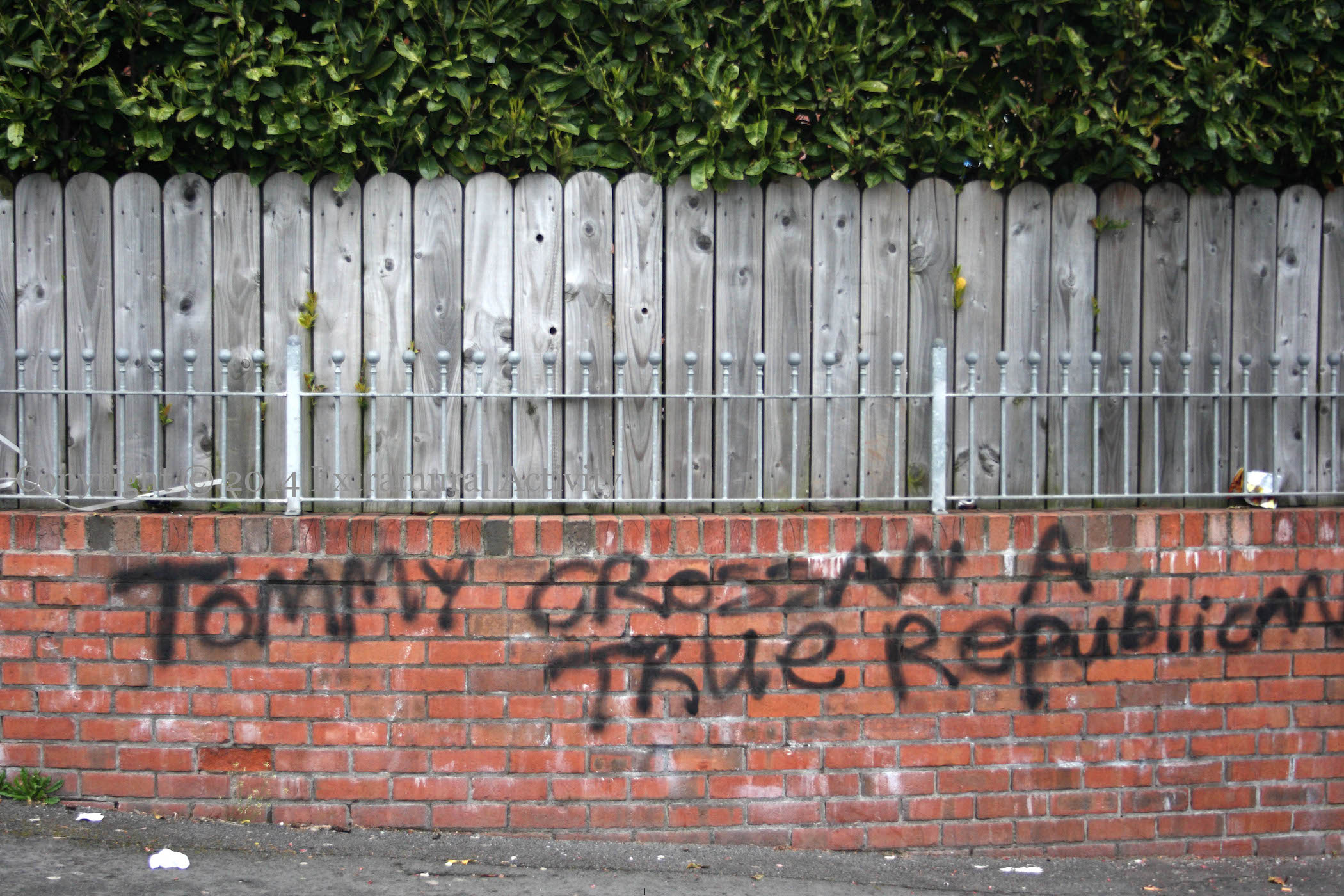
These two pieces of graffiti have appeared on the Stewartstown Road: “RIP Tommy Crossan – slan a chara” and “Tommy Crossan a true Republican”. Crossan, a former leader of the CIRA, was shot and killed on Friday (April 18th, 2014 – Good Friday) (Guardian).
A board in the Glen Rd/Falls Road triangle: “Belfast I.R.S.P. Commemoration parade, Easter Sunday, Dunville Pk 11am”. The board is a permanent fixture but this year the commemoration in question is of the 40th anniversary of the IRSP itself, as well as the 1916 Rising.
Like a phoenix. This is part of a new (as yet incomplete) RNU (Republican Network For Unity) mural at the corner of Northumberland Street and Divis Street.
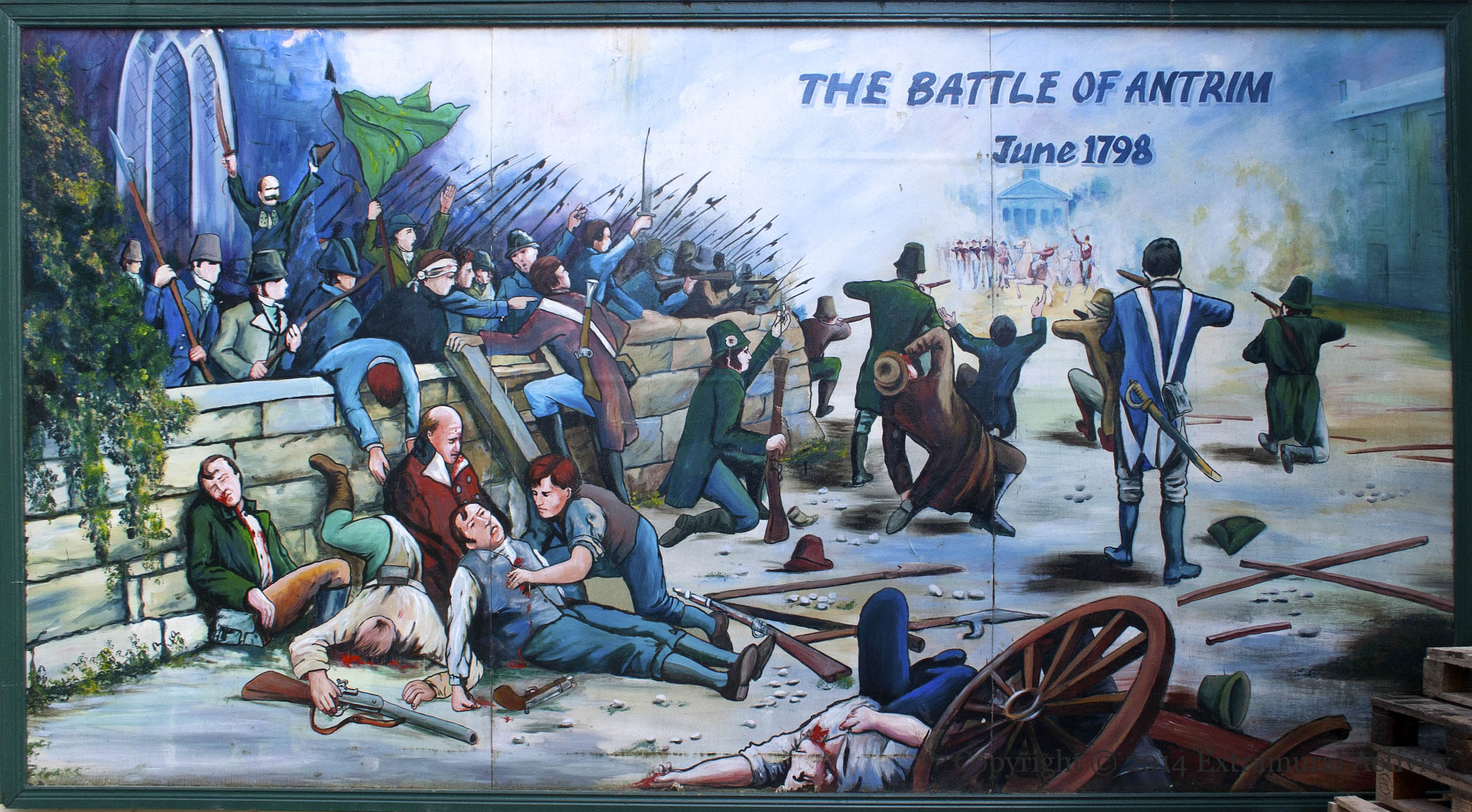
The Battle of Antrim took place on June 7th, 1798, as part of the Irish Rebellion of that summer. Led in the North by the Protestant Henry Joy McCracken, the rebellion met with initial successes in smaller towns, before failing in Antrim. In the full shot, below, the British soldiers can be seen in the distance.
The board above is in the grounds of The Roddy’s, a social club named after Roddy McCorley, another Protestant member of the United Irishmen, most famous for the song written about his hanging at the bridge of Toome in 1800. (Here’s a version by Tommy Makem.)
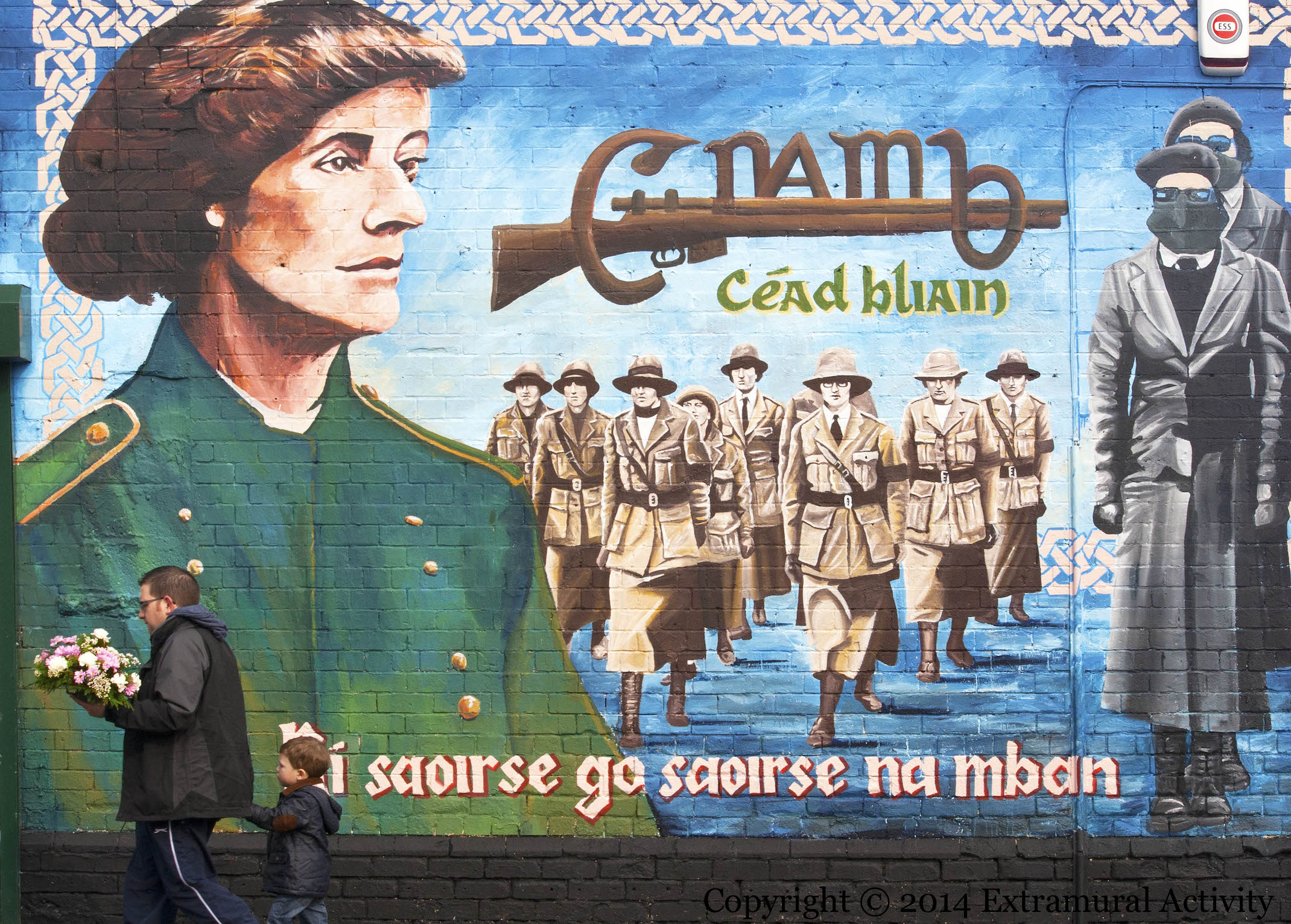
Mothering Sunday 2014 was yesterday, Sunday March 30th. On Saturday, when this image was taken, menfolk were out and about tracking down flowers and chocolates. This week also happens to be the one-hundredth anniversary (“céad blıaın”) of the founding of Cumann Na mBan on April 2nd, 1914, and it is being commemorated in various ways, including a new mural on Ascaıll Ard na bhFeá/Beechmount Avenue.
Cumann Na mBan was the women’s division of the Irish Volunteers and is best remembered for its role in the Easter Rising of 1916. Its members were involved in the occupation of many locations. Some, including (non-combatant) Winifred Carney, were in the GPO, while Countess Markievicz, the main figure of the mural, was in St. Stephen’s Green. (Here is an RTÉ gallery of vintage photographs, including one of Markievicz surrendering.)
The letters “Cnamb” on a rifle formed the badge of Cumann Na mBan. The Irish “Ní saoırse go saoırse na mban” means “No freedom until the freedom of women”. Below are an ‘in-progress’ shot from last week; and a close-up of the finished mural. Below these is a plain shot of the full mural.
Three generations of boards at the junction of the Falls and Glen roads: from most recent to least: Pearse Jordan (“Murdered by RUC! Covered up by PSNI”), Gibraltar Three (“I nDıl Chuımhne”; this was later realized on the Divis Street International Wall, see 25 Years), and a (presumably) IRSP board (“If there is to be a revolution, there must be a revolutionary party.” [Mao Zedong]). The oldest of the three appears to be the one in the best shape. The site itself used to be the Andersonstown RUC/Army barracks.
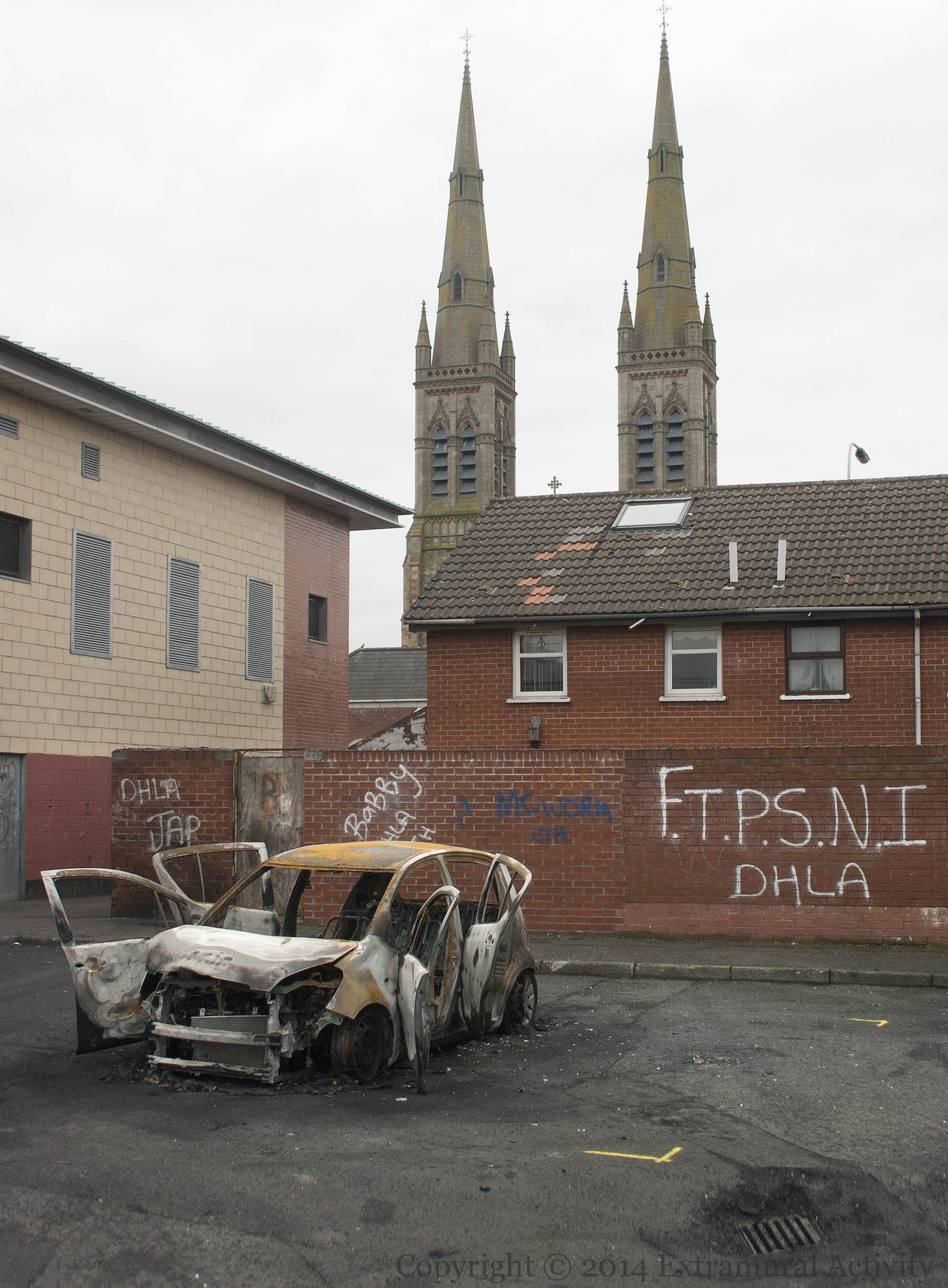
A burnt-out car in the shadow of St. Peter’s cathedral and at the back of the Maureen Sheehan Health Centre, just off Albert Street, which is infamous for “DHLA” (Divis Hoods Liberation Army) joyriding. The new murals in the area (such as Our Youth, Our Future) are part of an intervention project to improve it. 2014-12 update: there has been an upsurge in carjackings in late 2014 (BelTel).
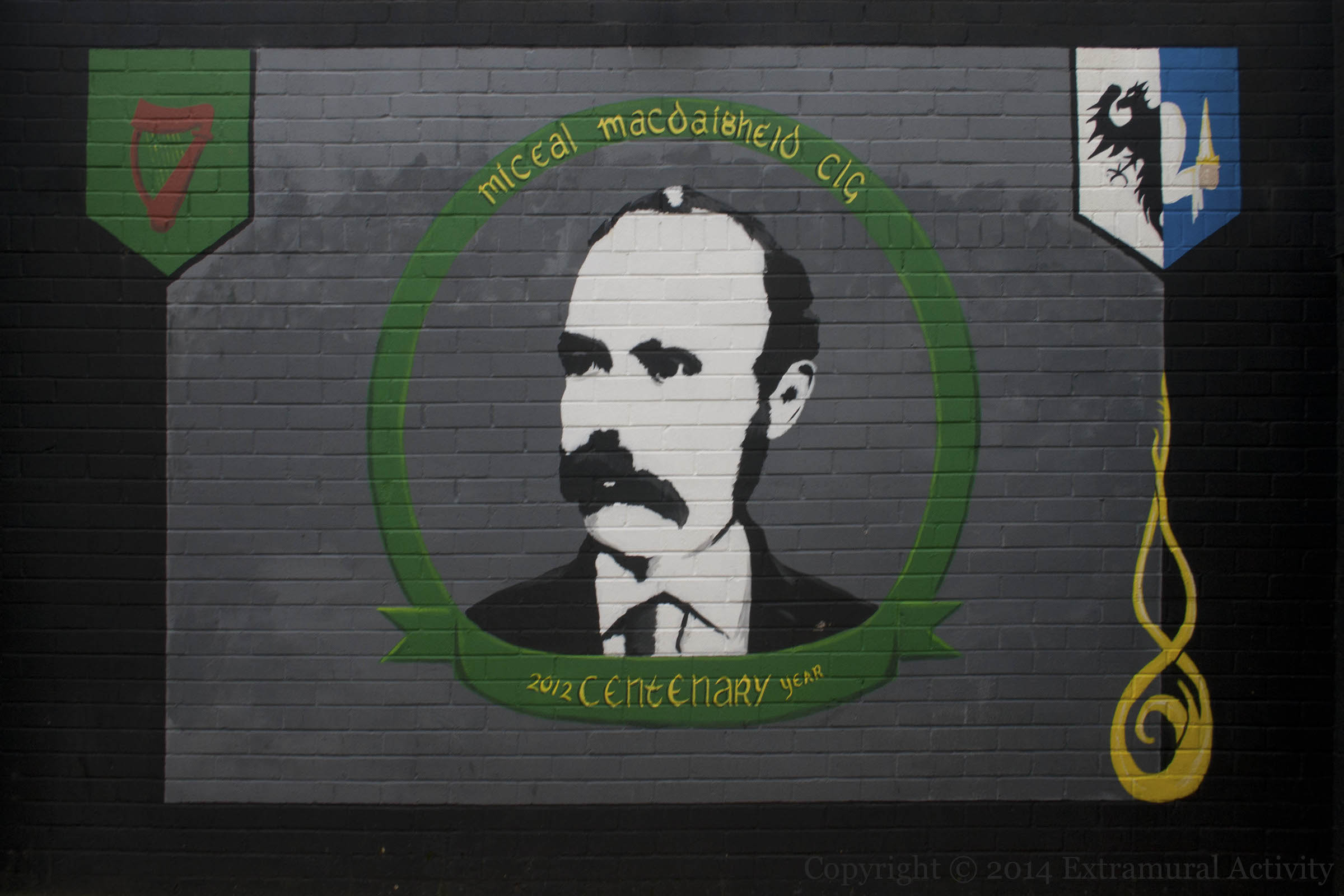
CLG Mac Daıbhéıd/Davitt’s GAA club is named for Mícheál Mac Daıbhéad/Michael Davitt, famous for leading the Irish Republican Brotherhood and the Land League. Mac Daıbhéad himself had his right arm amputated at age eleven after it got caught in the cogs of a spinning machine. The murals shown here are in the grounds of the social club on Clonard Street and celebrate the centenary of the club, 1912-2012.







 Extramural Activity