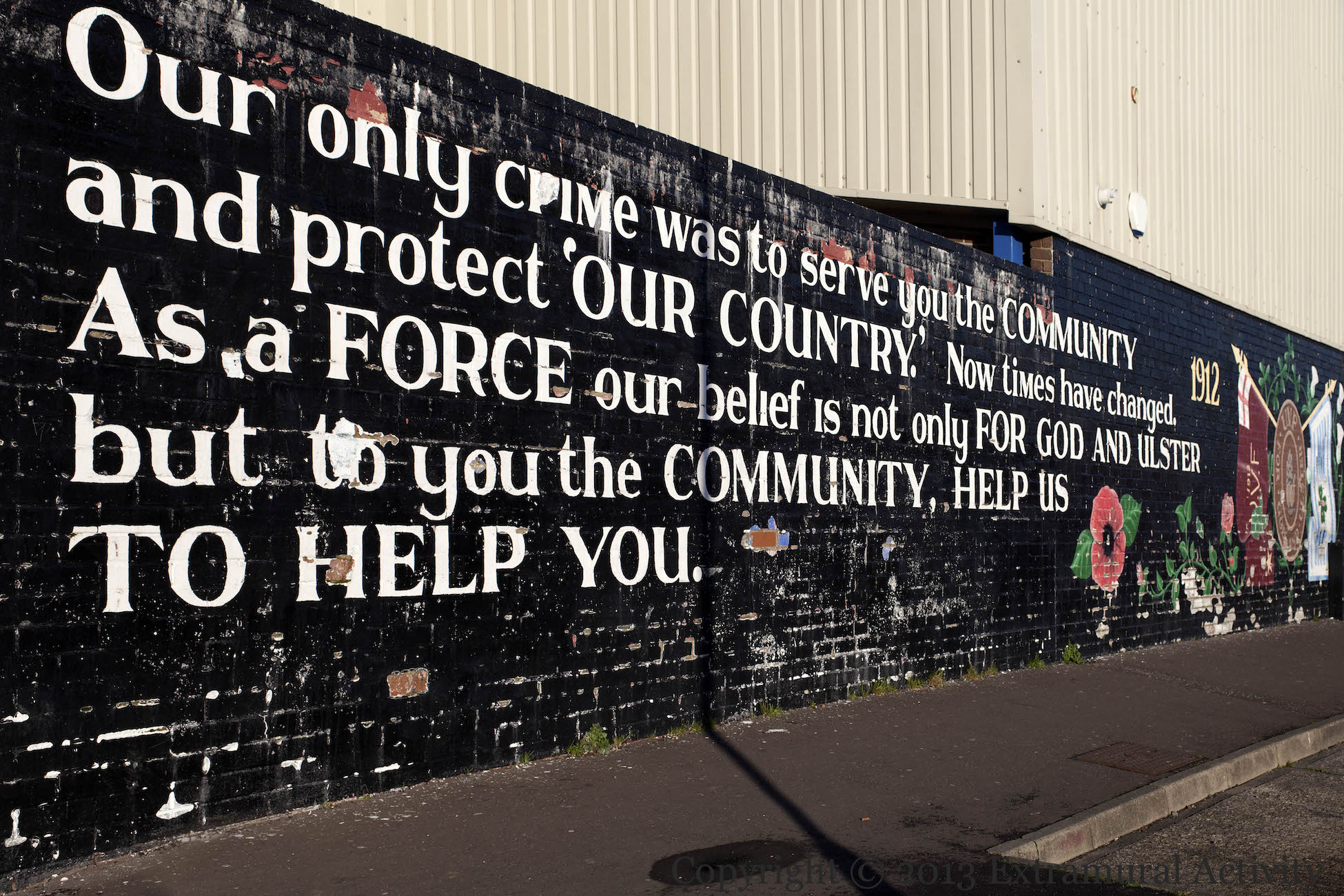
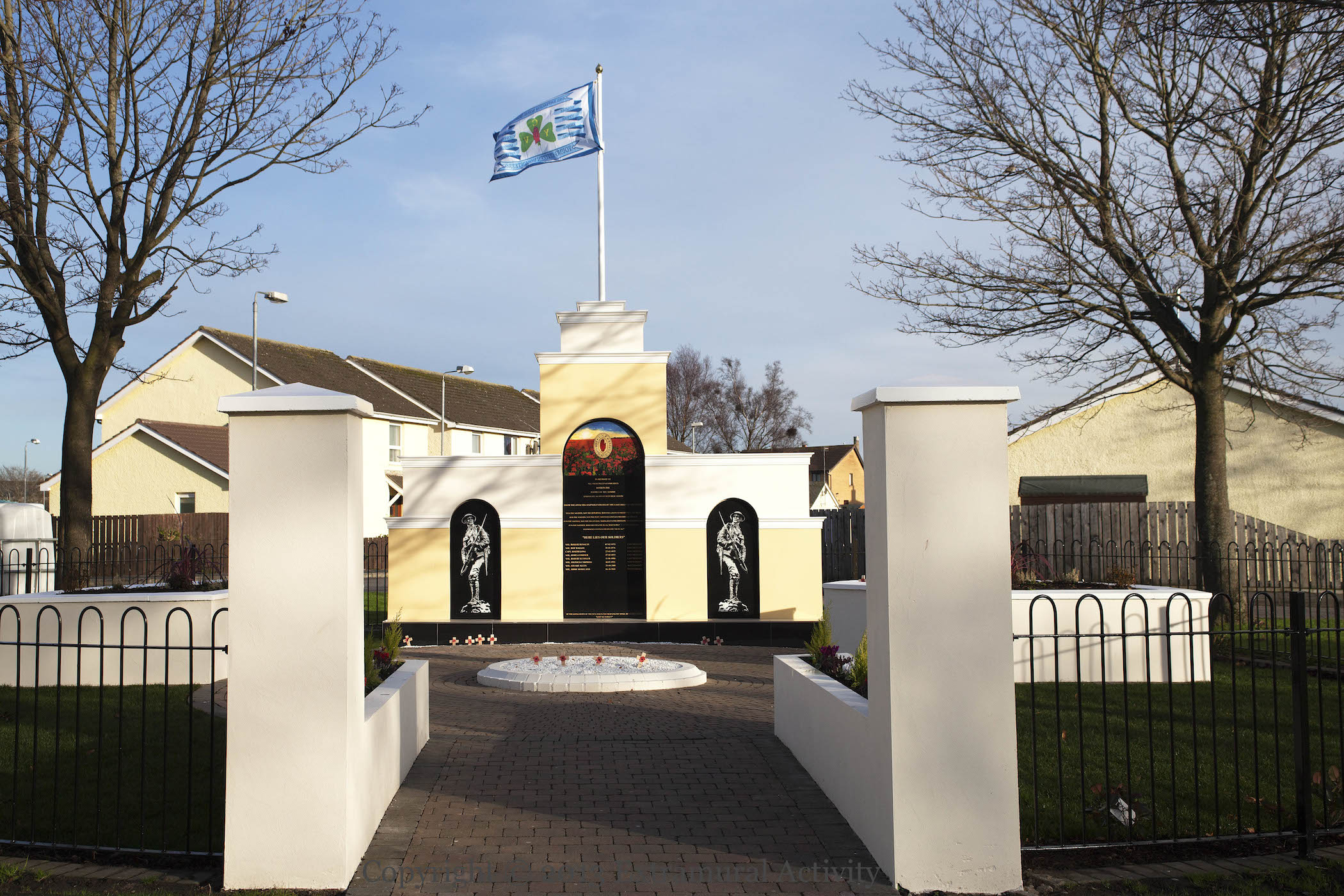
A message from the local UVF in the Westwinds estate: “Our only crime was to serve you the COMMUNITY and protest ‘OUR COUNTRY.’ Now times have changed. As FORCE our belief is not only FOR GOD AND ULSTER but to you the COMMUNITY, HELP US TO HELP YOU.”
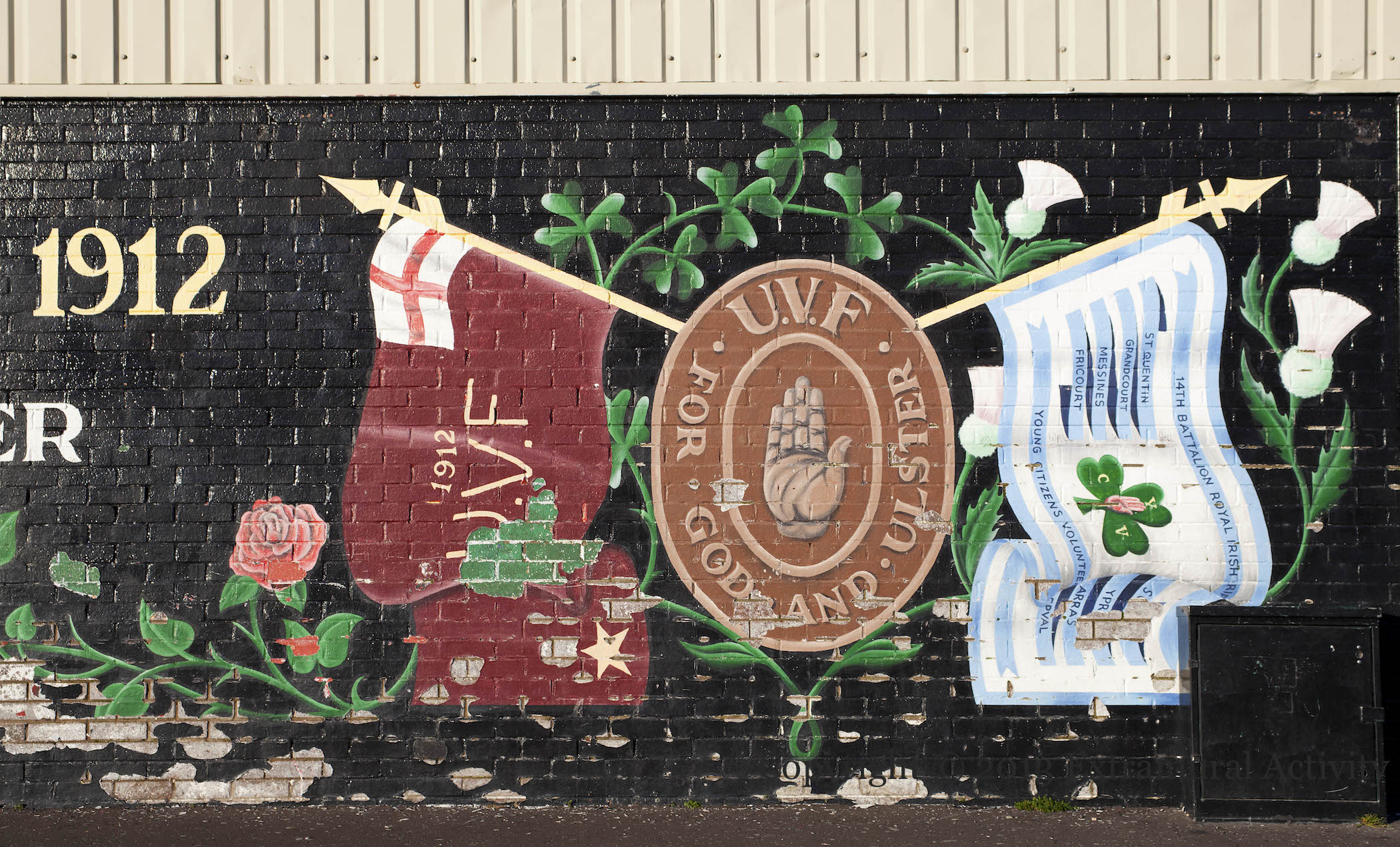
A close-up of the flags and emblem on the right hand side can be found below. There’s a flag of the 1912 UVF and YCV, and a rose and thistles and shamrock in the background, in addition to a poppy.
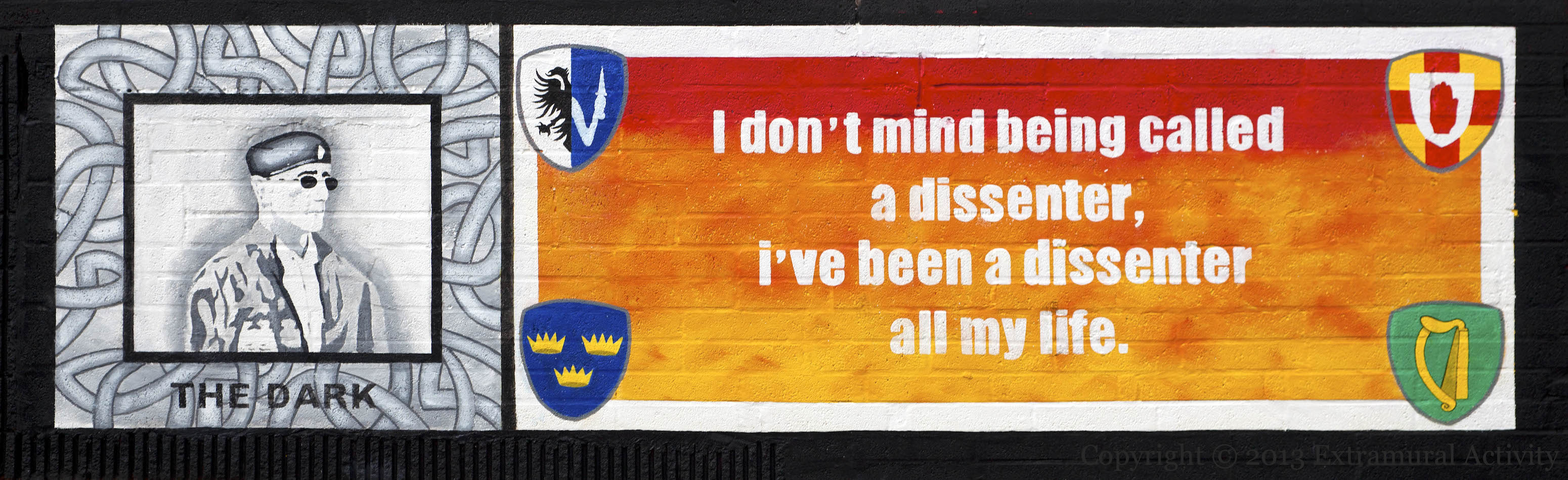
“I don’t mind being called a dissenter, I’ve been a dissenter all my life”. Mural to, and quote from, Brendan Hughes, IRA volunteer and leader of the 1980 (first) Maze hunger strike (WP).
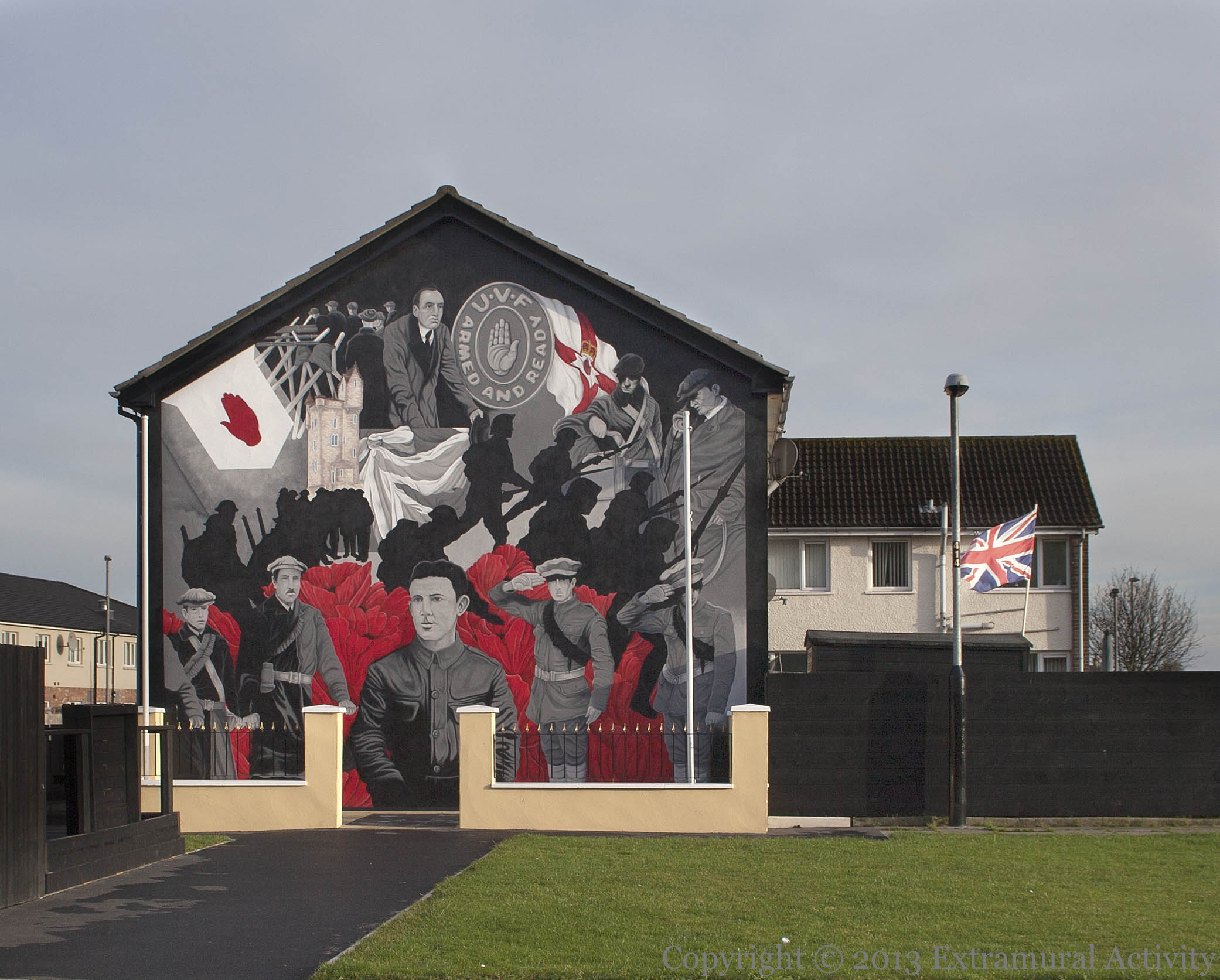
Above is a detail (wide shot below) of a new (June, 2013) mural in Newtonards’s Westwinds estate presenting a familiar UVF theme, that the Ulster Volunteers are an independent body, armed and ready to fight against whatever enemy is present, whether it be London’s decision to grant Home Rule (see Carson in the apex of the building and the figures in militia-style clothing) or the Germans in WWI (as represented by the uniformed figures and Thiepval tower) or any threat to Northern Ireland as a political entity (the Northern Irish flag flies in the top right).
INLA member Mickey Devine was the tenth and final hunger-striker to die in 1981, on August 20th. The mural above, in the familiar style of the IRSP/INLA (see Patsy O’Hara | IRSP), is in Chemical Street, in the Short Strand, across from the set of five murals on Mountpottinger Road – see the wide shot below.
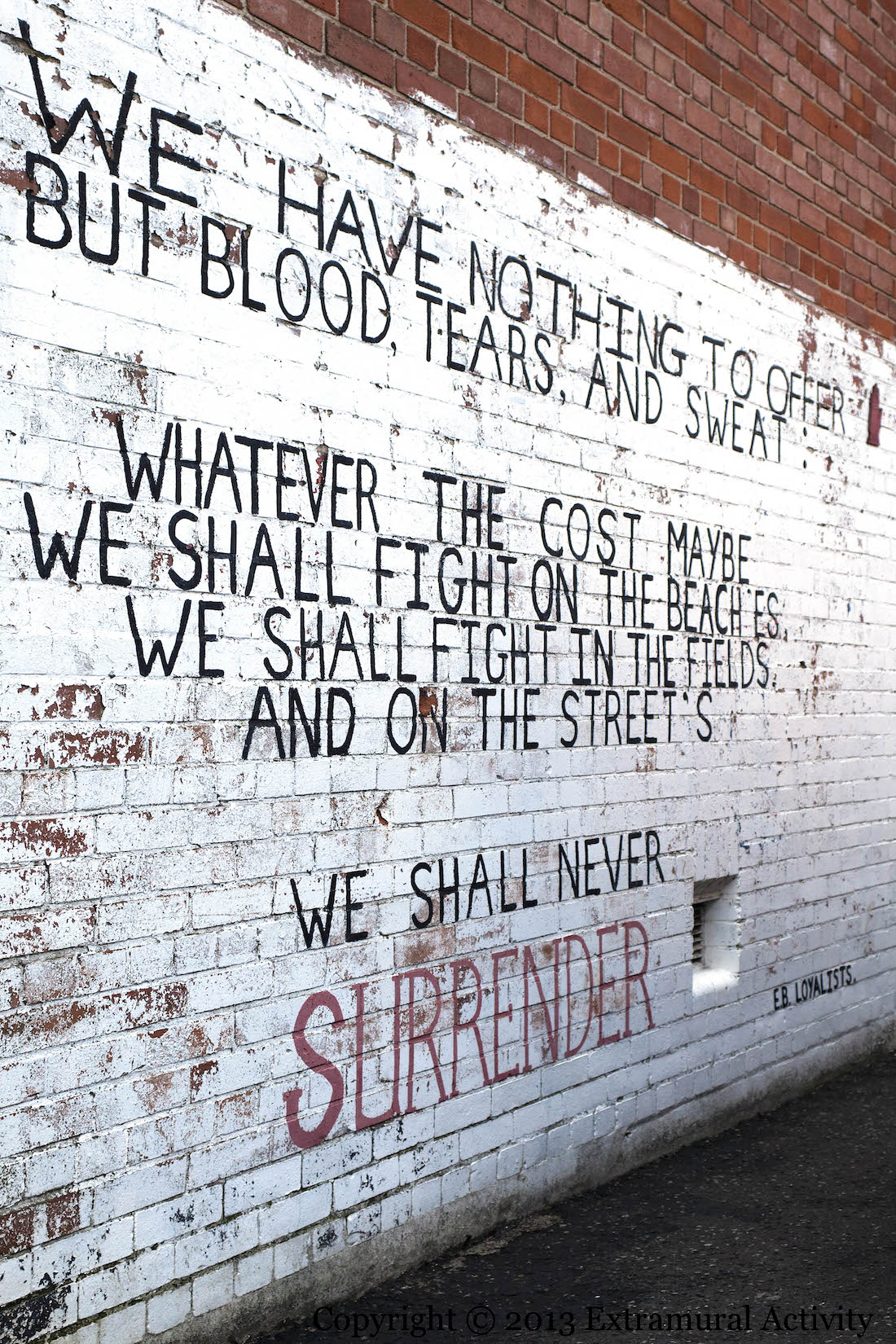
A message from “E.B. [east Belfast] Loyalists” in Castlereagh Parade, combining two speeches of Winston Churchill’s: “We have nothing to offer but blood, tears, and sweat” and “Whatever the cost maybe, we shall fight on the beach’es [sic], we shall fight in the fields and on the street’s [sic]. We shall never surrender.”
1940-05-13: “I would say to the House, as I said to those who have joined the government: I have nothing to offer but blood, toil, tears and sweat. We have before us an ordeal of the most grievous kind. We have before us many, many long months of struggle and of suffering. You ask: What is our policy? I will say: It is to wage war, by sea, land and air, with all our might and with all the strength that God can give us, to wage war against a monstrous tyranny, never surpassed in the dark and lamentable catalogue of human crime.”
1940-06-04: “We shall defend our island whatever the cost may be. We shall fight on the beaches. We shall fight on the landing grounds. We shall fight in the fields and in the streets. We shall fight in the hills. We shall never surrender. “
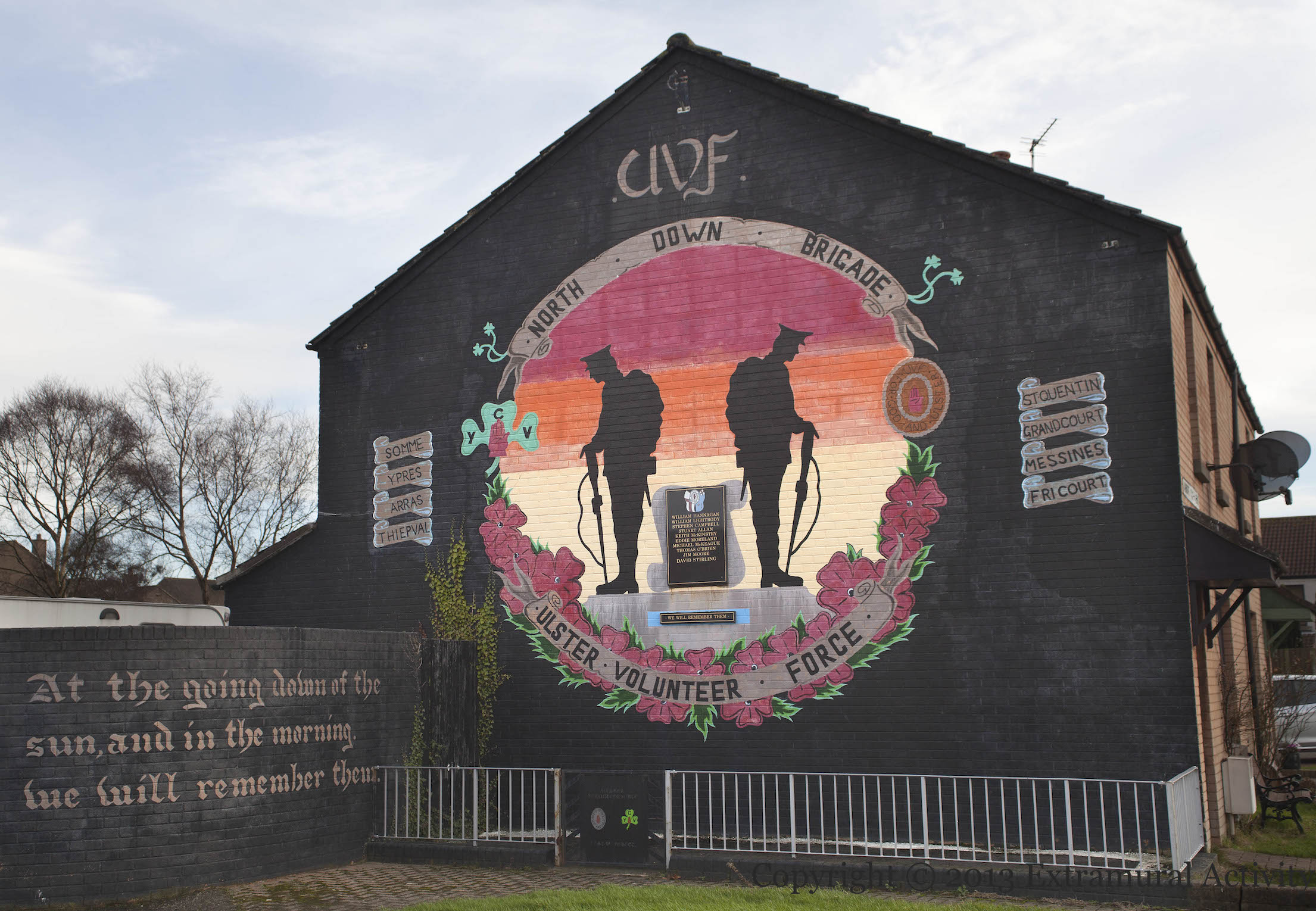
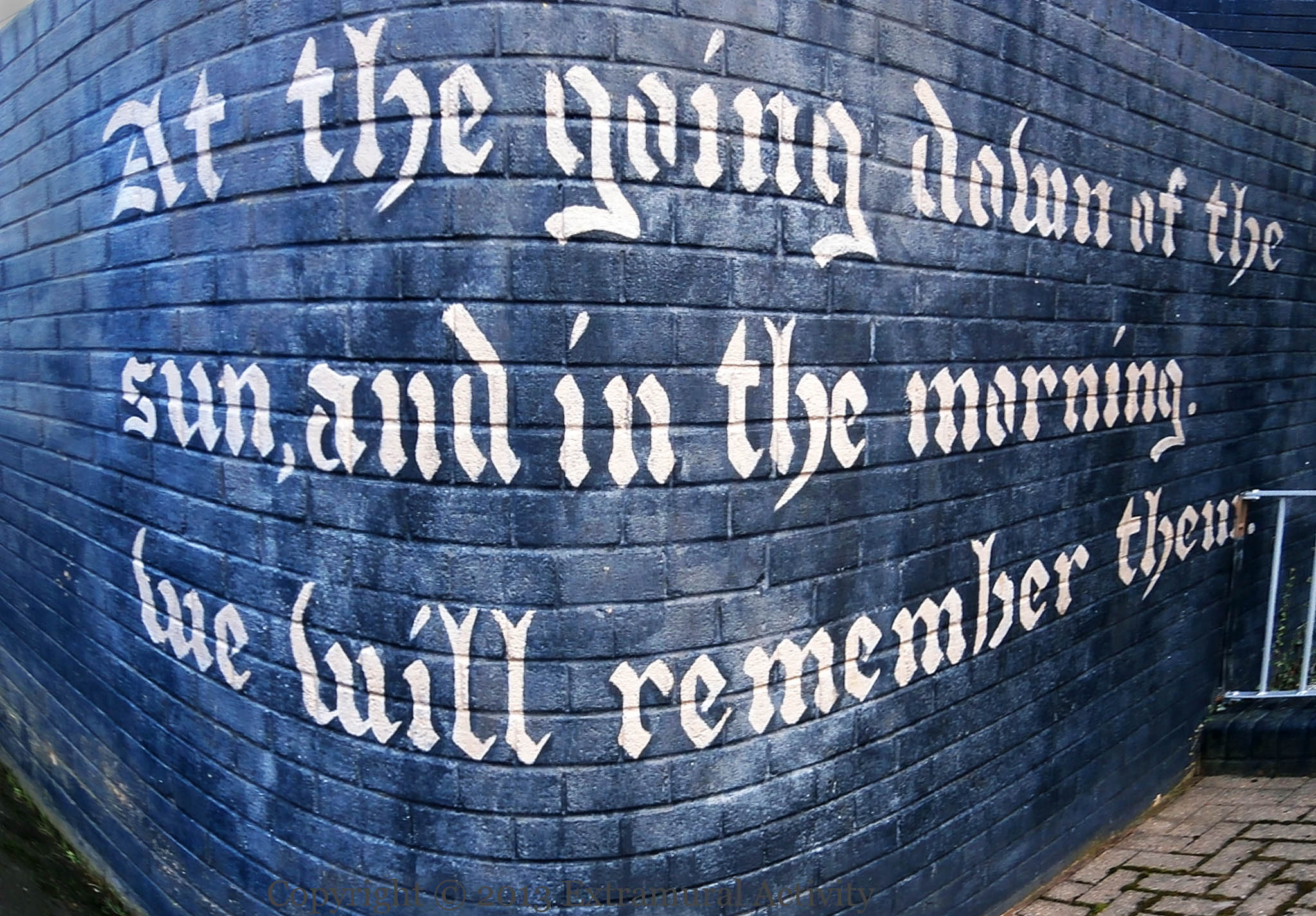
Mural in Newtownards to the Ulster Volunteer Force and Young Citizen Volunteers of the first world war shows two soldiers bent in reflection against an orange and red background, suggesting sunrise/sunset. “At the going down of the sun and in the morning, we will remember them.”
Close-ups of the wall to the left (featuring lines from Binyon’s For The Fallen) and the plaque in the middle can be found below.
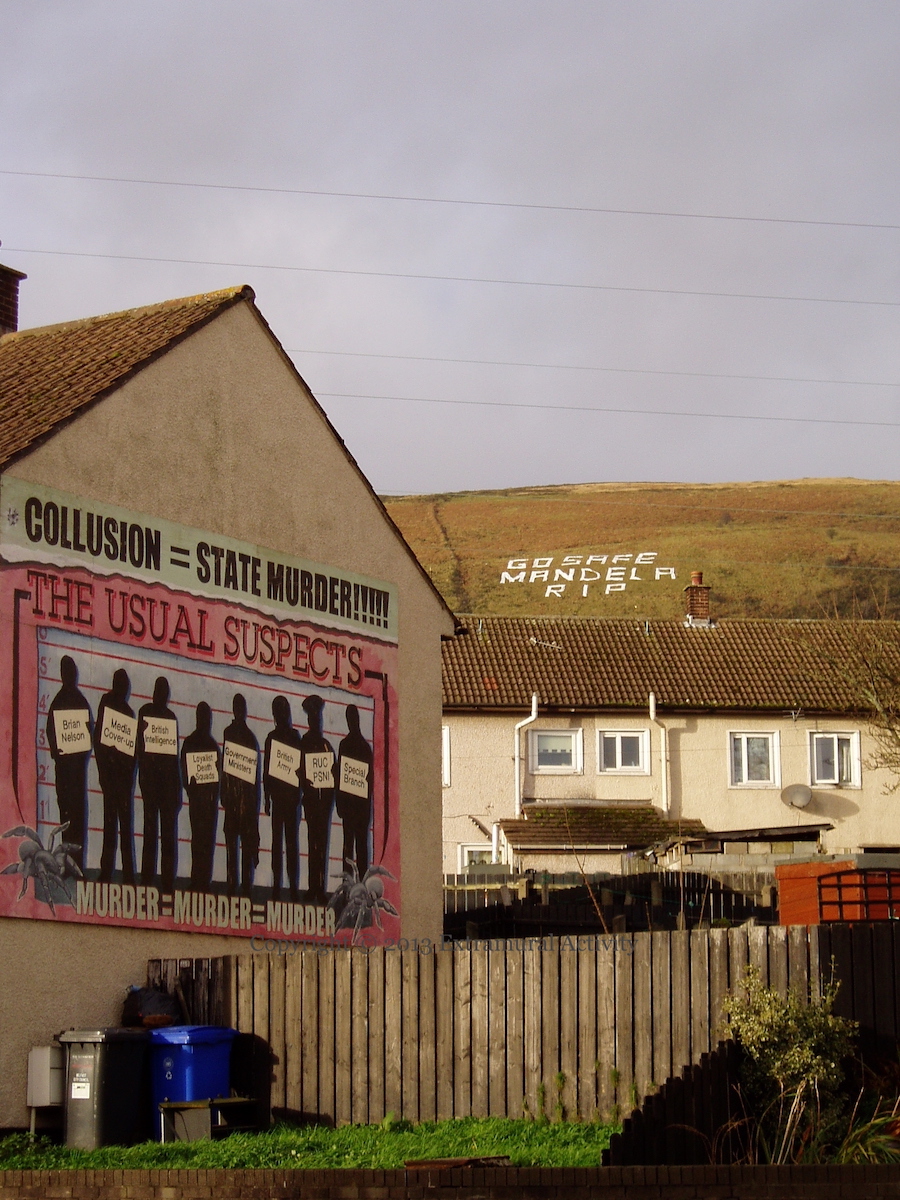
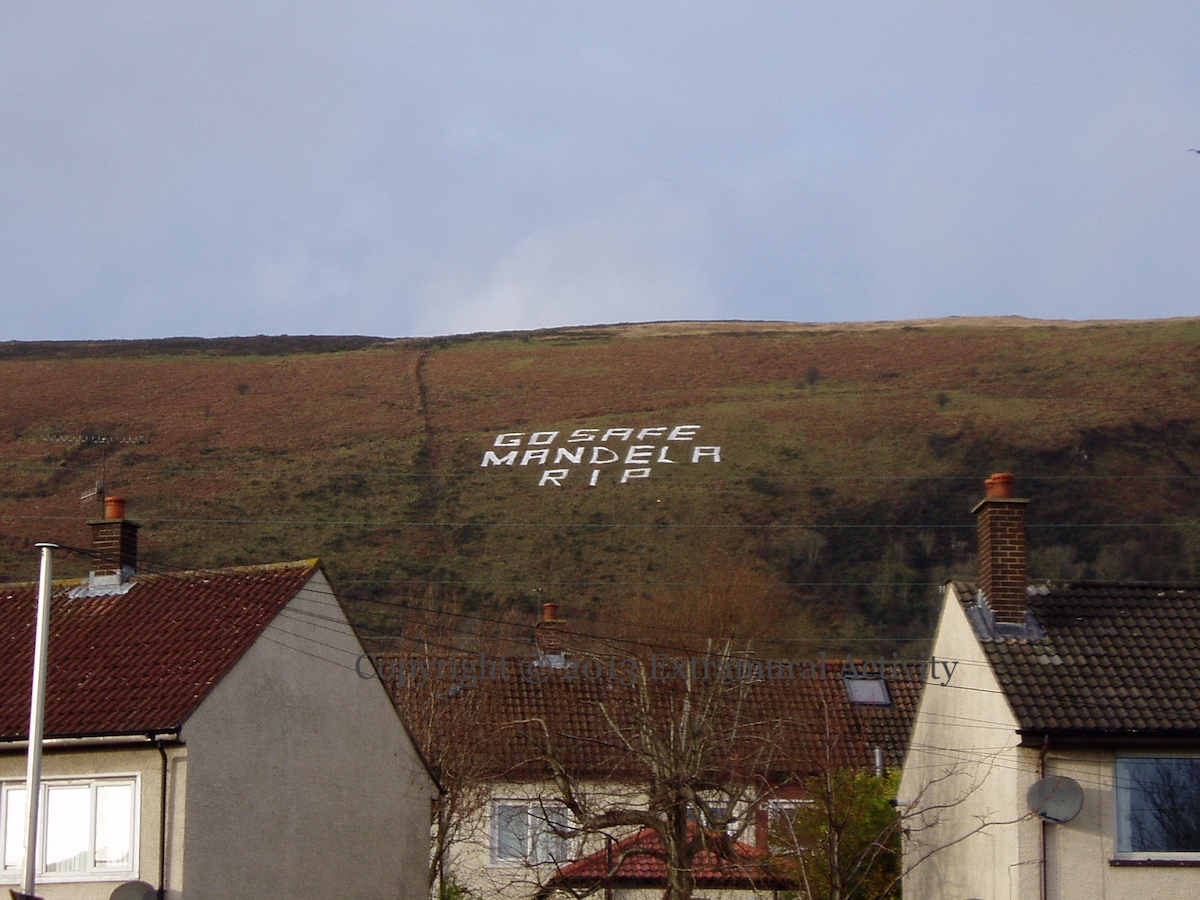
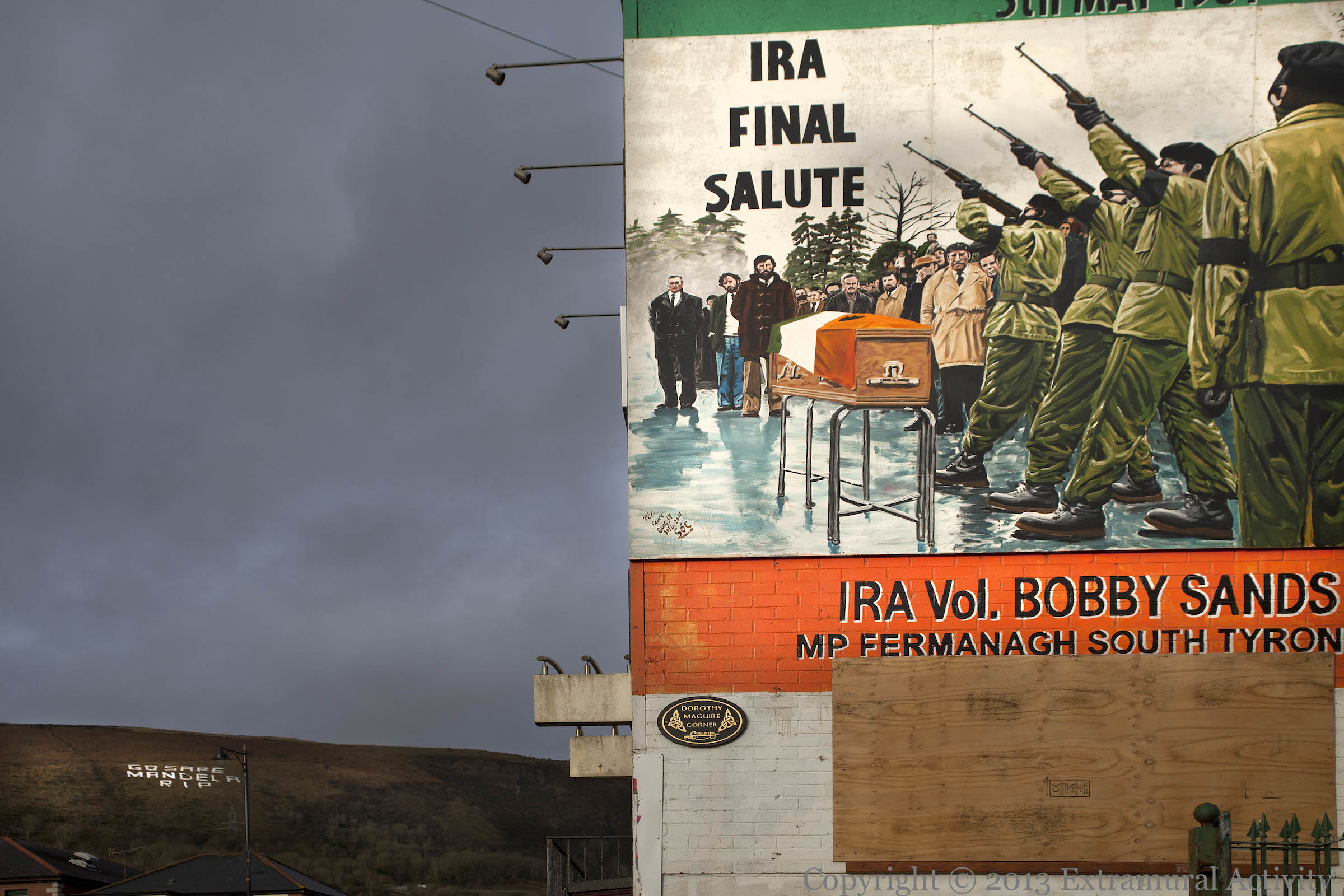
Four shots of the “Go safe Mandela – RIP” lettering by Gael Force Art on Slıabh Dubh/Black Mountain two weeks ago, commemorating the death of Nelson Mandela on December 5th, 2013. The one above is on the Springfield Road with ‘The Usual Suspects’ in the foreground. (Previously from the same location: G8 War Criminals.) The second, below, is from the Whiterock Road and involves the ‘IRA Final Salute’ mural.
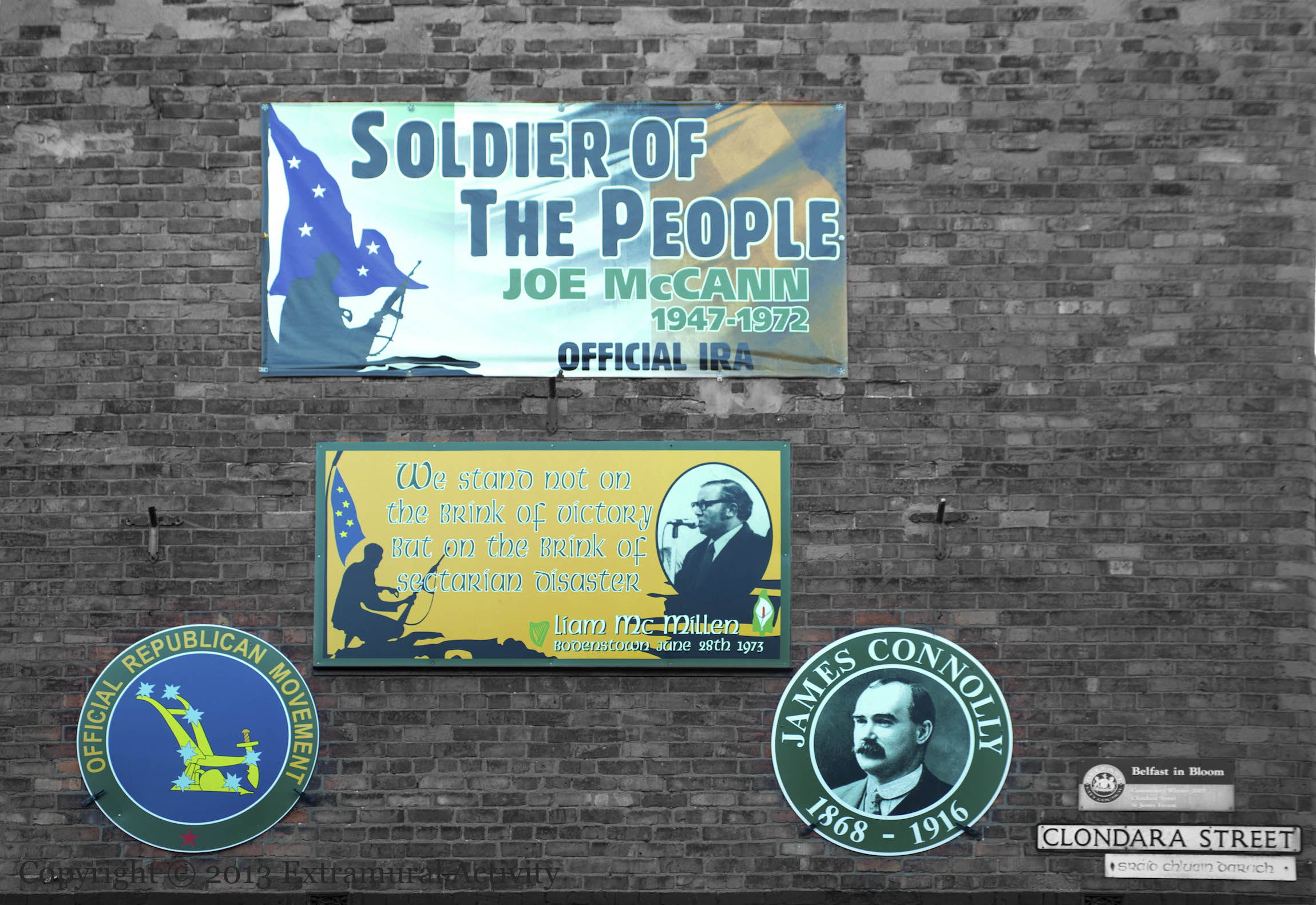
A selection of Republican iconography above the James and Nora Connolly mural in Clondara Street: a tarp to Joe McCann – ‘Soldier of the people, Joe McCann 1947-1972 Official IRA’ (WP) – a board with a Liam McMillen quote – ‘”We stand not on the brink of victory but on the brink of sectarian disaster”, Liam McMillen, Bodenstown June 28th 1973’ (see the post on McMillen at Peter Moloney Collection) – and two circular pieces, one showing the Starry Plough (created in 1914 as the flag of the Irish Citizen Army) and one to co-founder of the ICA ‘James Connolly 1868-1916’ (WP).
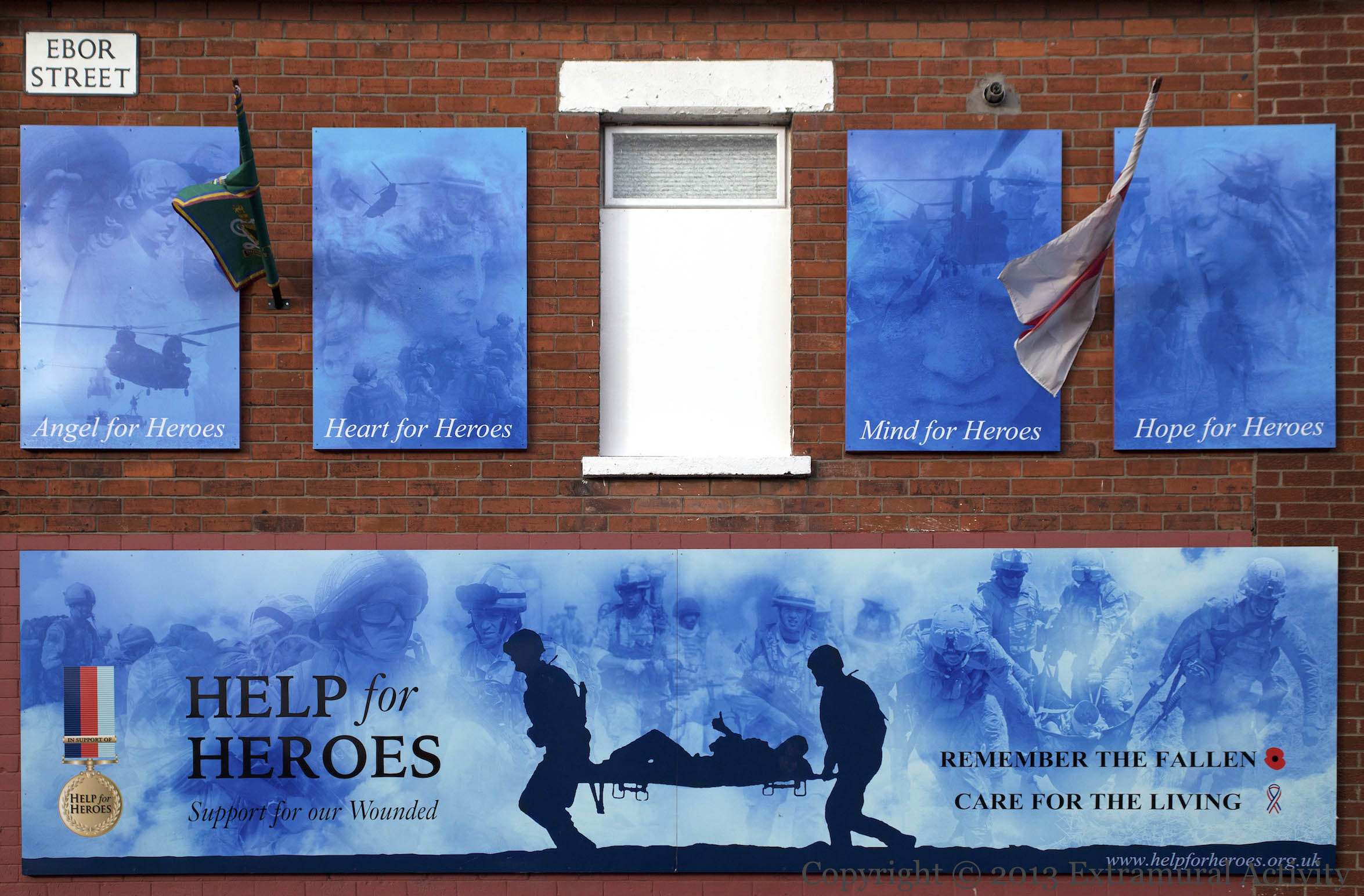
“Remember the fallen, care for the living”. Five boards arranged into a single piece in Ebor Street, south Belfast. The large bottom panel features a silhouette of a (staged) photograph taken in Basra (DailyMail) of a soldier on a stretcher giving the ‘thumbs up’ sign.
As can be seen from the initial cartoon for this mural, below, it was originally intended to have two hooded gunmen firing a funeral volley, but because of protest by locals (see, e.g. NewsLetter) this was changed to two unmasked men, one of whom is clearly of the WWI era. The Nissen huts and towers of Long Kesh, however, remain in the image, which thus expresses the complex relationship of loyalists (and especially the UVF, whose members Robert Seymour, James Cordner, Joe Long, and Robert Bennett are listed on the left-hand side) to the British army. As Bill Rolston put it: “How could one display visually the value of opposing British policies in the name of remaining British? What could be the symbols of such a schizophrenic message? (Drawing Support (1), p. ii).
The side-wall to the right of shot is painted solid black but otherwise remains unfinished as of the end of 2013.







 Extramural Activity