Union Is Strength

“Colonel Edward Saunderson MP, UDU founder, leader of the Irish Unionist Party. 1837-1906. Union is strength. ‘We must be prepared for every possible eventuality’ – on the issue of Home Rule 1893.”

The dates given are the span of Saunderson’s life, not his political career, which began in 1865 as MP for his home county of Cavan.

The bill under consideration in 1893 was the second Home Rule bill, which the UDU was formed to resist. The UDU initially met in Belfast in March; the manifesto of the meeting can be read on page 5 of the [Sydney] Freeman’s for 1893-04-29.

On June 8th, 1893, the Westminster government asked the police for a report on the Union, fearing its goal was armed resistance to Home Rule, and considering declaring it an illegal organisation ([Sydney] Daily Telegraph, 1893-06-10 page 5).

In September, the bill was passed in the Commons but defeated in the Lords. An account of the October meeting quotes Saunderson saying that the organisation should maintain itself by “if the necessity arose” “proving – not by words, but by deeds – that they meant what they said.” (Gympie Times & Mary River Mining Gazette, 1893-12-07 page 3).

Saunderson at the time was (also) leader of the Irish Unionist Alliance (here called the “Irish Unionist Party”) and he went on to be the first leader of the Ulster Unionist Party, from 1905 to 1906 (WP), when he died of pneumonia (WP).

The Ulster Defence Union is employed as an origin-story by the Troubles-era UDA as the UDU formed an ‘Ulster Defence Association’ – see UDU-UFF-UDA and UDU-WDA-UDA-UFF – and the name is used by the post-Agreement UDA – see Daffodil Days.

Next to Saunderson are boards mounted to celebrate the seventieth (platinum) jubilee of Queen Elizabeth in June 2022. Similar paintings were produced by schoolchildren in west Belfast – see The People’s Monarch.

“This artwork was designed and created by pupils from Abbots Cross Primary School in partnership with the local children from Rathcoole Community Hub to commemorate the platinum jubilee of Her Majesty Queen Elizabeth II.”

“From Rathcoole to the house of Windsor – happy platinum jubilee 1952-2022. God save the Queen.”

Owenreagh Drive, Newtownabbey

Click image to enlarge
Copyright © 2026 Seosamh Mac Coılle
X15957 X15958 X15959
X15956 X15955
X15961

Ulster & Israel

“Ulster & Israel – brothers in arms”. The Uzi was developed in Israel in the late 1940s and became a general-issue weapon in 1956 (WP). It was used (and copied) by loyalist paramilitaries in Northern Ireland (Balaclava Street has a comprehensive history of loyalist weaponry) and appeared in a both UDA and UVF murals and graffiti: The Elite | Ulster Says No! To The Politicians | Sandy Row 2nd Batt | UFF Uzi.

Here is an article from TheJ.ca interviewing PUL politicians on their support for Israel and an Irish News article revisiting the issue in light of the current conflict. And loyalists have previously (since 2002? Irish Times | OU) flown the flag of Israel — see Gregg & Carson (2011) | View From The North Bank (2012) | The Young Conquerors (2013) | The United Nations (2014) | The Glorious Memory (2014) | Ulster Supports The People Of Israel (2018) | EU Hands Off Ulster (2021). But this is the first time that a symbol of violence has been used as the symbol of solidarity. (In republican muraling, see PLO-IRA (1982) | Women In Armed Struggle (1983).)

Tate’s Avenue, in the Village area of south #Belfast.

The placard in the middle, between Brothers In Arms and “Sir E. Carson K.C., M.P.” was discussed in Stand Firm. The Winning Hand was seen previously in The Red Hand And The Winning Hand.

See also: Godfather Of The Israeli Army.

Click image to enlarge
Copyright © 2023 Seosamh Mac Coılle
X14476 X14477 X14478 X14479 X14475
Copyright © 2024 Seosamh Mac Coılle
X15251

What Answer From The North?

These are the boards at the chip shop (formerly a Spar and before that a Mace) in the centre of the Mourneview estate, Lurgan.

Above, in Mourne Road, a gallery of photographs of the Craigavon Protestant Boys (Fb) past and present, with a plaque in memory of Victor Stewart. “Our only crime is loyalty.”

Below are the images from the front of the shop, in Pollock Drive:

First/right: “When injustice becomes law resistance becomes duty.” The same panel was seen in Ballyclare, though for the 1st East Antrim battalion rather than the Mid Ulster brigade.

Next: A company, 1st battalion, Mid Ulster brigade UVF – Lurgan as well as Broxburn (outside Edinburgh) and Thornliebank (near Glasgow).

Next: A tribute to the Ulster Volunteers from the area: the 9th battalion Royal Irish Fusiliers joined the 108th brigade in the 36th (Ulster) Division; the 5th battalion joined the 31st brigade and the 10th (Irish) Division. This board goes back to (at least) 2011.

Next: “Believe, we dare not boast,/Believe, we do not fear/We stand to pay the cost,/In all that men hold dear.//What answer from the North?/One Law, one Land, one Throne/If England drive us forth,/We shall not fall alone!” Kipling’s poem Ulster.

The first stanza also appears in a Belfast RHC mural, and other lines from the poem have been used elsewhere: We Perish If We Yield | The Terror, Threats, And Dread.

All of the preceding pieces are UVF/PAF, but the last, high up on the left, is a UDU board in the top left of the wall, to 1 company, D battalion, South Belfast.

With thanks to Jackie Findon for today’s images.

Click image to enlarge
Copyright © 2023 Jackie Findon
X12356 X12357 X12358 X12359 X12360

Our Cause Will Always Remain The Same

“Through the years the uniforms may change, but our cause will always remain the same.” On the left (of the main panel) are the Ulster Volunteers drilling in 1914 (photograph at the Library of Congress) and a UVF show of strength on Newtownards Road (seen previously in East Belfast UVF On Parade).

On a wall along Abbot Drive (Newtownards) with purple and orange coping stones.

Click image to enlarge
Copyright © 2022 Seosamh Mac Coılle
X11274 X11273

It’s A Long Way To Tullygarley

The previous Tullygarley mural on this wall included images of the local area in addition to the emblem of the 36th Division and the Clyde Valley but the new one is devoted solely to the years 1912-1918. On the left is the Ulster Covenant and the Clyde Valley, then an image of Drumalis House, Larne, which was a training ground for the Ulster Volunteers (see silent film from 1914 at BFI and photo of Carson presenting colours at Drumalis) and the base from which the gunrunning was staged, along with Carson acknowledging the troops at Glencairn (in Belfast). In the third image, the 36th (Ulster) Division goes over the top and sits in trenches. Finally, there is a ‘Local Area Roll of Honour’ listing 60 locals who died in WWI.

The odd-man-out image – of paint peeling to reveal a red hand – shows the re-emergence of a mural from 1999 on the side wall.

Click image to enlarge
Copyright © 2022 Seosamh Mac Coılle
X10602 [X10603] X10604 X10601 X10605 X10598 [X10599] X10600 Glynn Road Larne

The Central Antrim Regiment

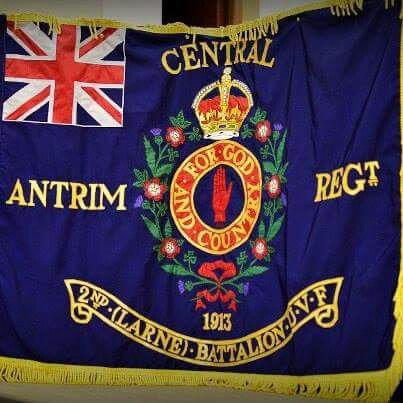
As this plaque in the Factory area of Larne indicates, the 2nd battalion of the Central Antrim regiment (of the Antrim division) of the Ulster Volunteers was drawn from Larne. Edward Carson reviewed the entire regiment at Drumalis in Larne on July 11th, 1914, (here is a postcard depicting the review) where he was presented with the colours of the 2nd from a Lady Smiley of First Larne Presbyterian. (The colours of the 1st and 2nd battalions are included below; the colours of the 3rd (Carrickfergus) Battalion can be seen at Sam’s Flags.) In the Royal Irish Rifles of WWI, Central Antrim became the 12th battalion (War Time Memories Project); its members included Larne man Rifleman Robert King.

“The Clydevalley flute band [Fb] proudly remembers all who served in the [Antrim Division,] Central Antrim Regt, 2nd Larne Battalion, Ulster Volunteer Force. Lest we forget.”

The plaque is on the gun-running mural and next to a King Billy mural in Greenland Drive. Both murals were seen previously in 2016; see Amazing Night At Larne and Civil & Religious Liberty.

Click image to enlarge
Copyright © 2022 Seosamh Mac Coılle
X09339 [X09338] X09379 X09382 [X09380] X09381

Is Your Home Worth Fighting For?

“… It will be too late to fight when the enemy is at your door.” In 1914, at the time of the Larne gun-running – see the mural in the second image and (previously) Amazing Night At Larne – the enemy was the threat of Home Rule and its enforcement by British Army forces and RIC that would remain under British control for at least three years after the commencement of home rule (Home Rule And Ulster’s Resistance p. 9). A bill to amend home rule by excluding some or all of the Ulster counties was introduced in July, 1914 (WP), but both Home Rule and the amendment were put aside when the Great War began; the enemy of Unionists then became the Central Powers. The contemporary enemy is the NI Protocol and Brexit, with the powers in Westminster again suggesting a separation of Britain and (Northern) Ireland.

Click image to enlarge
Copyright © 2022 Seosamh Mac Coılle
X09336 X09335 X09337 Greenland Drive Larne

What We Have We Hold

This Village board celebrates the Covenant, Ulster Volunteers, and the 36th (Ulster) Division, with photographs both vintage and contemporary.

For the photograph of Carson signing the Covenant, and an earlier mural, see Betting Office. For the photograph of the car-mounted gun, and an earlier mural recreating the photo, see UVF 75th Anniversary. For images akin to the contemporary photos, see these BelTel galleries one | two of the 100th anniversary celebrations of the Ulster Volunteers.

Click image to enlarge
Copyright © 2021 Seosamh Mac Coılle
X08430 X08429 Lwr Rockview St

A Soldier Of The Great War

“The Great War (1914-1918) 36th (Ulster) Division. This memorial is dedicated to the memory of those who fell in the Great War. May their names be held in honour and their sacrifice be remembered with pride.”

Next to to the UVF Flute Band 50th anniversary mural and the Singer Sergeant painting (Observe The Sons Of Ulster) in the old Newcastle Street, east Belfast.

Click image to enlarge
Copyright © 2020 Seosamh Mac Coılle
X07005 X07006 X06986  X06985 X06983 X06982

Observe The Sons Of Ulster

The 62 year-old painter John Singer Sergeant went to the western front in 1918 to find a scene suitable for painting on the theme of Anglo-American co-operation during the war. On the 21st of August, however, he witnessed at Arras British soldiers blinded by a German mustard gas attack, one following behind the other in a human chain, each group being directed by an orderly towards a dressing station. The War Memorials Committee agreed to change its commission and Sergeant received 600 pounds (about 34,000 in today’s money) for his painting, Gassed (WP).

This copy is in St Leonard’s Crescent (or the old Newcastle Street), part of the 50th anniversary garden and mural for the UVF regimental band and memorial for east Belfast volunteers who joined the 36th Division (which did not fight at Arras as it had been disbanded in May, 1918). The plaque below list the nine counties of Ulster and reads “To strive, to seek, to find and not to yield. Sons Of Ulster RBP 375.”

Click image to enlarge
Copyright © 2020 Seosamh Mac Coılle
X06984