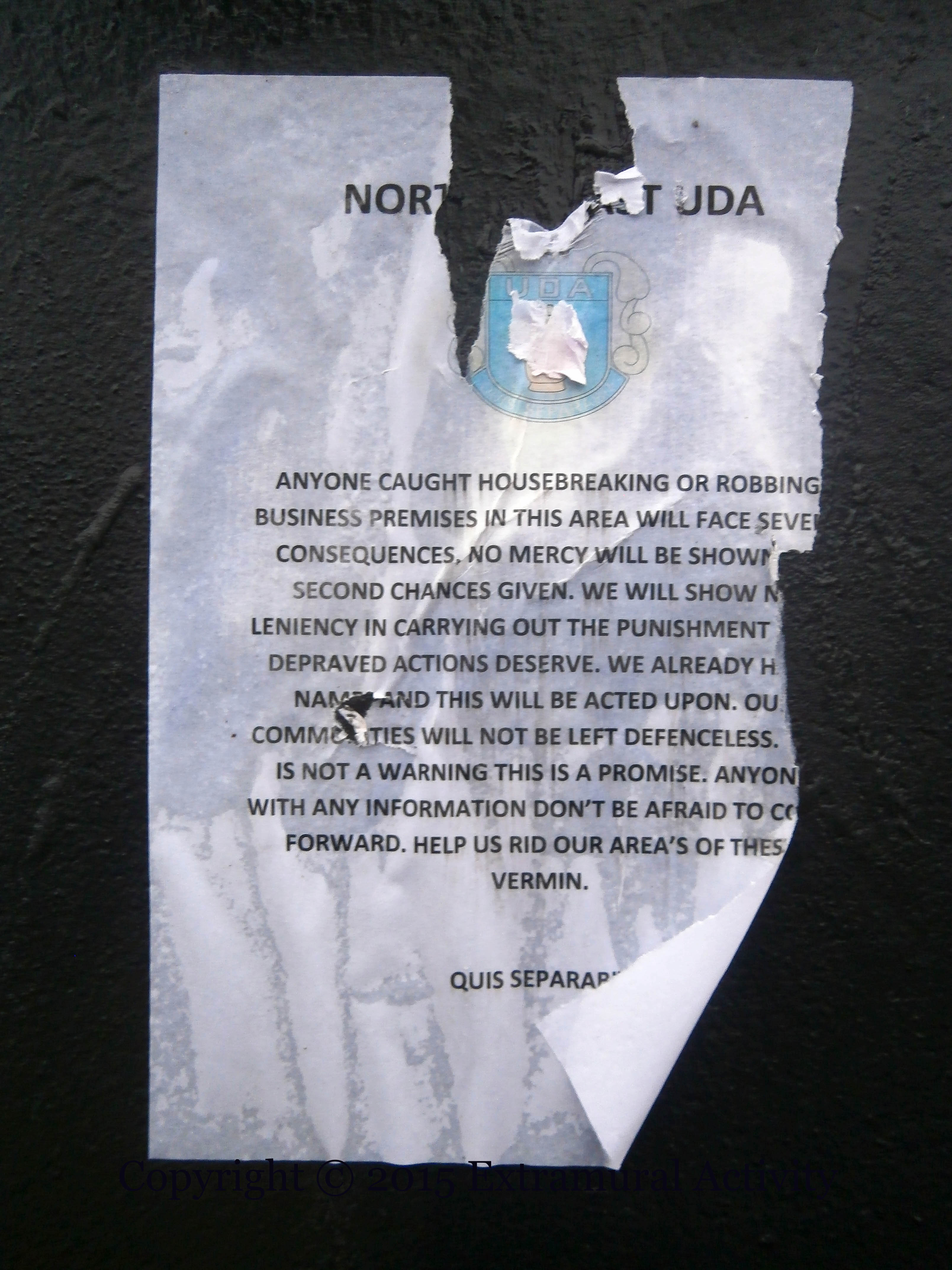
According to this Irish News article (see also Irish Republican News), the flyer above (this one is on the Crumlin Road in the centre of Ligoniel) is the work of a UDA faction that has intimidated people out of their homes in the Glenbryn area. (See also Irish Republican News.)
“North Belfast UDA: Anyone caught housebreaking or robbing business premises in this area will face severe consequences. No mercy will be shown or second chances given. We will show no leniency in carrying out the punishment your depraved actions deserve. We already have names and this will be acted upon. Our communities will not be left defenceless. This is not a warning this is a promise. Anyone with any information don’t be afraid to come forward. Help us rid our area’s of these vermin. Quis separabit.”
Today’s image is of the final new mural in the recent re-imaging of the Lower Shankill estate. It shows a patchwork quilt of word related to women and the roles they play in families and communities, such as “aunt”, “mother”, “sister”, “granny”, and “caring”, “diverse”, “strong”, and “unheard voices”.
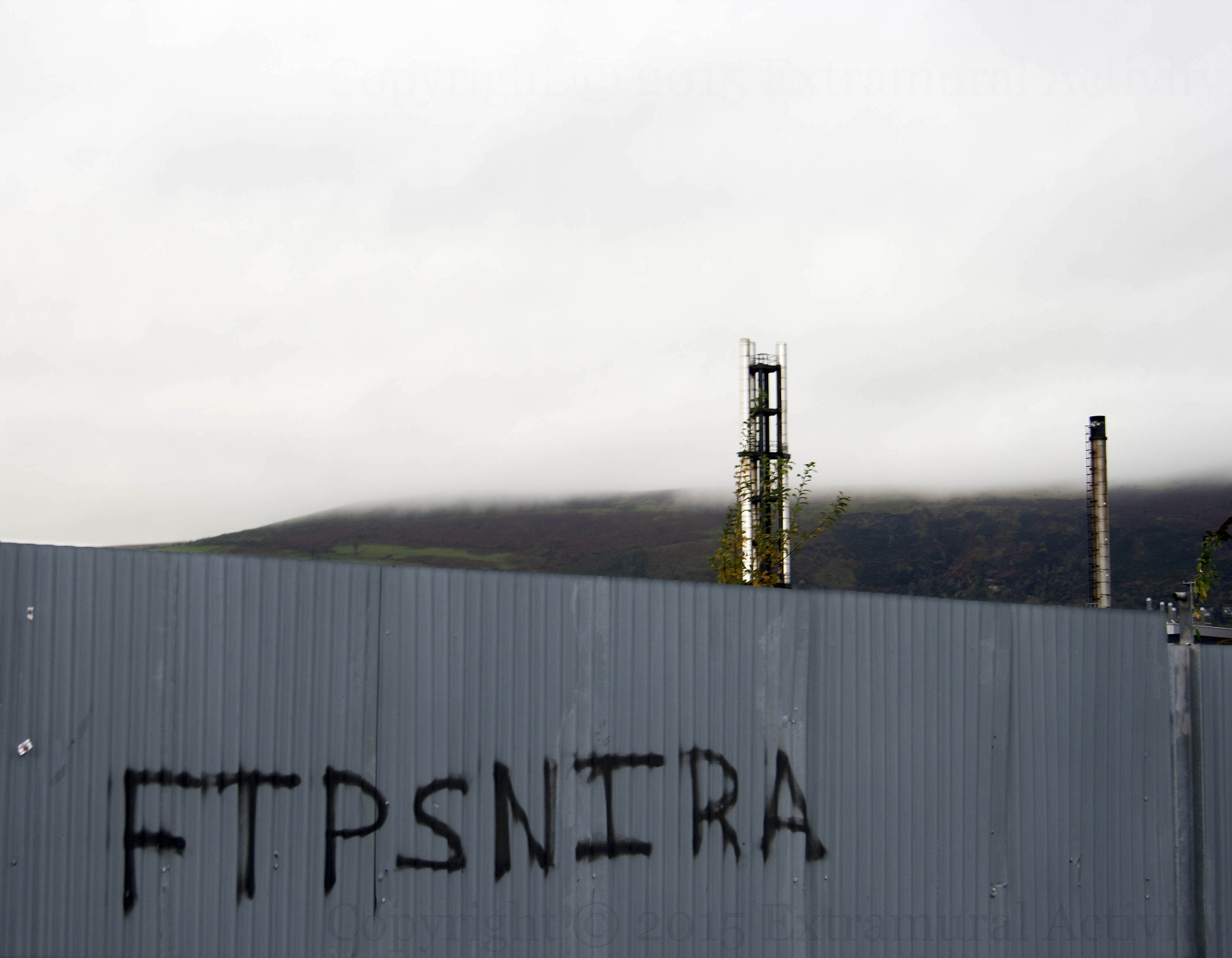
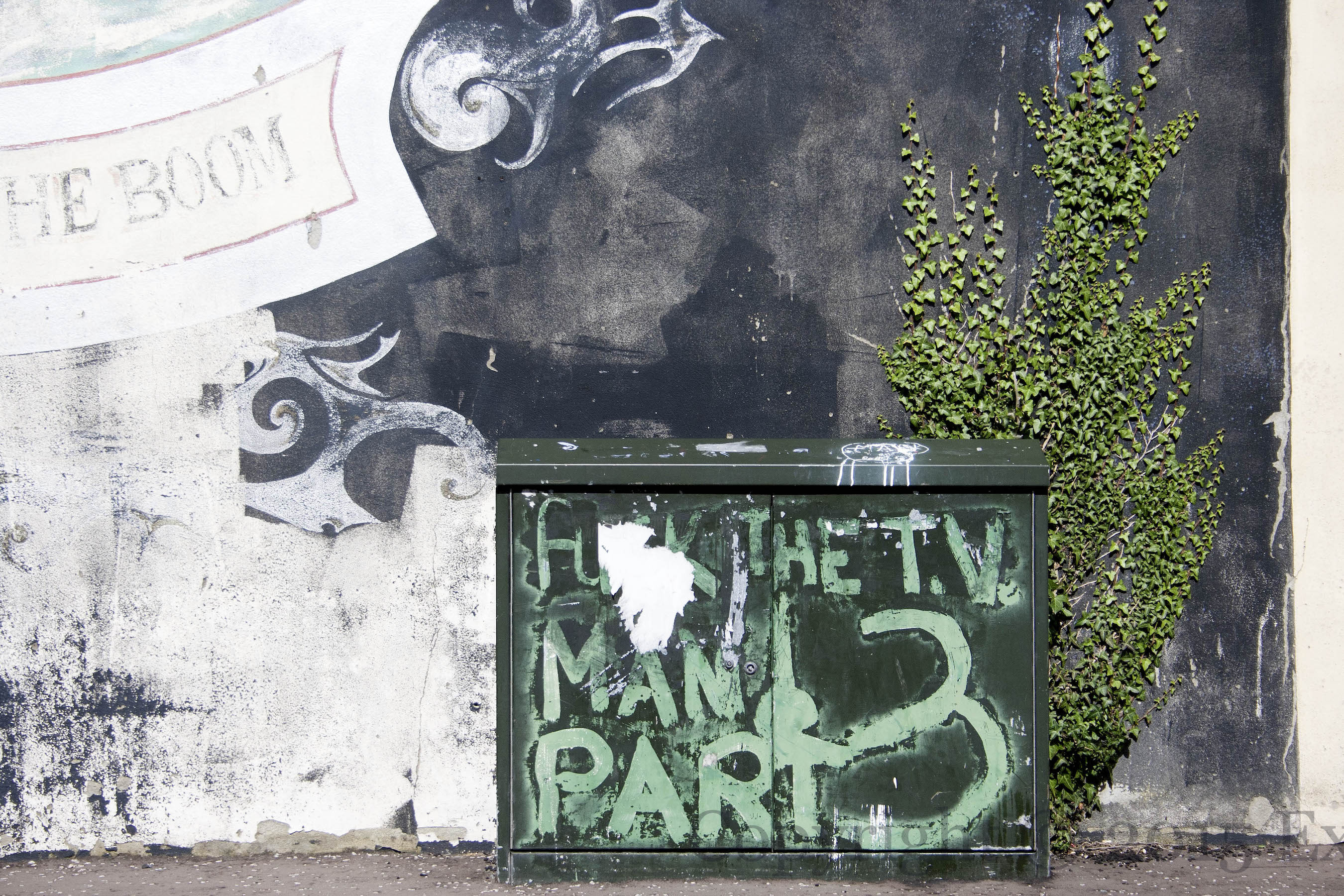
Three F-bombs today in a concentrated package. Above we have the PSNI and the IRA combined into one (and next to a swastika, not shown) in Maladon Street, south Belfast. Below, we have “Fuck the TV man, part 3” in Roulston Street in Londonderry’s Waterside. And finally, there is is “Fuck DAAD fags” on the New Lodge Road in north Belfast. “DAAD” stands for “direct action against drugs”, a group which counted Kevin McGuigan and Jock Davison as members (both of whom were killed in a feud this summer) and now goes by “AAD”. (For AAD and the murders of Davison and McGuigan see Irish News | Belfast Telegraph | Guardian.)
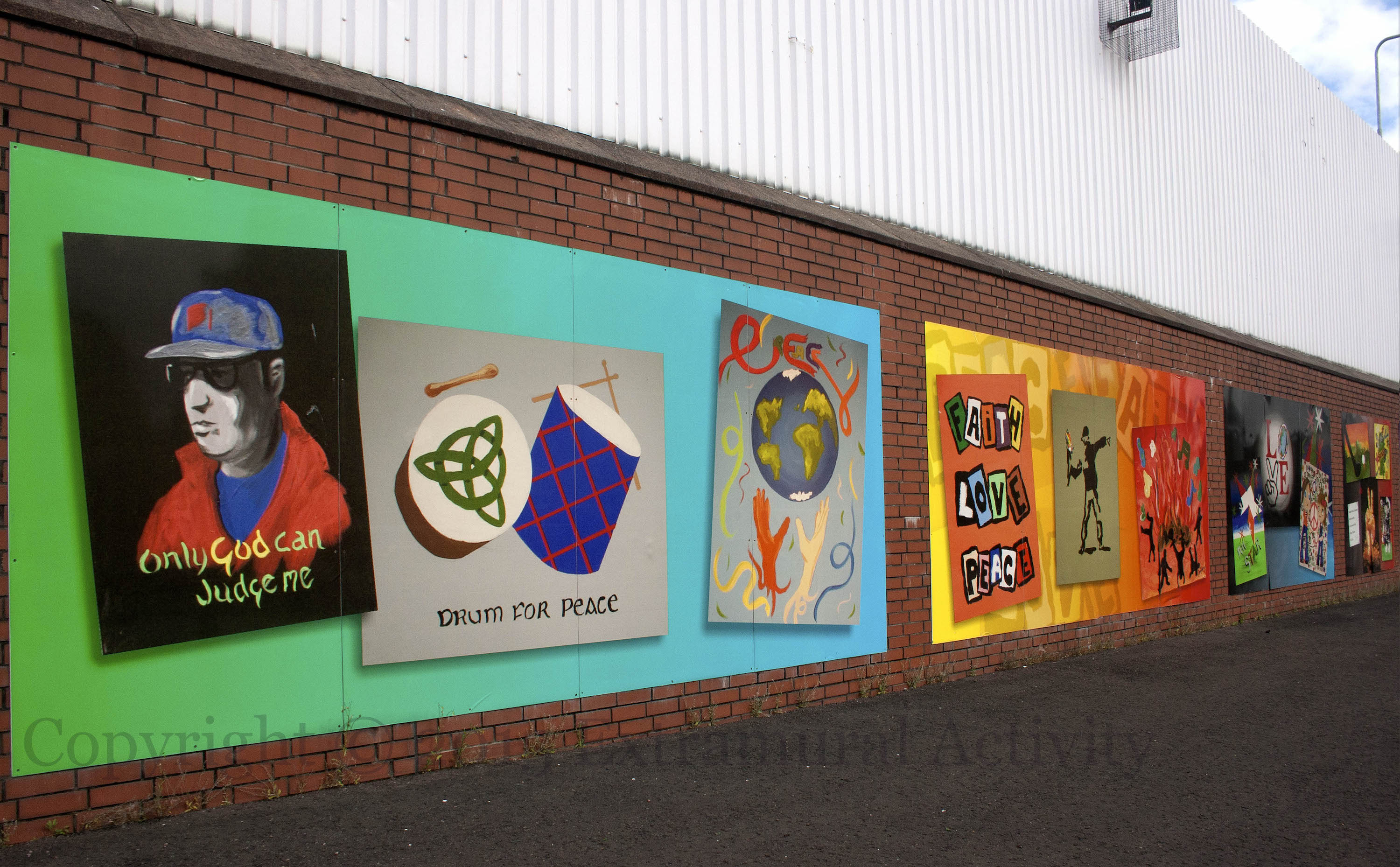
Bonfire break-dancers and bouquet-throwing rioters outside the Woodbourne PSNI station, as well as a lambeg drum side-by-side with a bodhrán and “Only God can judge me”, here used (probably) as an anti-suicide message rather than as an excuse to take the law into one’s own hands.
The quote on this new board in the Lower Shankill estate – “Never doubt that a small group of thoughtful, concerned citizens can change the world. Indeed, it is the only thing that ever has” – is attributed to “Margaret Mead, American Author 1901-1978”. Mead in fact was best known as an anthropologist and in particular for her study of adolescent coming-of-age in the islands of Samoa which concluded that adolescence there was not at all the stressful and confused period that it was Western teens.
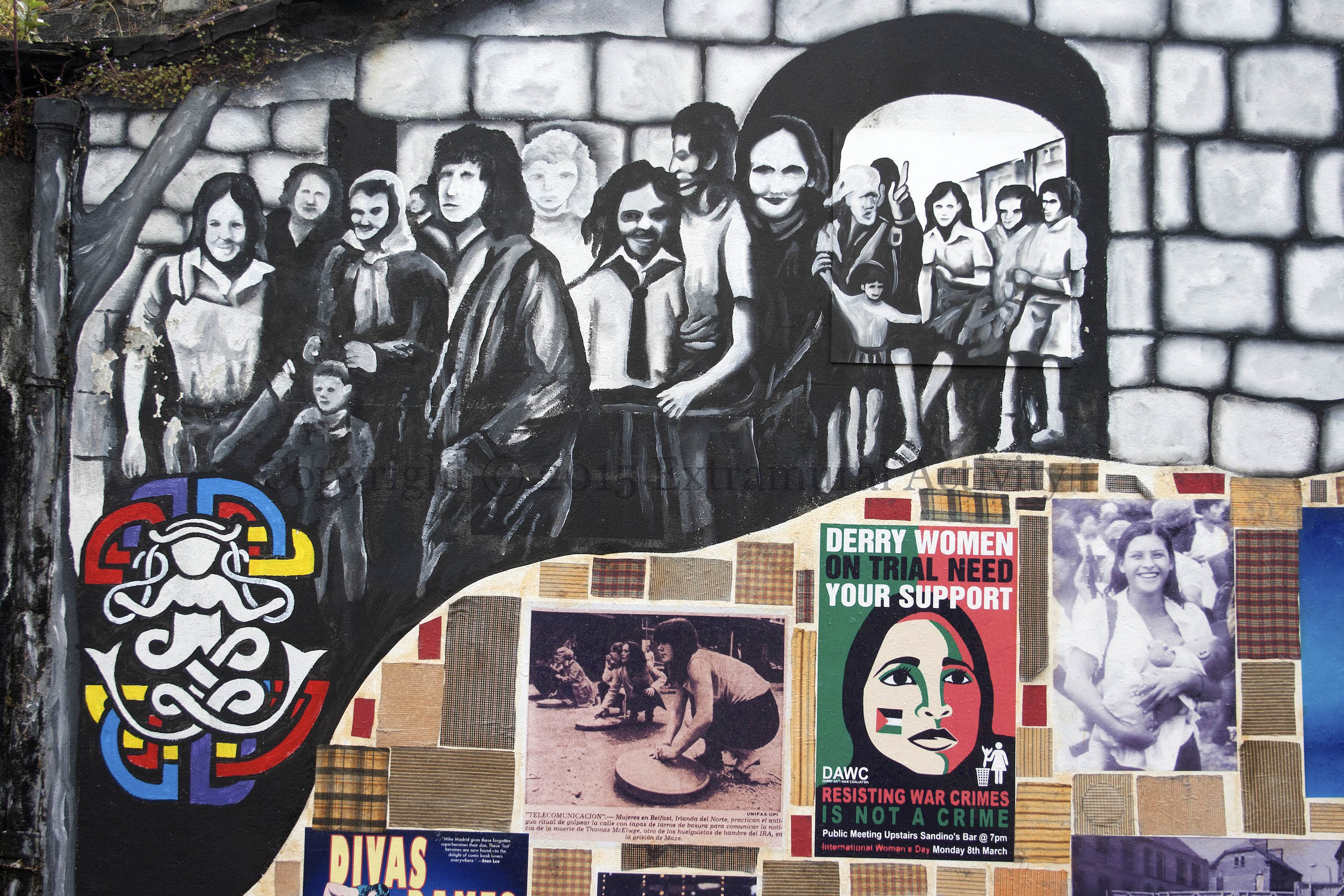
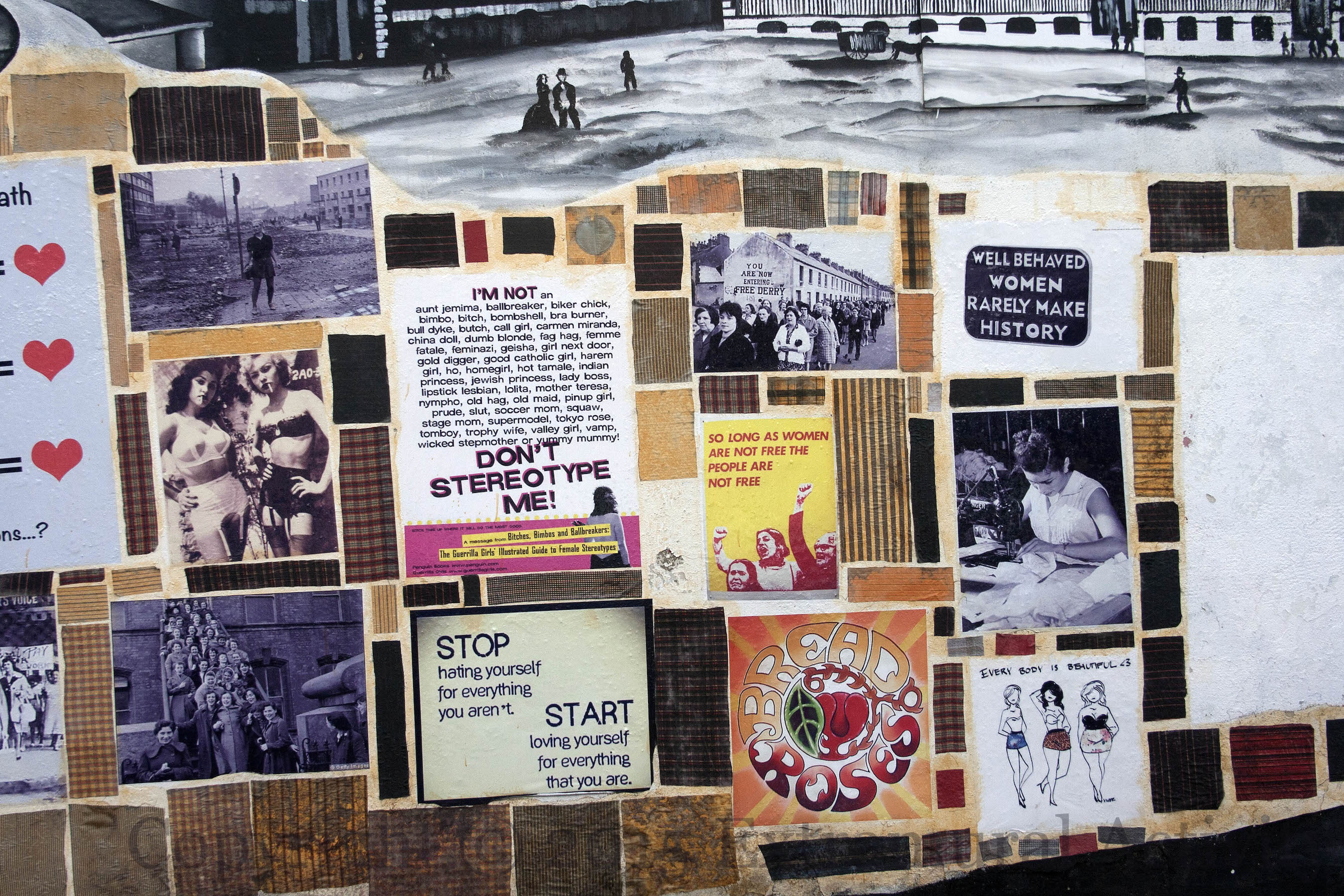
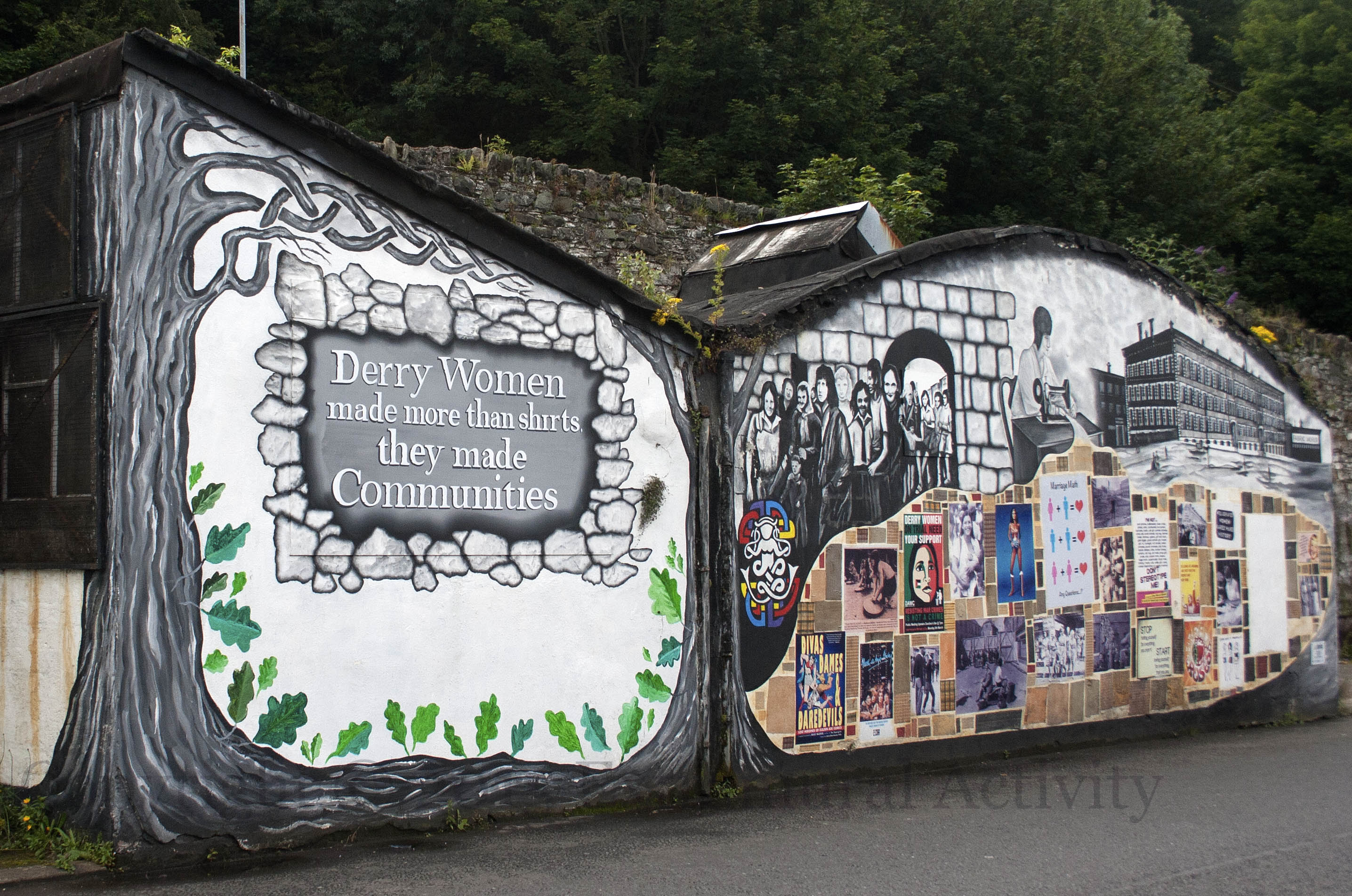
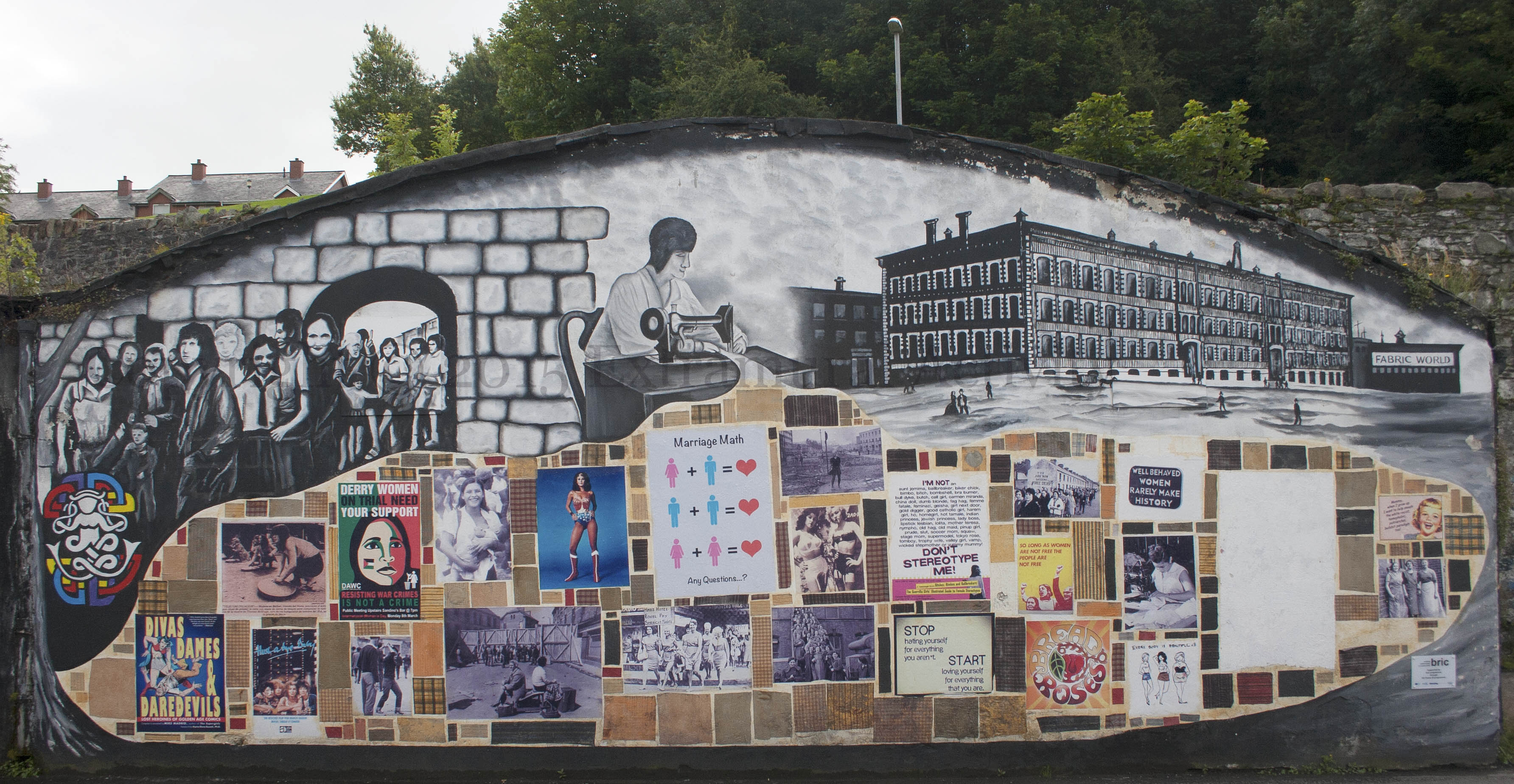
Historian Laurel Ulrich‘s 1976 phrase is one of a variety featured in this Derry mural celebrating the role of women both locally and world-wide. It includes images of local women banging bin lids, marching past the ‘Free Derry’ graffiti on 33 Lecky Road, and rioting; images of women striking and protesting; support for Palestine and gay rights; celebrations of femininity; and Wonder Woman. As the final image, below, shows, the tapestry of images and posters is being sewn by a woman at a sewing-machine in one of Derry’s large shirt- and collar-making factories. (For some history see these Derry Journal articles: one | two.) As the panel on the left-hand side notes, “Derry women made more than shirts; they made communities”.
On the left of the main panel, women march out of one of the city’s gates. The information sheet (which has fallen off) reads as follows: “On International Women’s Day, March 8th [1991, not 1981 as the hand-written addition suggests], the first ever women’s mural in Derry was unveiled on the back of Free Derry Wall. It was designed and painted by Patricia Hegarty and Joe Coyle, and helpers, both men and women. The mural takes its inspiration from a march in November 1968, after Minister for Home Affairs Bill Craig banned all civil rights marches in the walled city. Women factory workers walked out and spent the afternoon marching in and out of every gate in the city, deliberately “breaking the ban”. Men marched in from DuPont to join them, and a rally was held in the Diamond. In the mural you can find the faces of some of those marching on that historic day, as well as other women who played their part in the ongoing struggle for justice. Civil rights workers Bridget Bond and Women’s Aid refuge founder Cathy Harkin march alongside republicans such as Ethel Lynch, Bridget Sheils, Peggy Derry, prisoners’ rights activists Susie Coyle, and many others. You may find images of your granny, sister or aunt. The mural is dedicated to all those women whose energy and determination have changed their lives and the world about them.”
The board on FDC can be seen in Woods’s Seeing Is Believing?, plate 19.








 Extramural Activity