Ireland’s most famous export is not its music – including Fontaines D.C. (web) – or its stout – including Guinness – but its people, about 10 million of them since 1800 (WP). The youngster in this new mural by Dublin artist ACHES (ig) is torn in different directions.
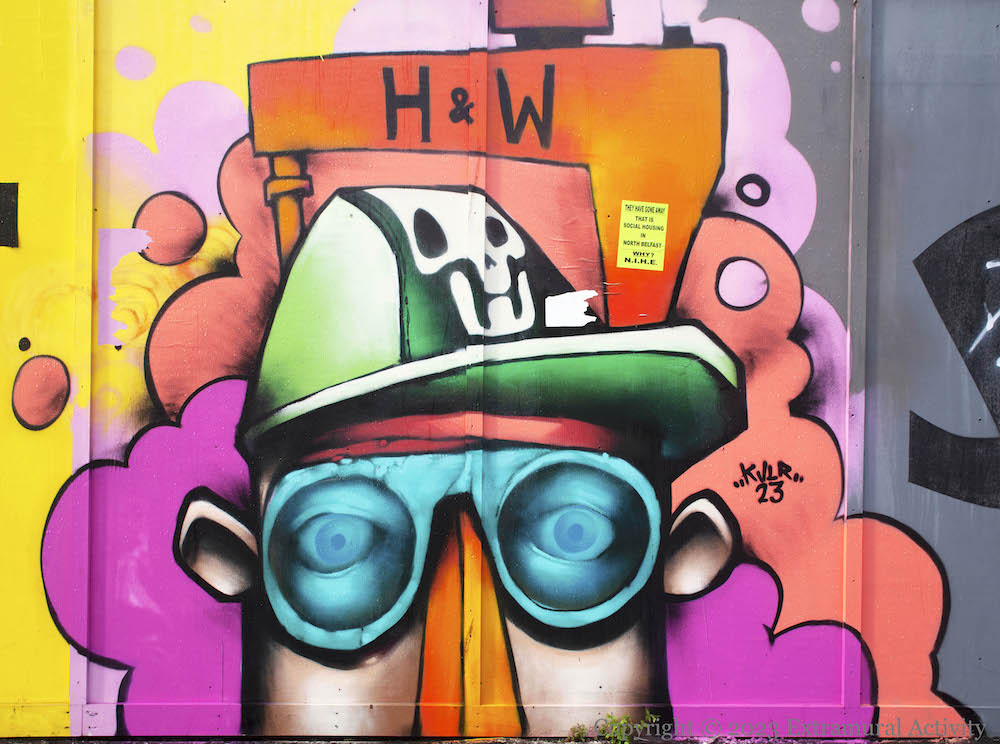
How’s about ye?! FGB (ig), Leo Boyd (ig), and KVLR (ig) added three pieces at the end of April to what is now the “Belfast Stories” construction hoarding. FGB’s piece, shown above, was inspired by the fact that the northern branch of North Street was called “Goose Lane” (tw) at the time of (Chichester’s) Belfast Castle, as herders headed through the north gate (see the map at Lennon Wylie). There is a “Goose Lane” plaque on just the other side of Royal Avenue; it is included below.
“One of the earliest streets in the city, North Street was known as Goose Lane, along which geese were driven to feed on the fields outside the town. That 17th century street consisted of single-storey houses and the old city wall bisected it at what is now Royal Avenue – Belfast City Council.”
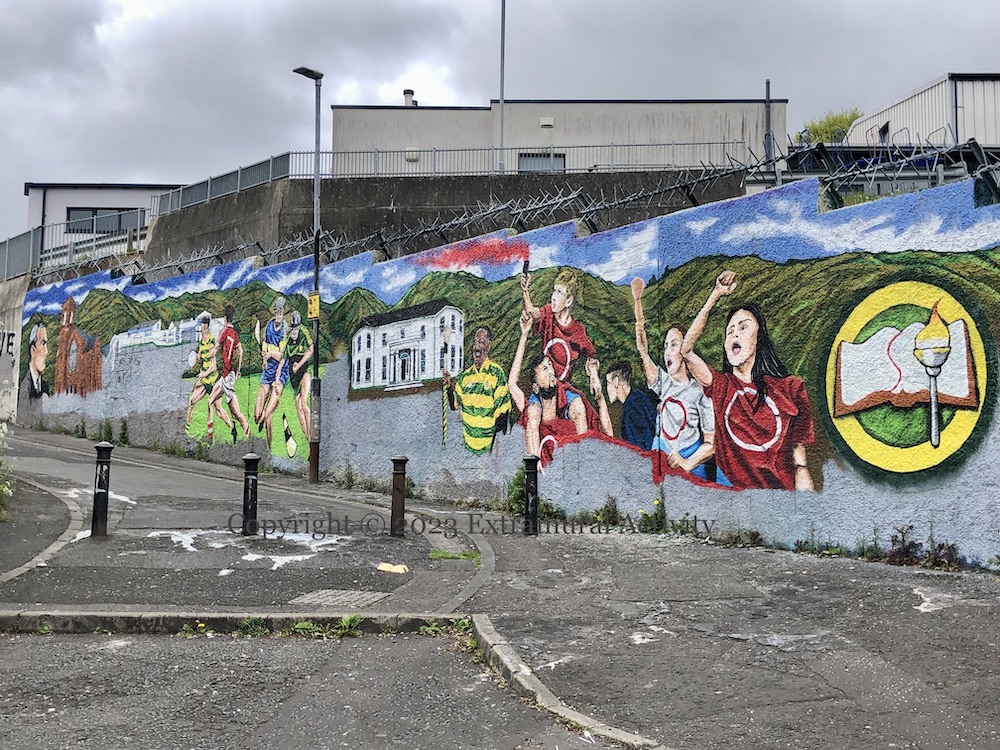
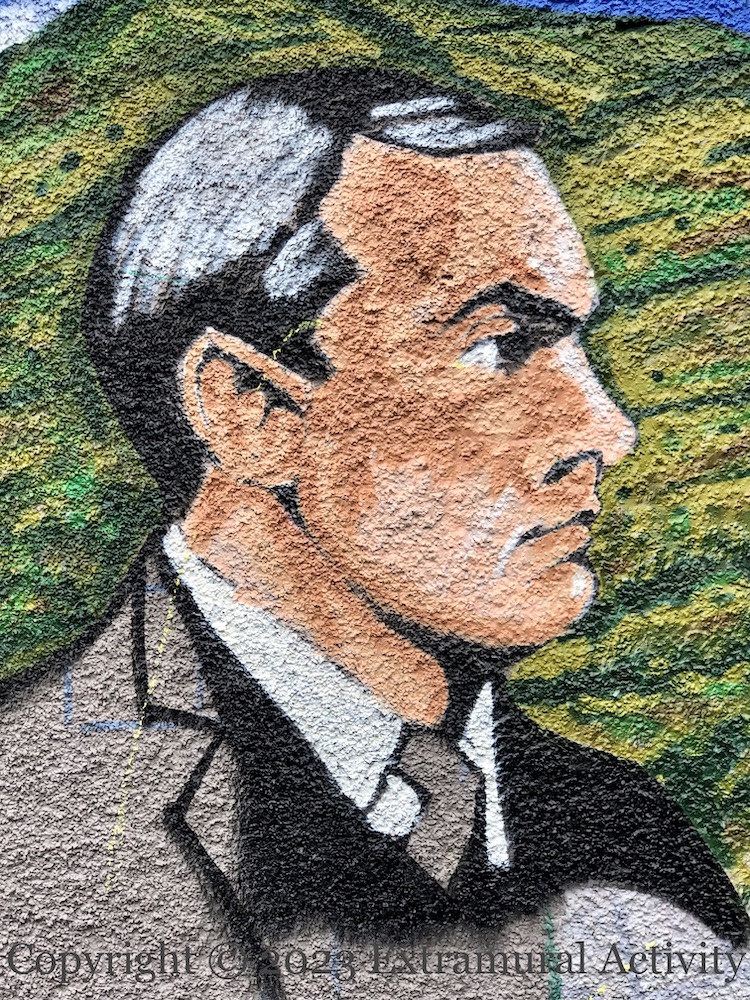
What is now Coláıste Feırste began life as Meánscoıl Feırste in 1991, teaching a group of nine students a curriculum inspired by Patrick Pearse (discussed previously in An Tusa An Chéad Laoch Eıle?) and based in Cultúrlann MacAdam-Ó Fıaıch (Cultúrlann). It moved to Beechmount in 1998 and in 2018 expanded into new buildings that were meant to accommodate 600 pupils (Doherty Architects), which it has now exceeded (BBC) as it enters its thirty-third year in existence.
The theme of preserving and promoting the Irish language occurs in several places in the mural: next to Pearse we see his saying, “Máırtín Ó Chadháın ” [a land without a language [is] a land without a soul], in the classroom scene we have “Labhaır í agus maırfıdh sí” [speak it and it will endure], and finally we see the Dream Dearg protesting for an Irish-Language Act (see previously #AchtAnoıs).
The in-progress images included below among completed detailed shots date from May 6th and 20th.
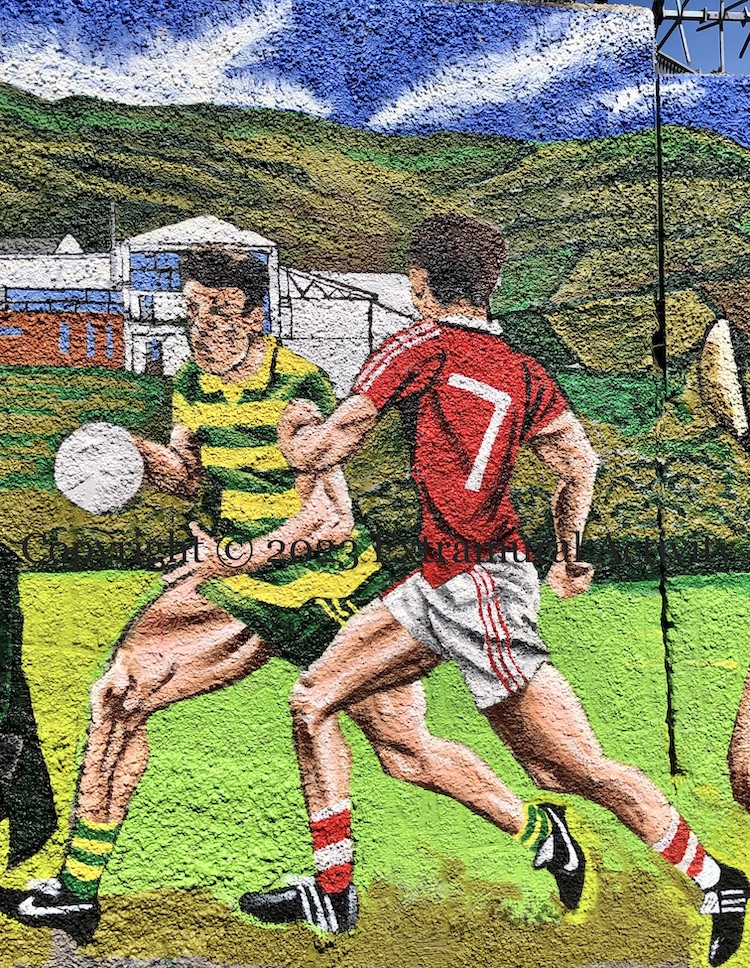
Giant’s Foot/Beechview Park. Replaces the short-lived mural of Olympians, seen in Sporting Giants.
“Wherever life plants you, bloom with grace.” When the Shankill Women’s Centre was first formed, in 1987, it was located in The Hummingbird on the lower Shankill (SWC). (When the Wellbeing Centre was built on that site, the Women’s Centre moved further up the Shankill to its current location in the Hammer.) A hummingbird features in one of the paintings on the hoarding around the construction site of a new “Shankill Shared Women’s Centre” on Lanark Way, a 6.5 million euro project funded by PEACE IV (Belfast CC).
The Shankill Area Social History (SASH) (Fb) celebrates the people and events of the Shankill Road with a new mural in Downing Street.
From left to right: girls wrapped in Union Flags watching the parade; boys on pallets; the Shankill Mission; Orange Order parade; the Summer festival in Woodvale Park (The Cabin); the former Belfast Savings Bank, now an undertaker’s; the Winter festival and switching-on of the Christmas tree lights, with Mrs. Claus, the Grinch in Santa jacket and hat, and last year’s (2022) celebrity guest Charlie Lawson (youtube); local band Casual Riots (ig). (SASH Fb Gallery)
For a mural of famous Shankill faces and places, see Save The Shankill.
This is a new mural on the Ballysillan Road by MWAK/Pigment Space (ig) close to the Boys’ Model and featuring a student at the centre of symbols of learning – a film camera in the top left; Hokusai’s Great Wave in the top right, for art; Titanic (for engineering?) and a thermometer (for chemistry? or global warming?) on the right; musical notes in the bottom right; sports in the bottom left. The dates on the left are obscure. “1971” is perahps for the year the school won the Schools’ Cup in rugby (News Letter); there is a soccer ball next to “1996” but no similar victory can be found – get in touch if you can supply a meaning.
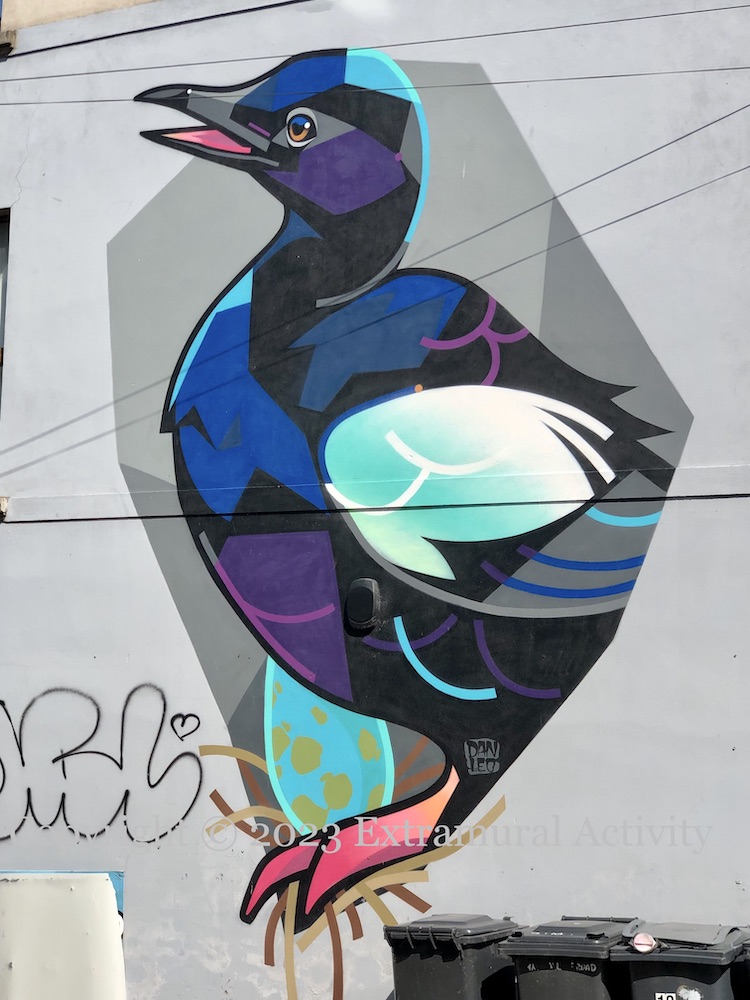
The guillemot is distinctive for its red “gape” (inside of mouth). It spends most of its time on and around water but nests on cliff ledges and other remote spaces in May (BirdWatchIreland). The pointed shape of the egg makes it less likely to fall off cliffs (British Birds). They have been nesting in Bangor since at least 1911 (Geograph). If you can’t spot any at the marina, you can check out this mural by Dan Leo (ig) in nearby Victoria Road.
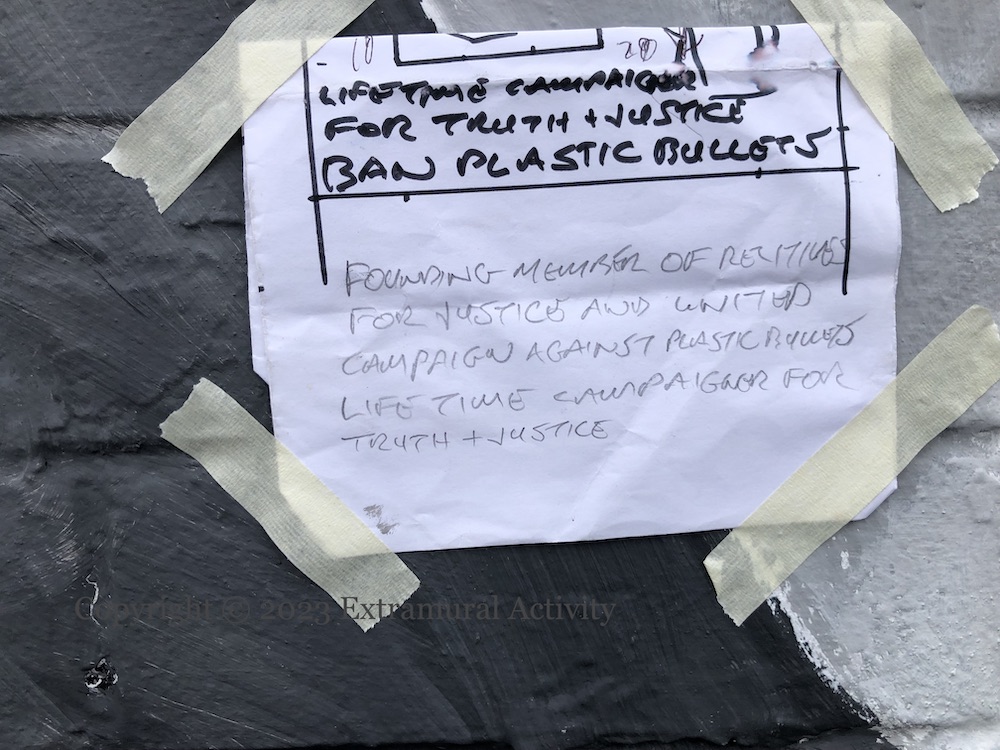
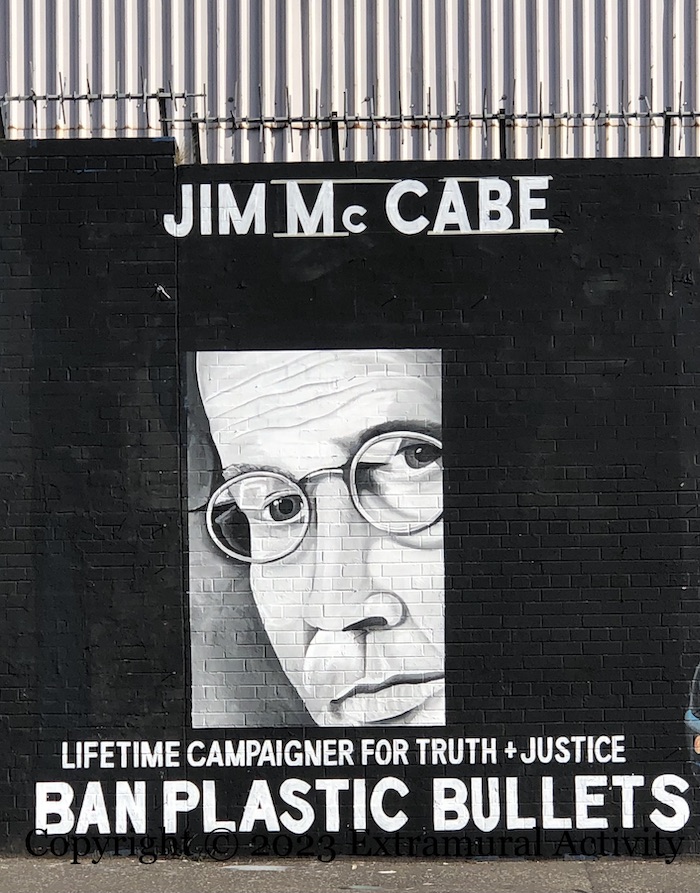
A new mural was unveiled yesterday in memory of Jim McCabe, the husband of Norah McCabe who was hit by a plastic bullet in 1981 and died a day later. Jim went on to become a “lifetime campaigner for truth + justice” and a “founder member of Relatives For Justice [web] and United Campaign Against Plastic Bullets [web]” – the sketch shown in the third image suggests this line was part of the plan for the mural. (For a profile of Jim’s campaigning work, see Belfast Media.) Jim died in January of this (2023) year.
The image above shows one of the children of Norah and Jim – James – standing in front of the new mural wearing a ‘Ban plastic bullets’ t-shirt and carrying an image of his mother.
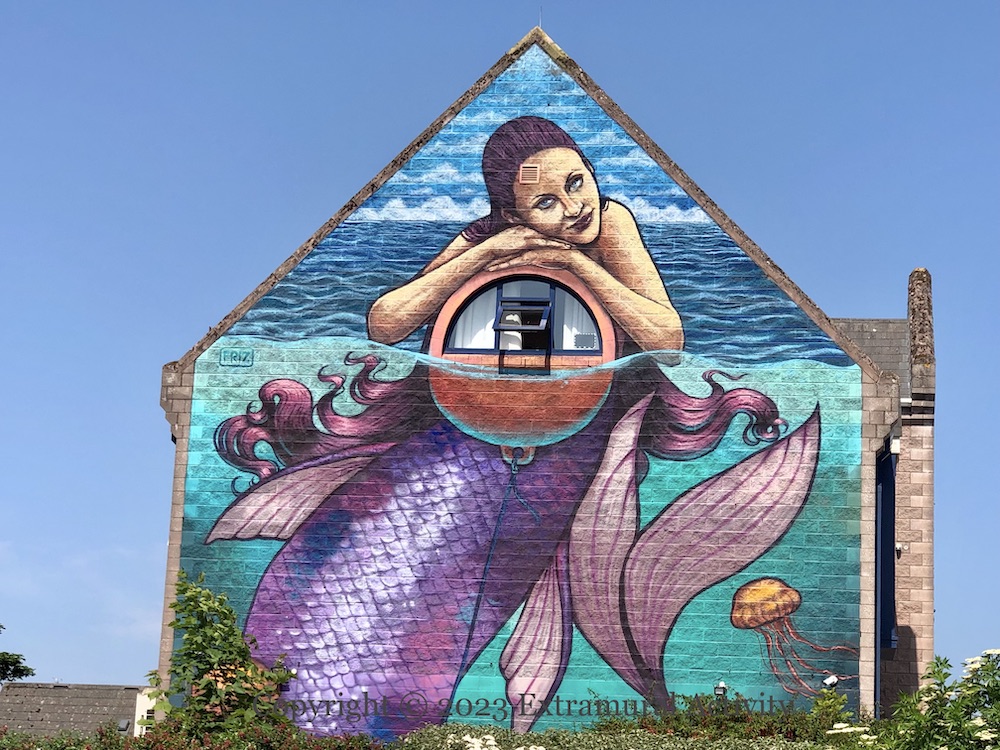
Lí Ban became a mermaid – half-human, half-salmon – after a year spent living in an underwater bower, taking shelter from the family’s uncovered spring that overnight formed Lough Neagh. Three hundred years later (circa 558 A.D.) she told an envoy of Saint Comgall’s who was on his way to Rome, that she would come ashore at Larne a year later. She forwent another 300 years of sea life in favour of being baptised and dying immediately. She was baptised by Comgall, the abbot of Bangor, and christened “Muirgen” (sea-born) and was buried in the Lough Derg (Donegal) abbey (O’Grady | WP). Muirgen’s feast-day is January 27th (Sacred Sisters).
Painted by Friz (ig) for the Bangor Seaside Revival Festival, with support from Seedhead Arts (ig).
For a different style of presentation of Lí Ban, see Shaped By Sea And Stone in Larne. The end of the story is similar to the fate of the children of Lear, who spend 900 years as swans before a monk hears their song, puts them (willingly) in chains, but in protecting them from others touches them, which restores them to human form only for (baptism and) death to follow immediately. (See The Children Of Lear.)













 Extramural Activity