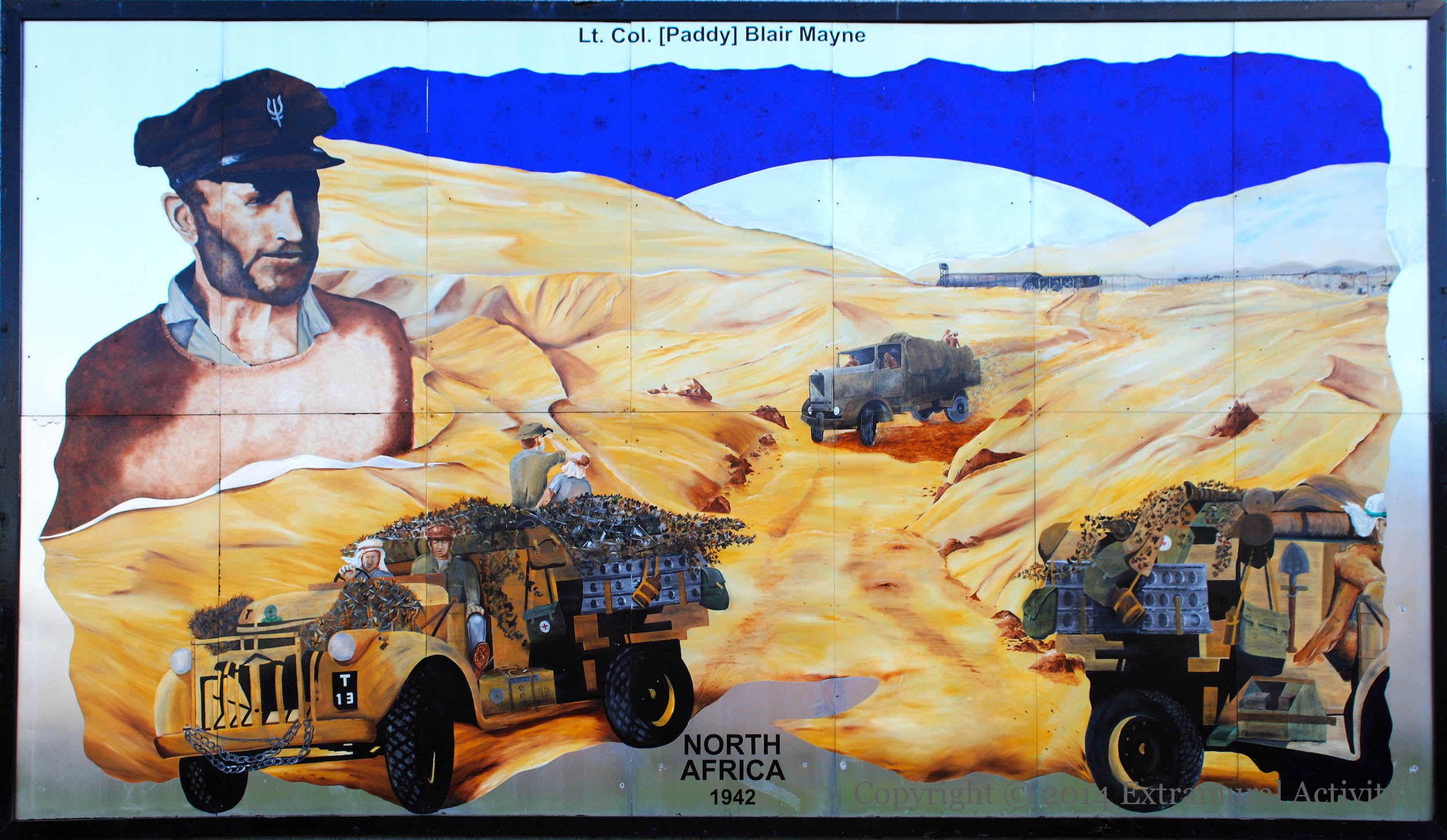
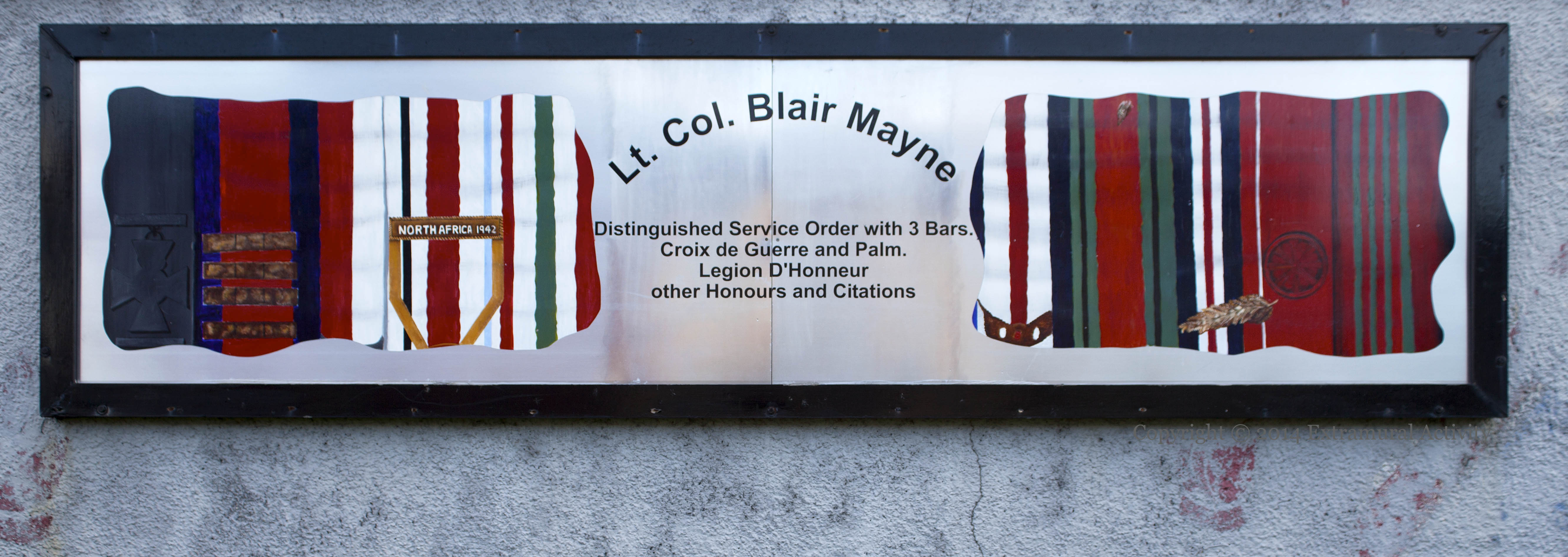
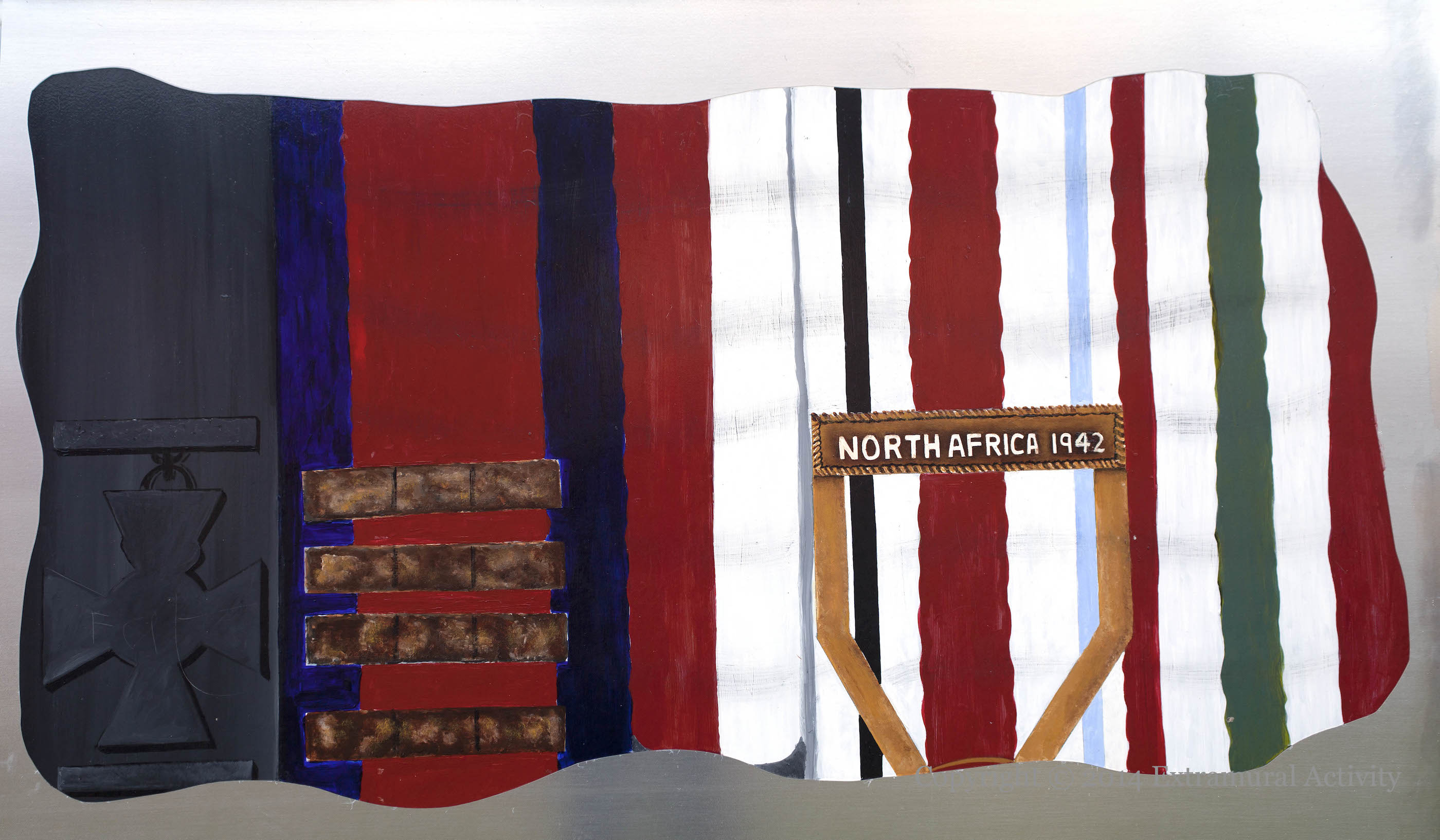
Robert Blair “Paddy” Mayne was a rugby player, boxer, golfer, and solicitor, and in WWII a commando and one of the first members of the SAS (Special Air Service), participating in raids behind enemy lines in Egypt and Libya (depicted in the board above), and later, as SAS commander, in France, Belgium and other countries. His many decorations, including the DSO (four times) and French Croix De Guerre and Legion D’Honneur, are pictured below. (His WP page includes an explanation of the ribbon bars.)
Mayne was born in Newtownards and returned there at the end of the war. His statue stands in the town’s Conway Square and this board can be found in Queen Street.
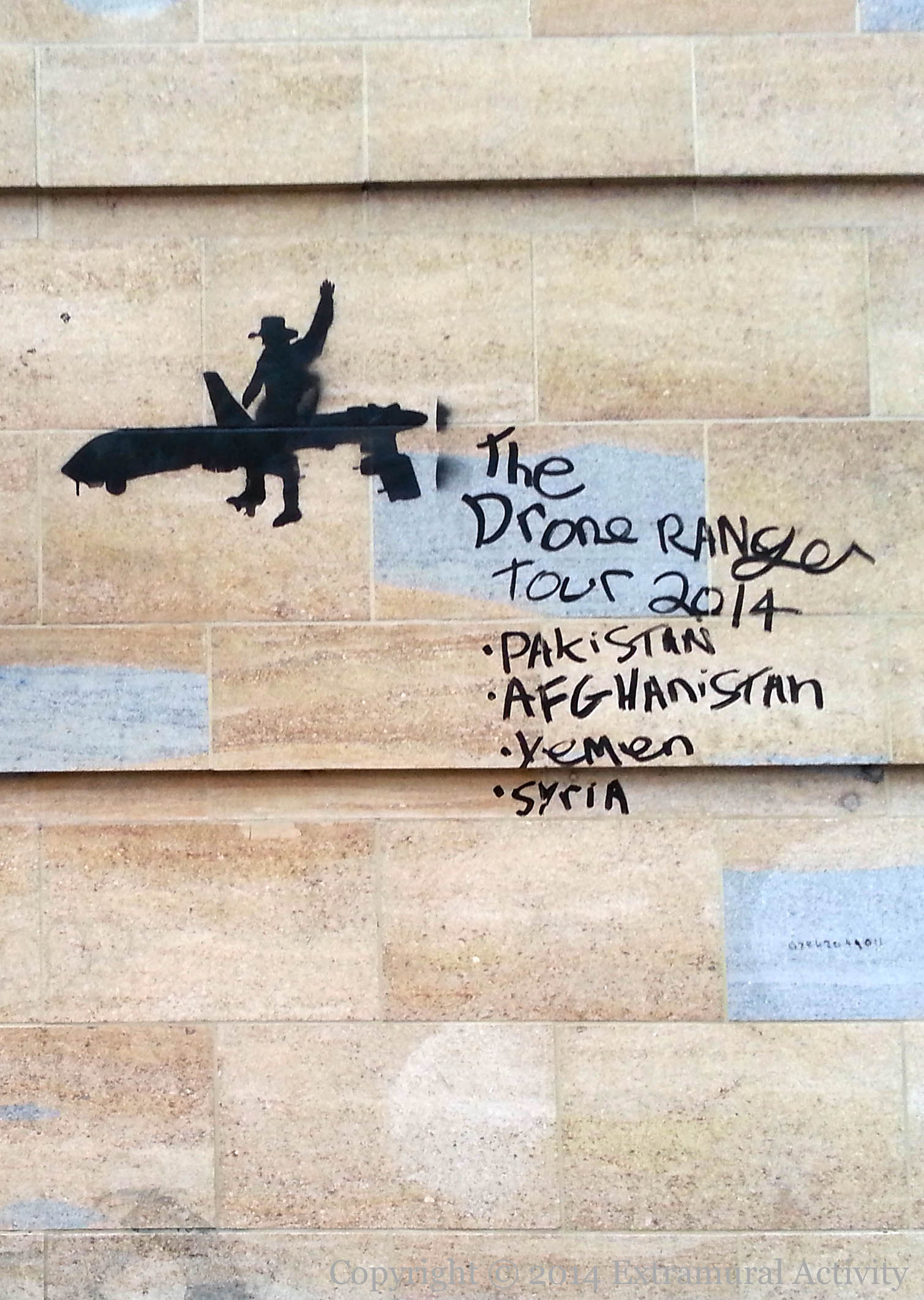
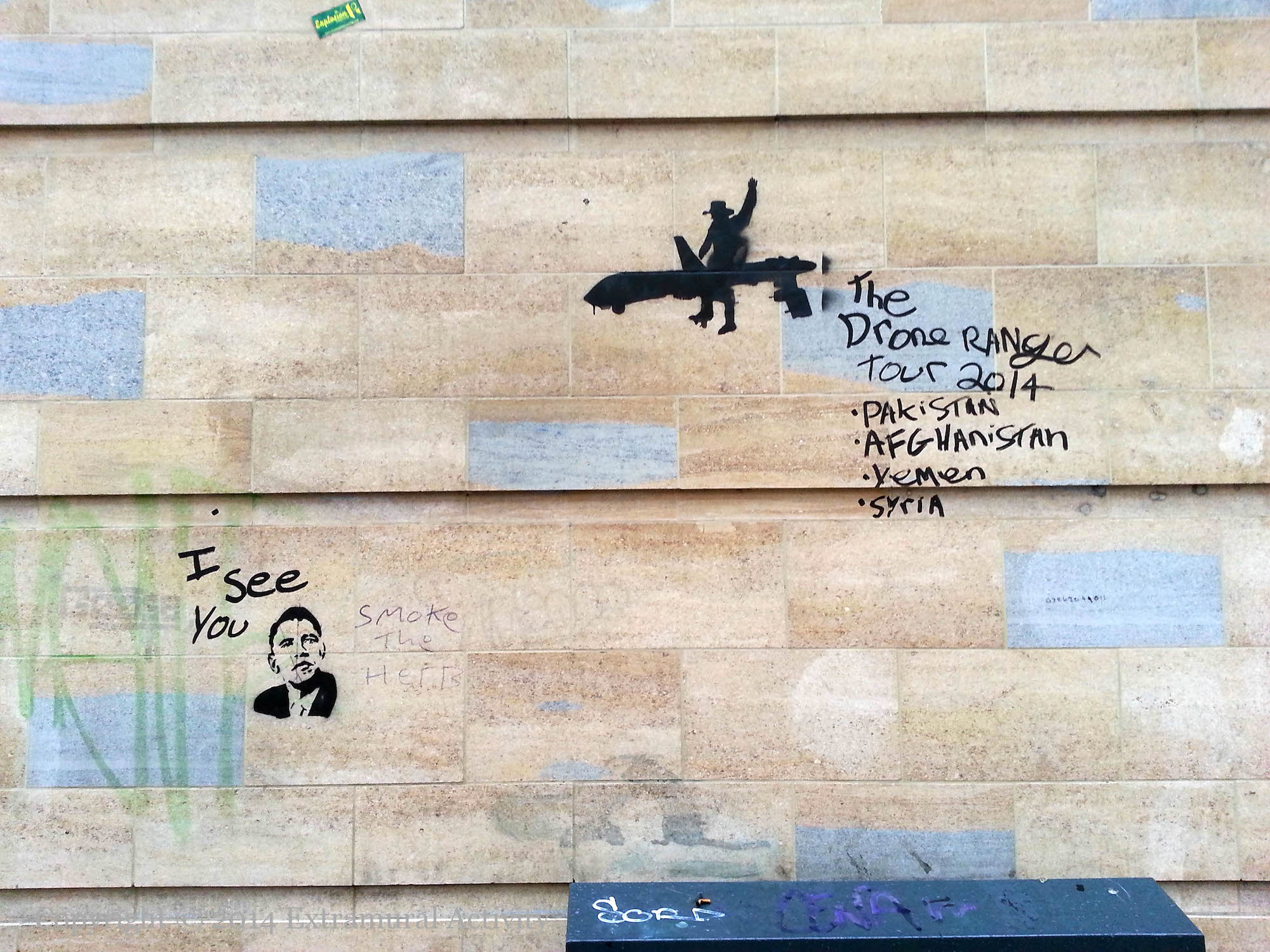
Yesterday (29 January, 2014) marks the 50th anniversary of Kubrick’s Dr. Strangelove, currently#42 on IMDb’s list of greatest films. (See the image below – Slim Pickens in the scene of a lifetime, a role Peter Sellers intended to play, alongside his three others; see also this New Yorker magazine retrospective “Almost Everything in “Dr. Strangelove” Was True”.) The movie retains its relevance in 2014, as evidenced by this stencil in Fountain Street, protesting the use of drone technology by the US in the mideast and Pakistan. Next the stencil of a cowboy riding a drone are the words “The Drone Ranger Tour 2014 – Pakistan, Afghanistan, Yemen, Syria”.
As can be seen in the wide shot below, this piece is next to the Obama ‘I See You‘ (and round the corner from the ‘Don’t Drone Me, Bro‘ stencil).
Slim Pickens as T. J. “King” Kong riding a bomb to mutually assured destruction in Dr. Stangelove.
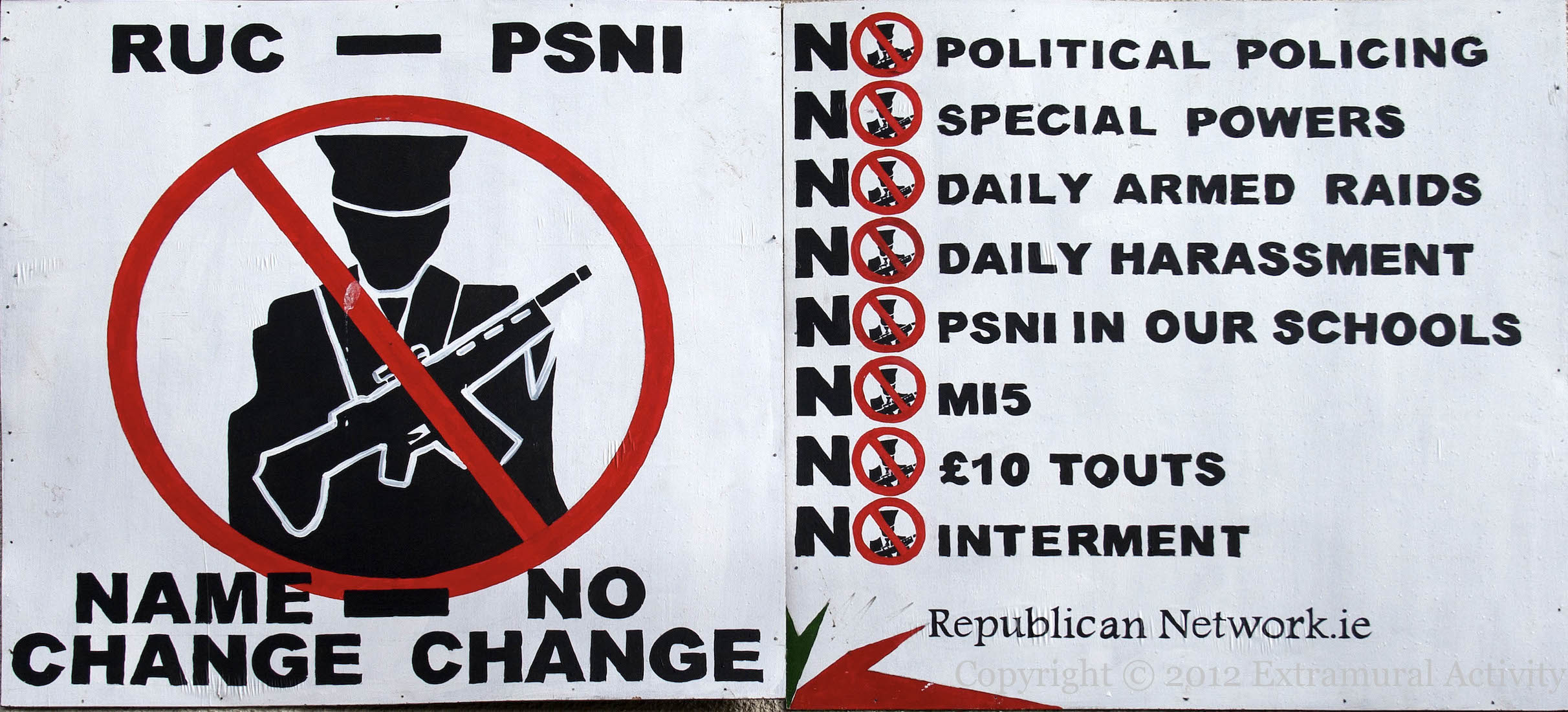
Above is an RNU board from Lenadoon, protesting against the police system and an alleged identity of the PSNI, the Orange Order and loyal paramilitaries. (See previously: Trinity)
“No political policing. No special powers. No daily armed raids. No daily harassment. No PSNI in our schools. No MI5. No £10 tours. No interment [sic].”
The board dates from 2012 (eleven years after the PSNI’s creation and five years after Sinn Féin’s acceptance of the PSNI) but is no longer present.
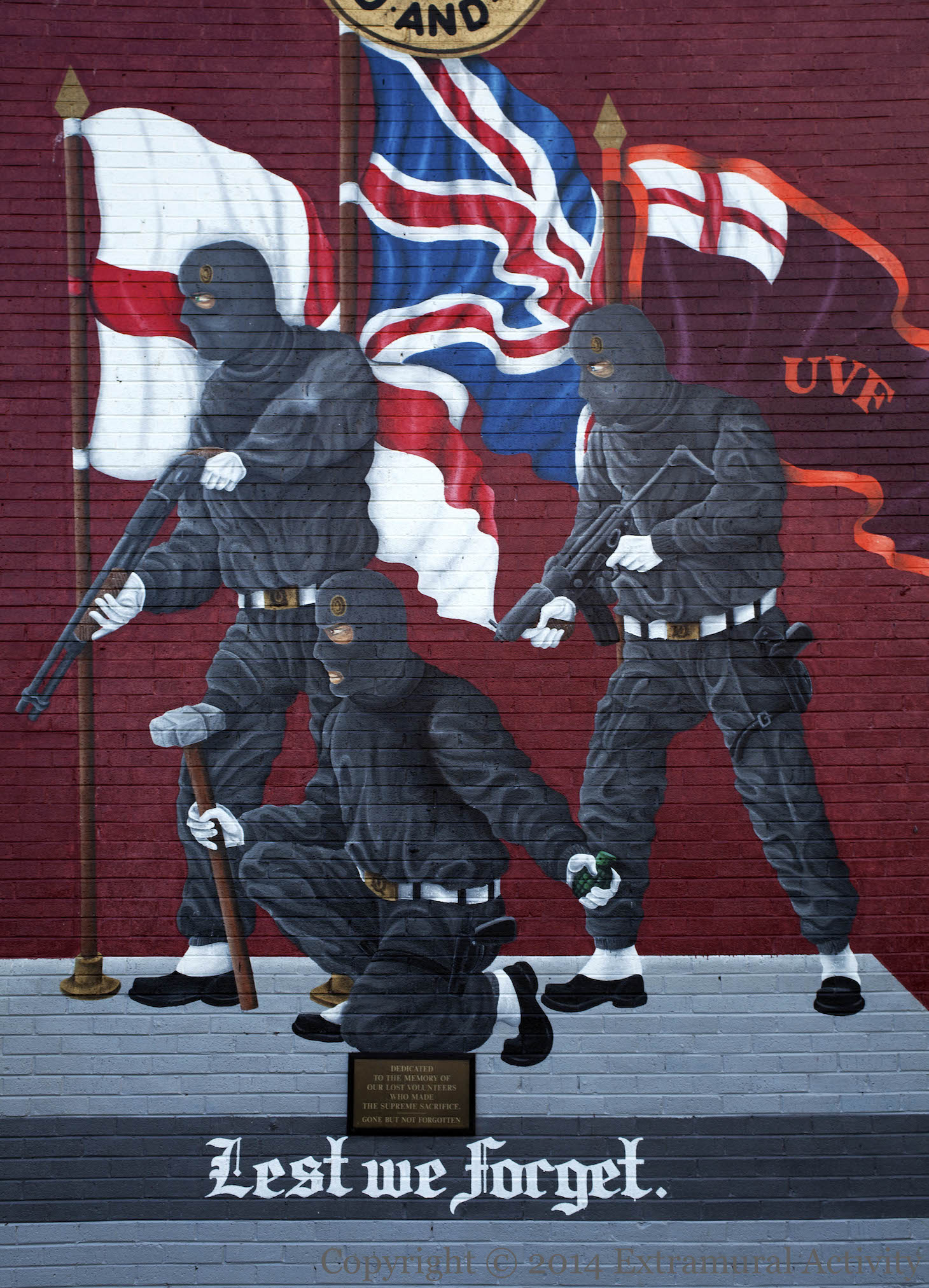
Armed masked men, shotgun, automatic weapon, sledgehammer, hand grenade and two pistols, with the flags of Northern Ireland, the UK and the UVF in the background. The plaque reads, “Dedicated to the memory of our lost volunteers who made the supreme sacrifice. Gone but not forgotten”. “Lest we forget” at the bottom. The full mural (below) shows (clockwise from top left) YCV, PAF (Protestant Action Force), UVF (on an Ulster shield), and 36th (Ulster) Division insignia.
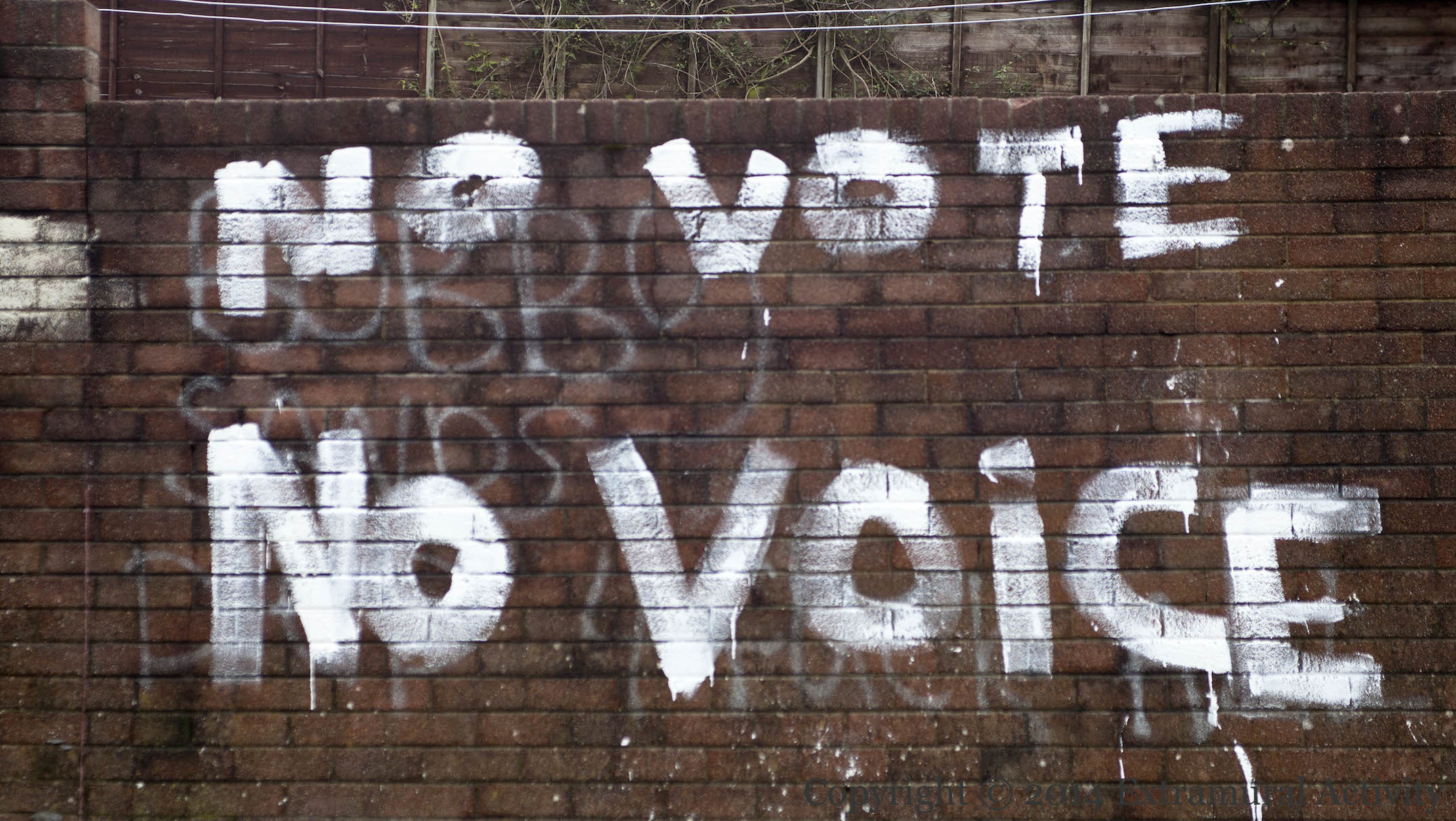
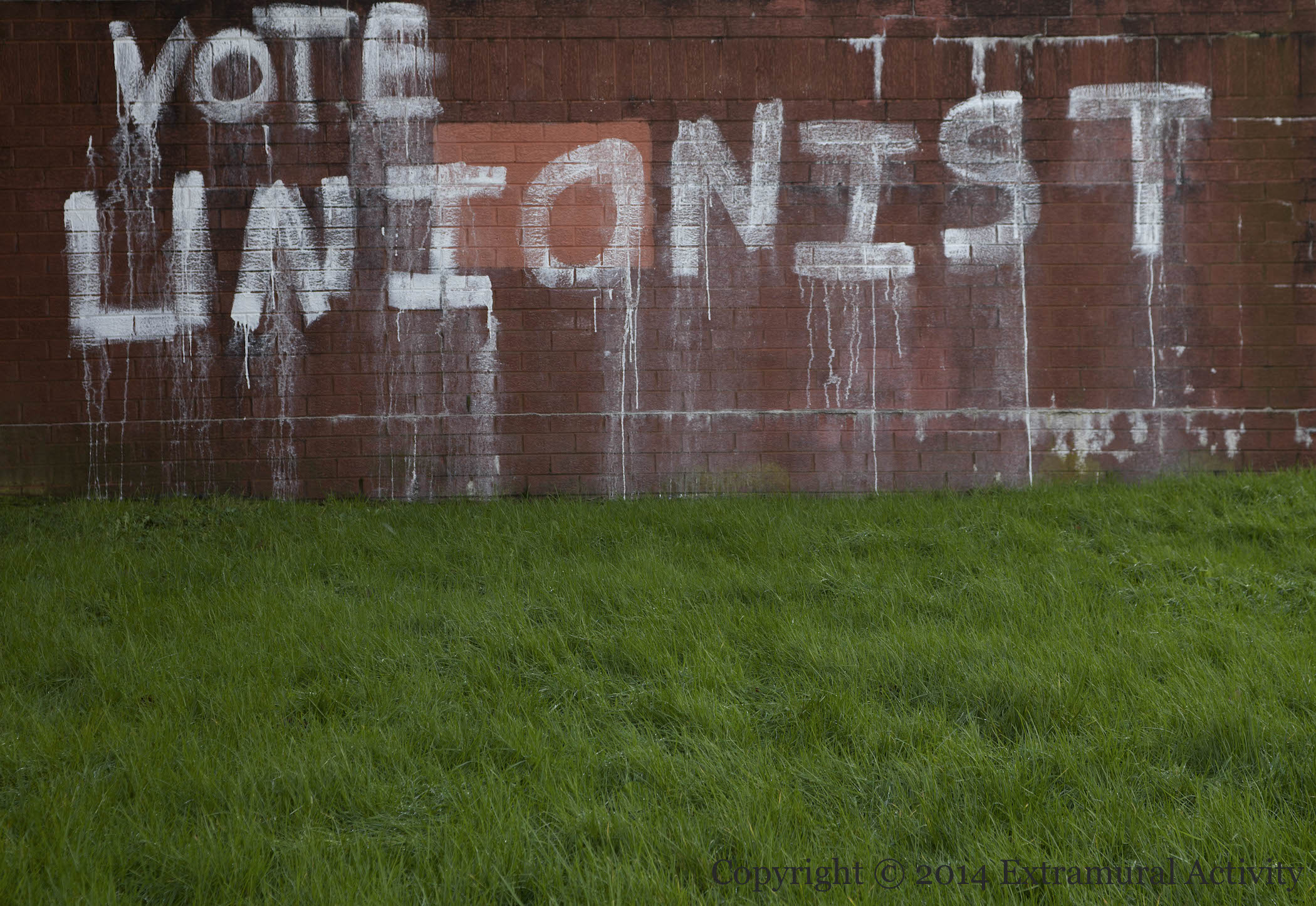
“No vote, no voice” and “Vote Unionist”. Here are two pieces of loyalist graffiti concerned with (as they see it) under-representation in the political process. The first is at the corner of Springmartin Road and Ballygomartin Road (“Bobby Sands died 4 fuck all” can be seen underneath). The second is on the Forthriver Road at the Glencairn Day Centre.
A metal banner (attached to the two barrels) outside the Bowtown Youth Club in Newtownards shows the classic image of the signing of the Ulster Covenant against the background of a Union flag, and also a rocket taking off, in the children’s mural painted on one side of the club.
“NVF” in the left-hand insignia stands for “Newtownards Volunteer Flute [Band]” (Fb). On the right is the insignia of another flute band, the North Down Defenders (Fb).
The caption below the image of the covenant signing lists a good number of those in the picture:
Sir Edward Carson (later Lord Duncairn) signing the Ulster Covenant in the Belfast City Hall, September 28, 1912.
Left to right, 1st row: Mr. R.J. McMordie, Lord Mayor of Belfast, Lord Charles Beresford, Marquess of Londonderry, Sir Edward Carson, Captain James Craig (later Lord Craigavon), Mr. J.H. Campbell, K.C. (later Lord Glenavy), and Dr. W. Gibson.
2nd row: present Lord Londonderry, and Col. R.H. Wallace, C.B., D.L. Behind the latter, Ronald McNeill, M.P. (later Lord Cushendun).
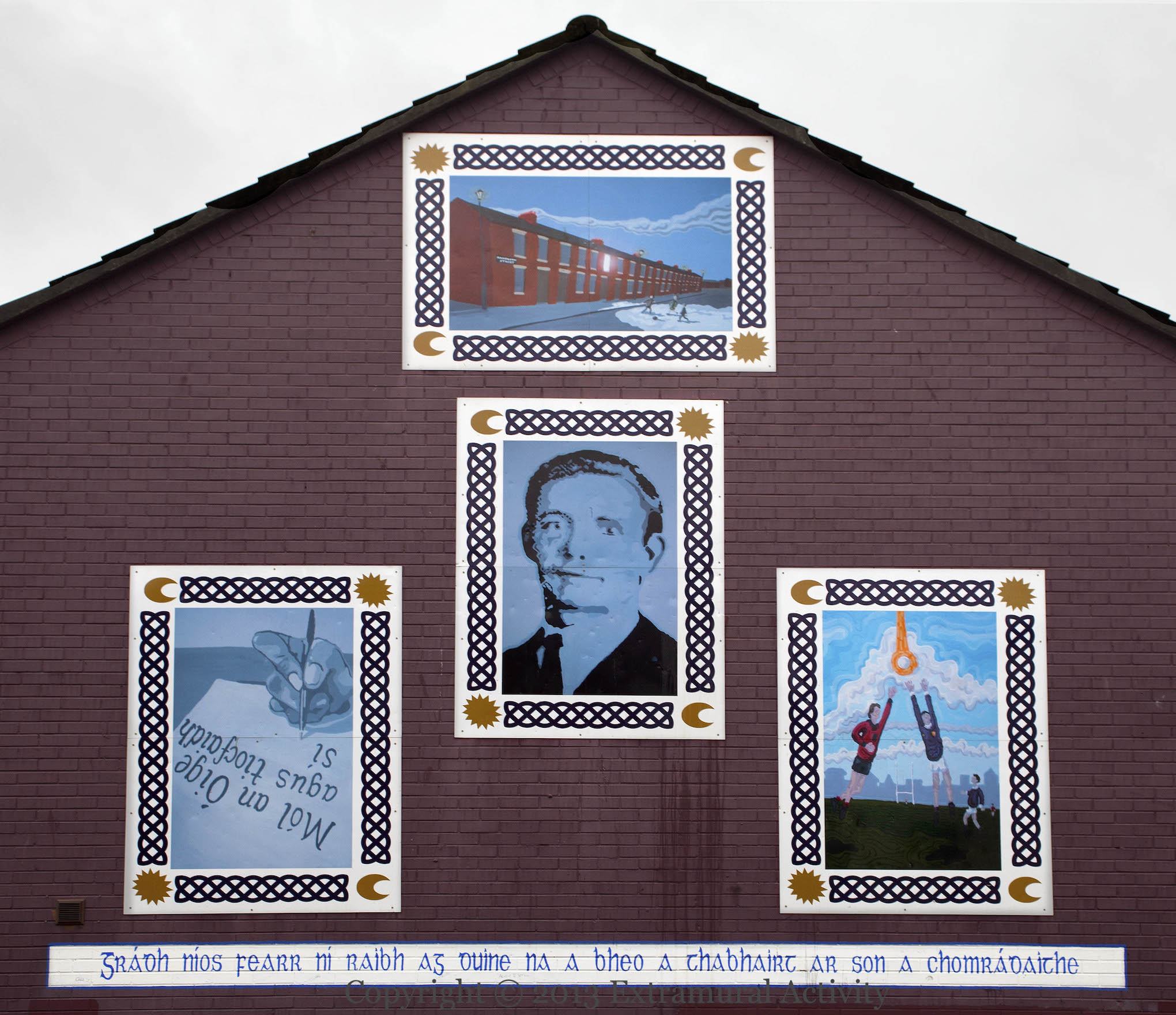
IRA Volunteer Sean Martin is at the centre of these panels in Beechfield Street, in the Short Strand, (CNR) east Belfast. The image in the apex of the house depicts his death in nearby Anderson Street (which no longer exists; roughly where Arran Street is).
milltowncemetery.com (link now dead) reports that Sean Martin “was killed in April 1940 during a lecture on arms and a Millis hand grenade in a small terrace house in Anderson Street. In the course of the lecture Sean, who was giving the instruction, had dismantled the grenade, and was putting it together again. The detonator which he was using was thought to have been a dud one. In demonstrating how to throw the grenade, he pulled out the pin and released the lever. Hearing the hissing sound of the fuse he realised that the detonator was live and that the grenade was about to explode. He rushed to the window with the intention of throwing it out on to the street, but some children were playing outside. In the few seconds left to him, Sean had to make that terrible choice; shouting to the others to get out of the house – he pulled the grenade into himself with his two hands and leaned over the kitchen table with the grenade covered by his whole body. The device exploded and blew him right across the kitchen, killing him instantly. All the others escaped uninjured.”
The Irish at the bottom reads “Grádh níos fearr ní raıbh ag duıne na a bheo a thabhaırt ar son a chomrádaıthe” – “A greater love no person has than to give his life for his comrades” (John 15:13)
Belfast Forum has some pictures of Anderson Street; according to the accompanying conversation, the Martins (might have) lived at no. 29. Sean Martin’s CLG/GAA club was named after Martin.






 Extramural Activity