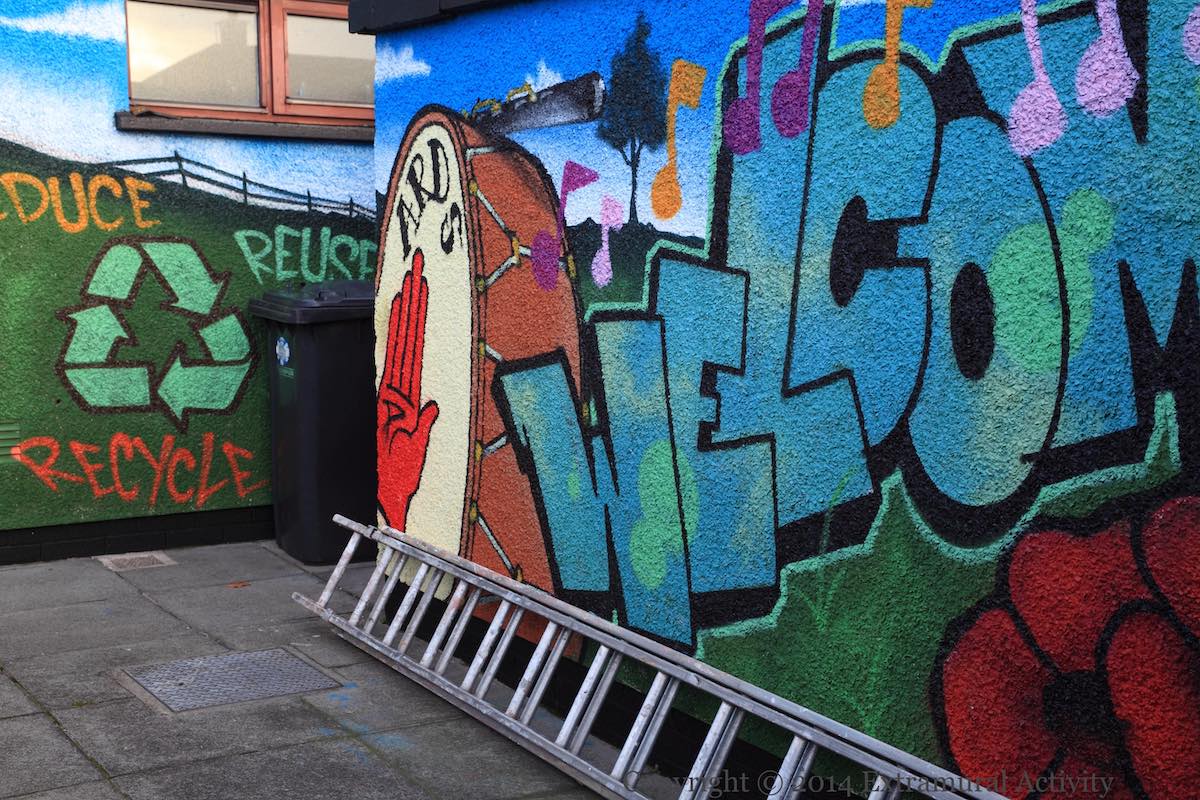
Scrabo tower (or possibly Helen’s Tower/Thiepval tower) and the Union flag appear alongside a football, a heart, a bird and the handprints of local children in this board in the Bowtown estate in Newtownards. The wide shot, below, shows a Bowtown Youth Club board higher up and in the background the Somme mural featured a few days ago.
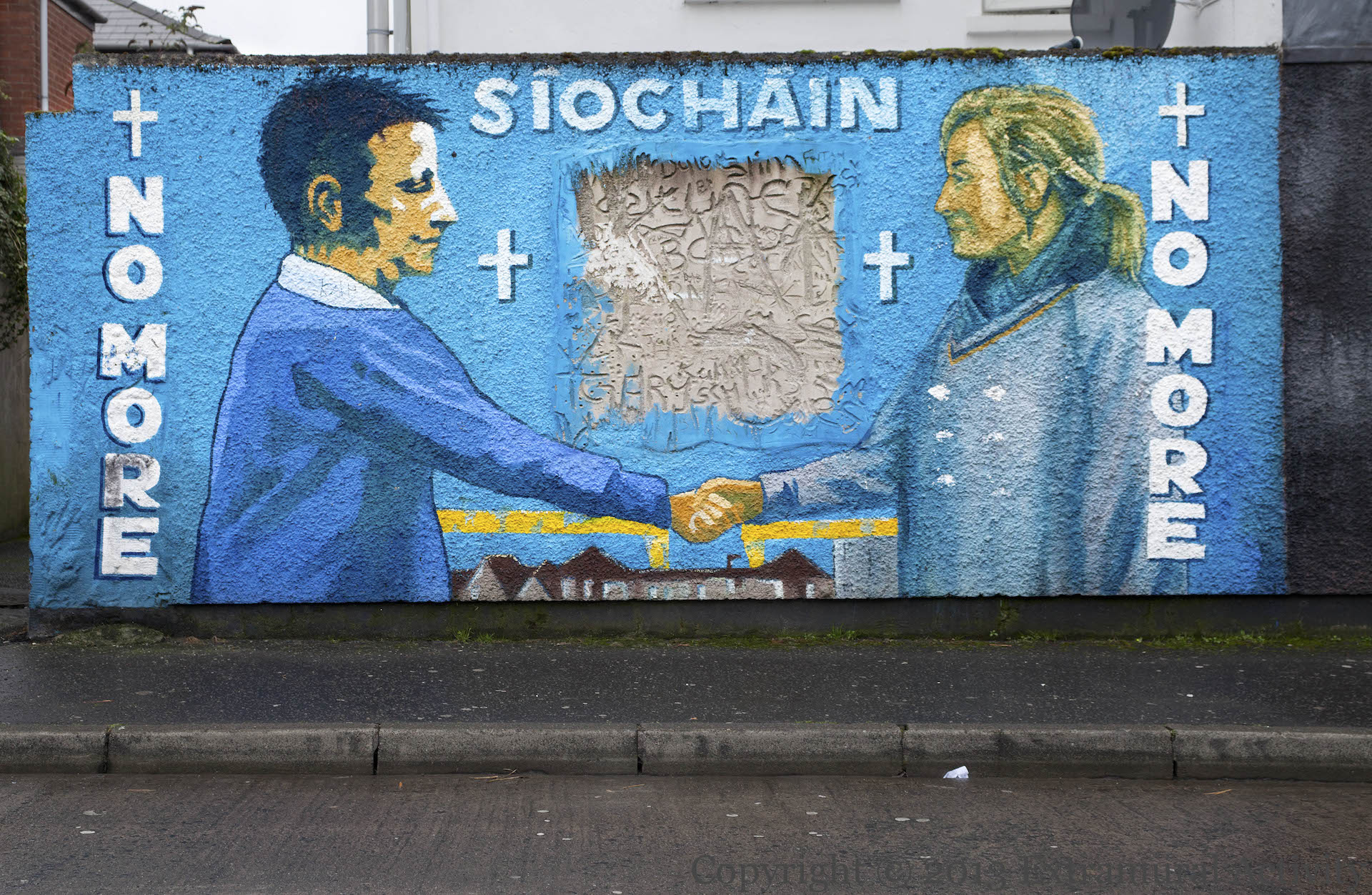
A boy — Dylan Wilson from east Belfast, grandson of loyalist community worker Jim Wilson —shakes hands with a girl – Dearbhla Ward, granddaughter of Short Strand Sınn Féın councillor Joe O’Donnell (sources: Al Jazeera | NewsLetter | The Scotsman). The centre was left for locals to make their mark on.
A gable-wall version of this image — without the word “síocháın” (peace), with the girl in green, and with Wilson’s poem ‘No More’ — can be found about half a mile away in Wolfe Close, just across the Newtownards Road. See No More, Again. This mural was part of the re-imaging effort of 2010.
No more bombing, no more murder No more killing of our sons No more standing at the grave side Having to bury our loved ones
No more waking up every hour Hoping our children, they come home No more maimed or wounded people Who have suffered all alone
No more minutes to leave a building No more fear of just parked cars No more looking over our shoulders No more killing in our bars
No more hatred from our children No more. No more. No more!
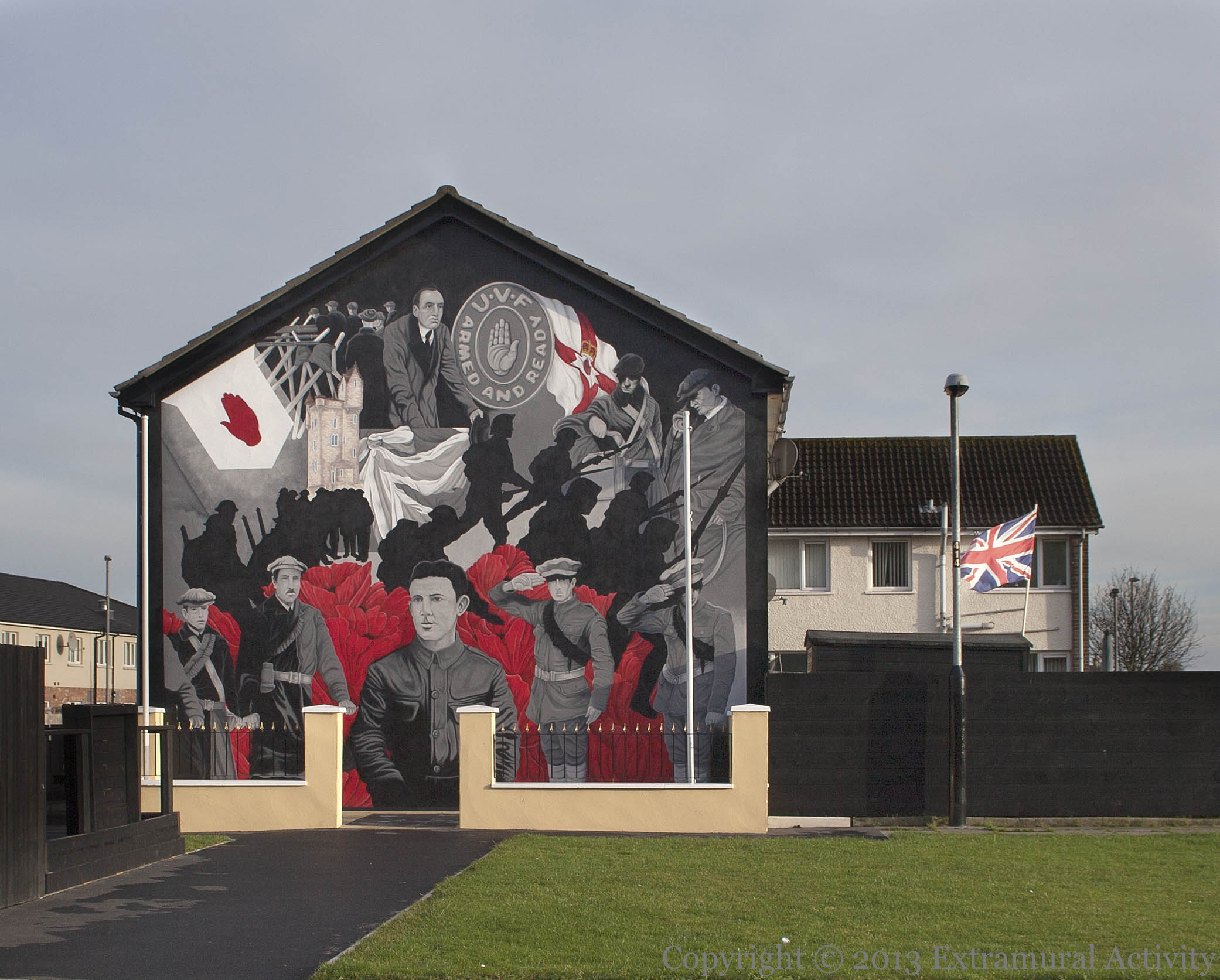
Above is a detail (wide shot below) of a new (June, 2013) mural in Newtonards’s Westwinds estate presenting a familiar UVF theme, that the Ulster Volunteers are an independent body, armed and ready to fight against whatever enemy is present, whether it be London’s decision to grant Home Rule (see Carson in the apex of the building and the figures in militia-style clothing) or the Germans in WWI (as represented by the uniformed figures and Thiepval tower) or any threat to Northern Ireland as a political entity (the Northern Irish flag flies in the top right).
INLA member Mickey Devine was the tenth and final hunger-striker to die in 1981, on August 20th. The mural above, in the familiar style of the IRSP/INLA (see Patsy O’Hara | IRSP), is in Chemical Street, in the Short Strand, across from the set of five murals on Mountpottinger Road – see the wide shot below.
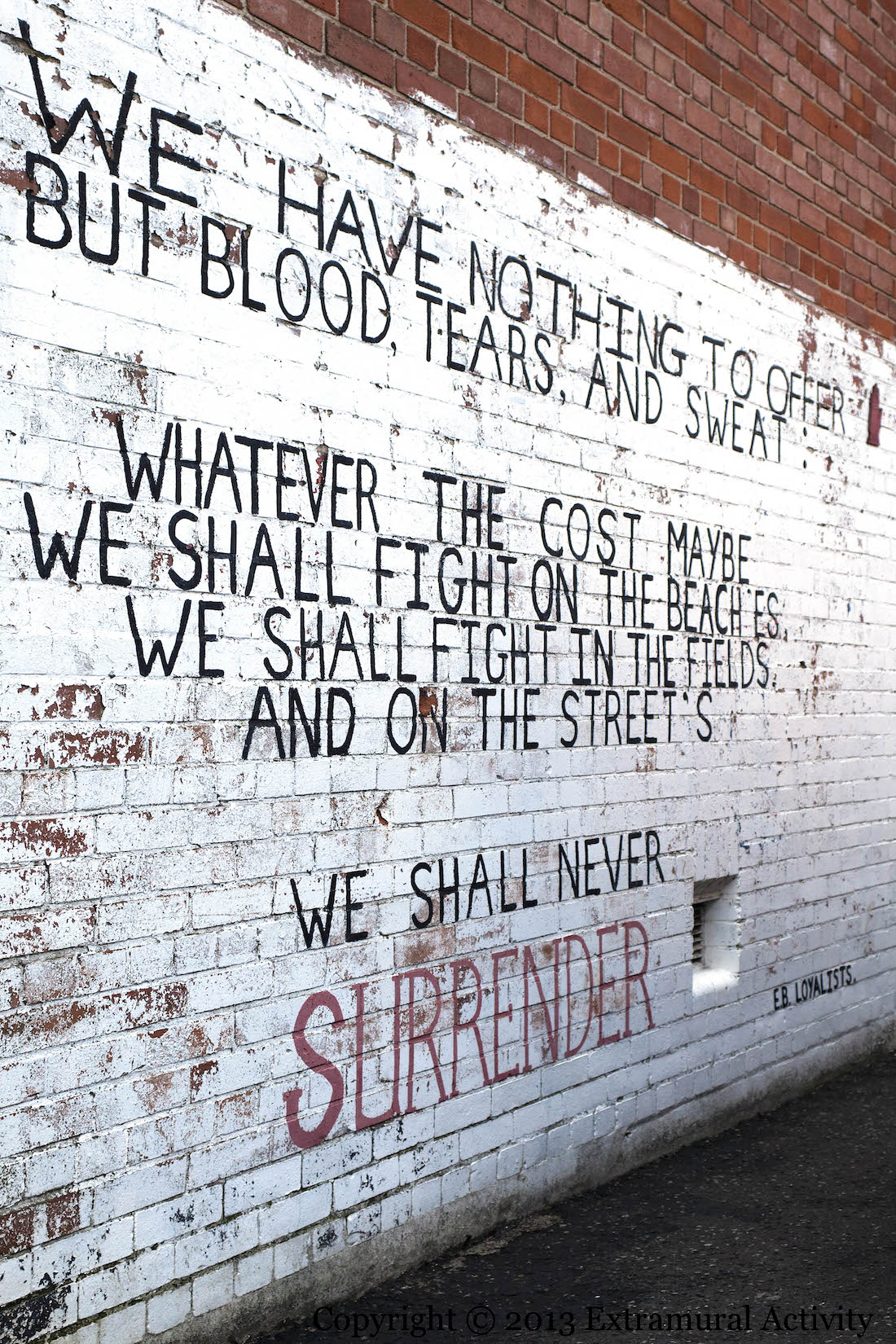
A message from “E.B. [east Belfast] Loyalists” in Castlereagh Parade, combining two speeches of Winston Churchill’s: “We have nothing to offer but blood, tears, and sweat” and “Whatever the cost maybe, we shall fight on the beach’es [sic], we shall fight in the fields and on the street’s [sic]. We shall never surrender.”
1940-05-13: “I would say to the House, as I said to those who have joined the government: I have nothing to offer but blood, toil, tears and sweat. We have before us an ordeal of the most grievous kind. We have before us many, many long months of struggle and of suffering. You ask: What is our policy? I will say: It is to wage war, by sea, land and air, with all our might and with all the strength that God can give us, to wage war against a monstrous tyranny, never surpassed in the dark and lamentable catalogue of human crime.”
1940-06-04: “We shall defend our island whatever the cost may be. We shall fight on the beaches. We shall fight on the landing grounds. We shall fight in the fields and in the streets. We shall fight in the hills. We shall never surrender. “
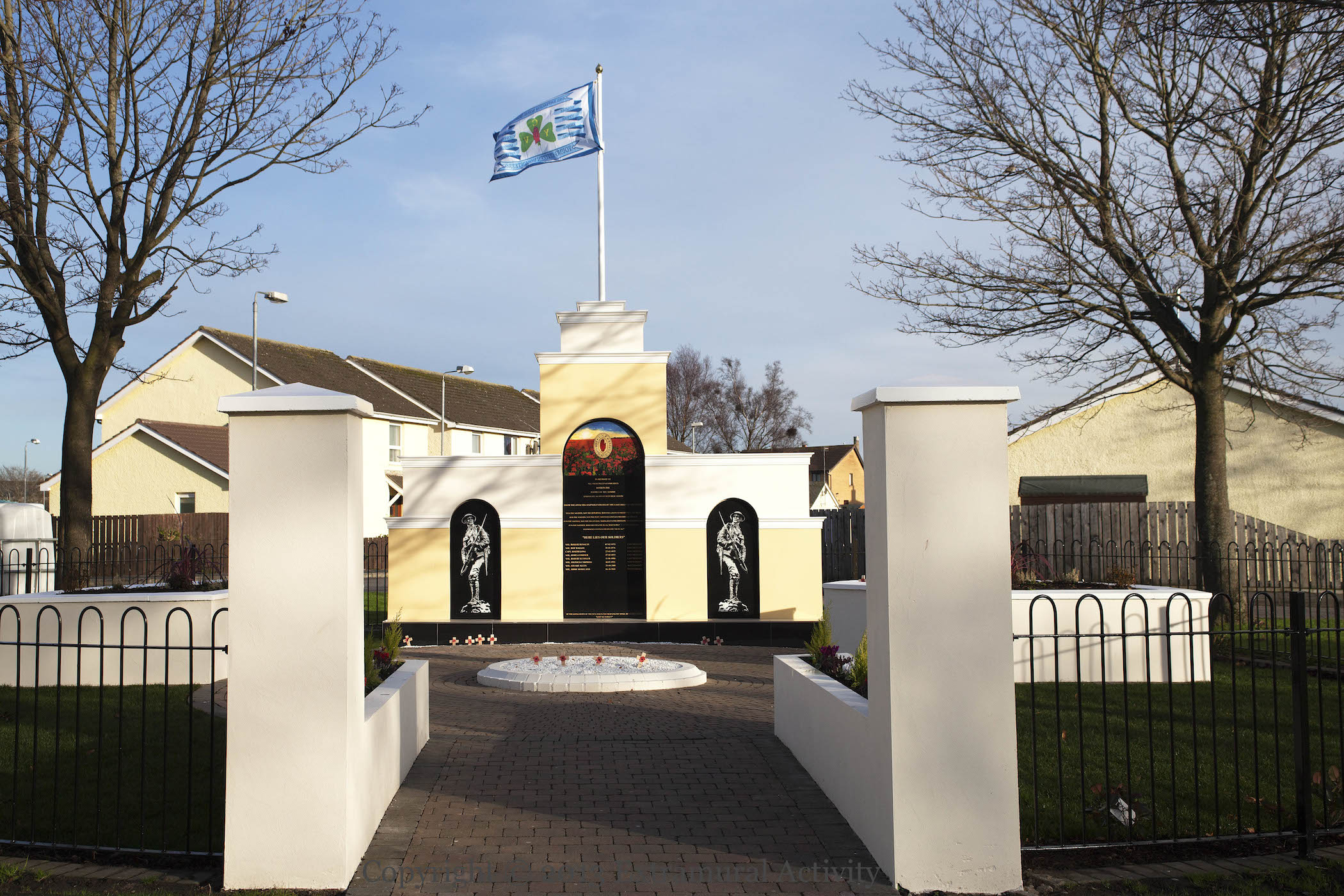
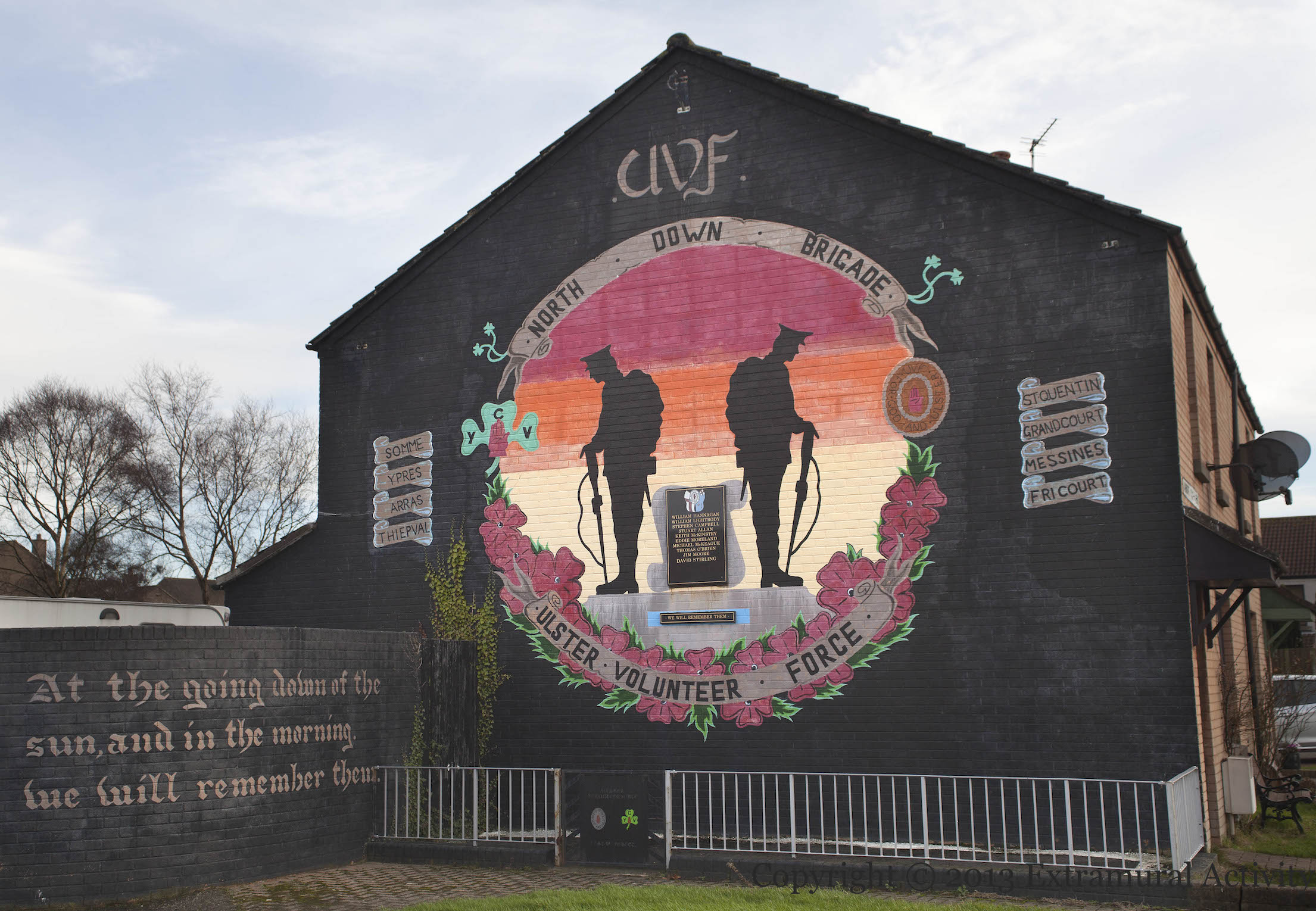
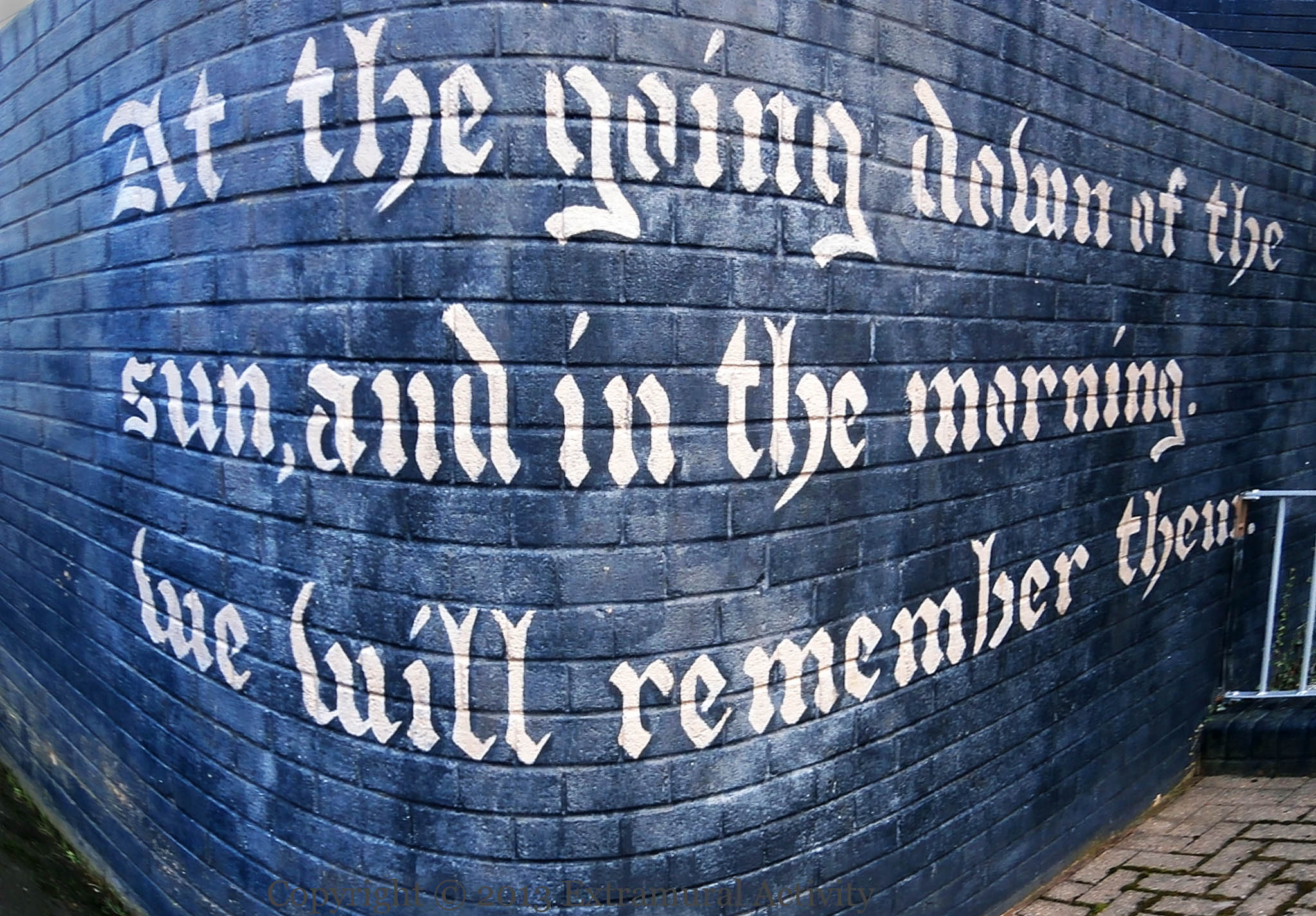
Mural in Newtownards to the Ulster Volunteer Force and Young Citizen Volunteers of the first world war shows two soldiers bent in reflection against an orange and red background, suggesting sunrise/sunset. “At the going down of the sun and in the morning, we will remember them.”
Close-ups of the wall to the left (featuring lines from Binyon’s For The Fallen) and the plaque in the middle can be found below.
This piece – a small figure in white made grotesque by a gas mask, with the This Means Nothing hand in the background – is in North Street, originally next to Praise’s ‘Dot‘ (and the ‘Get Paid’ crosses, which are still on the electrical box) from Culture Night 2012, and now between DMC’s Long Runs The Fox and Visual Waste’s ‘bird snatching boy’ (Carried Away).
Three panels in Newtownards about the Scotch-Irish (or: Ulster Scots) emigration to the United States in the middle of the eighteenth century. Each of the three shows a stage of the experience: ‘Farewell Brothers’ shows family left behind looking out over the sea at the receding ships; ‘The Voyage’ shows sleeping conditions on-board; ‘The Arrival 1731’ shows the flags of the United States and Northern Ireland, with the statue of liberty superimposed upon a red hand.
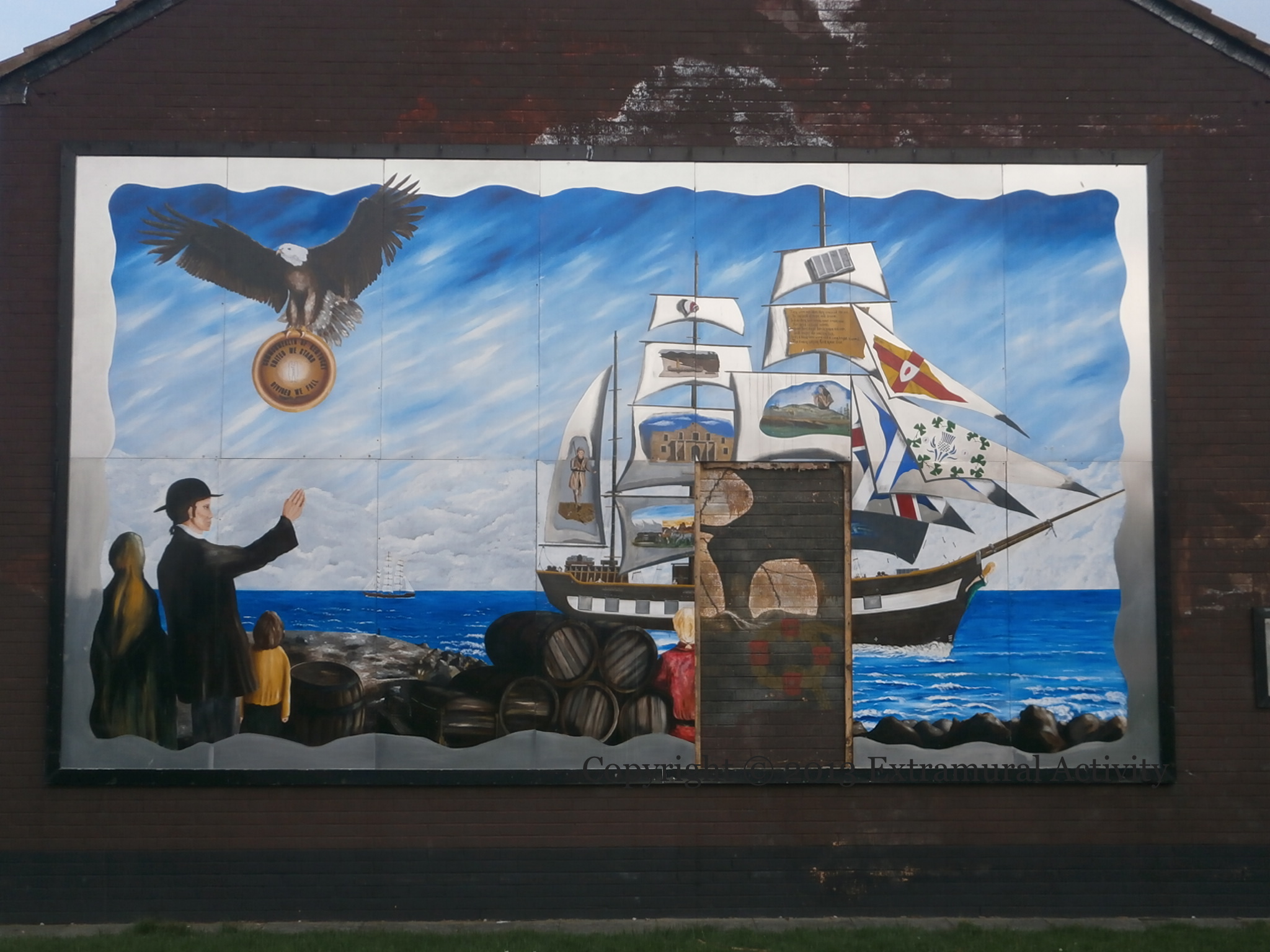
The three panels are next to a larger, now damaged, board also portraying emigration to the States, shown in the final images below.









 Extramural Activity