Michael Devine was the last of the 1981 hunger-strikers to die, on August 20th, 1981, and although the strike was not called off until October 3rd, his death now marks the end of the strike for commemorative purposes. The 44th annual national commemoration of the strike will take place this year on the 24th, “assembling at Dunville Park” in west Belfast.
Antrim Rd/New Lodge Rd, north Belfast. For the street art on the electrical box, see Rotten And Corrupt.
“We stand with Lıam Óg”, that is Lıam Óg Ó hAnnaıdh (on the left of the image above), a.k.a. Mo Chara, a member of the rap group Kneecap who appeared in court (in London) on Wednesday August 20th on “terrorism” charges and was bailed for a further month while the judge rules on a technical issue about whether the trial can go forward (BBC). (See previously The Magic Within and Seasaımıd Le Kneecap.)
The night before (the 19th) this board featuring images of the band-members and the band in its early days was unveiled on the Whiterock Road. (Video of the launch can be found on the Glór Na Móna instagram account.)
In the background is a Palestinian flag and “Saoırse don Phalaıstín” [Freedom for Palestine] is written along the bottom.
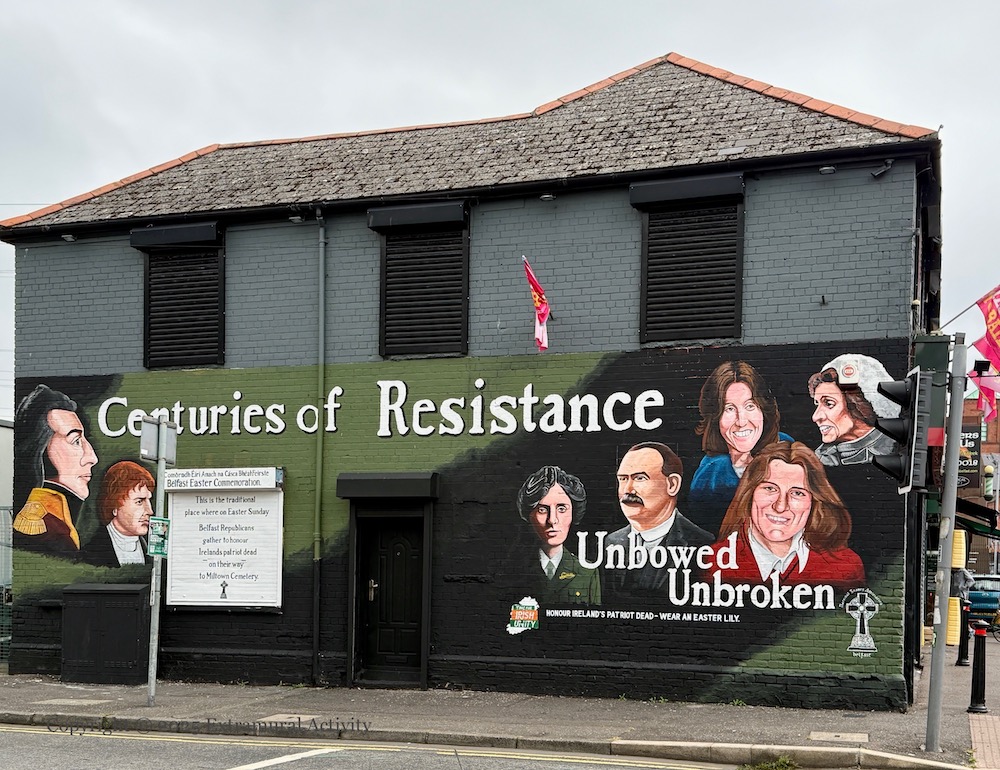
The United Kingdom Of Great Britain And Ireland was created in 1801, a reaction to the 1798 Rebellion, led by (amongst others) Wolfe Tone and Henry Joy McCracken, the pair also being founding members of the Society Of United Irishmen in 1791 in Belfast.
In this mural, Tone and McCracken on the left gaze across the “centuries of resistance” from 1798 to 1916 Rising revolutionaries Countess Markievicz and James Connolly, and beyond to Troubles-era figures Maıréad Farrell, Bobby Sands, and Máıre Drumm.
Around the same time as this mural was painted, a Féıle exhibition called ‘Vibrant Colours, Violent Past’ included A Panorama Of Republicanism which contains dozens of figures but again chooses 1798/Tone, 1916/Connolly, and the Troubles/Martin McGuinness as the pivotal moments and figures.
“Comóradh Éırí Amach Na Cásca Bhéal Feırste/Belfast Easter Commemoration. This is the traditional place where on Easter Sunday Belfast republicans gather to honour Ireland’s patriot dead on their way to Milltown Cemetery.” “Honour Ireland’s patriot dead – wear an Easter lily.” “Unbowed, unbroken.”
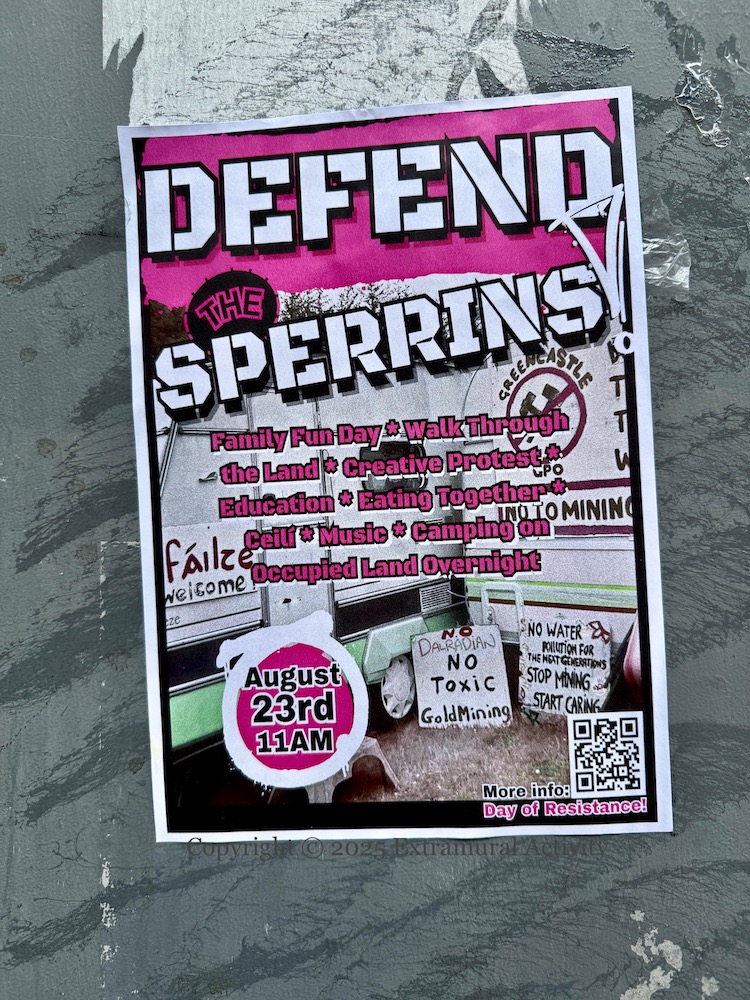
The “defend the Sperrins” “day of resistance” on Saturday August 23rd will include a “family fun day – walk through the land – creative protest – education – eating together – céılí – music – camping on occupied land overnight”.
At issue is a plan to mine for gold from US-backed company Dalradian Mining (web) in an area of Outstanding Natural Beauty. In response to local pressure (see the “No toxic goldmining” placard in the poster), the company has already ditched its plan to use cyanide during the extraction process (BBC | The Planner).
“Victory to Kneecap” and “Free Palestine” on the shutters of the former West Belfast Partnership building on the Falls Road. For background see Seasaımıd Le Lıam Óg.
This year’s internment bonfire in Derry’s Bogside was swathed in flags prior to being set alight. The flags of the UK, Northern Ireland, and Israel can be seen in numbers, as well as flags of the SAS, Paras, IDF, UVF, LVF, UDA, ABOD, various flute bands, King Billy, King Charles, “deport, not support”, and … Bohemians FC, in connection with rioting at a match in July (BBC | BBC).
While it was being built, one person fell from the bonfire and broke a bone (BelTel), and it carried a message of support for Gaza (Derry Journal). The Creggan bonfire caused controversy for a board that named as targets police officer John Caldwell and Tullyally youth Kyle Bonnes who died (in 2010) in the river Faughan while fleeing police (BBC | Ombudsman).
This mural celebrates the Irish-language institutions in west Belfast. From left to right, the buildings by the loch are: Gaeltacht Bhóthar Seoıghe, Bunscoıl Phobal Feırste, Raıdıó Fáılte, An Chultúrlann, Teach Ard Na bhFeá, Coláıste Feırste, and Áras Na bhFál. In a sense they are all ripples from the initial drop that was the Shaw’s Road Gaeltacht, established in 1969 and which led quickly to the bunscoıl in 1971 (WP). The NVTv documentary about the Shaw’s Road gaeltacht borrows its title from the slogan motivating the early efforts, “Ná habaır é, déan é” [Don’t say it, do it] – the bunscoıl was not officially recognised until 1985.
Among the pioneers (“ceannródaıthe”) of those early ventures were the Mac Seáın family, who grew up in a house adjacent to the wall on which the new mural is painted: “Tógadh Séamus Mac Seáın, Seán Mac Seáın, agus Caıtlín Mıstéıl (née Mhıc Sheáın) sa teach seo. Bhí an trıúr seo ı measc na gceannródaıthe a bhunaıgh Gaeltacht Bhóthar Seoıghe.”
The mural was commissioned by Spórtlann Na hÉıreann’s Irish-language heritage project “Gael Staır” (Meon Eıle | Belfast Media), with support from Mary’s Gift (Belfast Media), and painted by Aodán Ó Manacháın (Fb). It was unveiled Sunday 10th.
“In our community no one walks in the darkness alone.” West Wellbeing (web) offers counselling and suicide-prevention services from its offices in the Dairyfarm centre on the Stewartstown Road. This new mural – by Glen Molly (ig) – is a little further along the road, just past Bell Steel Road.
The RNU mural supporting Palestine has been cleaned up to remove graffiti calling Sınn Féın “traitors and touts” (RNU Belfast Fb).
Pantridge Road, replacing the boards seen in Conscience. The poster below, criticising RNU leadership, is on the Cogús board to the left.
Update: the mural was (for a second time) vandalised and repaired (RNU Belfast Fb) and then was (a third time) vandalised with “SF traitors & touts REM Oct 07” – see below
“I was only a working-class boy from a [nationalist] ghetto, but it is repression that creates the revolutionary spirit of freedom.” This is a widely-quoted line from Bobby Sands, from an article in Republican News, 16 December, 1978 (page 7 pdf).