For weeks (since April) a whitewashed panel on the International Wall sat empty, before being partly filled in with “RIC – RUC – PSNI”, “RUC -> Collusion covered up by PSNI”, but progress seems to have halted again and a 32-County Sovereignty Movement tarp has been placed on top: Oppose British political policing.
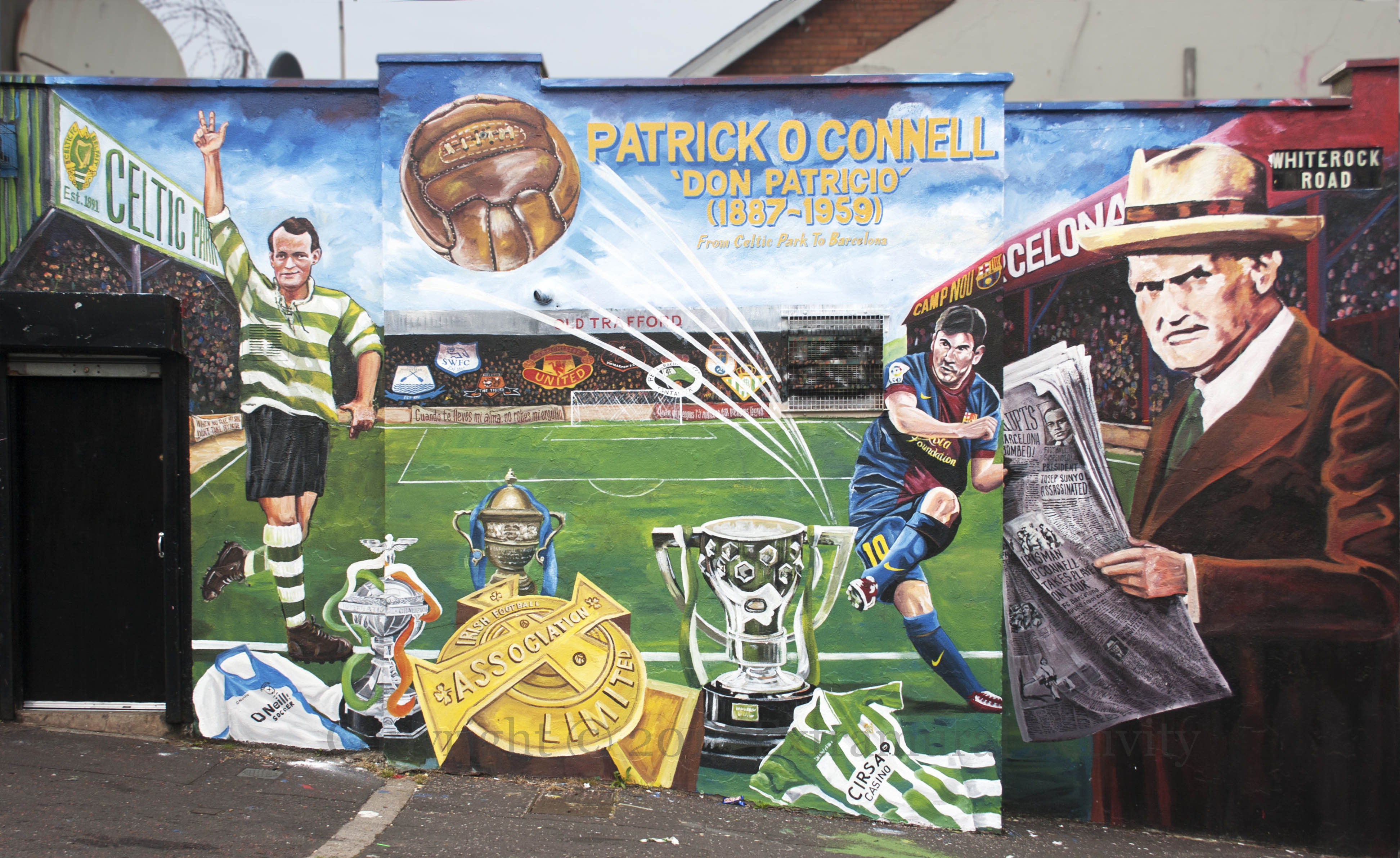
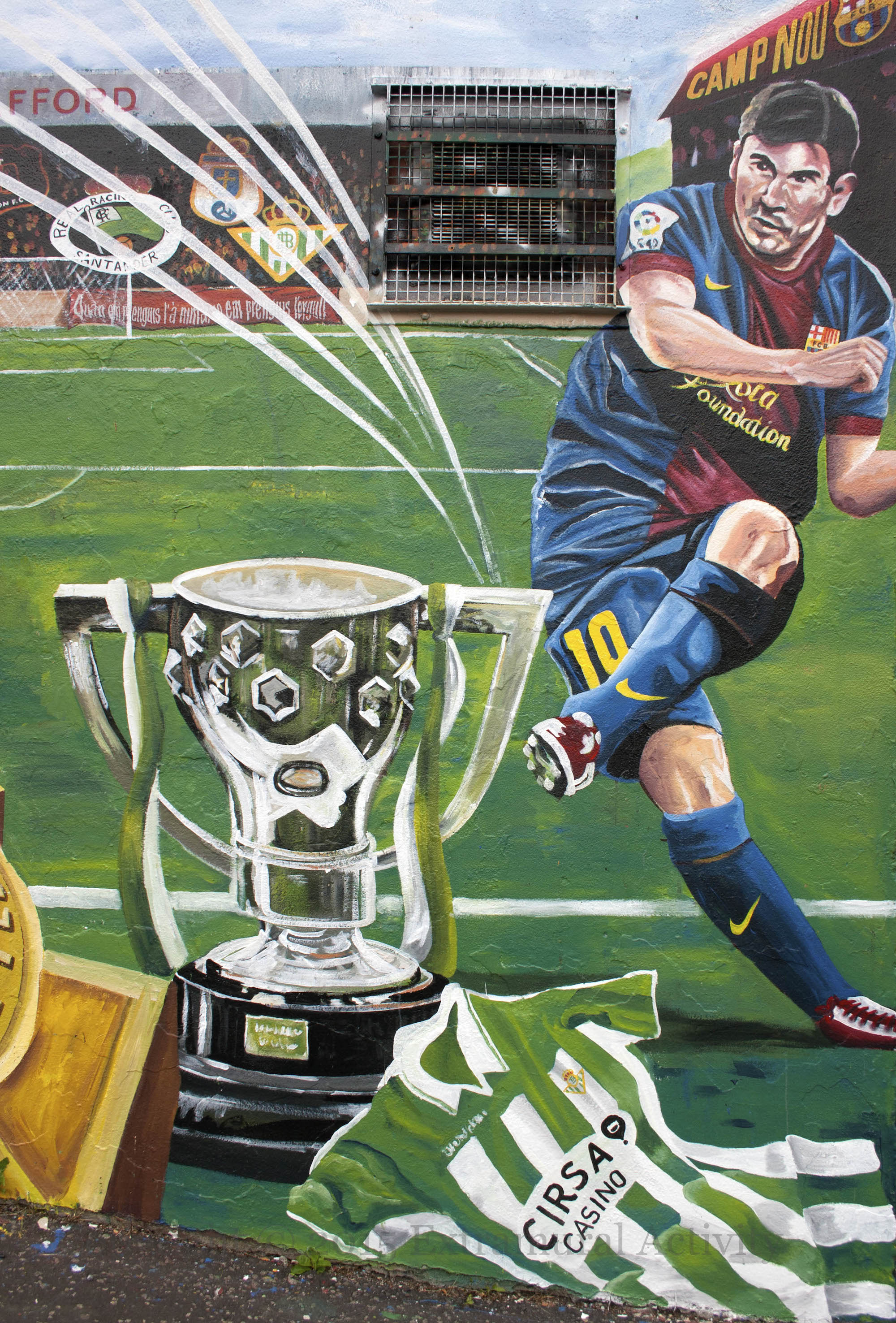
The stands of three football stadiums are shown in the background of the Don Patricio mural at the bottom of the Whiterock: Belfast Celtic’s Celtic Park (“Paradise”), Manchester United’s Old Trafford, and Barcelona’s Camp Nou. The Old Trafford stands bear the emblems of the teams Patrick O’Connell played for and managed: Liffey Wanderers (whose shirt is also featured, on the left), Sheffield Wednesday, Hull City (The Tigers), Manchester United, Dumbarton, Real Racing Club de Santander, Real Oviedo, and Real Betis Balompié (also shirt on the right).
Yesterday we had ‘Barcelona Past’ in the form of Patrick “Don Patricio” McConnell (The Don); today we have ‘Barcelona Present’, in the form of Lionel Messi. The Argentinian forward is shown in front of the Spanish League cup, which Barcelona won this year (2014-2015) with a goal from “La Pulga” (“the flea”) – Messi is 5’7″ but four-time world player of the year.
Here is part of the new Patrick O’Connell, “Don Patricio”, mural at the bottom of the Whiterock. As a player, the Dublin-born O’Connell started with Belfast Celtic before moving on to various English and Scottish clubs, including a period at Manchester United at the time of WWI. He then went on to manage a string of Spanish clubs. As manager of Barcelona during the Spanish civil war, he accompanied the club on their tour of Mexico and the United States. The money from the tour saved the club from bankruptcy but 12 of the 16 players went into exile in Mexico and France. (WP) Barcelona returns to the US this month (2015-07) for games against the LA Galaxy, Manchester United, and Chelsea. (FCBarcelona)
The newspaper in the mural above crams all of this news onto one page: “Civil war erupts in Spain – Barcelona bombed”, “Football suspended – President [of FC Barcelona] Josep Sunyol assassinated” [by Franco’s troops] (WP); “Irishman O’Connell takes players on tour – FC Barcelona saved from extinction”; “Funds lodged in Switzerland”. In the bottom left-hand corner of the newspaper is Robert Capa’s famous photograph of ‘The Falling Soldier’, purporting to show a Republican soldier at the very moment he is struck by a bullet and dies. The image is now thought to have been staged (WP).
The New Lodge youth centre has received a make-over, with kids’ drawings of purple pencils, yellow flowers, pink buses, and red circles. Even the security wire at the top has been included in the gaiety.
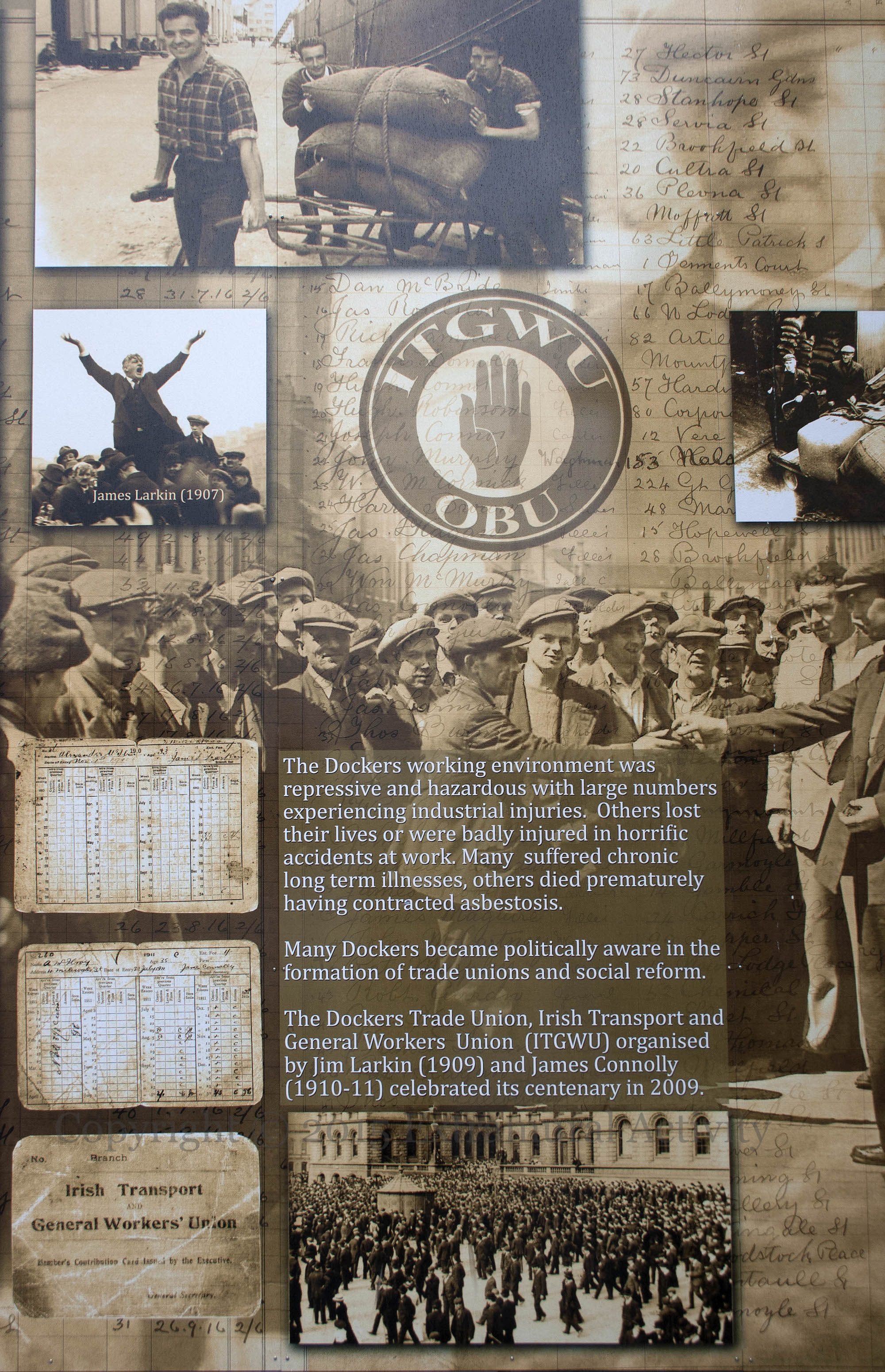
Every day, men would line up in schooling pens on the various docks of the port of Belfast to be hired by foremen. As mentioned on the left-hand side of the board above (recently erected on the New Lodge side of the Duncairn “peace” line) the rise of the shipping container in the 1970s spelled the end of the docker: “from 3000 listed dockers in 1970, the number had fallen to 280 by 1985.” Author and poet John Campbell recalls his first day on the docks in 1952, unloading cement, in this NVTv video.
“This artwork celebrates the unique contribution that generations of dockers have made to the port and City of Belfast.”
“It was a physically demanding job, the hours were long, the conditions were tough and the availability of work was not constant. Without the Dockers, however, the Port of Belfast would not have been able to grow. / Transportation of goods by containers led to a revolution in working practices at Belfast Docks and the number of dockers decreased dramatically. From 3000 listed dockers in 1970, the number had fallen to 280 by 1985. Behind these figures lay the human story of vast social changes in the harbour area as well as the gradual dissappearance [sic] of an entire community who had earned their living from the sea and also through the loading and unloading of ships. These were the Dockers and their families, many of whom lived in Sailortown. / The workforce of dockers spanned both traditions. Red button and Blue button. Dockers had a common allegiance to the Port of Belfast which provided a living for men and families from both communities. / The work was backbreaking, yet the Docks educated us about life, integrity, discipline, about standing up for our rights, about having pride in our identity as working men, as Dockers. / The Dockers[‘] working environment was repressive and hazardous with large numbers experiencing industrial injuries. Others lost their lives or were badly injured in horrific accidents at work. Many suffered chronic long term illnesses, others died prematurely having contracted asbestosis. Many Dockers became politically aware in the formation of trade unions and social reforms. The Dockers Trade Union, Irish Transport and General Workers[‘] Union (ITGWU) organised by Jim Larkin (1909) and James Connolly (1910-11) celebrated its centenary in 2009.” OBU one big union
Englishman Clive Dutton was an urban planner who was best known for work in Birmingham, London (Newham), and Belfast. He produced “The Dutton Report” in 2004 and “The Big Plan” (pdf) (the cover of which is pictured in the mural) in 2013. In them, he proposed and then updated a plan to tackle economic deprivation in west Belfast by the creation of a ‘Gaeltacht Quarter’ or ‘Ceathrú Gaeltachta’. He died on June 8th at the age of 62 and the mural above has been painted in remembrance.
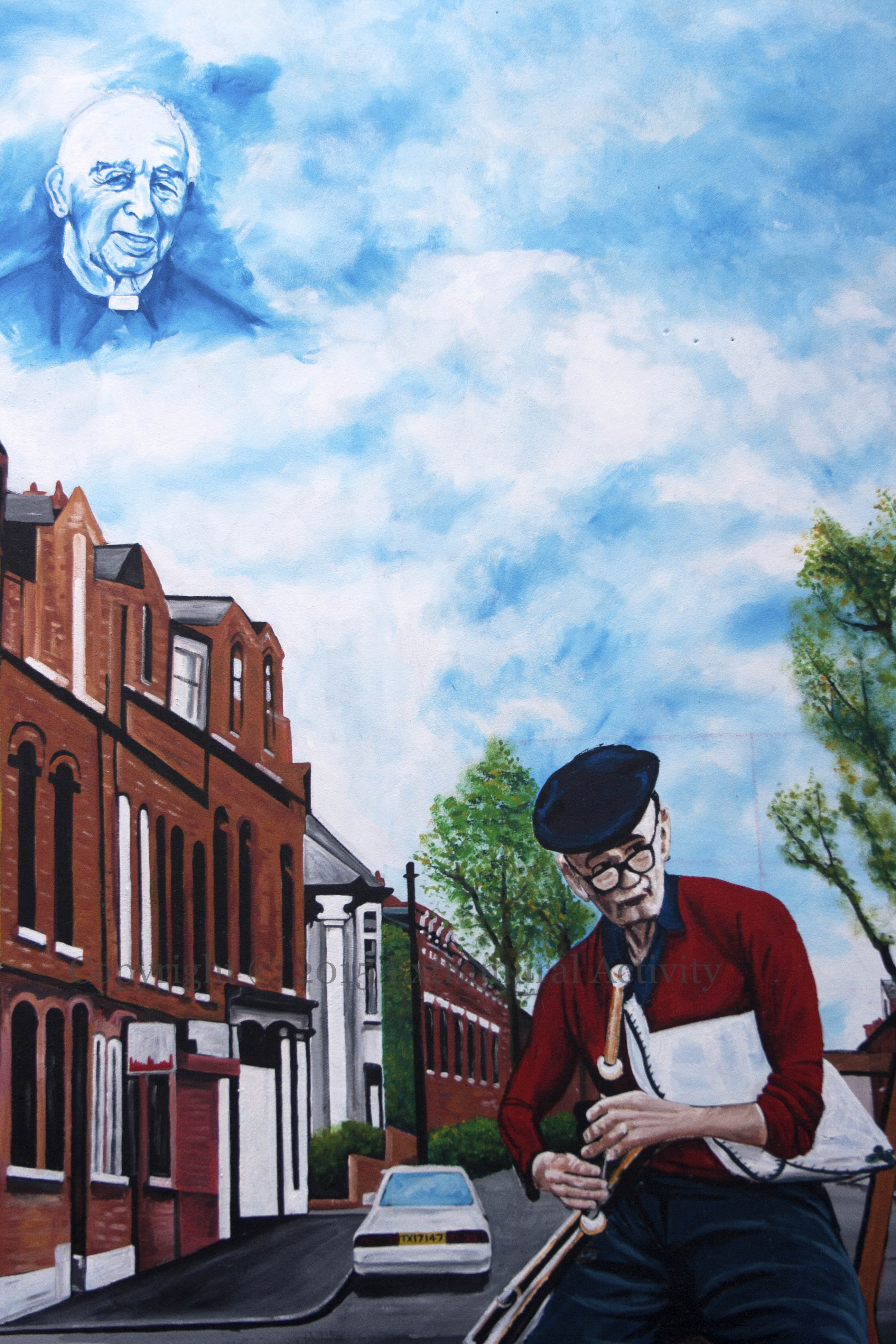
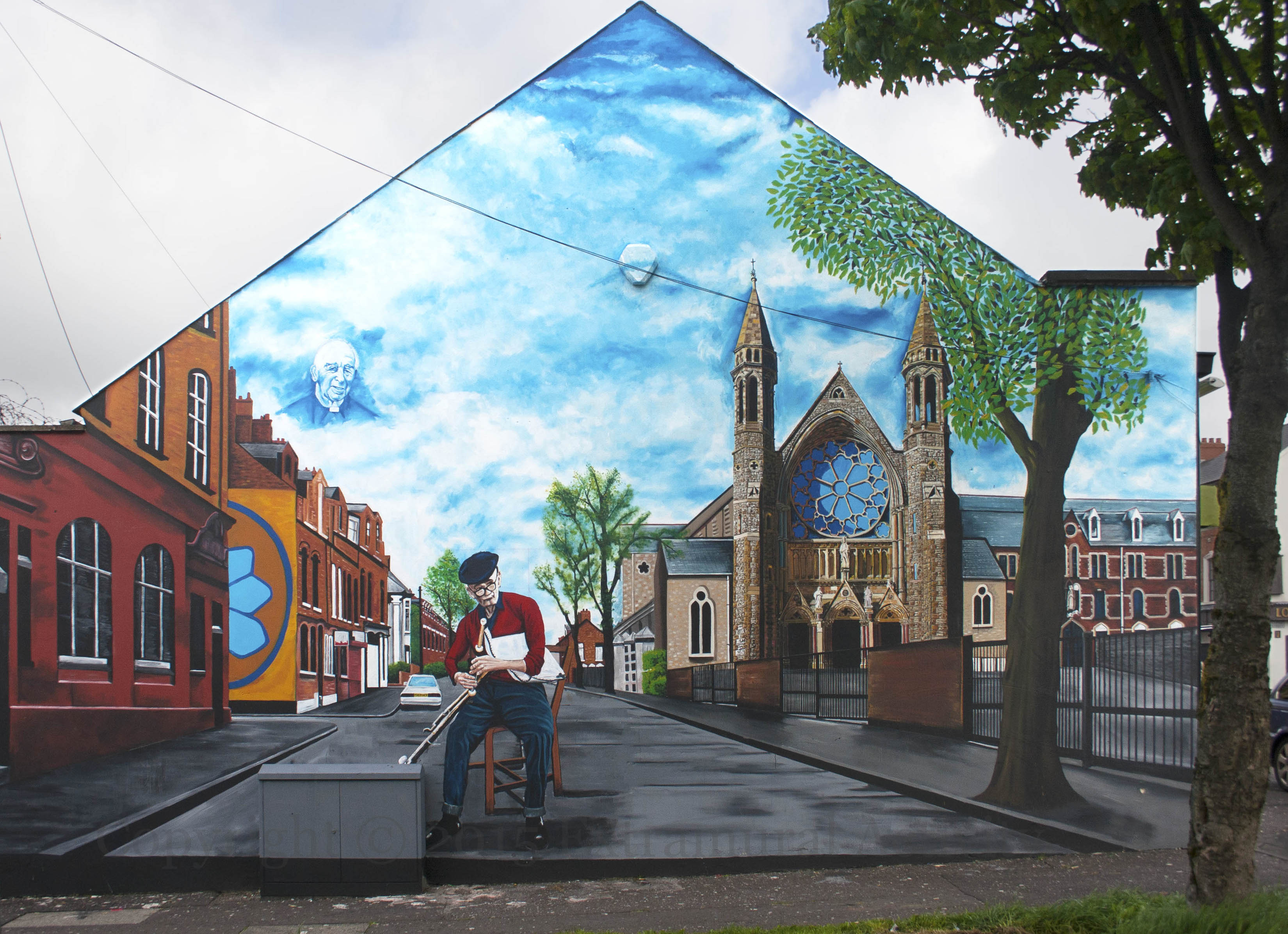
This new mural pays tribute to two long-time residents of Clonard. On a good day, Noel Fitzpatrick, a cobbler with a little shop on the corner of Odessa and Clonard streets, would take his chair out into the street and play the uıleann pipes. Looking down from above is Alec Reid, the Redemptorist priest who spent 40 years at Clonard monastery and played an important role in the peace process. He died in 2013 at age 82. (WP)
Painted by Marty Lyons & Mickey Doc in Springfield Drive. For the large ‘flower’ mural to the left of this mural (which imitates the stained glass in the cathedral), see C01044.
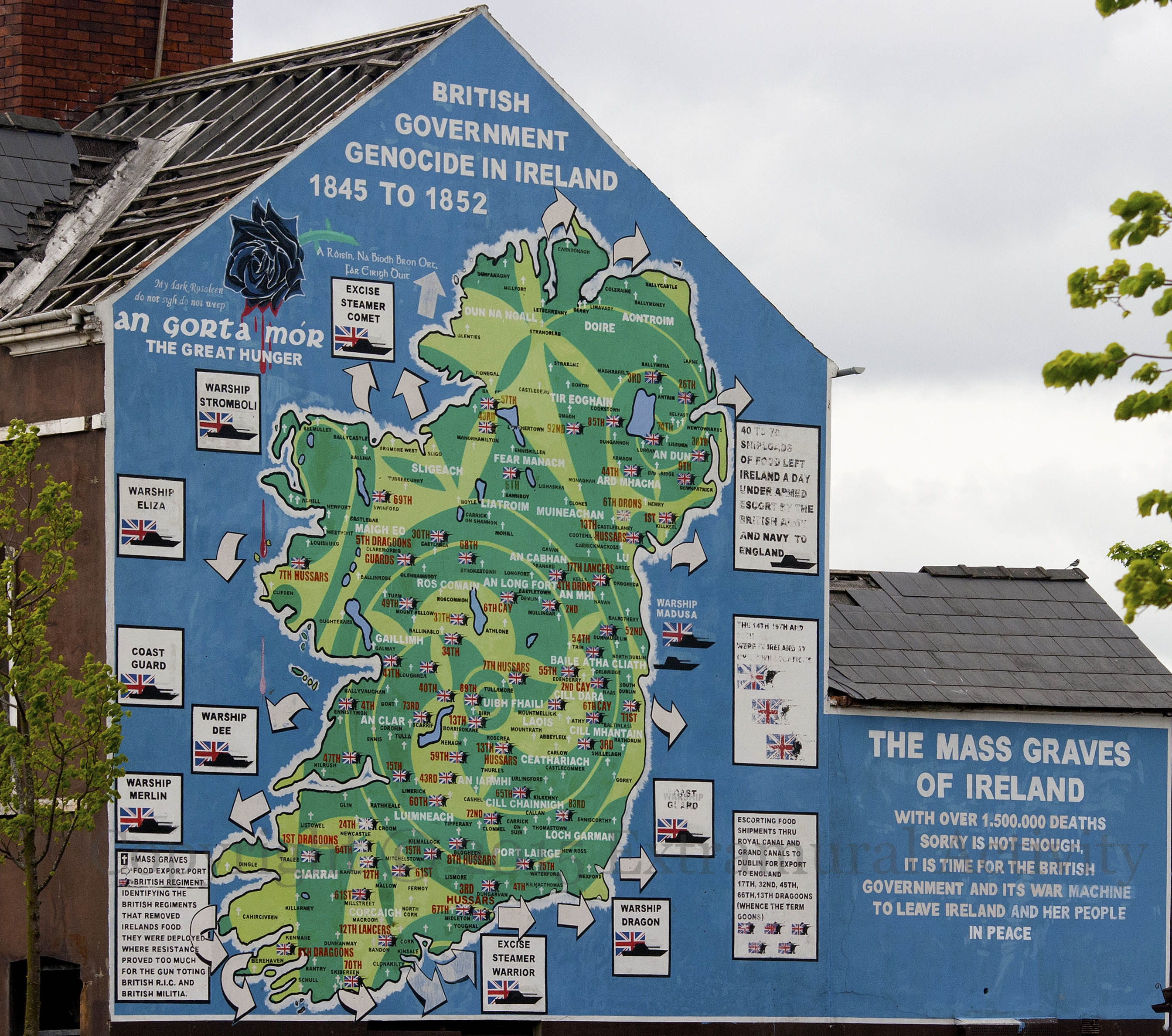
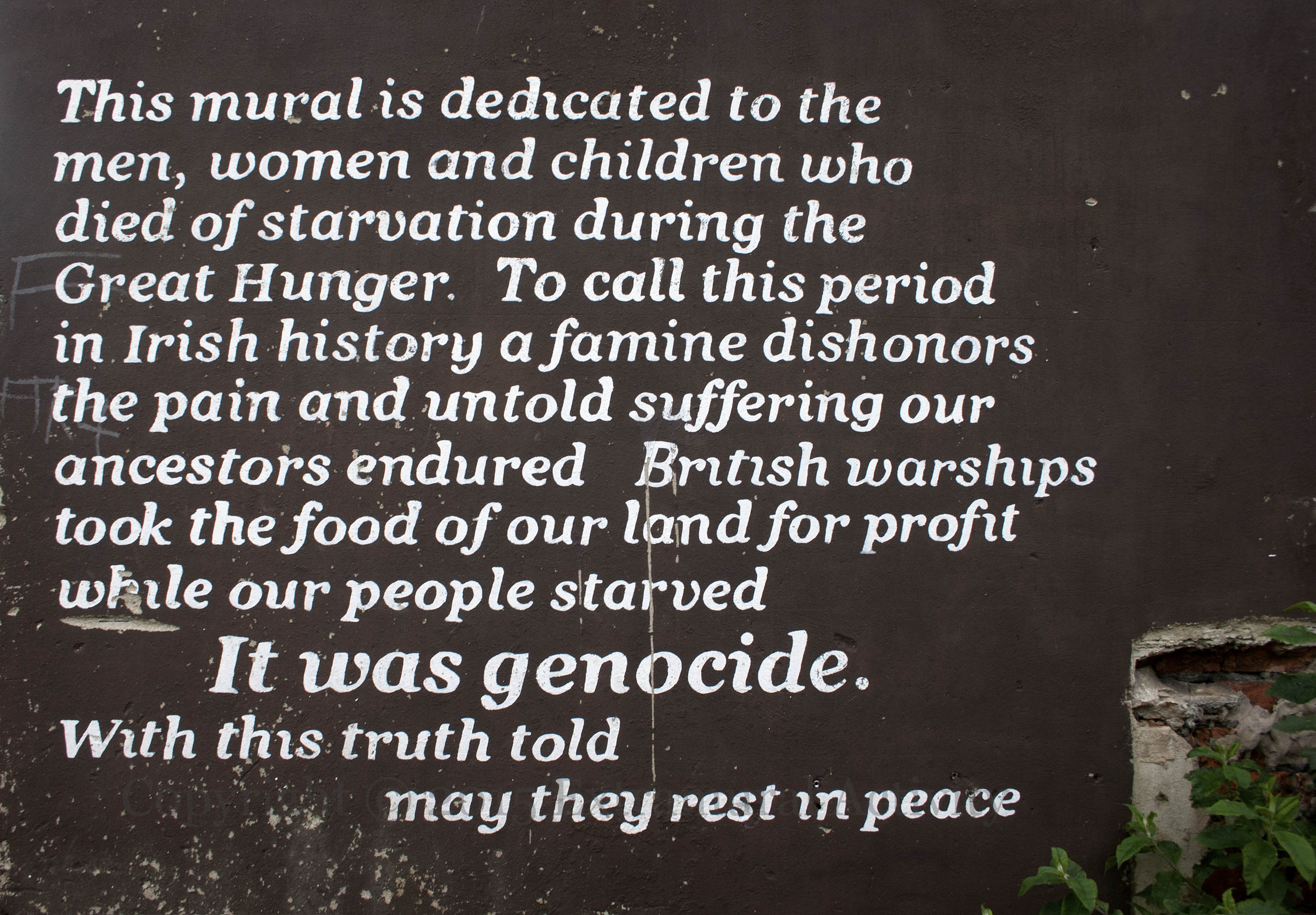
In 1997, then-Prime Minister Tony Blair’s office issued a statement acknowledging that the administration of the time of the Hunger failed to intervene (Guardian | Independent).
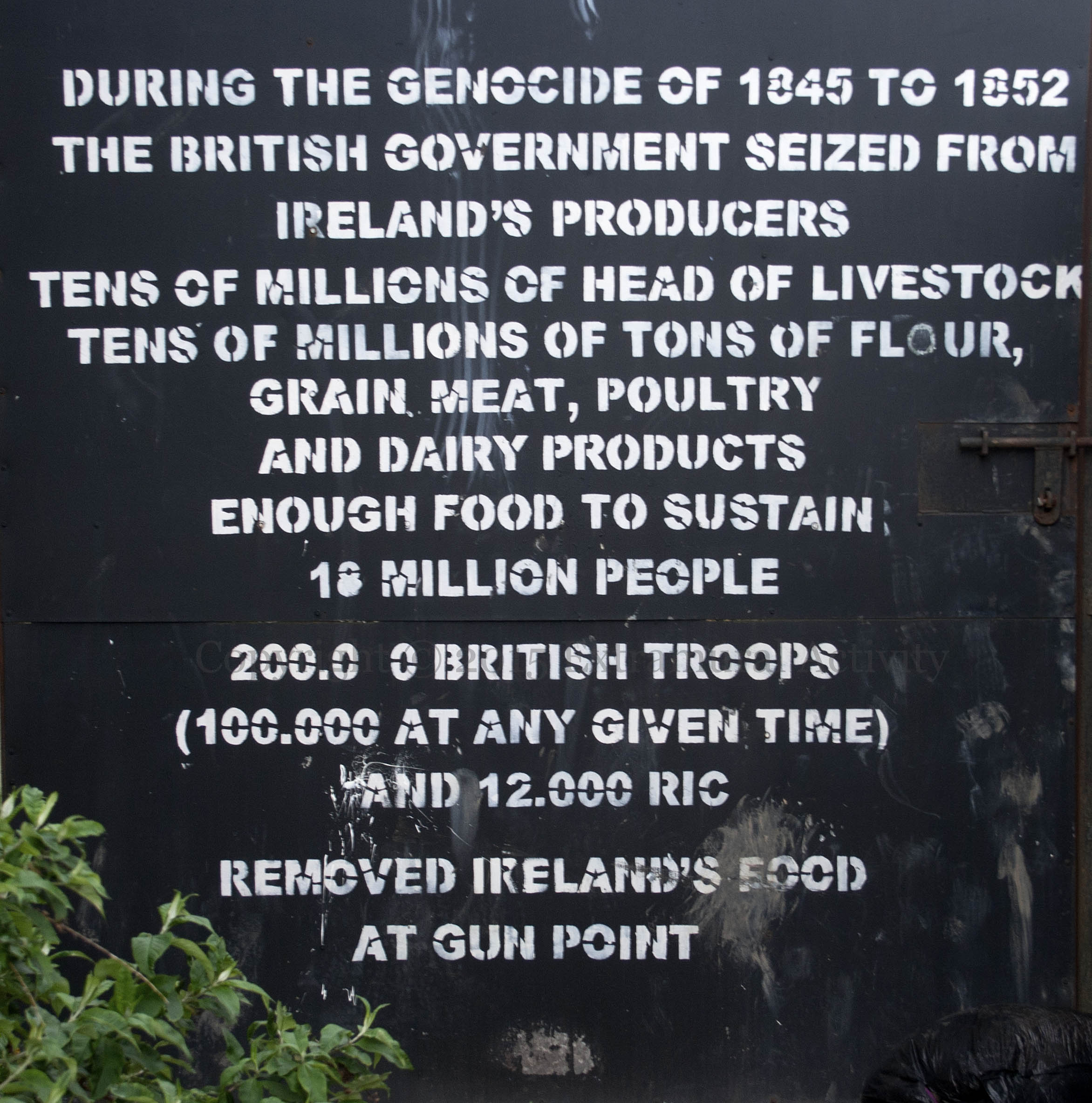
The mural above asserts that it was not merely a matter of negligence but of will: “With over 1,500,000 deaths “sorry” is not enough. It is time the British government and its war machine to leave Ireland and her people in peace. During the genocide or 1845 to 1852 the British government seized from Ireland’s producers tens of millions of head of livestock, tens of millions of tons of flour, grain, meat, poultry and dairy products, enough food to sustain 18 million people. 200,000 British troops (100,000 at any given time) and 12,000 RIC removed Ireland’s food at gun point. This mural is dedicated to the men, women and children who died of starvation during the Great Hunger. To call this period in Irish history a famine dishonors the pain and untold suffering our ancestors endured. British warships took the food of our land for profit while our people starved. It was genocide. With this truth told may they rest in peace.”
Each white cross on the map represents a mass grave. The map is originally from irishholocaust.org.









 Extramural Activity