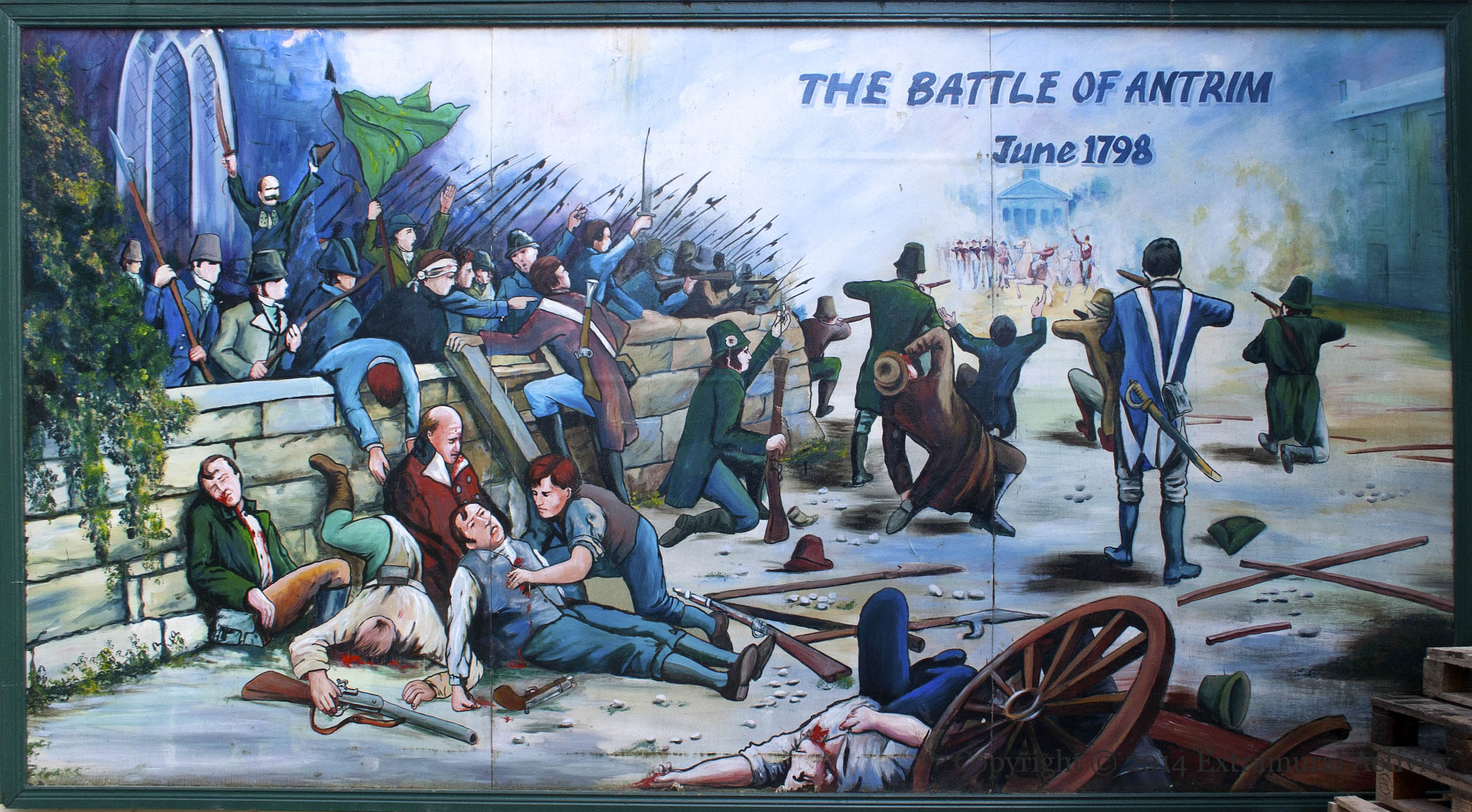
The Battle of Antrim took place on June 7th, 1798, as part of the Irish Rebellion of that summer. Led in the North by the Protestant Henry Joy McCracken, the rebellion met with initial successes in smaller towns, before failing in Antrim. In the full shot, below, the British soldiers can be seen in the distance.
The board above is in the grounds of The Roddy’s, a social club named after Roddy McCorley, another Protestant member of the United Irishmen, most famous for the song written about his hanging at the bridge of Toome in 1800. (Here’s a version by Tommy Makem.)
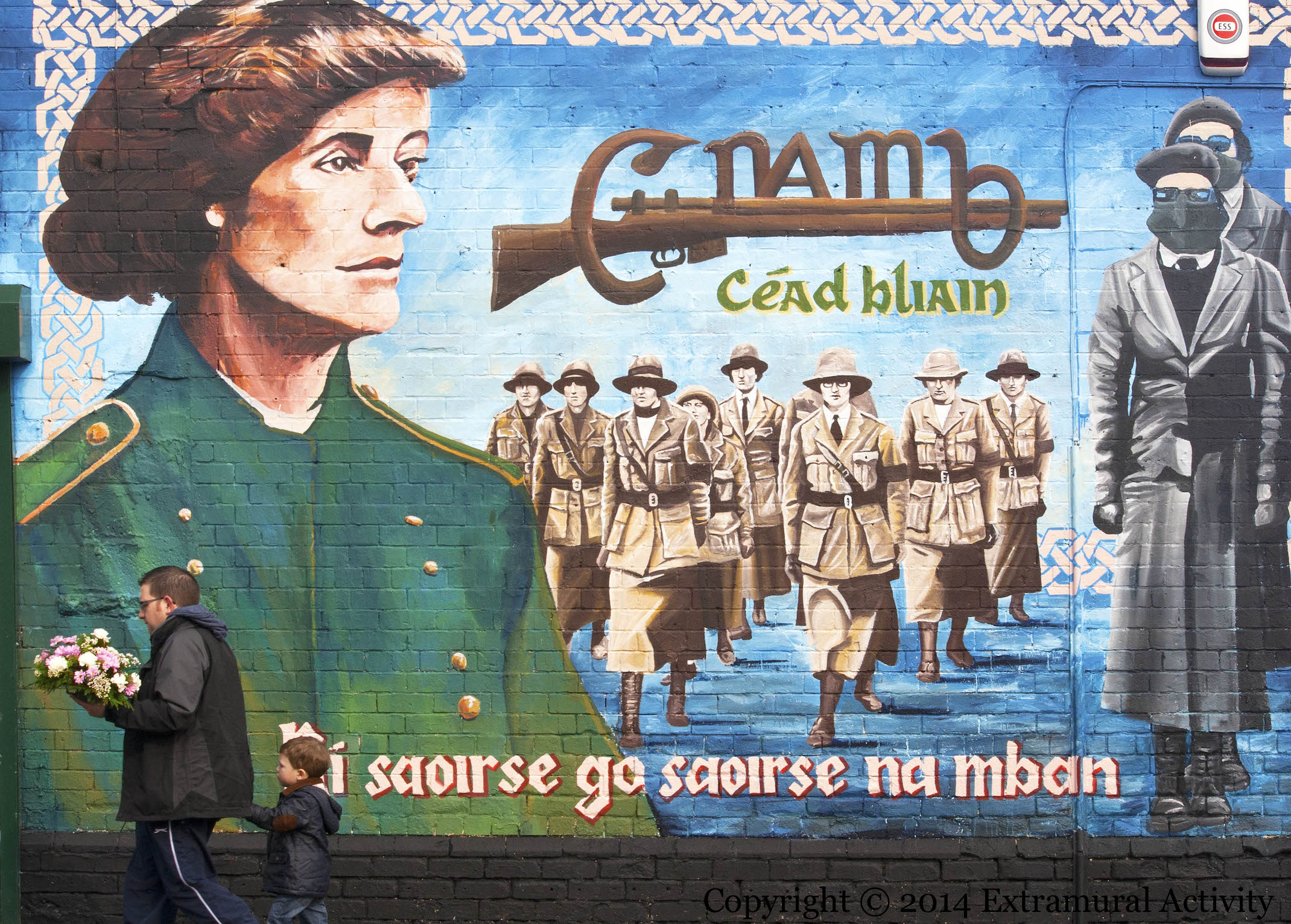
Mothering Sunday 2014 was yesterday, Sunday March 30th. On Saturday, when this image was taken, menfolk were out and about tracking down flowers and chocolates. This week also happens to be the one-hundredth anniversary (“céad blıaın”) of the founding of Cumann Na mBan on April 2nd, 1914, and it is being commemorated in various ways, including a new mural on Ascaıll Ard na bhFeá/Beechmount Avenue.
Cumann Na mBan was the women’s division of the Irish Volunteers and is best remembered for its role in the Easter Rising of 1916. Its members were involved in the occupation of many locations. Some, including (non-combatant) Winifred Carney, were in the GPO, while Countess Markievicz, the main figure of the mural, was in St. Stephen’s Green. (Here is an RTÉ gallery of vintage photographs, including one of Markievicz surrendering.)
The letters “Cnamb” on a rifle formed the badge of Cumann Na mBan. The Irish “Ní saoırse go saoırse na mban” means “No freedom until the freedom of women”. Below are an ‘in-progress’ shot from last week; and a close-up of the finished mural. Below these is a plain shot of the full mural.
Three generations of boards at the junction of the Falls and Glen roads: from most recent to least: Pearse Jordan (“Murdered by RUC! Covered up by PSNI”), Gibraltar Three (“I nDıl Chuımhne”; this was later realized on the Divis Street International Wall, see 25 Years), and a (presumably) IRSP board (“If there is to be a revolution, there must be a revolutionary party.” [Mao Zedong]). The oldest of the three appears to be the one in the best shape. The site itself used to be the Andersonstown RUC/Army barracks.
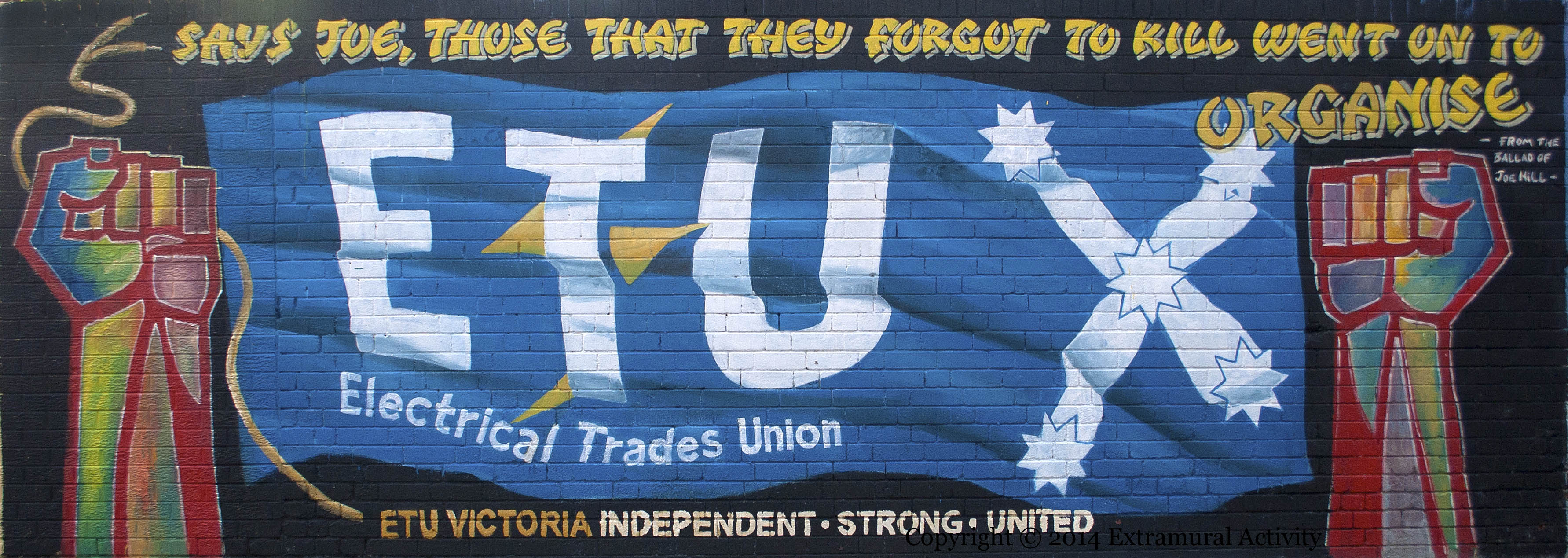
“Says Joe, ‘Those that they forgot to kill went on to organise.'” Words from ‘(The Ballad Of) Joe Hill’ are included in a mural in Conway Street sponsored by the Australian Electrical Trades Union (ETU) in Victoria.
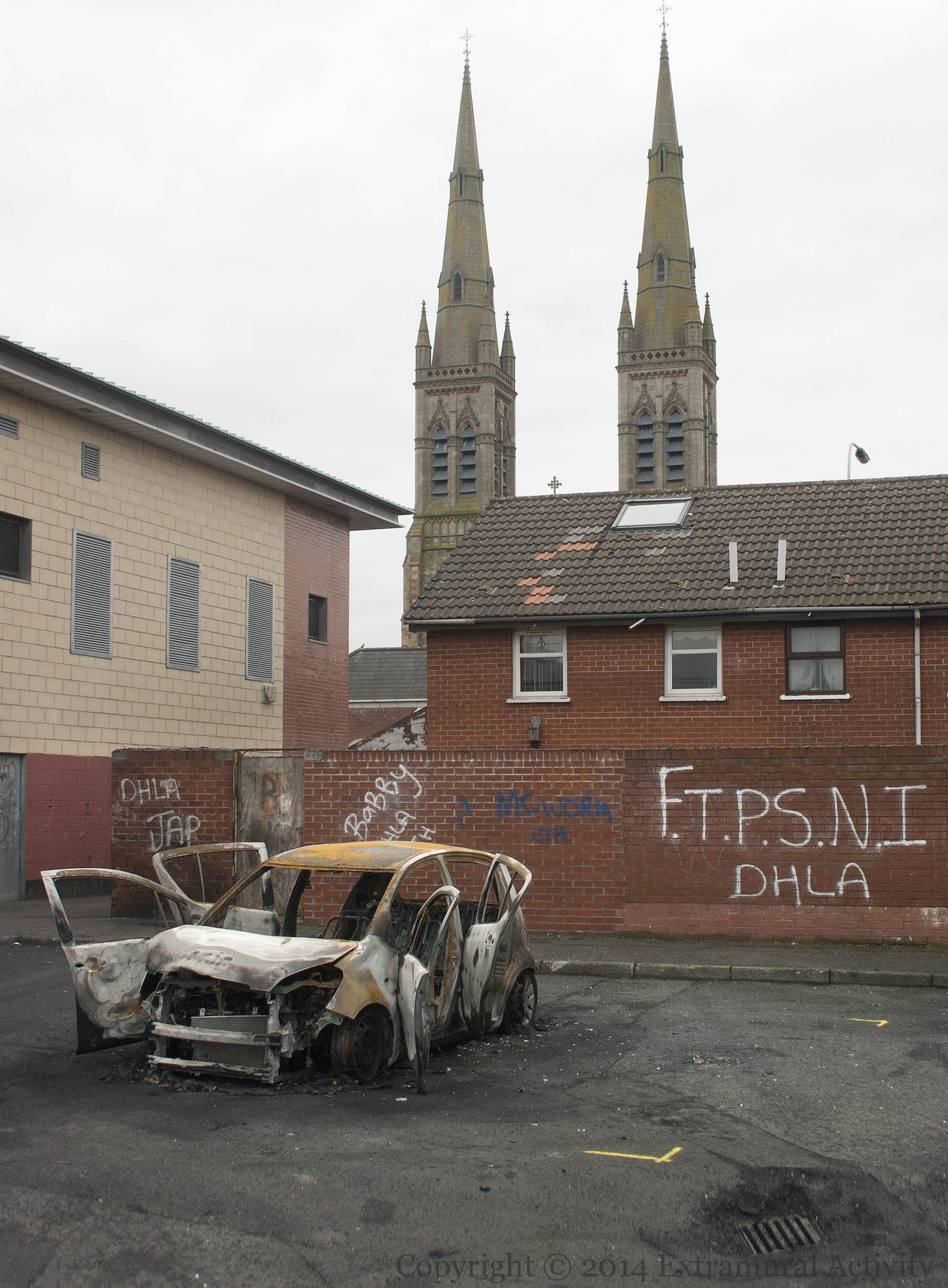
A burnt-out car in the shadow of St. Peter’s cathedral and at the back of the Maureen Sheehan Health Centre, just off Albert Street, which is infamous for “DHLA” (Divis Hoods Liberation Army) joyriding. The new murals in the area (such as Our Youth, Our Future) are part of an intervention project to improve it. 2014-12 update: there has been an upsurge in carjackings in late 2014 (BelTel).
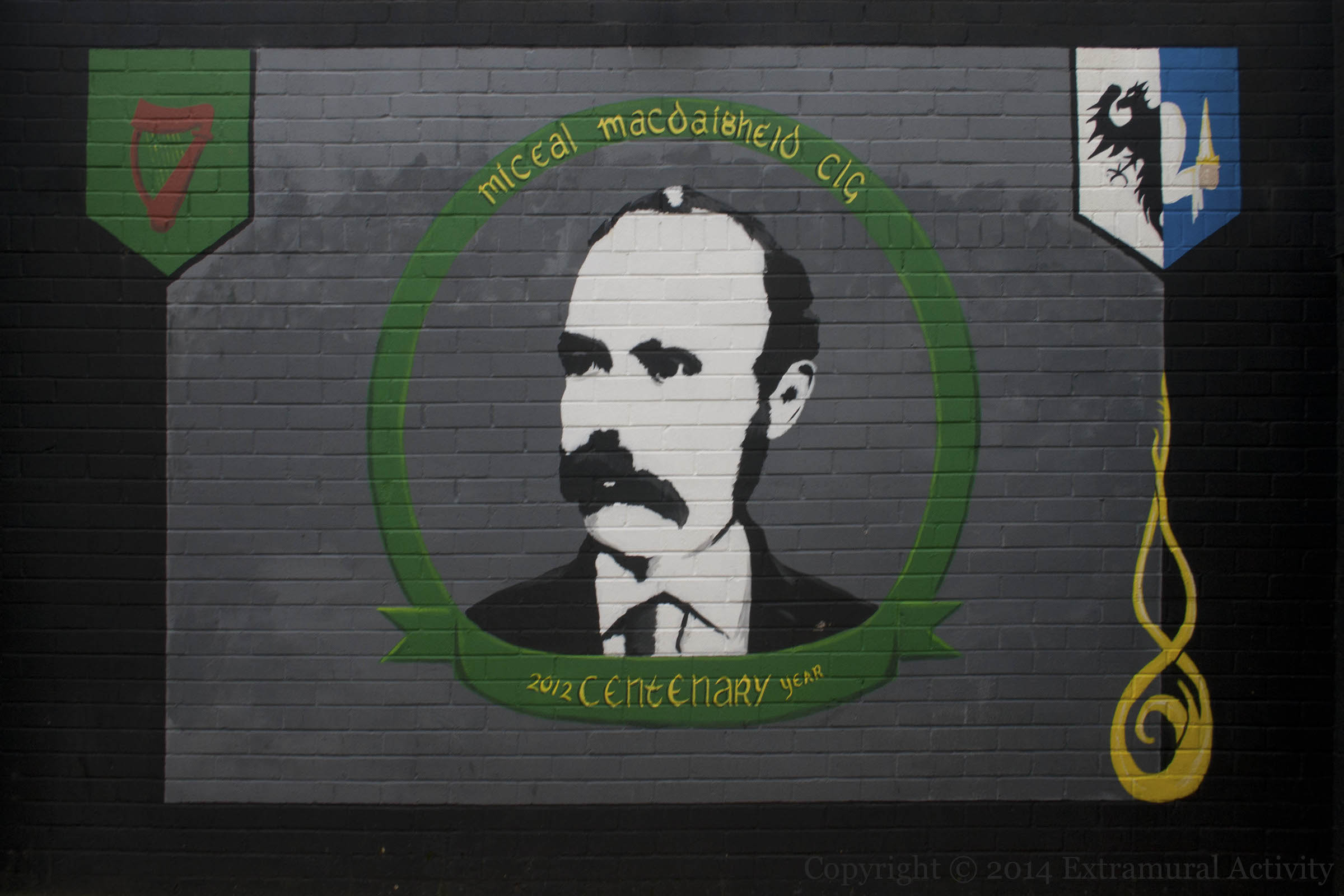
CLG Mac Daıbhéıd/Davitt’s GAA club is named for Mícheál Mac Daıbhéad/Michael Davitt, famous for leading the Irish Republican Brotherhood and the Land League. Mac Daıbhéad himself had his right arm amputated at age eleven after it got caught in the cogs of a spinning machine. The murals shown today are in the grounds of the social club on Clonard Street and celebrate the centenary of the club, 1912-2012.
Above is a new board (on painted background) at the Falls Road Garden of Remembrance for IRA volunteers in D company (the ‘Dogs’) of the 2nd battalion Belfast Brigade and local civilians from the lower Falls who died in the 20s, 70s and 90s. The main board shows a map of the area from Dunville Park to the Divis flats with lilies marking the spots of various deaths. Surrounding it are the portraits of fourteen of the volunteers listed on the marble – Maguire, O’Rawe, McKelney, Donaghy, Quigley, McAreavey, Hughes, Loughran, MacBride, Kelly, Carson, Campbell, Skillen, Marley.
Below is a wide shot showing the garden and mural.
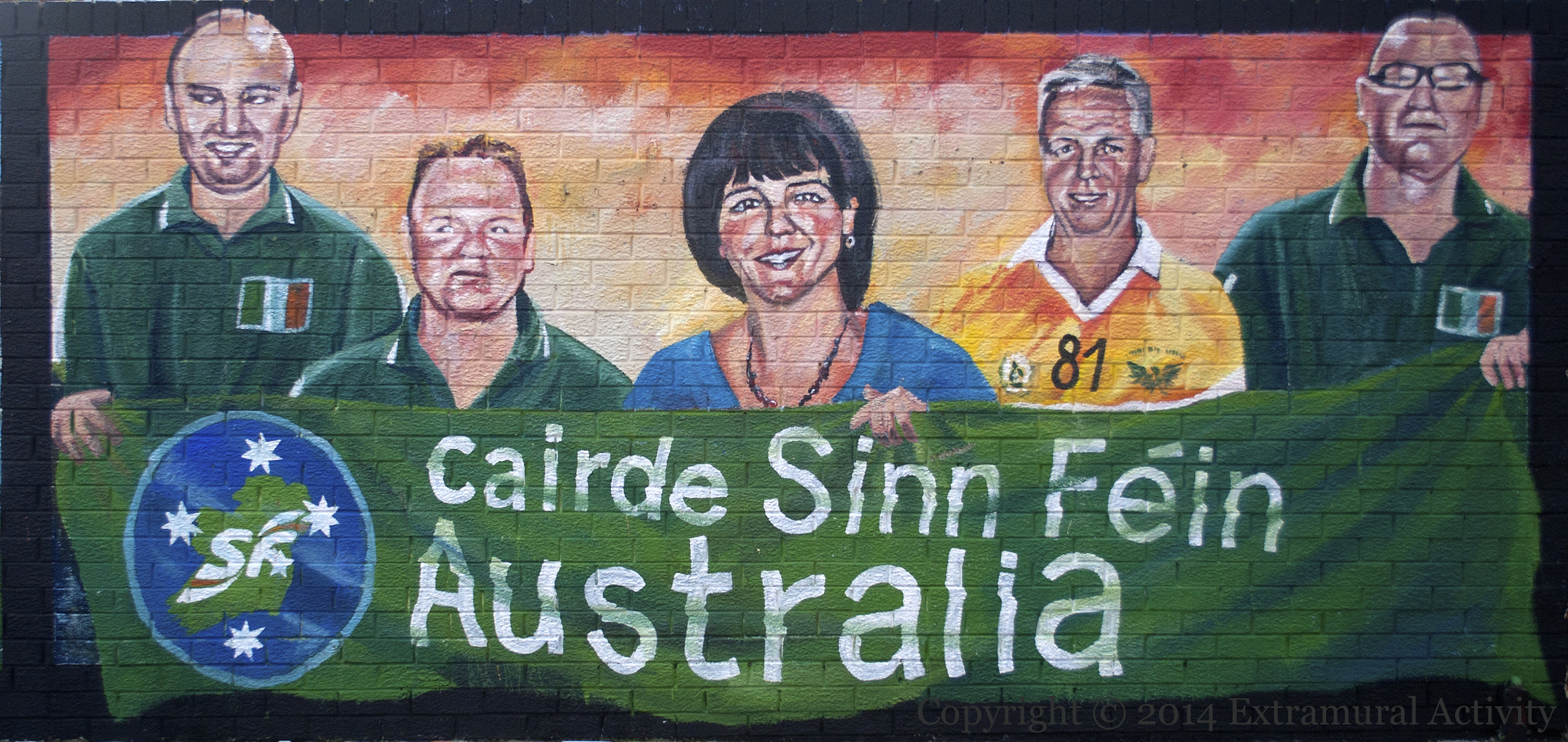
Above is the second of three 2013 murals sponsored by Australian groups outside the Republican Museum in Conway Street. This one shows members of the main sponsoring group, Caırde Sınn Féın (Fb).








 Extramural Activity