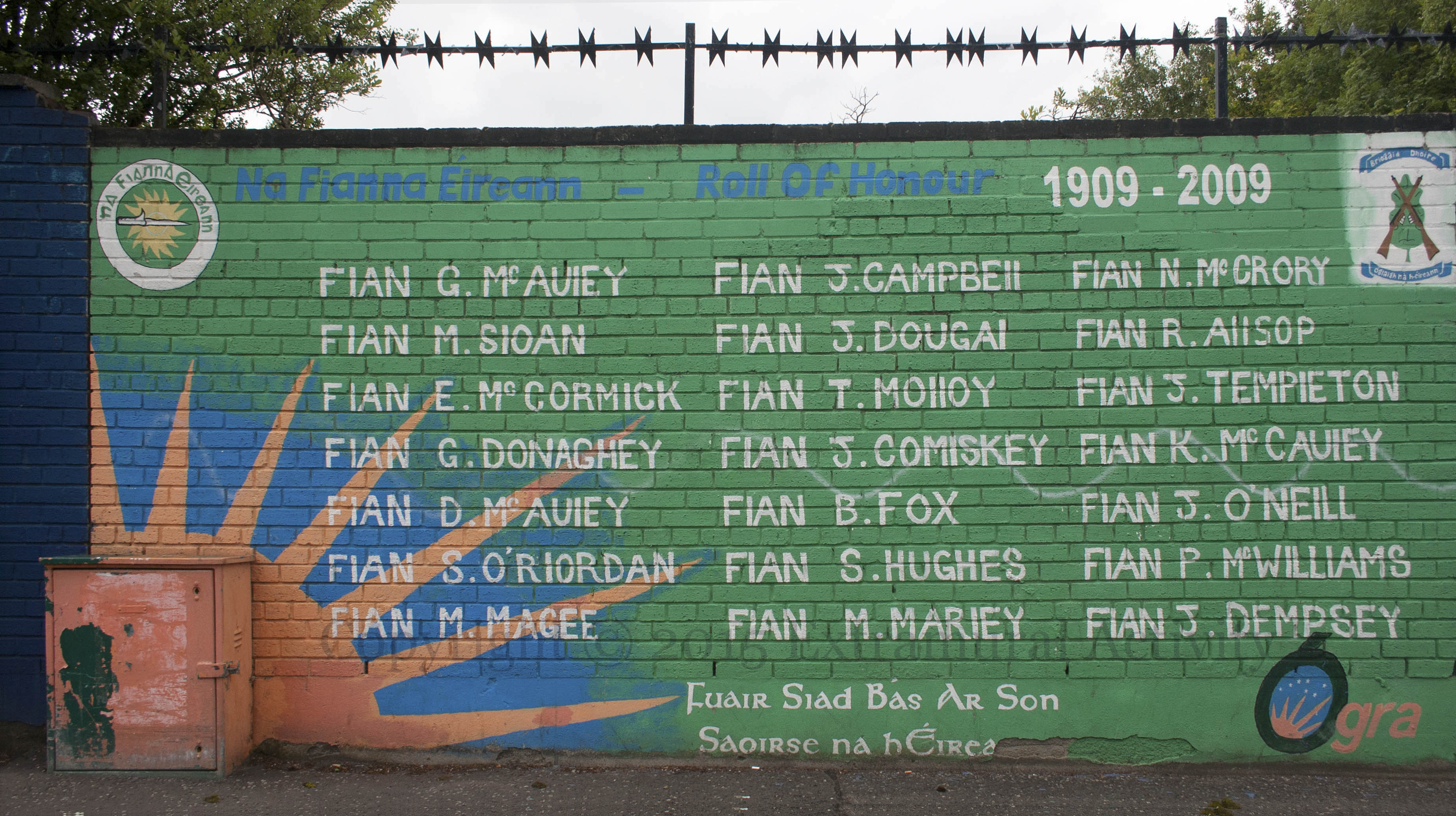
Mural in Derry commemorating members of Na Fıanna Éıreann, the youth wing of the IRA. The names are listed in the order of death, from earliest to latest, beginning with fifteen-year-old Gerald McAuley who was shot dead in Clonard (Belfast) in 1969, and ending with John Dempsey shot on the Falls Road (Belfast) in 1981.
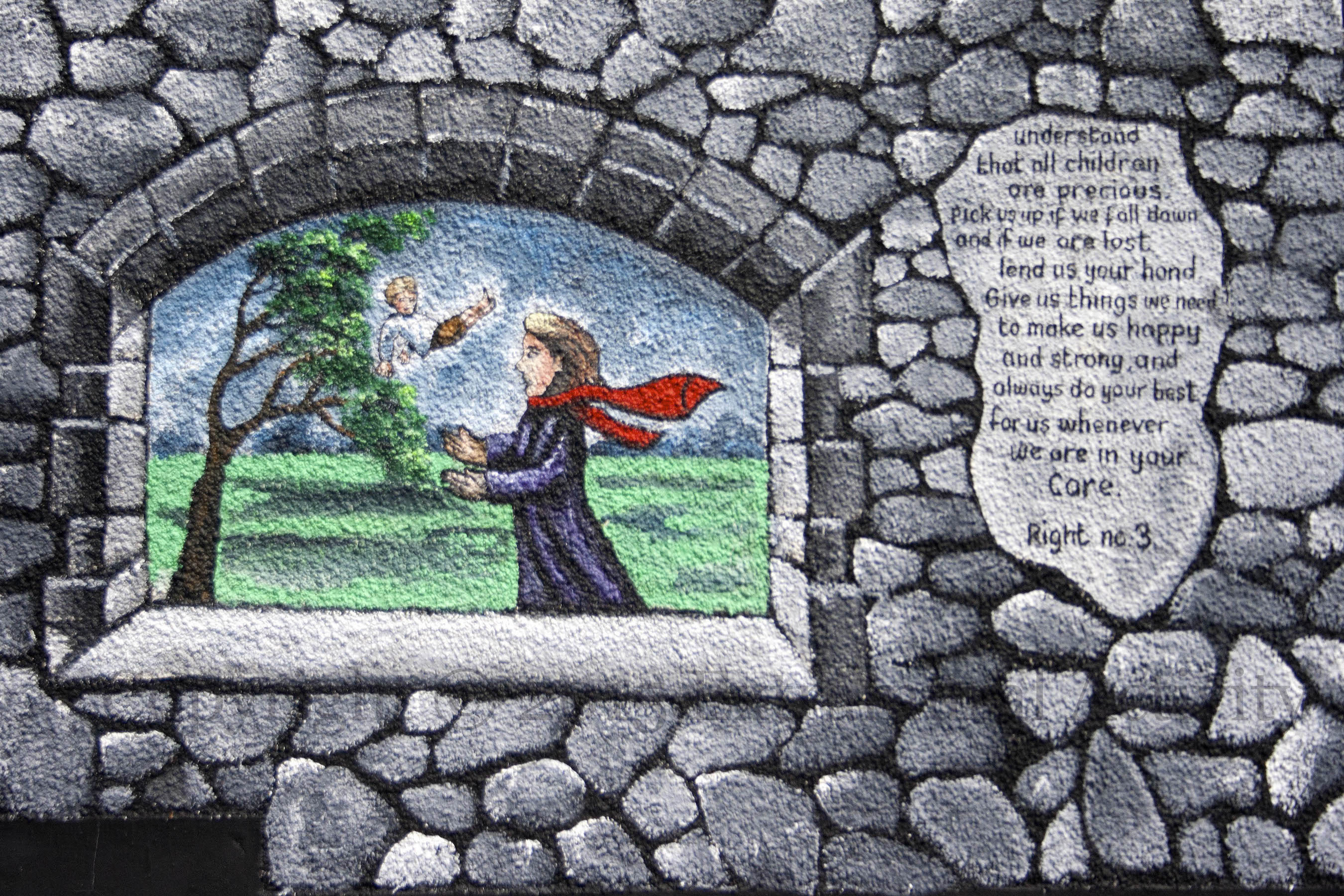
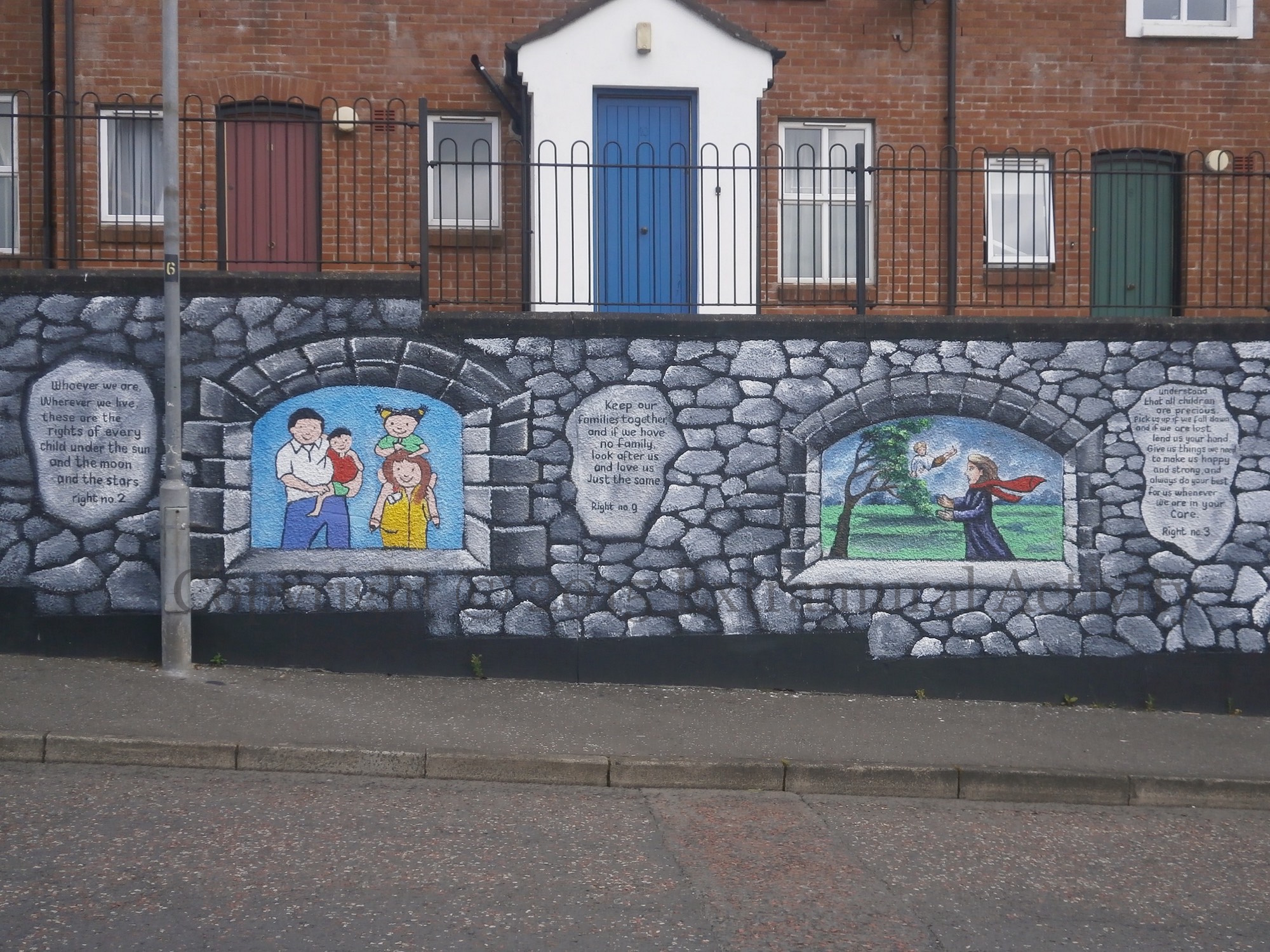
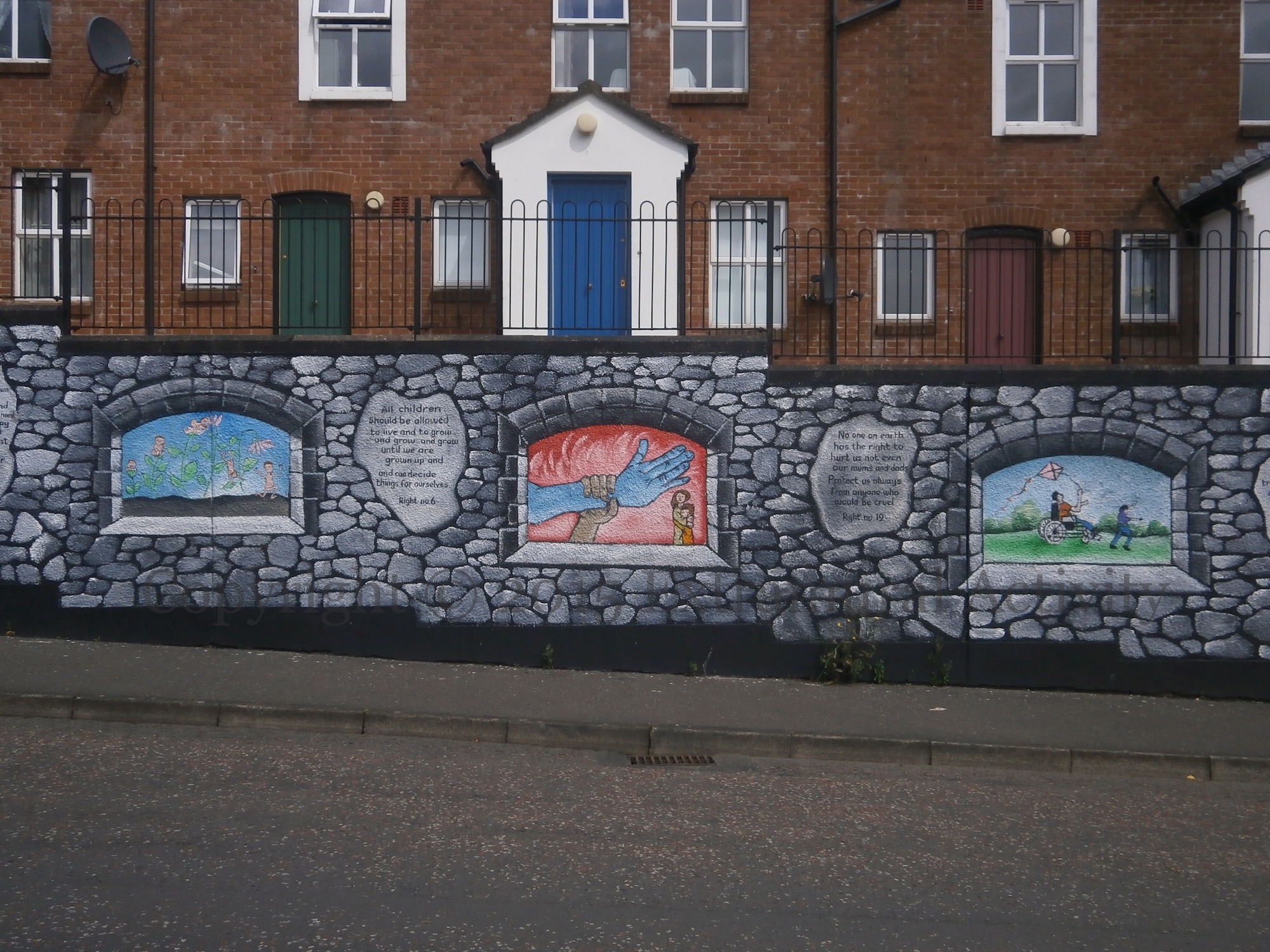
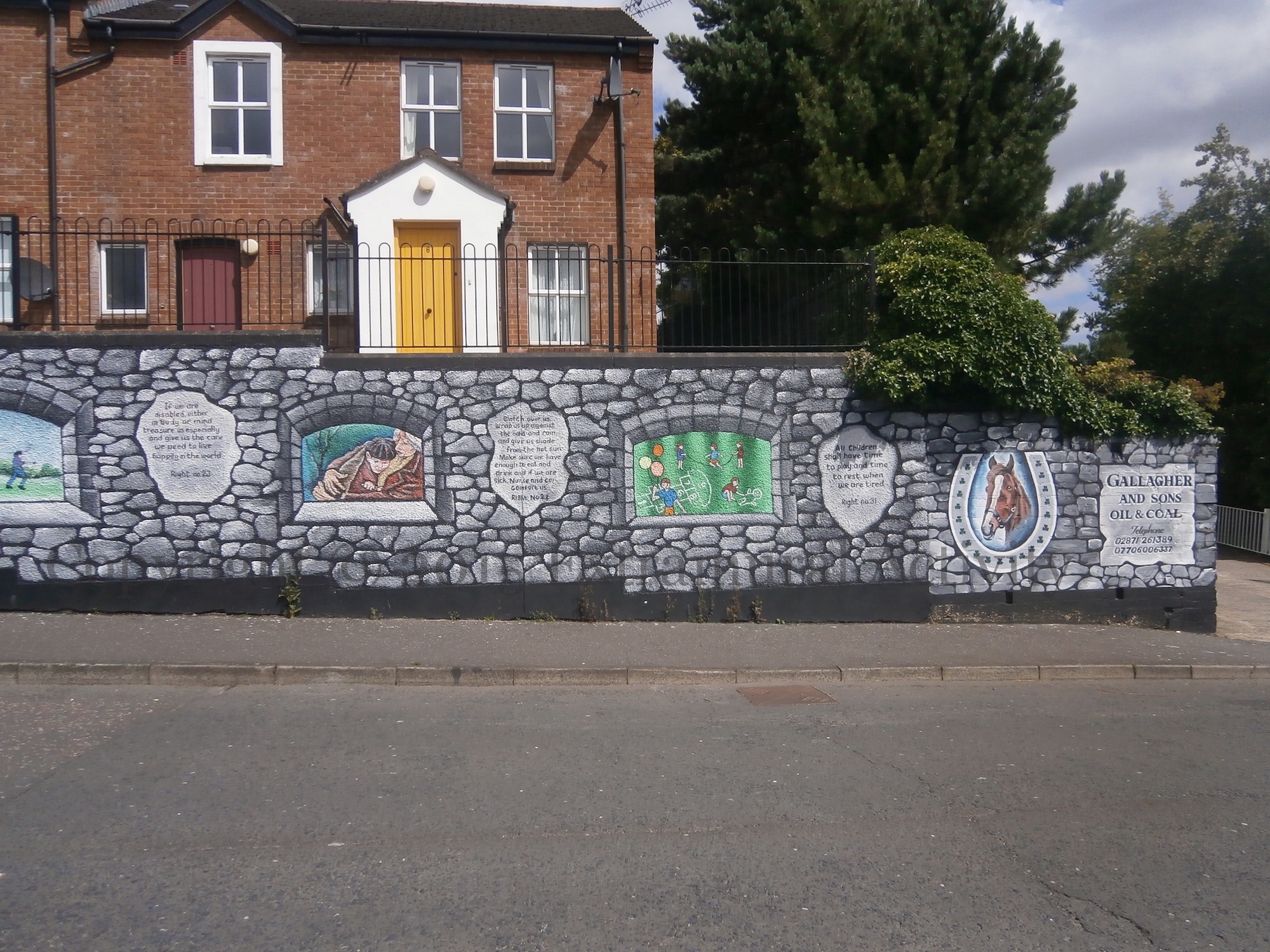
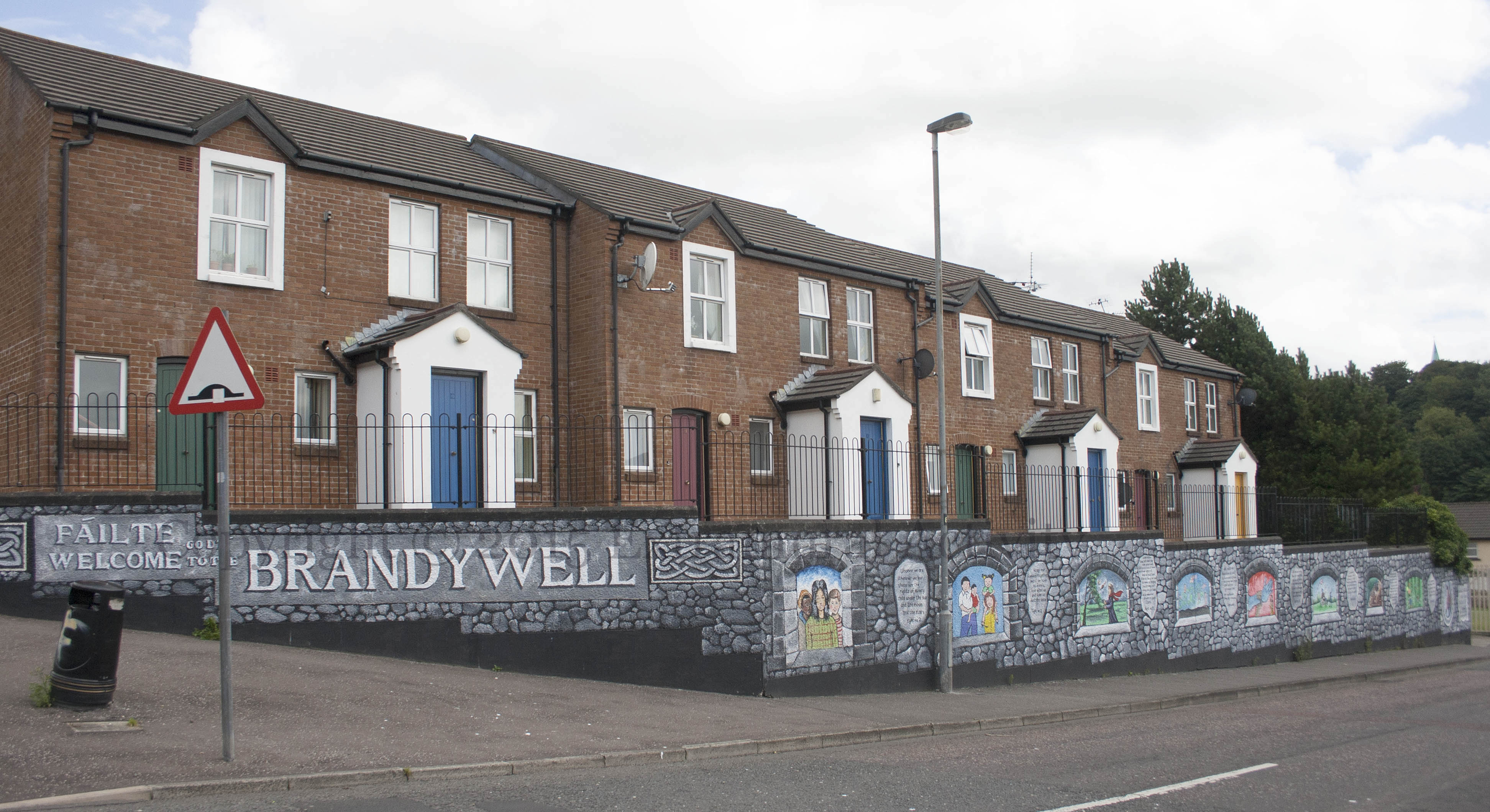
This mural featuring the rights of children was painted in Derry’s Brandywell area in 2014; it puts images alongside parts of Caroline Castle’s rendering of the UN’s Rights of the Child. The one above reads “Understand that all children are precious. Pick us up if we fall down and if we are lost lend us your hand. Give us things we need to make us happy and strong and always do your best for us whenever we are in your care. Right no. 3”.
The bombs of the US, NATO, and the EU drive fleeing refugees into a circle of barbed wire in this new mural on Beechmount Avenue: “Capitalism & imperialism created refugees! Syria • Iraq • Afghanistan • Libya … Stop wars not people!!!” A report in Saturday’s New York Times on the migrant crisis cites a June UN report when it asserts that “There are more displaced people and refugees now than at any other time in recorded history — 60 million in all”.
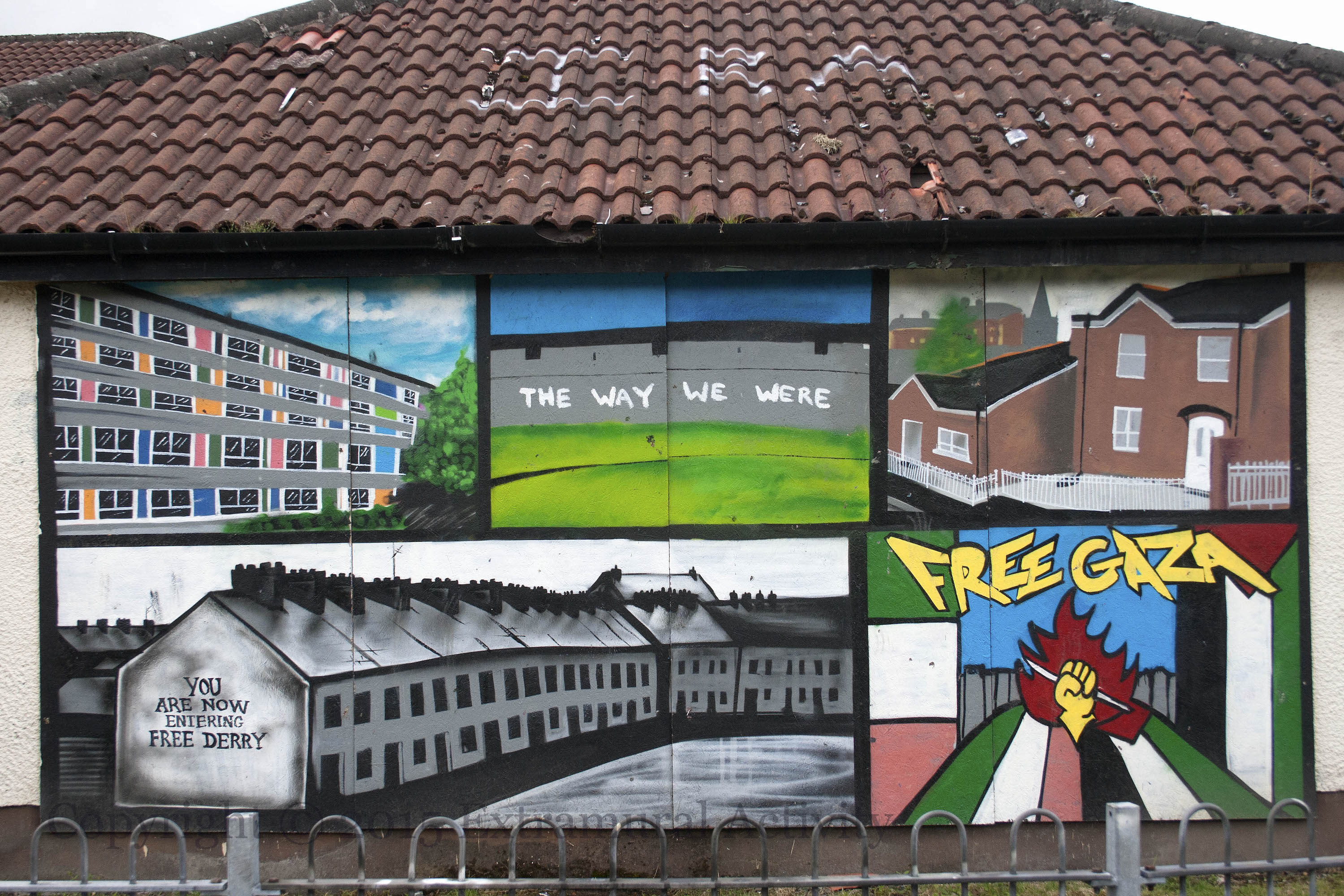
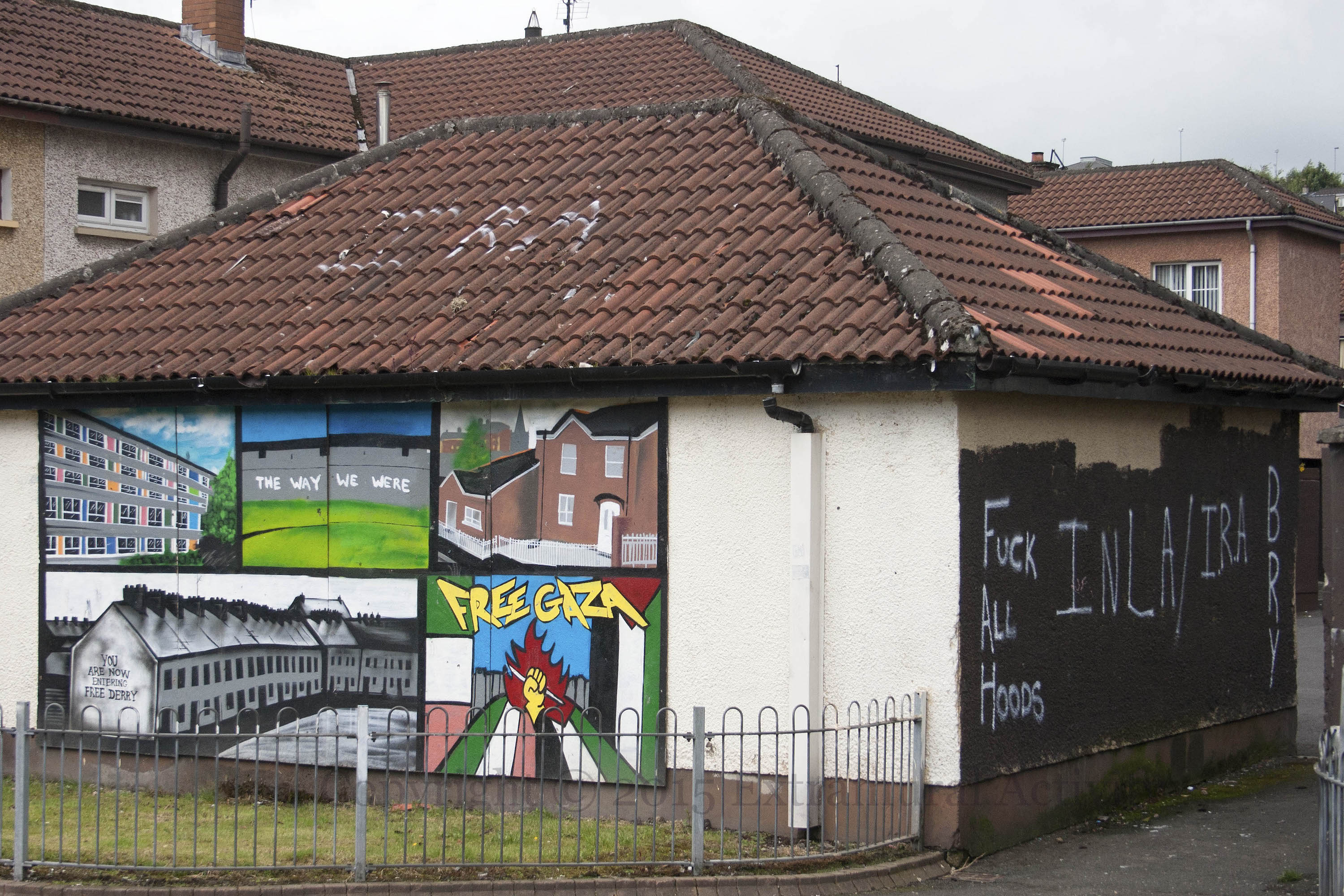
“The way we were” written on the bog side of the walls of Derry provide a name for this mural behind Derry’s Bogside Inn. The old Rossville flats are in the top left hand corner. (Both Rossville flats and graffiti on the walls – “God made the Catholics, the armalite made us equal” – can be seen in this 1982 image (M00039) from Peter Moloney’s collection.)
On Saturday mornings Brandywell Celtic play in the premier division of the Northwest league, while on Sunday mornings Brandywell Harps and Ballymoor FC play in the Senior league. Brandywell Swifts played in the Astroleague. Also included are the Oakleaf Amateur Boxing Club (Fb) and the Long Tower Judo Club.
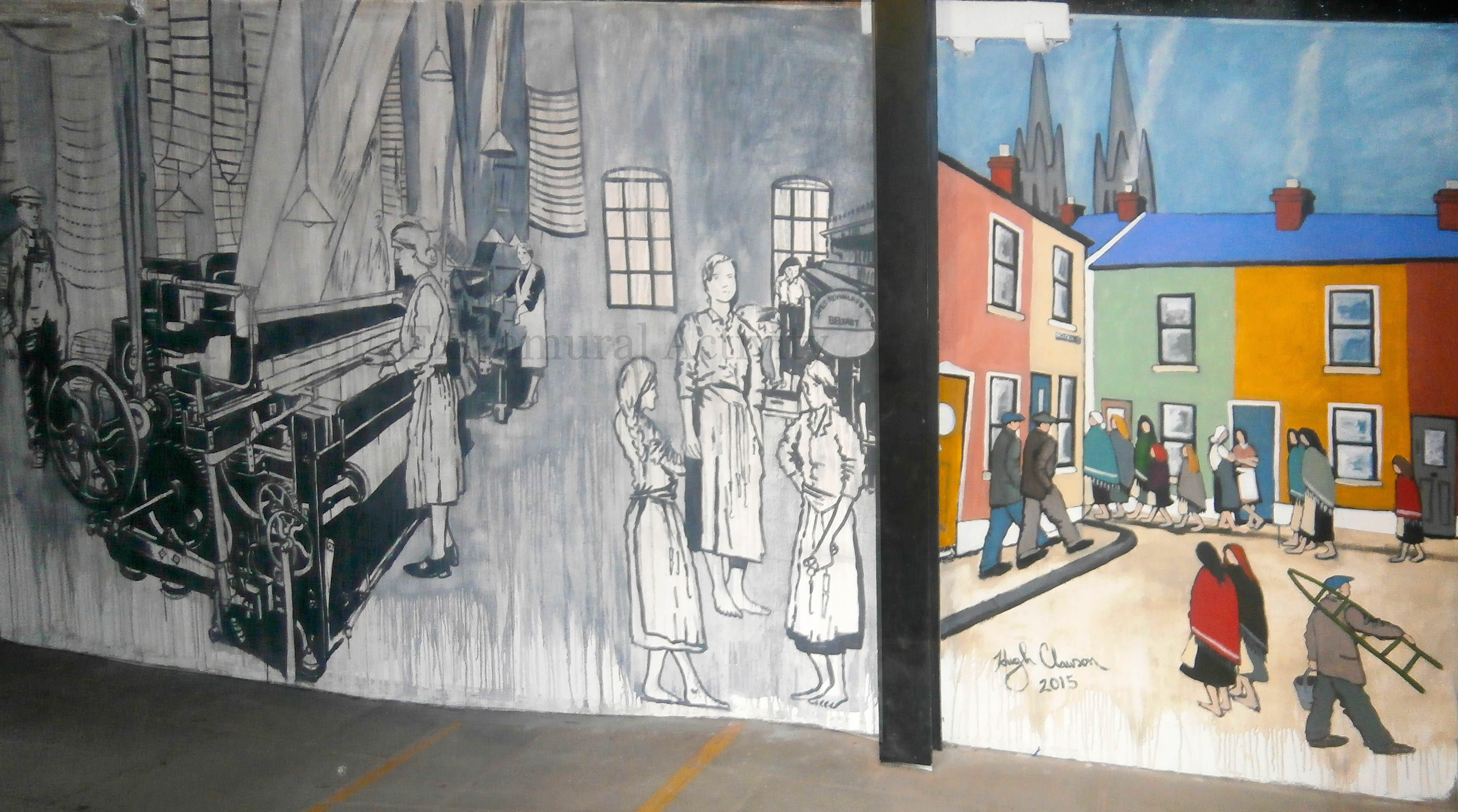
Work by artist Hugh Clawson (whose web presence is extremely modest) inside Conway Mill showing life in the mill and the lower Falls/Clonard area from years gone by. Painted directly onto an interior wall.
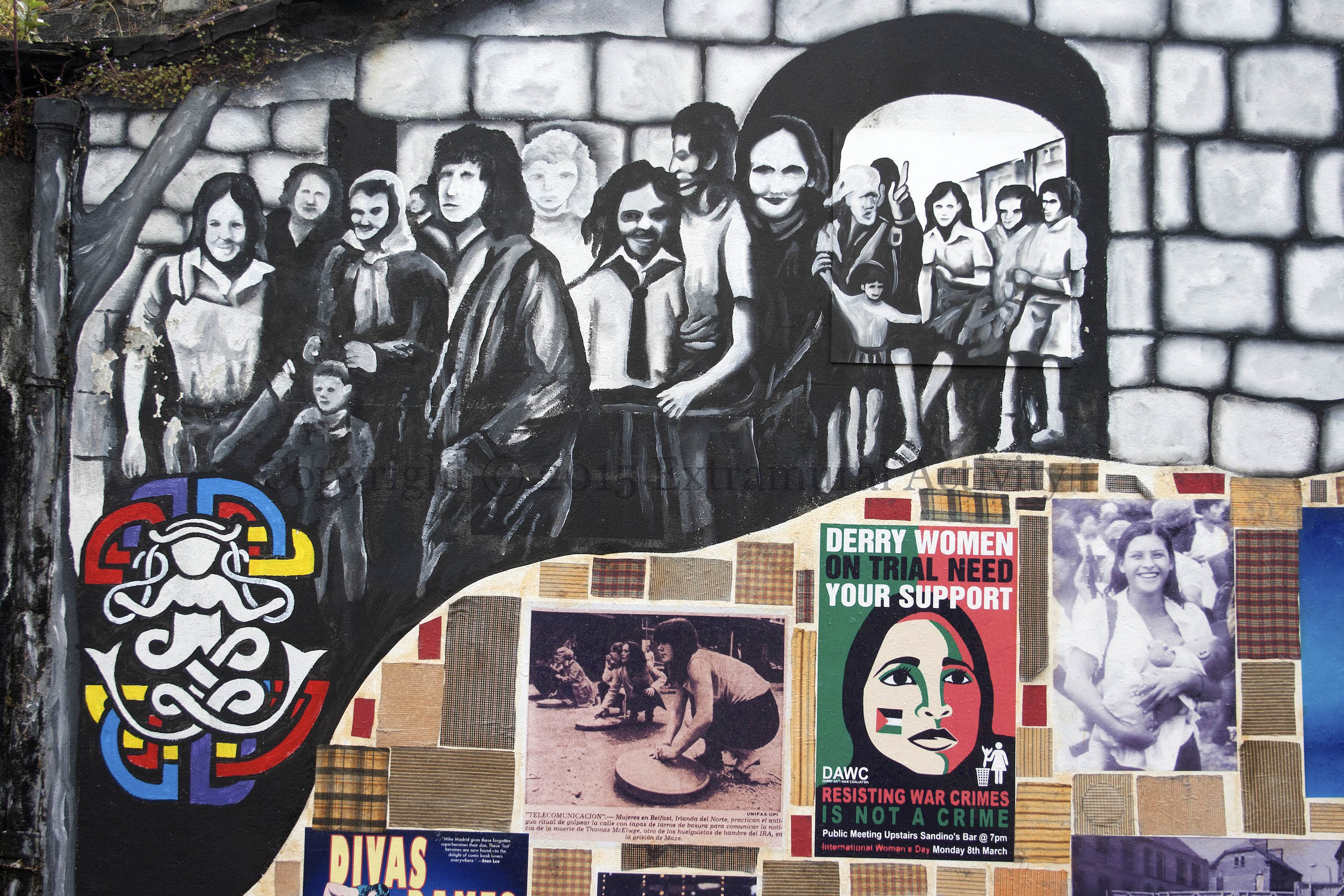
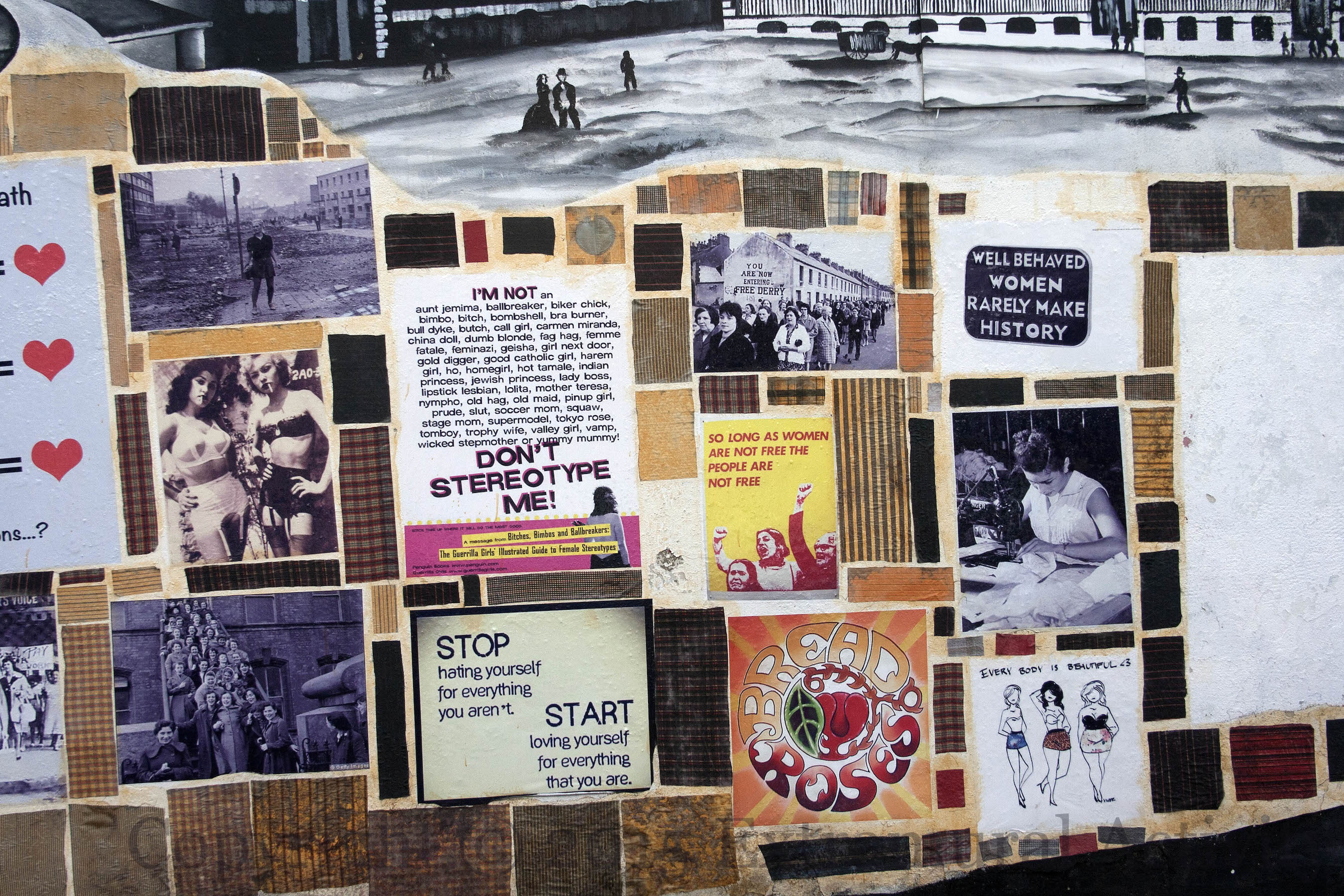
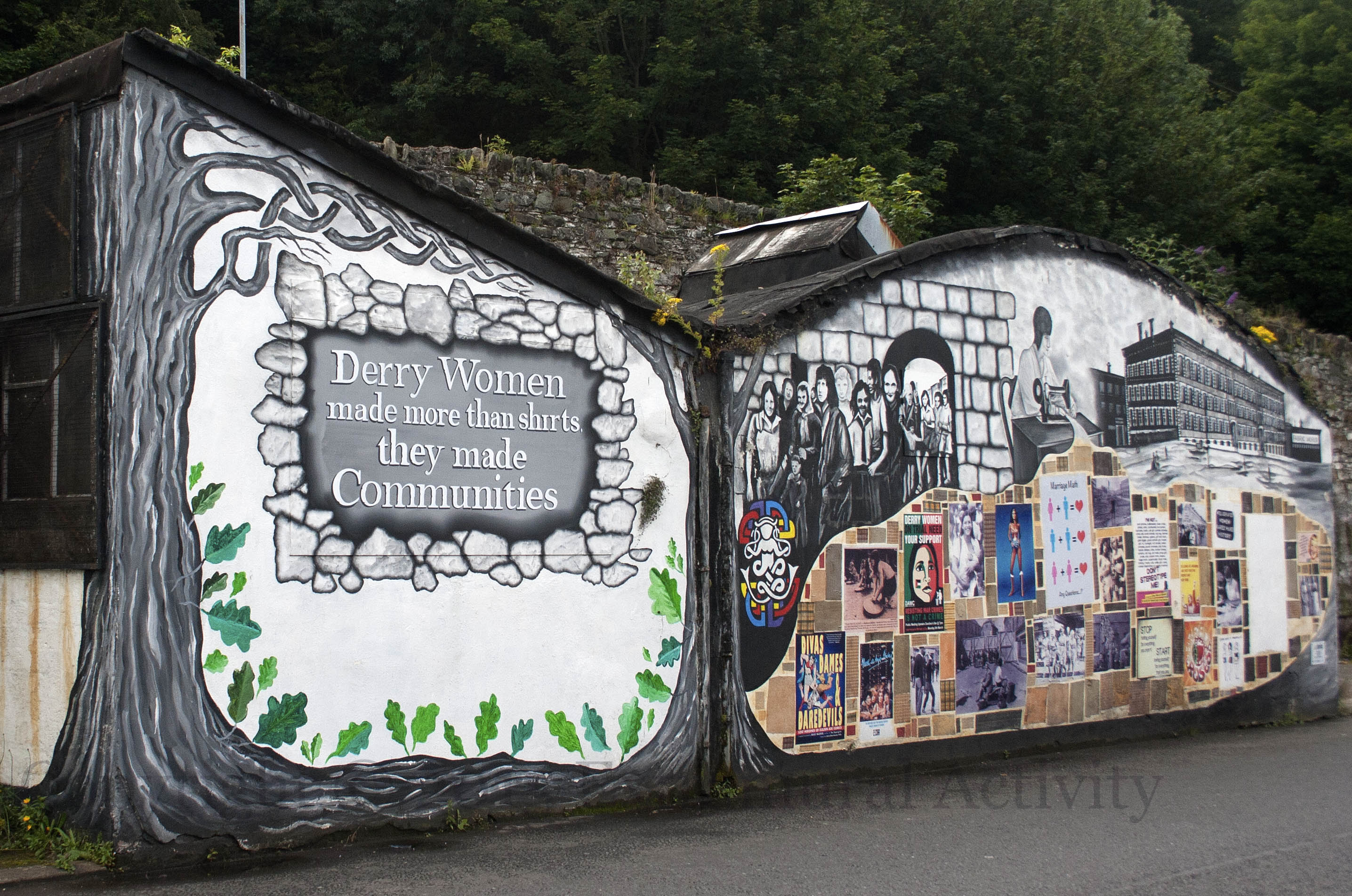
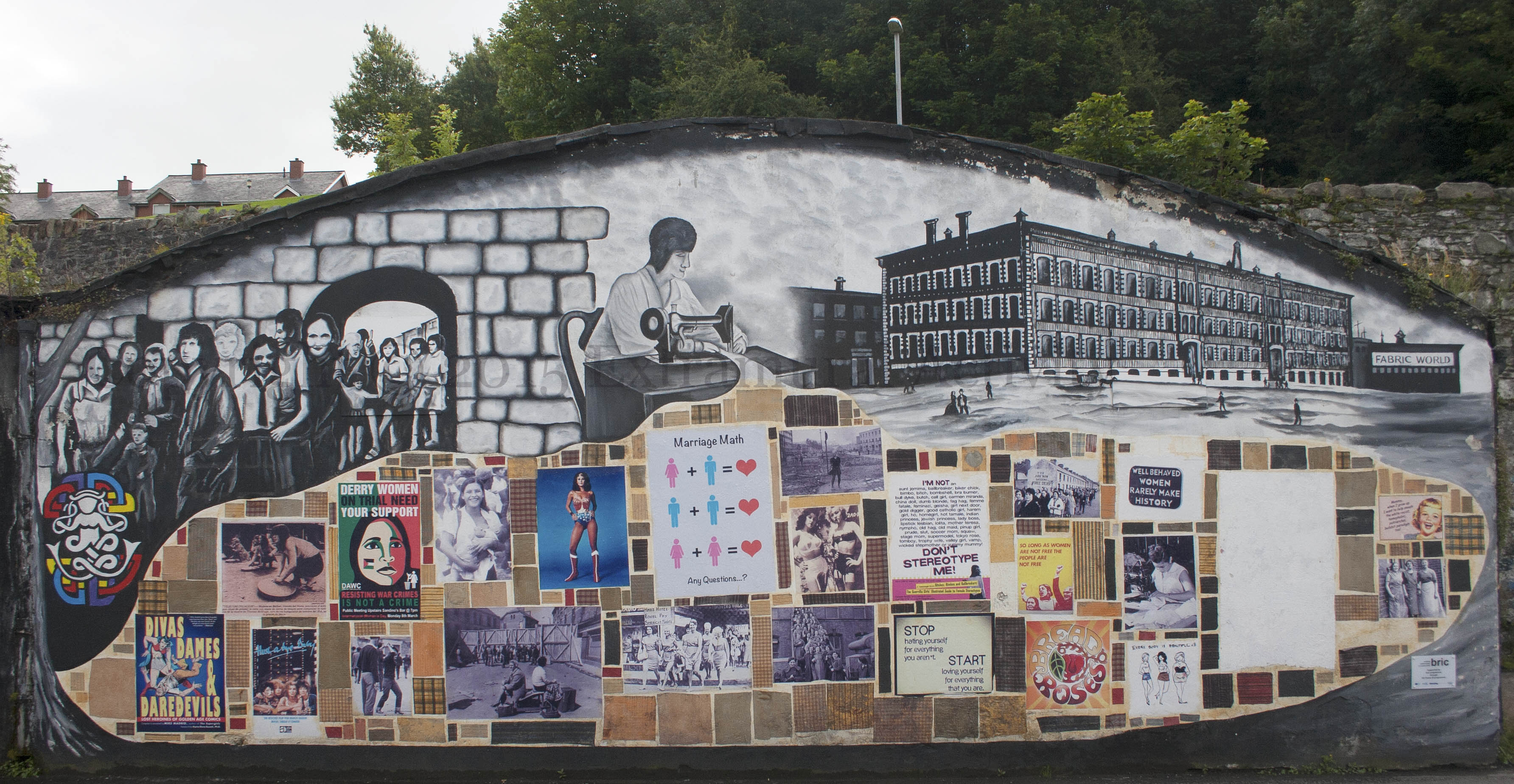
Historian Laurel Ulrich‘s 1976 phrase is one of a variety featured in this Derry mural celebrating the role of women both locally and world-wide. It includes images of local women banging bin lids, marching past the ‘Free Derry’ graffiti on 33 Lecky Road, and rioting; images of women striking and protesting; support for Palestine and gay rights; celebrations of femininity; and Wonder Woman. As the final image, below, shows, the tapestry of images and posters is being sewn by a woman at a sewing-machine in one of Derry’s large shirt- and collar-making factories. (For some history see these Derry Journal articles: one | two.) As the panel on the left-hand side notes, “Derry women made more than shirts; they made communities”.
On the left of the main panel, women march out of one of the city’s gates. The information sheet (which has fallen off) reads as follows: “On International Women’s Day, March 8th [1991, not 1981 as the hand-written addition suggests], the first ever women’s mural in Derry was unveiled on the back of Free Derry Wall. It was designed and painted by Patricia Hegarty and Joe Coyle, and helpers, both men and women. The mural takes its inspiration from a march in November 1968, after Minister for Home Affairs Bill Craig banned all civil rights marches in the walled city. Women factory workers walked out and spent the afternoon marching in and out of every gate in the city, deliberately “breaking the ban”. Men marched in from DuPont to join them, and a rally was held in the Diamond. In the mural you can find the faces of some of those marching on that historic day, as well as other women who played their part in the ongoing struggle for justice. Civil rights workers Bridget Bond and Women’s Aid refuge founder Cathy Harkin march alongside republicans such as Ethel Lynch, Bridget Sheils, Peggy Derry, prisoners’ rights activists Susie Coyle, and many others. You may find images of your granny, sister or aunt. The mural is dedicated to all those women whose energy and determination have changed their lives and the world about them.”
The board on FDC can be seen in Woods’s Seeing Is Believing?, plate 19.
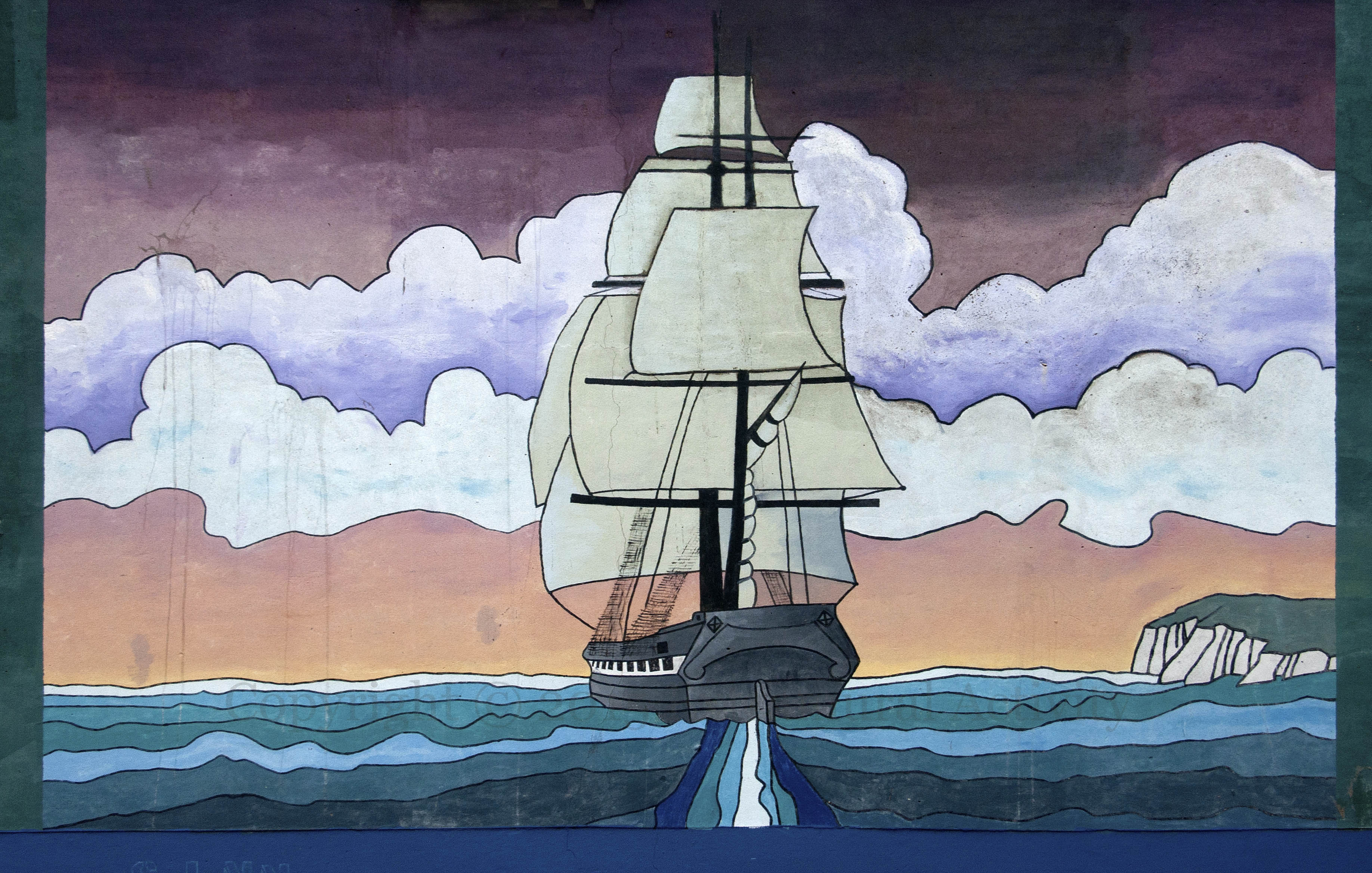
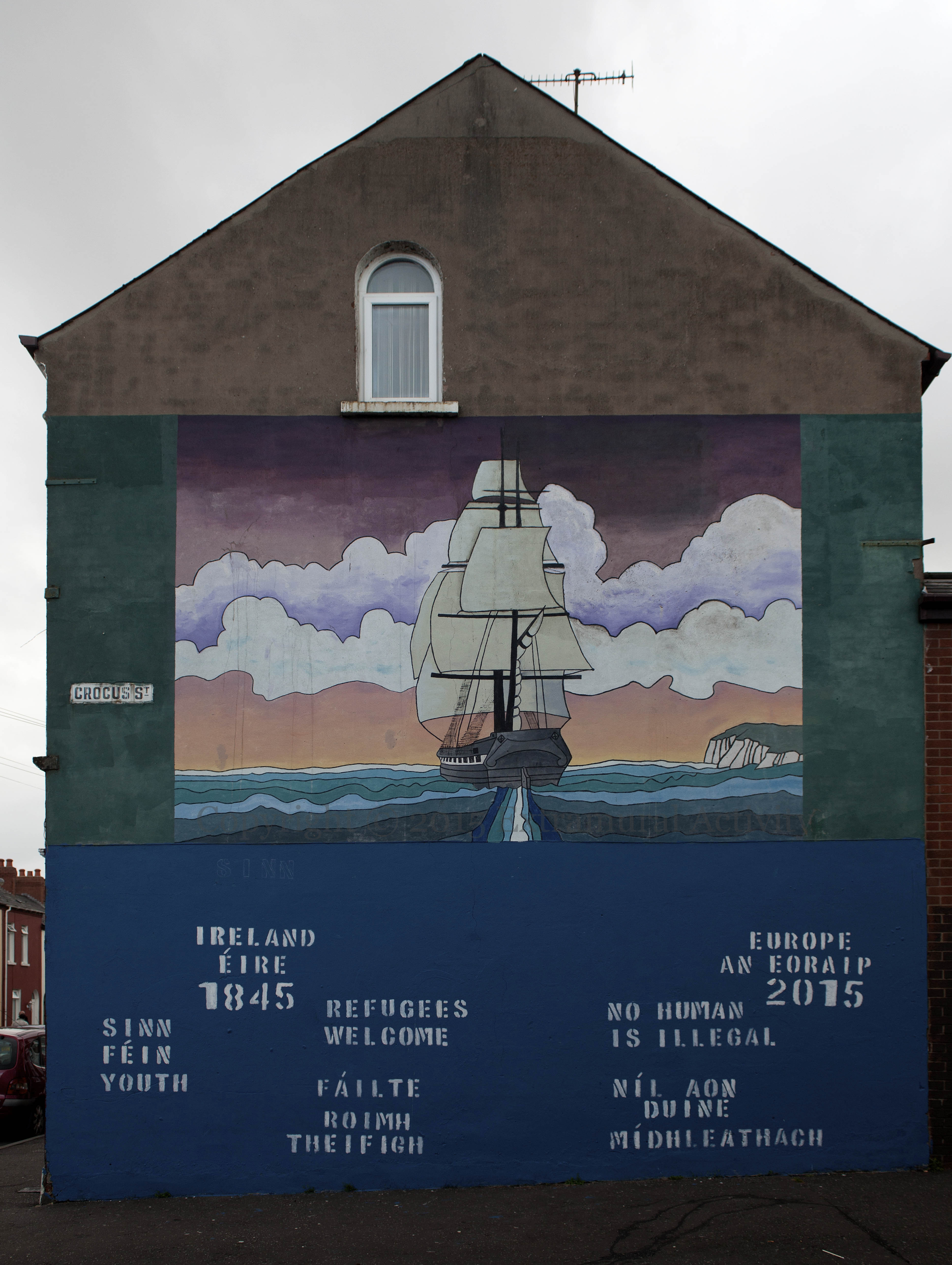
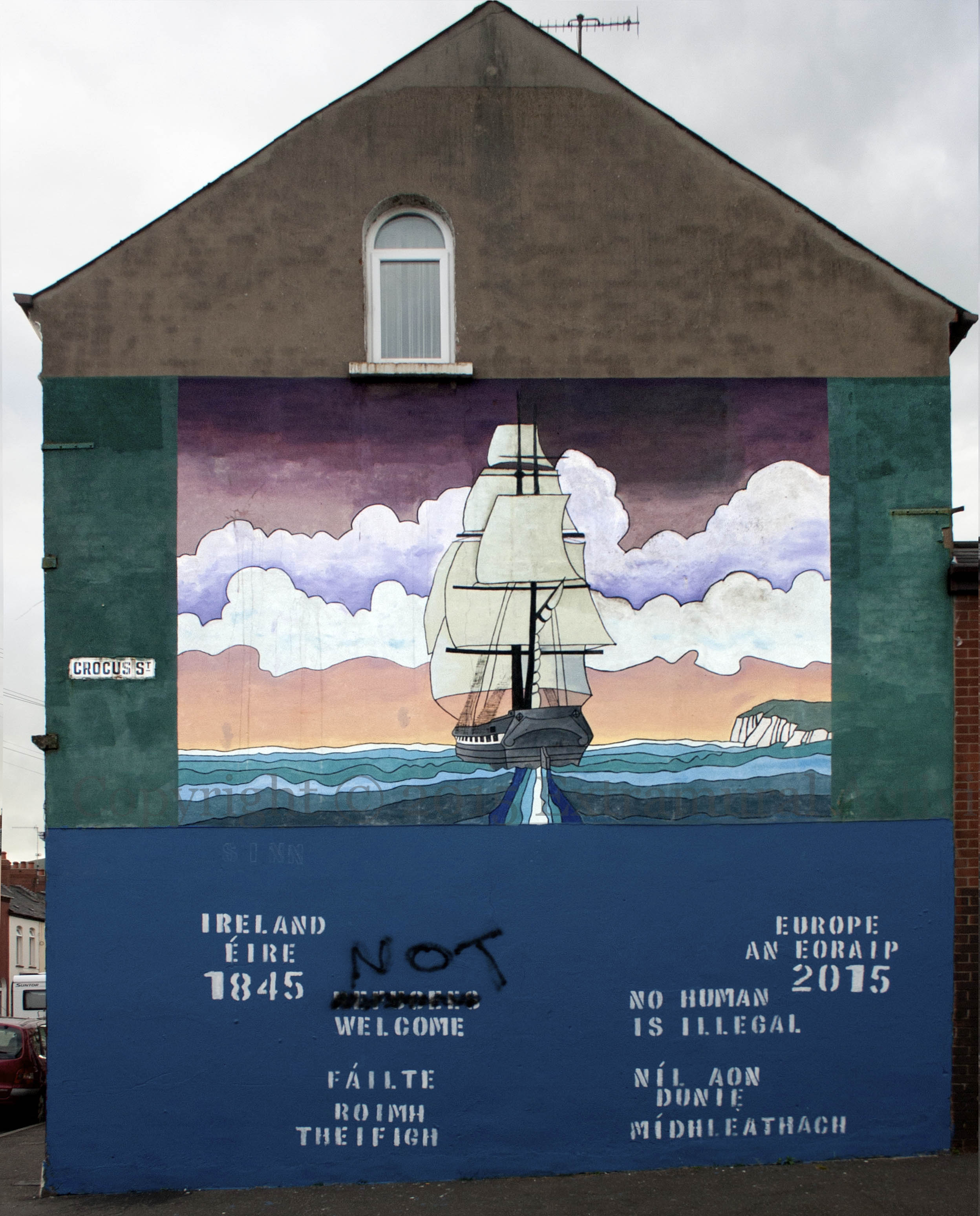
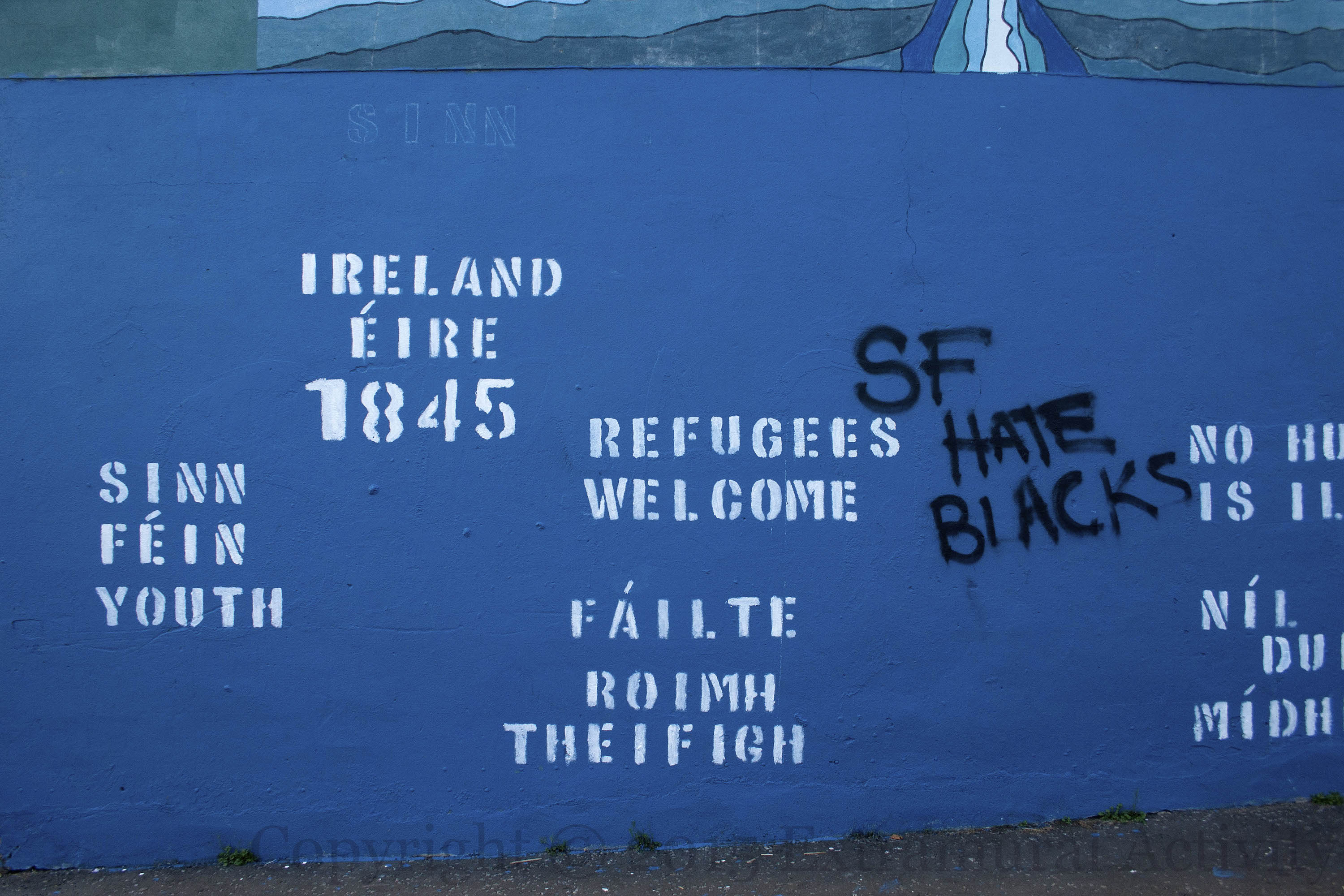
Incidents involving ships of African emigrants seeking refuge in Europe are so many that there is a separate Wikipedia page for them. In response to the crisis, an old mural in Crocus Street (see M01486) remembering the emigration of Irish to North America during the Great Hunger was repainted and the lower part (which had images of the Great Hunger) replaced by stencilling which makes reference to the 2015 situation: “Ireland/Éıre 1845 – Europe/An Eoraıp 2015”, “Refugees welcome – Fáılte roımh theıfıgh”, and “No human is illegal – Níl aon dunıe [duıne] mídhleathach”. It was immediately vandalized with a “not” (see the final image, below; Fb) but has now been repaired, along with the mis-spelling.
Update 2015-10-19: the mural has been graffitied with “SF hate blacks” – see the fourth image, below.
Paul “Maxi” McVeigh scored over 200 goals during his career at Donegal Celtic – “The Wee Hoops” – the team he played his entire career with before retiring at the end of the 2012-2013 season. (Sunday World) The club grounds, and the mural shown above and below, are at the top of the Suffolk Road in west Belfast.
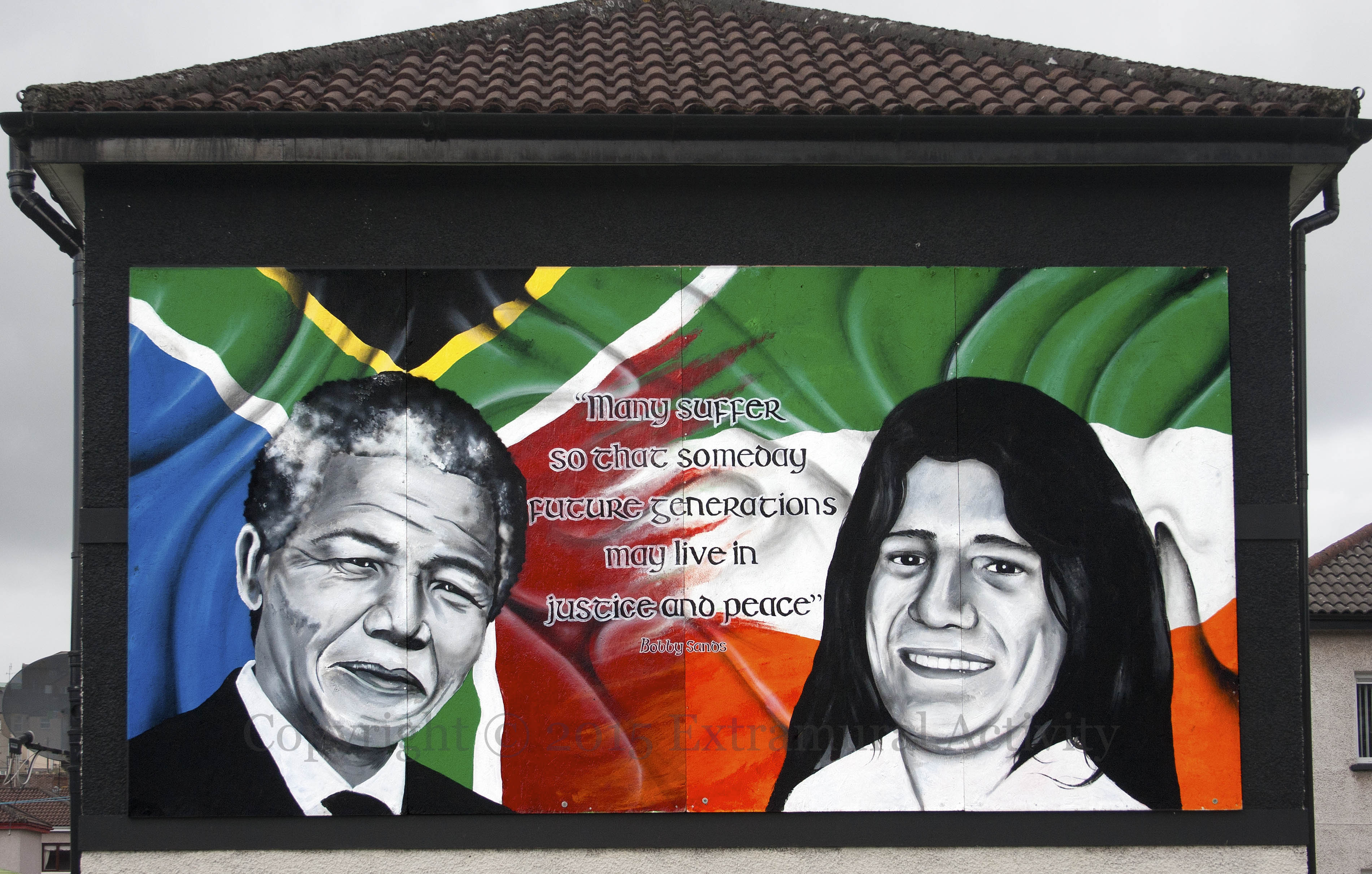
“Many suffer so that someday future generations may live in justice and peace.”
Portraits of Nelson Mandela and Bobby Sands are presented side by side, both smiling, in front of the flags of (post-apartheid) South Africa and the Republic of Ireland.




 Extramural Activity