Above is a colourful metal-worked piece bolted to the “peace” line on Cupar Way, celebrating “Shankill Ingenuity” while commemorating the lives lost on Titanic.
“1140” p.m. local time, April 14th, 1912, was when the ship hit an iceberg and began sinking. At about 2:20 a.m., in the early hours of the 15th, it went under.
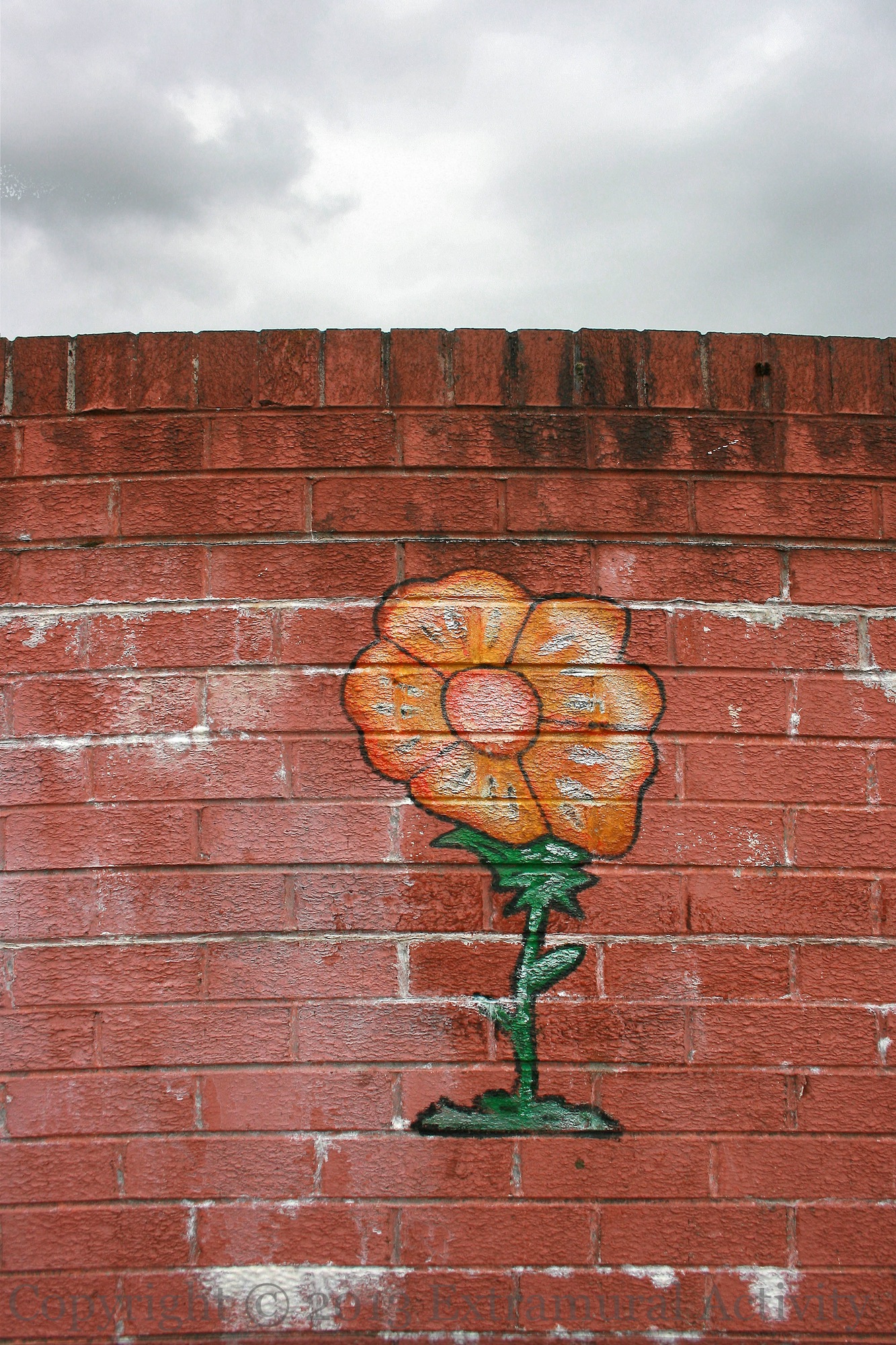
The Linfield area of south Belfast is named for the flax plant, genus Linum (presumably – there doesn’t seem to be a history of the area on-line), though that plant is blue (see this image), while this one – in Linfield Gardens – is orange.
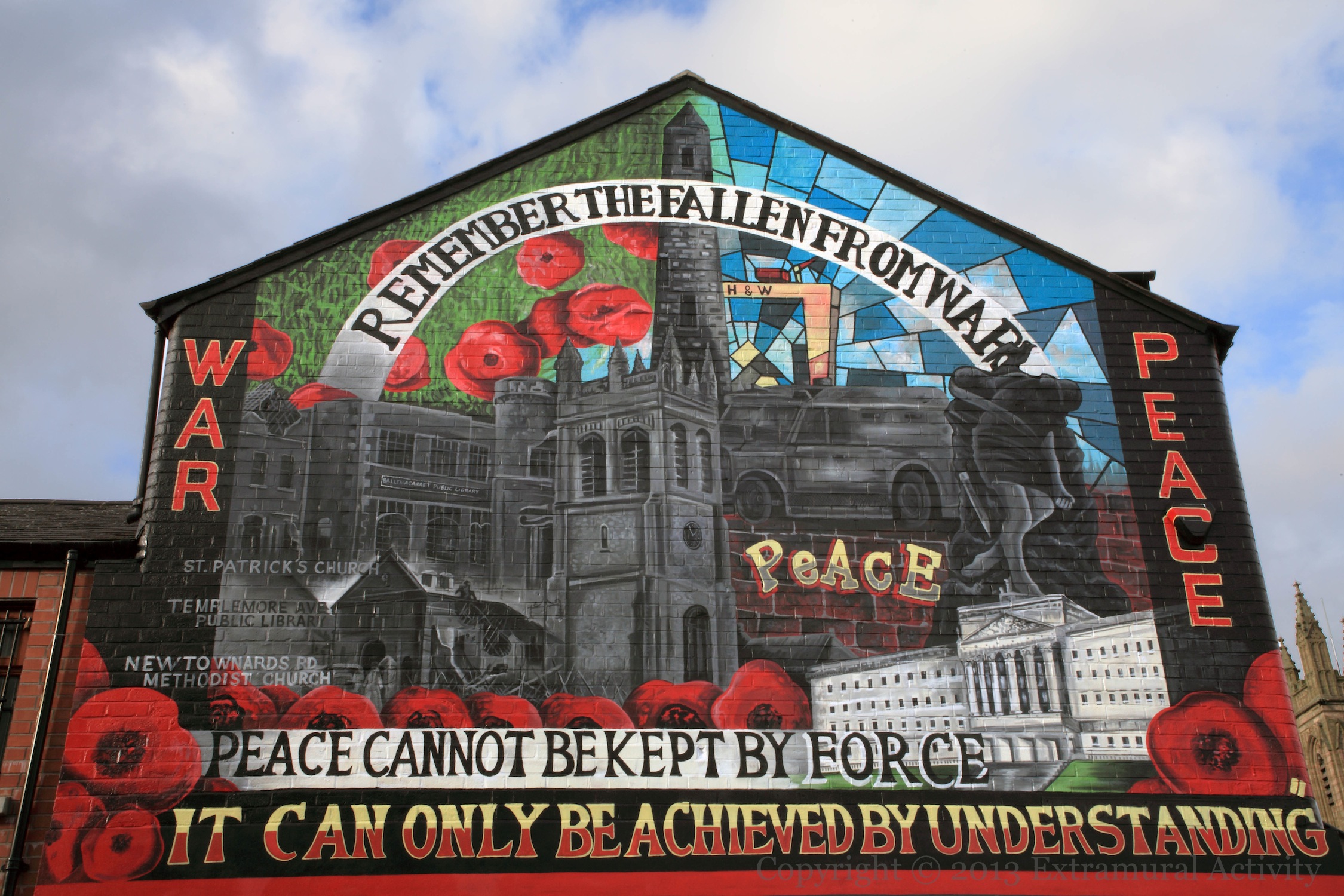
The mural above is on the Newtownards Road at Lendrick Street and shows a bombed-out Ballymacarrett library, St. Patrick’s church (the church itself is visible in the lower right-hand corner) – both were hit by the blitz in 1942 – a police land rover (perhaps representing the “fallen” during the Troubles), and Cuchulainn (perhaps representing the IRA, though Cuchulainn is also a UDA icon – see the bottom of the Visual History page on Cú Chulaınn), and Stormont (representing … peace???). Poppies in a field and a H&W crane against stained glass provide a background.
We are supposed to remember the dead because (perhaps) their deaths were unnecessary and misguided as means to peace, at least according to the saying along the bottom (sometimes attributed to Einstein): “Peace cannot be kept by force; it can only be achieved by understanding” – understanding of the Nazis during the blitz, it seems, and of loyalists and republicans during the Troubles. (If you have a better interpretation, please leave a comment.)
The mural was imitated on the hoarding around An Cultúrlann on the Falls Road during its renovation (shown below): the left hand side of the side was replaced with images of the Falls library and Bobby Sands mural and Divis tower, and Cú Chulaınn on the right was placed in front of the GPO, and the poppies were joined by lilies, and the words translated into Irish. The message here seems clearer, lamenting the CNR dead and calling for understanding of the CNR community (sc. by Britain and the Orange state) though the poppies below include the dead of WWI.
Vintage mural in Linfield Avenue, flanking the Sandy Row Methodist church, with the 1690-1990 piece on the other side. ‘In glorious memory, 36th Ulster division. YCV – In God our trust.’
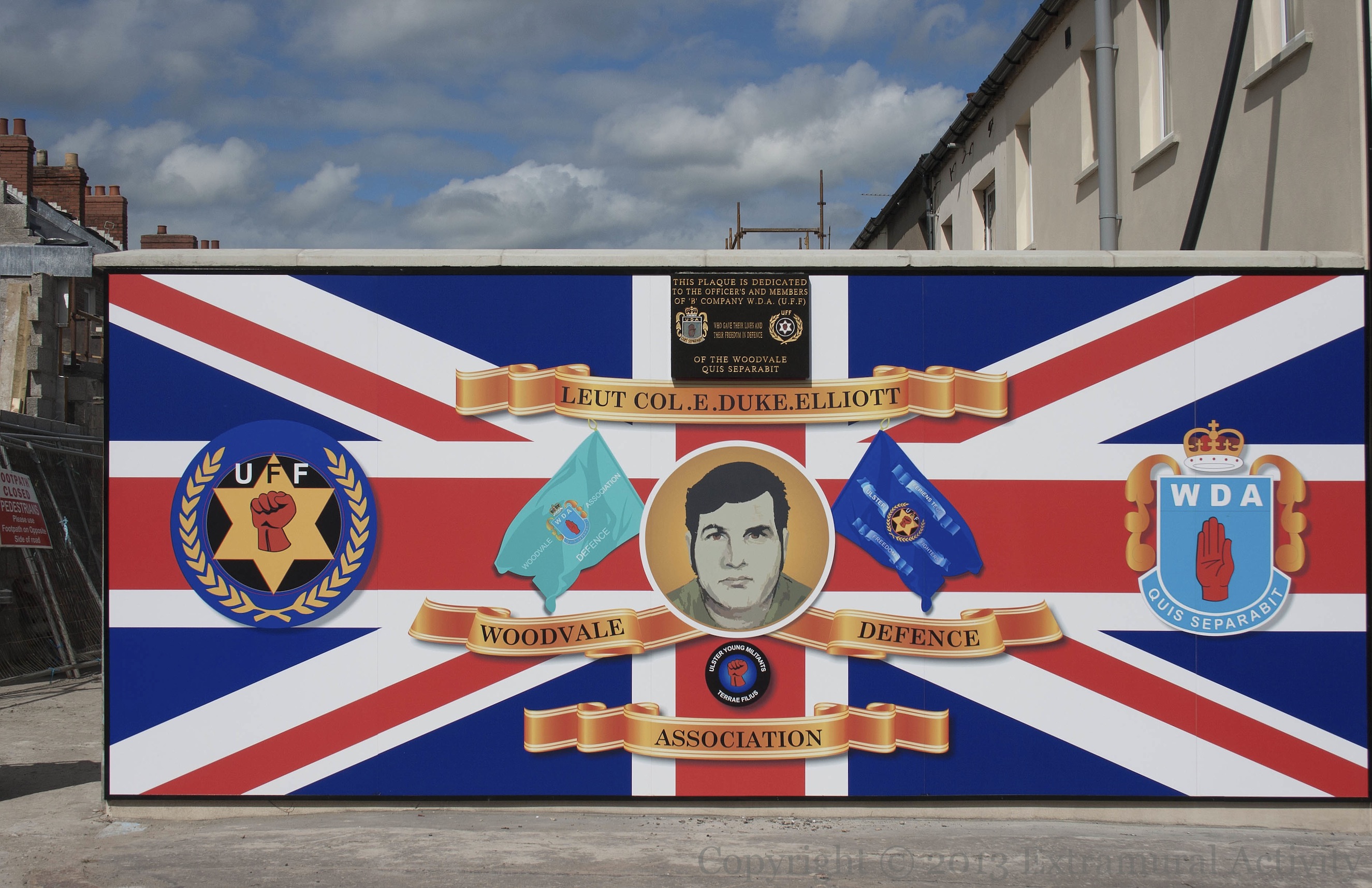
As mentioned in UDU-WDA-UDA-UFF, the end wall of Columbia Street was knocked down, taking with it a former Duke Elliott/UDA mural, which has now been replaced with boards (rather than murals) commemorating the history of the UDA and Elliott. Elliott lived one street over, in Leopold Street (WP). He was killed in 1972, at age 28, in a dispute with other UDA members.
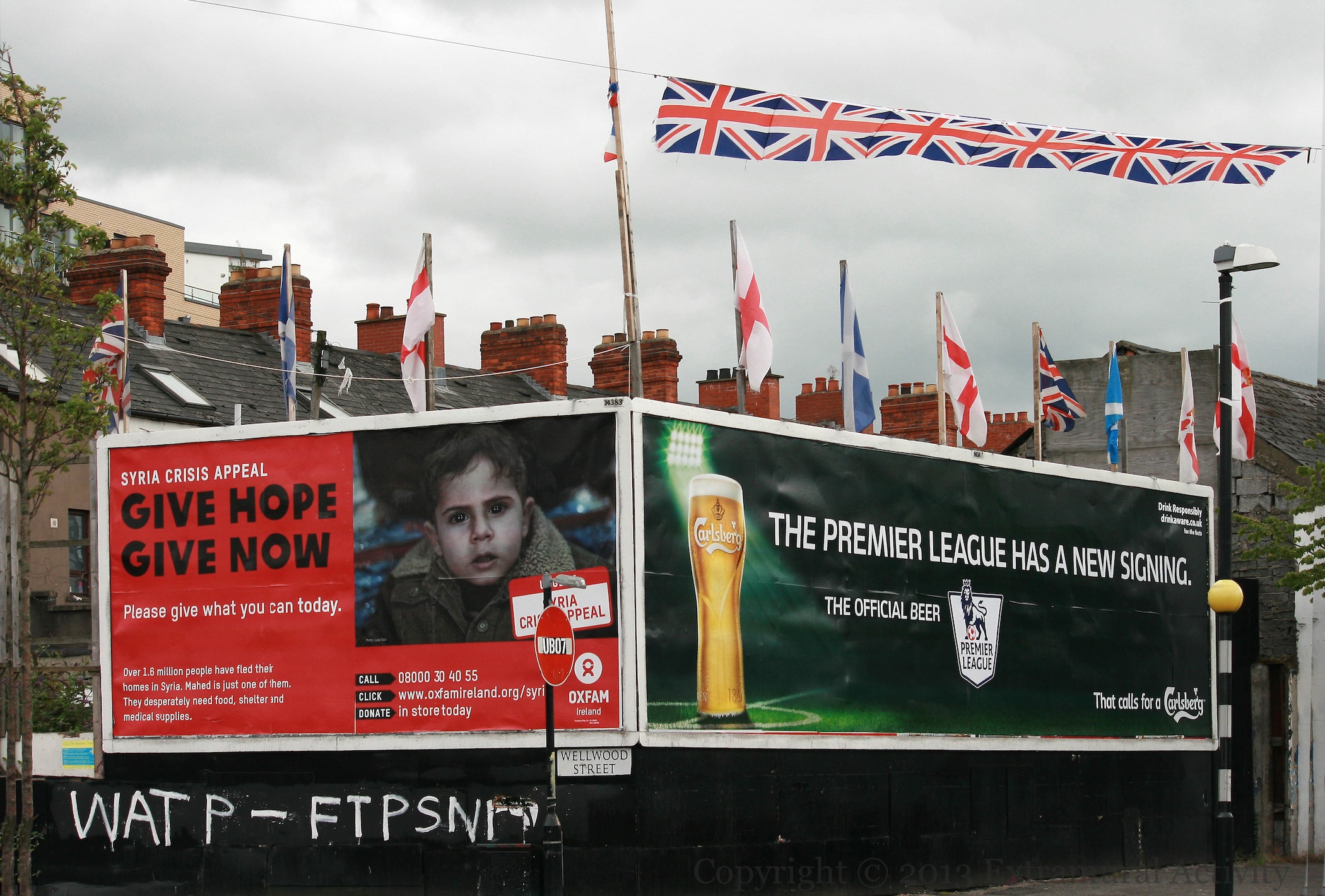
Loyalist graffiti on the corner of Wellwood Street and Sandy Row, beneath a variety of UK flags and union bunting. ‘WATP’ is ‘we are the people’; ‘FTPSNI’ is ‘eff the Police Service [of] Northern Ireland’. On the stop sign you can also see ‘UB07’ – Union Bears, a Rangers supporters club.
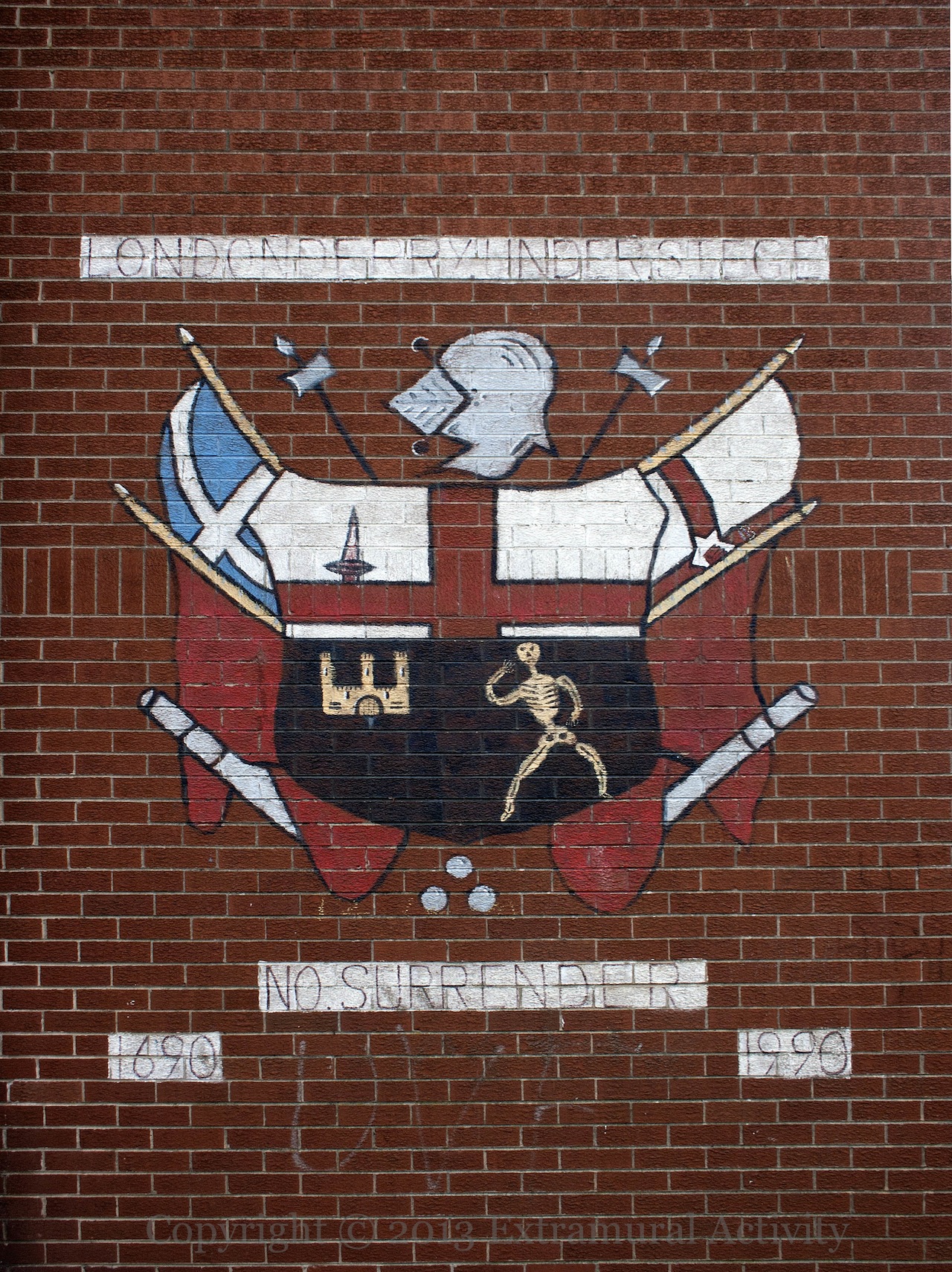
This Sandy Row mural commemorating the siege of London-/Derry is in pretty good shape, despite being more than 20 years old. It features the coat of arms of Londonderry – see this post – Vita, Veritas, Victoria – for some background. For more on the siege, and relief, of Derry, see Breaking The Boom. The siege ended in 1689; the battle of the Boyne was in 1690. It is in Linfield Avenue and is visible from Rowland Way, off Sandy Row.
Graffiti in Linfield Gardens (off Sandy Row) making reference to the banner shown in this post (on a bonfire) and on-going disputes over the routes established by the Parades Commission for Orange Order marches: They may have stole[n] our banner but they will never steal our culture.
The gable wall at the end of Columbia Street (on Ohio Street) has been rebuilt and the old WDA/Duke Elliott mural has been replaced. Above is the right side of the piece, which describes the transition from the Woodvale Defence Association to the Ulster Defence Association to the Ulster Freedom Fighters, and grounds all three in the Ulster Defence union of 1893.
In the second image, below, Ewart’s mill, on the Ardoyne side of the Crumlin Rd, can be seen in the background. From the WP page on the Crumlin Rd … “The mill was built for William Ewart, a cotton trader and politician who switched his interests to the production of linen, which at the time became the leading industry in the city. During the Second World War the mill was converted from the production of linen to the manufacture of munitions.” There is a statue diagonally across the street (at the corner of Cambrai and Crumlin Roads) of a millworker.
In 1971 in order to combat an increasingly aggressive republican movement, the WDA amalgamated with a number of other defence groups in form the UDA. This ensured a more organised and coherent response to the onslaught faced by the citizens of Northern Ireland.
The UFF was established in 1973 to take the war to republicanism. With tenacity, courage and resilience the members of the UFF distinguished themselves in battle by striking at the very heart of republican movement and ensuring that the attacks faced by their community didn’t go unanswered.
2013: The genesis of these groups can be traced right back to the formation of the UDU in 1893. Formed to resist Home Rule in the late 19th and 20th centuries, the UDU adapted the motto Quis Separabit. This motto was used by ulster defenders throughout the period known as “the troubles”.









 Extramural Activity