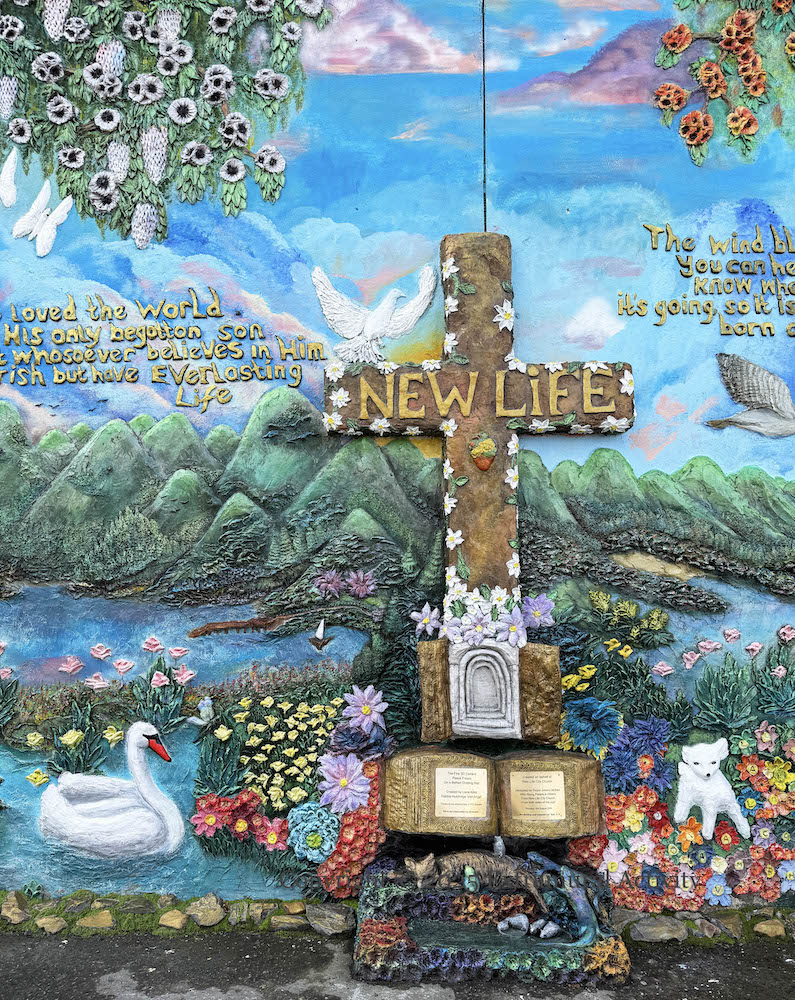
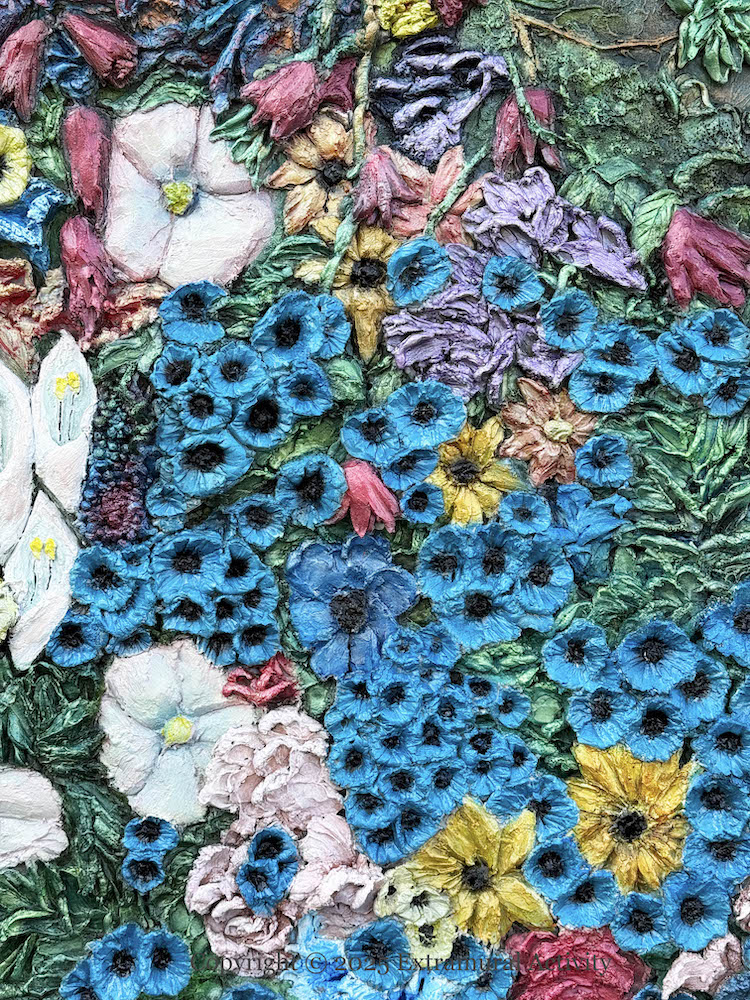
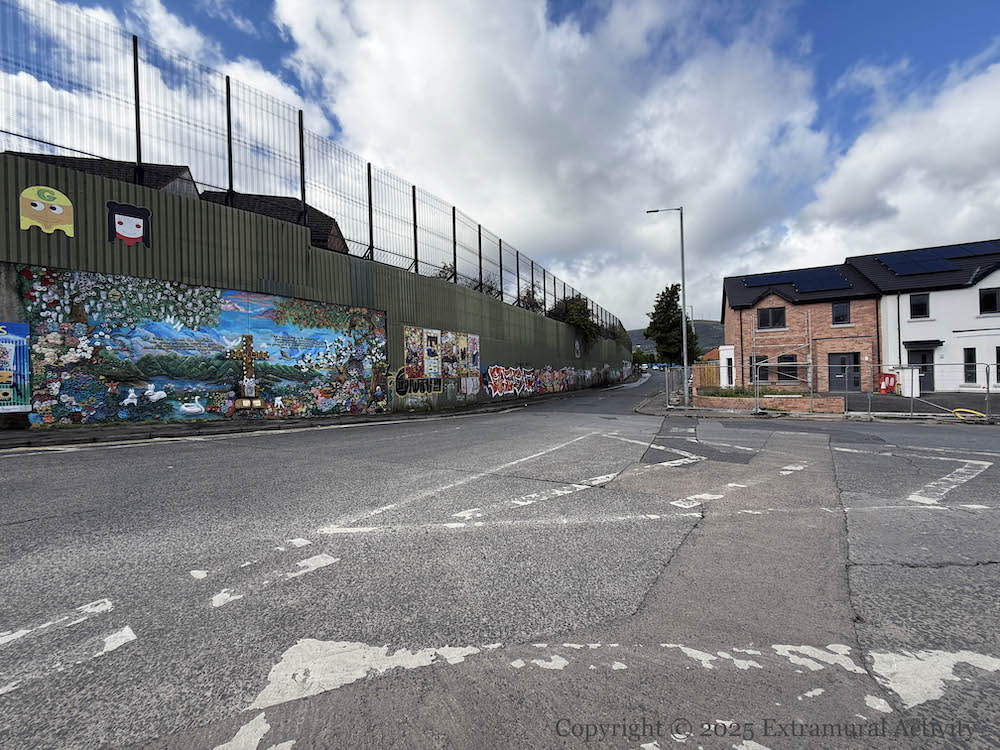
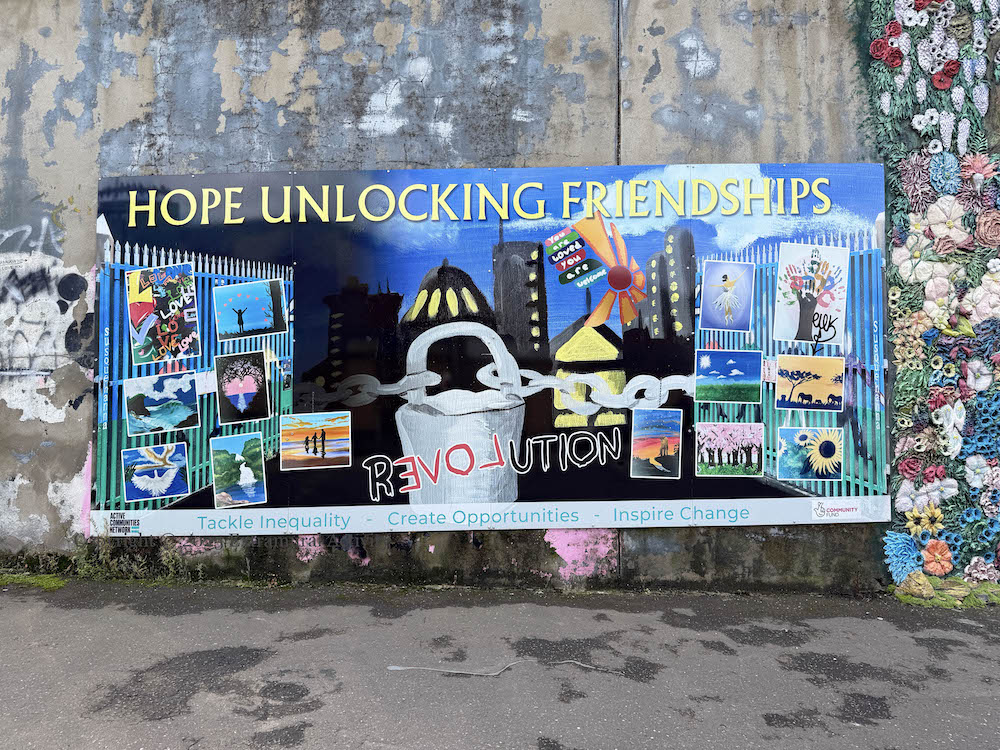
“Tackle inequality – create opportunities – inspire change”. The large board shown here is in Cupar Way, near the security gates in North Howard Street, which are locked nightly between 8:30 and 6:30 a.m. (DoJ). These and the nearby Northumberland Street gates separate the lower Falls and the middle Shankill, including the young people from the Active Communities Network (web), a cross-community youth group that lobbied for increased opening hours to allow members to return home quickly after meetings (BBC).
The UVF mural overlooking the entrance to Mount Vernon has been repainted after Storm Darragh back in December (2024) knocked down part of the wall it was painted on (see Taken By Storm) and the remainder of the wall was subsequently knocked down (see Prepared For Space, Ready For Wall).
There were local voices against the repainting of the mural (Sunday World) but after the wall (which is owned by the Housing Executive) was rebuilt, scaffolding went up at the end of March (BelTel) and painting began in June.
The mural will be officially launched at the Twelfth celebrations. The repainting has been criticised by the father of one UVF victim (BelTel). One (very) small mercy is that neither of the gunmen – from the North Belfast UVF – is directly confronting the viewer (including the drivers coming off the M2 at Fortwilliam.
Images of the completed mural are from June 26th; the in-progress images are as dated below.
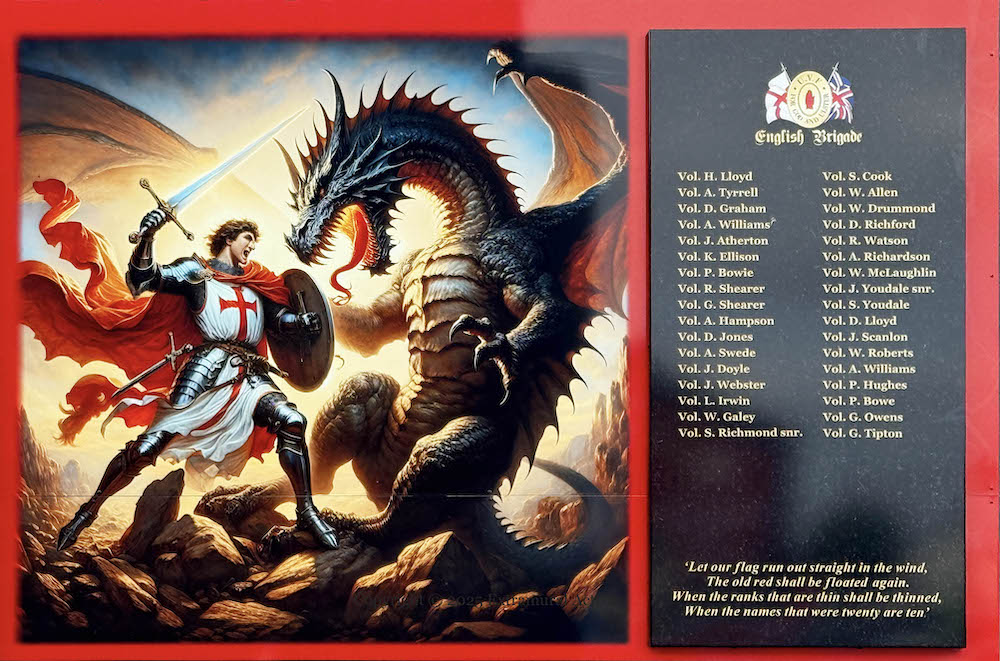
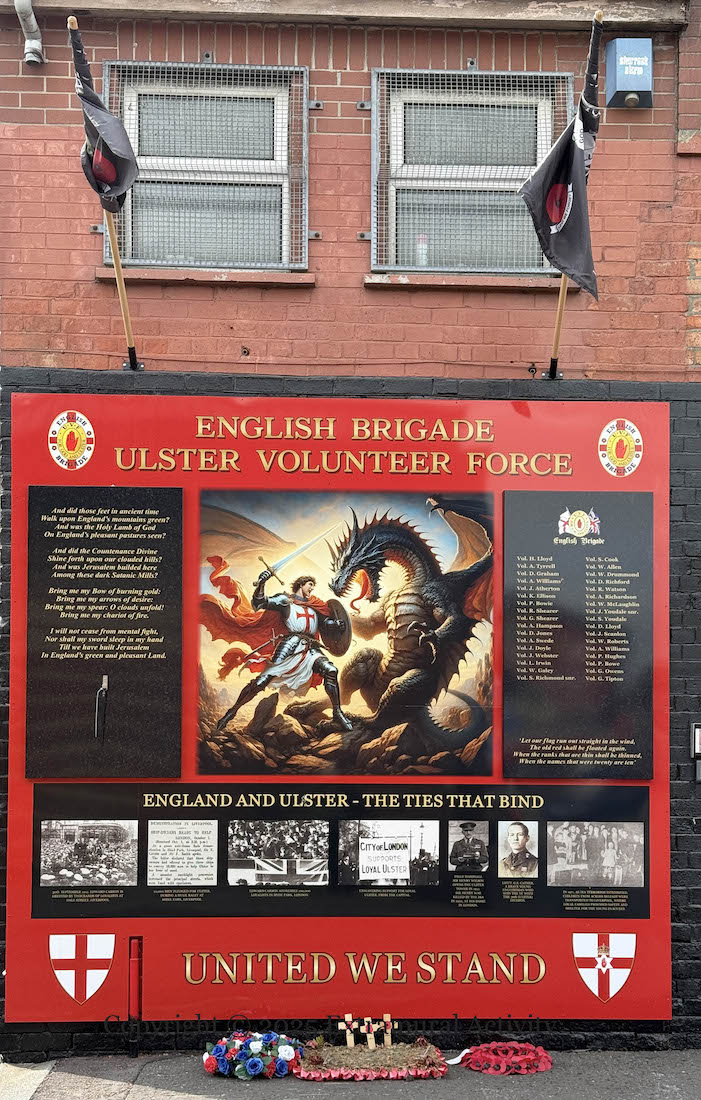
“English Brigade Ulster Volunteer Force.” “England and Ulster – the ties that bind.” “United we stand.”
“Let our flag run out straight in the wind/The old red shall be floated again./When the ranks that are thin shall be thinned/When the names that were twenty are ten.” [from Swinburne’s A Song In Time Of Order which was also used as a socialist song]
On the left are the words from William Blake’s poem, which also serve as the lyrics to the hymn Jerusalem.
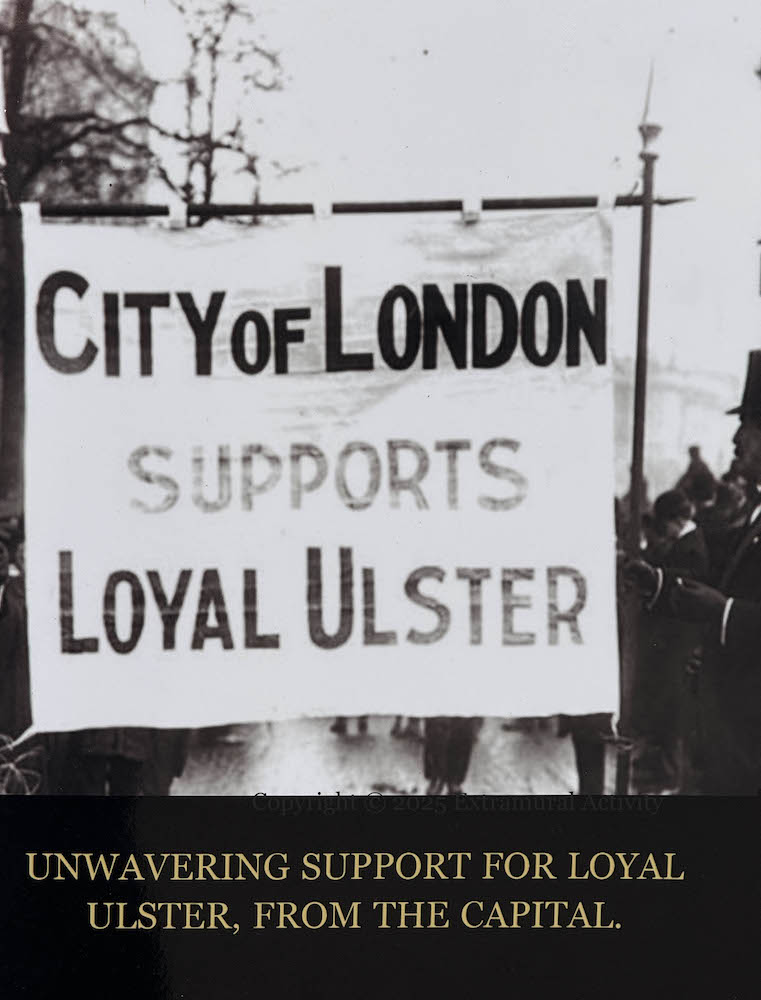
The images along the bottom illustrate the connection between Northern Ireland and England. From left to right: Edward Carson in Liverpool in 1912; 10,00 pledges from Liverpool men; Carson addressing 100,000 people in Hyde Park, London; a banner reading “City of London supports loyal Ulster”; “Field Marshall Sir Henry Wilson opens the Ulster Tower in 1921. Sir Henry was killed by the IRA in 1922 at his home in London”; GS Cather, VC winner with the Ulster Division; evacuees to Liverpool in 1973.
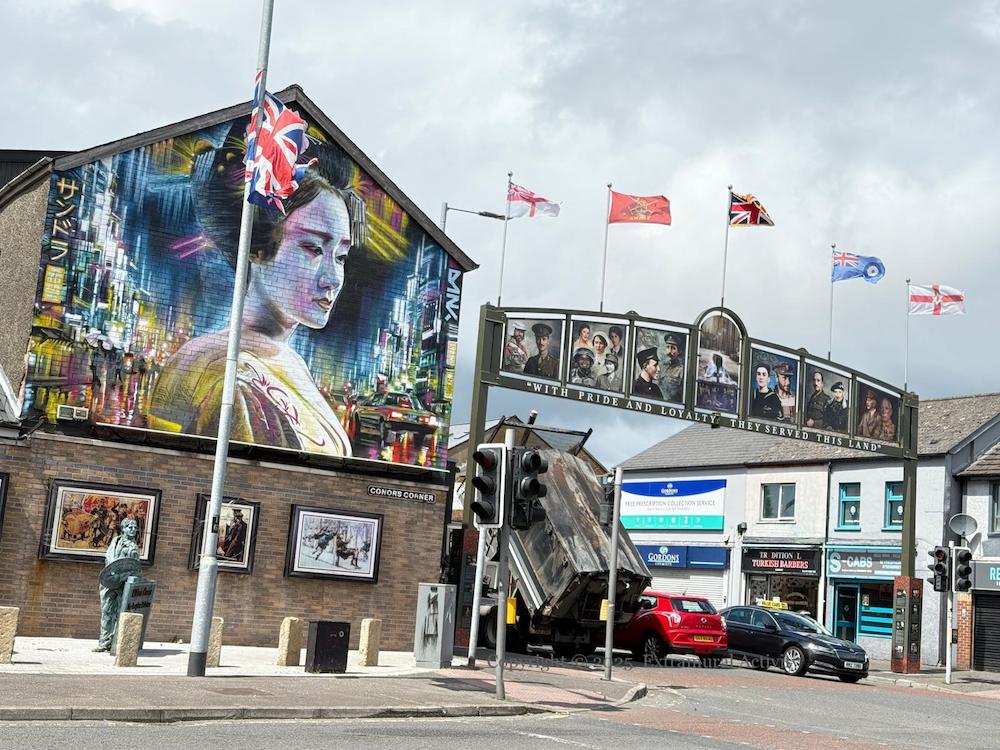
“The ‘Ulster Military Memorial Arch’ was funded by the generosity of the local business community, local residents, and our friends from Scotland. The arch was designed entirely by the people of the Greater Shankill, and erected to coincide with the 80th anniversary of VE Day 8th May 1945 – 8th May 2025. Our servicemen and women are proudly remembered.” For images of the VE Day launch, see the BelTel.
Pictured on Peter’s Hill side of the arch (bearing the quote “With pride and loyalty they served this land”) are (left to right) … Private Bernard McQuirt (a VC winner in 1858 during the Indian Rebellion) and Lt Colonel John Henry Patterson Monica De Wichfeld (raised in Fermanagh and Danish resistance member), Jessie Roberts (a nurse for the Ulster Volunteers and (in WWI) for the Volunteer Aid Detachment, serving in Birmingham and in Wimereux, France; she gets a very long entry on the info panels around the legs of the arch, as her biography is not available on-line), a (unidentified) nurse, Corporal Channing Day (a medic killed in Afghanistan, 2012), Princess Elizabeth Private William Frederick McFadzean and Sergeant Robert Quigg the tomb of “the unknown warrior” (central panel) Leading Seaman James Joseph Magennis and Lt Colonel Robert Blair ‘Paddy’ Mayne Field Marshal Alan Francis Brooke and Field Marshal Bernard Law Montgomery Field Marshal Sir Henry Hughes Wilson and Sir James Craig
On the other/Shankill side of the arch, bearing the quote “Throughout the long years of struggle … the men and women of Ulster have proved how nobly they fight and die”, the ‘WWII’ panel includes (top right) Warrant Officer David O’Neill, a Canadian Air Force pilot hailing from Ballymena, lost in 1943, and the ‘Northern Ireland’ panel features (left) Corporal Heather CJ Kerrigan, a UDR Greenfinch killed by the IRA in 1984. These two are also profiled in the info panels around the legs of the arch, along with Corporal Bryan James Budd, a 3rd Para soldier killed by friendly fire in Afghanistan, 2006.
Also included is JF Willcocks’s poem Poppies (sometimes called The Inquisitive Mind Of A Child): Why are they selling poppies, Mummy? Selling poppies in town today./The poppies, child, are flowers of love. For the men who marched away./But why have they chosen a poppy, Mummy? Why not a beautiful rose?/Because my child, men fought and died in the fields where the poppies grow./But why are the poppies so red, Mummy? Why are the poppies so red?/Red is the colour of blood, my child. The blood that our soldiers shed./The heart of the poppy is black, Mummy. Why does it have to be black?/Black, my child, is the symbol of grief. For the men who never came back./But why, Mummy are you crying so? Your tears are giving you pain./My tears are my fears for you my child. For the world is forgetting again.”
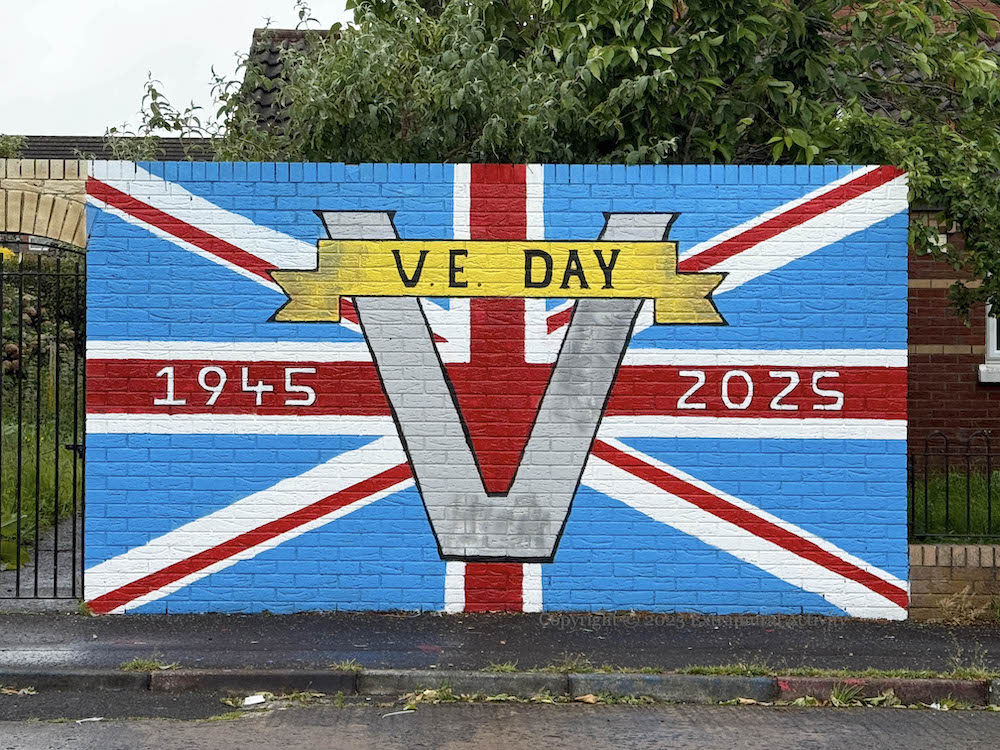
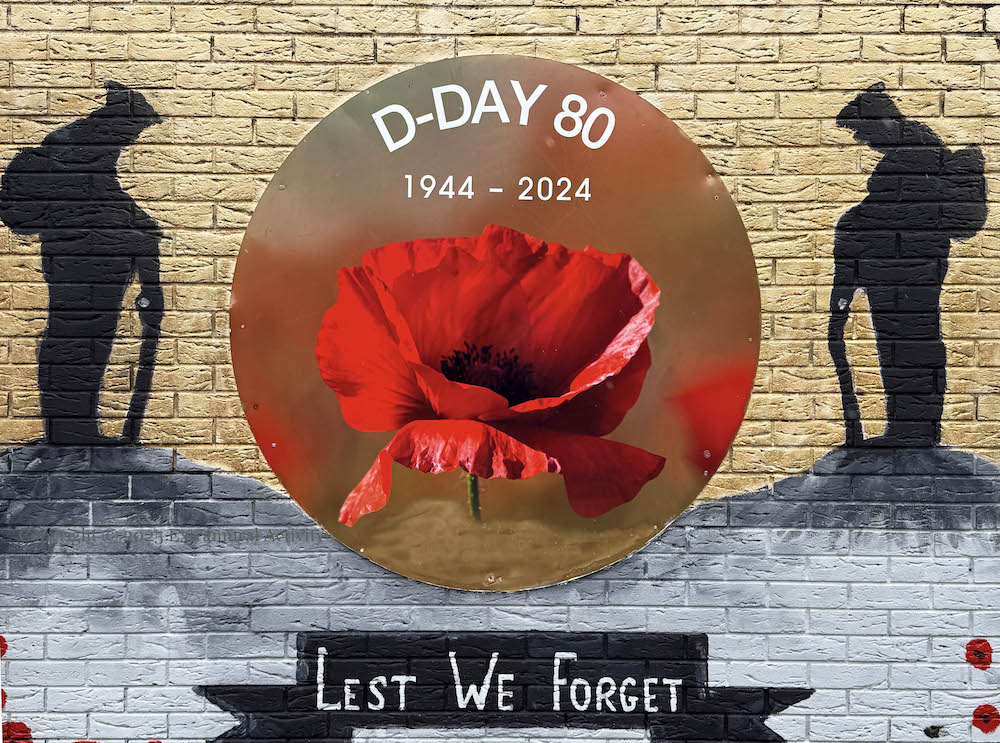
39 Allied divisions – 12 of them British – participated in the Normandy Landings – officially “Operation Neptune” – that took place on June 6th, 1944; in planning for the operation, the original “D-Day” was June 5th, but bad weather postponed it until the following day, when 160,000 troops stormed the beaches of the Bay Of The Seine. By the end of August, Paris had been liberated, and by the following May, victory in Europe had been achieved. 2024 was the eightieth anniversary of D-Day and 2025 the eightieth anniversary of VE Day, on May 8th.
This D-Day board and VE Day mural are in Edlingham Street, Tiger’s Bay, north Belfast. Also included below is a WWI memorial electrical box opposite, though as can be seen from the board (immediately below) the ‘graveside mourner’ silhouette is becoming a generic symbol of lost UK forces.
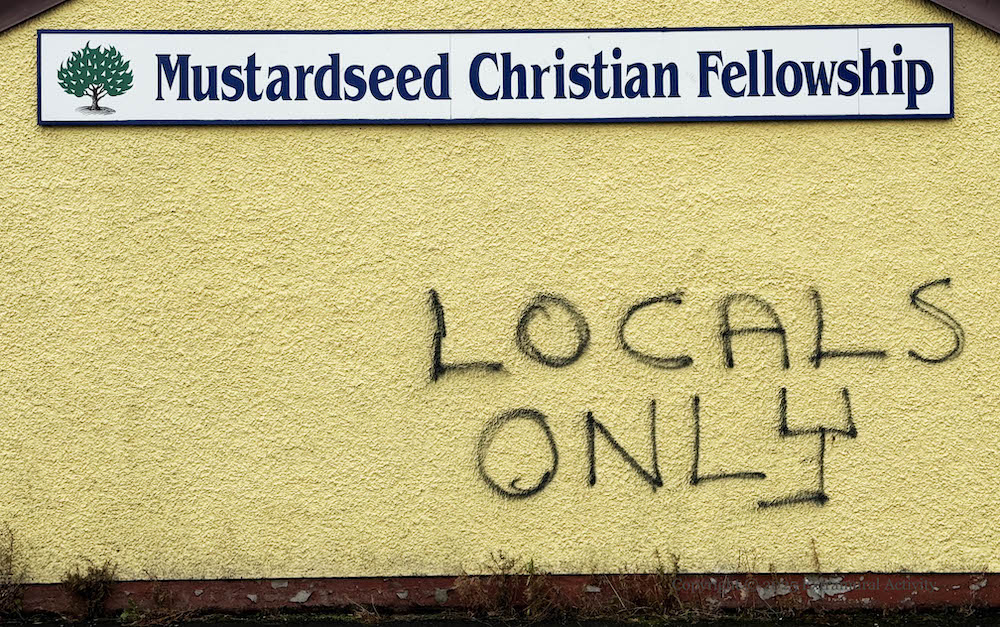
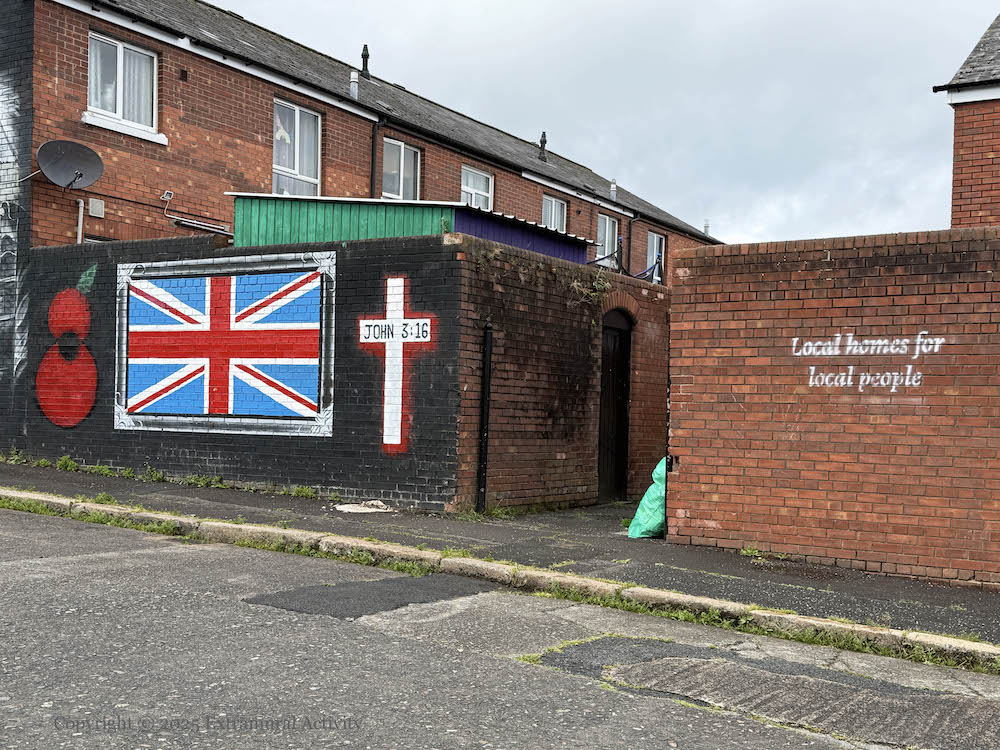
God so loved the world that he gave his only begotten son (John 3:16). And, greater love hath no man but to lay down his life for his friends (John 15:13, often used in the context of military sacrifice). But local homes are for local people. (The use of a stencil is a step up in sophistication.)
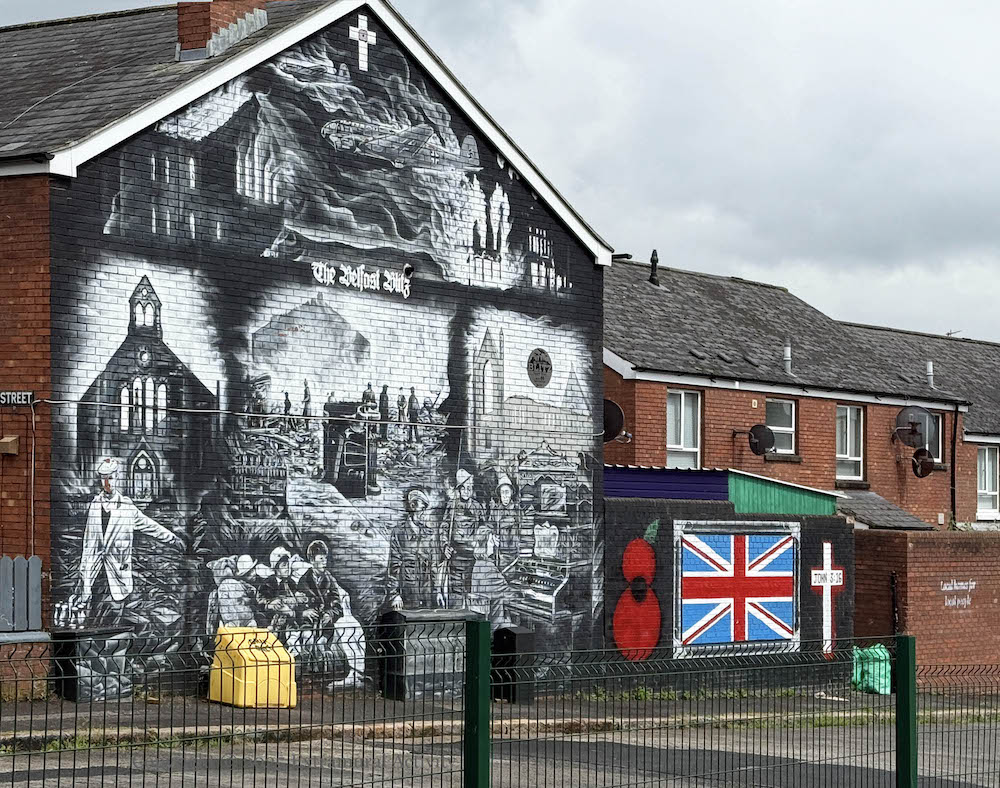
The Union Flag fills the empty frame where there used to be a list of locals who died in The Belfast Blitz.
Children play among and with the landmarks of the world – riding the Sydney opera house, building the pyramids out of sand, climbing the Eiffel Tower, building the Taj Mahal from blocks, blowing on a windmill, and swinging from Samson and Goliath.
This is an old (2016) piece by Friz (web), still in excellent shape on the wall of Currie Primary school, off the Limestone Road in north Belfast.
World War II ended in Europe at 11 p.m. on May 8th, after Germany’s unconditional surrender to the Allied forces. The date was dubbed “Victory In Europe Day” or “VE Day” and this year (2025) marks its eightieth anniversary. For the occasion, this Shankill Road shop-window has been decorated with sandbags and camouflage netting, along with a vintage photograph of the residents of nearby “Wiltton” [Wilton] Street from the summer of 1945.
The text on the poster (lower down the road) reads: “‘My dear friends, this is your hour. This is not the victory or of any class, it’s a victory of the Great British people as a whole. We were the first, in these ancient isles, to draw the sword against tyranny.’ – Prime Minister Winston S Churchill”. The lines come from brief remarks Churchill made to the crowds assembled at the Ministry Of Health in London – the text can be found at Forces News; Pathé newsreel of Churchill’s earlier radio announcement of the end of the war can be found on youtube.