“Behold, the dwelling place of God is with man, and He will dwell with them. They will be His people, and God Himself will be with them as their God. He will wipe away every tear from their eyes, and there will be no more death or mourning or crying or pain, for the former things have passed away. He will wipe every tear from their eyes.” (Revelations 21:4)
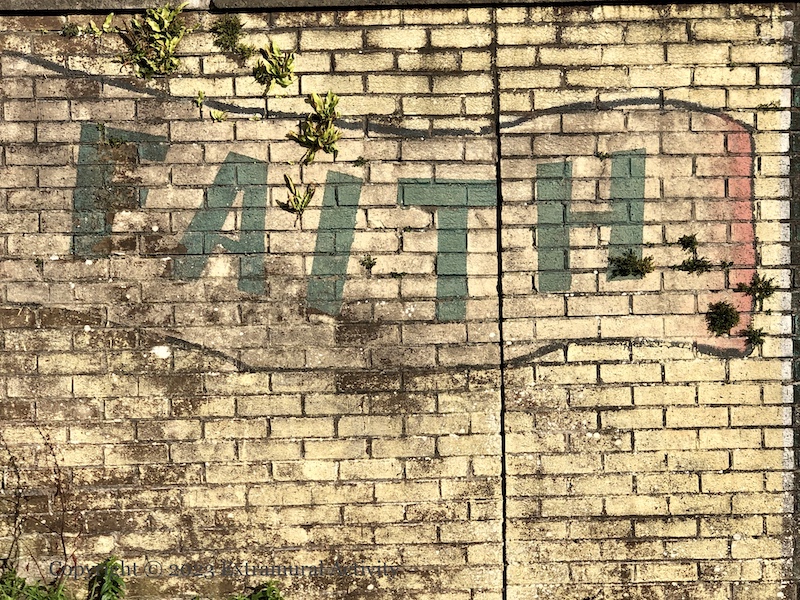
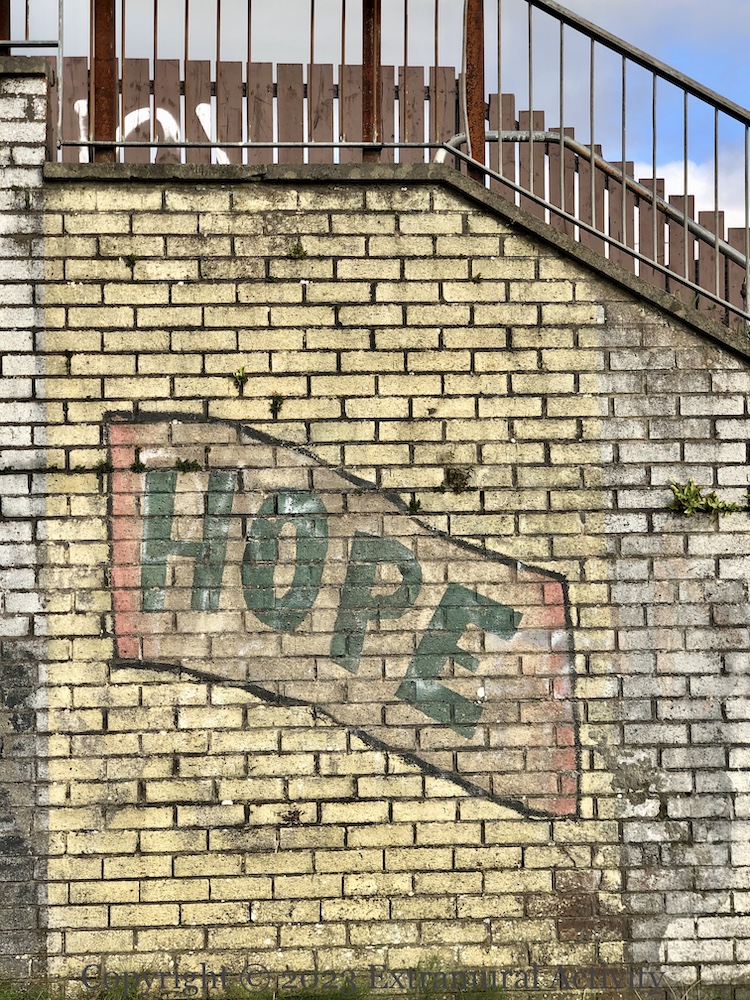
In addition to the image of a tear being wiped away there is a burning heart with the words “In the name of love” and panels reading “faith”, “hope”, and “forgiveness”. And also “Team Syracuse, NY, USA 2004”.
Across the street from St Andrew’s church in Forthriver (on the right of the widest image).
A fine of 500 pounds and eternal damnation. Belfast City Council first made various Belfast street “alcohol-free” areas in 2007. A full list of streets can be found in this 2012 pdf. The placard shown in the image above is on the Falls Road, outside the Royal. The grounds of the hospital are also included in the list of areas. About 50 people a year receive a summons (2016 minutes). How many of us, annually, are refused entry at the pearly gates is unknown.
Dundela “ultras” have been told they are not welcome at the team’s future games after “unsavoury chanting” at the NI Championship match against local rivals H&W Welders – “the most cataclysmic derby match in world football” (BelTel).
Thirteen more soccer-related stickers are below, including [Glasgow] Rangers Action Force.
“Saoırse don Phalaıstín [freedom for Palestine]/فلسطين حرة [free Palestine]” and “Ireland stands with Palestine/ايرلندا تقف مع فلسطين” – CYM [Connolly Youth Movement (web)] sticker with a mash-up of the Palestinian and Irish flags and a key that represents the keys that about 700,000 Palestinian householders took with them when they fled their homes in the Nakba of 1948.
TUV (Traditional Unionist Voice) has put up placards attacking the DUP (Democratic Unionist Party) – including outside the office of DUP leader Jeffrey Donaldson – in response to the possibility that the DUP might re-enter Stormont – which has been defunct now for two years – and implement the NI Protocol (BBC | BelTel).
It hasn’t happened yet, but a combination of public dissatisfaction concerning inaction over strikes by transport workers on December 22 and a general strike planned for January 18 (ITv)) and a financial package for pay awards are keeping the pressure on (Shropshire Star).
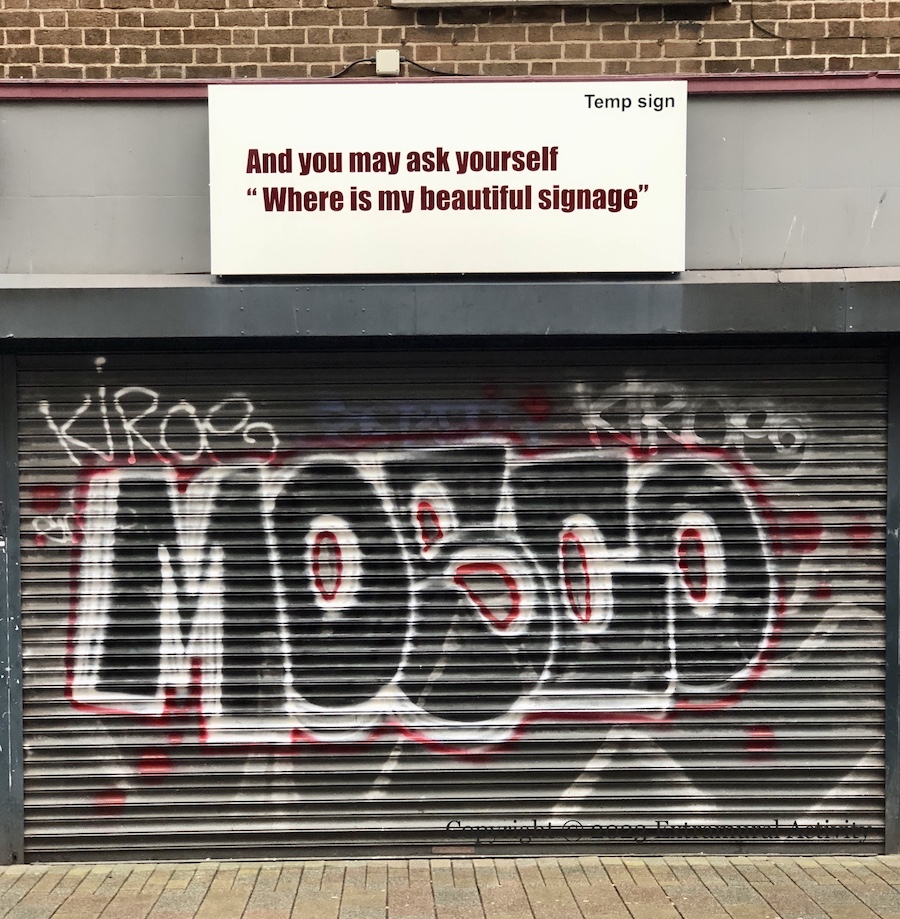
The Clements coffee shops in Belfast city centre closed in October, leaving only the two at Queen’s and UUJ (BelTel).
The abandonment of the Rosemary Street shop provides a space for art (see Visual History 11 on the rise of street art); replacing the Clements signage there is a “temp sign”: “And you may ask yourself, “Where is my beautiful signage[?]””.
Is this a plea for the return of Clements – a local chain – or investment in the city centre and a new business? Or perhaps it is meant ironically, as a protest against capitalism – the line is a modification of a lyric from the Talking Heads song ‘Once In A Lifetime’ (Stop Making Sense | Remain In Light), which describes a moment of awakening for the middle-aged and middle-classed: “How did I get here?”
On the permanently-closed shutters is a different kind of beautiful signage, a MOSCO throw-up.
“Together building a united community” (“T:BUC” for short) is an Executive-Office strategy (pdf) aiming (among other things) at “good relations” for children and young people. The web page details various programmes that fall under this initiative, including youth camps that bring together children from different religious communities.
The piece shown combines wild-style writing with graphics of landmarks (The Big Fish, Albert clock) and “hello” in various languages, including Irish.
With support from South Belfast Alternatives (web) and Flour Power sandwich shop (web) – “home of the Belfast Melt” – both in Donegall Pass.
The name “Ulster-Scots” refers to the emigrants to North America from Ulster that had previously come from Scotland and the English borders, and most of the Ulster-Scots murals in the 2000s focused on emigration to America and on US Presidents with Scotch-Irish heritage (see the Visual History page of Ulster-Scots murals).
In 2017, a series of boards along York Street focused on industrialists in Northern Ireland with Scottish backgrounds: 13 panels in five posts: one | two | three | four | five. And this new collection of “Ulster-Scots” luminaries (which is 100 paces away) likewise presents figures who are associated with Northern Ireland rather than America. Modern folk such as those portrayed in these new boards presumably have Scottish heritage rather than Scotch-Irish. (The title of this entry – The Scots In Ulster – comes from a Discover Ulster Scots poster about the Scots who came to Ulster in the 1600s, regardless of whether or not they or their descendants later moved to America.)
From left to right, the people shown are as follows. (Links are to previous entries in the Extramural collection.)
Mountcollyer: motorcyclist Rex McCandless, author CS Lewis, physicist John Stewart Bell, song-writer Jimmy Kennedy, medical inventor Frank Pantridge






 Extramural Activity