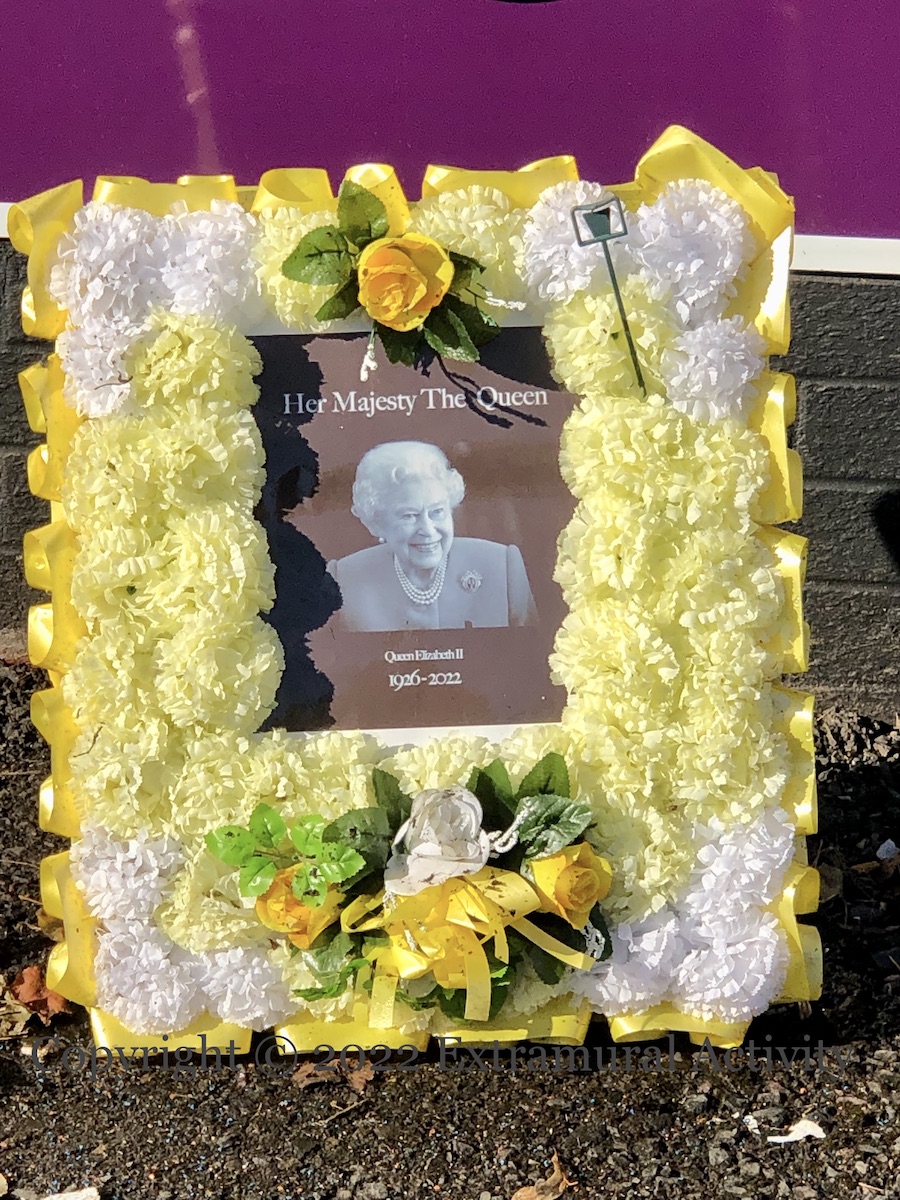
The “now” in “now is the time to kneel” would seem to suggest that there is some inappropriate kneeling going on at some other time, besides as a mark of respect to the patriotic dead (in this case, Queen Elizabeth II, who died on September 8th) – perhaps the kneeling prior to Premier League soccer matches as a protest against racism (World Soccer Talk).
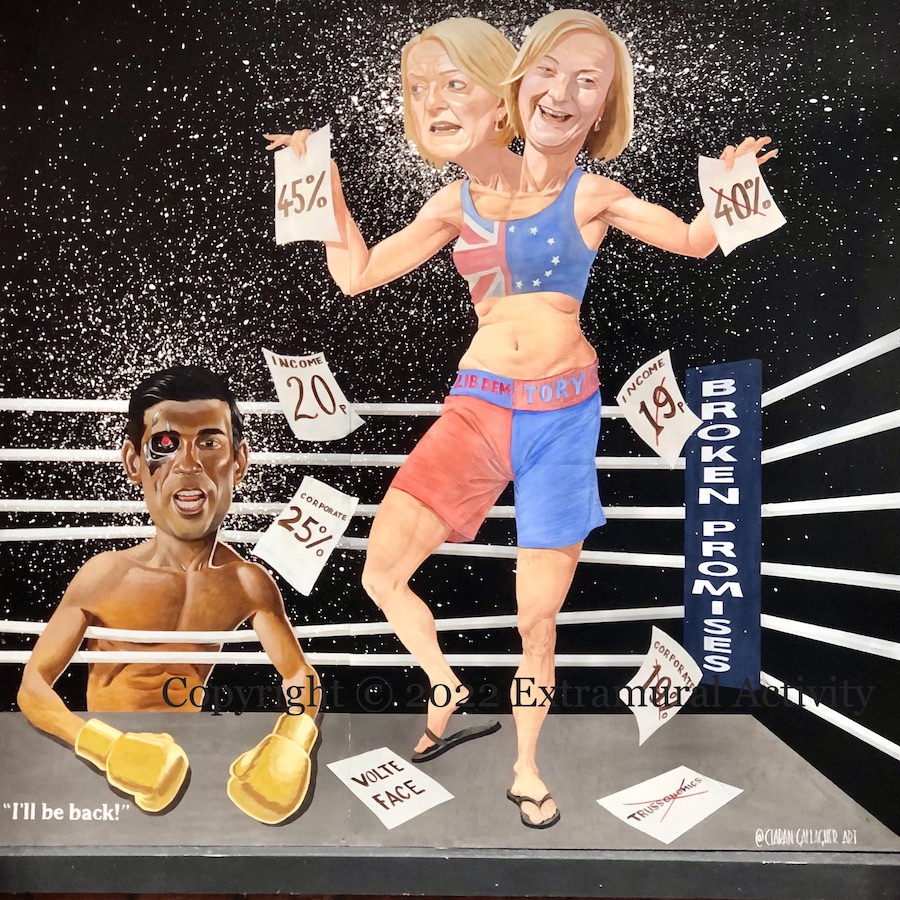
The newspaper front pages reporting the “90-minute shouting match” between the resigning UK Home Secretary Suella Braverman and Prime Minister Liz Truss (third image, below) were barely dry when Truss herself resigned yesterday. The main cause was the September 23rd “mini-budget” that promised to scrap the 45% personal tax rate entirely, lower the 20% to 19%, and keep the corporate rate at 19% instead of having it increase to 25% in April 2023 – these numbers are seen on the pages falling from Truss’s hands, above – without explaining how the reductions would be funded. Over the next three weeks these positions were reversed – “volte face”, Truss’s flip-flops, and the two-headed Truss; all part of a pattern, artist Ciaran Gallagher (web) suggests with Truss’s clothing: she was originally in the Lib Dems before joining the Conservatives in 1996 and supported ‘remain’ in the Brexit vote (WP).
Chancellor Kwasi Kwarteng went on the 14th. Braverman resigned over a breach of the Ministerial Code – sharing an official document on migration from her personal e-mail account – but got in a few digs at the Truss government as she left. (WP)
The Tories hope to put a new leader and PM in place within a week. Rishi Sunak, Terminator-style, says “I’ll be back!” and is – as of today, at least – the bookies’ favourite (BBC).
For Larry the cat – who was previously pictured sitting on the steps outside Number 10 but has gone from the mural – next week’s prime minister will be his fifth.
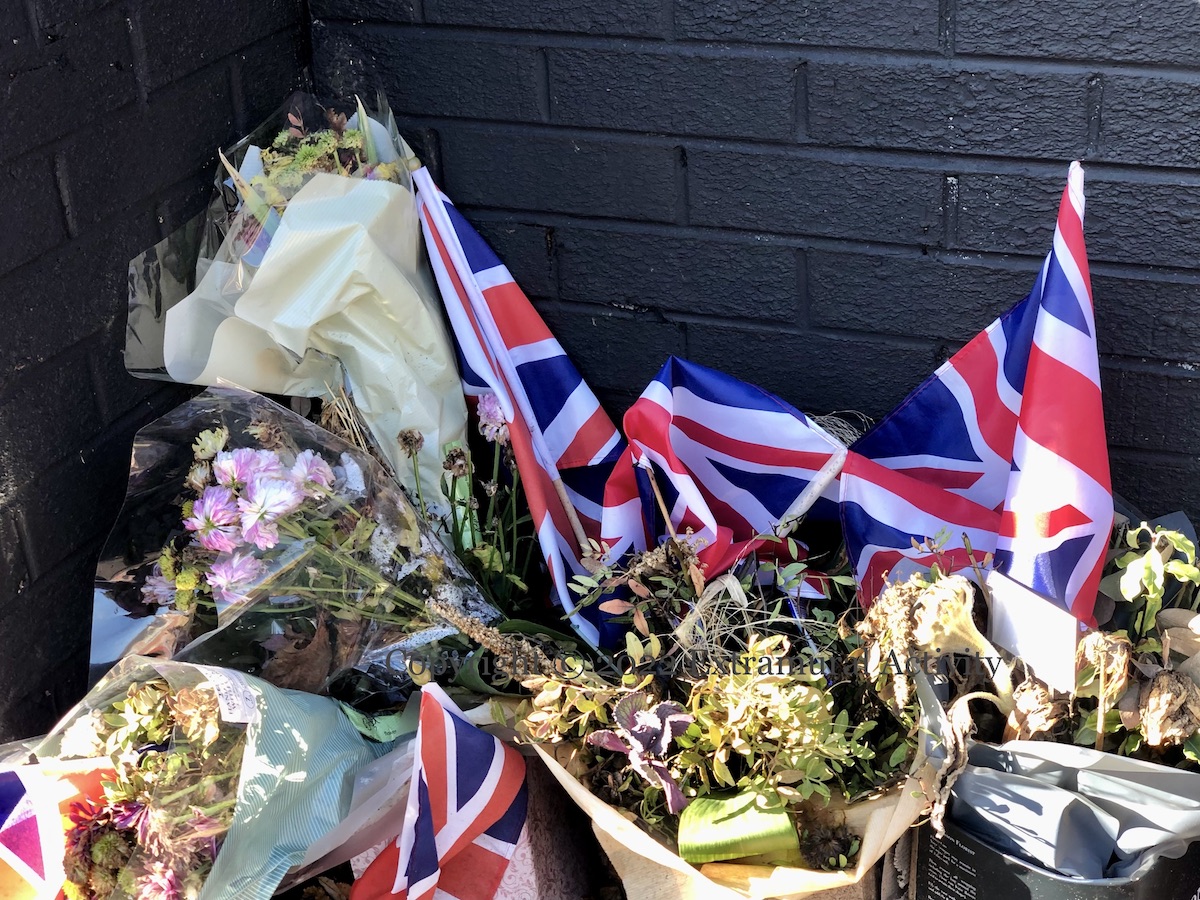
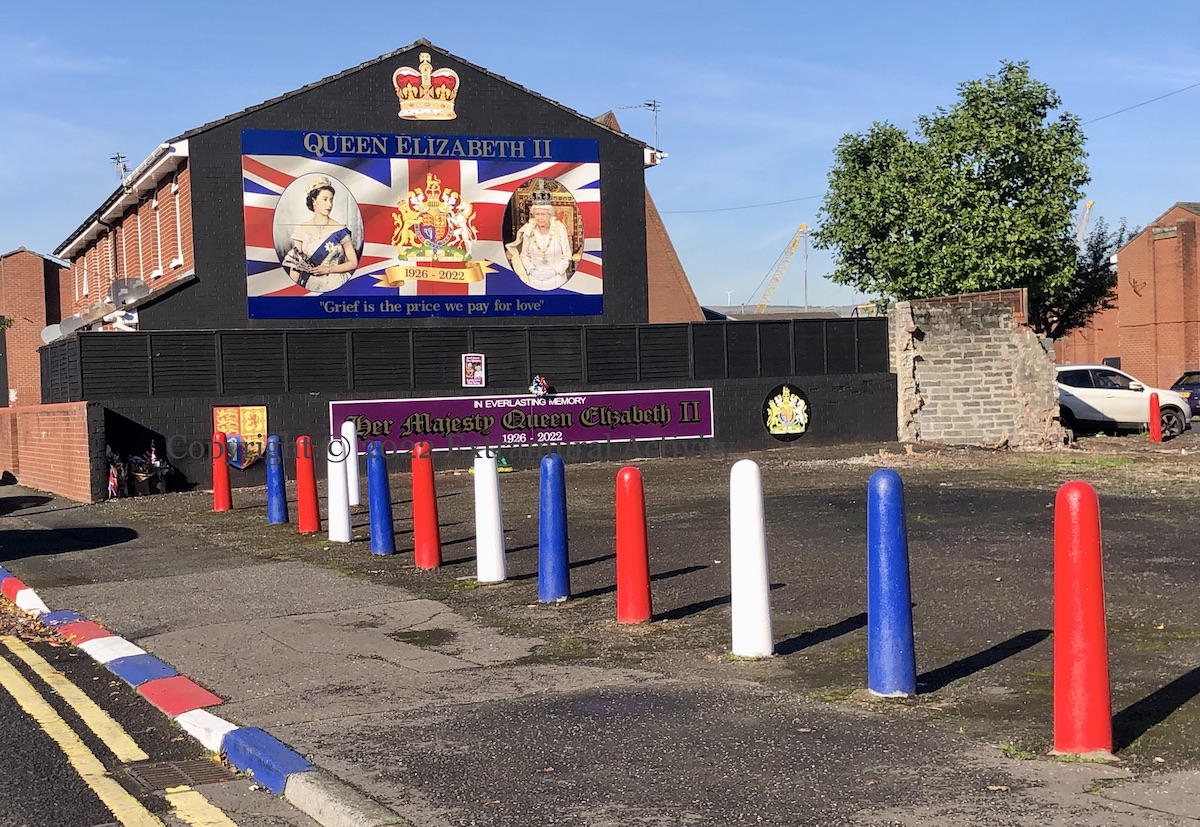
Elizabeth II, queen of the United Kingdom, passed away on September 8th, at the age of 96, in the same year of her platinum jubilee, the 70th anniversary of her accession. The phrase “grief is the price we pay for love” comes from a message from Elizabeth in consolation with the relatives of those killed in the “9-11” attacks in 2001 (text at The Guardian).
“In everlasting memory – her majesty Queen Elizabeth II – 1926-2022.” “Long live the King”
The re-painted mural to plastic-bullet victim Julie Livingstone was rededicated this past Saturday (October 15th). For the previous mural, see 2010. “The Stolen Child – Come away, O human child/To the waters and the wild/With a faery hand in hand/For the world’s more full of weeping/Than you can understand… – WB Yeats.”
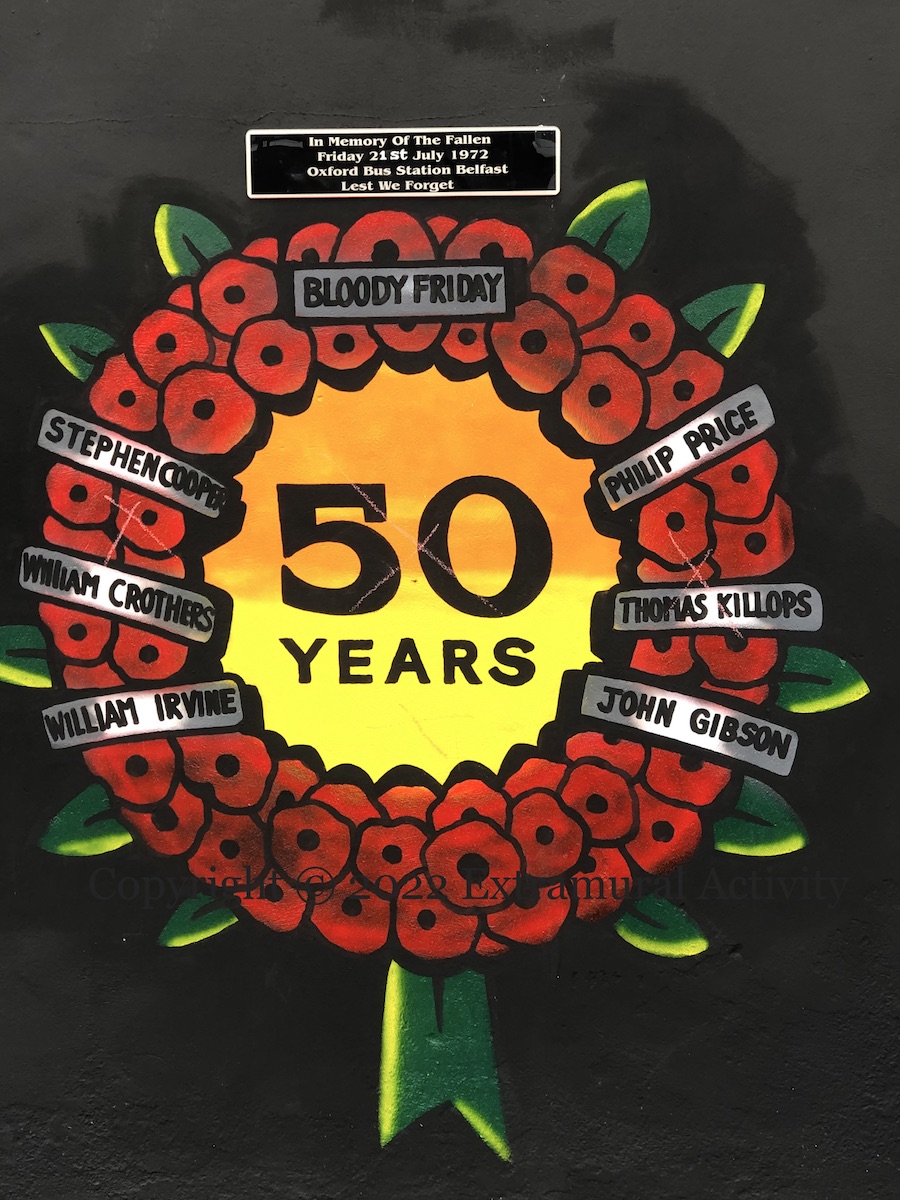
On July 21st, 1972 – Bloody Friday – 19 IRA bombs exploded in the course of an hour, killing 9, six of them at the Oxford Street bus station, including 15-year-old William Crothers from Parker Street in east Belfast who worked for Ulsterbus as a parcel-boy. The others were three more employess – William Irvine, Thomas Killops, and John Gibson – and two British Army soldiers – Stephen Cooper (32 Squadron) and Philip Price (Welsh Guards). (BBC | WP | Paper Trail | BBC documentary)
“In memory of the fallen Friday 21st July 1972 Oxford [Street] Bus Station Belfast. Lest we forget”
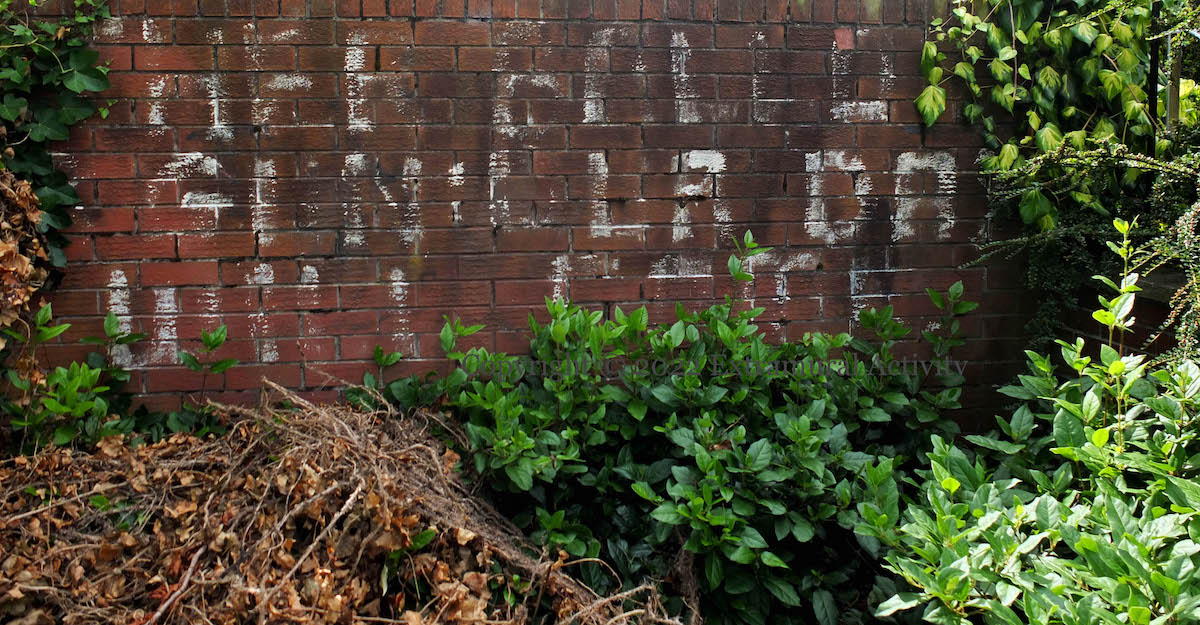
“Either ballot or gun, our day will come – PIRA.” This graffiti dates back to at least 1998 (see C01268) and probably to the breakdown of the ceasefire in 1996; the same slogan was present in Wall St (Carrick Hill) in 1996. It is still visible on the Falls Road in 2022.
“I gcuımhne na nÓglach a fuaır bás ar son saoırse [in memory of the volunteers who died for freedom].” The “22” are the familiar 12 deceased Troubles-era hunger-strikers, plus 10 from 1917 to 1946: Thomas Ashe, Terence McSwiney, Michael Fitzgerald, Joseph Murphy, Joe Witty, Dennis Barry, Andy O’Sullivan, Tony Darcy, Jack McNeela, Sean McCaughey.
“‘A Letter To The 22: You have not gone away. You are in the hearts/and on the lips of your people./The old speak of you with knowing tongue. The middle/aged, as those who walked beside you./The young men and women with a passion not unlike your own./Your names can be heard on the wind taken from the mouths/of men who tend their flocks on Slieve Gullion, Cnoc Phádraıg, Glenshane./They echo in small graveyards in/Cork, Kerry, Galway, Mayo, Tyrone, Antrim, Derry and Armagh./They are heard among your people at the mass gate on/Sunday, in the crowd at the hurling game, around the hearth when/the bottle is cracked and song in sung. Your image can be seen/on the faces of happy smiling children for whose freedom you gave your all./You are in our prayers, you have not gone away, you never will’ – Colum Mac Gıolla Bhéın“
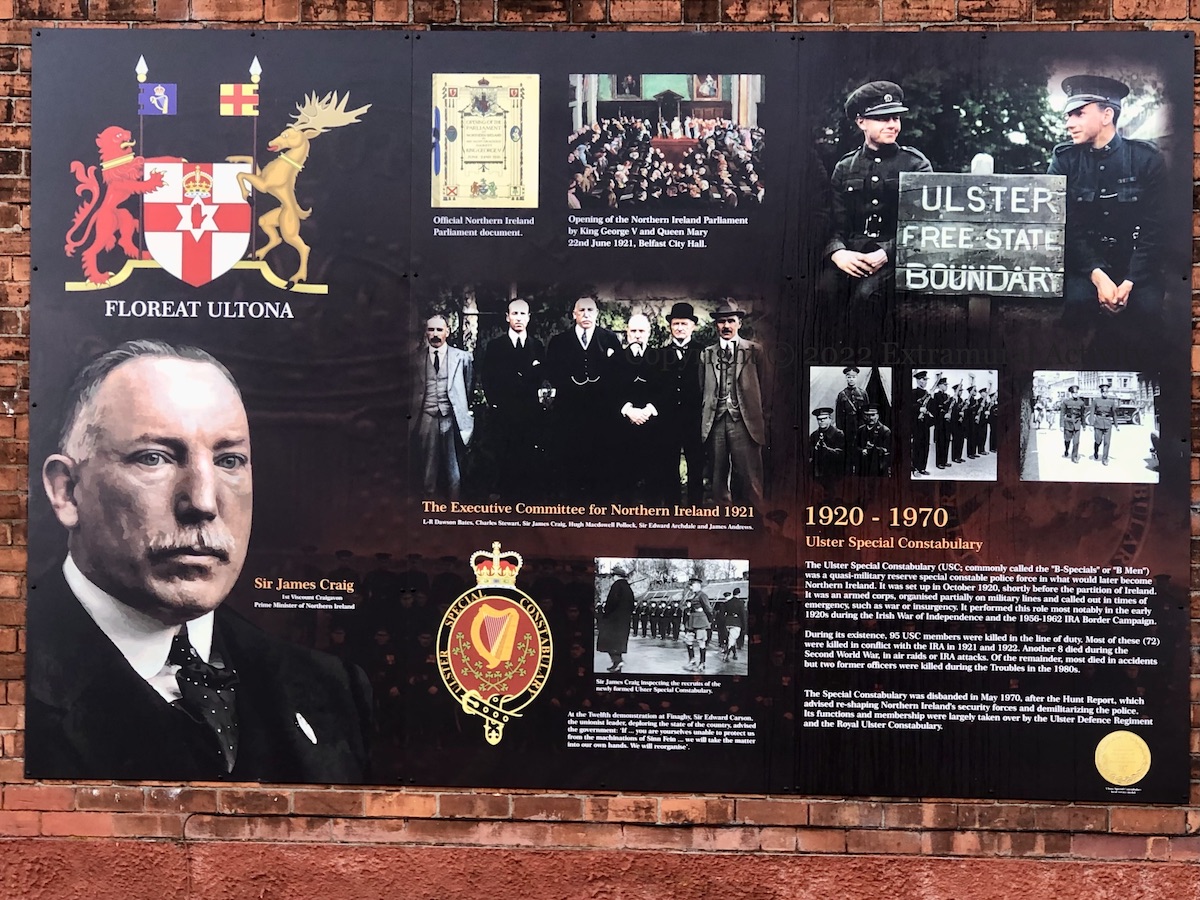
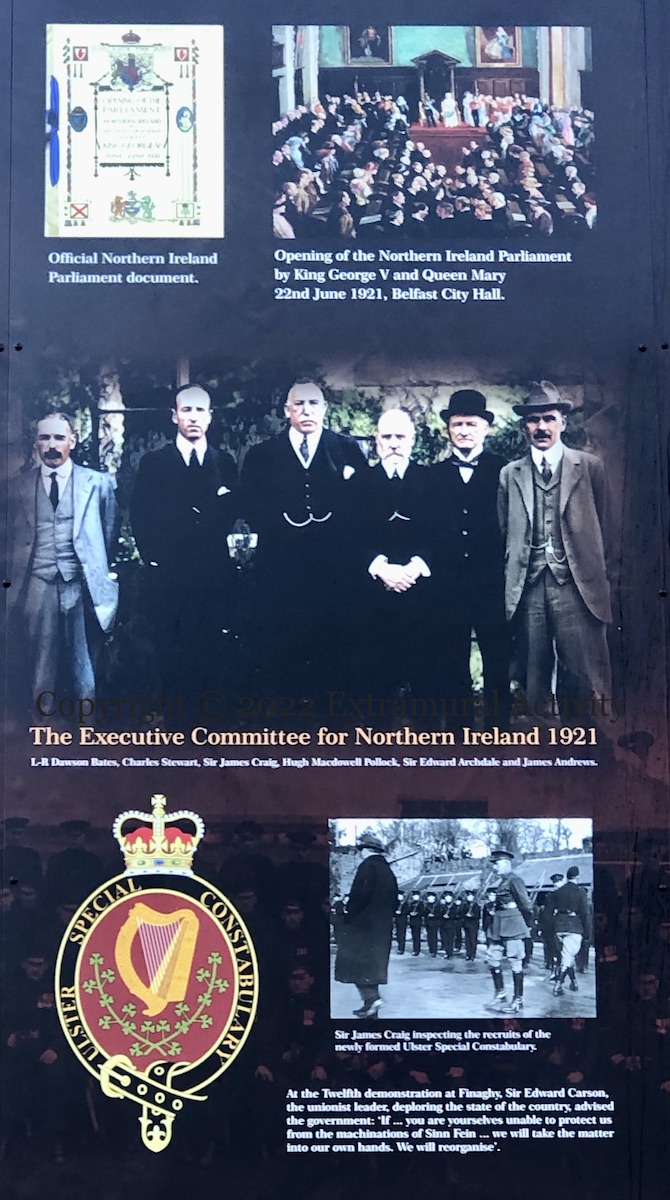
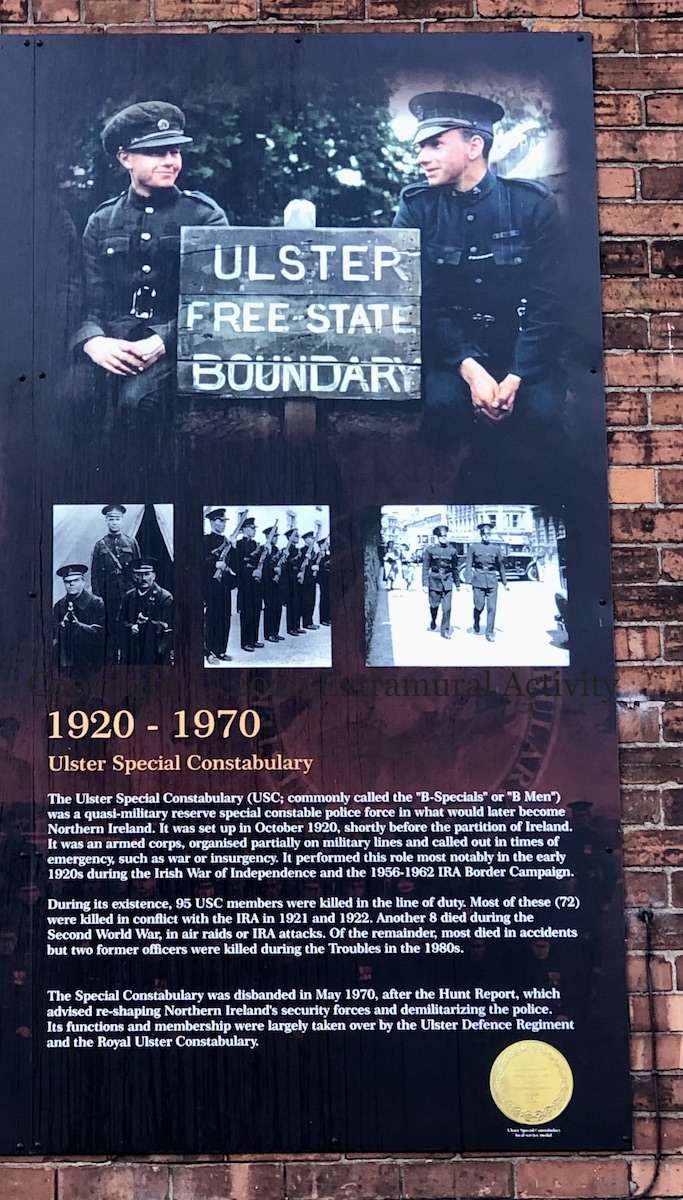
“May Ulster flourish” as the newly created Northern Ireland under “Sir James Craig, 1st Viscount Craigavon, Prime Minister of Northern Ireland”. The Northern Ireland parliament was opened in 1921 and the coat of arms adopted in 1924 (WP); the Special Constabulary (including the B-Specials) had been formed prior to and in preparation for partition – the quote from Carson (also seen in an east Belfast mural) is from July 12th, 1920.
The text on the board is the same as at WP: “The Ulster Special Constabulary (USC; commonly called the “B-Specials” or “B Men”) was a quasi-military reserve special constable police force in what would later become Northern Ireland. It was set up in October 1920, shortly before the partition of Ireland. It was an armed corps, organised partially on military lines and called out in times of emergency, such as war or insurgency. It performed this role most notably in the early 1920s during the Irish War of Independence and the 1956-1962 IRA Border Campaign. During its existence, 95 USC members were killed in the line of duty. Most of these (72) were killed in conflict with the IRA in 1921 and 1922. Another 8 died during the Second World War, in air raids or IRA attacks. Of the remainder, most died in accidents but two former officers were killed during the Troubles in the 1980s. The Special Constabulary was disbanded in May 1970, after the Hunt Report, which advised re-shaping Northern Ireland’s security forces and demilitarizing the police. Its functions and membership were largely taken over by the Ulster Defence Regiment and the Royal Ulster Constabulary.”
This Belfast Live article (which has images from the launch) leads with the headline that this new board replaces a UVF mural, but there hasn’t been anything on this wall since a large “UDA” lettering in 1999. The adjacent wall, which has now been painted over, previously (in 2010) had a UVF flag which had been vandalised with “Jesus Christ Is Lord Of All’ graffiti by 2017.















 Extramural Activity