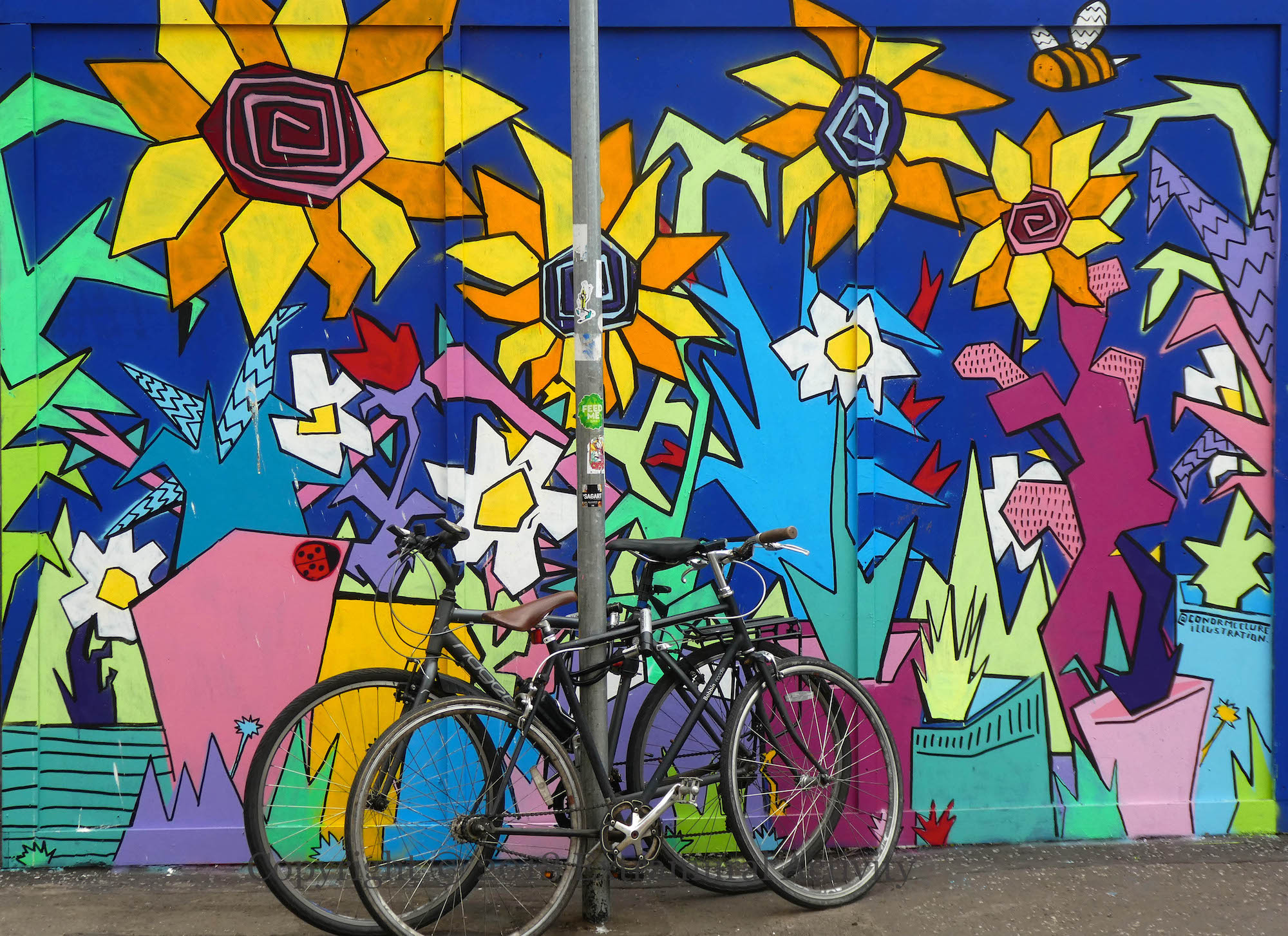
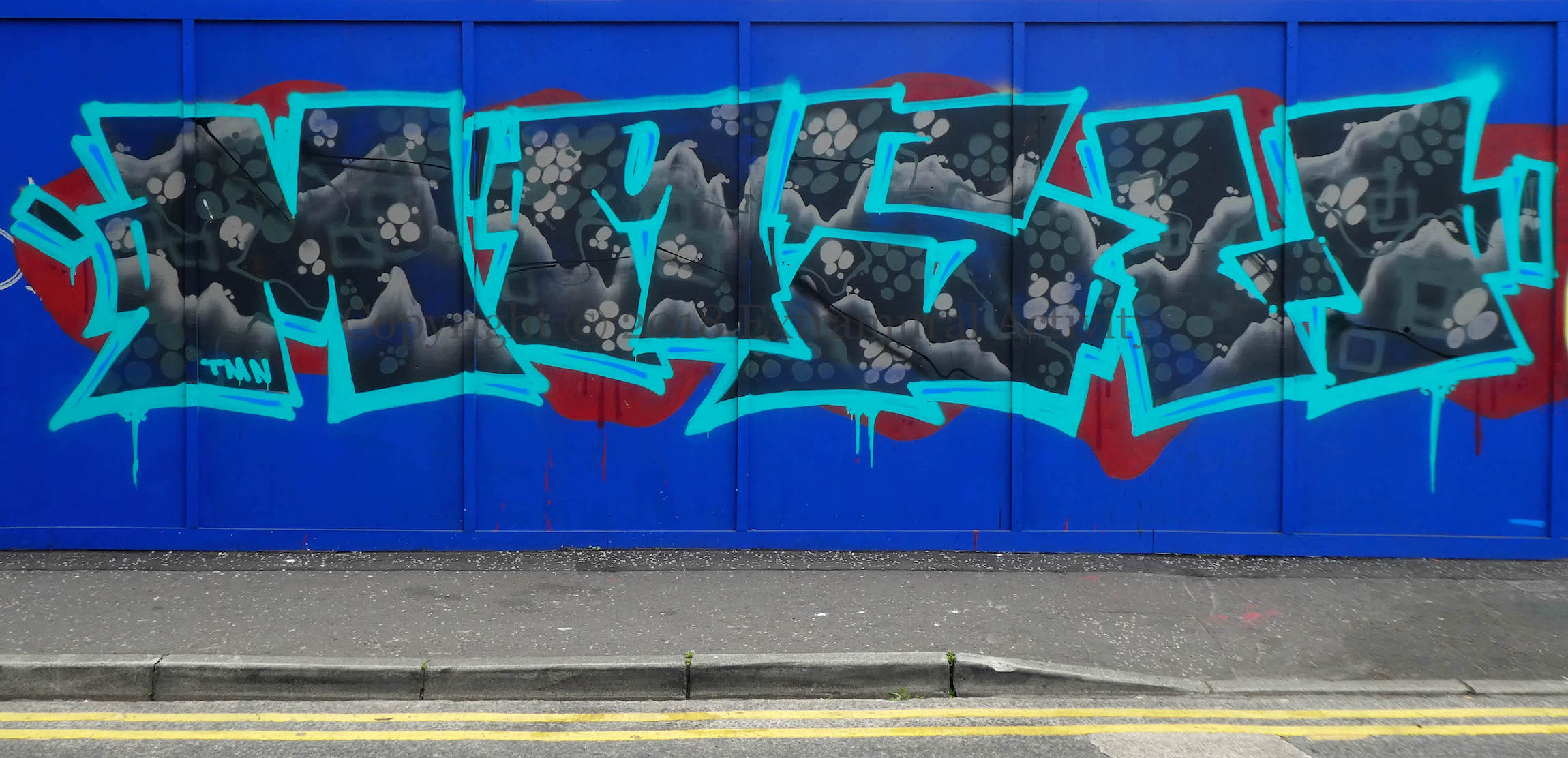
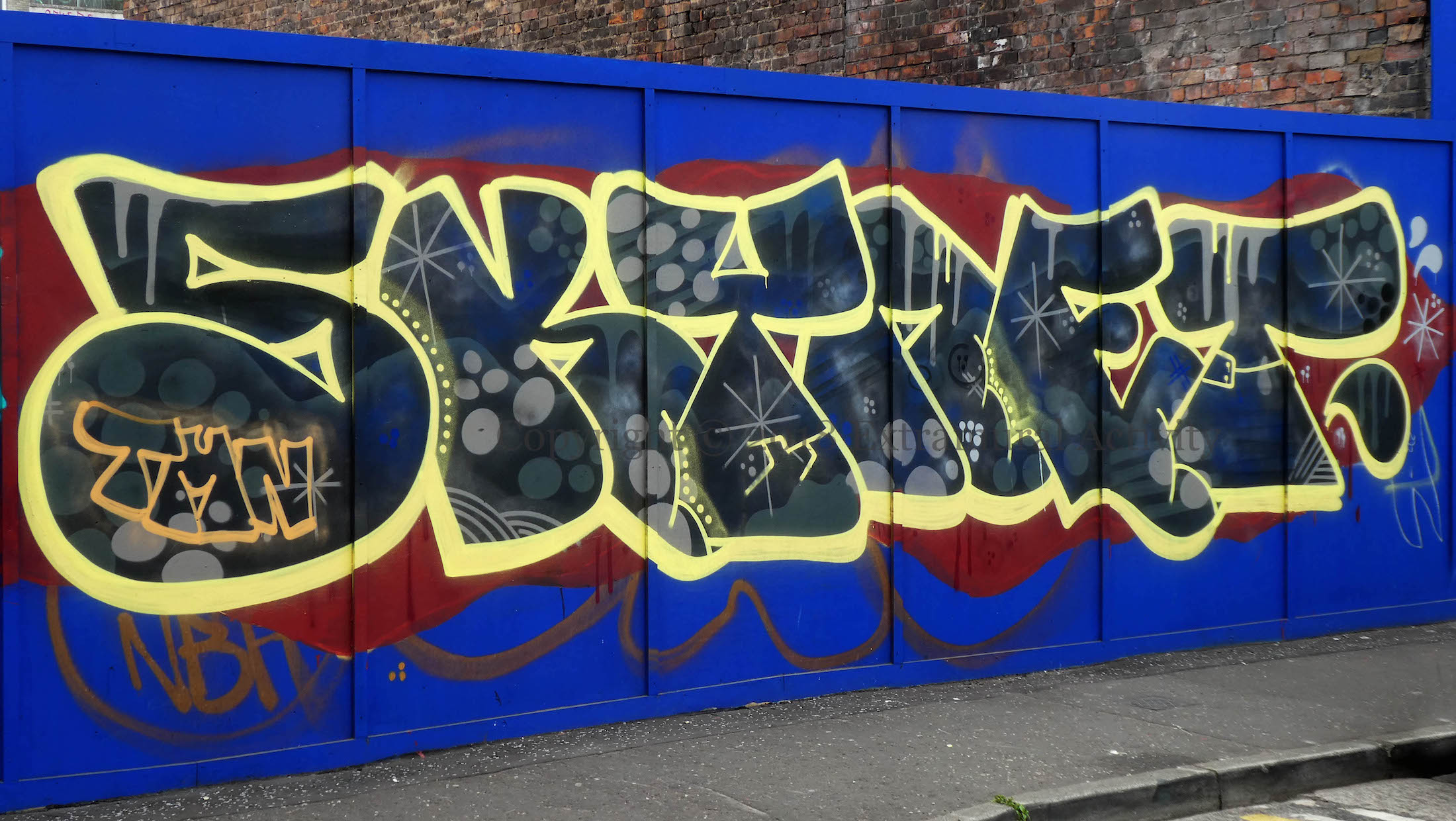
Work continues at the site opposite The Sunflower (Union Street and Kent Street). Nine murals (at least) were lost when the building was torn down but the substantial hoarding is providing artists with a temporary canvas. Above are sunflowers by Conor McClure (web | Fb | tw – see previously More Wolf Than Woman | Spring Wings); below are pieces by TMN crew members – MASH and “Skynet“.
This was presumably to be a UDA mural in the Bangor estate of Kilcooley (there used to be a UFF mural on this wall – see M03710), but the mural was started in May 2016 and the image above taken in April 2017. If you have any information about why the painting stopped, please get in touch.
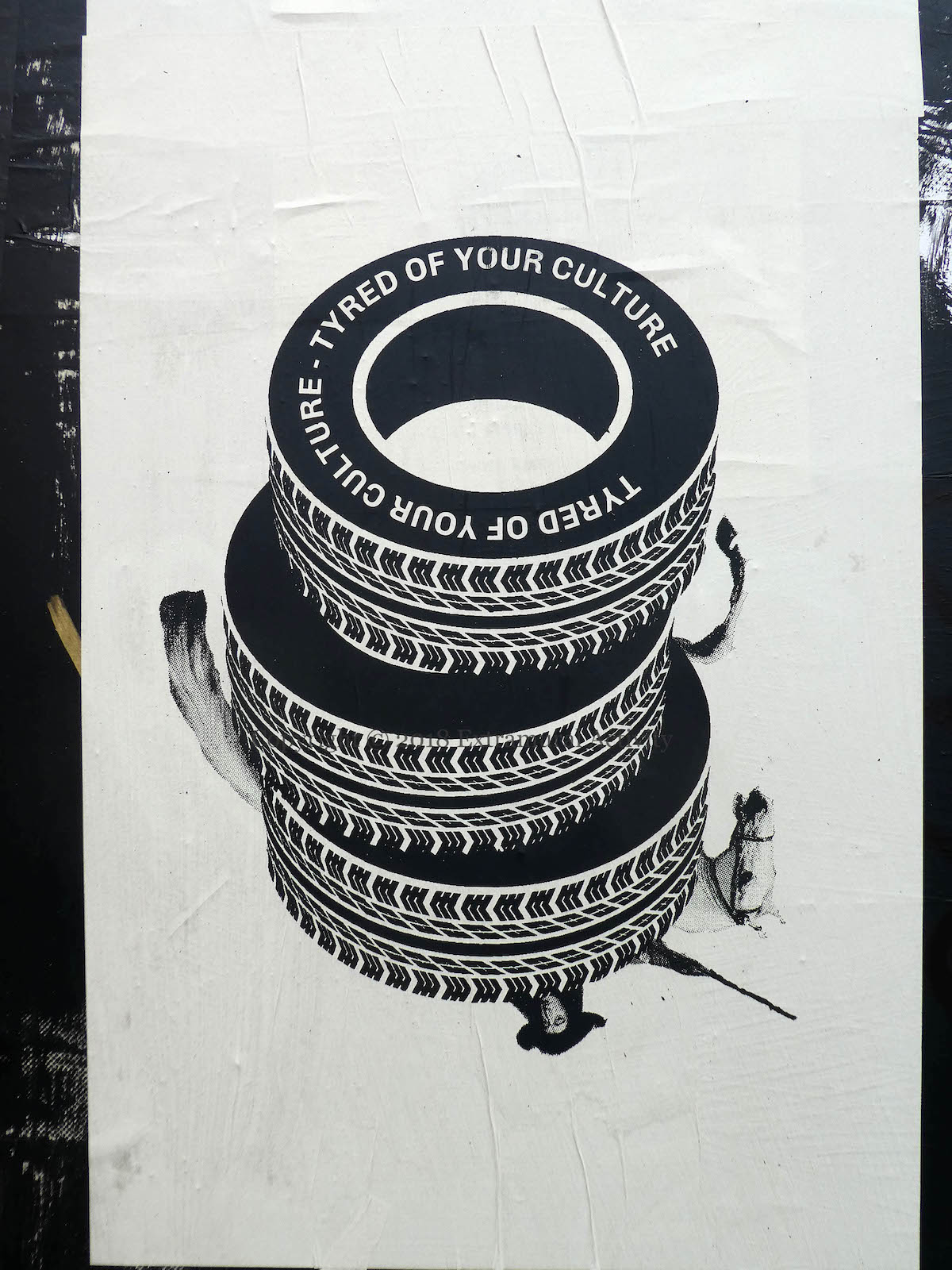
There’s one month to go before 11th night bonfires (and parades on the 12th) and collection of pallets is well under way in loyalist areas. TLO (web) is back this year protesting the use of tyres on bonfires, with King Billy and horse crushed beneath a pile tyres. Under the ‘bonfire management programme’ communities receive funds only if their pyres do not contain tyres. The Irish News reports that 72 groups have signed up this year, down from 95 in 2015. 40% of Belfast fires are in the scheme (BelTel).
Below is one of last year’s posters – still visible – partly covered with a pride sticker (see Good Year For A Bonfire and below that Lost Duppy).
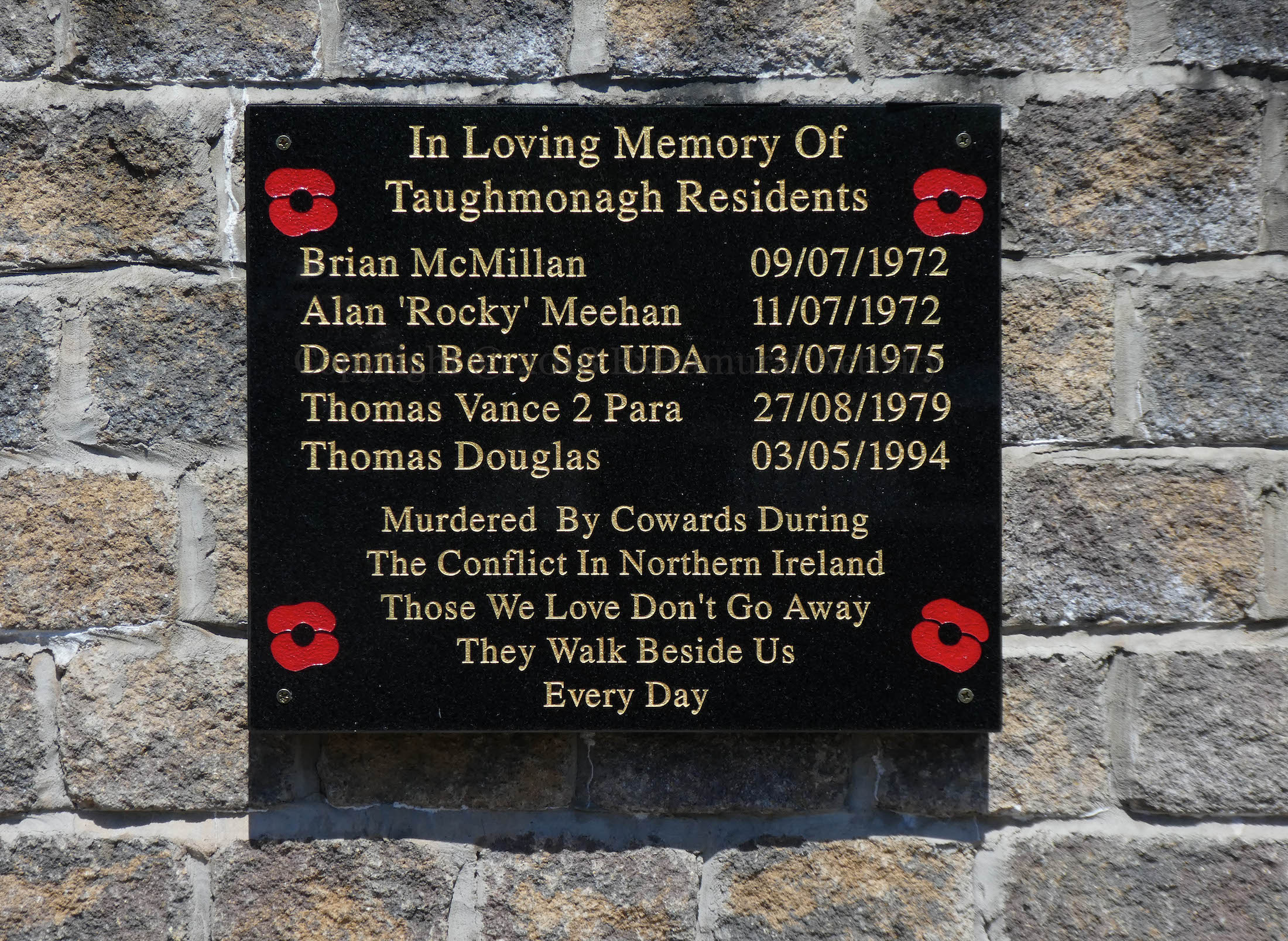
“In loving memory of Taughmonagh residents Brian McMillan, Alan ‘Rocky’ Meehan, Dennis Berrty (Sgt UDA), Thomas Vance (2 Para), Thomas Douglas. Murdered by cowards during the conflict in Northern Ireland. Those we love don’t go away, they walk beside us every day.”
McMillan and Meehan were civilians shot along with TA staff sergeant (and English Catholic) Joseph Flemming on July 9th, 1972.
Dennis Berry was shot by the UVF after leaving the UDA social club in Taughmonagh. According to Lost lives, “Reliable loyalist sources said the shooting was the result of a personal row rather than having any political or organisational basis.” (p. 441)
Thomas Vance died in the IRA’s 1979 ambush of the British Army at Narrow Water Castle, near Warrenpoint (WP), on the same day that Louis Mounbatten was killed. (Republican mural)
Thomas Douglas was shot while walking along the street. His family denied he was a leading loyalist and simply a member of the Orange Order (CAIN | Fb).
This plaque has been added to the UDA memorial garden in Taughmonagh (at the corner of Finbank Gardens & Malfin Drive).
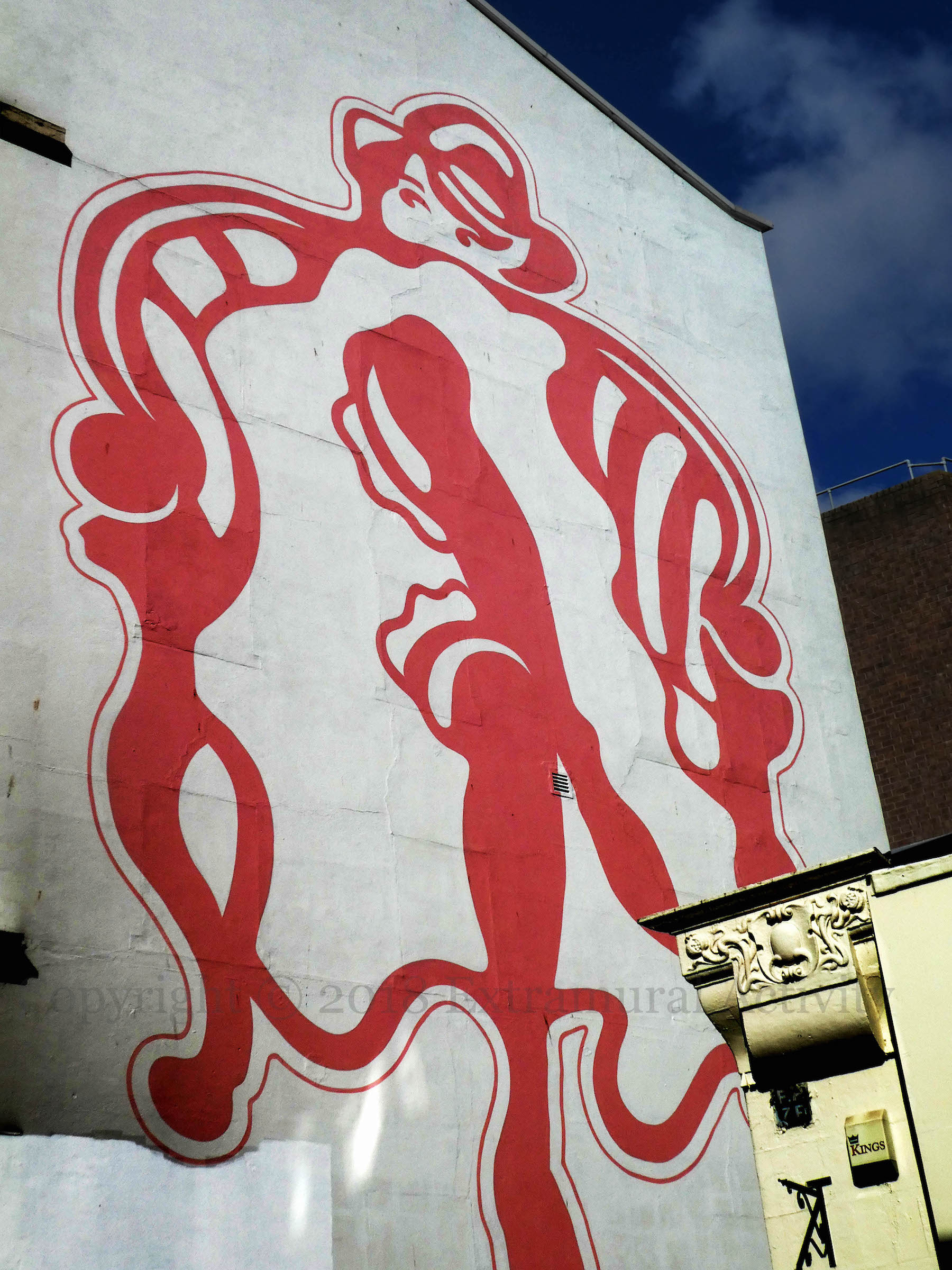
Patisserie Valerie, founded in London in 1926 by Belgian Madam Valerie, opened its second Belfast store in November 2016, in Castle Lane, and had a large-scale version of its can-can dancer emblem painted on the side by Dee Craig (Fb) on the side of the building in Castle Lane, Belfast.
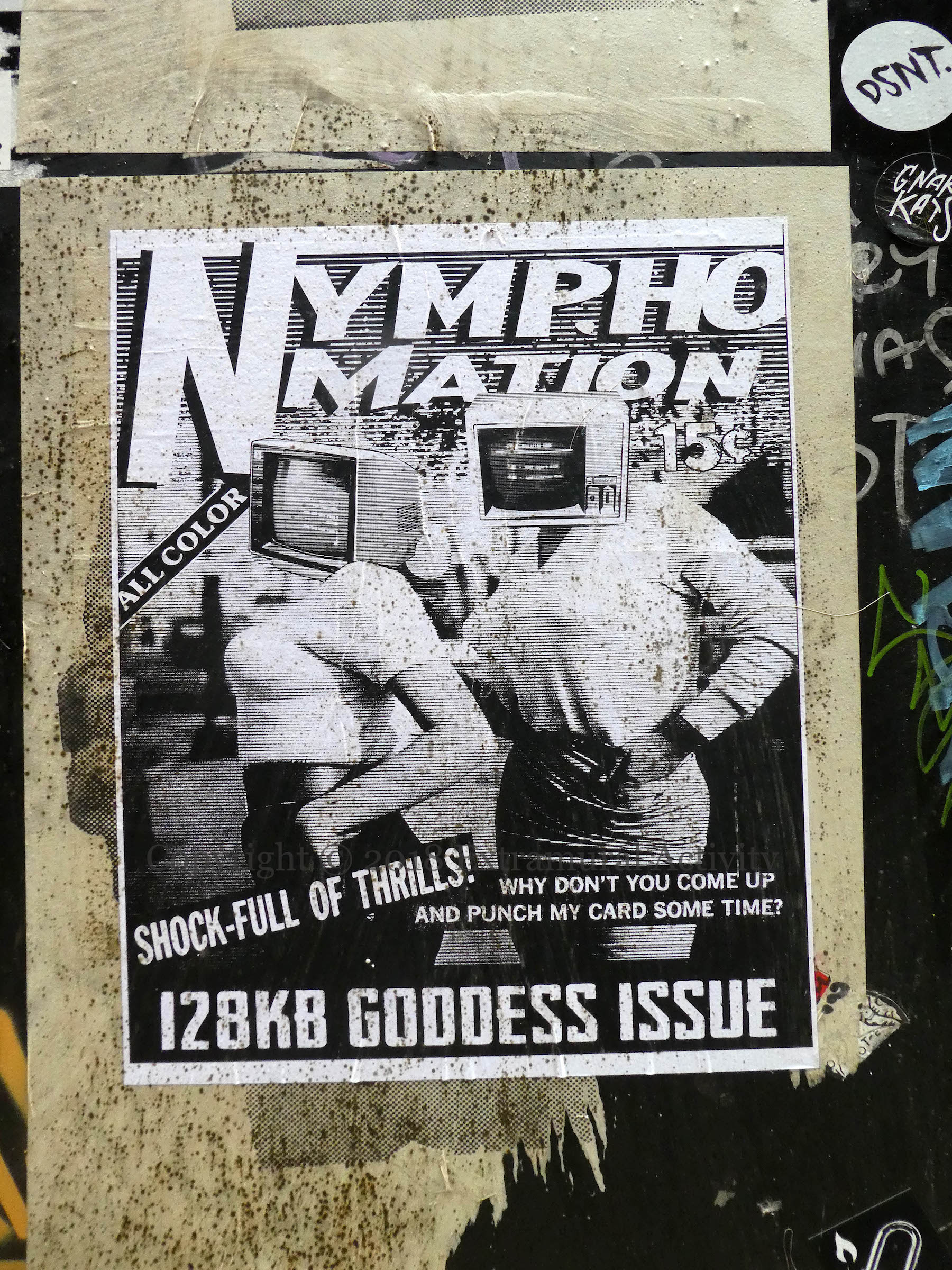
Here’s a recent paste-up from print-maker Leo Boyd (web) combining two of his typical themes: retro pulp magazines and what he calls “tech heads” and “tele heads”. For more schlock-horror, see When Urban Love Goes Wrong. For some tele heads, see Are You A Robot? | She Is My Spy. His latest project is Welcome To The Simulation (tumblr).
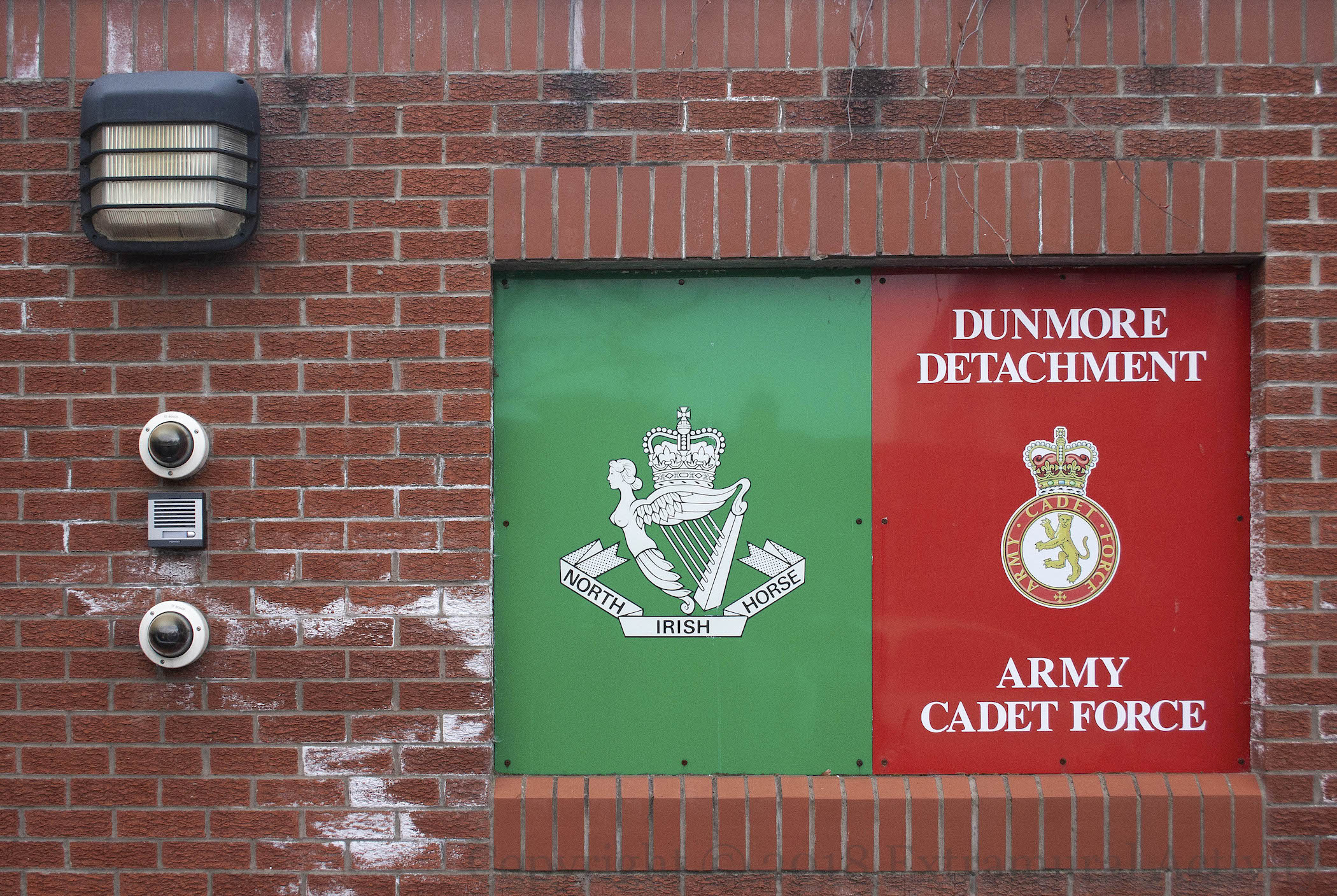
Tucked away at the end of Ashfield Crescent in north Belfast is the Dunmore base – there is another in Coleraine – of the North Irish Horse (web | Fb), a light cavalry reconnaissance unit of the British Army. It was originally created in 1902; after recent restructuring, it comes under the command of the Scottish and North Irish Yeomanry.
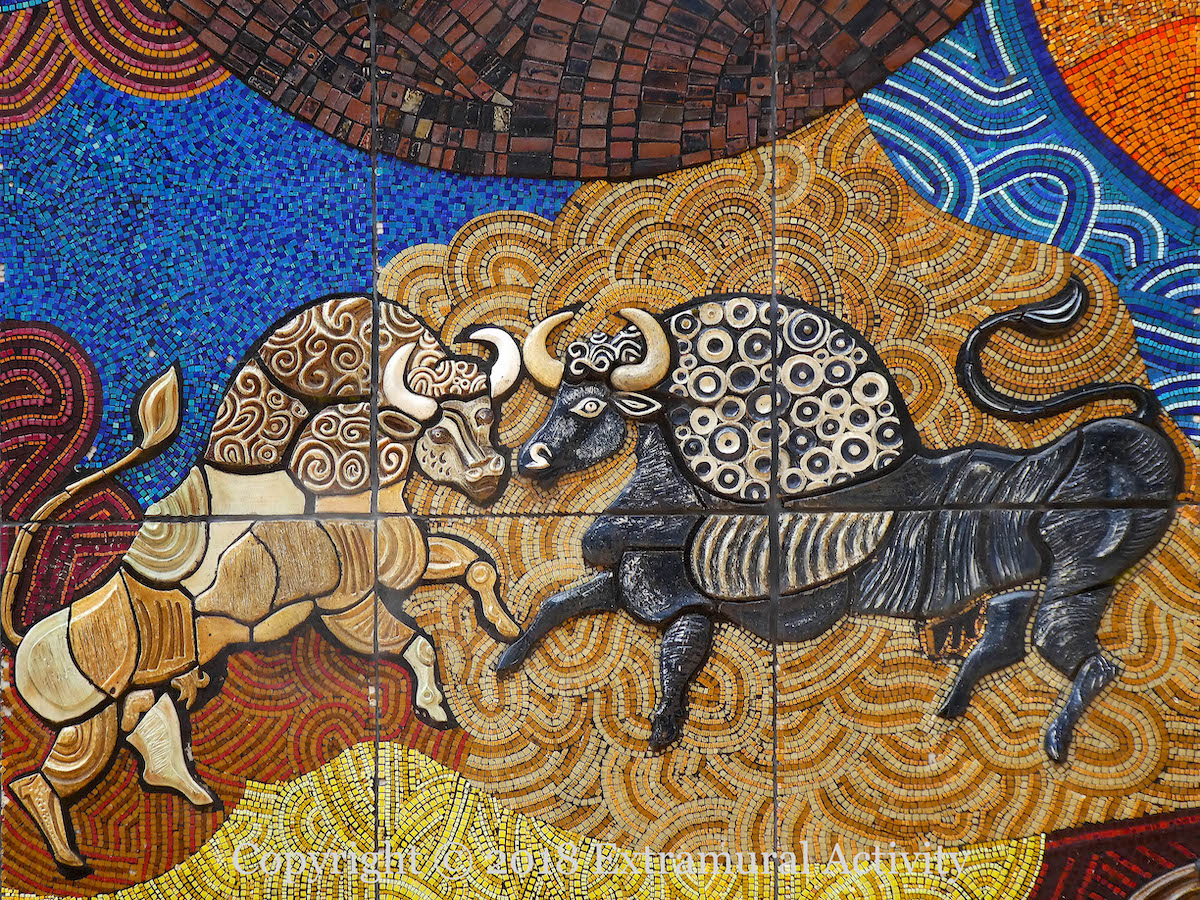
In the Táın, Queen Medb invades Ulster (opposed single-handedly by Cú Chulaınn) to take the Brown Bull (Donn Cuaılnge) in order that her wealth matches that of her husband, Aılıll, who has a prize bull called Fınnbhennach (the White-Horned). When she returns with the bull, the two bulls fight and kill each other. (So, … mission accomplished?)
The mosaic shown above is a detail from Desmond Kinney’s 1974 mosaic mural off Nassau Street in Dublin. For more images and explanation, see Richard Marsh.
It is usually the fourth verse from Laurence Binyon’s poem For The Fallen that is quoted on memorial stones to the fallen of the WWI but here we have the third verse: They went with songs to the battle, they were young/Straight of limb, true of eyes, steady and aglow/They were staunch to the end against odds uncounted/They fell with their faces to the foe. The stone commemorates “the men of the 36th (Ulster) Division who gave their lives for King and country at the Battle of the Somme 1st July – 18th November 1916”. It is in the garden adjacent to the West Kirk Presbyterian church (Fb) on the Shankill Road. As the image below shows, the garden is also host to many small boards to individual soldier (see previously Among The Fallen | XXXVI | The Sacrifice Remains The Same).
The Great March Of Return was a six-week protest by Palestinians in Gaza. Most protestors at the border fence with Israel were non-violent but there are reports of some with rocks, burning tyres, Molotov cocktails on a kite, and an AK-47 (WP). It ended (officially – incidents have continued) on May 15th, Nakba Day, the “day of the catastrophe”, meaning the displacement of Palestinians in the 1948 war. The protest demanded that refugees be allowed to return home – there are 1.1 million living in Gaza. During the protest more than 100 Palestinians died, many by live fire by Israeli forces, and more than 13,000 were injured. According to the mural above, “It’s time the Irish Government show some humanity and act for the Palestinian people. 1. Officially recognise the state of Palestine. 2. Impose economic sanctions on Israel. 3. End all diplomatic ties with the apartheid state. Boycott Israel, an apartheid state.”
The wheelchair protester shown on the right is double amputee Saber Al-Ashkar. He has not, however, been reported dead, as the text below the image (and reports on Twitter and elsewhere) suggests: “They took his land, his legs, and finally his life.” The death might refer to another such protestor Fadi Abu Salah, who was killed in May (Alaraby) (or Ibrahim Abu Thuraya, who was shot in December 2017 – Independent obituary). The UN Commissioner for Human Rights called the killing “incomprehensible” (Guardian); an internal IDF investigation found that Abu Thuraya was not shot by Israeli snipers (Times Of Israel).







 Extramural Activity