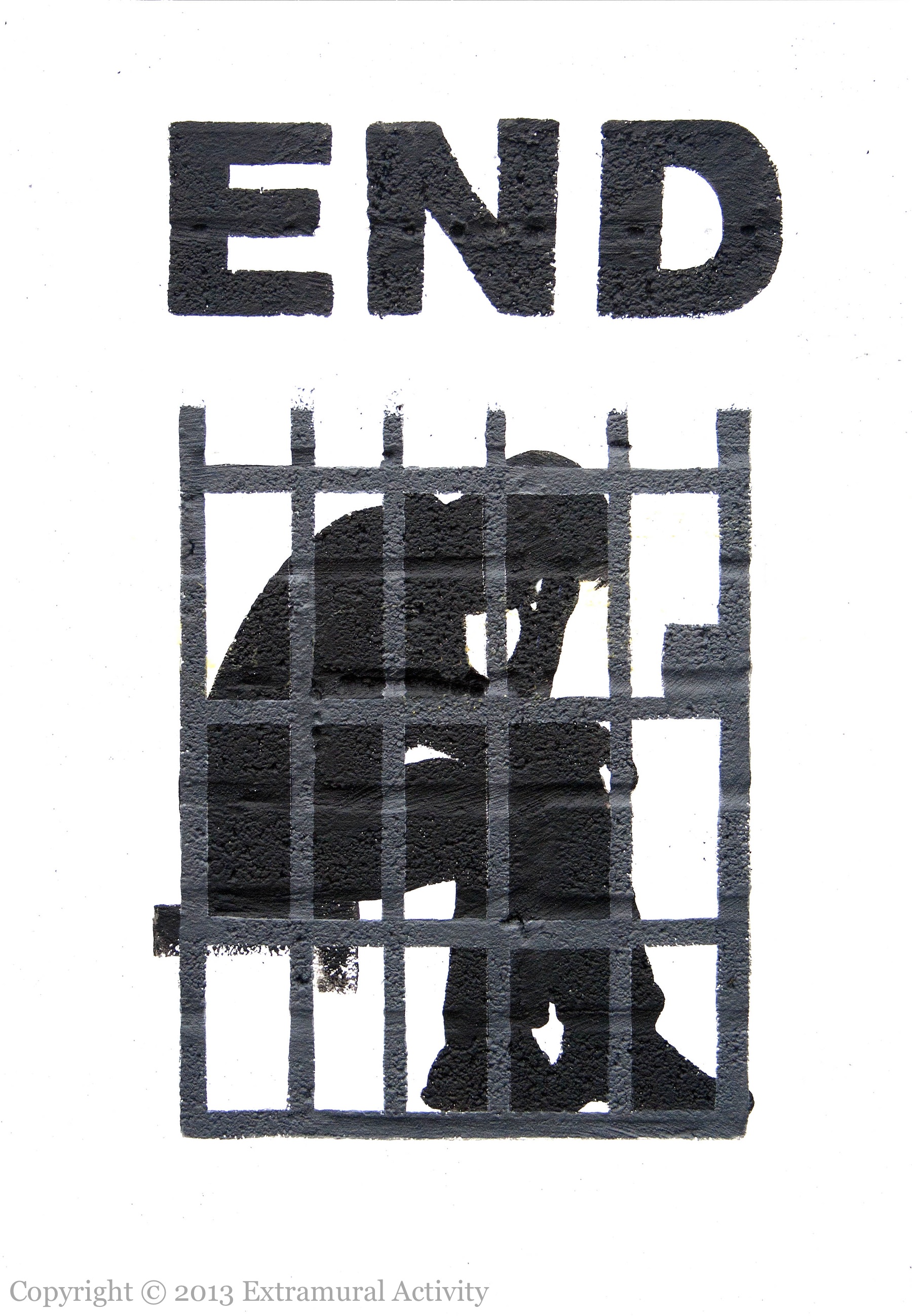
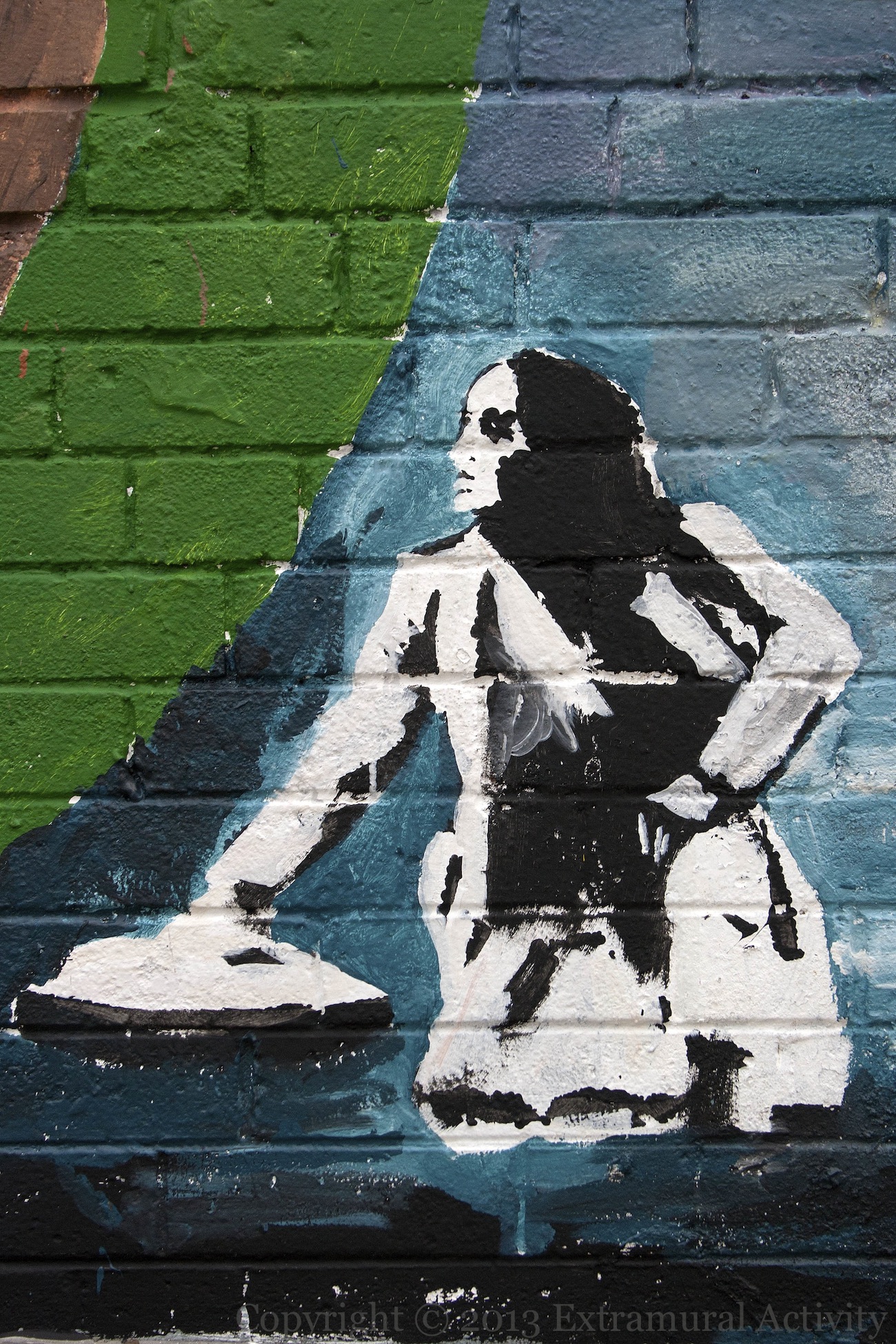
Detail from a new mural on the Springfield Road, opposite the barracks: End British internment of Irish Republicans, 2013. Painted by Rebel Rebel of the Gael Force Art group. A shot of the whole piece can be found below.
This is the (second) memorial to Paul ‘Topper’ Thompson in Moyard. He was killed by the UDA on April 27th, 1994. Collusion is alleged – see Relatives For Justice.
“In memory of Topper Thompson, murdered by British death squads, 27th April 1994 aged 25. Deeply missed by never forgotten. Erected by his friends.”
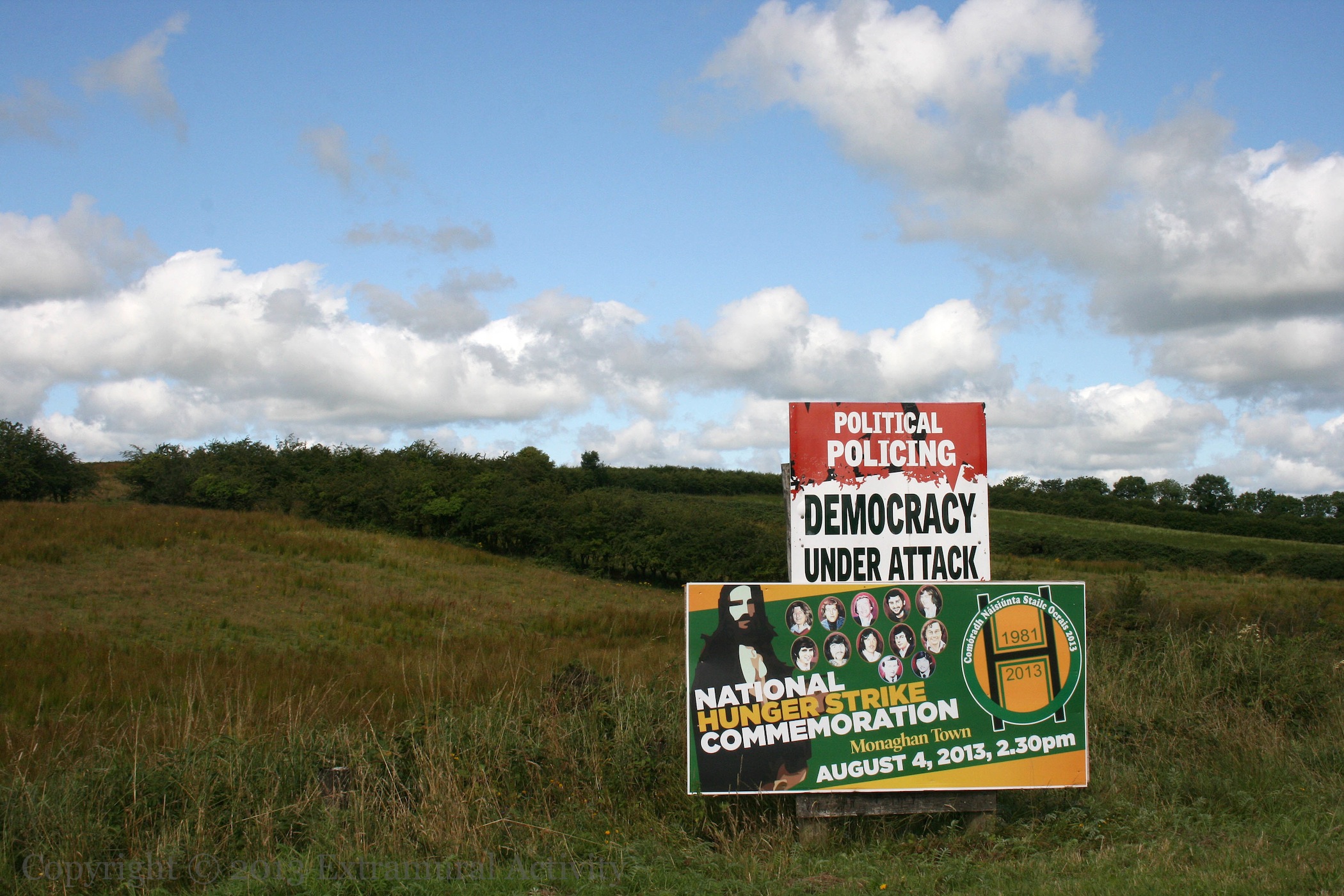
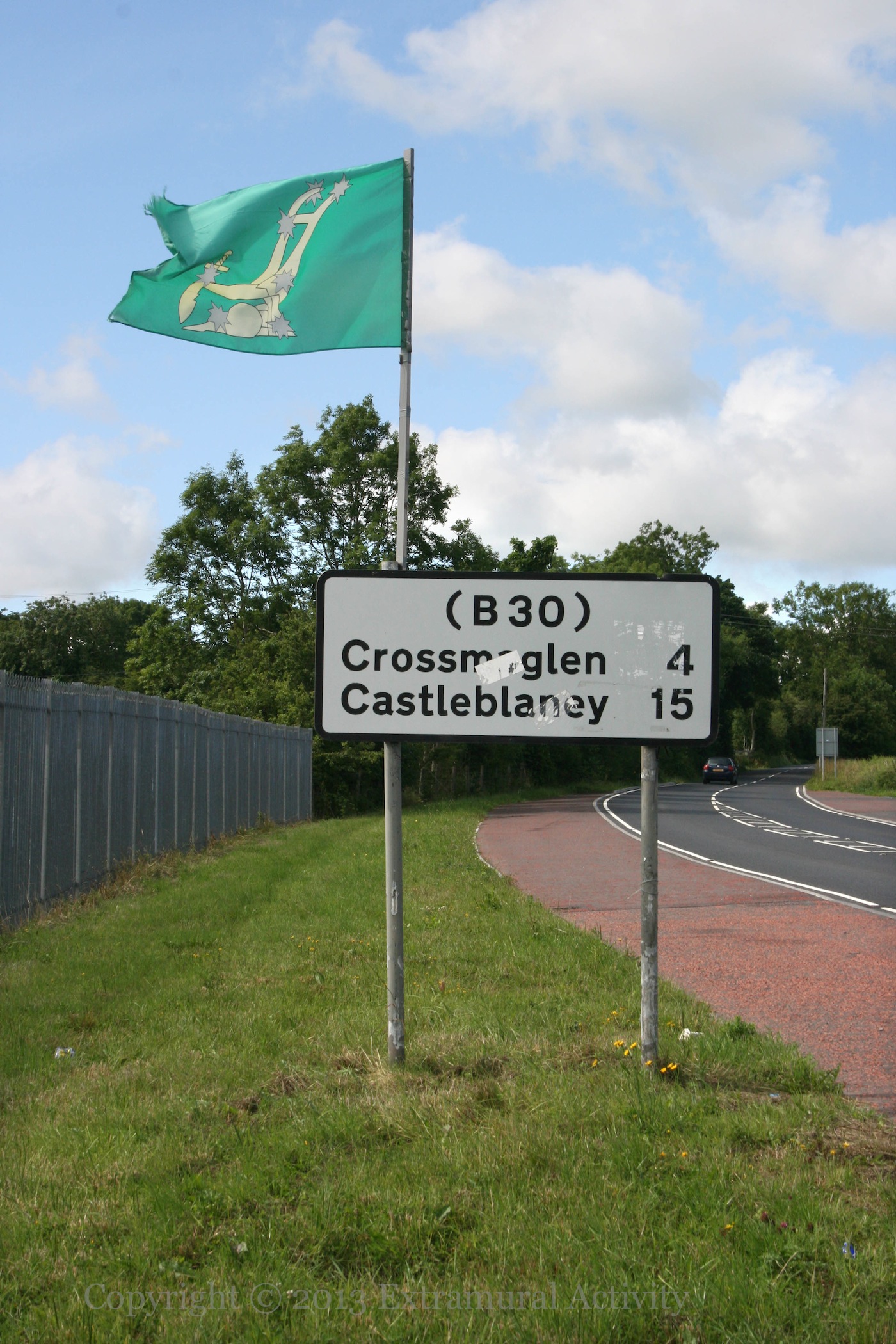
Two images today from the crossroads at the intersection of Crossmaglen-Newry and Newtownhamilton-Dundalk roads (a.k.a. Ford’s Cross, Silverbridge). The first shows a hunger-strikers board from this year over a much older ‘democracy under attack’ board (see D02009). The second shows the plough and the stars flying above the mileage sign. There is also a memorial, with a tricolour flying overhead, at this crossroads
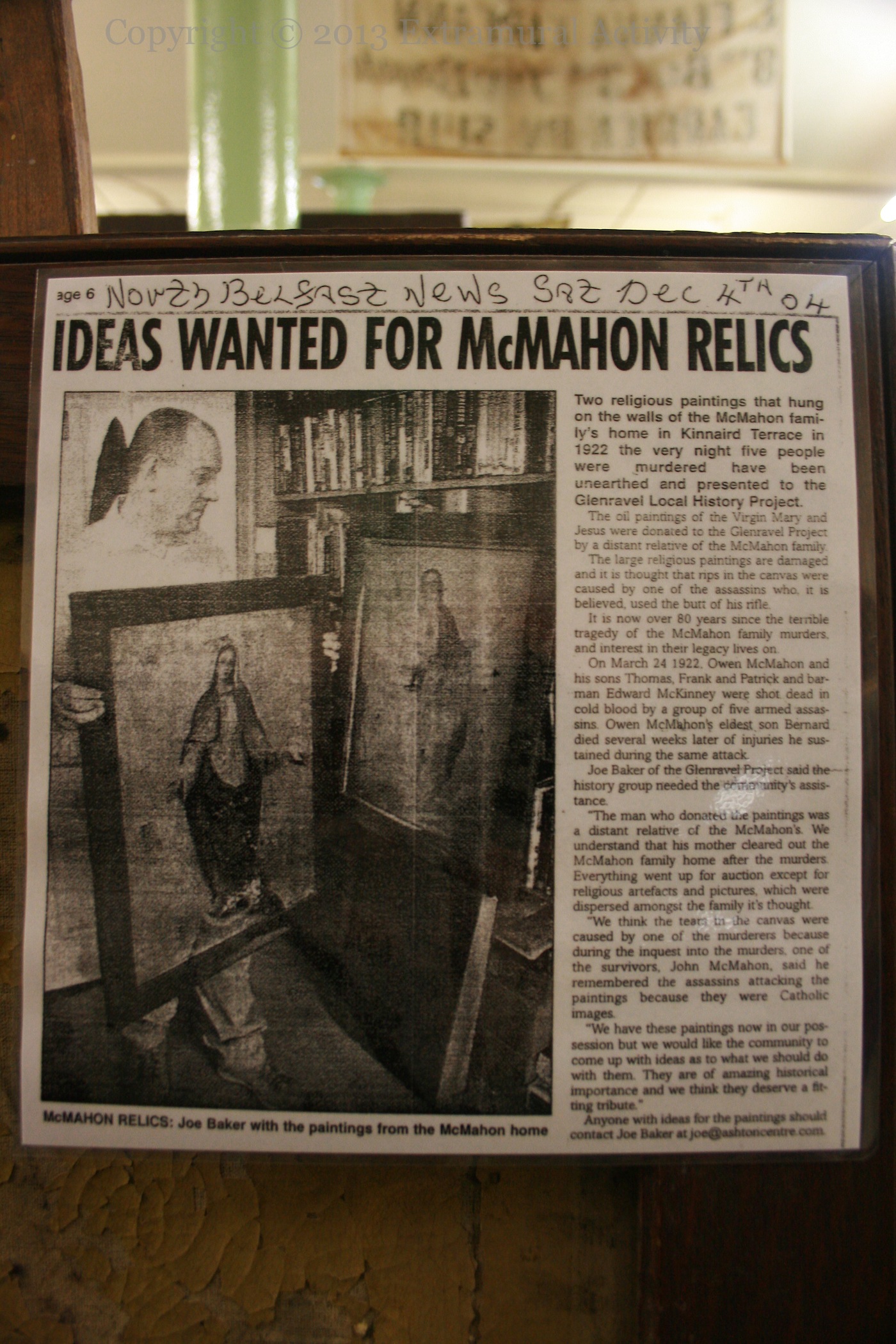
Above is an image of one of two surviving religious pictures from the McMahon household on Kinnaird Terrace, off the Antrim Road. The picture was in the house the night five members of the family and one other person were killed, in 1922, by members of the RIC or the Specials (milltowncemetery.com, WP). The holes on the left and at the bottom are thought to be bullet holes, while the article below claims the tear in the upper centre is from the butt of a rifle. The picture is at present on display in the Republican Museum on Conway Street.
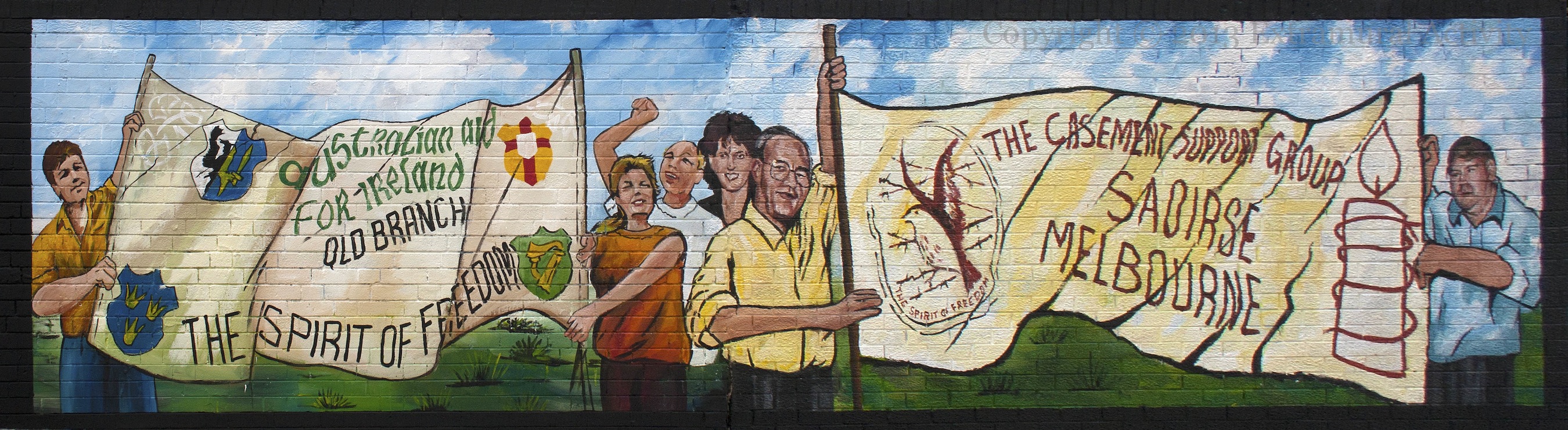
Above is an extra-wide shot (2700 pixels) of another panel from the wall next to the Republican Museum on Conway Street (next to the previously featured Eileen Hickey). The mural features banners of two Australian Republican support-groups, holding banners reading “Australian Aid for Ireland QLD [Queensland] Branch – The Spirit of Freedom” and “The Casement Support Group – Saoirse Melbourne”.
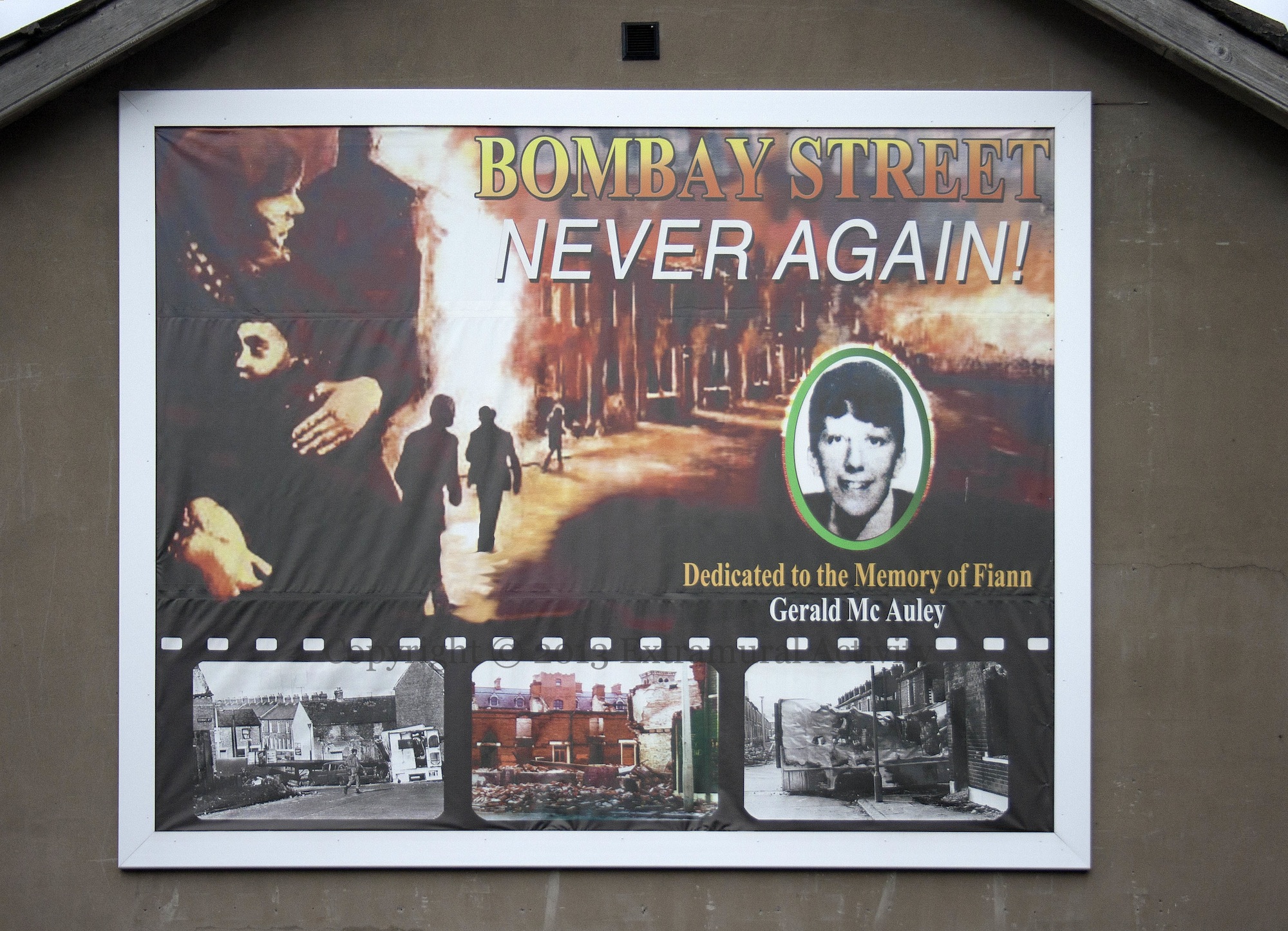
Printed and framed tarp in Bombay Street, commemorating the burning of Bombay Street during the August 1969 Belfast riots and the death Gerald McAuley, a young IRA member (Fian, not “Fiann” as written here) killed by a sniper during the trouble. Three photographs from the street at the time are reproduced in the bottom third of the board.
Ten years ago, an earlier incarnation of this board could be found on the other side of the street, connected to the issue of the day: No (Decom)mission.
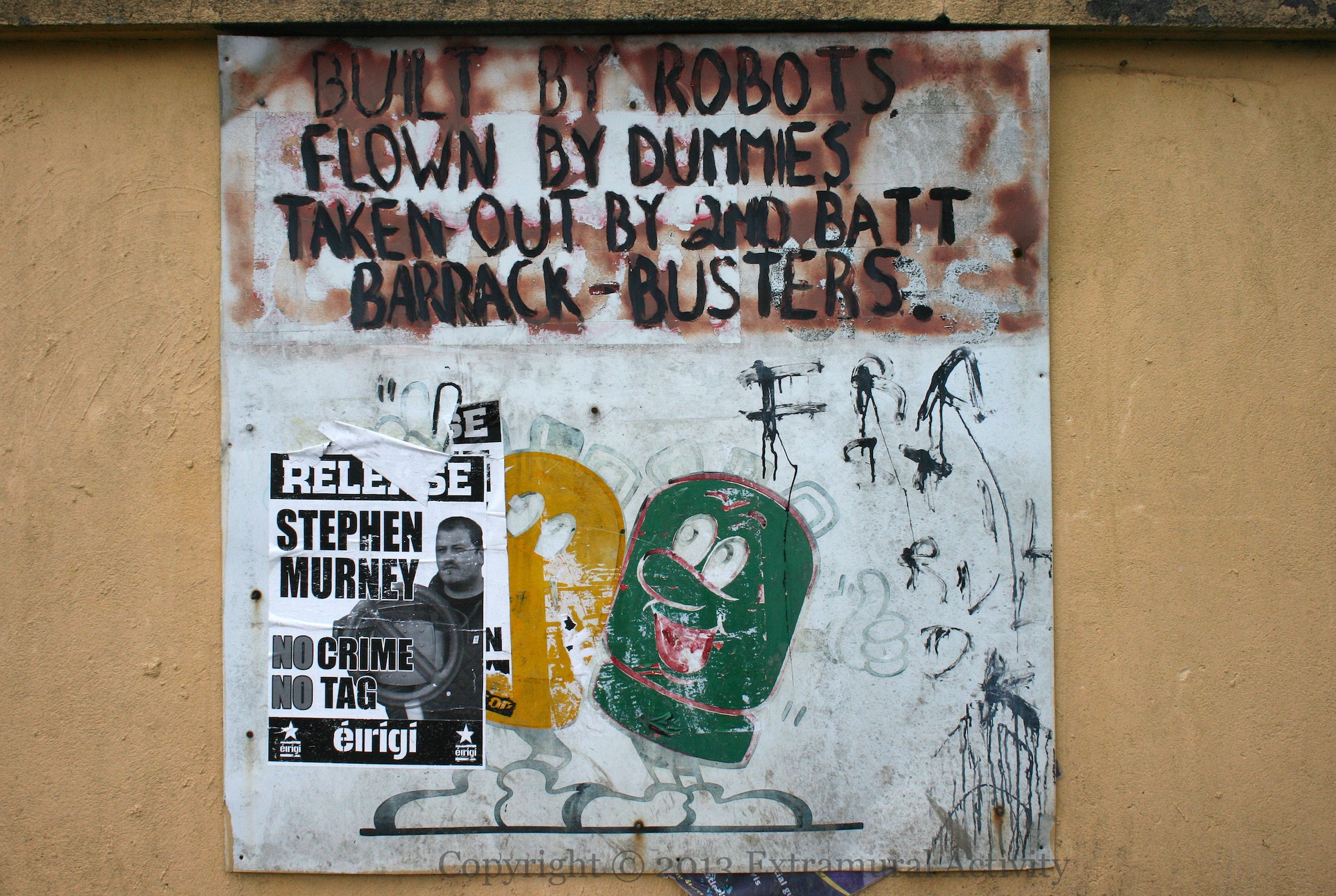
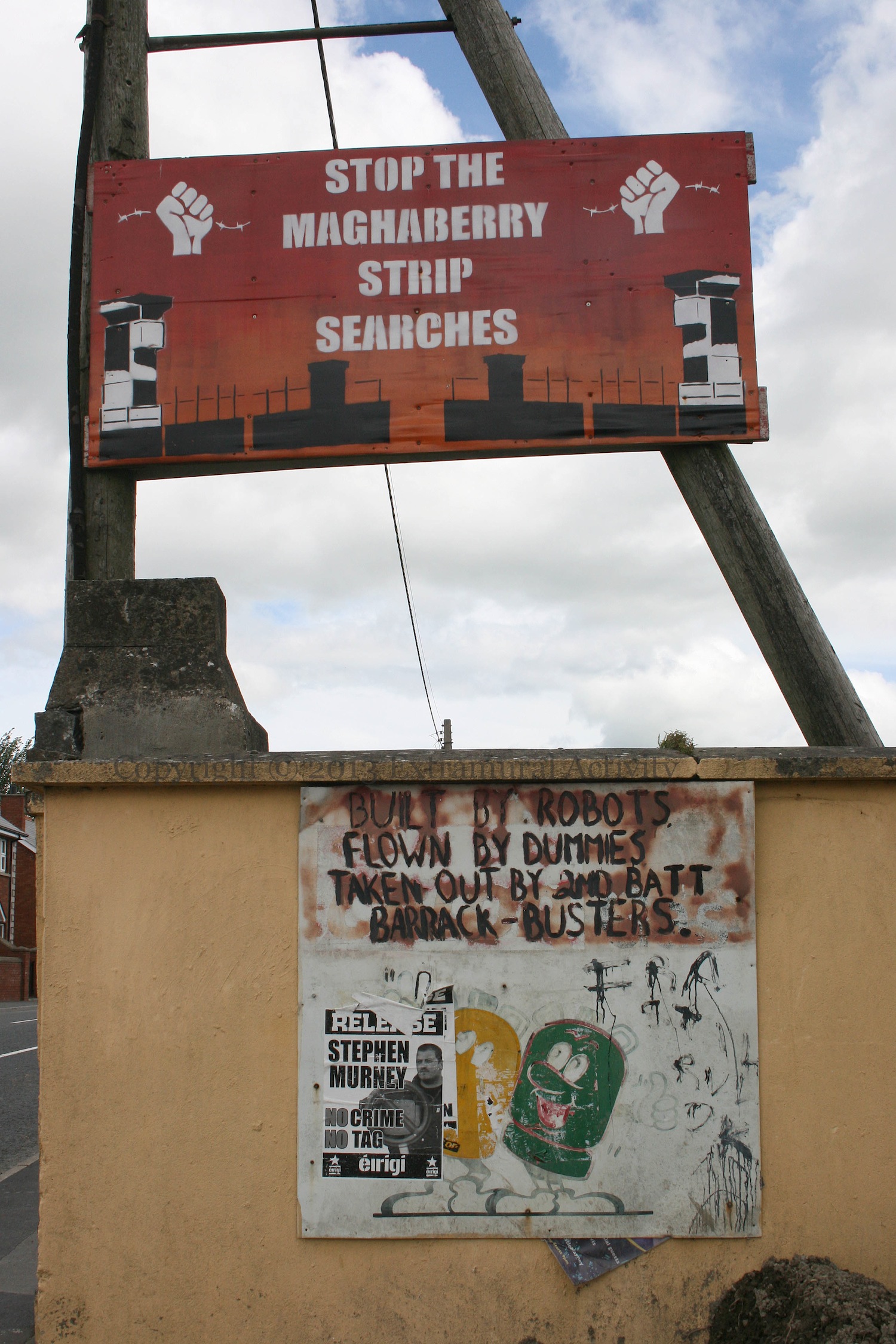
A metal plate, previously an advertisement for Calor Gas, now sports republican graffiti and a flyer: Built by robots, flown by dummies, taken out by 2nd Batt. barrack-busters.
The incident in question is a 1994 IRA mortar attack on a British Army helicopter at the Crossmaglen barracks. (CAIN | WP page on the incident). The mortar used a Calor Gas tube, though not the one shown here. (WP page on the mortar)
The shot below includes the board above the wall: Stop Maghaberry strip searches.
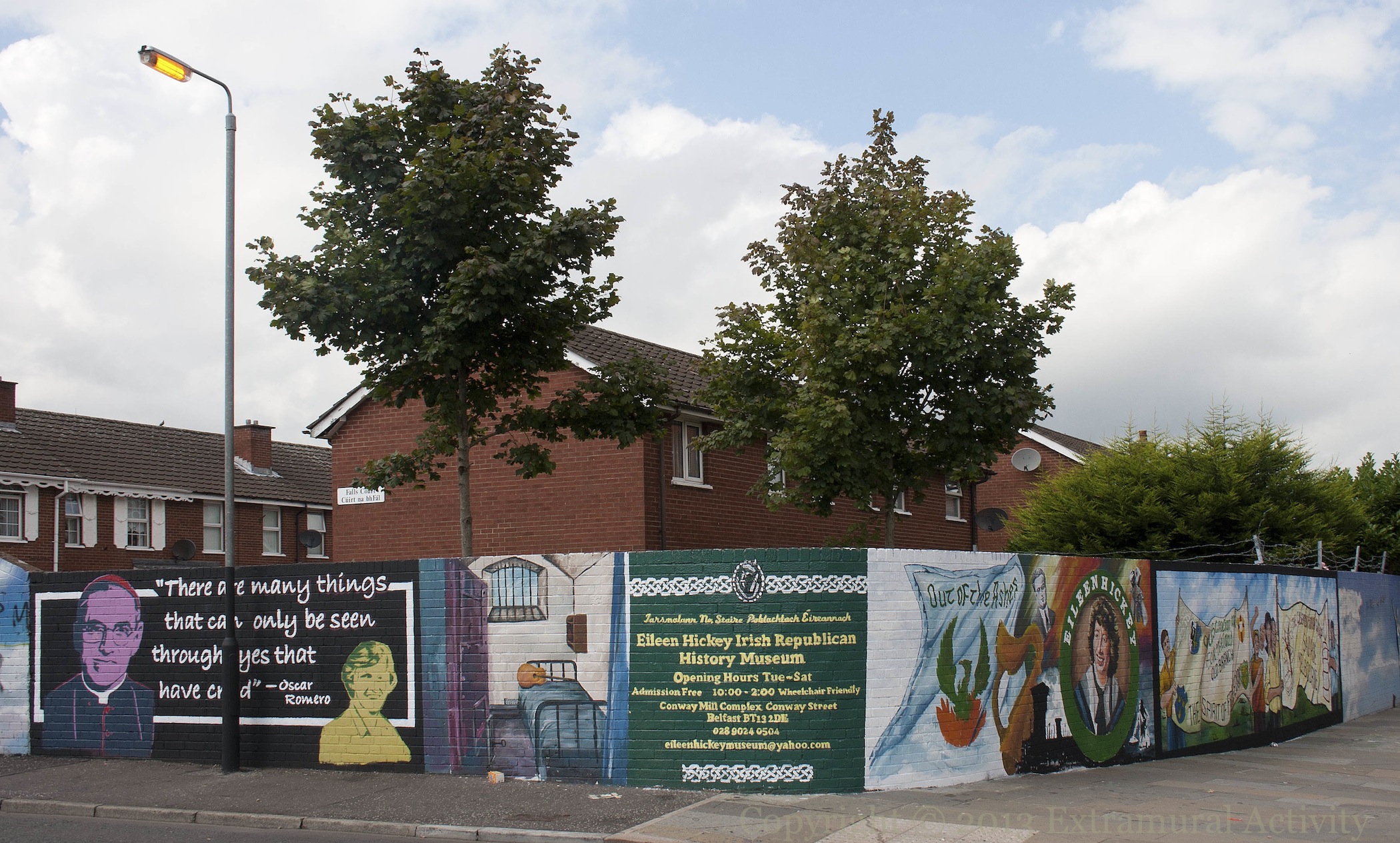
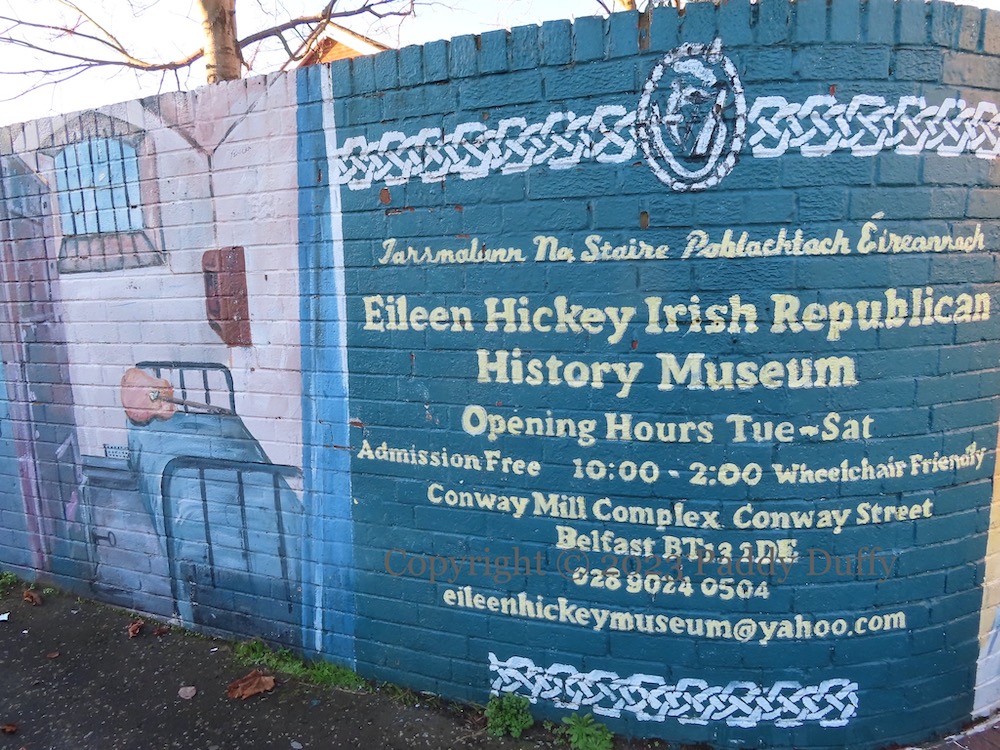
The ‘Eileen Hickey Irish Republican History Museum‘ — which is across the street behind the Conway Mill — is named for Eileen Hickey, a Provisional IRA member who served time in Armagh prison; she died in 2006, one year before the opening of the museum (obituary at An Phoblacht). A close-up of the woman with a bin lid, in the lower right-hand corner, can be found below.
Next to the opening hours is an image of a prison cell in the Armagh women’s prison. The museum itself contains a cell door and a bed from the prison.
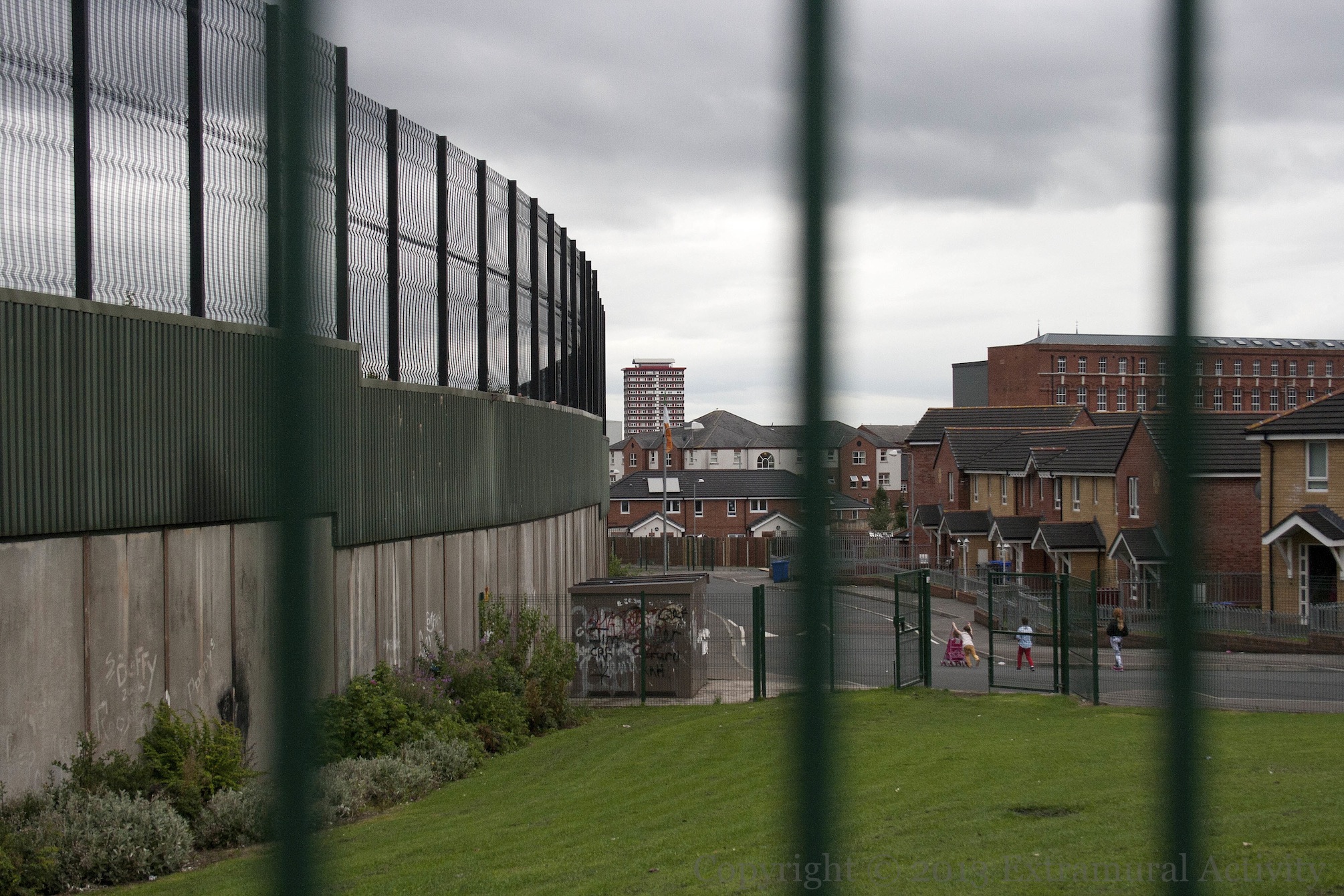
Previously we featured an image from the north (loyalist) side of the Cupar Way “peace” line, a.k.a. “war wall” or “wall of hostility” – the wall/fence separating neighbourhoods along the Shankill from those along the Falls. Here are two shots from the south (republican) side of the line, in Bombay Street. Divis tower is visible in the distance in the first. The second, below, shows the additional fencing that covers the backs of some houses.
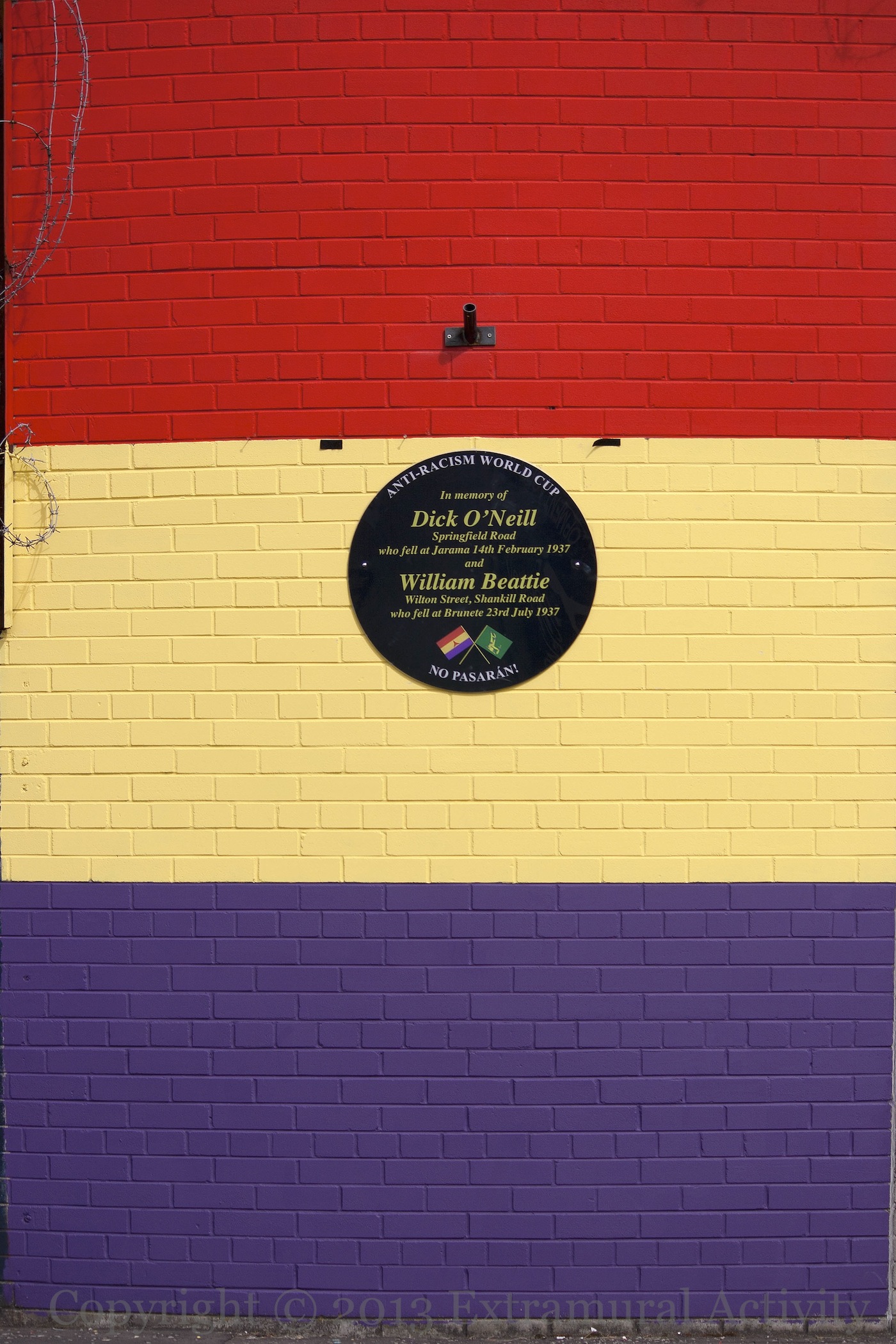
A second anti-fascist, and cross-community, piece has gone up on Northumberland Street. This one commemorates the deaths of Dick O’Neill and William Beattie who died fighting the fascists in the Spanish Civil War. O’Neill died at Jarama and Beattie at Brunete, both outside Madrid, in 1937.
As can be seen from the third image, below, the piece is immediately to the right of the Frederick Douglass mural.








 Extramural Activity