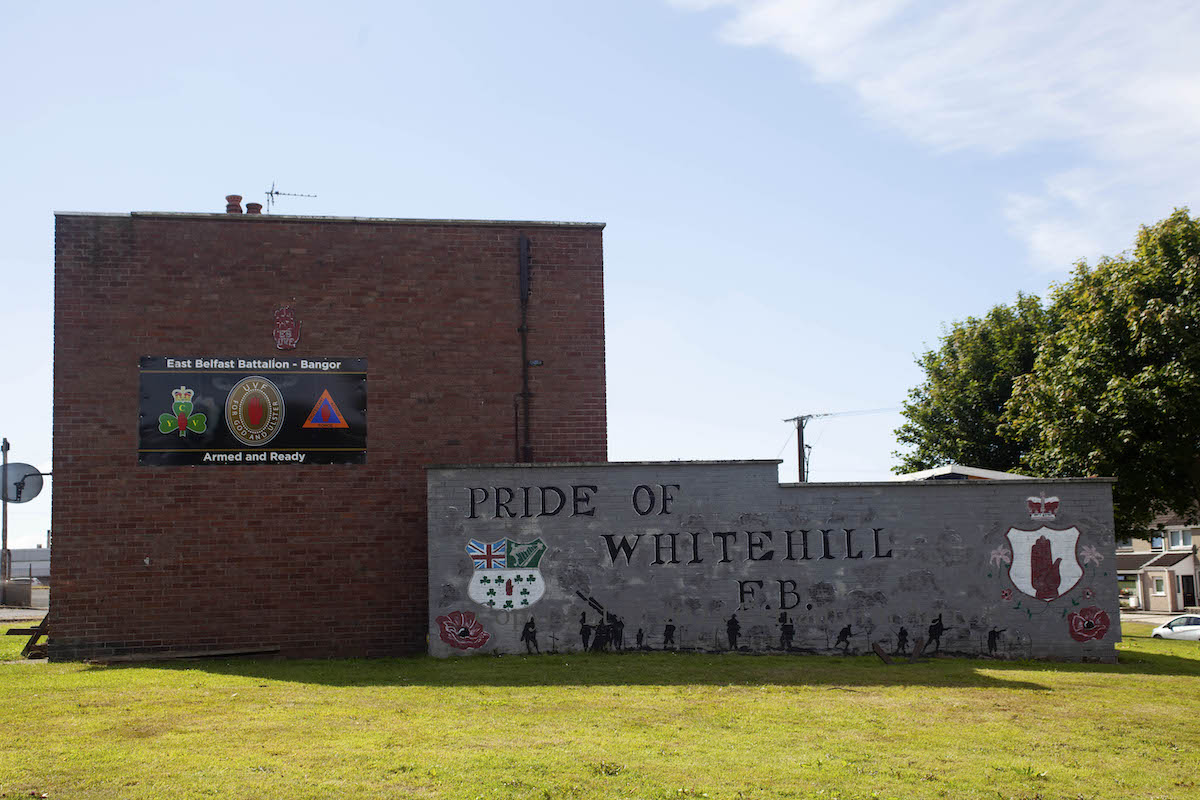
This UVF hooded gunman board (above the Pride Of Whitehill flute band (Fb) mural) was previously a memorial to the 36th (Ulster) Division (see They Sleep Side-By-Side) but has now become part of the East Belfast battalion’s markings in Bangor (see Always A Little Further).
The twelve “Gertrude Street Great War Fatalities” are: Robert Harvey; William Duff; James Fagan; Alexander Leckey; George McCune; Hugh Nabney; William Nabney; Matthew Scott; Robert C. Skillen; James Watson; Samuel Wright; James Burns.
This board was originally next to the To France And Flanders mural on the adjacent wall; the mural also named these twelve but which only lasted a year. That mural depicted the damaged basilica tower in the village of Albert and there is a similar mural in the village itself – a photograph of the mural and the rebuilt tower can be seen in the top right of the board; the mural can be seen in full here.
As the map in the top left shows, Gertrude Street was where Wolff Close now is, running north from the Newtownards Road; the original Gertrude Star mural (circa 1989) was on the first gable of what is now called “Freedom Corner” – see D00388.
“‘The Legacy Of Gertrude Street. Twelve brave young men from Gertrude Street,/Bravely fought in world war one./They tried their best as legends do./But never returned back home.//They dragged through muddy trenches,/In the darkness of the night./But never once would they give up,/As they bravely continued to fight.//Each year these men will be honoured,/As we stand together taking time to reflect./It’s vital to show these heroes the uttermost respect.//For now they lie in Flanders fields,/Between crosses row by row./They lived, they fought for our country,/And gave their lives many years ago.//Forever we will speak of these men,/Who came from Gertrude Street./Their legacy will always live on,/When we think of their marching feet.’ By Angela McCully”
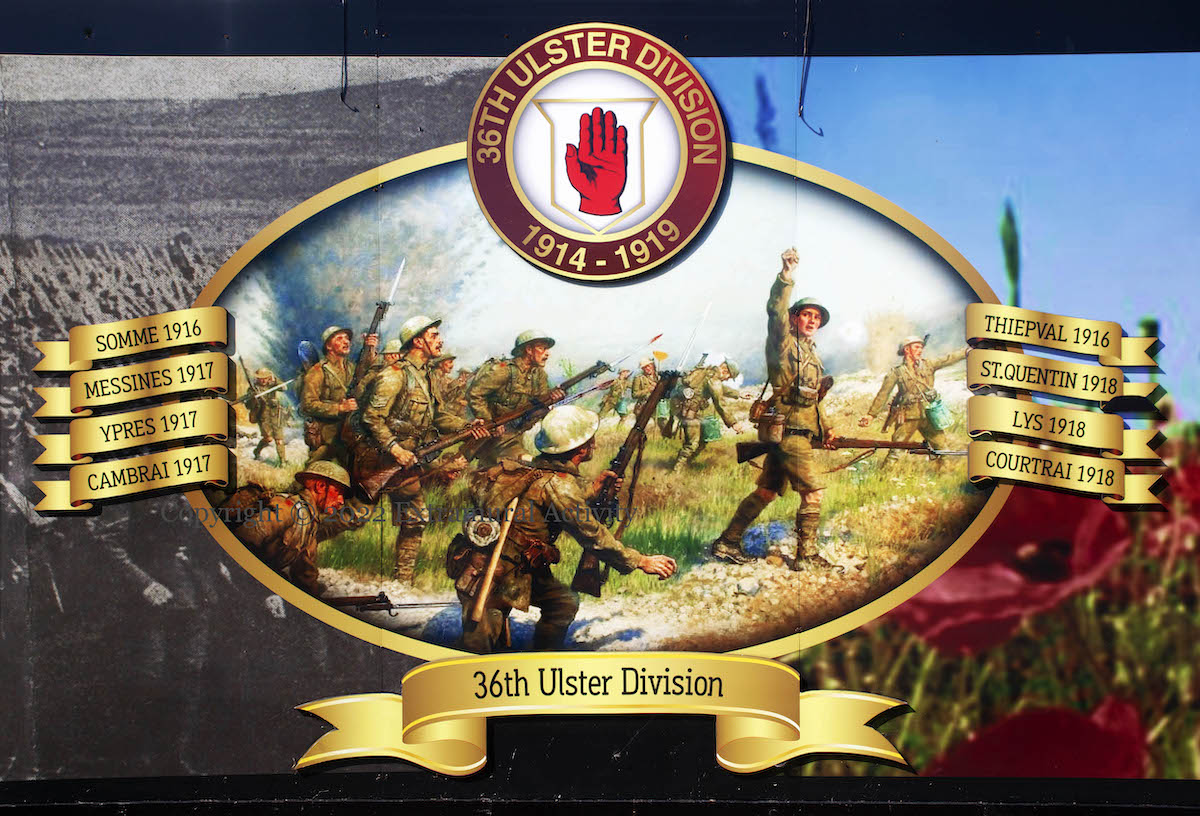
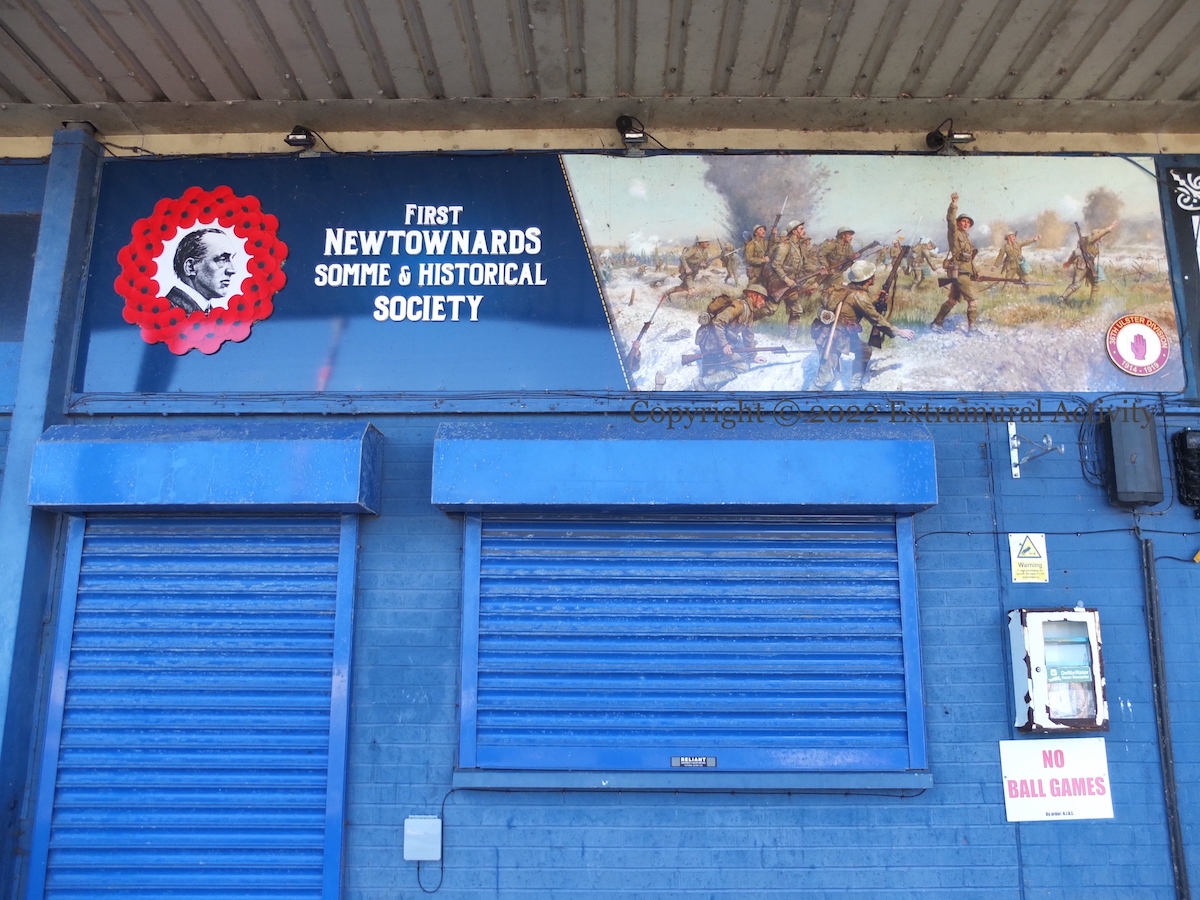
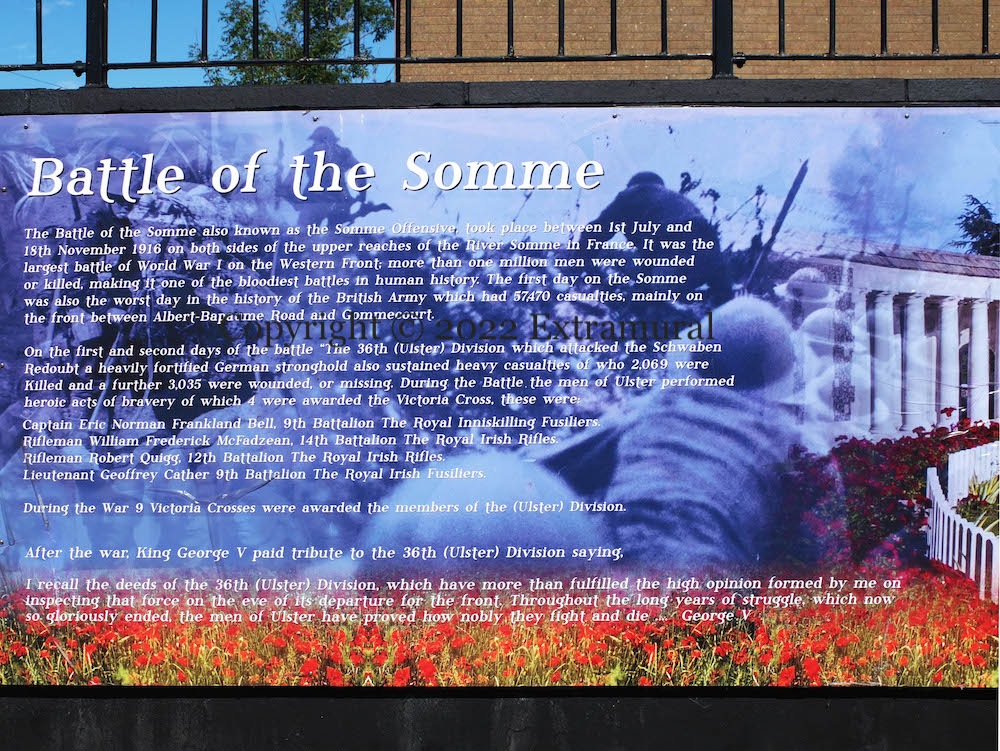
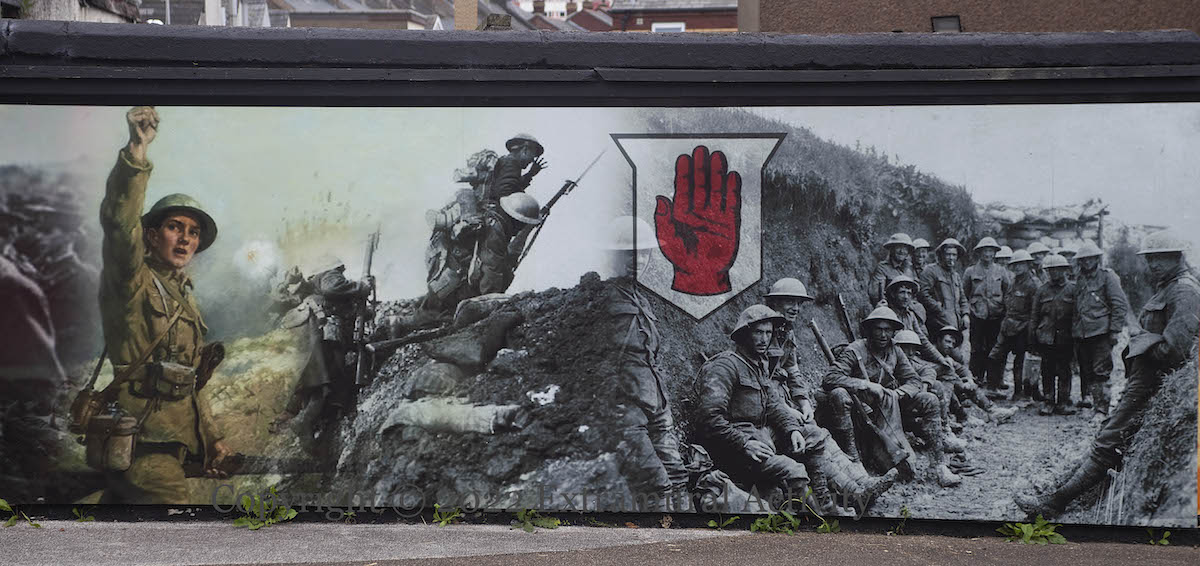
This is new, more extensive display from The First Newtownards Somme & Historical Society (Fb) (replacing The Pride Of Ulster). There are seven panels about the Ulster Volunteers and the 36th Division, plus an eighth panel on the Ulster Special Constabulary. The formation of the Ulster Volunteers (anti-Home Rule poster | anti-Home Rule postcard), formation of the 36th (Ulster) Division, the 13 battalions of the division, the Battle Of The Somme, JP Beadle’s Attack Of The Ulster Division (Royal Irish), the Ulster Tower, the USC (B Specials), the Victoria Cross.
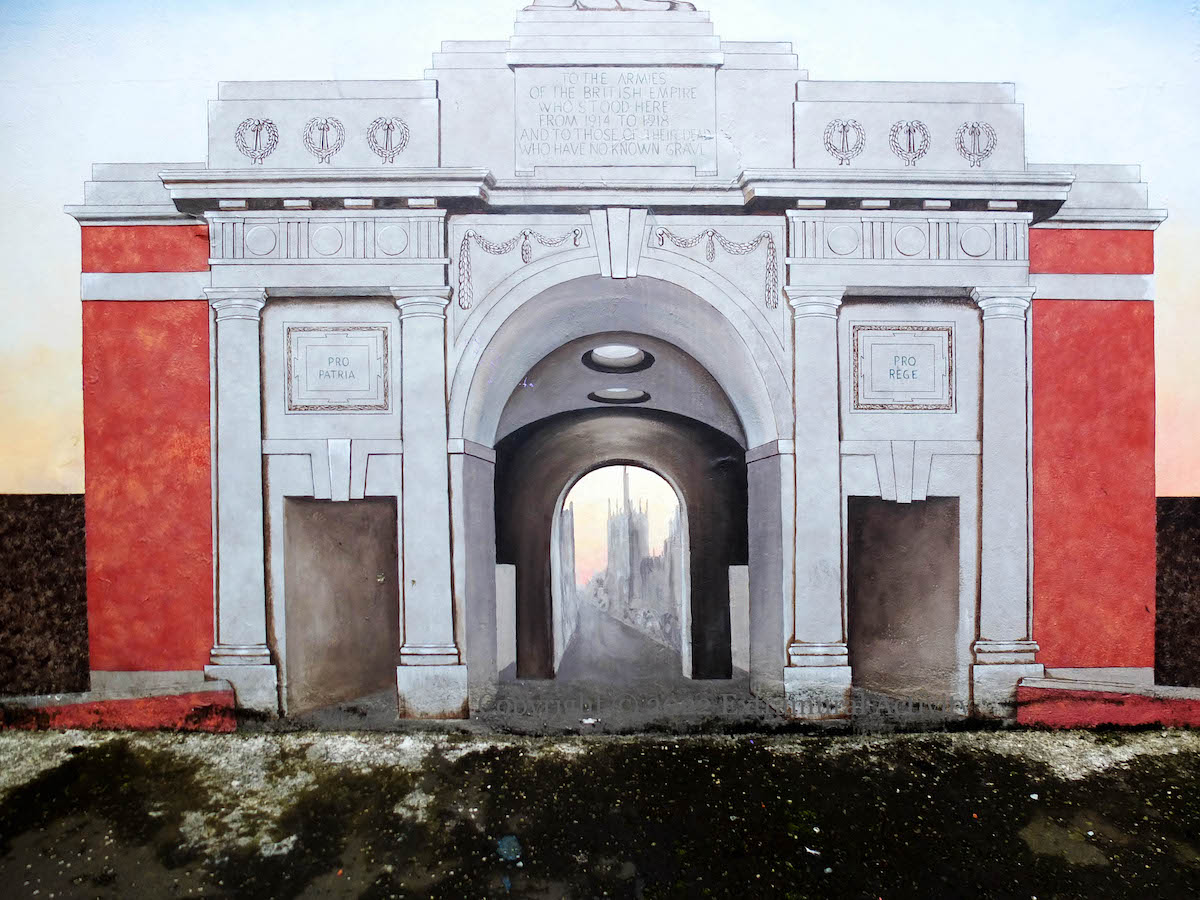
This post updates a 2018 post The Menin Gates with the addition of the side-wall shown above – which is still incomplete – and the two plaques shown in the middle image.
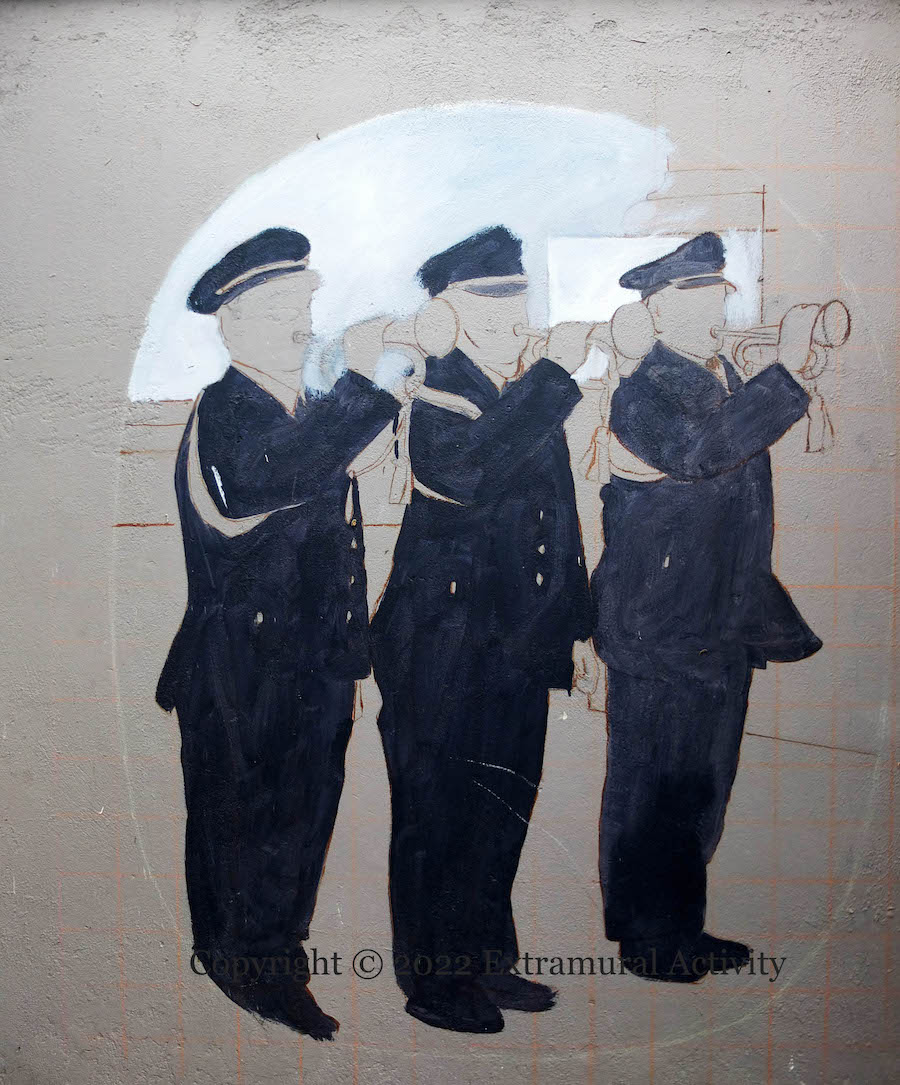
“The Menin Gate And Last Post Ceremony: Every night at 8.00pm (20:00 hours) a moving ceremony takes place under the Menin Gate in Ieper – Ypres. The Last Post Ceremony has become part of the daily life in Ieper (Ypres) and the local people are proud of this simple but moving tribute to the courage and self-sacrifice of those who fell in defence of their town. At 7.30pm the police arrive, and all traffic is stopped from driving through the Menin Gate until 8.30pm. For one hour the noise of traffic echoing around the Menin Gate from the cobbled road ceases. The crowd is hushed. A stillness descends over the memorial. Buglers of the local volunteer Fire Brigade arrive and stand ready at the eastern entrance of the Menin Gate Memorial. At 8.00pm The Last Post is sounded, and a moments [sic] silence is observed. “Réveille” [sic] signifies the end of the ceremony.” “Sponsored by East Bank Rangers Supporters Club“
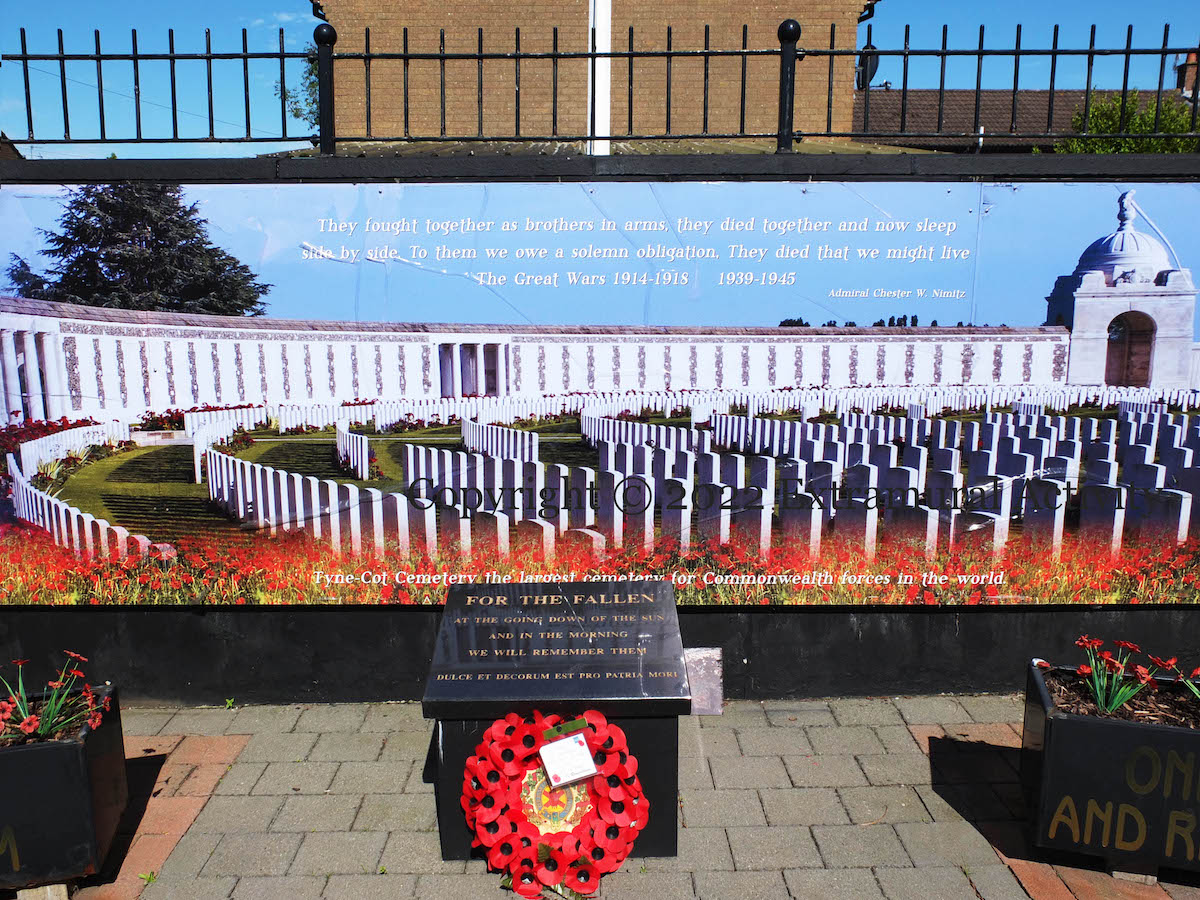
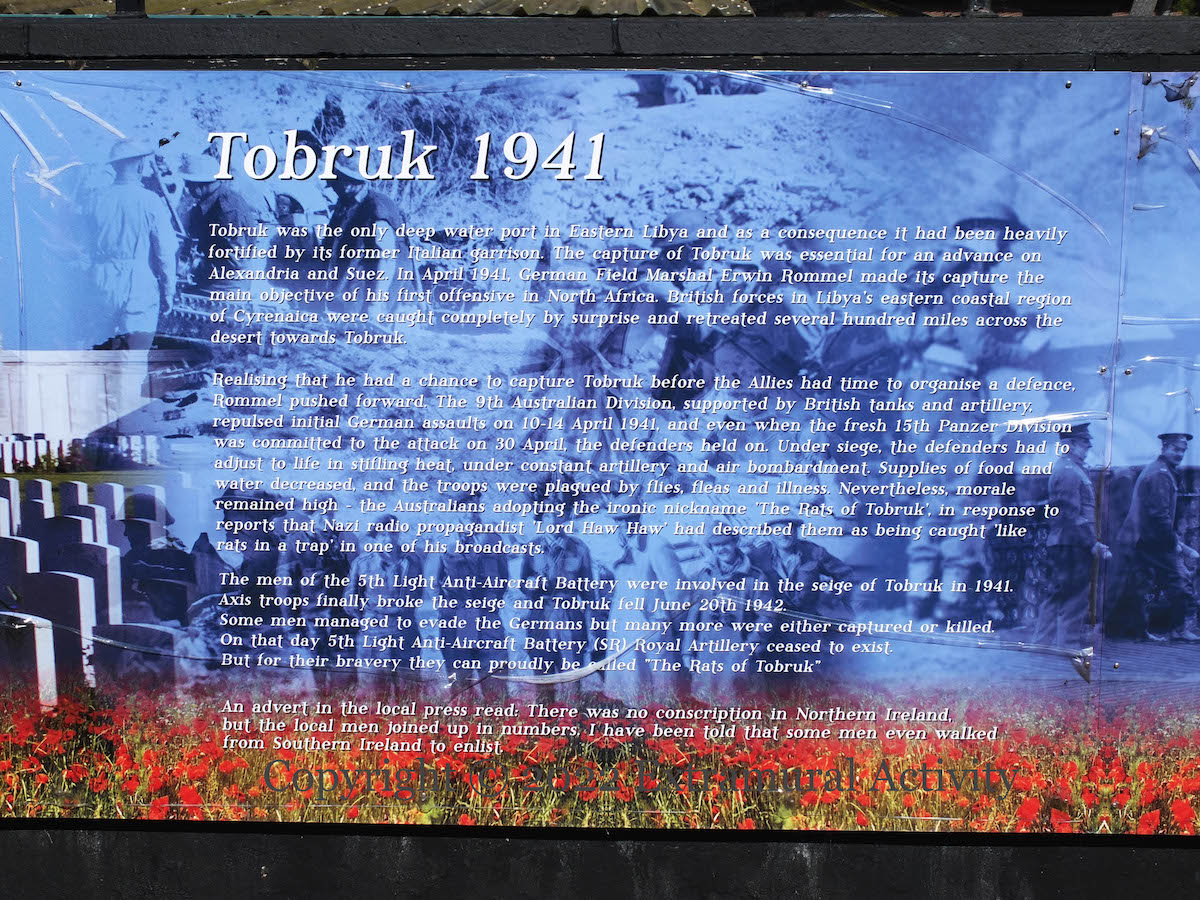
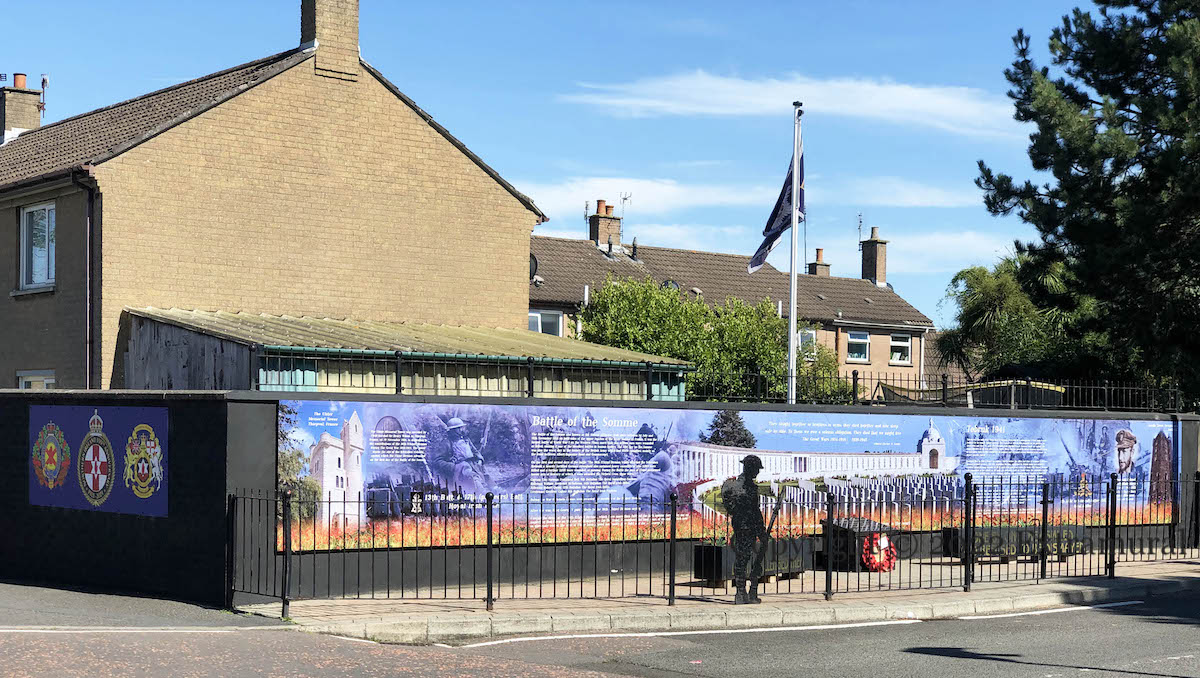
“They fought together as brothers in arms, they died together and now sleep side by side. To them we owe a solemn obligation. They died that we might live. The Great Wars 1914-1918, 1939-1945 – Admiral Chester W Nimitz”. The central image of this Newtownards homage to the men of the 36th (Ulster) Division and the Australian ‘Rats Of Tobruk’ who held that city against Rommel’s forces in north Africa during WWII is the Tyne-Cot cemetery near Passchendaele, Belgium, the biggest Commonwealth cemetery in the world but named ofter the “Tynside cottages” that the German pill-boxes in the area resembled (WP).
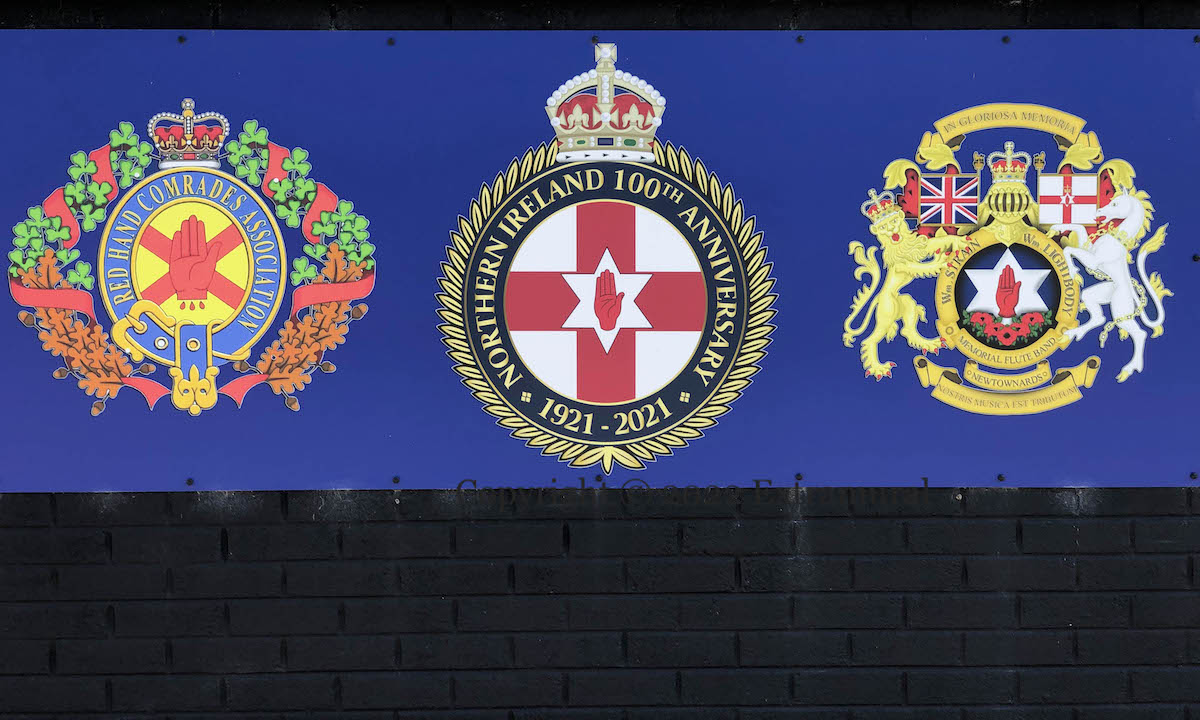
New for the NI centenary are three emblems on the side wall, with (on the left) the Red Hand Comrades Association and (on the right) the Strain-Lightbody Memorial flute band (Fb).
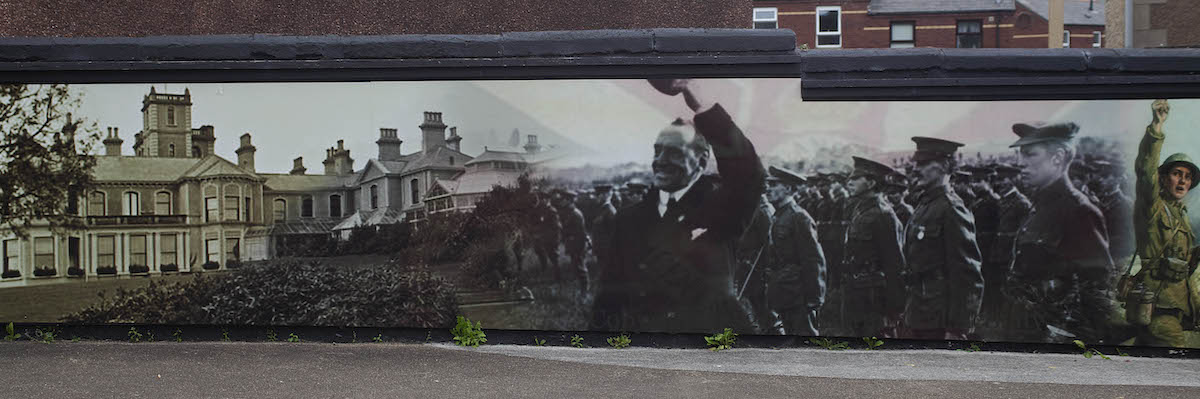
Orange Order Victims day is an annual commemoration (on September 1st) of the 339 members who were killed during the Troubles. The stained glass window reproduced in a board on the Newbuildings memorial garden is in the Museum of Orange Heritage in Schomberg House, south Belfast.
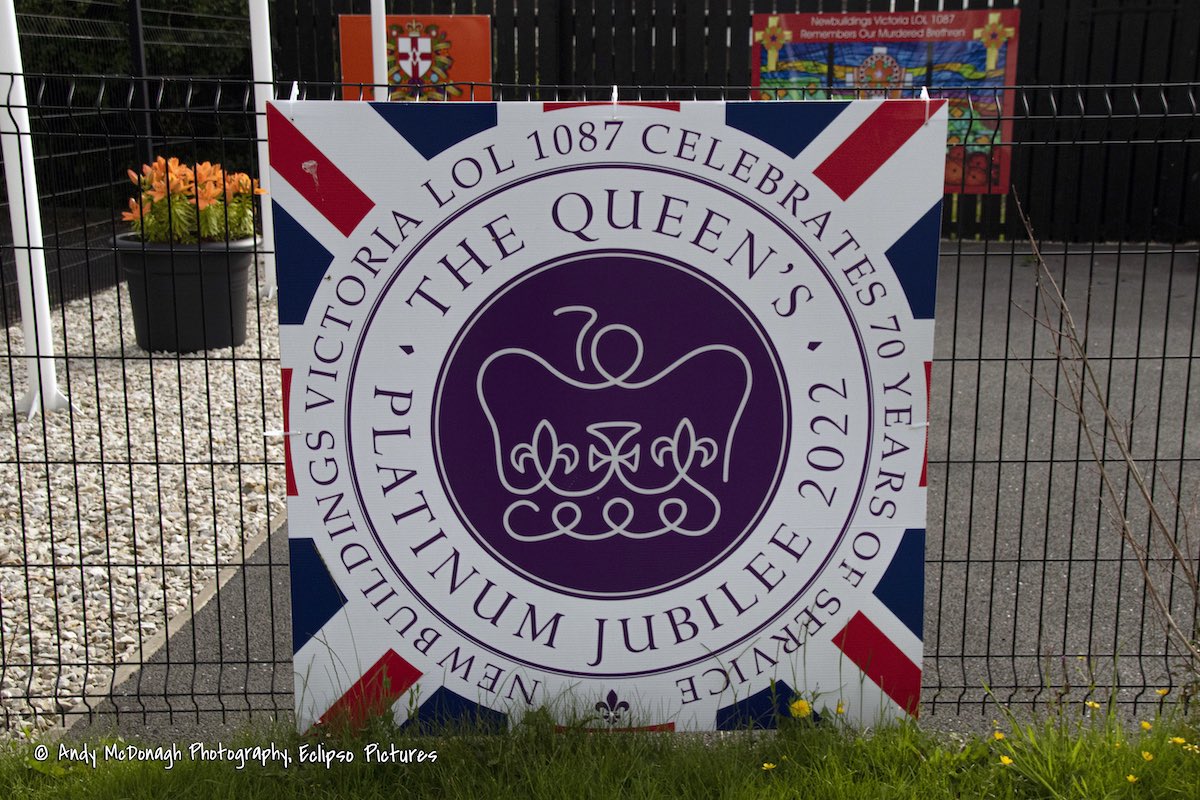
Compared with the garden in 2020 (see Newbuildings Victoria), there is a new NI Centenary board, and on the outside (replacing the tarps giving thanks for the NHS and commemorating the 75th anniversary of VE day) there is a celebration of the platinum jubilee of Queen Elizabeth II. On the electrical box, there is a stencil in support of Bloody Sunday’s “Soldier F”, who continues to face murder charges (for the killings of William McKinney and James Wray) and five attempted murder charges after the PPS’s decision to discontinue prosecution was quashed in March (Guardian); the PPS has appealed (News Letter).
339 Orange Order members killed during the Troubles.
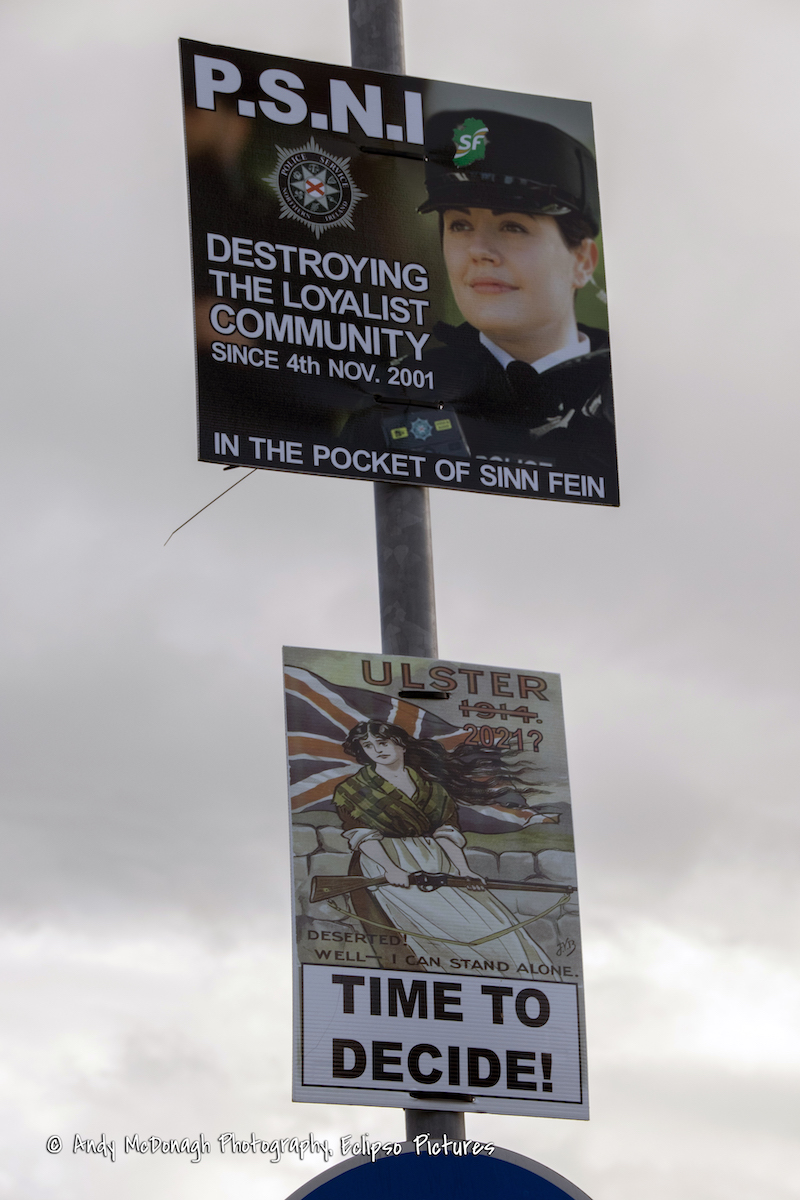
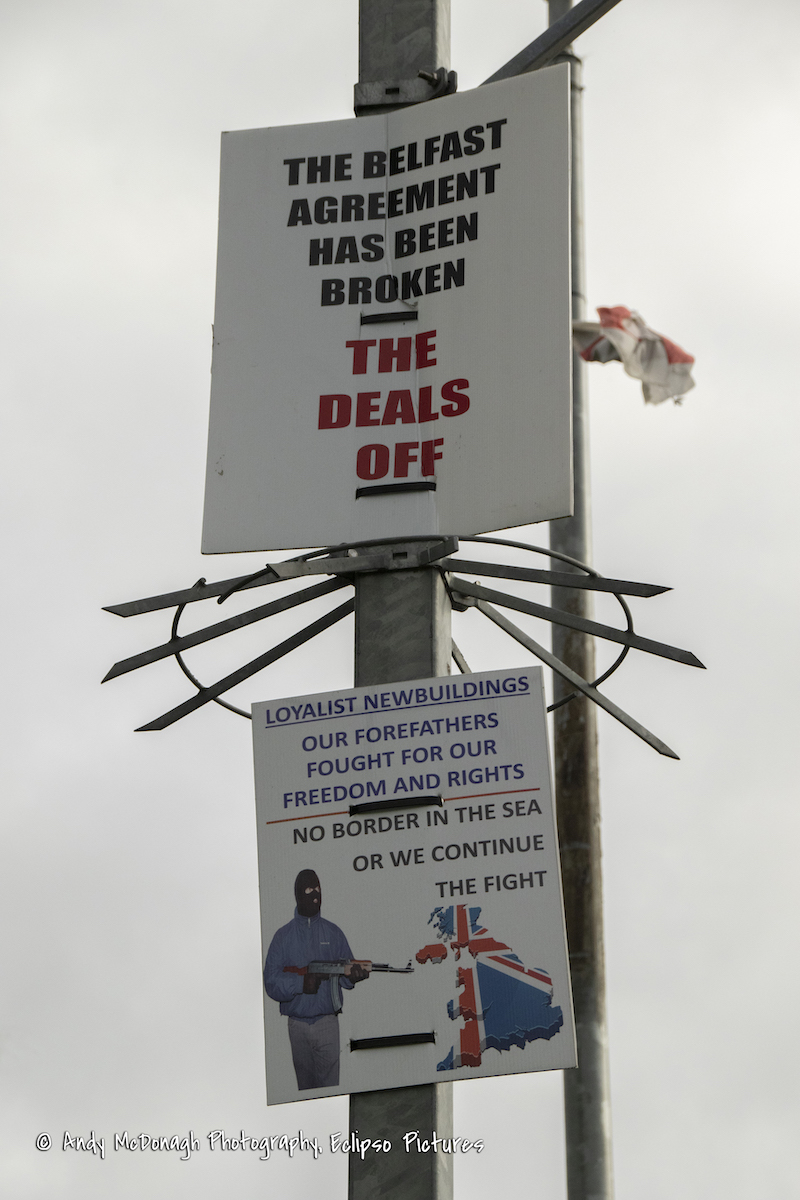
Here is a selection of anti-Protocol placards from the Caw, Londonderry and Newbuildings. Above: a PSNI officer with a Sinn Féin badge – “PSNI – destroying the loyalist community since 4th Nov. 2001. In the pocket of Sinn Féin.” (November 4th, 2001 is the date the PSNI was created.) For the farmer’s wife protecting the farm, see Deserted, well I can stand alone. Below: “Newbuildings says No to Irish Sea border”, “Loyalist Newbuildings will never accept a border in the Irish Sea”, “The Belfast Agreement has been broken – the deal’s off”, and “Our forefathers fought for our freedom and rights/No border in the sea or we continue the fight”.
The 36th (Ulster) Division Memorial Association (Fb) put on a play called From The Shipyard To The Somme (Fb | watch on youtube) in Connswater Community Centre in 2013. It follows a group of men from east Belfast who joined the Ulster Volunteers in Belfast but are now training at Abercorn barracks in Ballykinlar (later an internment camp) as members of the 36th Division, before going to the Battle Of The Somme in France.
Belfast – with one tenth of the population – provided about a third of the Irish soldier to participate in WWI. In the shipyards, Harland & Wolff responded to the slow-down in production not by putting everyone on short time but by letting go of employees, particularly unskilled employees, for whom the wages of soldiering were competitive (particularly if married), while skilled men were reclassified as “munitions workers” needed to fulfill war contracts (History Ireland | Long Kesh Inside Out).
As is often now the case, the modern UVF (McCrea died 1989-02-18 from wounds sustained in the IPLO attack on the Orange Cross, and Mehaffy on 1991-11-13, shot by the IRA in nearby Lecale Street) is mixed in with the 1912 anti-Home Rule Ulster Volunteers and Young Citizen Volunteers, which are themselves blended together with WWI and the 36th (Ulster) Division of 1914-1918.


















 Extramural Activity