Here are two images of modified Israeli flags, protesting the incursion into Gaza. The first, above is on the Divis tower and shows a tricolour flying next to an Israeli flag with swastikas. The second, below, is from Monday’s protest march outside Belfast City Hall and shows a young girl covering her eyes beneath an Israeli flag covered in red (bloody) hand-prints.
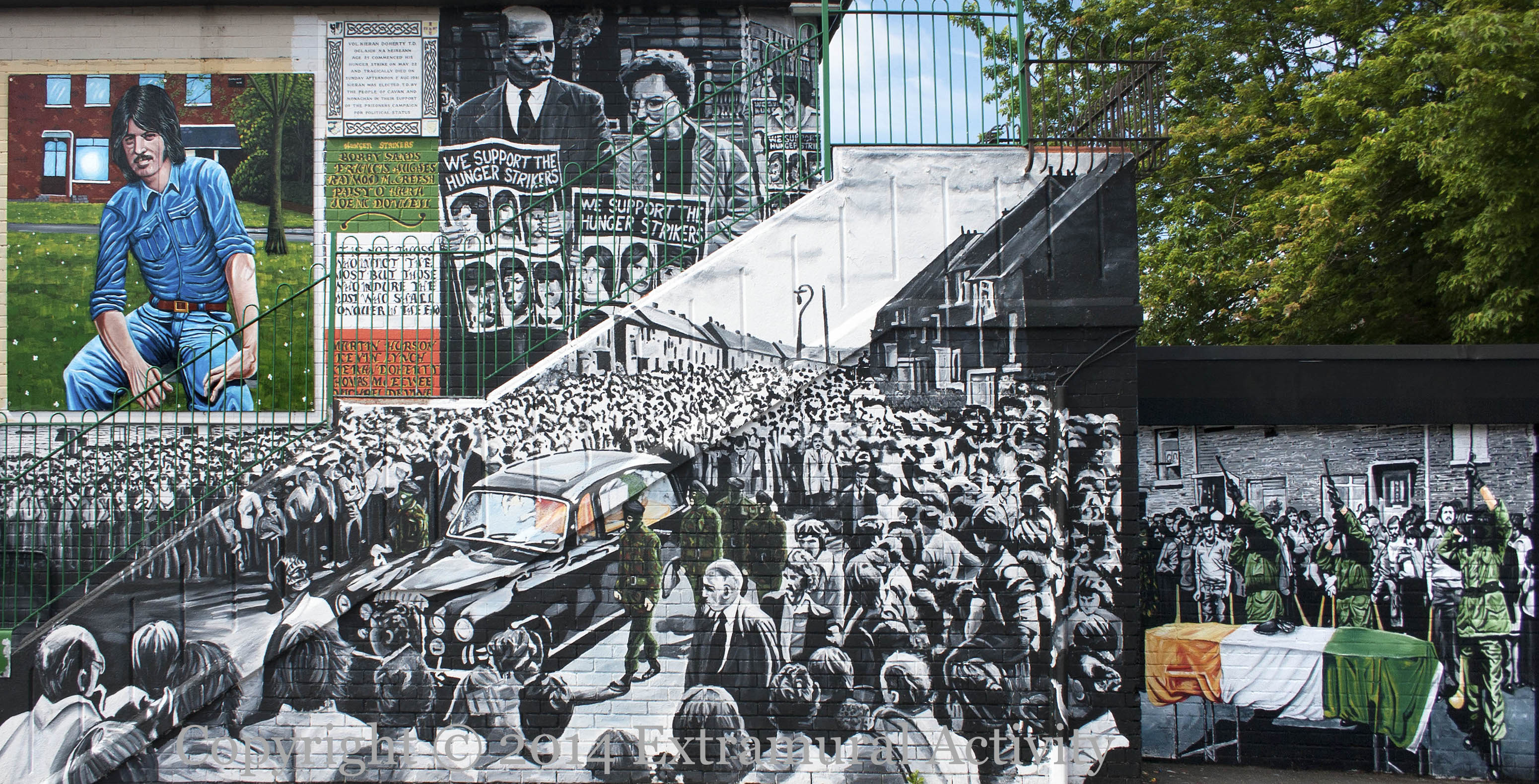
Kieran Doherty died on this date (August 2nd) 1981 after 73 days on hunger-strike. The new mural above depicts scenes from his funeral on 1981-08-04. The portrait of Doherty in the top left replaces a similar one in the same location; the plaque at the portrait’s top-right corner remains from before. The angled panel shows Doherty’s parents, Alfie and Margaret.
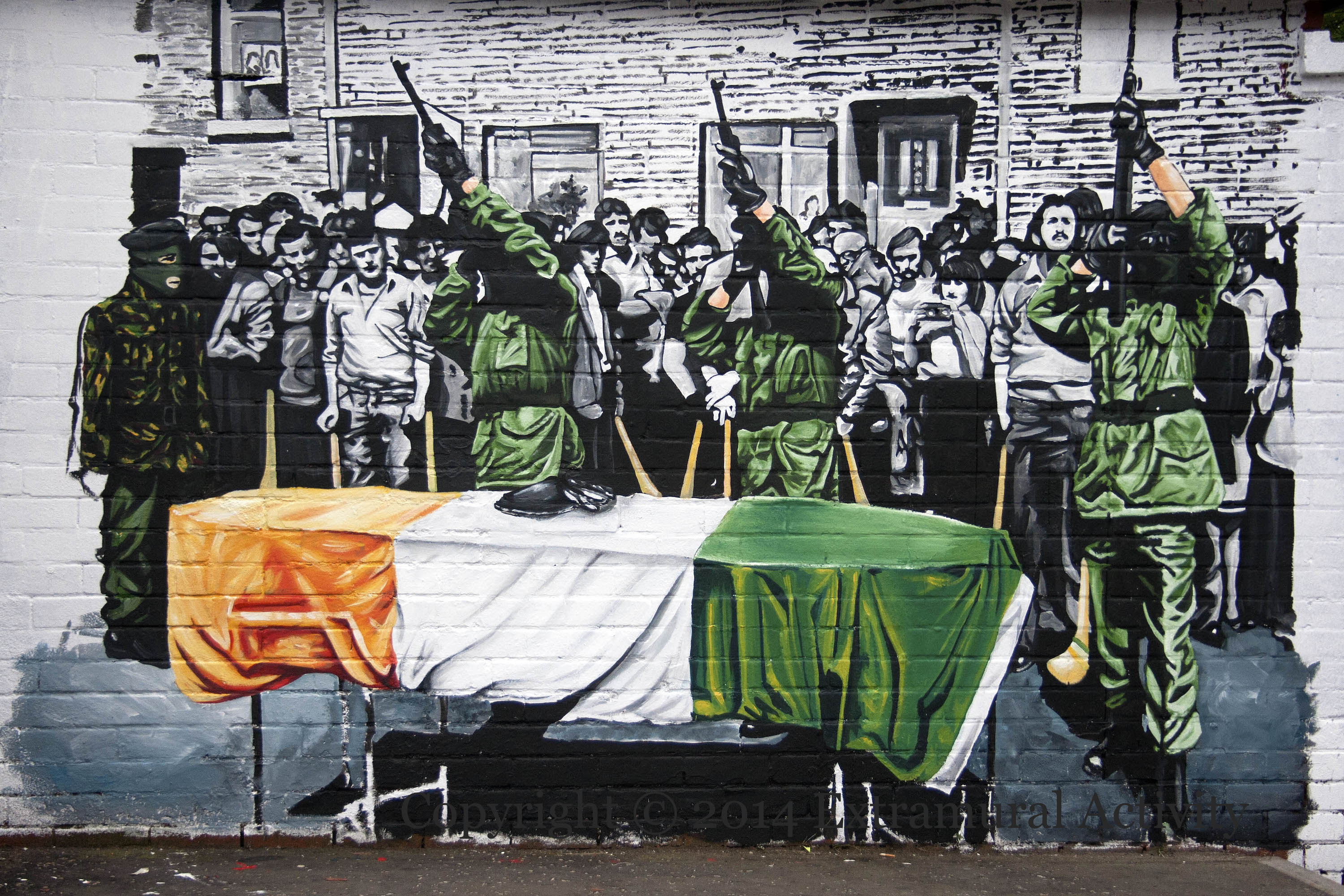
Below are two details – the hearse and the volley – taken in early July but at that time largely complete. At this time, the (in-progress) mural drew criticism for featuring masked gunmen (BBC | Tele). Finally, there is a shot of the whole wall at an early stage.
The photograph on which the central panel is based is by Derek Spiers; see also this set at hungerstrikes.org. The volley took place outside the Doherty family home in nearby Commedagh Drive (Belfast Media).
Above is a new board (on painted background) at the Falls Road Garden of Remembrance for IRA volunteers in D company (the ‘Dogs’) of the 2nd battalion Belfast Brigade and local civilians from the lower Falls who died in the 20s, 70s and 90s. The main board shows a map of the area from Dunville Park to the Divis flats with lilies marking the spots of various deaths. Surrounding it are the portraits of fourteen of the volunteers listed on the marble – Maguire, O’Rawe, McKelney, Donaghy, Quigley, McAreavey, Hughes, Loughran, MacBride, Kelly, Carson, Campbell, Skillen, Marley.
Below is a wide shot showing the garden and mural.
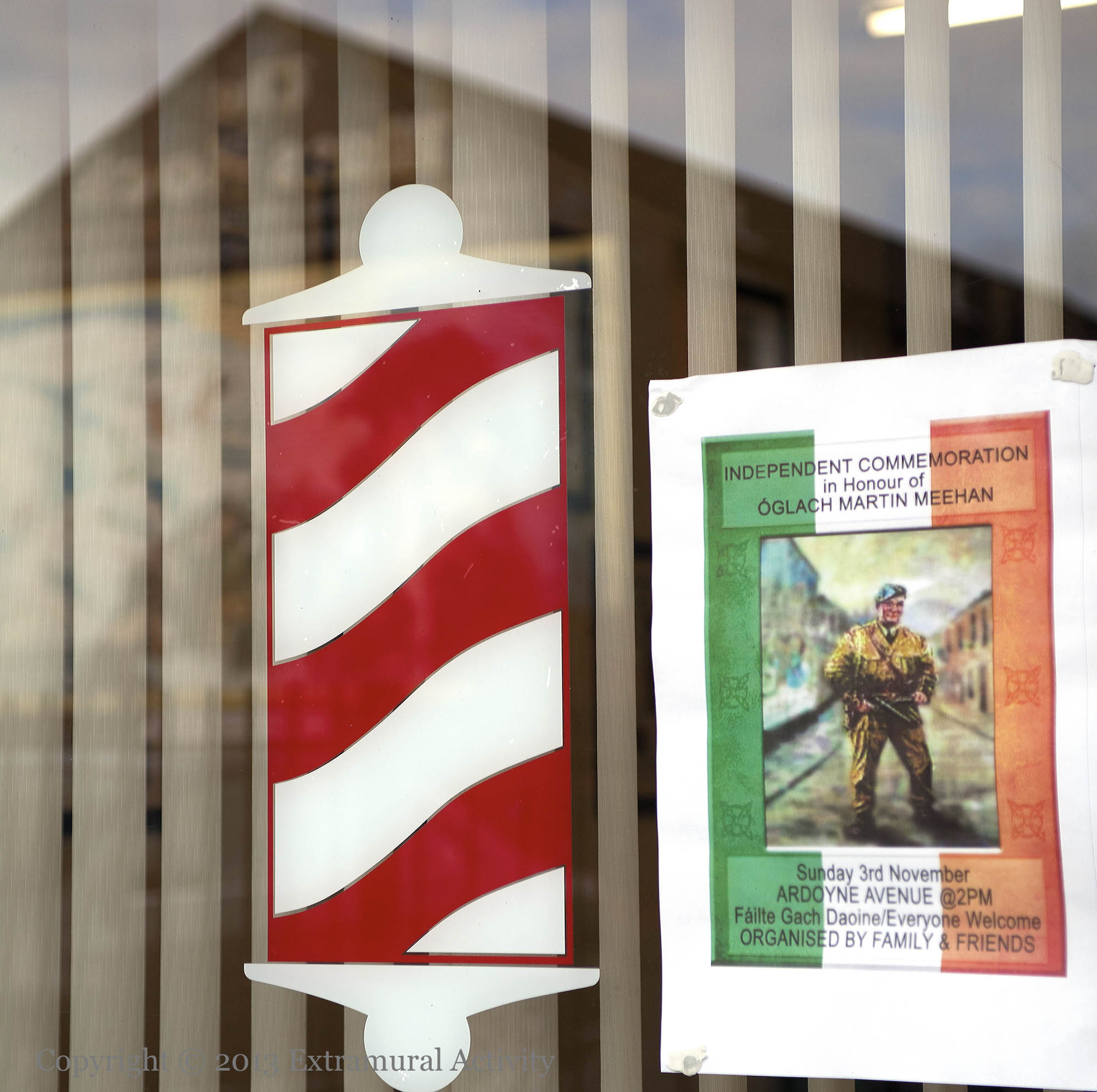
Above is a recently unveiled printed banner to Martin Meehan, an IRA volunteer from the local Ardoyne area. As can be seen from the flyer in the second image, the launch took place on November 3rd, on the sixth anniversary of his death. A gallery of images of the launch can be found at Demotix. The photograph which informs the controversial central portion can be seen on Meehan’s WP page. The piece was paint-bombed on Nov. 6th (Irish News)
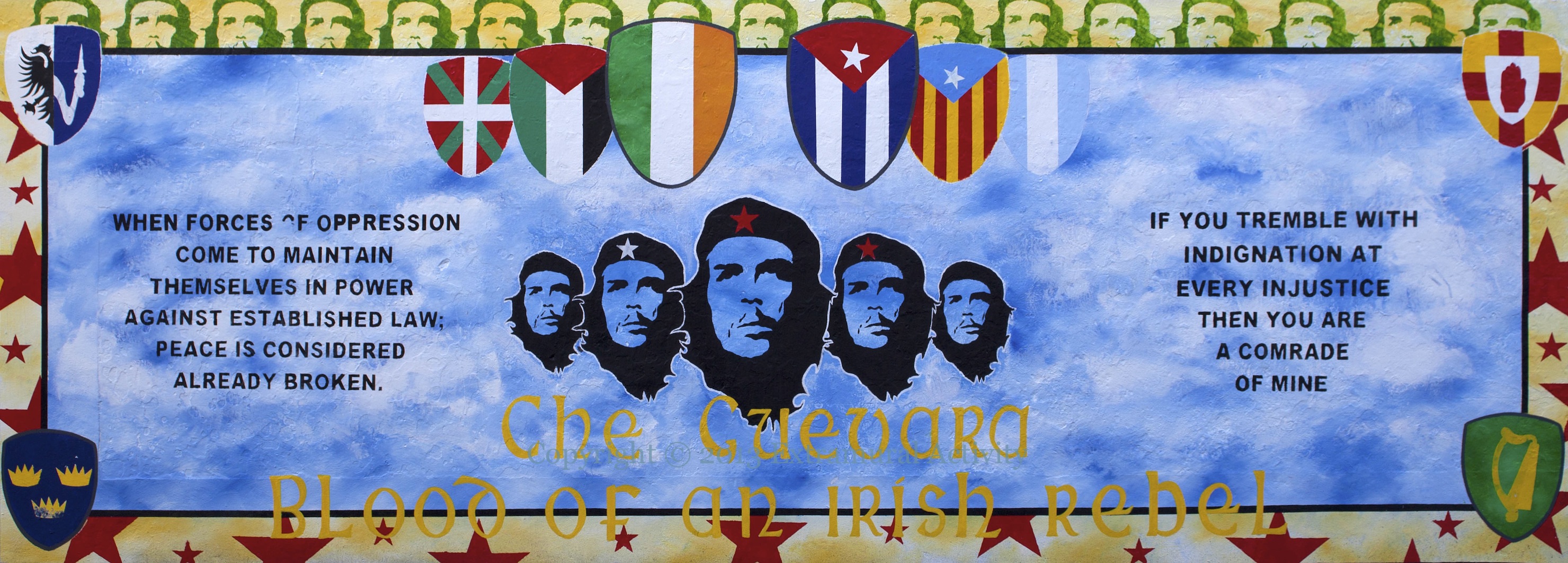
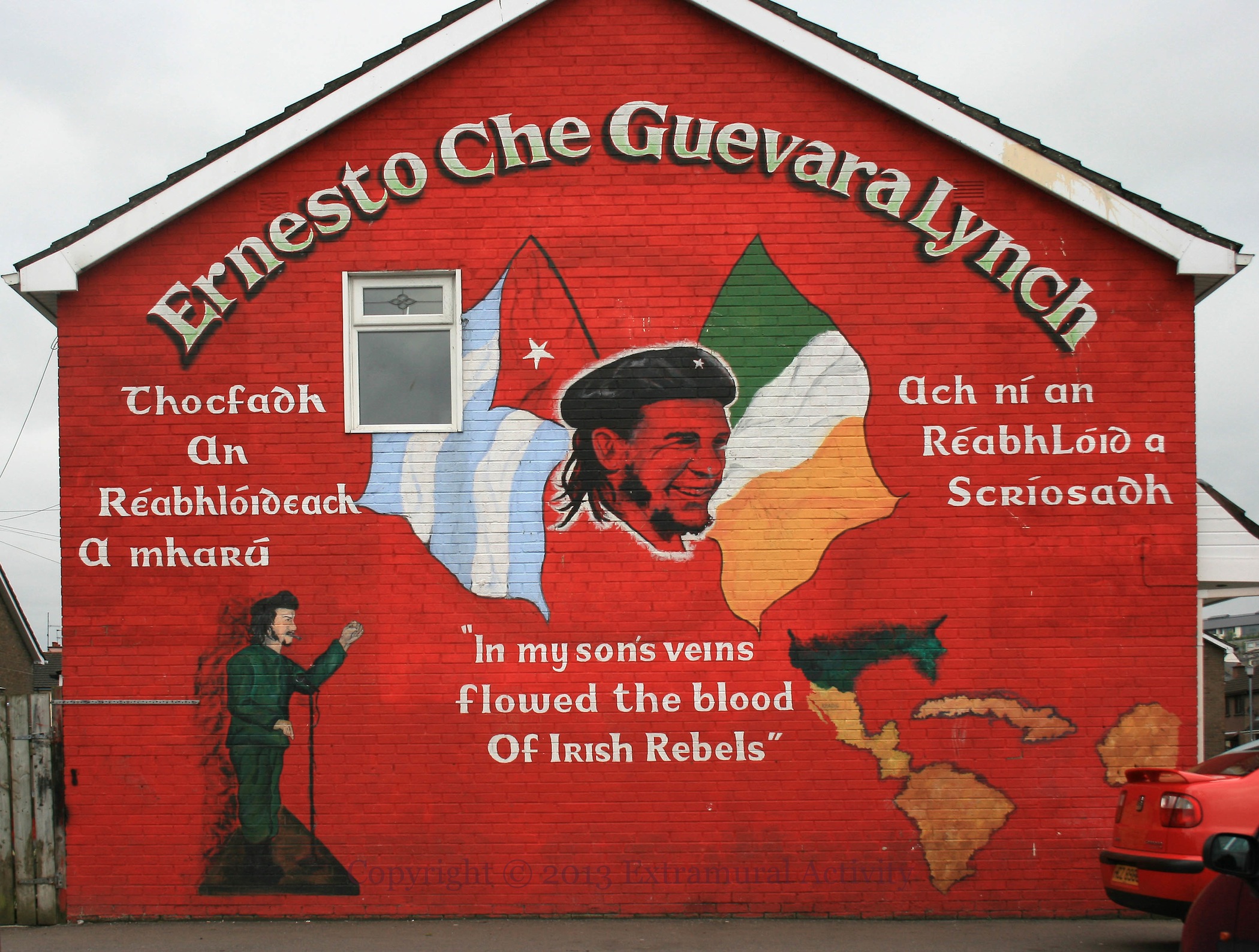
“Che Guevara – Blood of an Irish rebel.” A colourful new mural has been completed on the Falls Road (at the end of McQuillan Street) in time for the anniversary of Che Guevara’s death, on October 9th, 1967. The mural features multiple copies of Korda’s iconic Guerillero Heroico (discussed in the Visual History page on Jim Fitzpatrick), two quotes from Che – “When forces of oppression come to maintain themselves in power against established law, peace is considered already broken” and “If you tremble with indignation at every injustice then you are a comrade of mine” – and the flags of (from left to right) the Basque Country, Palestine, Ireland, Cuba, Catalonia and Argentina (where Che was born; or perhaps Guatemala, where he was first active – the shield above contains no central icon, which would distinguish the flags).
Che’s father declared that the blood of Irish rebels ran through his son, in reference to their Irish ancestry. For genealogical information, see the previous entry on the Che Guevara Lynch mural in Derry.
The artist is Damian “DeeDee” Walker, of the Gaelforce group. The piece has been in progress for about a month.
Poster from the 1916 Societies (Fb), specifically the West Belfast Joe McKelvey Society, named after the anti-treaty IRA commander (WP). (There is also a society named after McKelvey in his home town of Stewartstown, Co Tyrone. (Fb)) The flag (shown below) is in the Republican Museum, Conway Mill.
“Che” Guevara’s father, also called Ernesto Guevara Lynch, was an Argentinian descended from Patrick Lynch, who emigrated from Galway (in 1742?) and married in Buenos Aries in 1749. (Based on these rodovid pages: one | two | three.) Che’s father is the source of the quote at the bottom of the mural: “In my son’s veins flowed the blood of Irish rebels.”
The Irish inscription, “Thocfadh [Thıocfadh] an réabhlóıdeach a mharú ach ní an réabhlóıd a scríosadh [scrıosadh]”, means (roughly) “It’s possible to kill the revolutionary person but not to destroy the revolution.”
This mural is on Fahan Street in the Bogside, Derry/Doıre.
This is a memorial stone on Springhill Avenue in Ballymurphy to deceased republican volunteers from the area. This stone can be seen in the middle distance in first image in the post White Line, Black Flag.
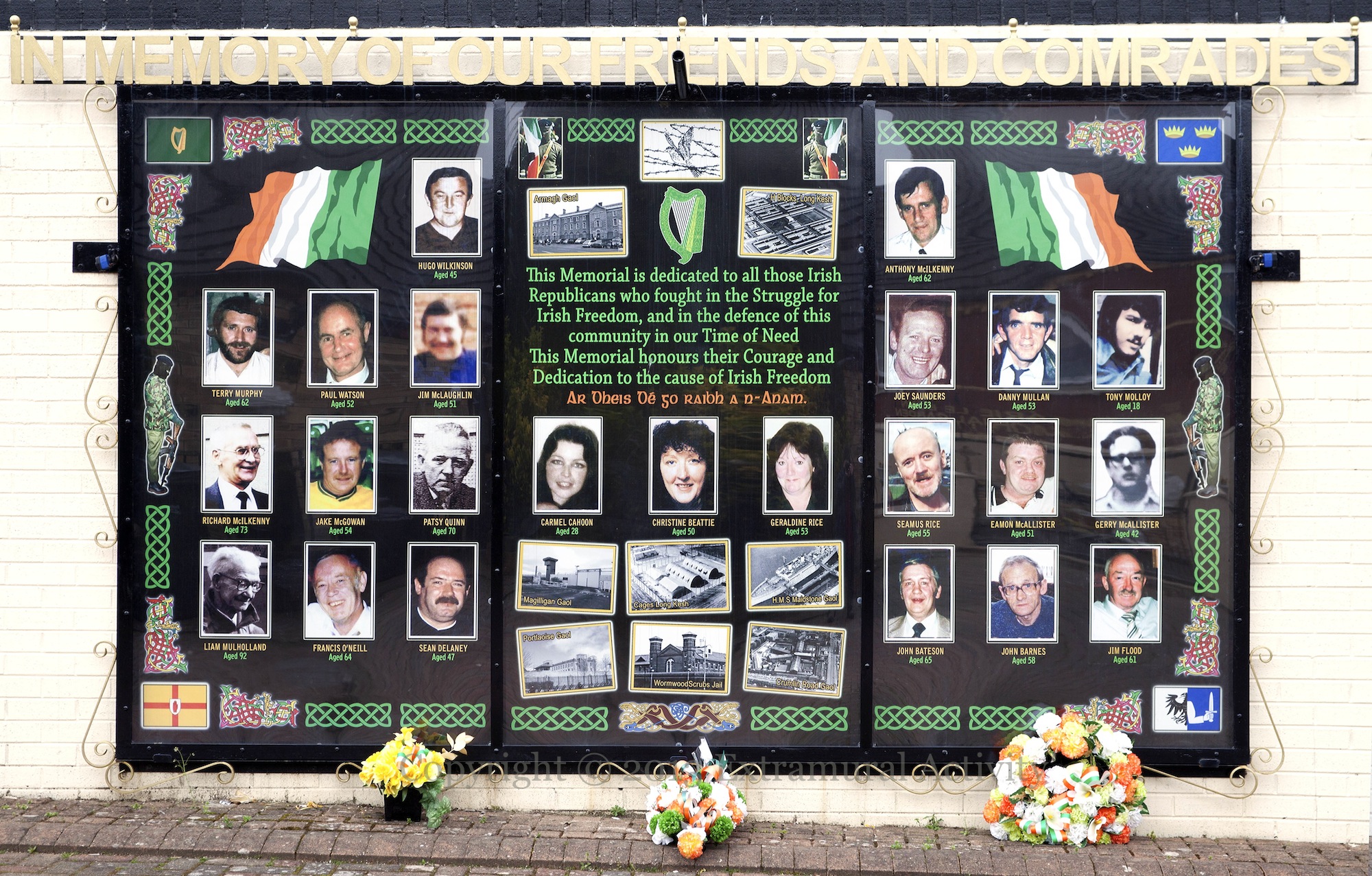
A fourth piece from Clós Ard An Lao/Ardilea Close, a short, dead-end, street in Ard Eoın/Ardoyne. “In memory of our friends and comrades. This memorial is dedicated to all those Irish Republicans who fought in the struggle for Irish freedom and in the defence of this community in our time of need. The memorial honours their courage and dedication to the cause of Irish freedom. Ar dheıs Dé go raıbh a n-anam.”
The Clowney Street phoenix, which dates back to 1981 (see The Oldest Murals), has been repainted, and above, the blanketmen painting (see 1981-2011) has been replaced with a montage of photographs from the period, including prisoners on the blanket and dirty protest, the funeral of Sands and of McDonnell, and three pieces of graffiti: “Thirty thousands can’t be wrong” (Sands’s election to Westminster), “Bobby Sands murdered 1.17 am 5th May 1981”, and “My position is in total contrast to that of an ordinary prisoner. I am a political prisoner.”









 Extramural Activity