A Panorama Of Republicanism

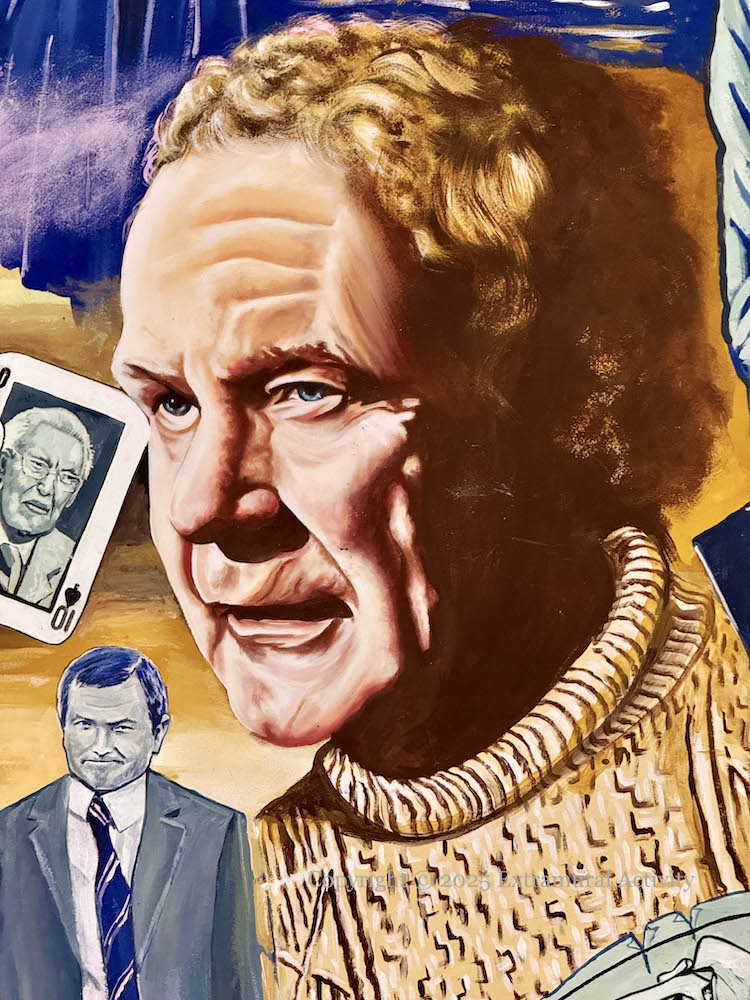
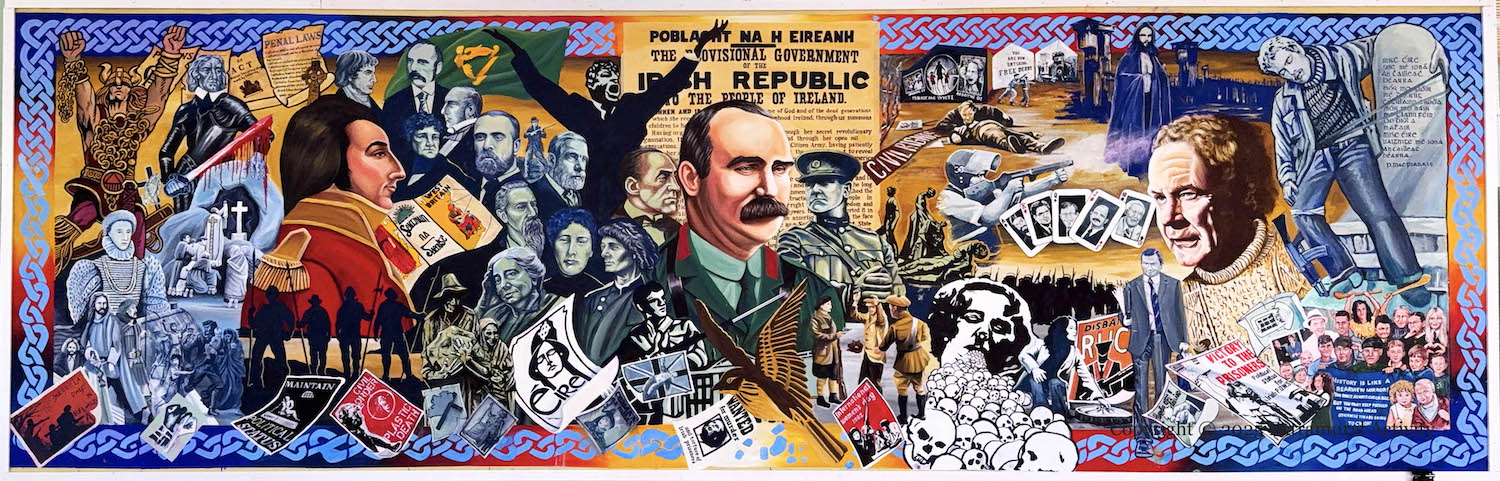
Féıle An Phobaıl (web) is now headquartered in the renovated (BCC) St Comgall’s on Divis Street in Ionad Eileen Howell, and during this year’s (2025) festival is home to an exhibition called “Vibrant Colours, Violent Past”, the centrepiece of which is a 20-foot-long panoramic history of republicanism, with Wolfe Tone, James Connolly, and Martin McGuinness as pivotal figures.

A full legend of who’s who is given in the leaflet at the bottom of this entry. It also explains the genesis of the project, as follows:

“A few years ago I met a great friend of Ireland and art collector Darius Anderson from California who was here on a trip with his wife Wendy and hoping to see some new work by Irish artists, not only work destined for gallery walls but having been fortunate to be included on one of local guide Dee Morgan’s tours he developed a love for and focus on our world-recognised mural art tradition.

“Then last year on another trip here I was able to introduce Darius to my life-long friends and probably the most prolific contributors to our local landscape.

“From a casual meeting alongside Marty and Micky at work repainting the Vol. Kieran Doherty mural in Andersonstown came an inspired suggestion that we accept a challenge from him to tell our story graphically on a canvas rather than the usual brick wall, not just on canvas to hang on a wall in his gallery in L.A. but a canvas to cover the entire wall 20ft x 7ft!

“Excited by our positive response Darius wondered could we invite some loyalist artist/activist to contribute a similar large canvas celebrating the history of the British, Unionist, Loyalist community here.

“That was last July. This exhibition is a result of that meeting but also a chance for the public to remind themselves of our often colourful and unfortunately violent past. – Danny D, Muralist/Activist”

“History is like a rearview mirror! You must always check back but you must keep focused on the road ahead, otherwise you are going to crash!” (Similar wording was used in a piece – Painting From The Same Palette – painted by Danny D and Mark Ervine in 2008.)

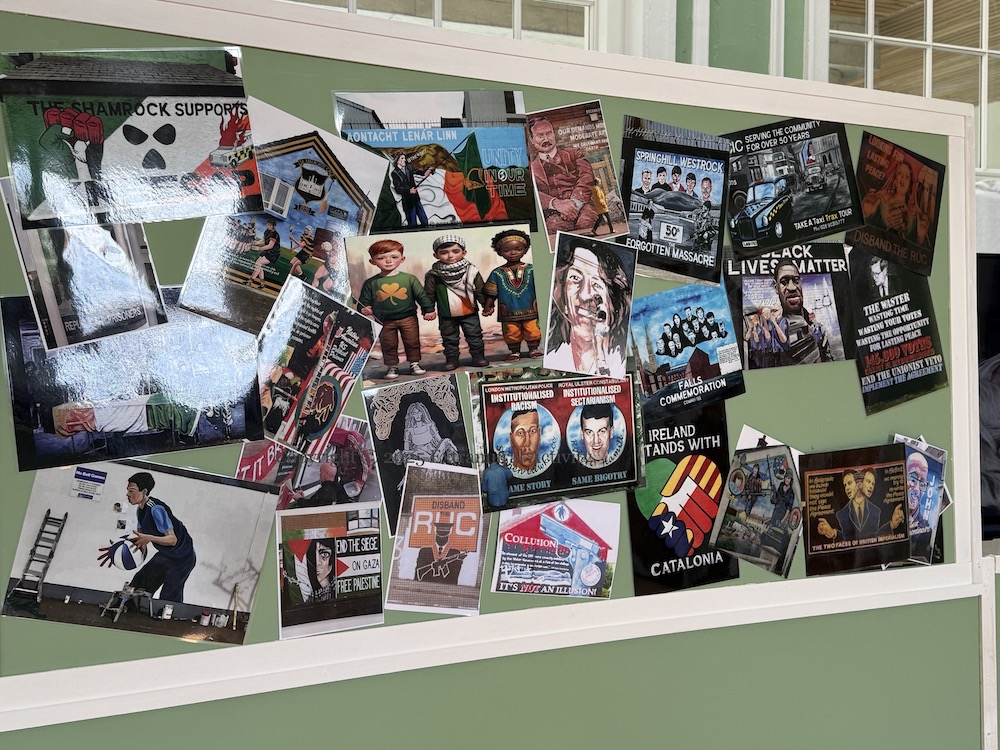
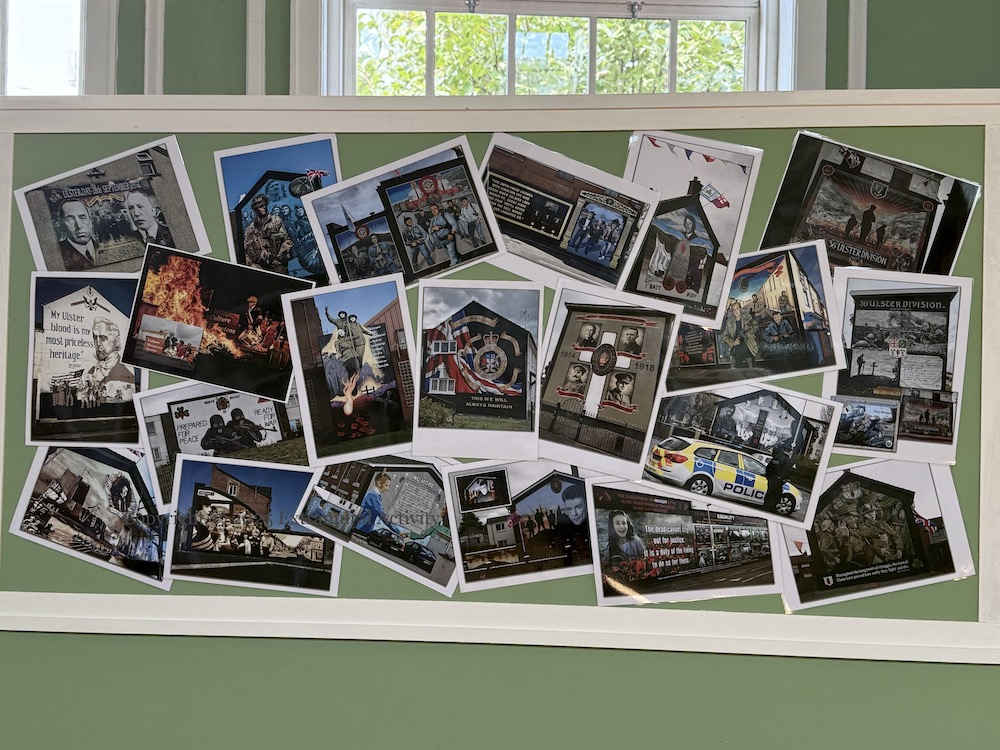
The exhibition was launched on August 1st and also included four display boards featuring murals by Danny D (CNR) and Dee Craig (PUL) (Fb).
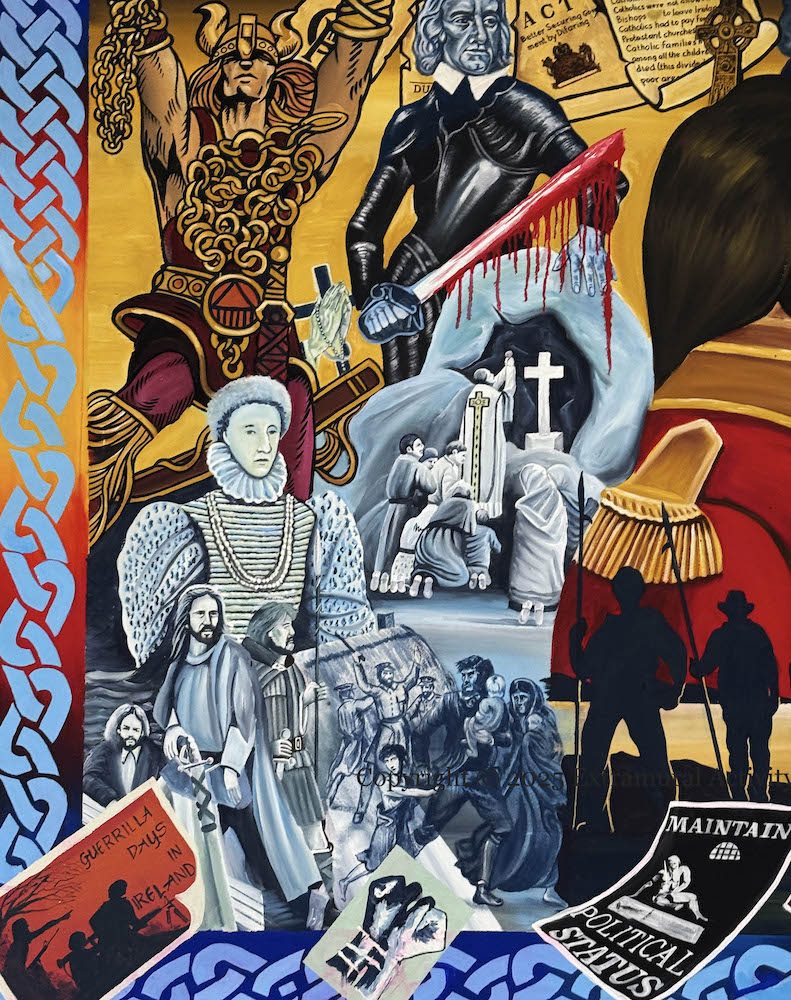
Display boards:
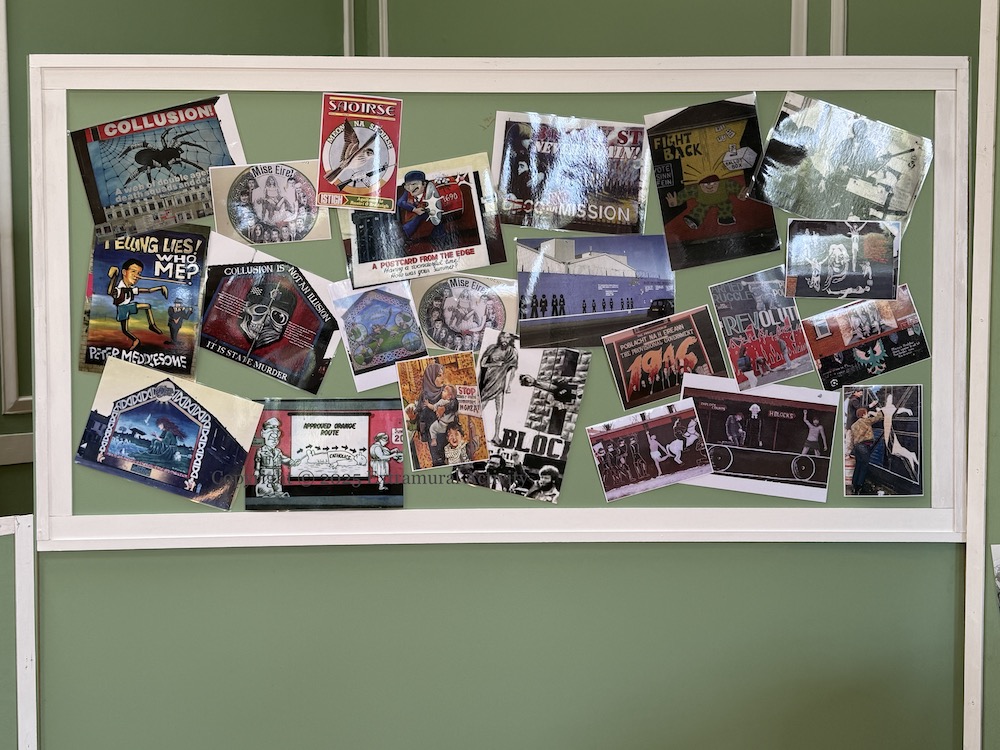
Images from the launch on August 1st, along with the two-sided leaflet:

Click image to enlarge
Copyright © 2025 Seosamh Mac Coılle
Panorama: X15618 X15619 X15620 X15621 [X15622] X15623 [X15624] [X15625] X15626 [X15627] X15628 X15629 X15630 X15631 X15632
Displays: [X15633] X15634 X15635 X15636 X15637
Launch & Leaflet: X15638 [X15639] [X15640] X15641 X15642 [X15643] [X15644] [X15645] X15646 X15647
Maggie McAnaney

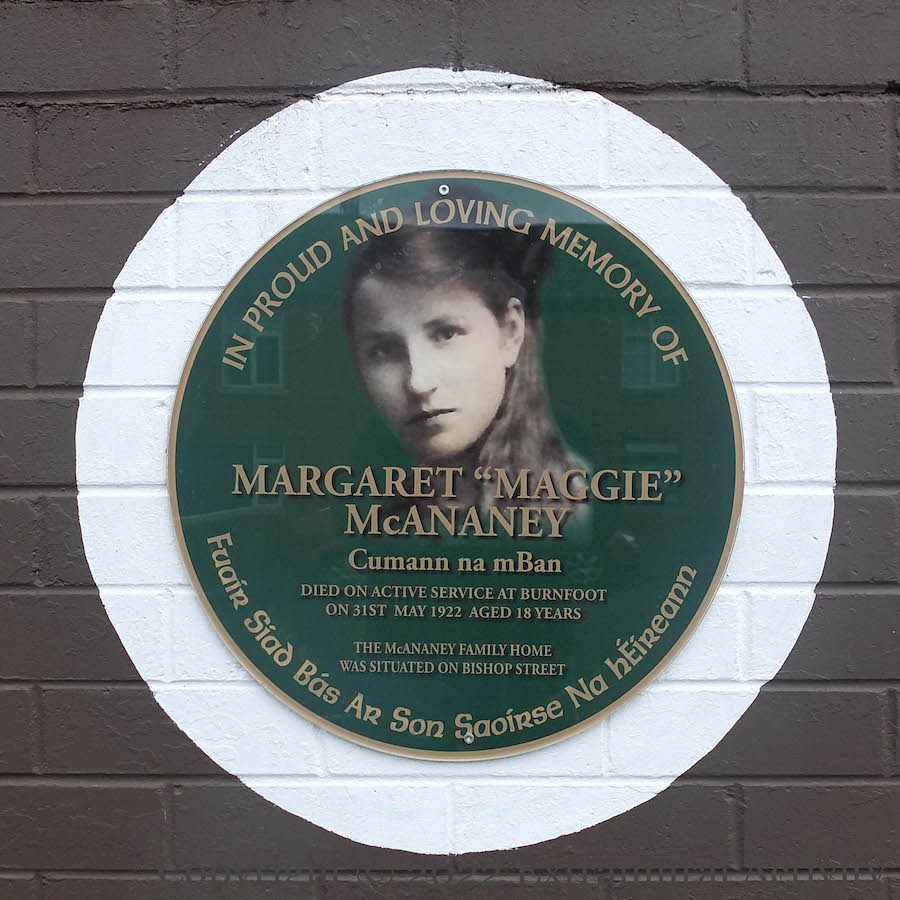
A plaque was mounted this (2022) summer to Maggie McAnaney, who died when a gun went off at an IRA checkpoint near Burnfoot, Co. Donegal, a month before the Civil War began (Derry Journal). This is an unusual use of the phrase “active service”, as McAnaney was travelling to a picnic at the time, rather than on exercises or preparing munitions; the phrase would later come to be associated primarily with a premature bomb explosion.

“In proud and loving memory of Margaret “Maggie” McAnaney, Cumann na mBan, died on active service at Burnfoot on 31st May 1922, aged 18 years. The McAnaney family home was situated on Bishop Street. Fuaır sıad bás ar son saoırse na hÉıreann.”

Derry Journal has images from the launch.

Click image to enlarge
Copyright © 2022 Seosamh Mac Coılle
X10825 Bishop St

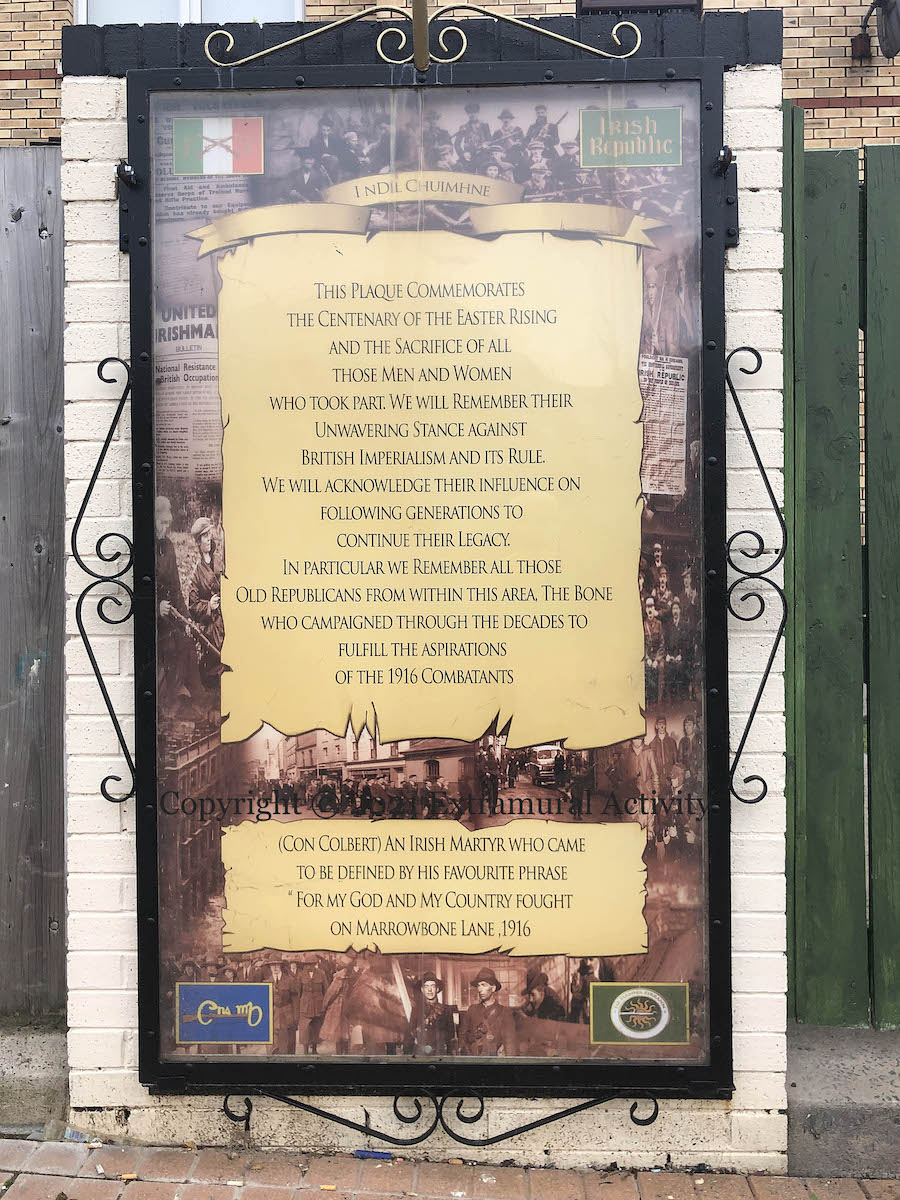
Continuing Their Legacy

“This plaque commemorates the centenary of the Easter Rising and the sacrifice of all those men and women who took part. We will remember their unwavering stance against British imperialism and its rule. We will acknowledge their influence on following generations to continue their legacy. In particular we remember all those old republicans from within this area, the Bone, who campaigned through the decades to fulfill the aspirations of the 1916 combatants. (Con Colbert) An Irish martyr who came to be defined by his favourite phrase “For my God and my country” fought on Marrowbone Lane [Dublin], 1916″.

Click image to enlarge
Copyright © 2021 Seosamh Mac Coılle
X08361

The Old IRA

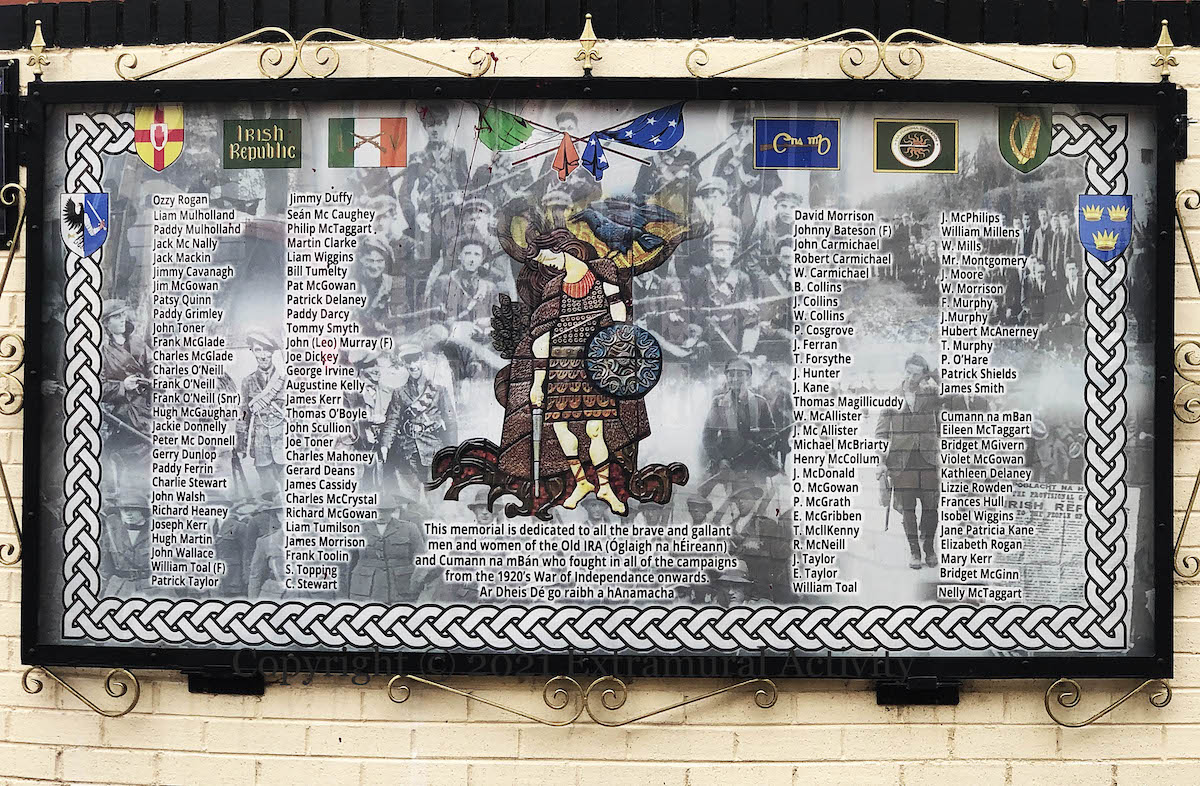
Cú Chulaınn stands dying; the raven on his shoulder will signal his death. “This memorial is dedicated to all the brave and gallant men and women of the Old IRA (Óglaıgh na hÉıreann) and Cumann Na mBán who fought in all of the campaigns from the 1920s War of Independence onwards.”

The Irish tricolour with crossed rifles was the flag of the Irish Volunteers (Óglaıgh na hÉıreann), the splits in which gave rise all the subsequent IRAs.

For a roll of honour 1916-1966, including some profiles, see Treason Felony.

Click image to enlarge
Copyright © 2021 Seosamh Mac Coılle
X08359 [X07822] Ardilea

The First Dáıl

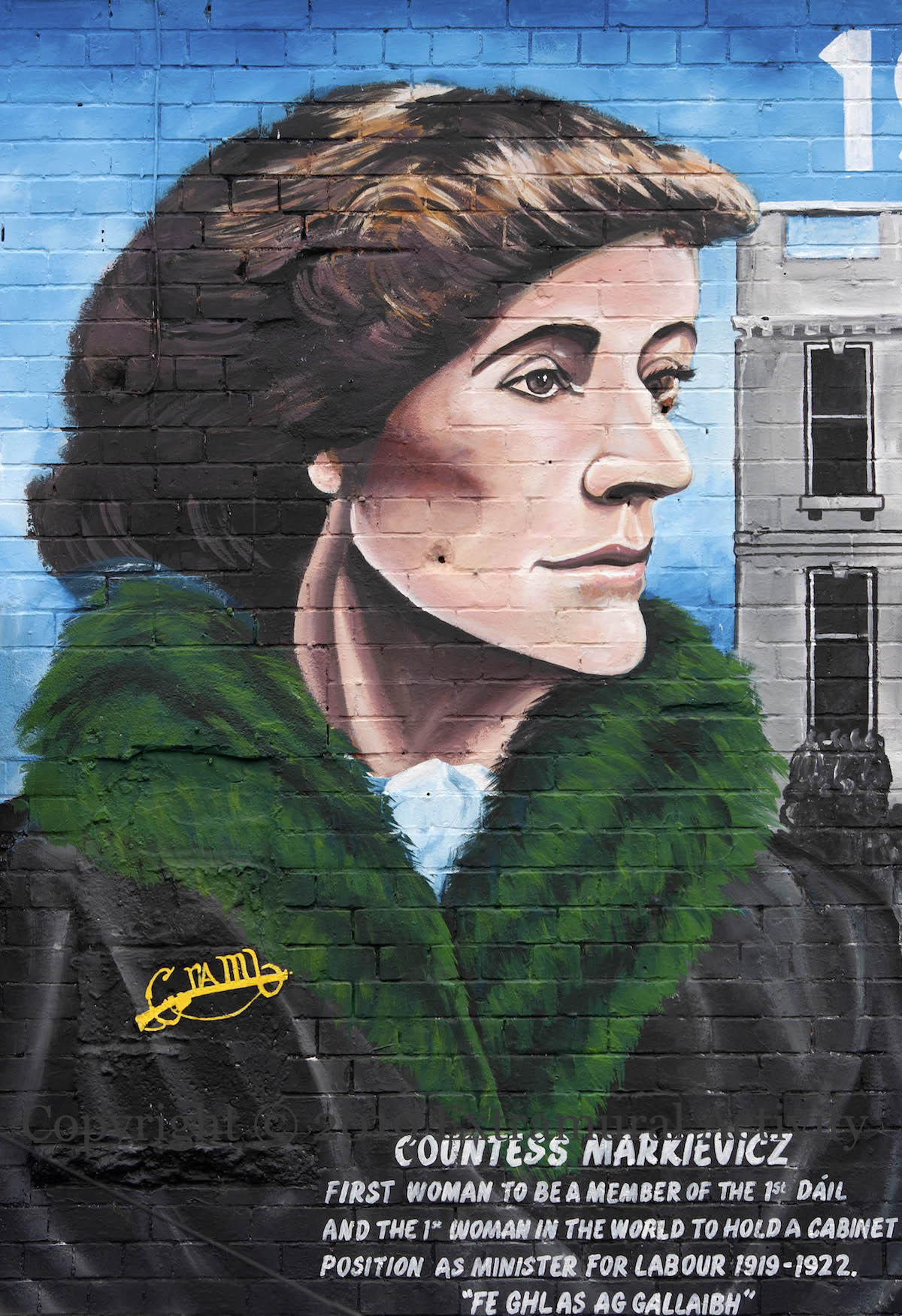
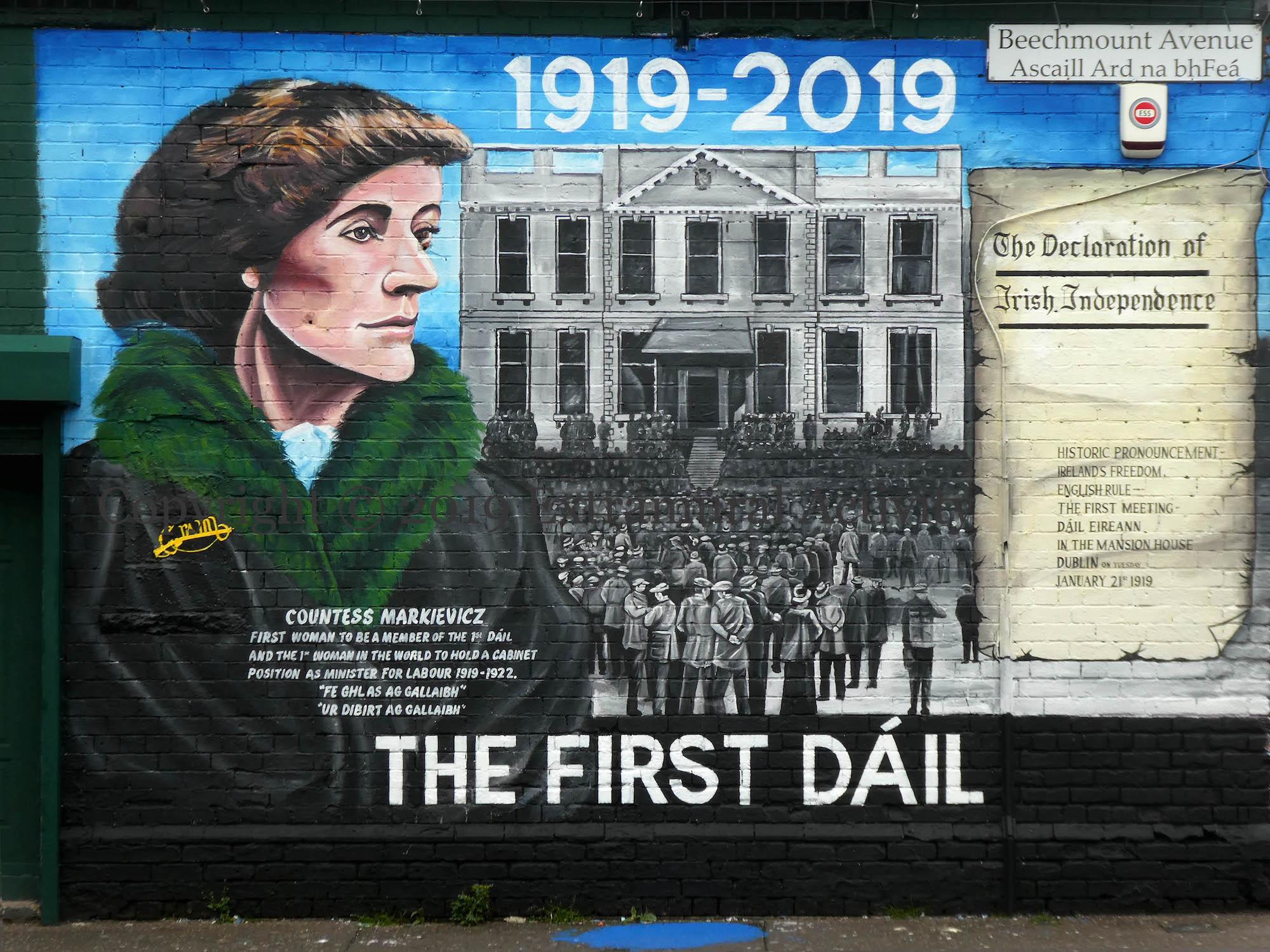
“Countess Markievicz – first woman to be a member of the 1st Dáıl and the 1st woman in the world to hold a cabinet position as minister for labour 1919-1922.” Markievicz is shown here in civilian garb with a Cumann na mBan pin – compare with the previous mural celebrating the centenary of CnamB. The first Dáil Éireann met in the Round Room of the Mansion House in Dublin (residence of the Lord Mayor) on January 21st, 1919. 35 Sinn Féin deputies – including Markievicz – were absent because they were “fé ghlas ag Gallaıbh” (“imprisoned by foreigners”) and four more “ar díbırt ag Gallaıbh” (deported by foreigners); Unionist members including Edward Carson did not attend (The Irish Story). Among its business was the adoption of a Declaration Of Irish Independence (title page shown on the right).

The photograph reproduced is of the crowd awaiting news of a truce in the War Of Independence in July 1921 (WP).

Click image to enlarge
Copyright © 2019 Seosamh Mac Coılle
X06541 X06538 [X06539] [X06540]

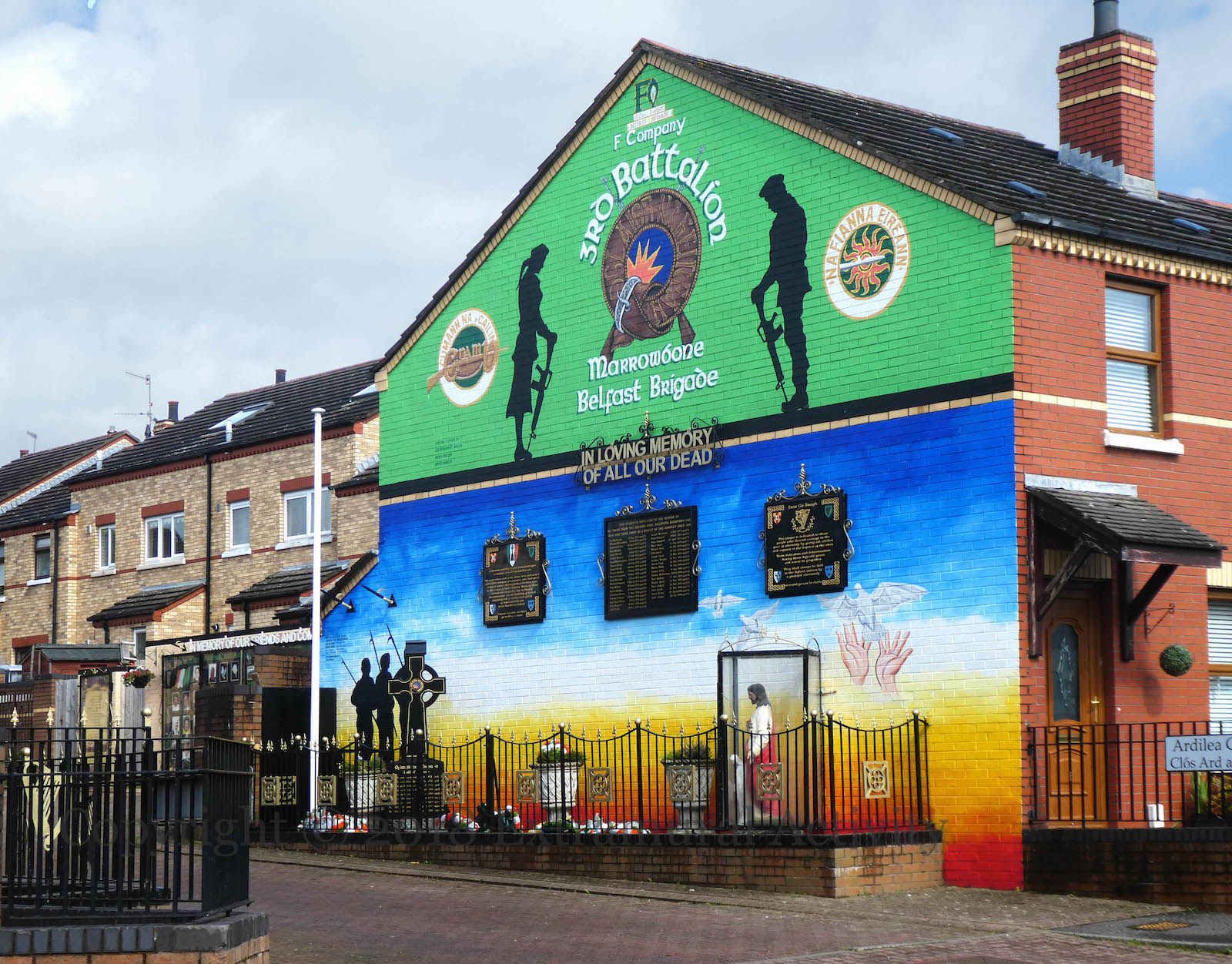
Marrowbone Company, Belfast Brigade

The Marrowbone (or simply “the Bone”, perhaps from the Irish “Machaıre Bothán”) is an area of north Belfast between Ardoyne and Cliftonville. Ardilea Close is home to four memorials to local republicans: on this wall, the plaque on the left is to “men and women from this and past generations who died from natural causes having dedicated their lives to the cause of Irish freedom” while the one on the right is to “those who showed courage in the face of adversity by giving aid, shelter and support in defence of the area.” Only one of the original walls mentioned the IRA (see Bone Memorial), as well as the 2014 addition of a Fıanna memorial – Hark To The Tramp Of The Young Guards of Éıreann. The new mural commemorating F company of the 3rd battalion – as well as the associated Cumann Na mBan, Cumann Na gCaılíní and Fıanna – can be added to these.

Click image to enlarge
Copyright © 2018 Seosamh Mac Coılle
X06109

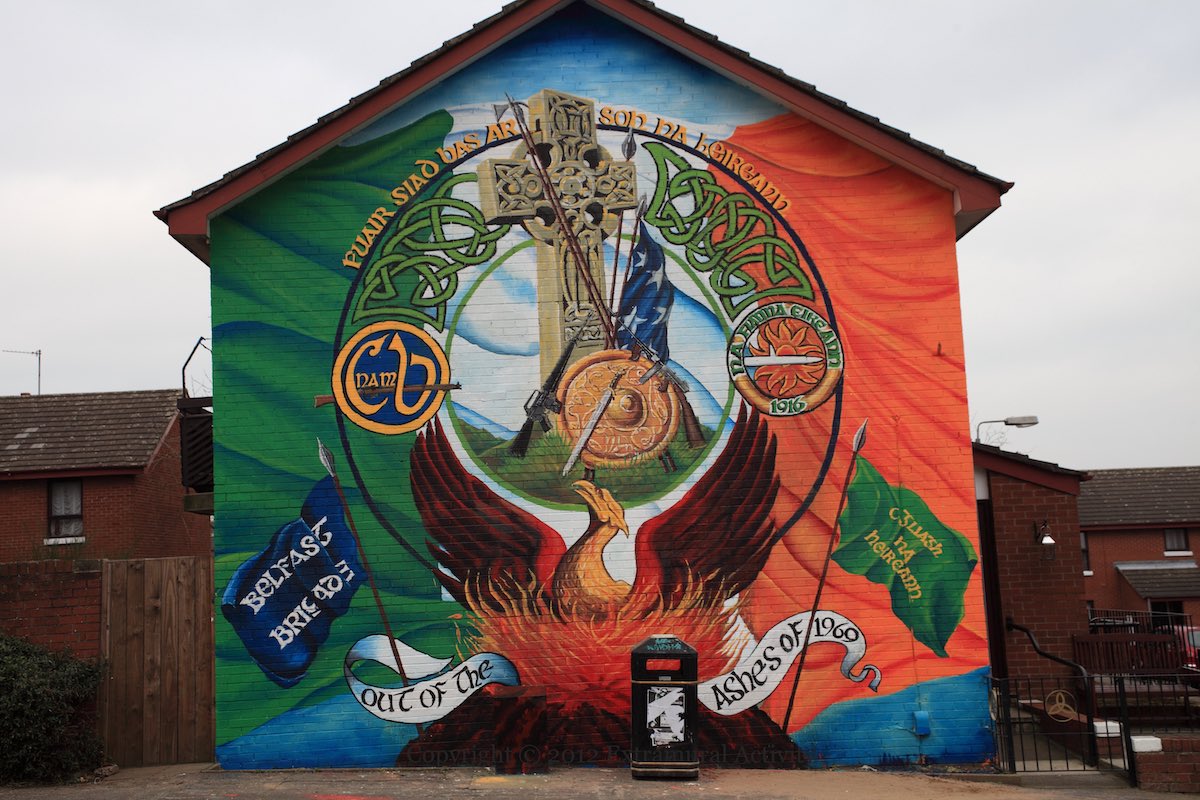
Out Of The Ashes Of 1969

The Provisional IRA arose “Out of the ashes of 1969”, but the lineage is a long one and all but one of the organisations, events, and arms depicted here precede 1969: Cumann Na mBan, Na Fıanna Éıreann, Óglaıgh Na hÉıreann, a Celtic shield and sword, a pike (from the 1798 Rebellion), a Thompson gun, the Tricolour; only the assault rifle is modern and perhaps also is meant to indicate the “Belfast Brigade” Provisionals. “Fuaır sıad bás as son saoırse na hÉıreann.”

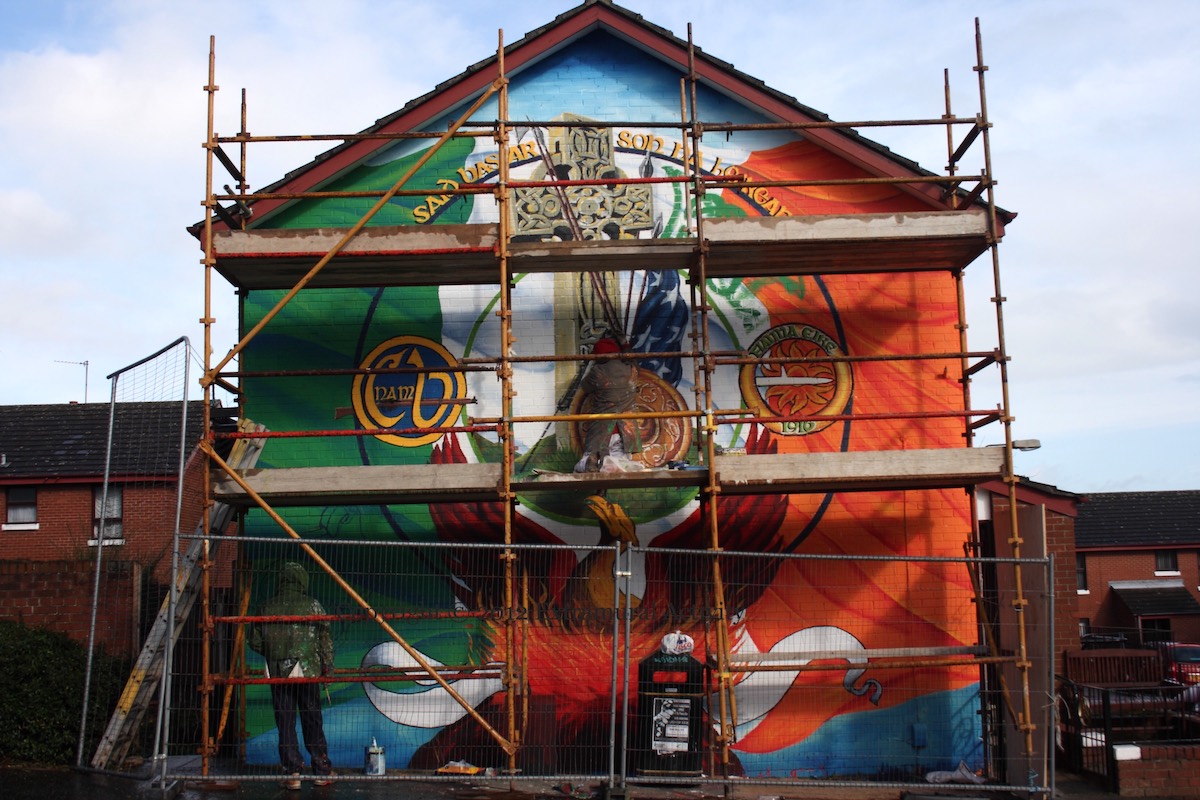
An in-progress shot from March 5th is below. Replaces Laochra Na nGael.

21 portraits of locals were later added – see M08552.

For a PUL use of the phrase, see Out Of The Ashes.

New Lodge Road, north Belfast

Click image to enlarge
Copyright © 2012 Seosamh Mac Coılle
X00857 X05190

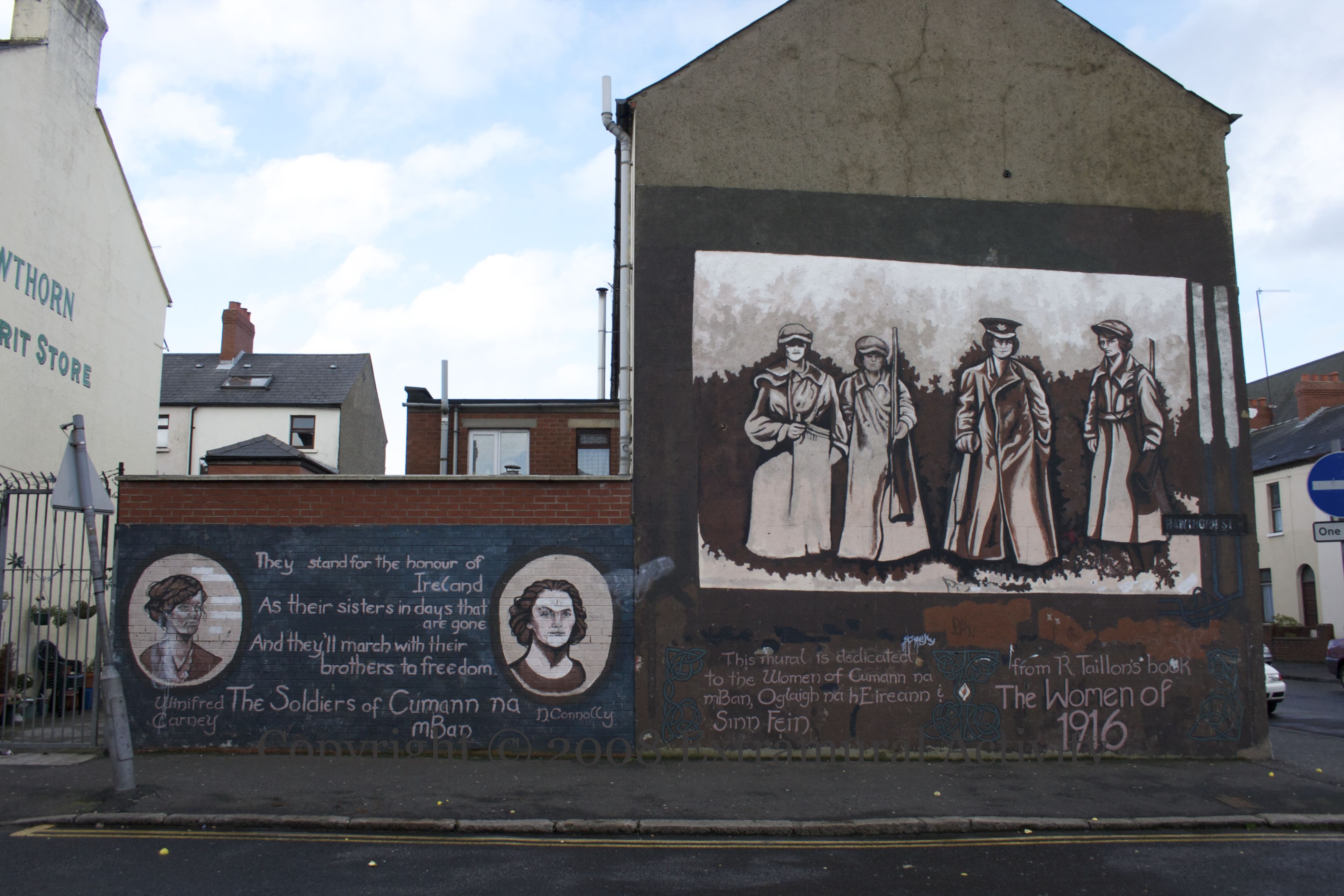
The Women Of 1916

“This mural is dedicated to the Women of Cumann na mBan, Óglaıgh na hÉıreann & Sınn Féın.” Image “from R[uth] Taillon’s book The Women Of 1916. For the mural on the left, see Sister Soldiers.

Hawthorn Street, west Belfast.

Click image to enlarge
Copyright © 2008 Seosamh Mac Coılle
X00237 X00235