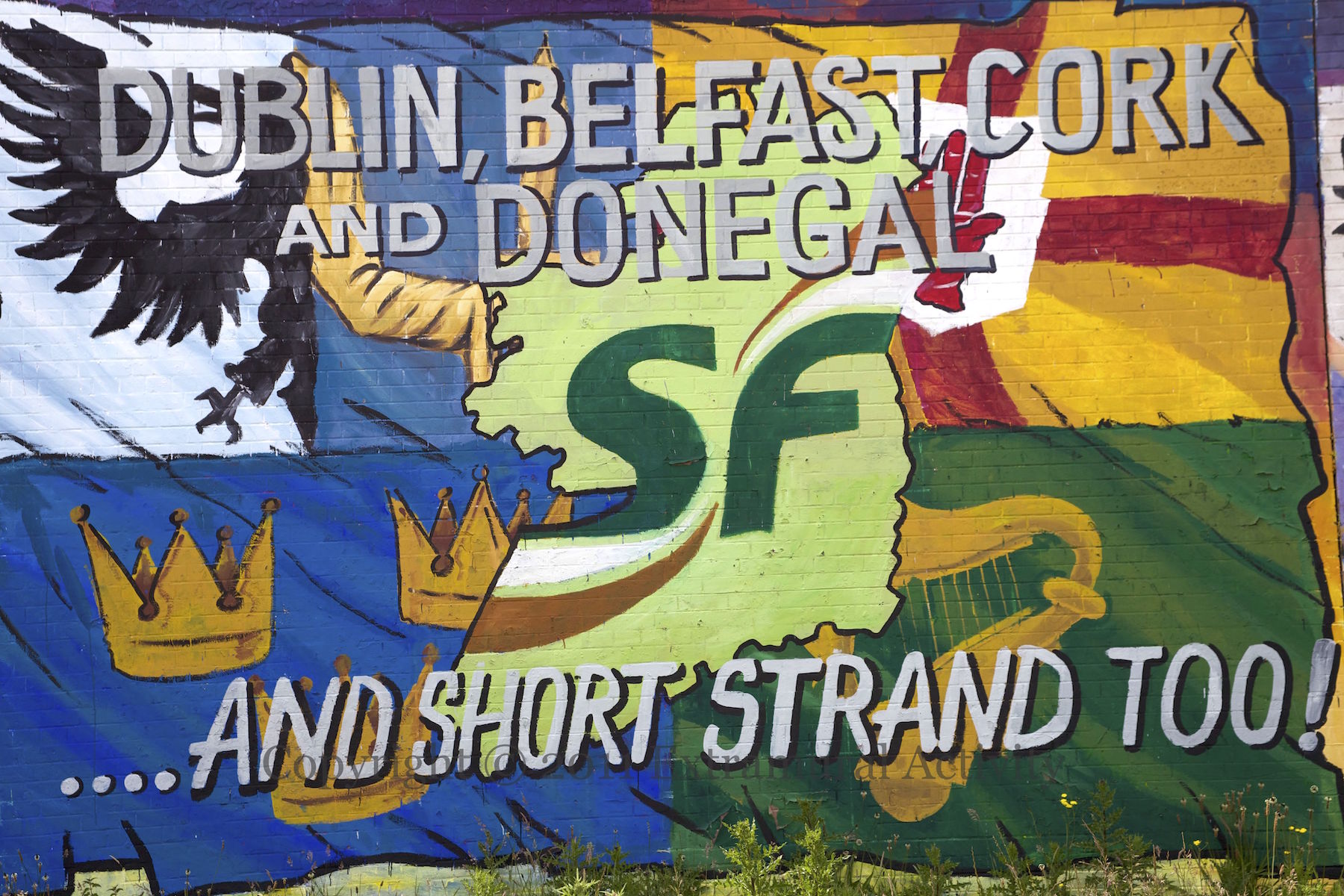
“Dublin, Belfast, Cork And Donegal” was a Sınn Féın media slogan in 2011, borrowing a line from (the song) On The One Road (here’s a Wolfe Tones rendition) and touting the fact that its candidates stand for election in both the Republic and Northern Ireland.
Naomh Éanna (St Enda) Gaelic Athletic Club is located in Glengormley and fields teams in football, hurling, and camogie. The grounds now also host a naíscoıl, which was opened in 2004, with a bunscoıl following in 2007.
The motto is in pre-Caıghdeán Irish: “Neart ın ár lámhaıbh [= lámh], fírınne ın ár dteangthaıbh [= dteangacha], agus glaıne ın ár gcroíthe.”
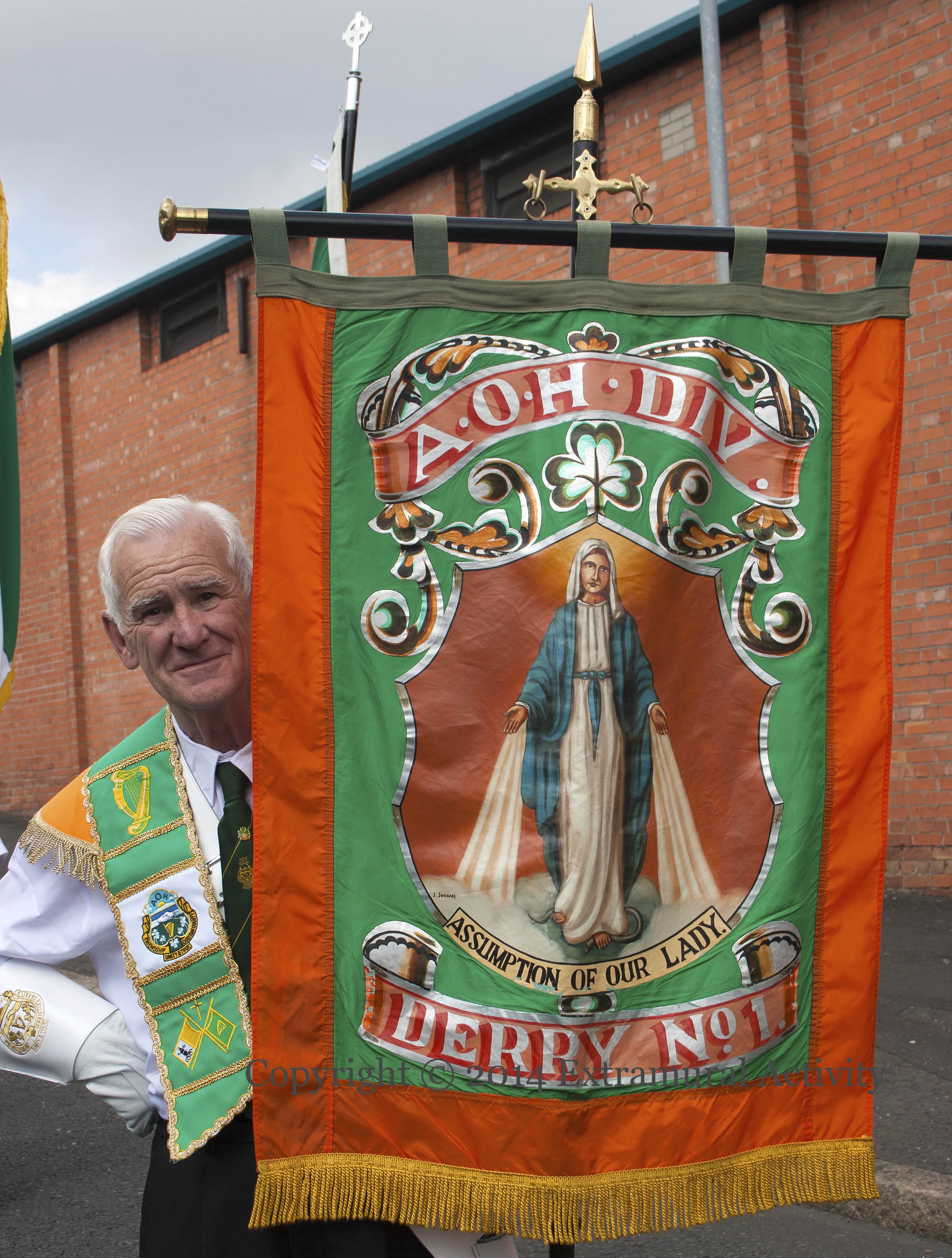
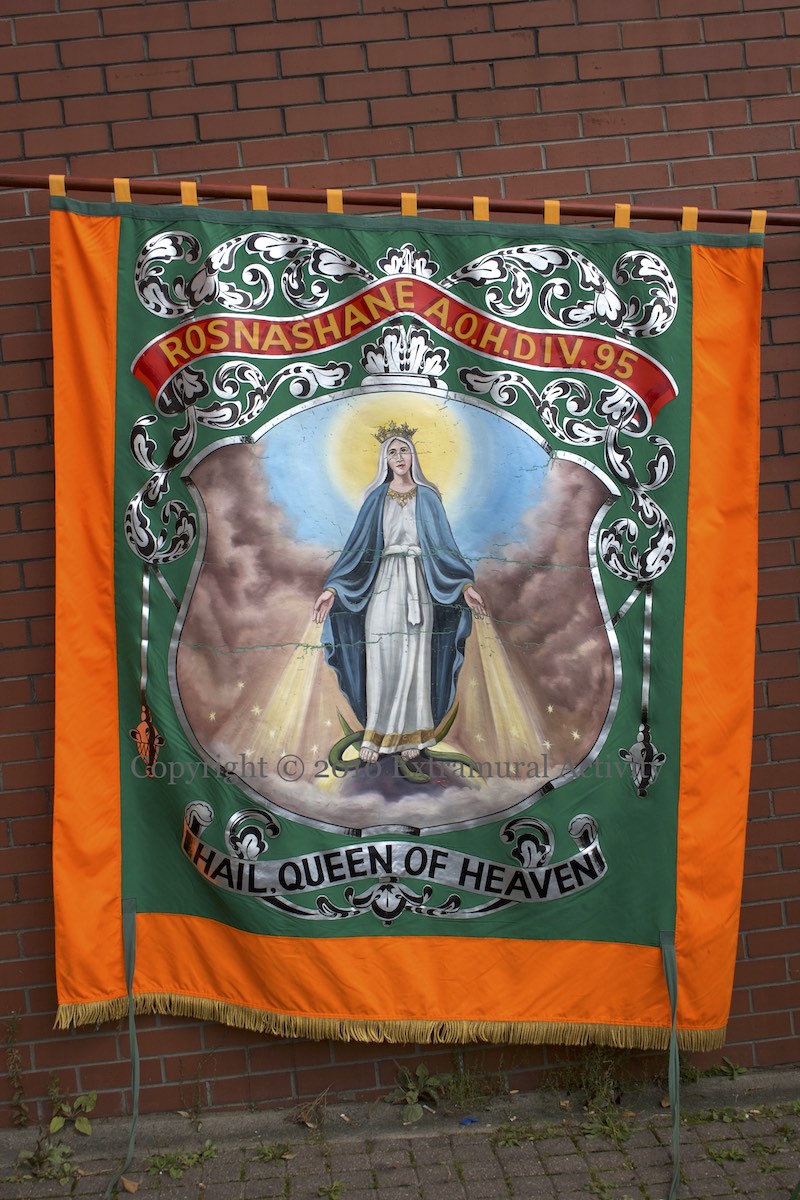
Above and below are images from the August 15th (feast of the assumption) march of the Ancient Order Of Hibernians, taken at Milltown Cemetery where AOH leader Joe Devlin is buried. The first two show banners of the Gortrighey division (387) – the first includes an image of a priest celebrating the nativity on Christmas morning at a mass rock in the penal days which is also reproduced in an Ardoyne mural. The Glassdrummand banner shown next includes a very similar image.
We then have two showing the assumption of our lady, the first from the first Derry division and the second from Rosnashane.
The final banner, from Randalstown, shows ‘Our Lady Queen Of Ireland”.
The final two images are of the lapels of a well-traveled Newry member, with badges from Michigan and Pennsylvania alongside a pike (1798), an easter lily (1916) and commemorations of Bloody Sunday and the hunger strikers, and of the side entrance to the local Clonard AOH lodge, division 58, which hosted the gathering.
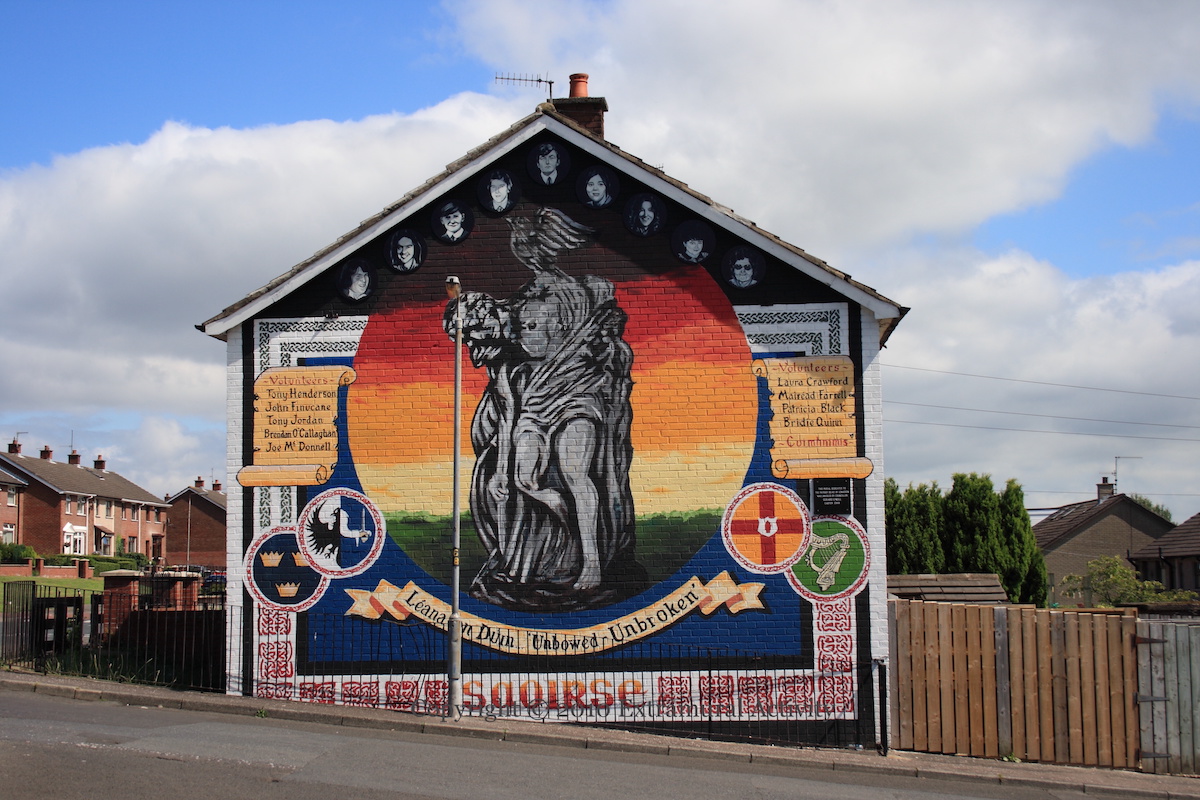
The main Lenadoon mural is refreshed and more portraits and a plaque added (on the right). The dying Cú Chulainn (as portrayed in bronze by Oliver Sheppard, in a statue installed in the GPO in 1935) is used as a symbol for the locals from Lenadoon (including IRA volunteers) who fought for freedom (“saoırse”). They are listed on the scrolls to each side and in the portraits in the apex: Tony Henderson, John Finucane, Brendan O’Callaghan, Joe McDonnell, Laura Crawford, Maıréad Farrell, Patricia Black, Bridie Quinn (previously listed as Bridie O’Neill).
For the previous version (though without the three faces it initially had, of O’Callaghan, McDonnell, and Farrell) see M01934.
“Ballymurphy unbowed, unbroken” with images of Ballymurphy including the mural of McCrudden-O’Rawe–Jordan and memorial garden on Divismore Way (left) and Springhill (right). The male figures in the foreground are unnamed but the four in jackets are presumably Stone, McWilliams, McCracken, and Dougal after their mural in Springhill Drive was blanked; the female activists on the left of Cú Chulaınn are Mary Austin, Kathleen Clarke, Annie McWilliams. “This mural was unveiled by Gerry Adams MP 2nd May 2010.”
“Ní thıg leat Éıre a chloígh, ní thıg leat fonn saoırse mhuıntır na hÉıreann a mhúc[h]adh.” [“You cannot subdue Ireland; you cannot extinguish the desire for the freedom of the Irish people.”]
Michael Gaughan’s final message included the line “Let there be no bitterness on my behalf, but a determination to achieve the new Ireland for which I gladly die” which is loosely quoted in this hunger strikers Ardilea Close (in the Bone) mural. He is buried with Frank Stagg in Leigue Cemetery, Ballina (WP). The mural has been added behind the plaque to the hunger strikers in the middle-right: “Erected by the Olpark 1981 Committee. In proud and loving memories fo ten young Republicans who gave their lives during the 1981 hunger-strike in the H.Blocks of Long Kesh. No greater love than a man lay down his life for his friends.”
The close-up shows three generations of toddler hurlers, from barefoot and cloth-cap to boots and braces to baseball cap and tracksuit. Kickhams is the local Cumann Luthchleas Gael (GAA club) (Fb | tw), founded 1907, named for republican writer Charles Kickham. The mural shows football, hurling, and handball.
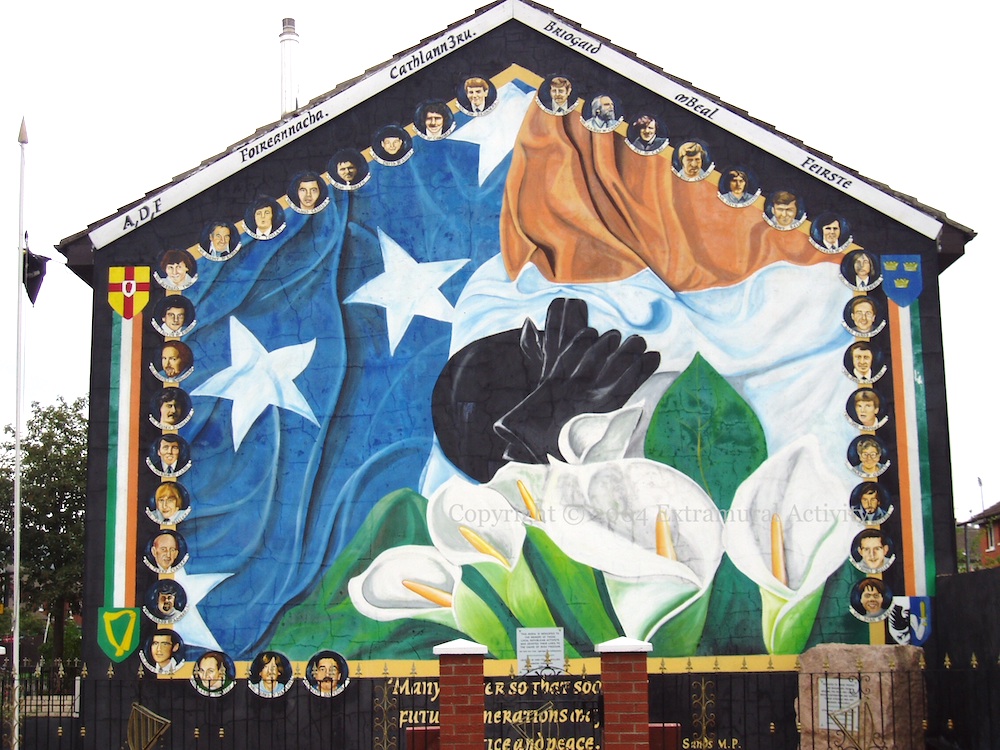
Easter lilies, starry plough (WP), Irish tricolour, black beret and gloves, commemorating dead IRA volunteers from the third battalion of the Belfast brigade.
The plaque on the stone in the corner thanks local residents for their contribution to the struggle. There’s a close-up of the stone in Peter Moloney’s collection (M02420).
“This mural is dedicated to the memory of those local republican activists [34 portraits of volunteers from “A, D, F foıreannacha, cathlann 3rú, Brıogáıd mBéal Feırste”] who devoted their lives to the cause of Irish freedom. Ar son na c[ú]ıse. Óglaıgh na hÉıreann. Unveiled by Sınn Féın councillors Martin Meehan and Margaret McClenaghan.”
“Many suffer so that some day future generations may live in justice and peace – Bobby Sands MP.”
“Dedicated to those friends and neighbours from Ardoyne, the Bone and Ligoniel whose contribution and support to our struggle was and remains invaluable. Aıthníonn muıd a gcrógacht. Óglaıgh na hÉıreann. Meán Fómhaır 2003.”
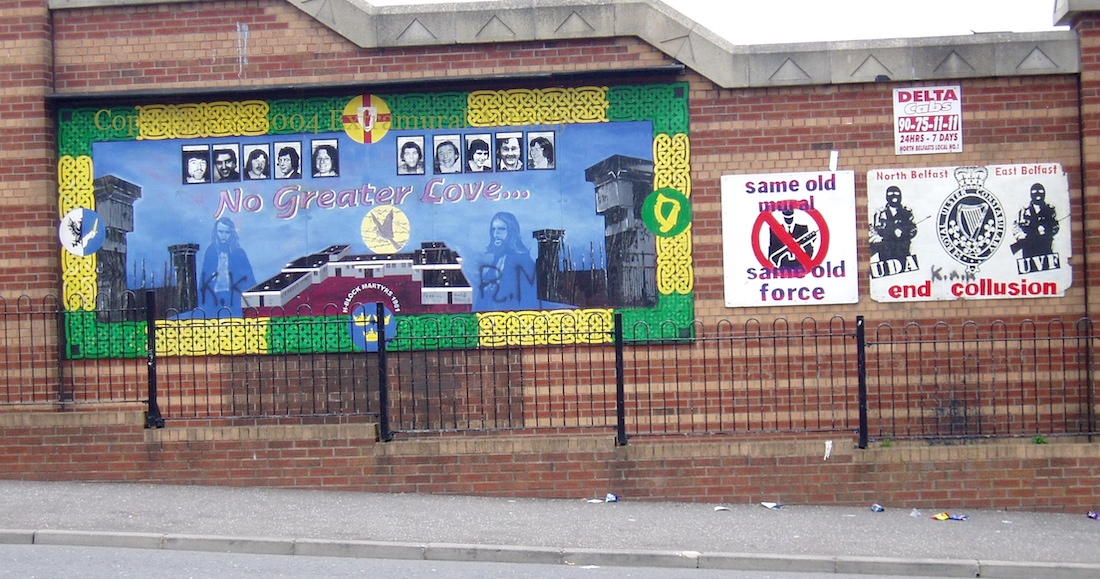
The large board on the left commemorates the 10 dead hunger strikers (WP) and two blanketmen. “No greater love” echoes John 15:13.
There are also two smaller boards on the right: first, “Same old mural, same old force” with the three-in-one figure of RUC, Orange Order, and loyalist paramilitary under a traffic “No” symbol; second, an interesting board alleging collusion between the RUC and the UDA and UVF in north and east Belfast.
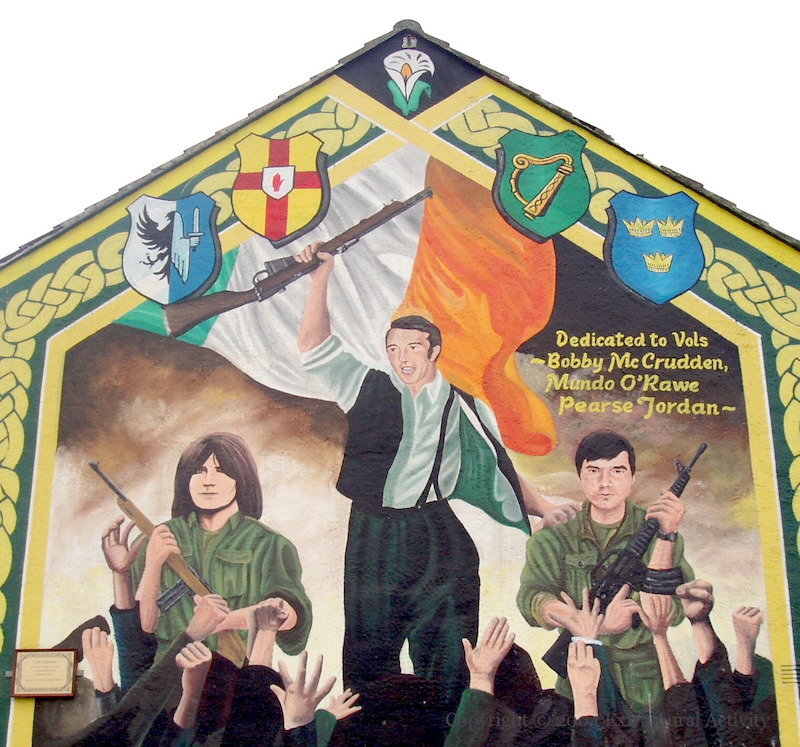
“In passing this mural, pause a little while, pray for us and Erin, then smile.” This is a Ballymurphy mural dedicated to three local PIRA volunteers: Bobby McCrudden, Mundo O’Rawe, and Pearse Jordan. McCrudden was shot in Ardoyne in 1972 (Sutton). O’Rawe was shot on the lower Falls in 1973 (Sutton). The circumstances of Jordan’s death in 1992 at the hands of an undercover RUC unit were controversial; his case went to the European Court Of Human Rights (WP).
From a photo in the Peter Moloney Collection, the plaque reads “I ndíl [ndıl] chuímhne [chuımhne] Oglach [Óglach] Edward ‘Mundo’ O’Rawe, Oglach Robert McCrudden, Oglach Pearse Jordan – who gave their lives for Ireland’s freedom.”







 Extramural Activity