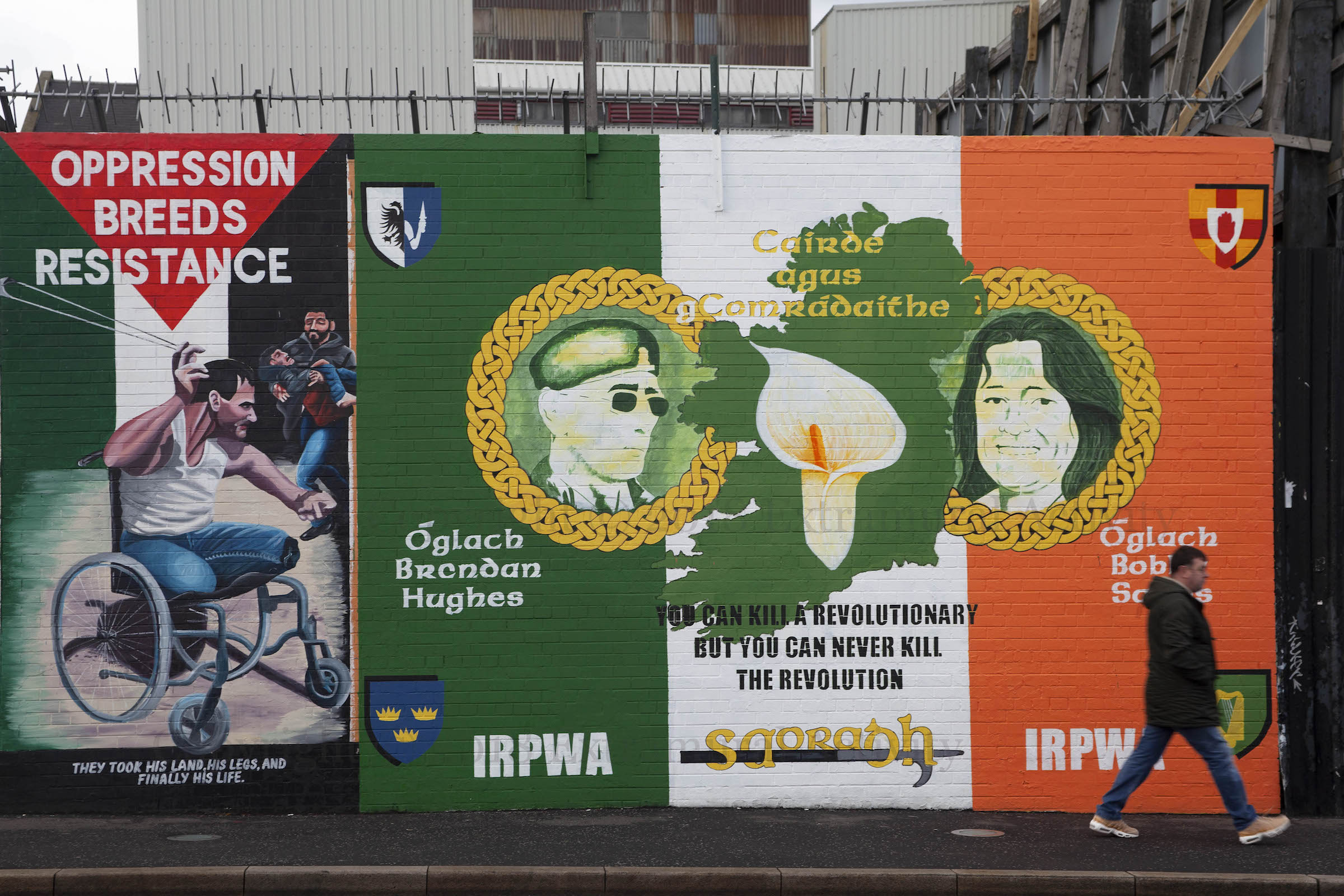
When this mural was first painted in October, 2016 there were calls for its removal on account of the re-appearance of a hooded gunman with RPG (Irish News | BelTel), in the style of IRA murals from before the peace (e.g. most similar to this 1989 mural but see also these other examples). It was still present in November of 2018. The “unfinished revolution” is that of the 1916 Easter Rising, represented by the Easter lily.
The mural is next to Junior McDaid House – the offices of the IRPWA (web | Fb) and Saoradh (web) – in Chamberlain Street, Derry – see previously Victory To The Republican Prisoners.
“The English may batter us to pieces, but they will never succeed in breaking our spirit – Maud Gonne.” The lesser-known figures here are Helena Moloney [Molony] and Margaret Skinnider. Both participated in the 1916 Rising. Actress Molony took part in the failed attack on Dublin Castle and, although ultimately captured, was not executed (Stories | WP). Scotland-born Skinnider was a sniper in the Easter Rising; she was shot three times but survived to flee to the USA where should would write a 1917 account of the Rising before returning to Ireland and a career in teaching (WP).
“Friends and comrades” – IRA volunteers Brendan Hughes (“The Dark”) and Bobby Sands were leaders of the 1980 and 1981 hunger strikes, respectively. Hughes survived when the first strike was called off after 53 days; Sands died in the ’81 strike after 66 days of fasting. “IRPWA” is the Irish Republican Prisoners’ Welfare Association (Fb | tw); Saoradh (web | tw) is a hard-line left-wing republican party.
The mural to the left shows Palestinian double-amputee Saber Al-Ashkar, protesting as part of the Great March Of Return.
Robert Ballagh’s 1916 Proclamation was first painted as a mural by Mo Chara Kelly and Rısteard Ó Mhurchú in 1991 for the 75th anniversary of the Easter Rising (see Cáısc 1916 which also contains the Ballagh piece). That version stood for ten years on the Whiterock Road. It has reproduced again in Ard An Lao above the hunger strikers, after the removal of several plaques (see All Our Dead). “With special thanks to Hugo Óg Wilkinson”.
Above is the plaque on Berwick Road/Paráıd An Ardghleanna to four teenaged members of Na Fıanna Éıreann who died in 1972 – Davy McAuley, Josh [Joseph] Campbell, Josie McComiskey and Bernard Fox – all four from Ardoyne/Ard Eoın. McAuley died of a gunshot wound, perhaps at a Louth training camp (Nelson McCausland). Campbell was shot in Eksdale Street in a gun battle with the British Army; McComiskey was shot in Flax Street in a gun battle with the British Army; Fox was shot by British Army in Brompton Street. For the tarp, see Purity In Our Hearts; for the 2016 lily, see In The Cause Of Irish Freedom.
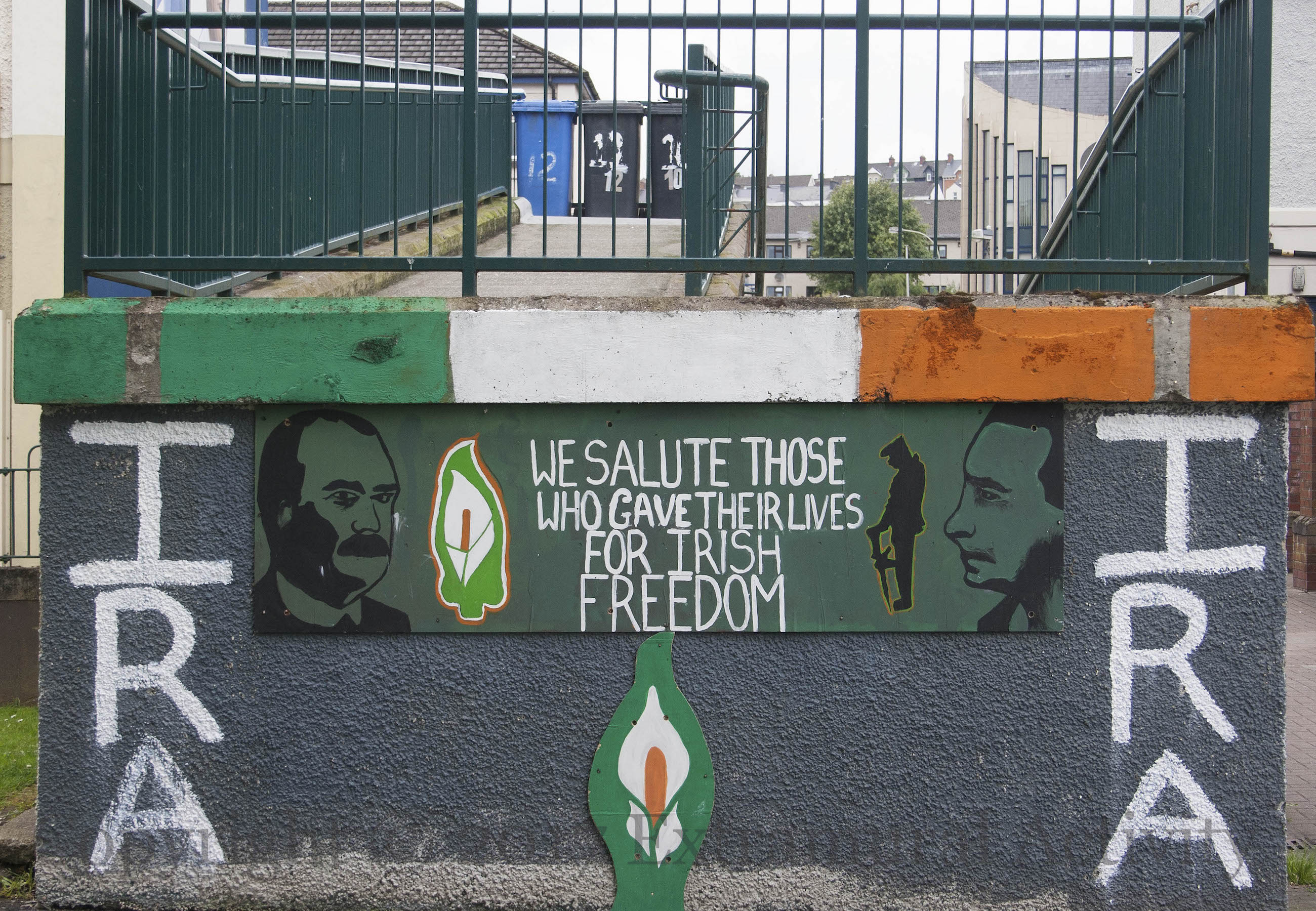
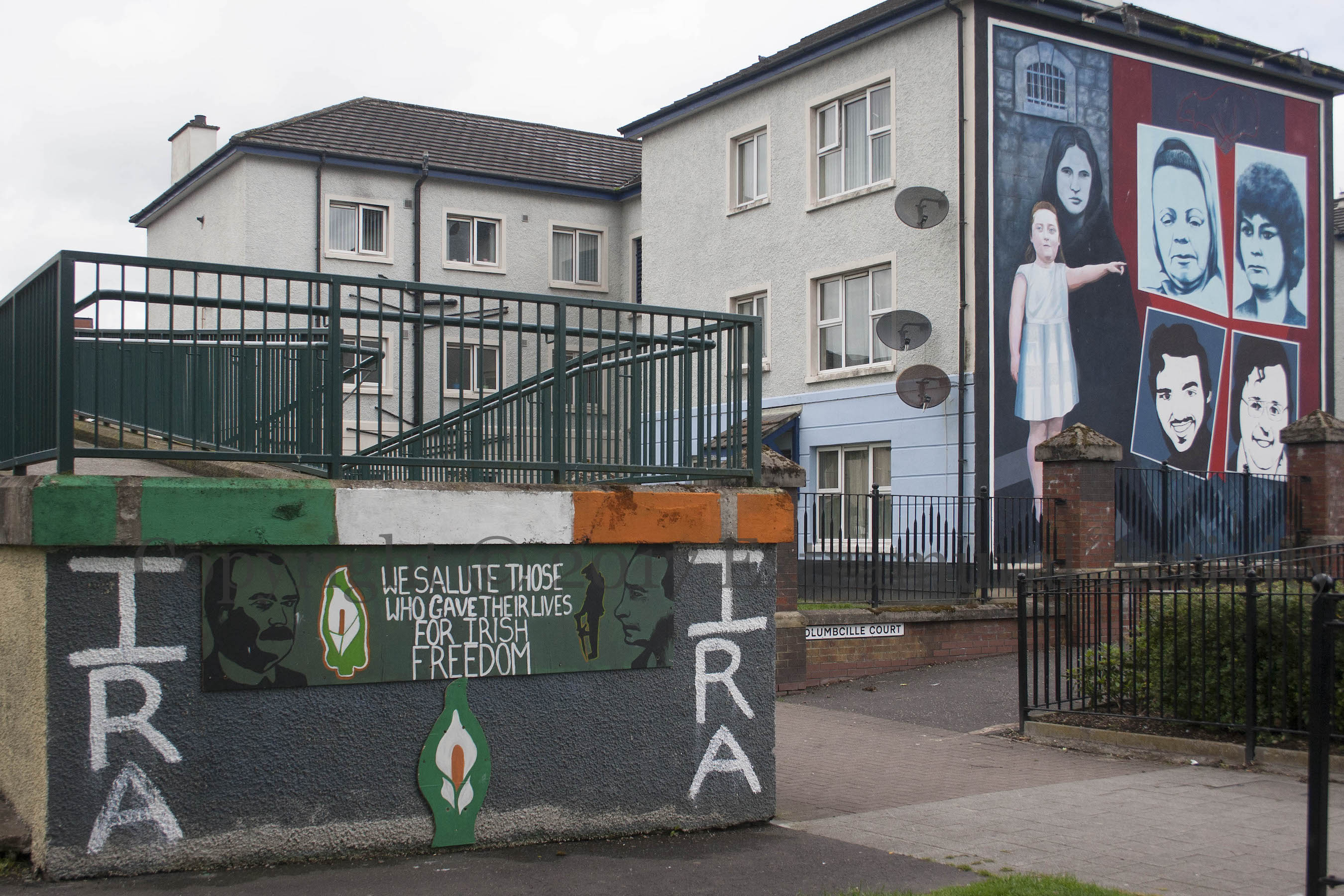
“We salute those who gave their lives for Irish freedom”, including James Connolly and Padraig Pearse in the 1916 Easter Rising, planned by Pearse (and others in the military committee of the Irish Republican Brotherhood (IRB). The IRA would be formed in 1919. The mural in the wide shot was featured in Mothers & Sisters.
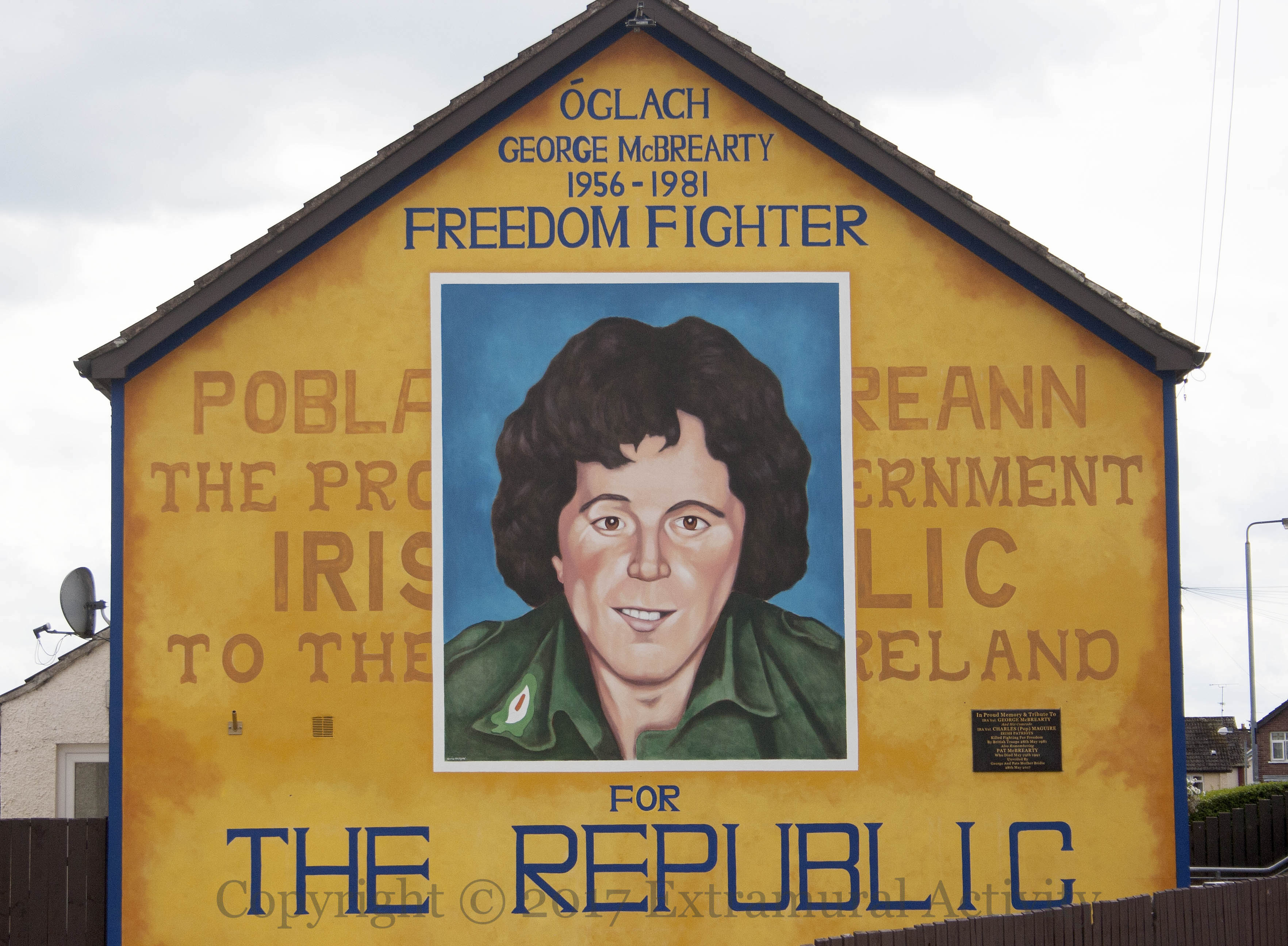
IRA volunteer George McBrearty was shot, together with Charles “Pop” Maguire, by the SAS on May 28th, 1981. This new mural was painted by Bogside Artist Kevin Hasson and unveiled on the 36th anniversary of his death. McBrearty is wearing an Easter lily on his lapel and the proclamation of independence backgrounds his portrait. (Video of the launch.)
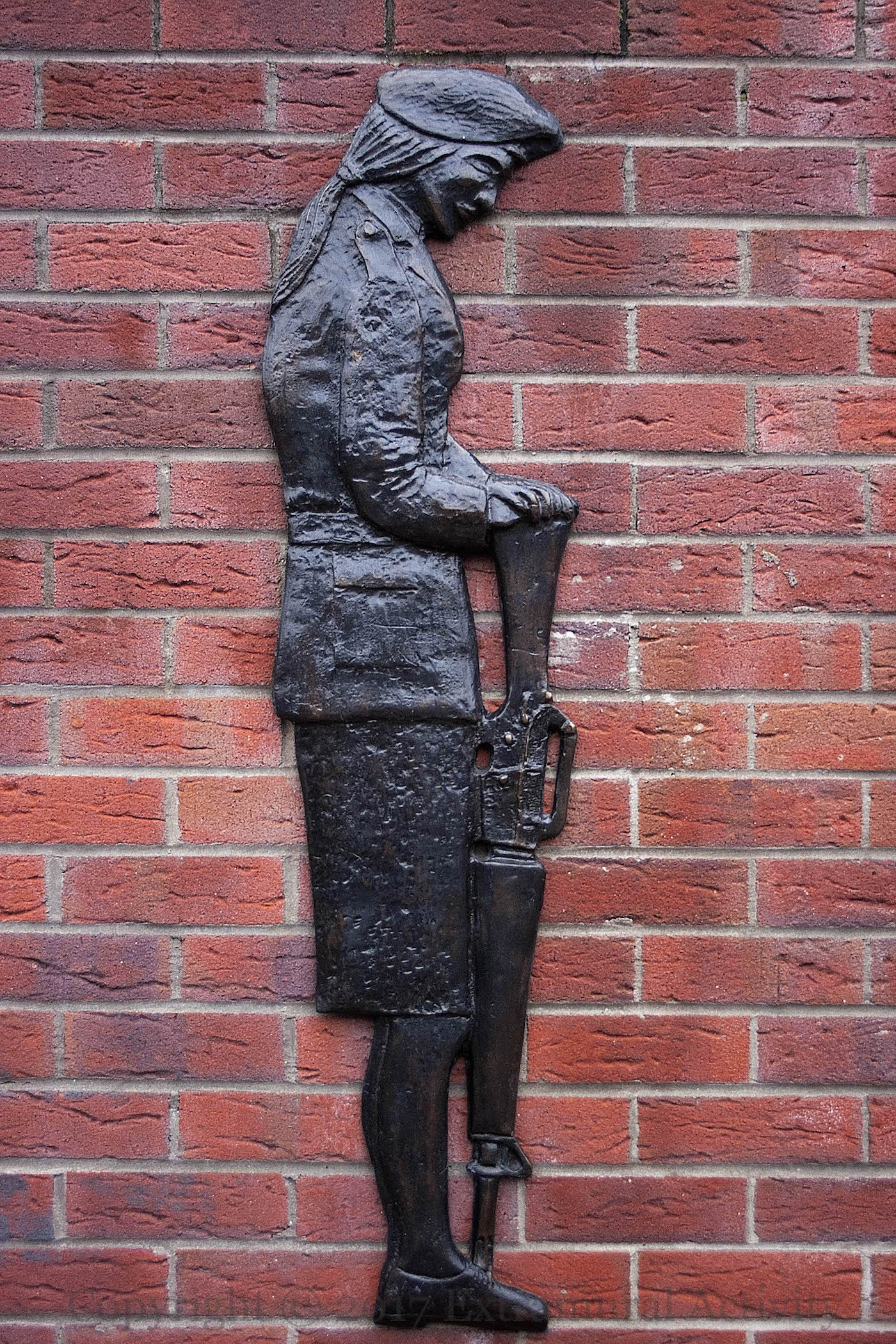
Here, from left to right, are all of the metalworks in the memorial garden on Ascaıll Ard Na bhFeá by sculptor and painter Hugh Clawson. On the stone (above) an IRA volunteer – with the emblem of the Easter lily on his beret – rests in the arms of Mother Ireland and her harp. Then two featuring the lark as the ‘spirit of freedom’ (from The Lark And The Freedom Fighter). In the first, the lark breaks through the bars of a prison cell, and in the image below, it flies in front of an “H” made of bricks, carrying a bin lid. (For a lark carrying a rifle, see Lark Of War and Armed Resistance.) Clawson’s name can be seen on the bars. In the second, a lark carries a binlid, used by locals to signal the presence of British Army troops. “In memory of all Irish martyrs who have died on hunger strike in the fight for Irish freedom. Their inspiration and courage will always be remembered by the republican movement and republican family (mid Falls).” One female and one male volunteer stand with bowed heads. A pair of hands joined in prayer in the Beechmount memorial garden: “in memory of those innocent people from this area who have died in this struggle for Irish freedom”. Finally, a scene of protest, in front of the Free Ireland mural at the bottom of the street. “In memory of the all the unsung heroes off [sic] this area who’s [sic] hardship, sacrifice and support during this struggle for Irish freedom will never be forgotten by the Belfast Brigade óglaıgh na h-éıreann.” The plaque depicts the work of print-makers (“Smash H-Block Armagh”), marchers carrying portraits of hunger strikers (“Mid Falls supports the women of Armagh”), bin-lid rattlers, and muralists. The tarp above reads “Cuımhníonn Lár na bhFál – Mid Falls remembers” Out of picture to the right of the wide shot is Bobby Sands’s quote “Our revenge will be the laughter of our children.” See M04415.
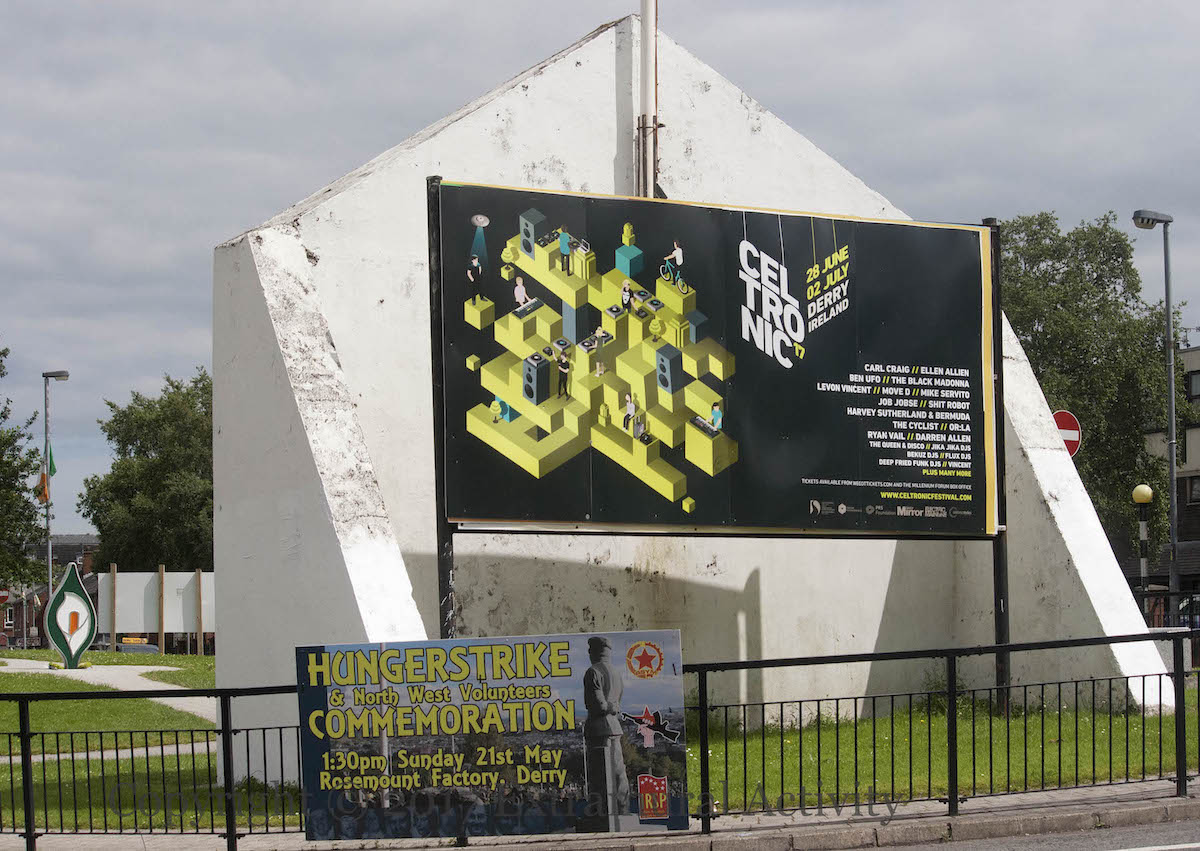
Here are four republican boards from Derry/Doıre and Dungiven/Dún Geımhın, from Cogús (republican prisoners’ welfare), 1916 Societies, IRSP, and the campaign for Justice For The Craigavon Two (Brendan McConville and John-Paul Wootton). The title comes from the last image: “There may be times when we are powerless to prevent injustice, but there must never be a time when we fail to protest.”









 Extramural Activity