The “now” in “now is the time to kneel” would seem to suggest that there is some inappropriate kneeling going on at some other time, besides as a mark of respect to the patriotic dead (in this case, Queen Elizabeth II, who died on September 8th) – perhaps the kneeling prior to Premier League soccer matches as a protest against racism (World Soccer Talk).
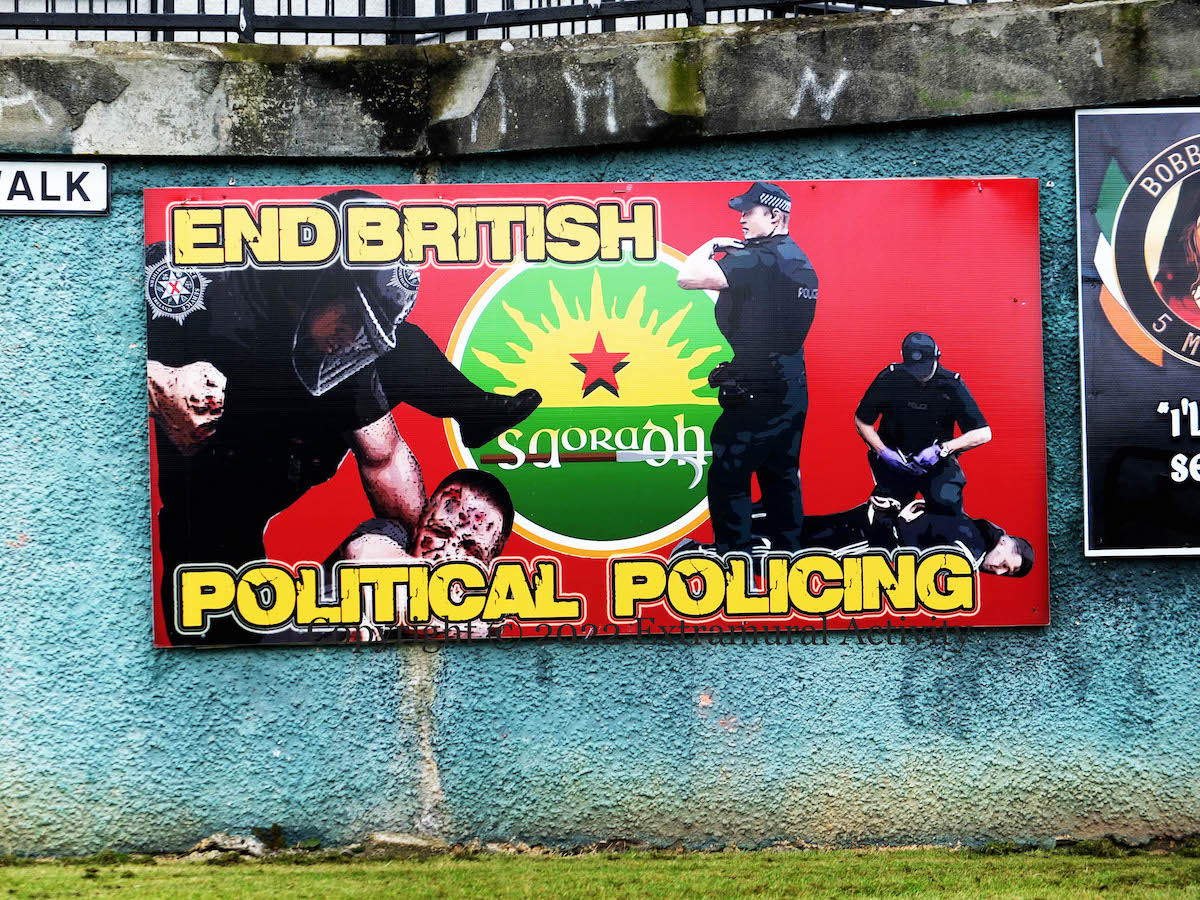
No Amnesty For British State Forces: “Democide is the murder of any person or people by a government, including genocide, politicide and mass murder. Democide is not necessarily the elimination of entire cultural groups but rather groups within the country that the government feels needs to be eradicated for political reasons and due to claimed future threats. – No amnesty for British state forces”
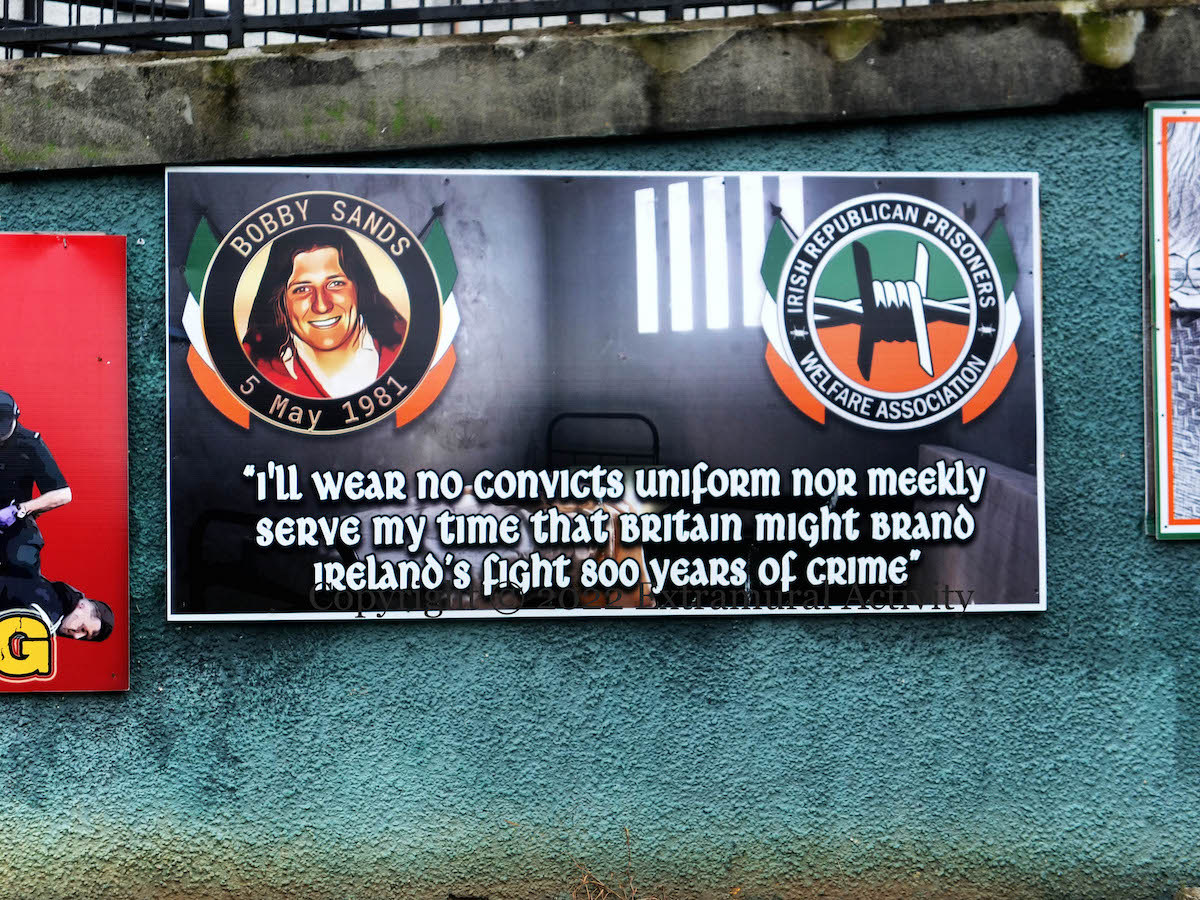
Bobby Sands/IRPWA: “I’ll wear no convict’s uniform/Nor meekly serve my time/That Britain might brand Ireland’s fight/800 years of crime” [Francie Brolly song] (IRPWA (web))
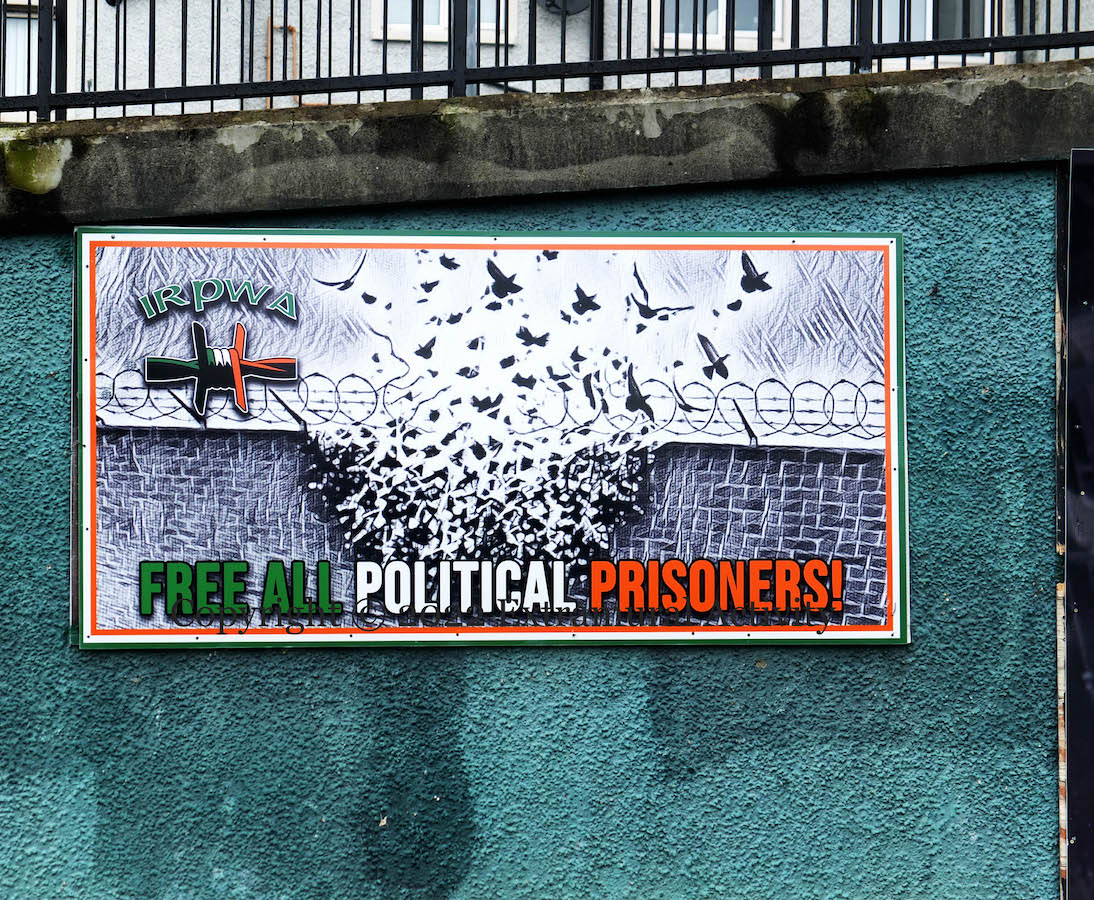
Free All Political Prisoners! (IRPWA)
1981: 1981: “I am a political prisoner. I am a political prisoner because I am a casualty of a perennial war that is being fought between the oppressed Irish people and an alien, oppressive, unwanted regime that refuses to withdraw from our land.” [Bobby Sands’s diary, day 1] (IRPWA)
Unity Referendum Now!: “British occupation has been a disaster for the people of Ireland. A united Ireland is the way forward for all the people of Ireland.” (IRSP.ie)
40th anniversary of the 1981 hunger strike: described previously in For A Socialist Republic (IRSM/IRSP)
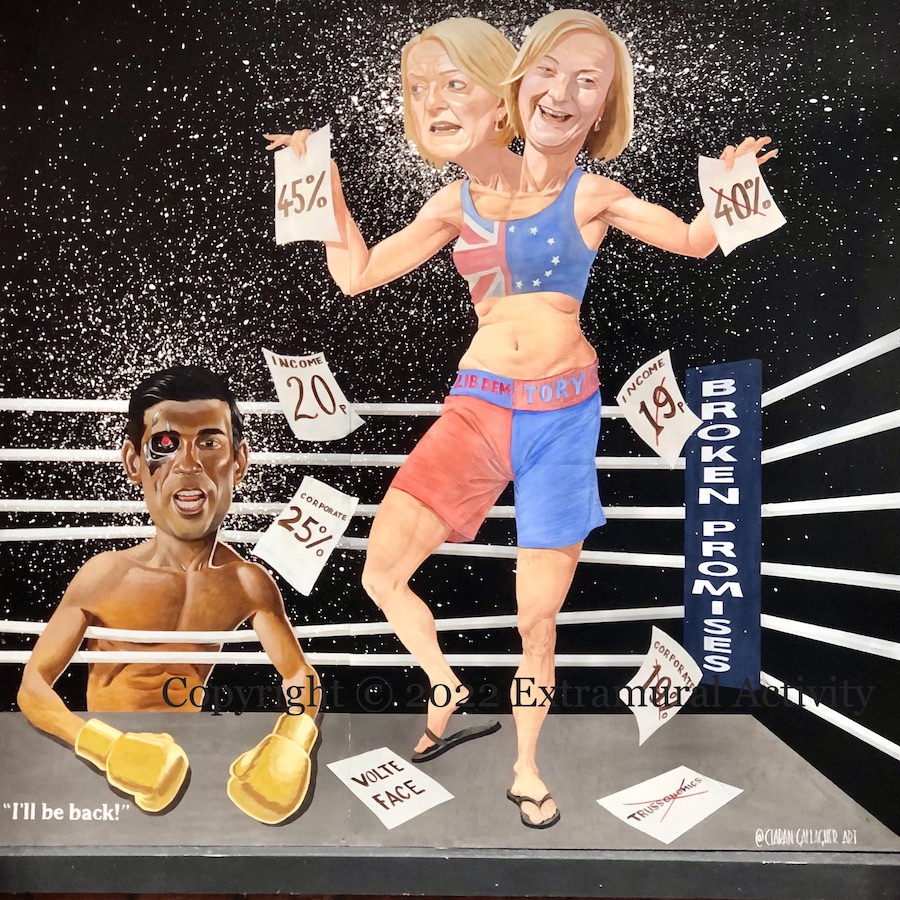
The newspaper front pages reporting the “90-minute shouting match” between the resigning UK Home Secretary Suella Braverman and Prime Minister Liz Truss (third image, below) were barely dry when Truss herself resigned yesterday. The main cause was the September 23rd “mini-budget” that promised to scrap the 45% personal tax rate entirely, lower the 20% to 19%, and keep the corporate rate at 19% instead of having it increase to 25% in April 2023 – these numbers are seen on the pages falling from Truss’s hands, above – without explaining how the reductions would be funded. Over the next three weeks these positions were reversed – “volte face”, Truss’s flip-flops, and the two-headed Truss; all part of a pattern, artist Ciaran Gallagher (web) suggests with Truss’s clothing: she was originally in the Lib Dems before joining the Conservatives in 1996 and supported ‘remain’ in the Brexit vote (WP).
Chancellor Kwasi Kwarteng went on the 14th. Braverman resigned over a breach of the Ministerial Code – sharing an official document on migration from her personal e-mail account – but got in a few digs at the Truss government as she left. (WP)
The Tories hope to put a new leader and PM in place within a week. Rishi Sunak, Terminator-style, says “I’ll be back!” and is – as of today, at least – the bookies’ favourite (BBC).
For Larry the cat – who was previously pictured sitting on the steps outside Number 10 but has gone from the mural – next week’s prime minister will be his fifth.
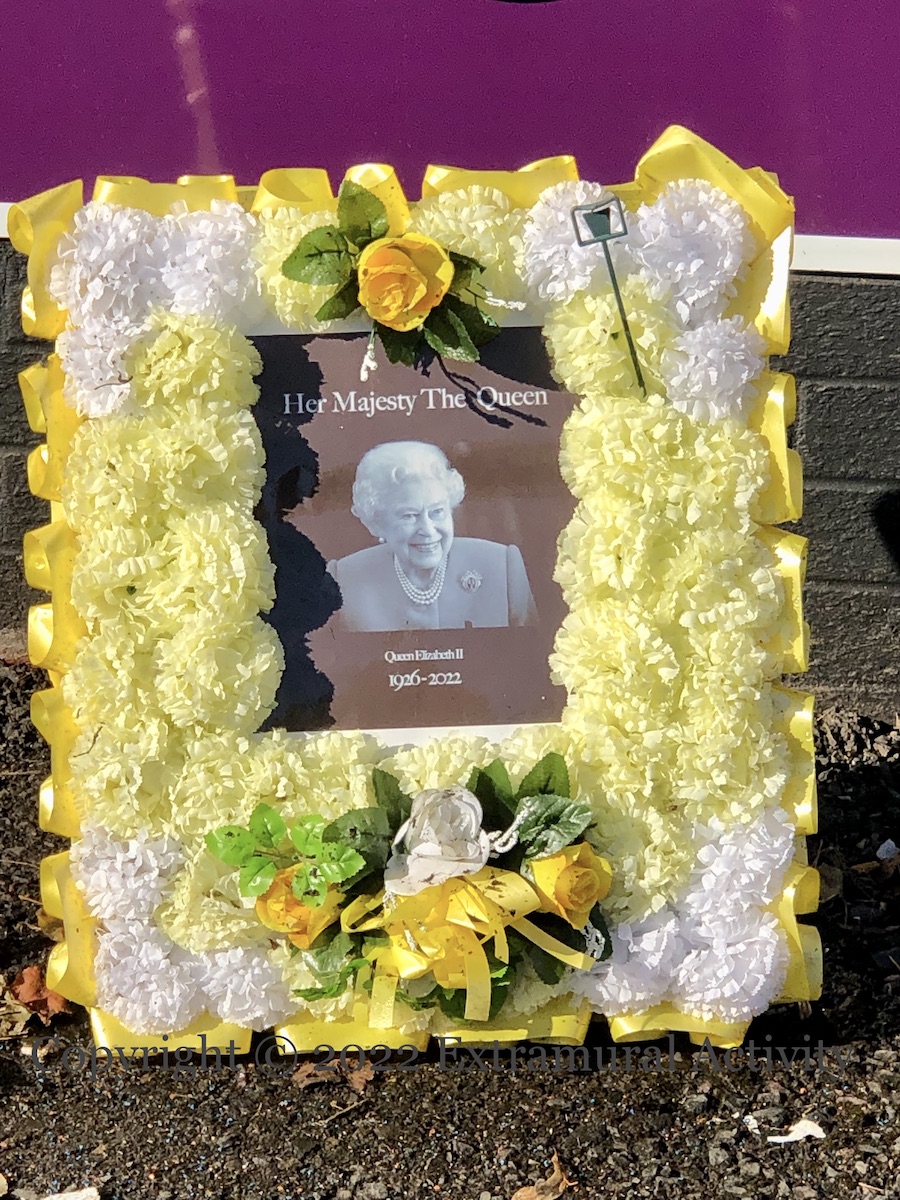
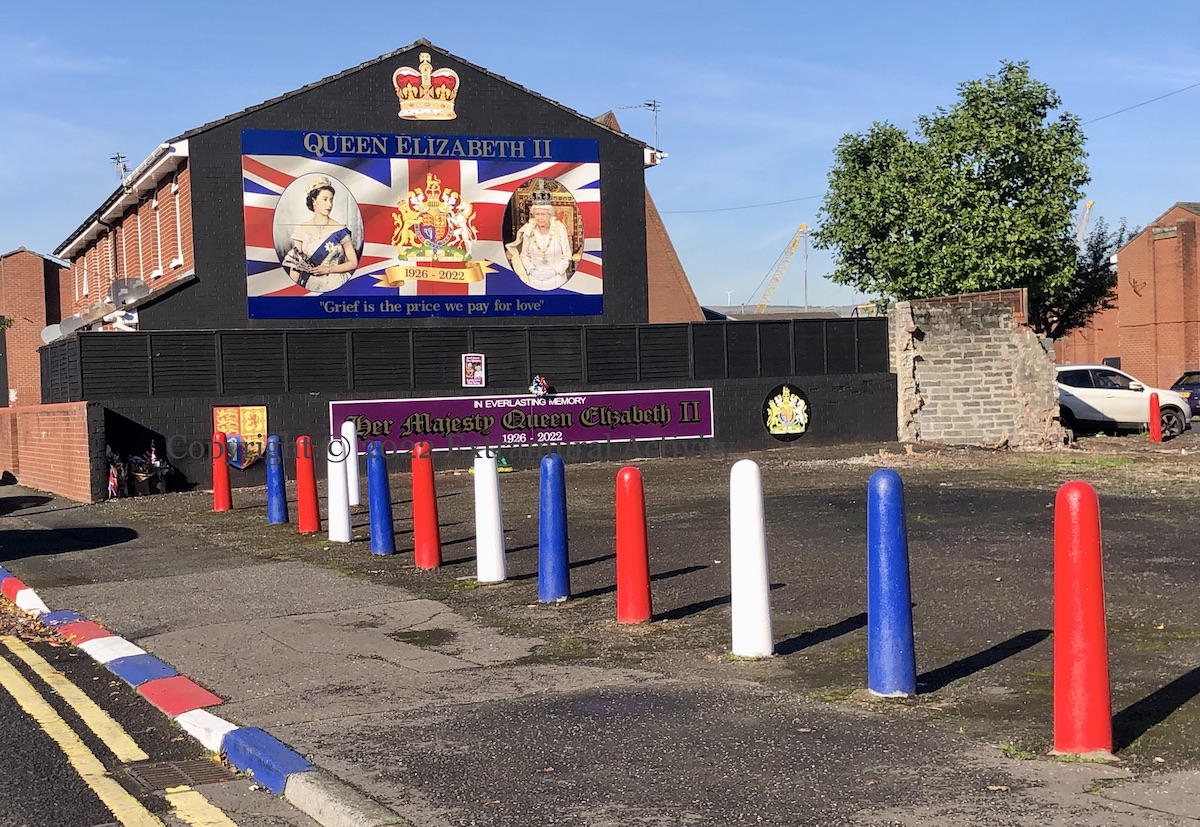
Elizabeth II, queen of the United Kingdom, passed away on September 8th, at the age of 96, in the same year of her platinum jubilee, the 70th anniversary of her accession. The phrase “grief is the price we pay for love” comes from a message from Elizabeth in consolation with the relatives of those killed in the “9-11” attacks in 2001 (text at The Guardian).
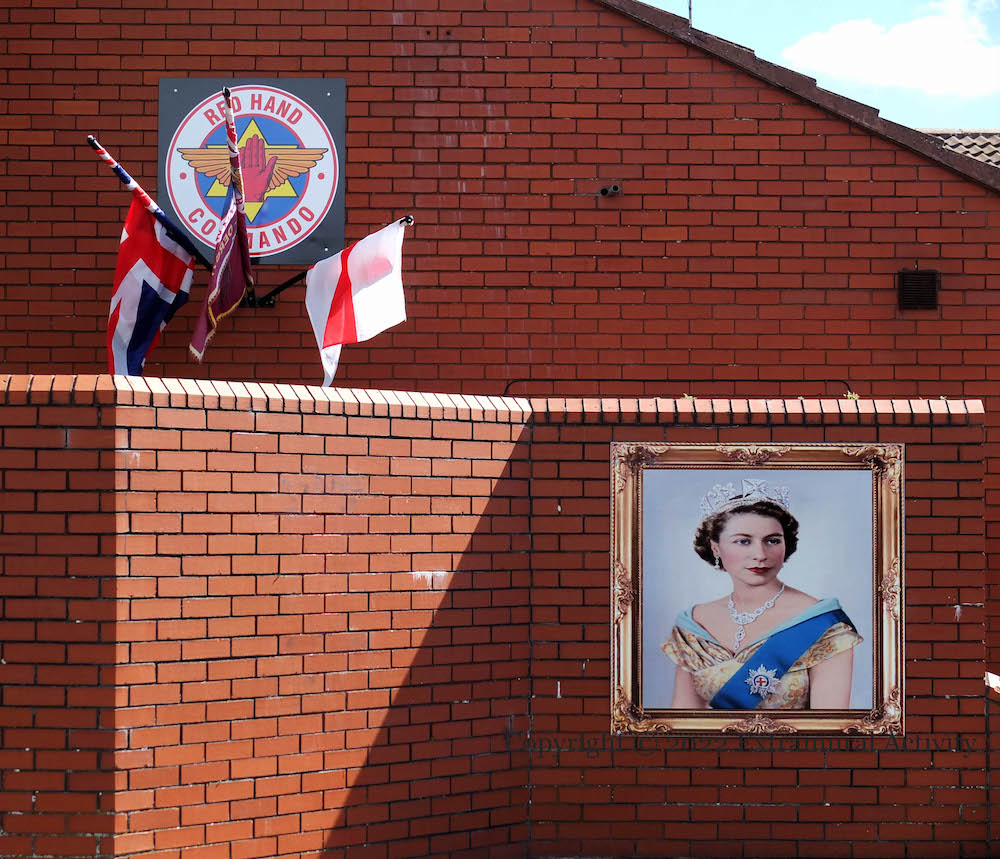
“In everlasting memory – her majesty Queen Elizabeth II – 1926-2022.” “Long live the King”
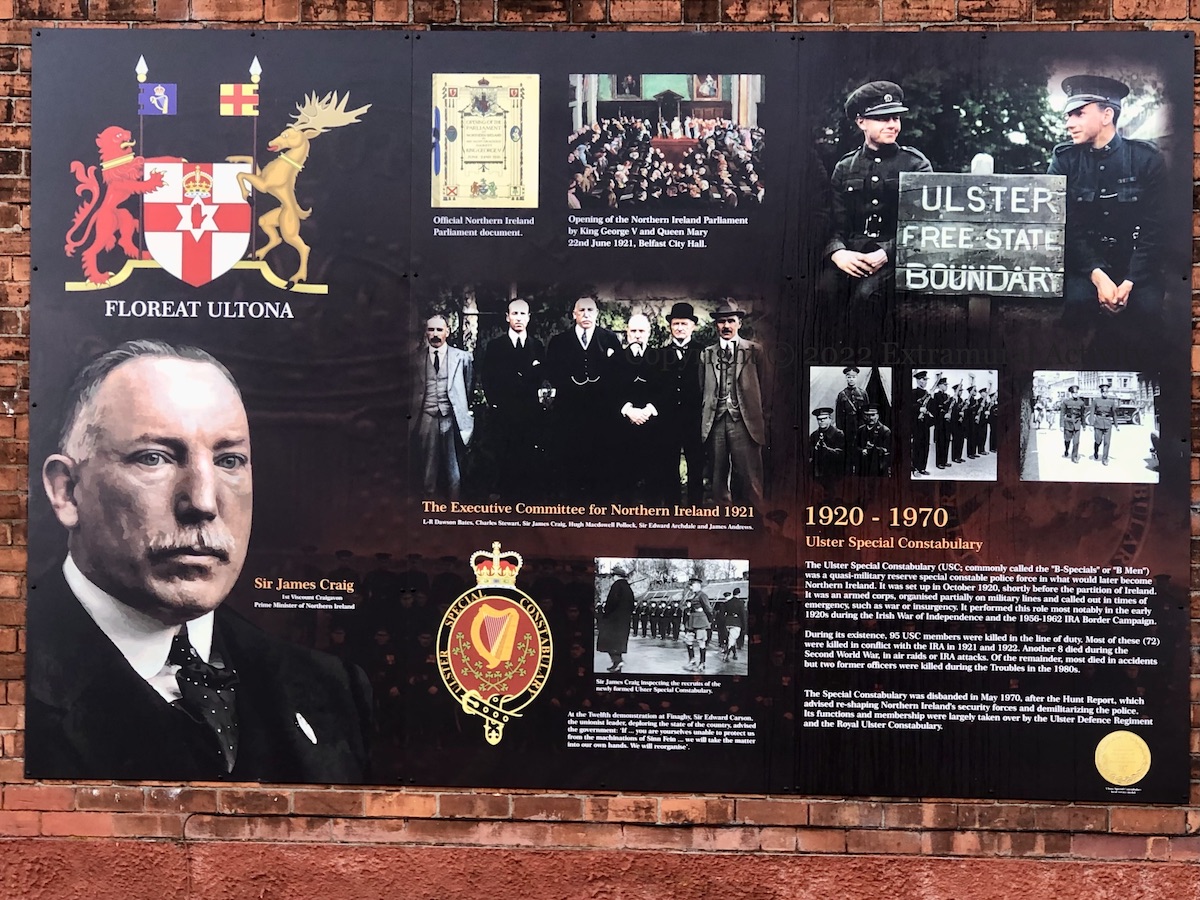
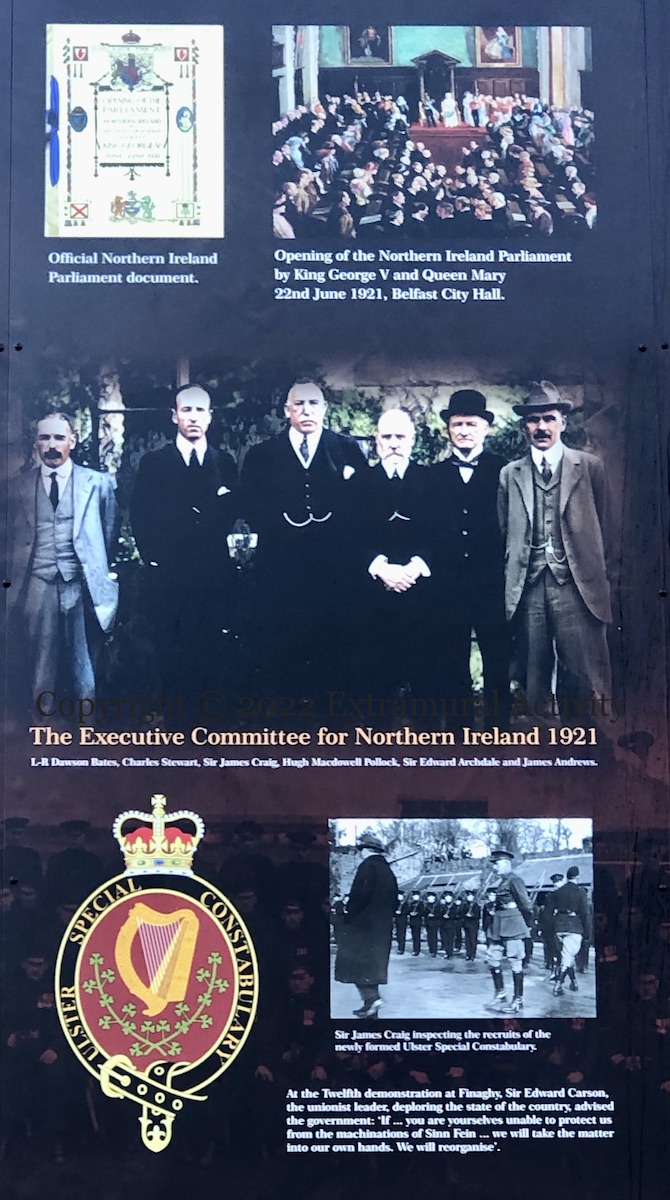
“May Ulster flourish” as the newly created Northern Ireland under “Sir James Craig, 1st Viscount Craigavon, Prime Minister of Northern Ireland”. The Northern Ireland parliament was opened in 1921 and the coat of arms adopted in 1924 (WP); the Special Constabulary (including the B-Specials) had been formed prior to and in preparation for partition – the quote from Carson (also seen in an east Belfast mural) is from July 12th, 1920.
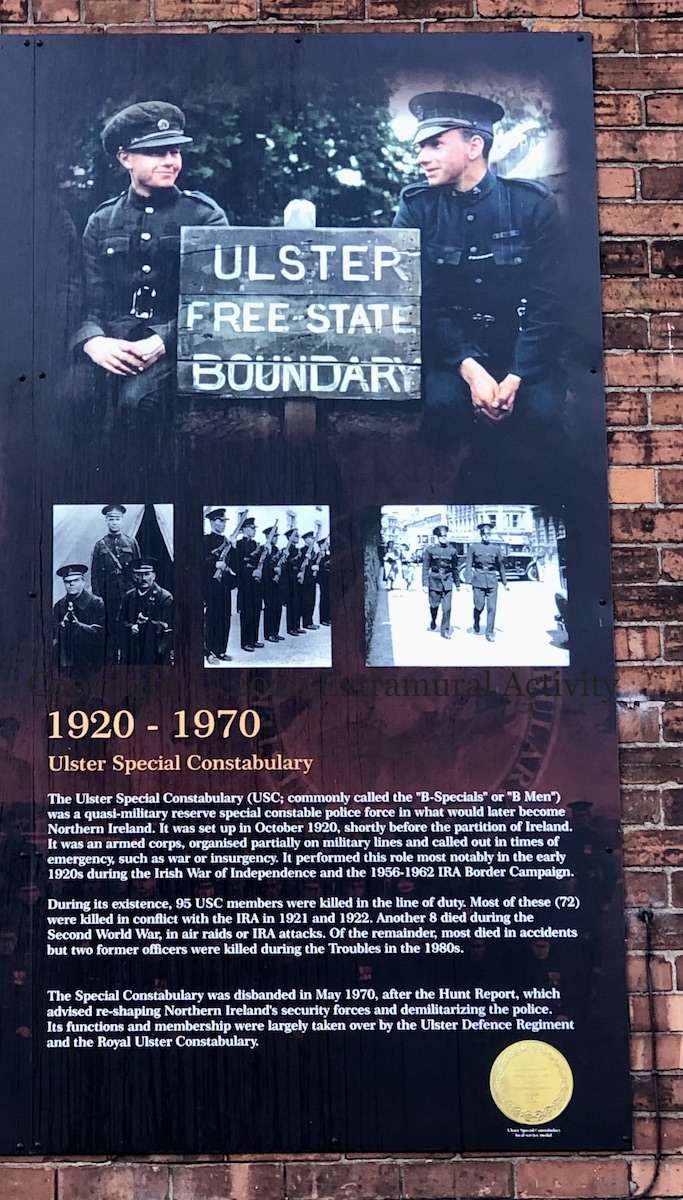
The text on the board is the same as at WP: “The Ulster Special Constabulary (USC; commonly called the “B-Specials” or “B Men”) was a quasi-military reserve special constable police force in what would later become Northern Ireland. It was set up in October 1920, shortly before the partition of Ireland. It was an armed corps, organised partially on military lines and called out in times of emergency, such as war or insurgency. It performed this role most notably in the early 1920s during the Irish War of Independence and the 1956-1962 IRA Border Campaign. During its existence, 95 USC members were killed in the line of duty. Most of these (72) were killed in conflict with the IRA in 1921 and 1922. Another 8 died during the Second World War, in air raids or IRA attacks. Of the remainder, most died in accidents but two former officers were killed during the Troubles in the 1980s. The Special Constabulary was disbanded in May 1970, after the Hunt Report, which advised re-shaping Northern Ireland’s security forces and demilitarizing the police. Its functions and membership were largely taken over by the Ulster Defence Regiment and the Royal Ulster Constabulary.”
This Belfast Live article (which has images from the launch) leads with the headline that this new board replaces a UVF mural, but there hasn’t been anything on this wall since a large “UDA” lettering in 1999. The adjacent wall, which has now been painted over, previously (in 2010) had a UVF flag which had been vandalised with “Jesus Christ Is Lord Of All’ graffiti by 2017.
“Óglach, gaeılgeoır, gníomhaí, Cara. Ár mbuíochas leat. [Volunteer (in the IRA), Irish-speaker, activist, friend. Our thanks to you]” Mac Nıallaıs was imprisoned in 1976 (Belfast Telegraph) and went on the blanket – here is his mother, Mary, protesting his treatment: Do You Care? Upon his release in 1986 he took up community work and political activism in Derry, including a prominent role the parade protests in the mid-90s (see No Sectarian Marches | No Consent No Parade). (Derry Journal) The mural is by local artists Razer and (Donncha’s brother) Paddy Nelis (BelTel).
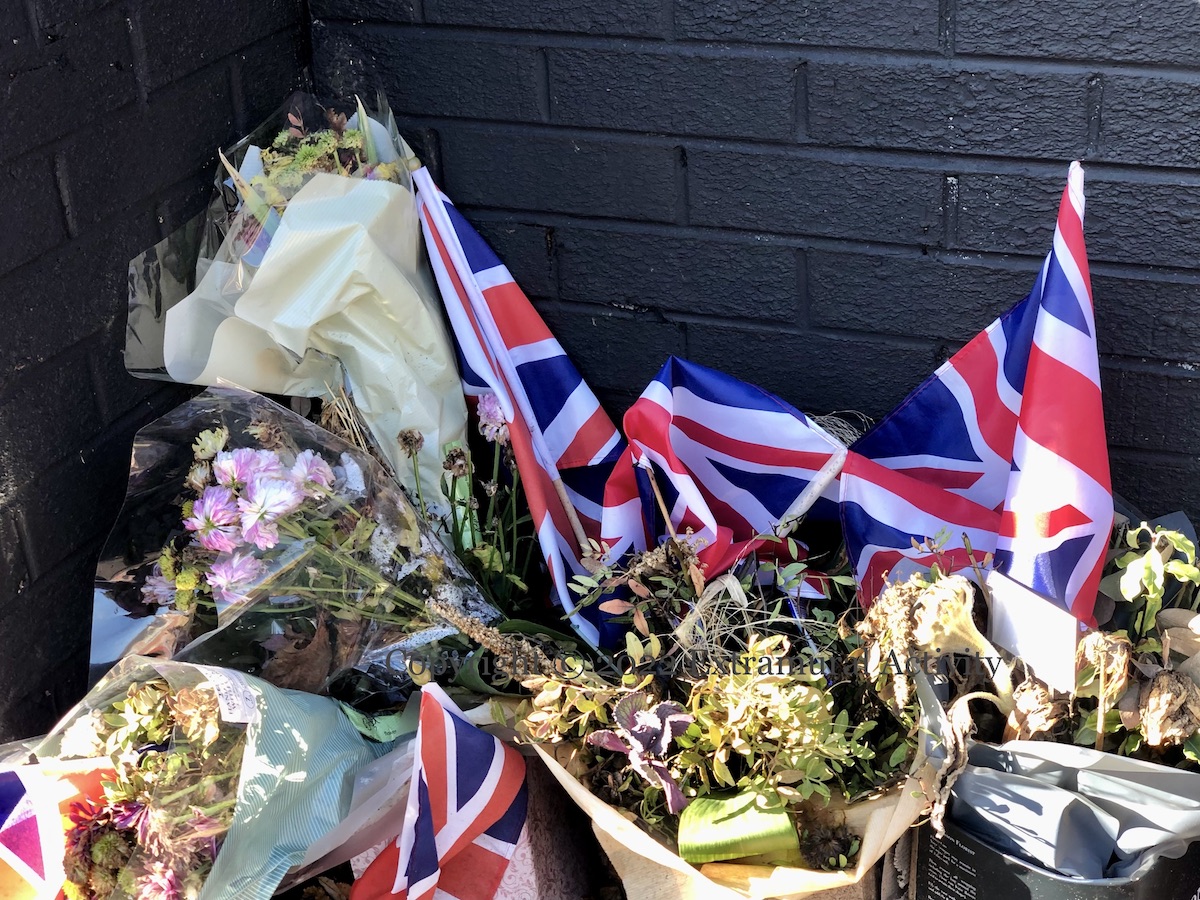
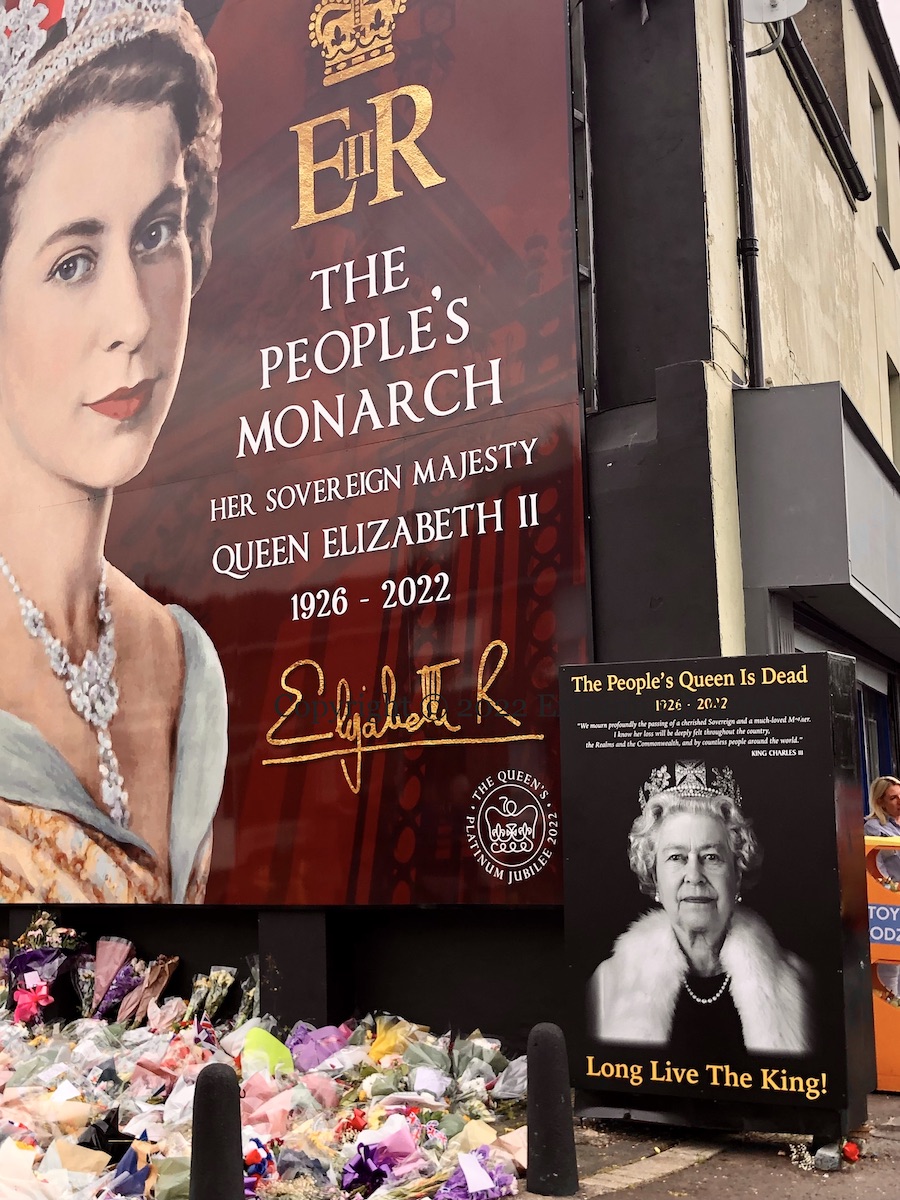
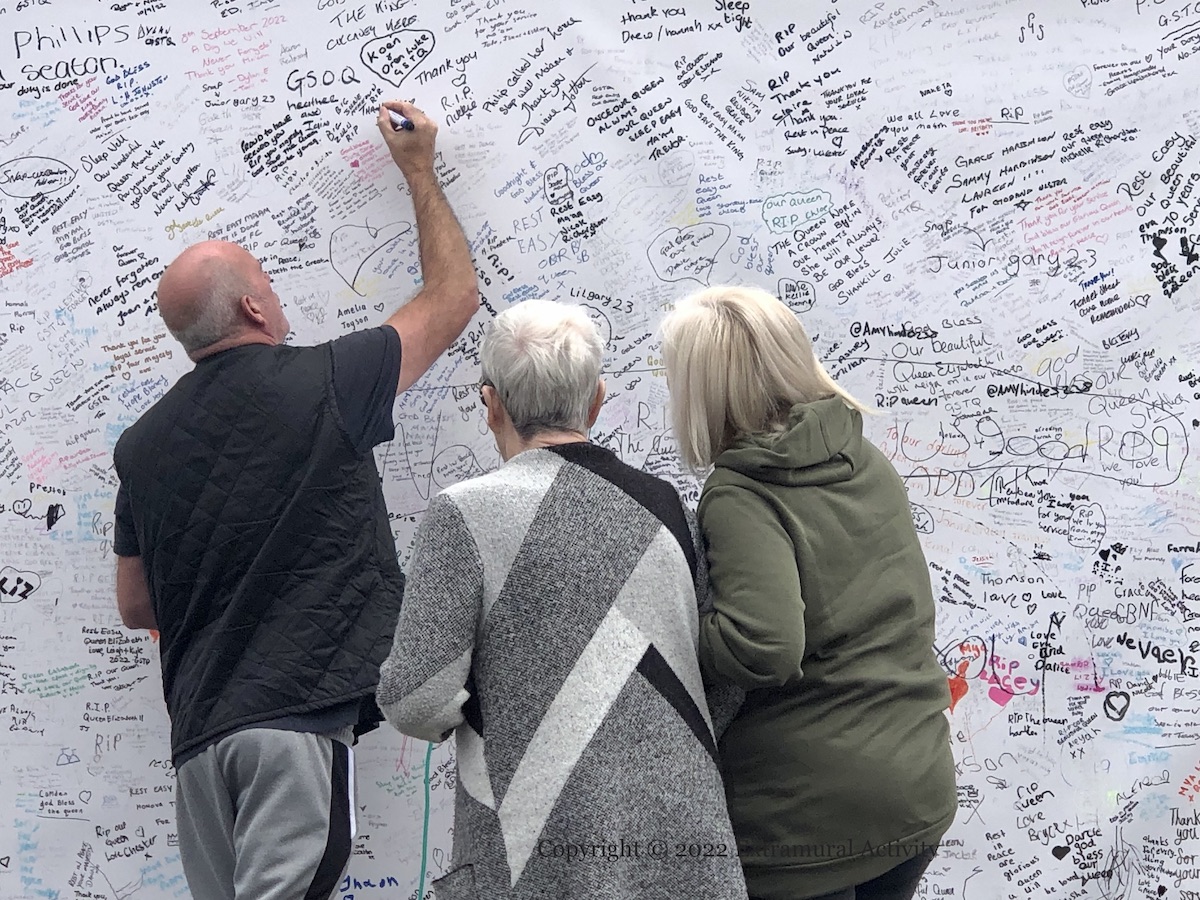
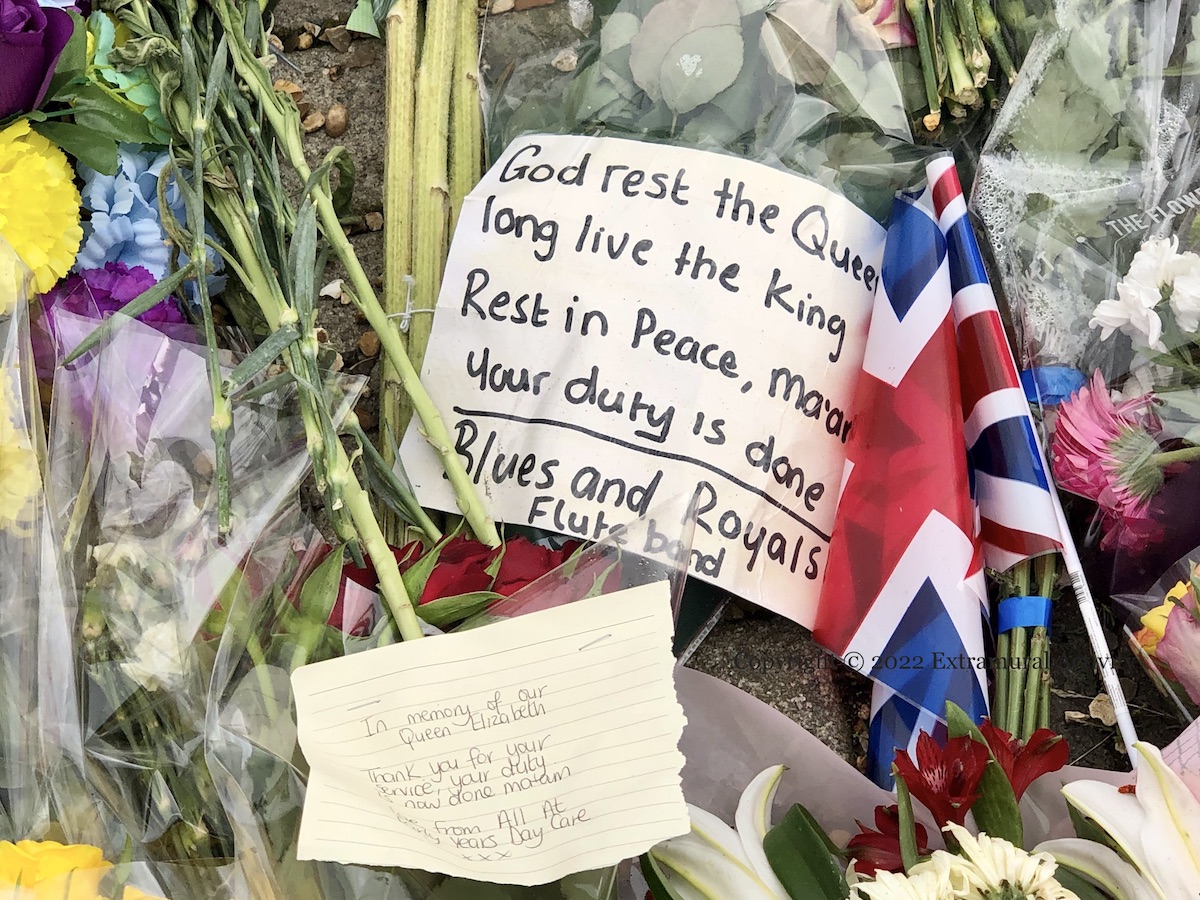
Upon news of Queen Elizabeth’s death, the platinum jubilee mural at the bottom of Crimea Street became a memorial, with hundreds of bouquets being laid before it and a “wall of condolences” set up. (For the mural itself, see The People’s Monarch.) In addition, to the right-hand side has been added a small commemoration of her passing, with a quote from her son, the newly acceded King Charles:
“We mourn profoundly the passing of a cherished Sovereign and a much-loved Mother. I know her loss will be deeply felt throughout the country, the Realms and the Commonwealth, and by countless people around the world”; “Long live the king!”
The fifteen commonwealth “realms” (previously called “dominions”) share a monarch – formerly Elizabeth II and now Charles III – while the commonwealth comprises 41 additional nations, including some which are now republics: Barbados, for example, became a republic on November 30th last year (2021) but is still in the Commonwealth (WP). Additional countries might take the passing of Elizabeth as a suitable juncture at which to sever ties (Edinburgh News has a round-up | for the Bahamas see Caribbean National Weekly | for Canada see Toronto Star).
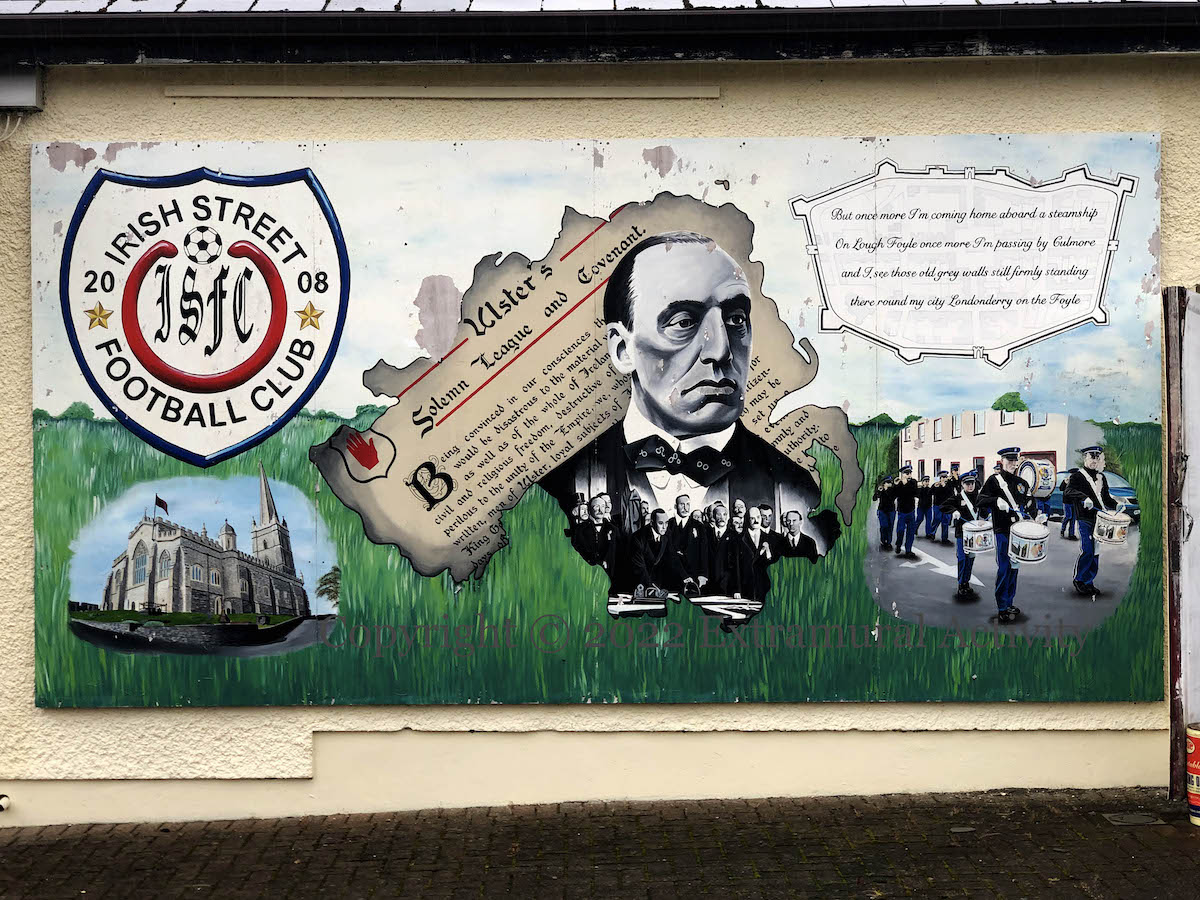
The sights and sounds of Irish Street and Londonderry: (clockwise from right) a verse from Londonderry On The Foyle (youtube) in a frame of the walls of the city of Derry – “But once more I’m coming home aboard a steamship/On Lough Foyle once more I’m passing by Culmore/And I see those old grey walls still firmly standing/There ’round my city Londonderry on the Foyle”; East Bank (Irish Street) Protestant Boys (Fb) on parade; Carson and the signing of the 1912 Covenant; St Columb’s Cathedral; Irish Street FC (Fb).


















 Extramural Activity