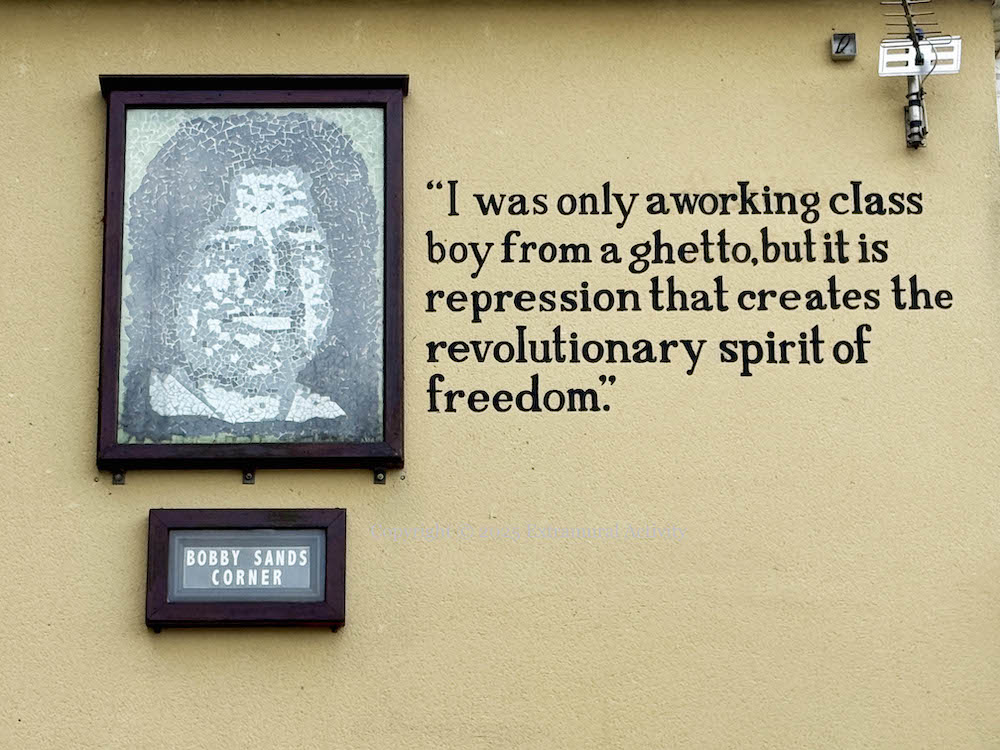
“I was only a working-class boy from a [nationalist] ghetto, but it is repression that creates the revolutionary spirit of freedom.” This is a widely-quoted line from Bobby Sands, from an article in Republican News, 16 December, 1978 (page 7 pdf).
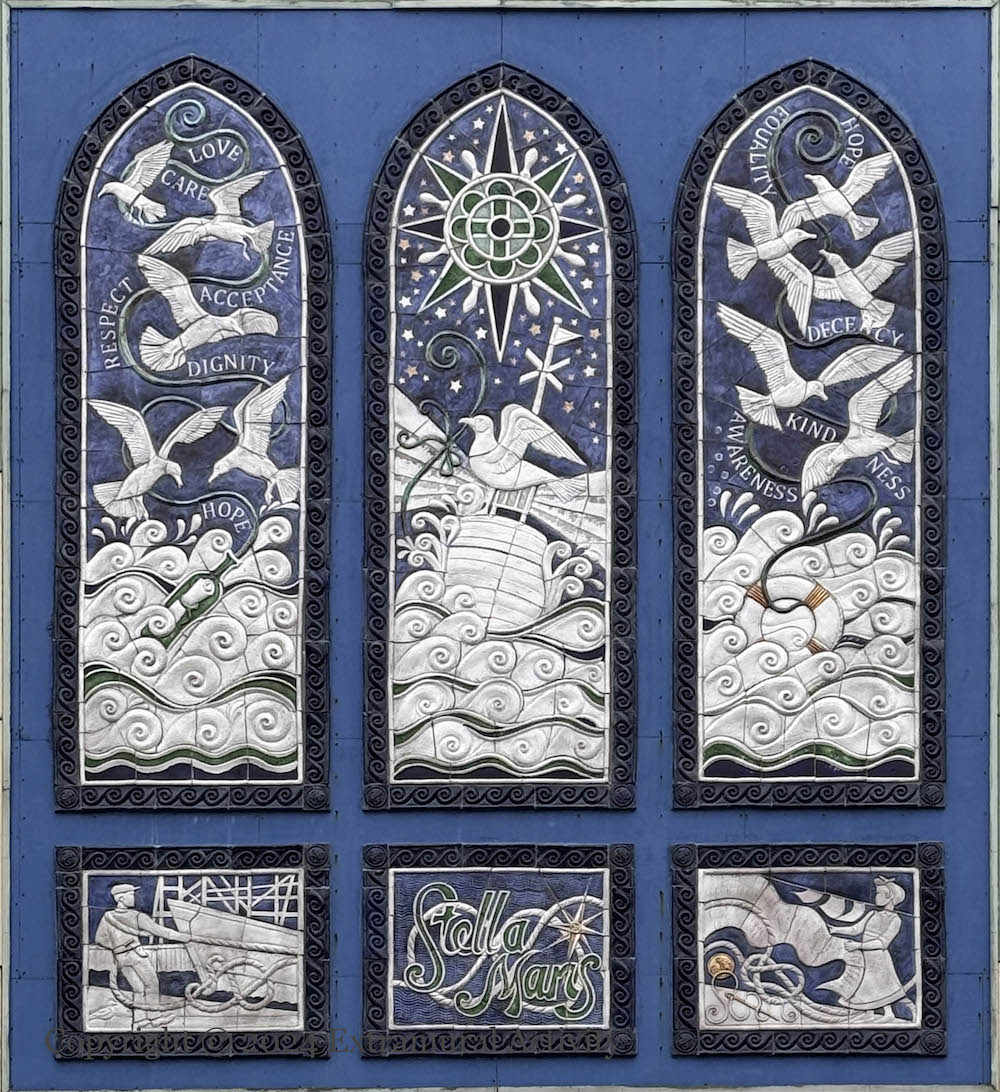
Stella Maris (“star of the sea”) hostel in Sailortown provides accommodations for “up to 23 long-term homeless street drinkers” (web). The name is a hold-over from the building’s former use as a charity for seafarers; the name “stella maris” has also long been associated with the pole star by which sailors reckon their course of sail.
This large installation (by Elfire Ceramics – ig) on the exterior wall of the hostel is full of maritime imagery, including the pole star, as well images of hope such as a message in a bottle (left) and a life-preserver (right), as well as inspirational words: love, care, acceptance, respect, dignity, hope, equality, decency, kindness, awareness.
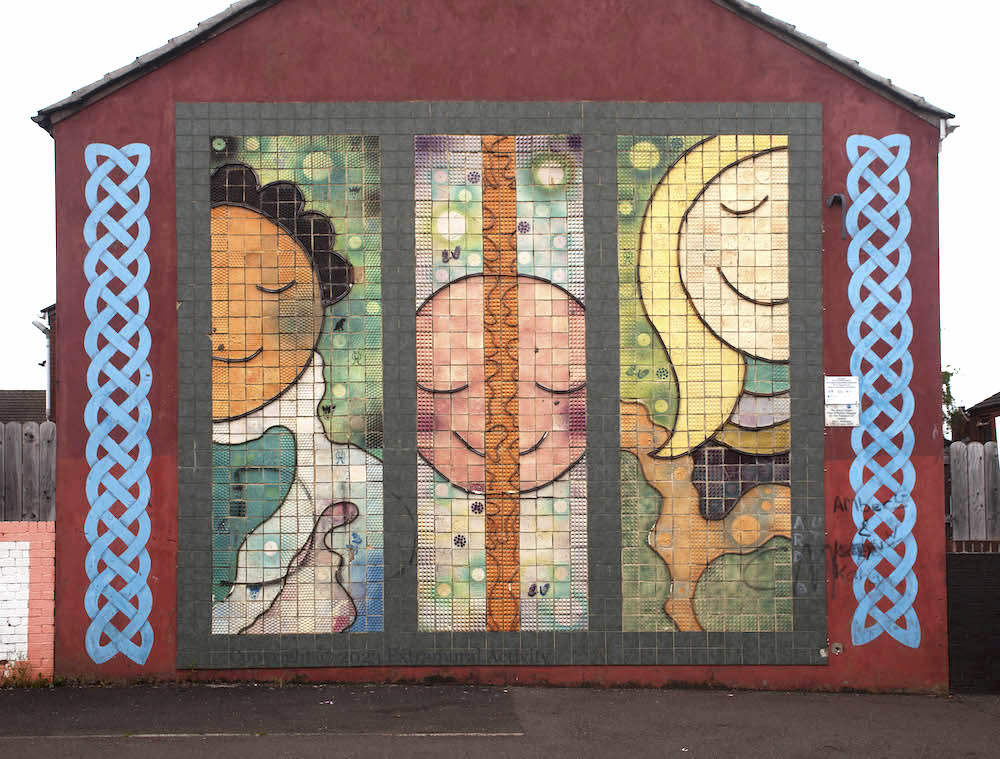
The faces of local children are rendered in ceramic tiles by Clare McComish (web), replacing a Sean McCaughey mural in Brompton Park, Ardoyne, as part of the 2009 Re-Imaging Communities project (see Visual History 10).
“”From here started the long hard march to allied victory” Dwight D. Eisenhower. “Opposite this point was the gathering area for a massive convoy of mixed ships which sailed to arrive at the beaches of Normandy on D-Day 6th. June 1944.”” US naval vessels gathered in Belfast Lough and Commander Thomas Keane (photo) was residing at the Royal hotel in Bangor (WartimeNI). General Eisenhower inspected the USS Quincy at Bangor on 19th May, 1944, (WartimeNI). Bangor’s North Pier was renamed Eisenhower Pier in 2004.
The quote is from August, 1945, when Eisenhower received an honorary doctorate from Queen’s (WartimeNI).
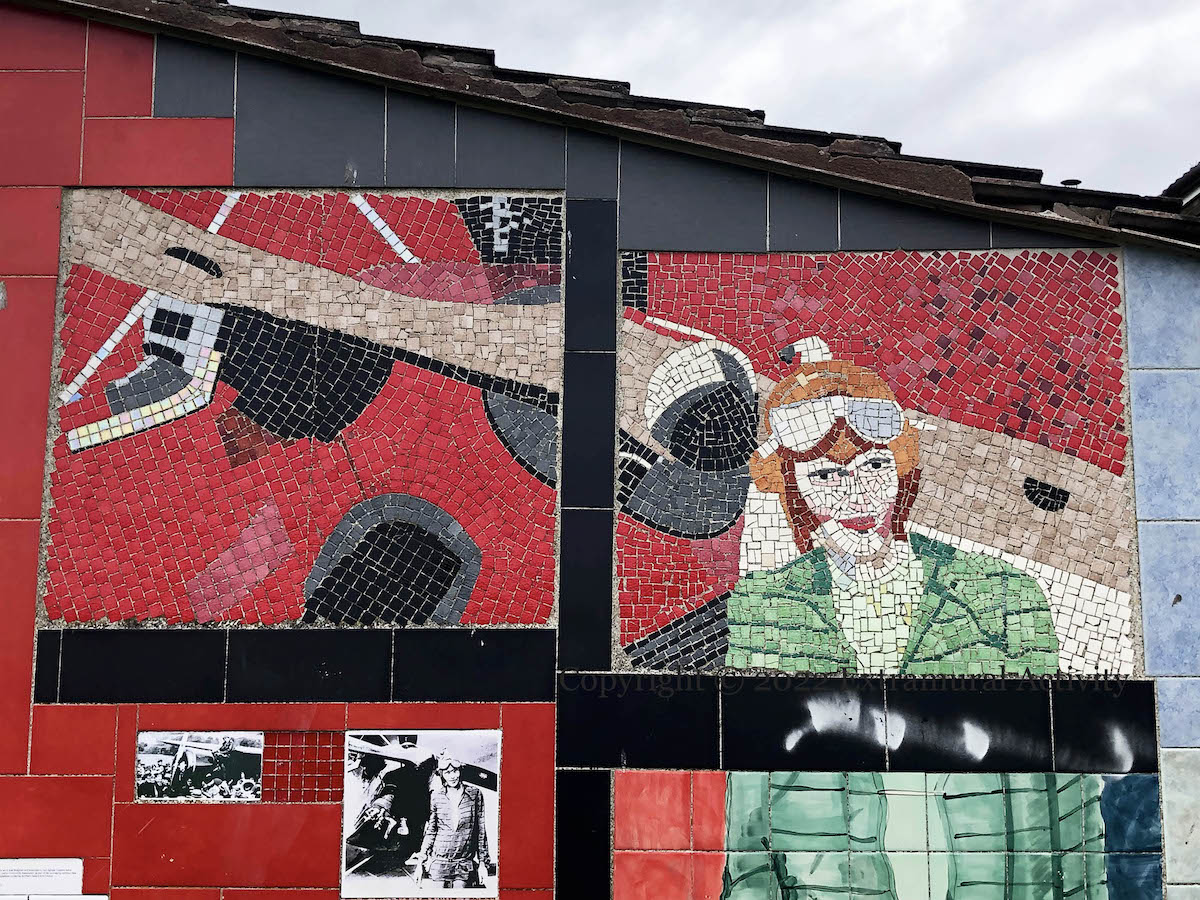
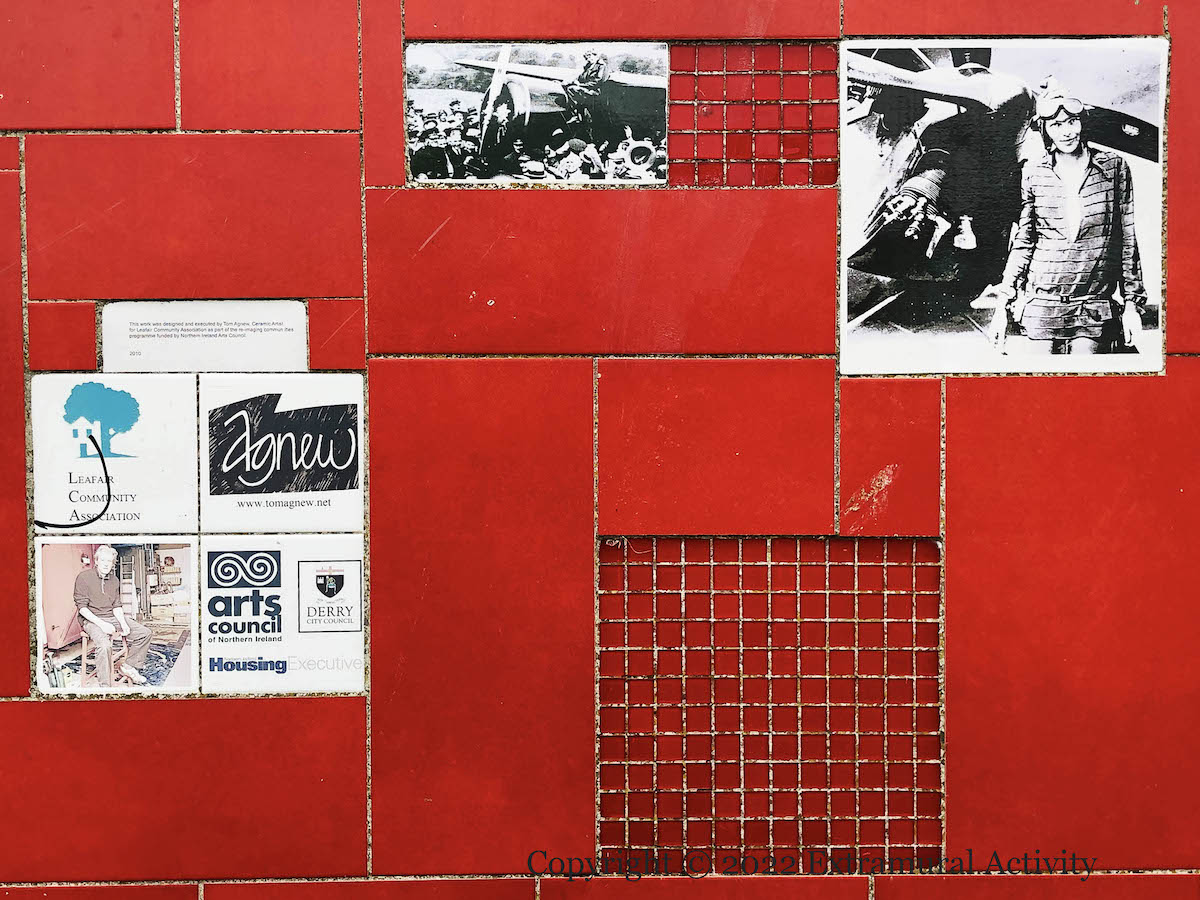
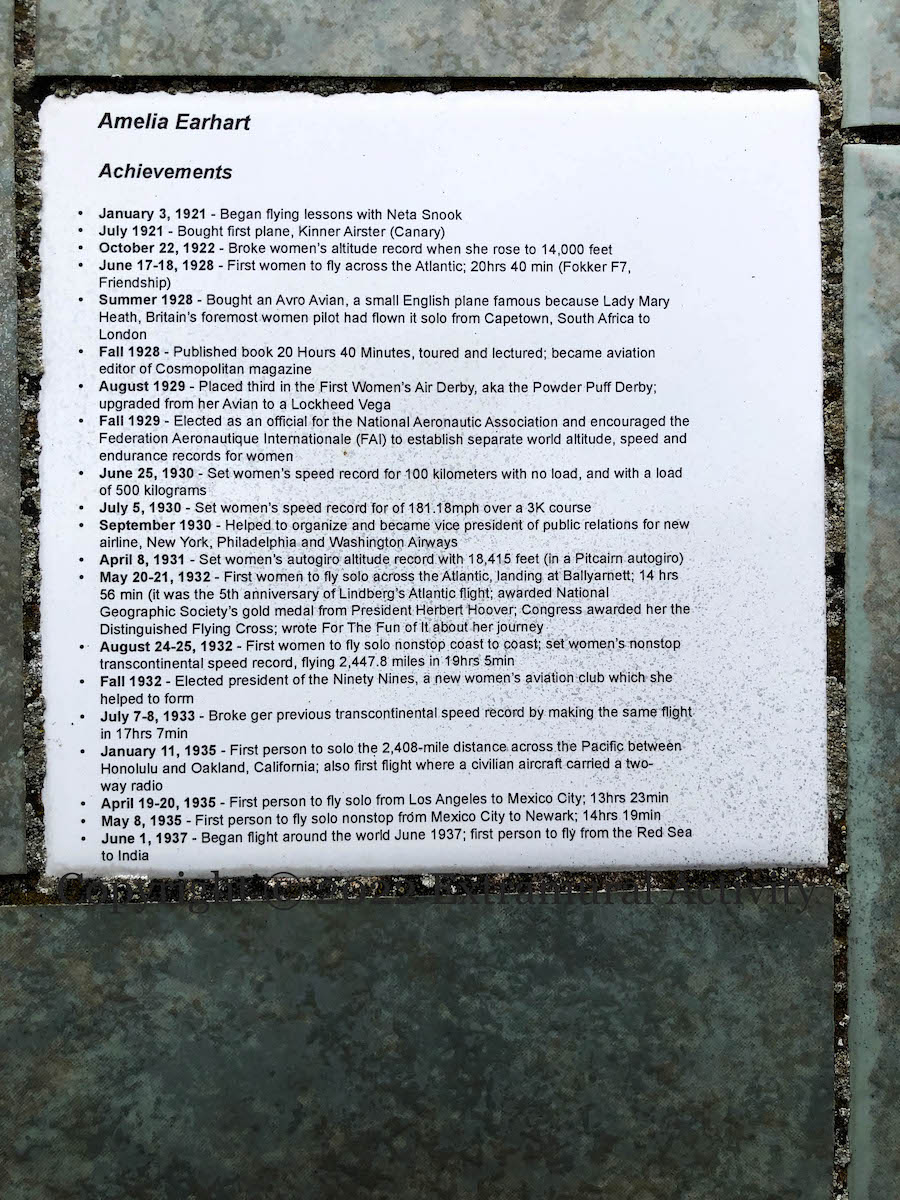
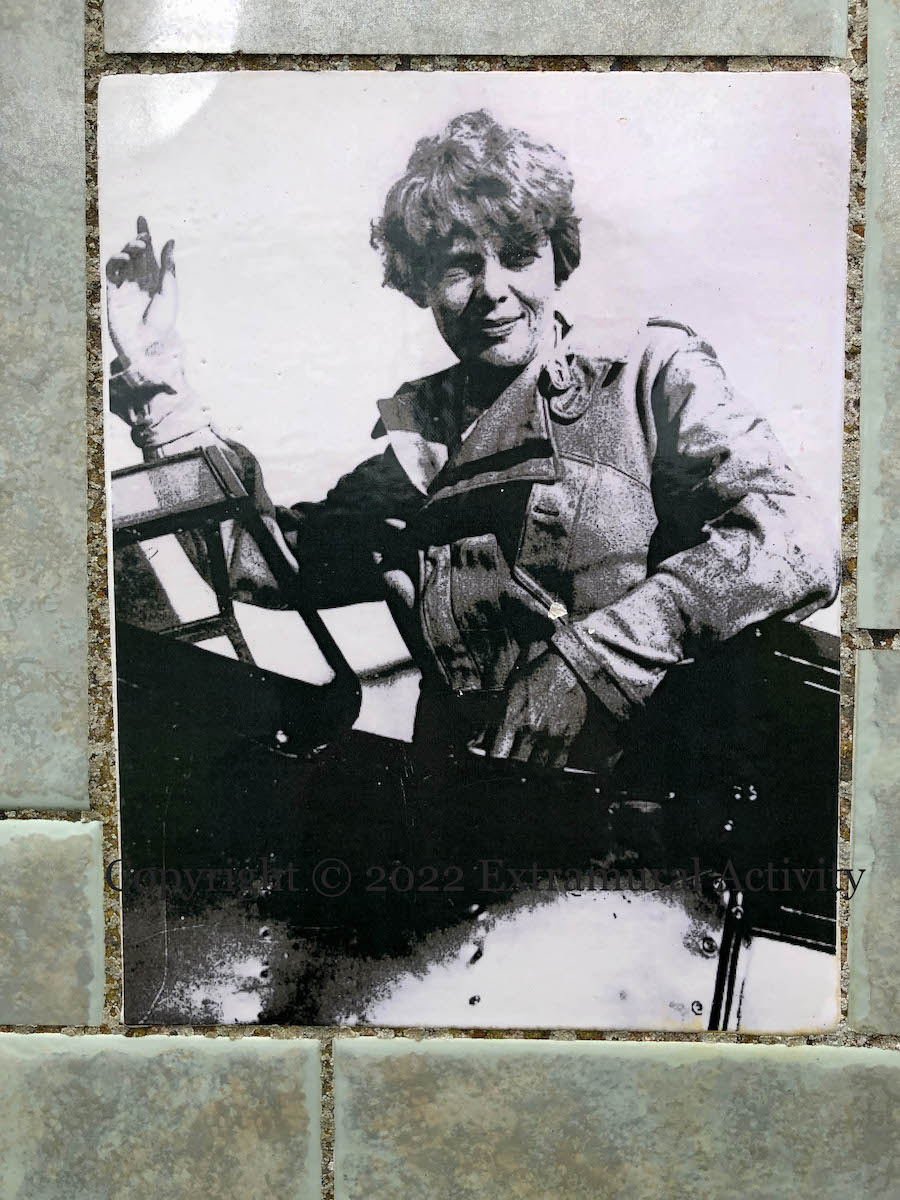
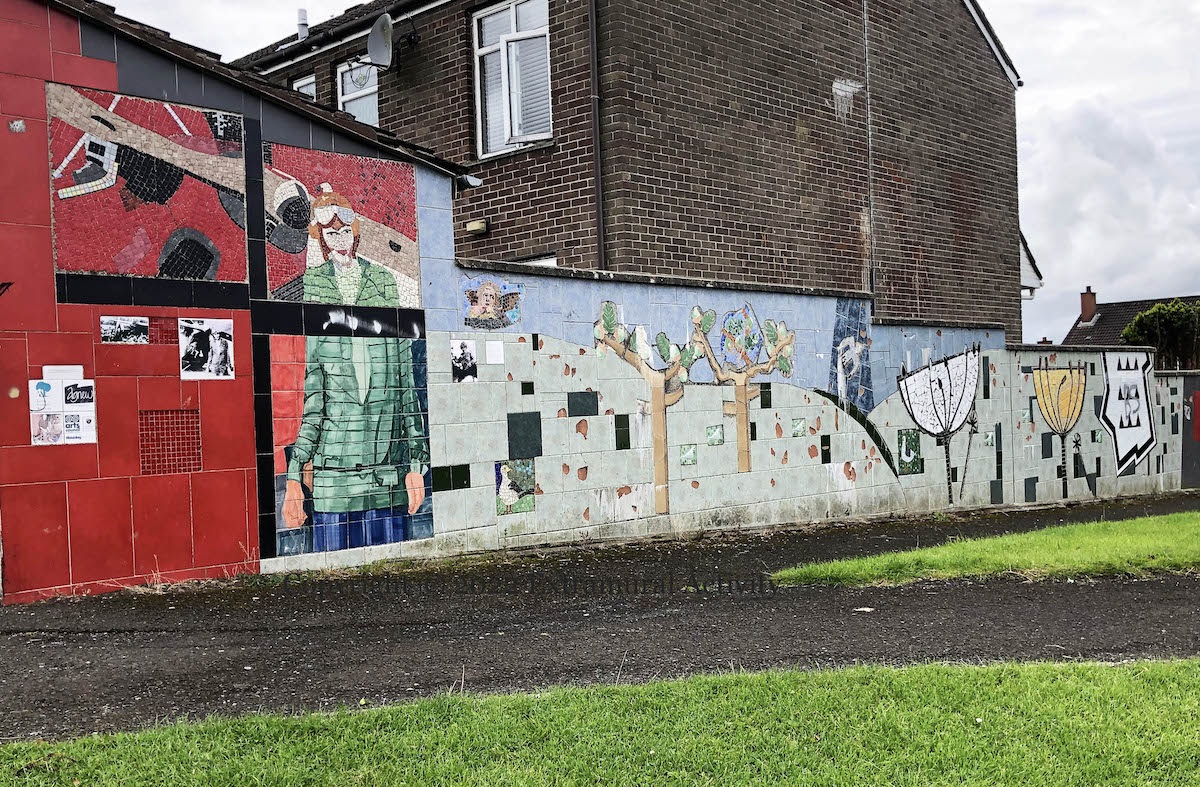
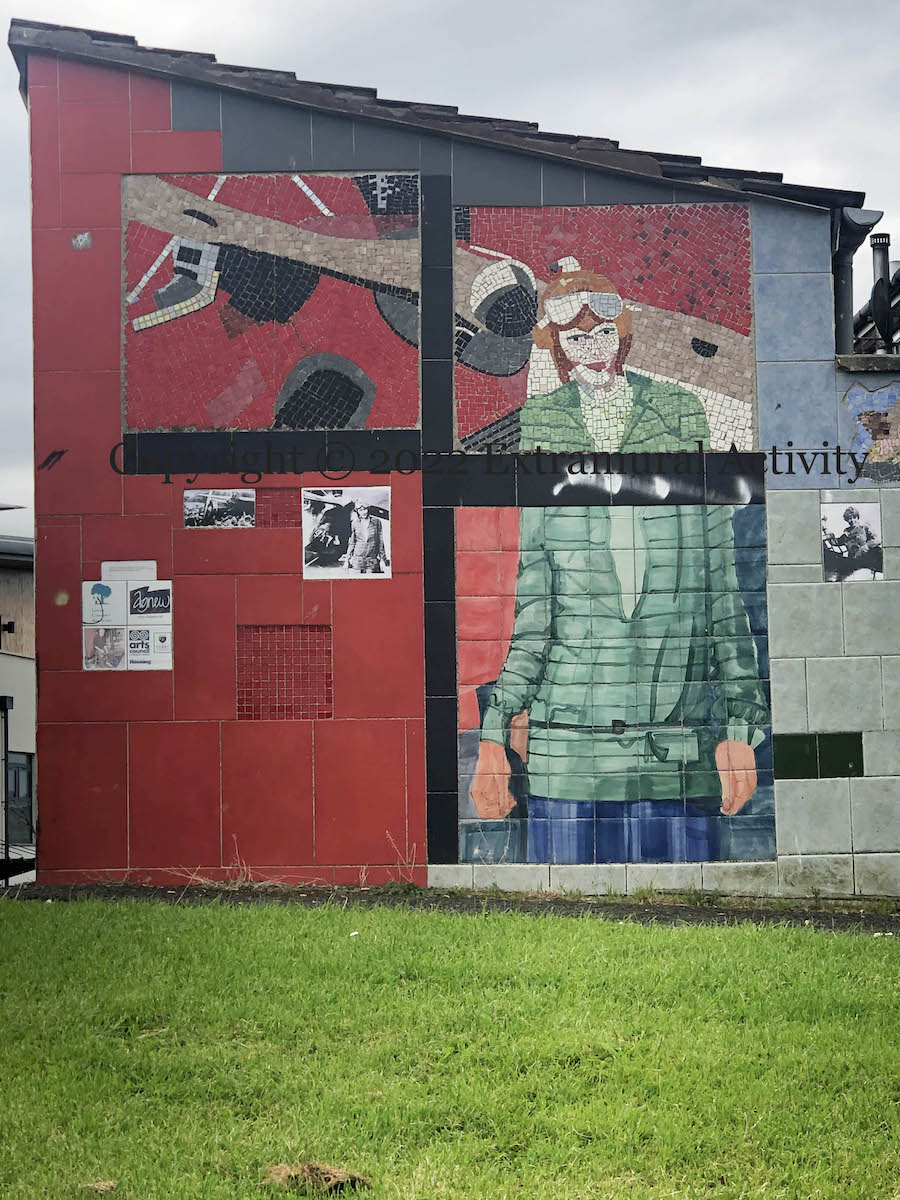
On May 20th, 1932, Amelia Earhart took off from Harbour Grace in Newfoundland hoping to be the first woman to fly single-handedly across the Atlantic and make it to Paris. It didn’t go entirely to plan. Fifteen hours later, however, she landed in Robert Gallagher’s farm in Ballyarnett, forced down by bad weather and technical problems. The farmer’s wife recorded her recollections of the event, three years later (youtube).
“This work was designed and executed by Tom Agnew, Ceramic Artist, for Leafair Community Association (Fb) as part of the re-imaging communities programme funded by the Northern Ireland Arts Council – 2010.”
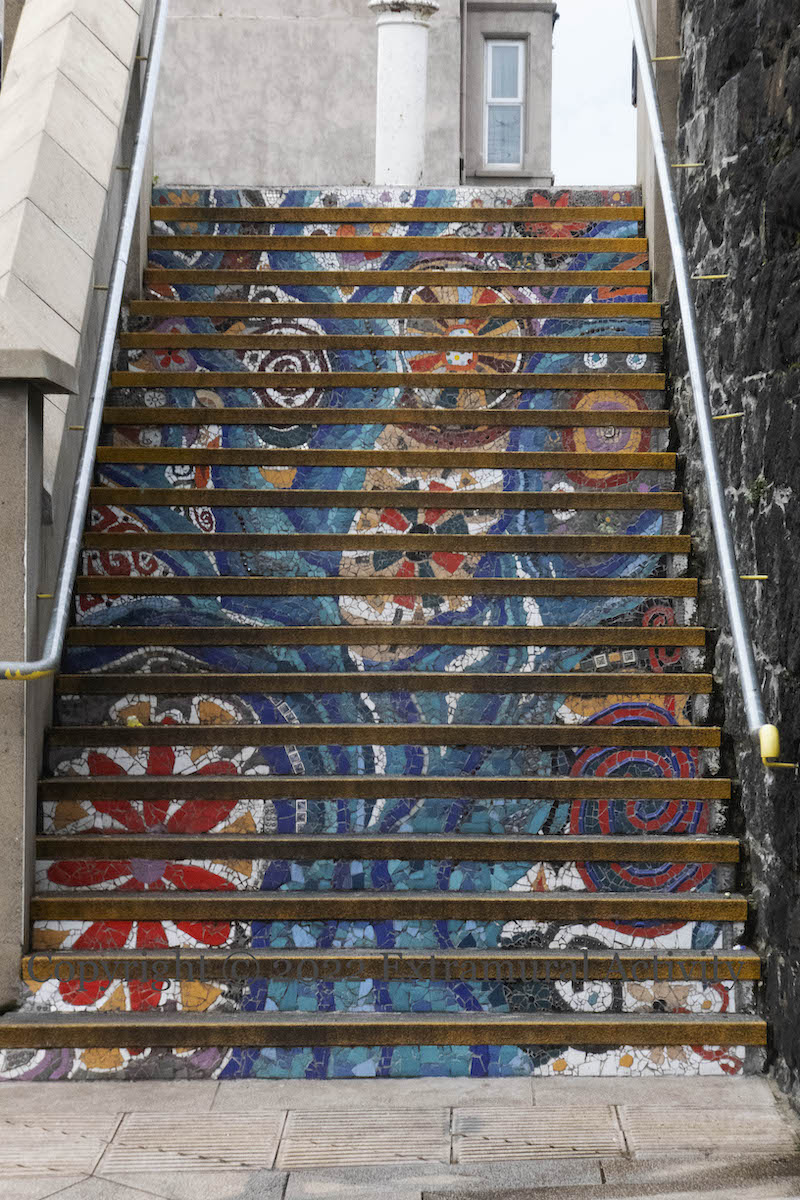
Two Larne trees: above, the tree mosaic at the Town Hall steps created by artist Janet Crymble (see previously Sports We Love), with support from Larne Renovation Regeneration, Larne Trader’s Forum, and Mid & East Antrim Borough Council (NIWorld); below, the “Armada Tree” that is purported to have sprung from a chestnut or chestnut seeds in the pocket of a dead sailor in the Spanish Armada – the tree fell over after 432 years in 2020, a victim of root disease (anglican.org), but is remembered by the board depicting it in Upper Main Street, Larne.
“Local legend has it that when the Spanish Armada was passing these shores in 1588, a sailor was washed up at Ballygally village, no doubt from one of the ships blown off course by gales. Locals were said to have taken the body and buried it in the graveyard of the picturesque St Patrick’s Church at Cairncastle. The ancient tree beside the chuch grew from one of the chestnut seeds that the sailor had in his pocket when he was buried. The tree has been analysed and found to date back to the sixteenth century, adding credence to the story.”
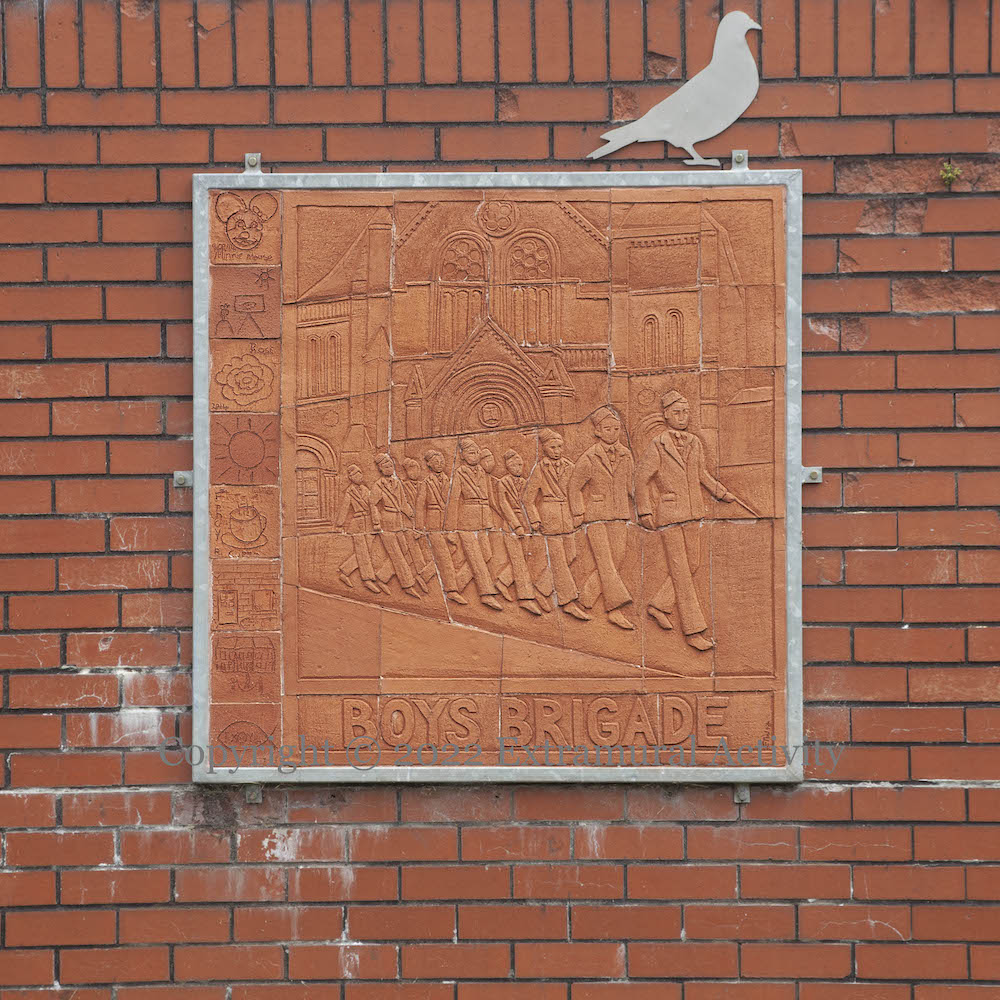
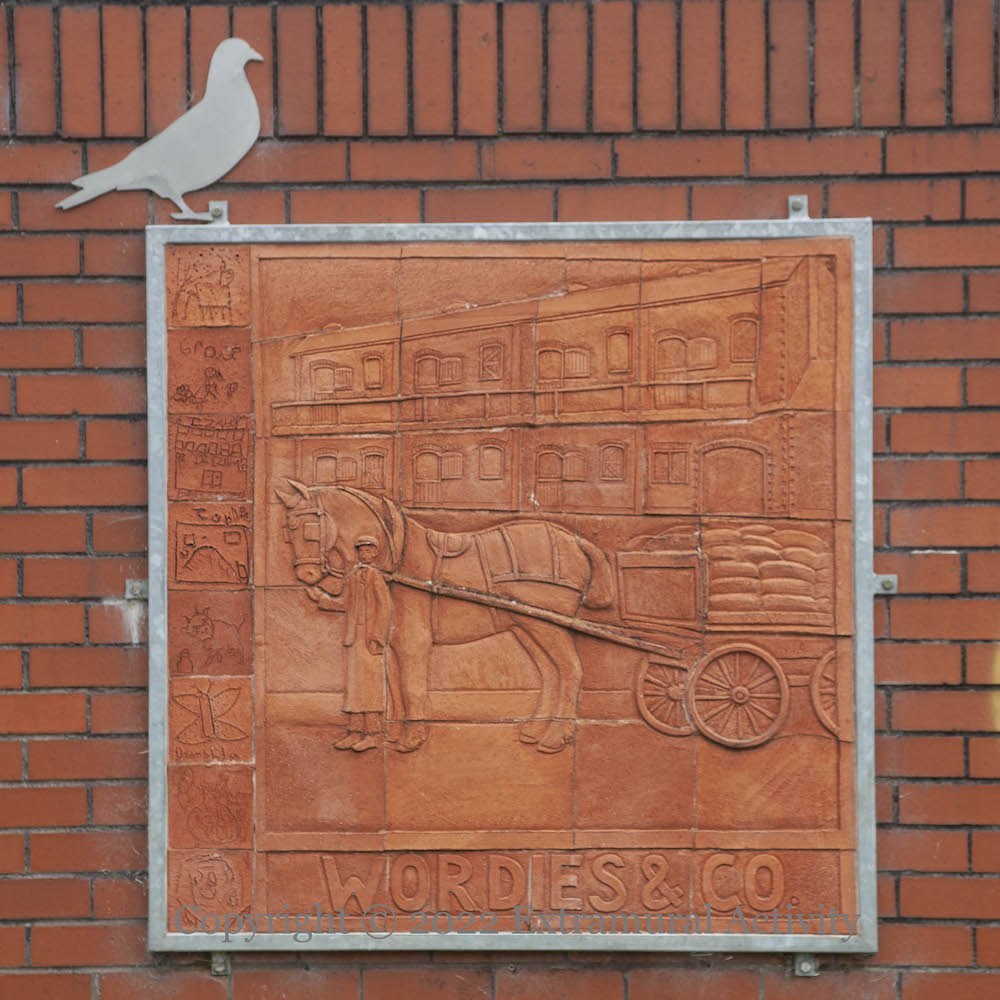
According to a history of Brown’s Square, the area was known as “the oasis” during WWII on account of its 3 dance-halls and 22 pubs (Religion, Riots And Rebels). As with so much publicly-funded art (though we cannot find any provenance for this art) it depicts Belfast in the “good old days” – that is, before the Troubles, which produced the so-called “peace line” dividing west Belfast.
In this case of Brown’s Square, the area was further desolated in anticipation of a planned ring road (formally to be known as the Belfast Urban Motorway). the plan produced only the subterranean “Westlink” that cut Brown’s Square in half. The images in today’s post are in Townsend Street, (these are from below the security gates; there are others above it). Before the construction of the Westlink, which opened in 1981, Townsend Street was considered the western border, and part of Brown’s Square. John Gilbert’s photographs at the Belfast Archive Project show the area in the mid-seventies, when much of it had been abandoned but prior to construction.
The Boys Brigade are shown parading in front of Townsend Presbyterian which held its last service in September and is being handed over to the Ulster Orchestra (Belfast Media) (see previously On The Other Side for stained glass windows inside the church). The Brown’s Square school was at the junction of Brown’s Square (the street) and Melbourne Street.
An arch of a different kind in the Kilcooley estate: a reflective steel arc overlooking a circular mosaic.
“This steel and ceramic sculpture was created by the residents, children and young people from the Kilcooley Community, working in collaboration with visual artists Duncan Ross and Helen Sharp. The sculpture was created as part of the North Down Borough Council Art of Regeneration Project. The sculpture was officially launched by the Chair of the Art of Regeneration Partnership Councillor Alan Leslie on the 28th April 2009. Funded by the Art Council of NI, NI Housing Executive, North Down Local Strategy Partnership through Peace II, Department for Social Development and North Down Borough Council. Tiles printed and supplied by Edinburgh Ceramics.”
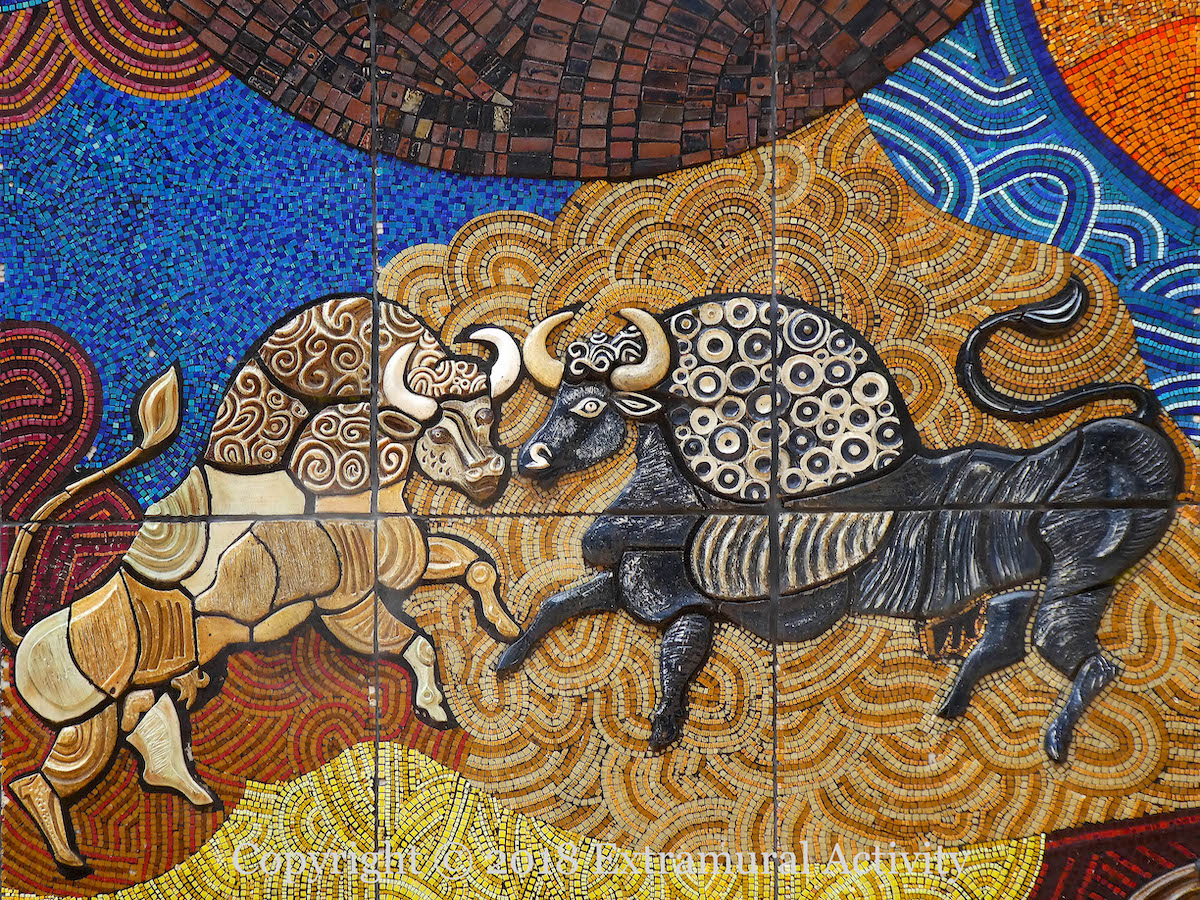
In the Táın, Queen Medb invades Ulster (opposed single-handedly by Cú Chulaınn) to take the Brown Bull (Donn Cuaılnge) in order that her wealth matches that of her husband, Aılıll, who has a prize bull called Fınnbhennach (the White-Horned). When she returns with the bull, the two bulls fight and kill each other. (So, … mission accomplished?)
The mosaic shown above is a detail from Desmond Kinney’s 1974 mosaic mural off Nassau Street in Dublin. For more images and explanation, see Richard Marsh.
“When the name is called by the one above/Their troubles at once did cease/Like the people who went there before them/I prey they will rest in peace.” The words of Shankill man Albert Haslett are used on a Daniella Balmaverde mosaic commemorating the dead buried in Shankill graveyard. The full poem can be found at Belfast Experience, which claims that the number of burials is about half a million. NVTv has a interview program with Haslett, who died in January of last year (2017) – photos and remembrance at Shankill Area Social History group.









 Extramural Activity