Geordie Bell was caretaker at the Short Strand community centre, on the other side of this mural, as well as a trade unionist and republican. A piece of art in the Skainos centre is dedicated to his memory (East Belfast Mission).
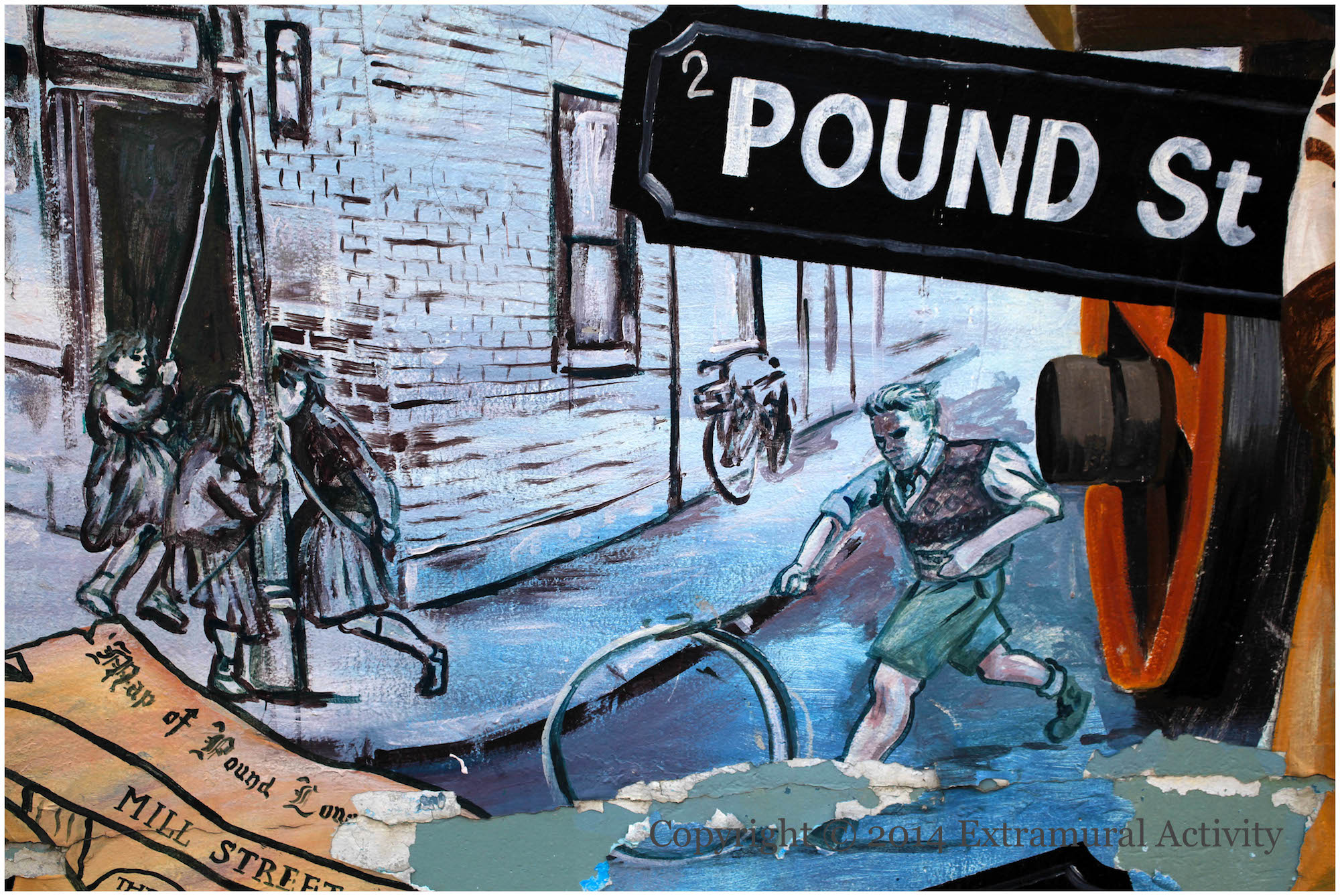
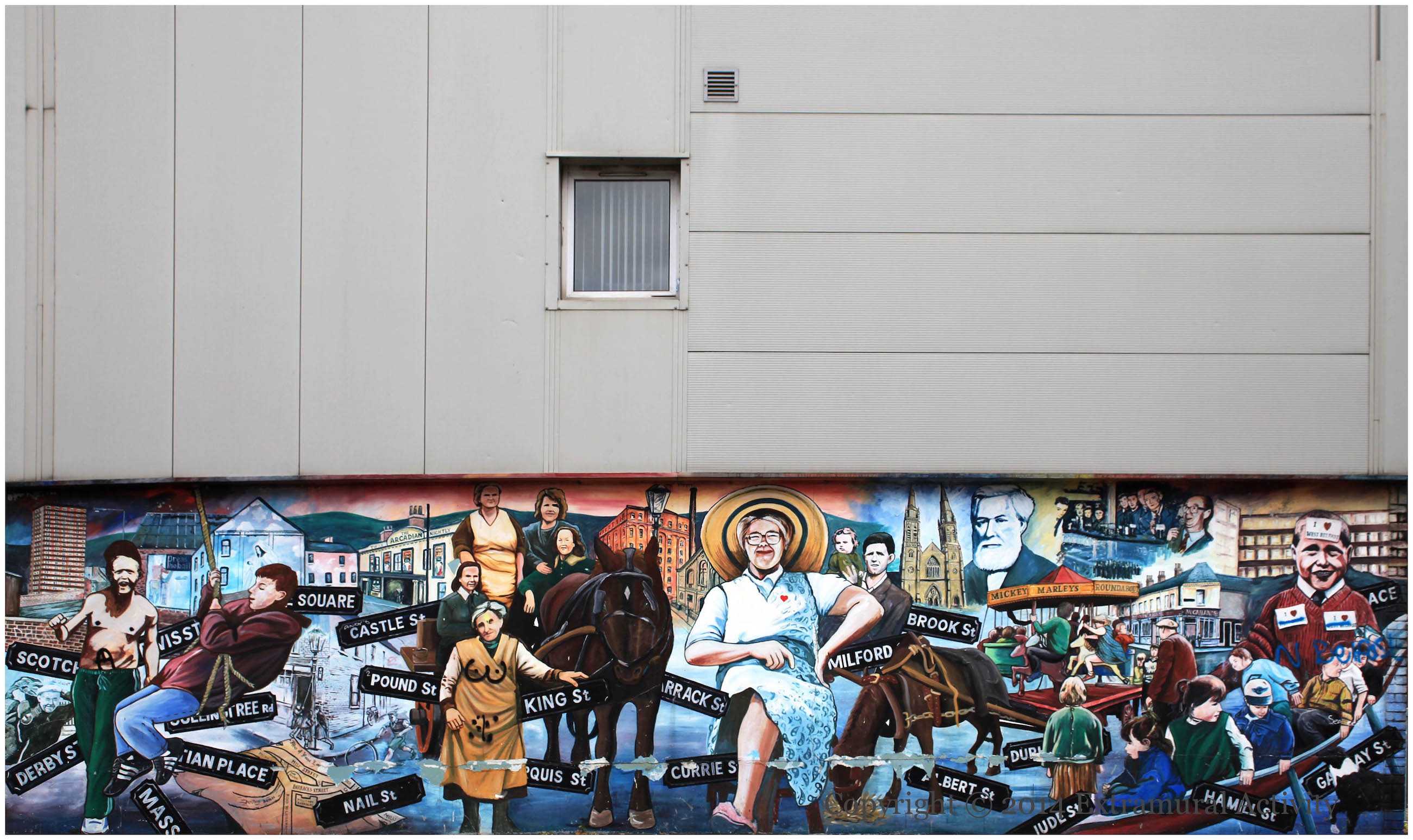
The area known as the Pound Loney is featured in a long mural in Durham Street. The Pound Loney is Divis or the lower part of Divis on either side of Cullingtree Road; a “loney” is a lane and originally a natural path, in this case next to a stream beside the sheep-pound that existed before the area was developed for housing (Old Belfast Districts).
The mural features many of the place-names, landmarks, and personalities of yesteryear, including the Arcadian cinema on Albert Street – left of centre in the full shot below; see also the two images below of the Arcadian in happier days and in 1969, at the start of the troubles (images from Cinema Treasures and the Belfast Forum). Also featured are the Divis tower block, the Blessed Virgin mural, Barney’s mill, McGahan’s pub, Saint Peter’s. The streets include Barrack St, Galway St, Cullingtree Rd, Scotch St, Christian Place, Derby St, Castle St, Pound St, Nail St, Currie St, Albert St, Brook St, Jude St, Hamill St, Divis St, Milford St and Massereene (Row or Path or Walk) in Divis flats. If you can identify any of the characters in the mural, please leave a comment.
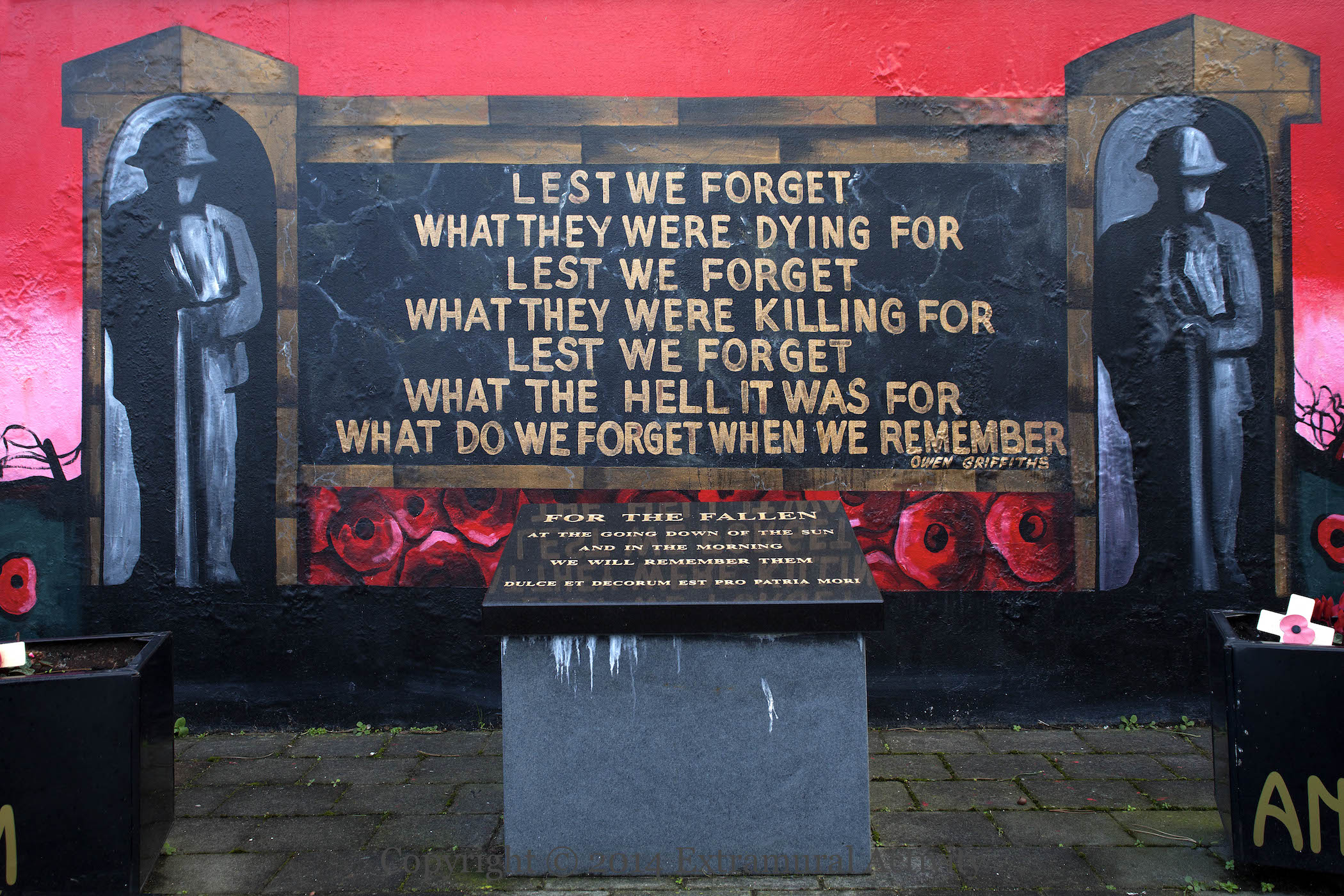
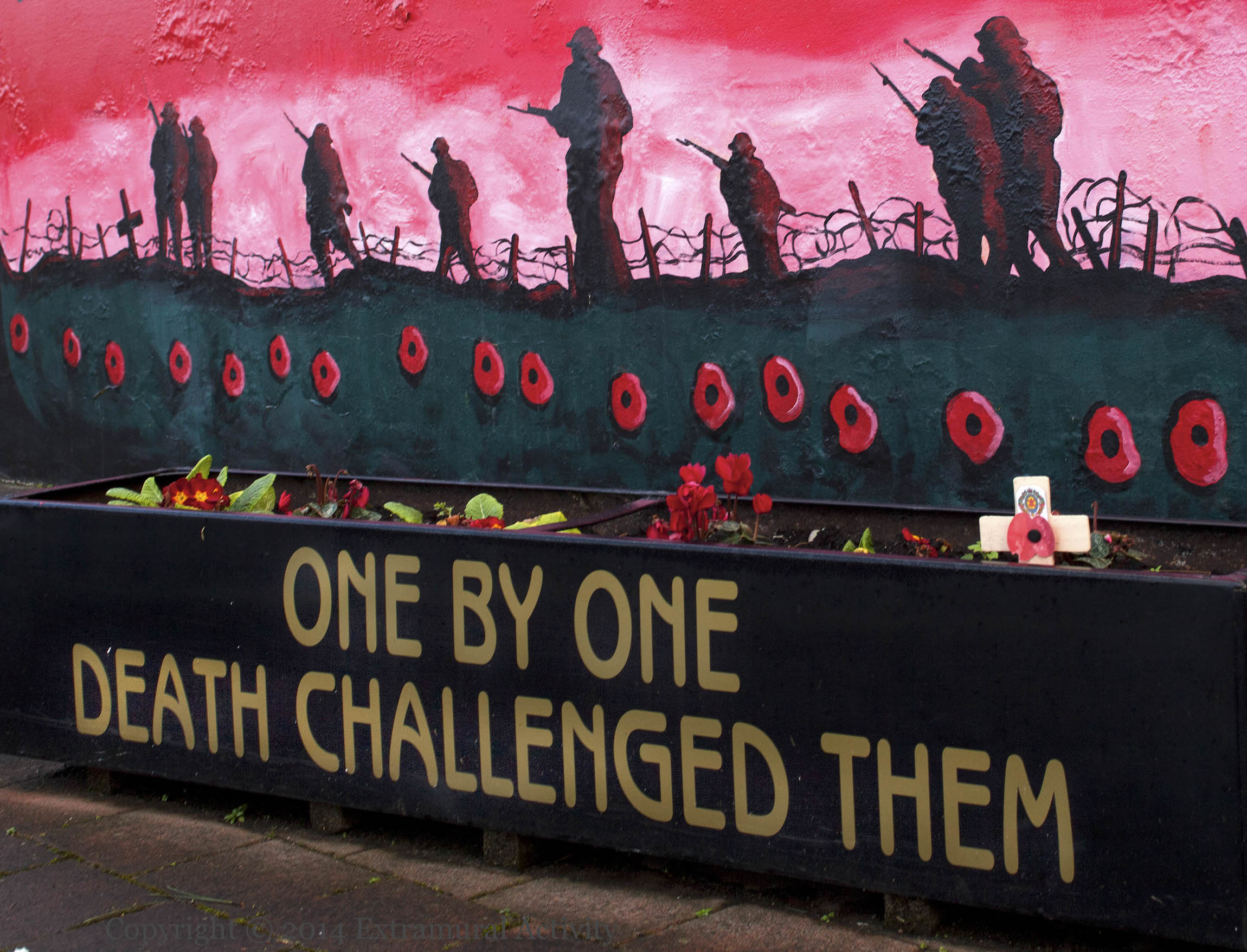
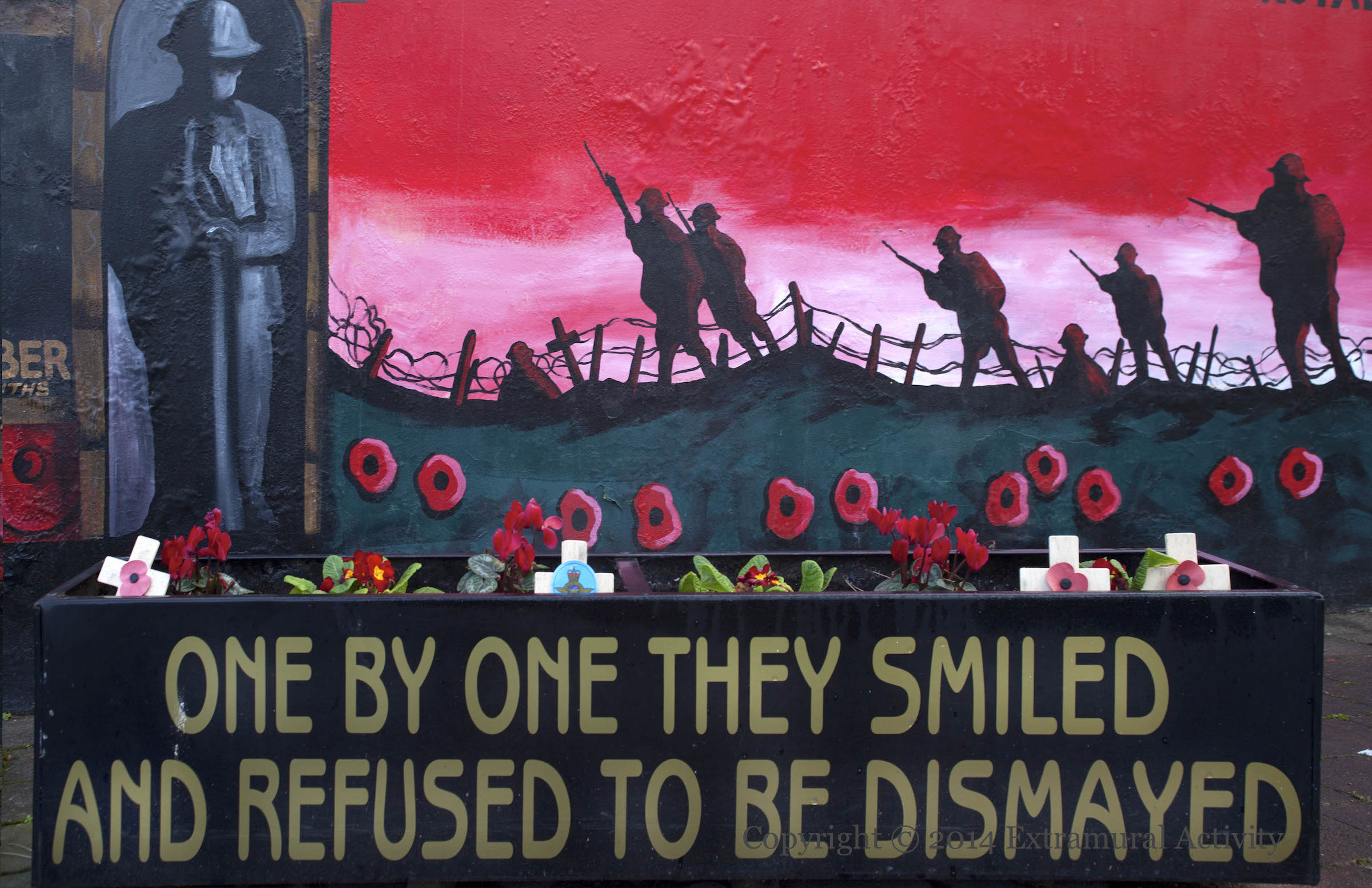
Two poems are featured prominently and another two alluded to in this Newtownards mural and memorial garden to WWI soldiers. The main panel features part of an anti-war work by Owen Griffith, Lest We Forget. Robert Laurence Binyon’s For The Fallen is featured on the stone, above a line of Latin from Horace’s Odes (III.2) – On Virtue(which most famously re-appears in Owen’s Dulce Et Decorum Est). On the left and right (see the wide shot at the very bottom) there appear the mottos of the Royal Irish Rifles – ‘Quis separabit’, which comes from Romans 8:35 – and the Royal Artillery – ‘Ubique – Quo Fas Et Gloria Ducunt’, which comes from Kipling’s Ubique.
For the (WWI) 13th battalion RIR, see Regimental List and similarly for the 16th (rather than the 17th) “Pioneers”. For the (WWII) 5th Anti-Aircraft battery, see Newtownards History.
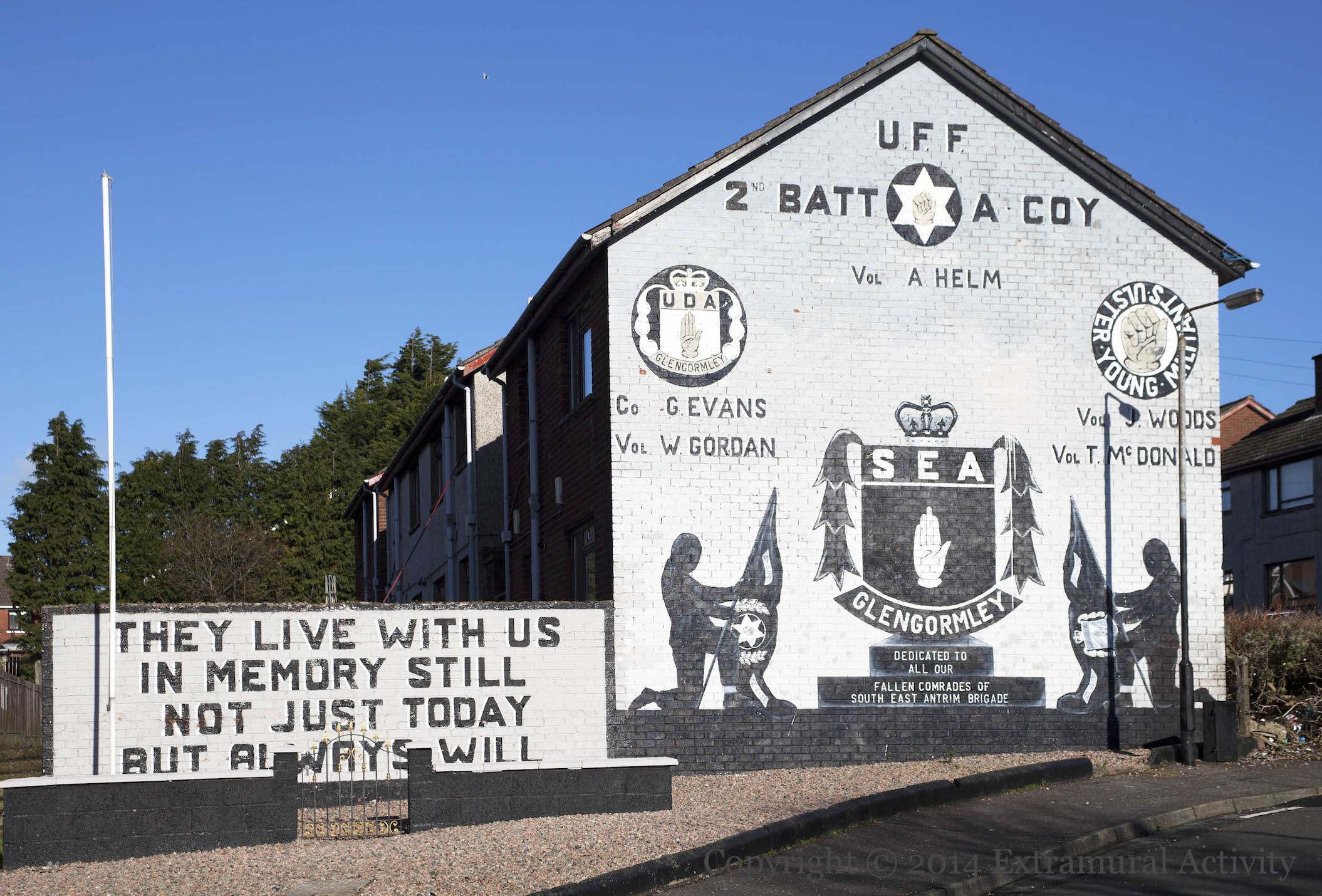
“They live with us/in memory still/not just today/ but always still.” Mural and memorial in Queen Street, Glengormley, to South East Antrim UFF/UDA/UYM volunteers A. Helm, G[erald] Evans, W. Gordan, J. Woods, and T. McDonald.
Maıgh Ard/Moyard and New Barnsley are at no risk of flooding, but this mural clearly shows the locals long to be paddling down the slopes of Black Mountain/Slıabh Dubh in canoes and kayaks .
A seven-year old Setanta become Cú Chulaınn (Culann’s Hound) after killing the beast by driving a sliotar (the ball used in hurling) down its throat. Detail from a mural in Roumania Rise, off Ross Road. Wide shot of the whole below. The lettering reads “Mol na nóıge agus tıocfaıdh sí [sic]” [as written: praise the young and it [sic] will flourish; usually the phrase is “Mol an óıge …” “praise youth …”]
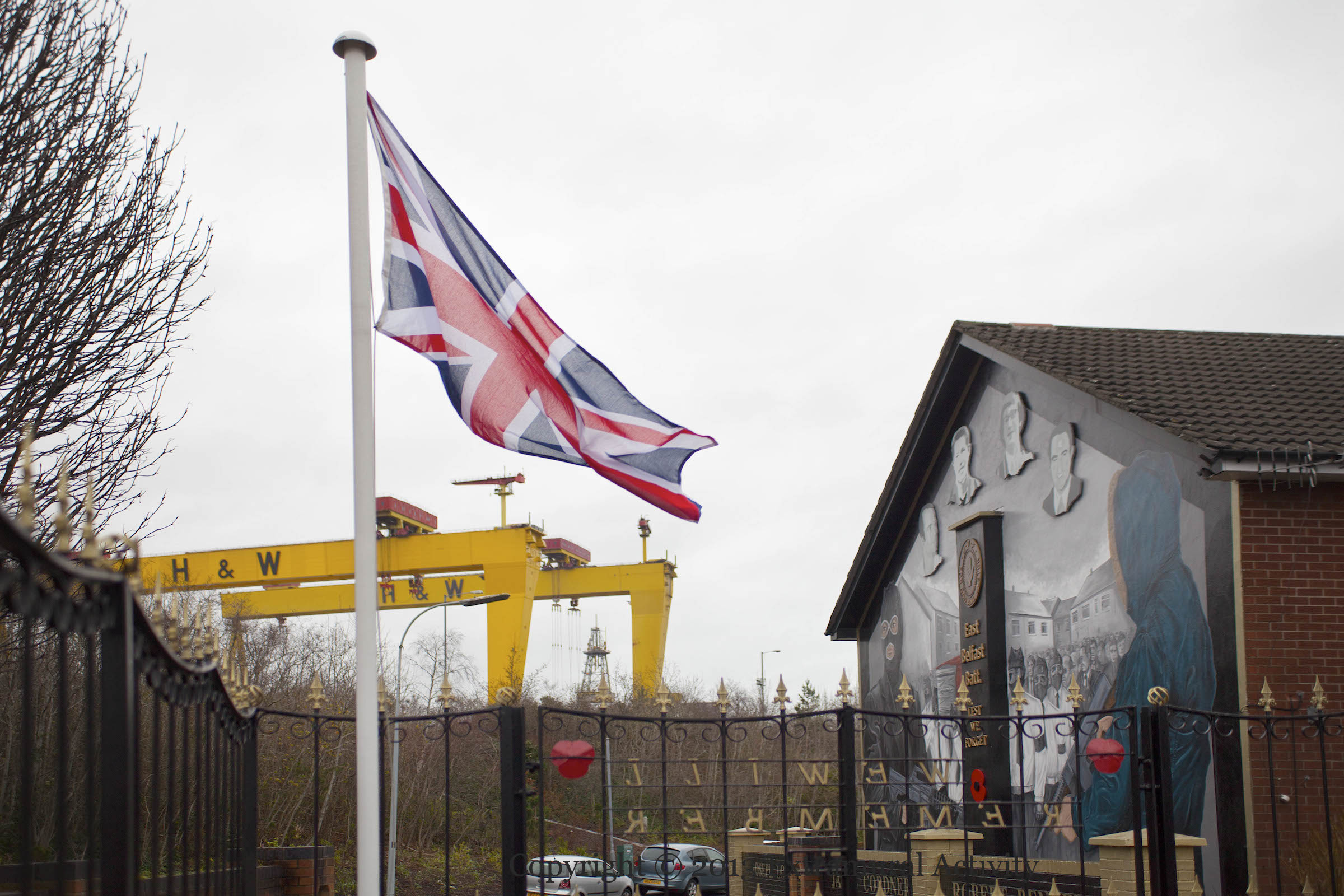
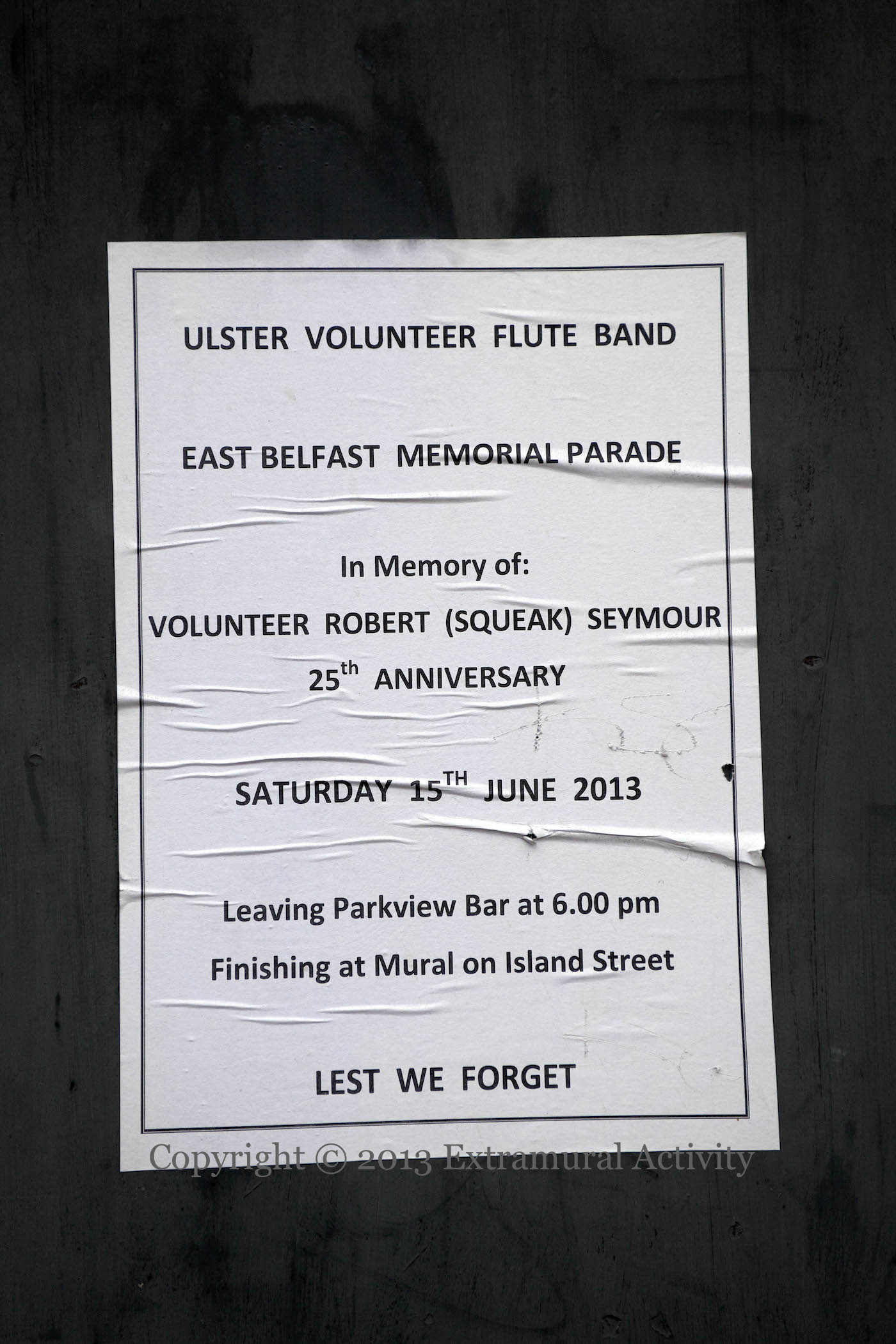
Here are four shots of a late 2011 UVF mural, with memorial wall, on Ballymacarrett Road in east Belfast. The four members named are Robert Seymour, shot dead by the PIRA; James Cordner and Joseph Long, who were killed in a premature explosion, and Robert Bennett, killed by the British Army during a riot. These same four are commemorated in the controversial 2013 mural featured in Years Of Sacrifice.
The nearby memorial (through the railings of which the third image, below, was taken) was constructed in 2003.
2013 saw the 25th anniversary of Seymour’s death; the final image, below, is of a flyer announcing a commemorative parade.
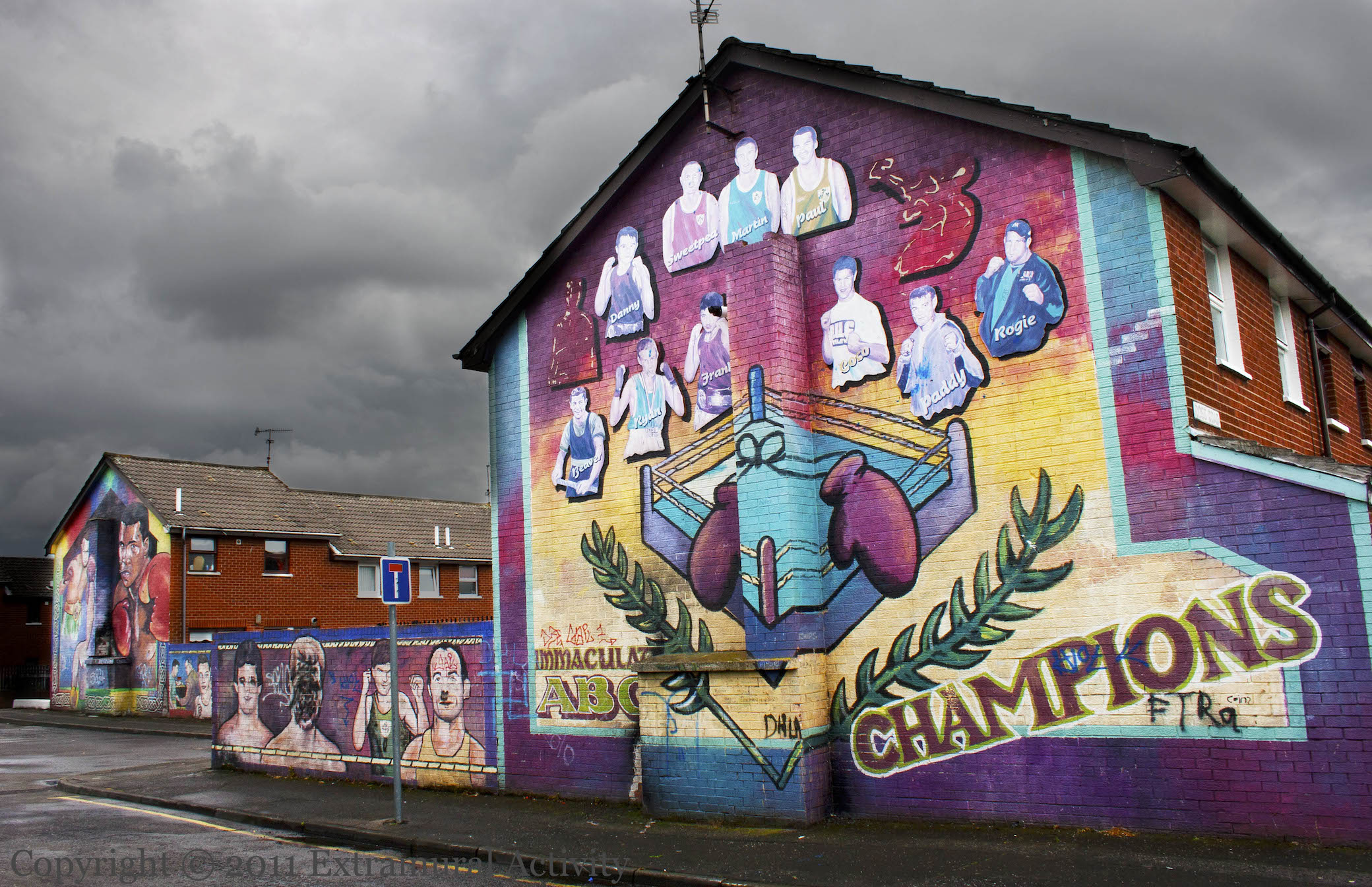
Here is a 2011 image of a 2005? boxing mural off Ross Road. The lower parts look like they have gone 10 rounds with graffiti artists. In the foreground is a mural featuring local boxers from the Immaculata Amateur Boxing Club (on the nearby Albert Road); in the distant mural, Muhammad Ali.






 Extramural Activity