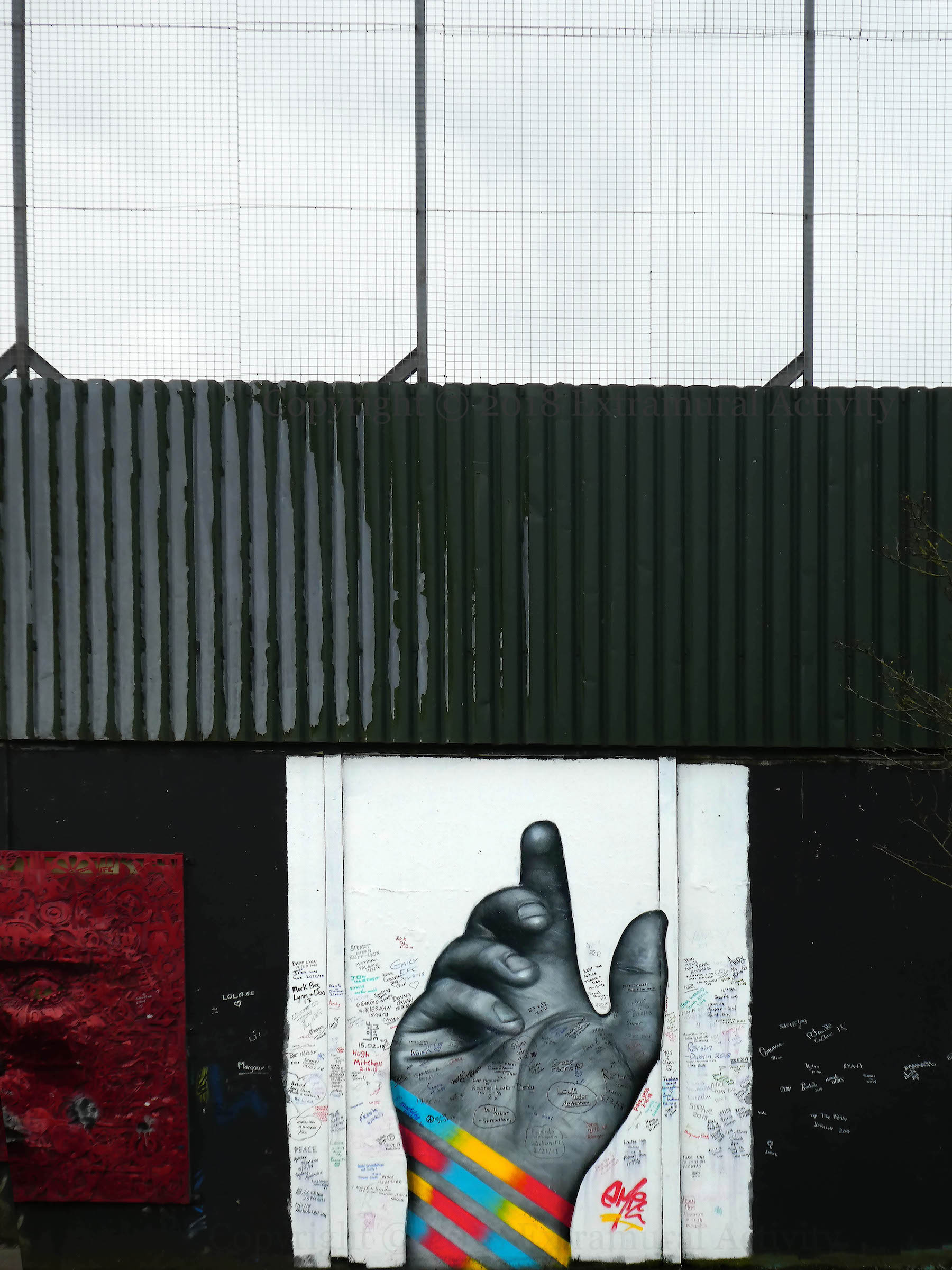
A colour version of emic’s (Fb | tw) piece gets no respect from the tourists visiting the Cupar Way “peace” line. It replaces his own Great Great Grandad.
Click image to enlarge
Copyright © 2018 Seosamh Mac Coılle
X04799
A colour version of emic’s (Fb | tw) piece gets no respect from the tourists visiting the Cupar Way “peace” line. It replaces his own Great Great Grandad.
Click image to enlarge
Copyright © 2018 Seosamh Mac Coılle
X04799
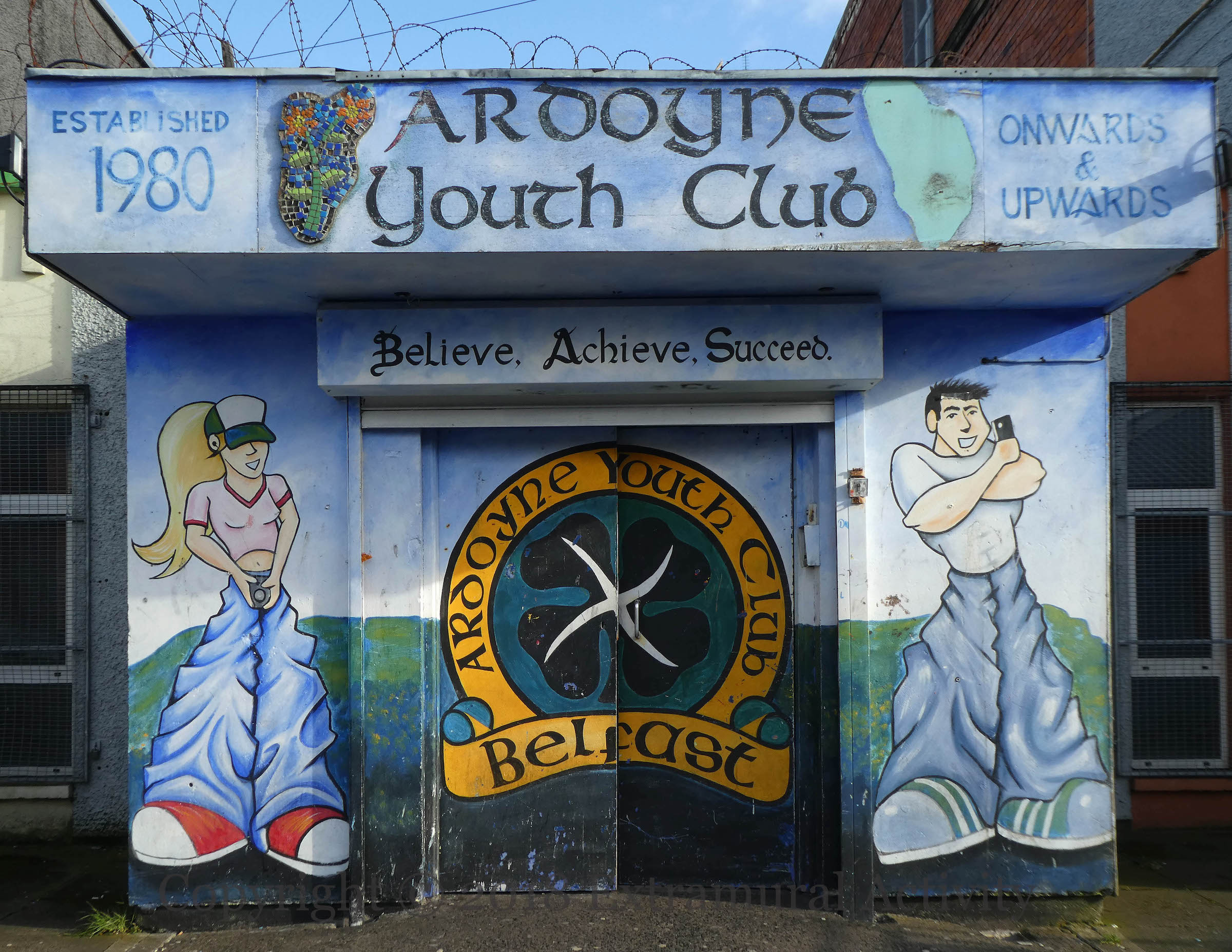
Here are two images of the four-leaf clover used by Ardoyne Youth Club (tw) as their emblem. The image above shows the doors of the club off Havana Way, while the one below is from the recently-completed mural at the top of the road Stronger Together. Compare with the emblem of Celtic FC, as in Just Can’t Get Enough.

Click image to enlarge
Copyright © 2018 Seosamh Mac Coılle
X04793 X04792 established in 1980 believe achieve succeed
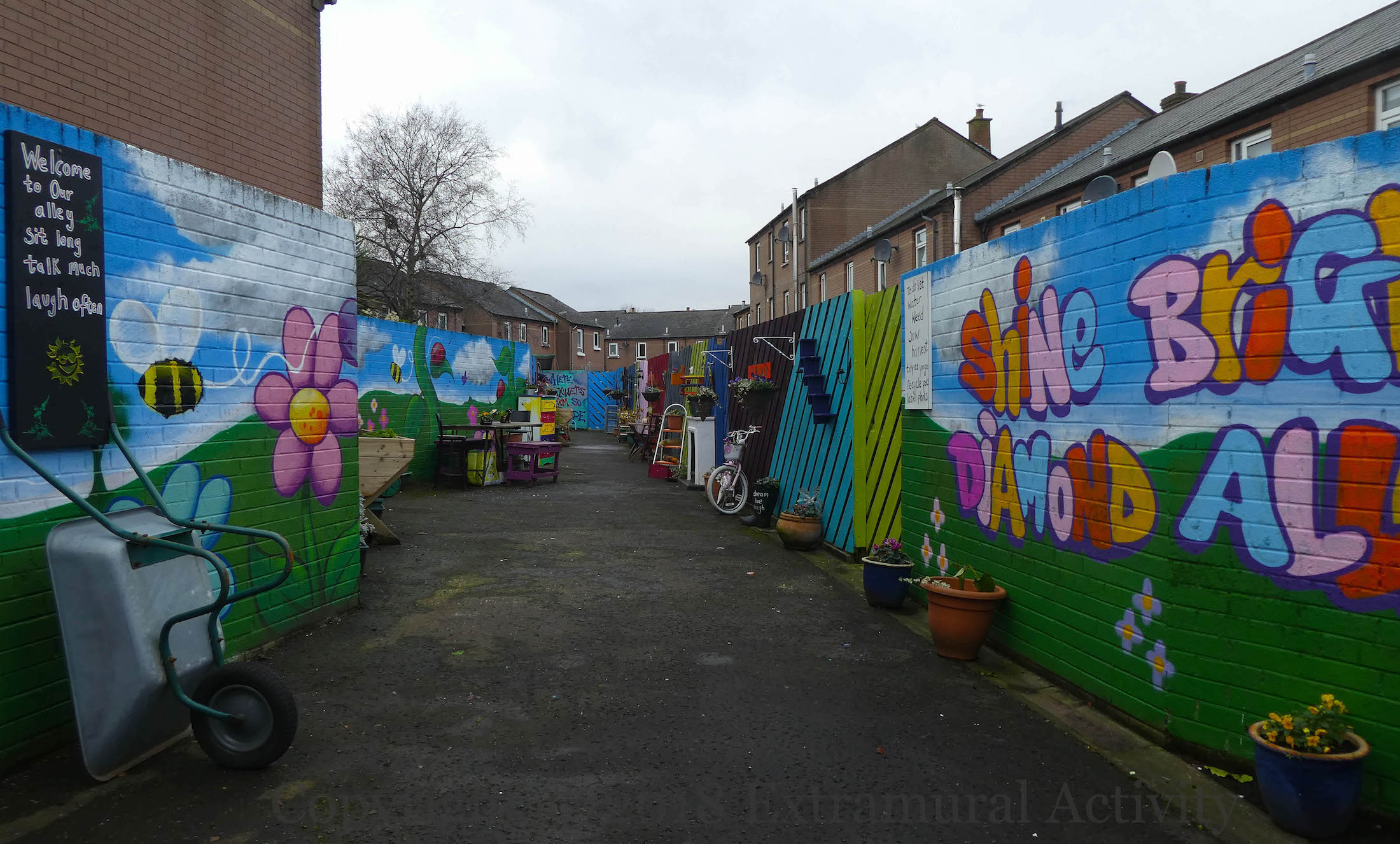
Diamond Alley is a disused alleyway off Lord Street in east Belfast, that has been rejuvenated with paint and plants, many placed in/on objects such as a wine rack, a chest of drawers, and a pair of jeans. The alley was funded by the Urban Villages Initiative (tw) and implemented by CharterNI/Diamond Project and East Belfast Mission/Hosford House, and launched on November 1st, last year (2017). The project was profiled on NVTv. (See also Always Keep A Diamond In Your Mind.)
Click image to enlarge
Copyright © 2018 Seosamh Mac Coılle
X04781

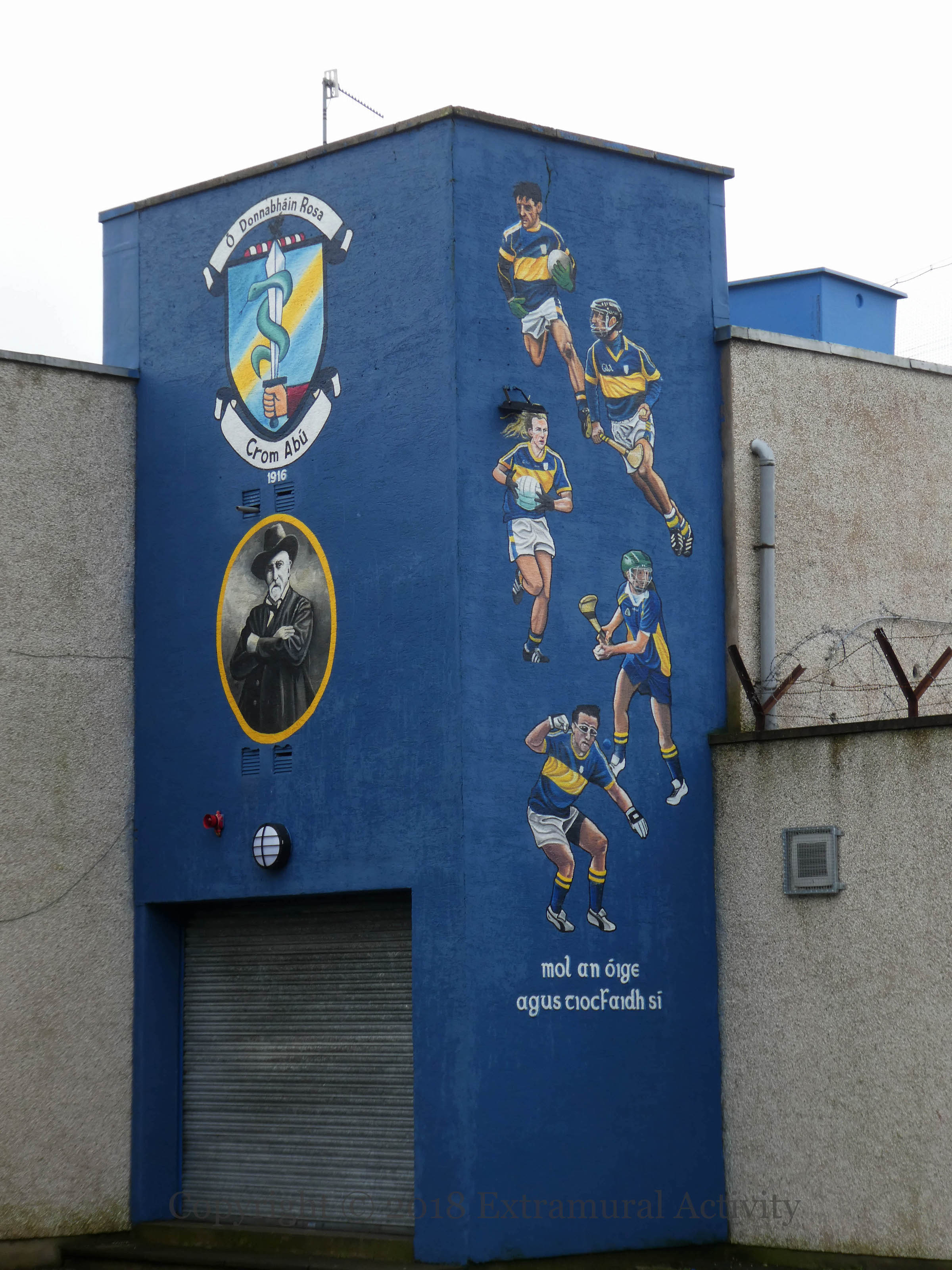
O’Donovan Rossa GAC (web | tw | Fb) dates back to 1916, just one year after the death of republican Jeremiah O’Donovan Rossa (at whose funeral Padraig Pearse gave the oration – “The fools, the fools …”). “Crom abú” is a war-cry of the ancient FitzGeralds as they attacked the O’Donovan fortress at Crom, Co. Limerick. Some of those fleeing eventually settled in Rosscarbery, Co. Cork, which is where Jeremiah was born in 1831. The sword is a symbol of justice, the snake of wisdom.
Click image to enlarge
Copyright © 2018 Seosamh Mac Coılle
X04780 X04779
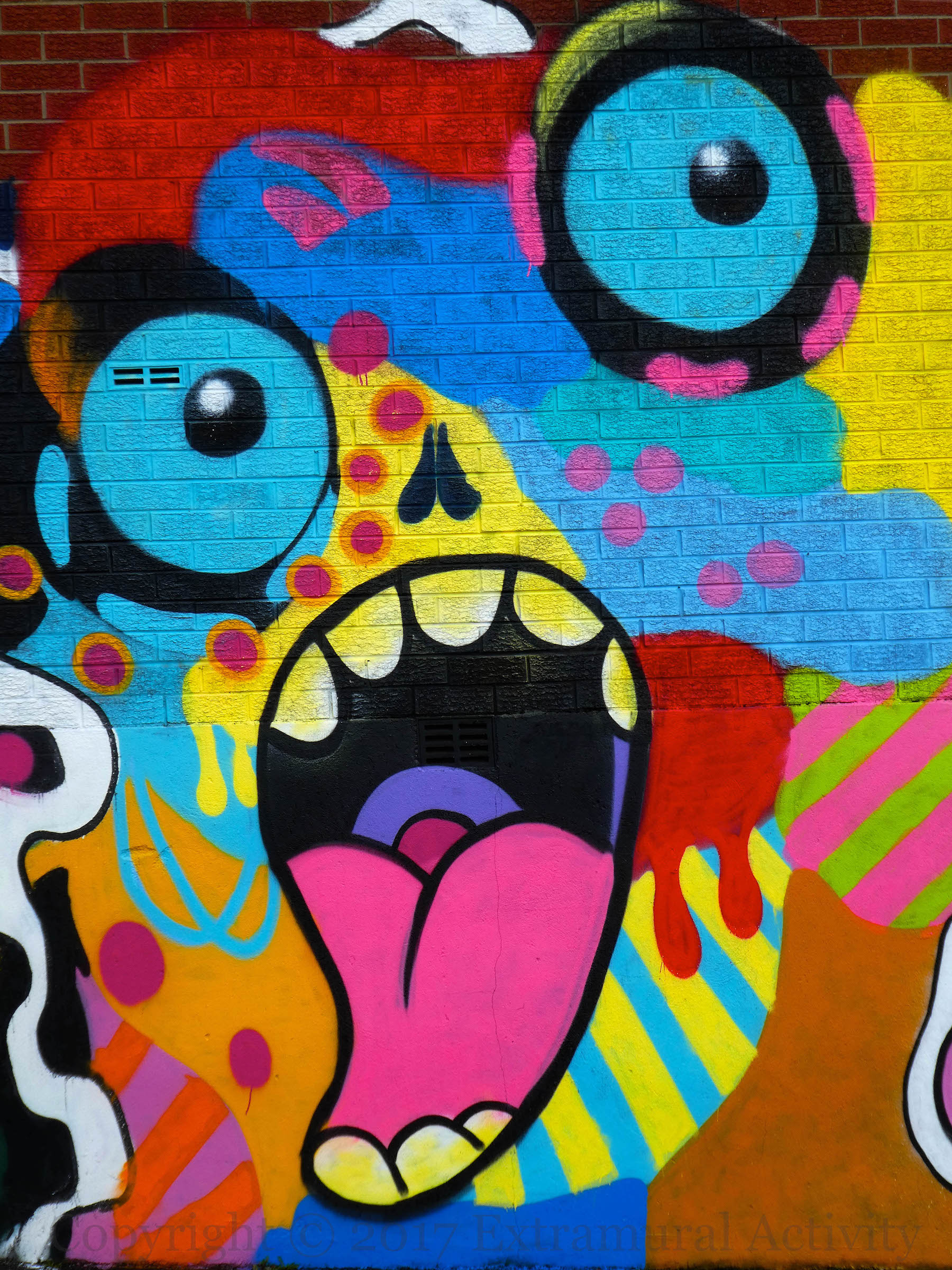
This striking art – perhaps an anti-drugs message? – is on the outside wall of the Turf Lodge Tenants’ Association & Social Club (Fb) – or simply “The Green Hut” – which served as a community centre during the Troubles. For a history, see the middle part of the NVTv programme The Edge Of The World.


Click image to enlarge
Copyright © 2018 Seosamh Mac Coılle
X04774 X04775 X04773

Writing by London-/Derry aerosol artist NOYS (inst) in Belfast. A gallery of NOYS’s work was just featured on Bombing Science.
Click image to enlarge
Copyright © 2017 Seosamh Mac Coılle
X04626 kent st
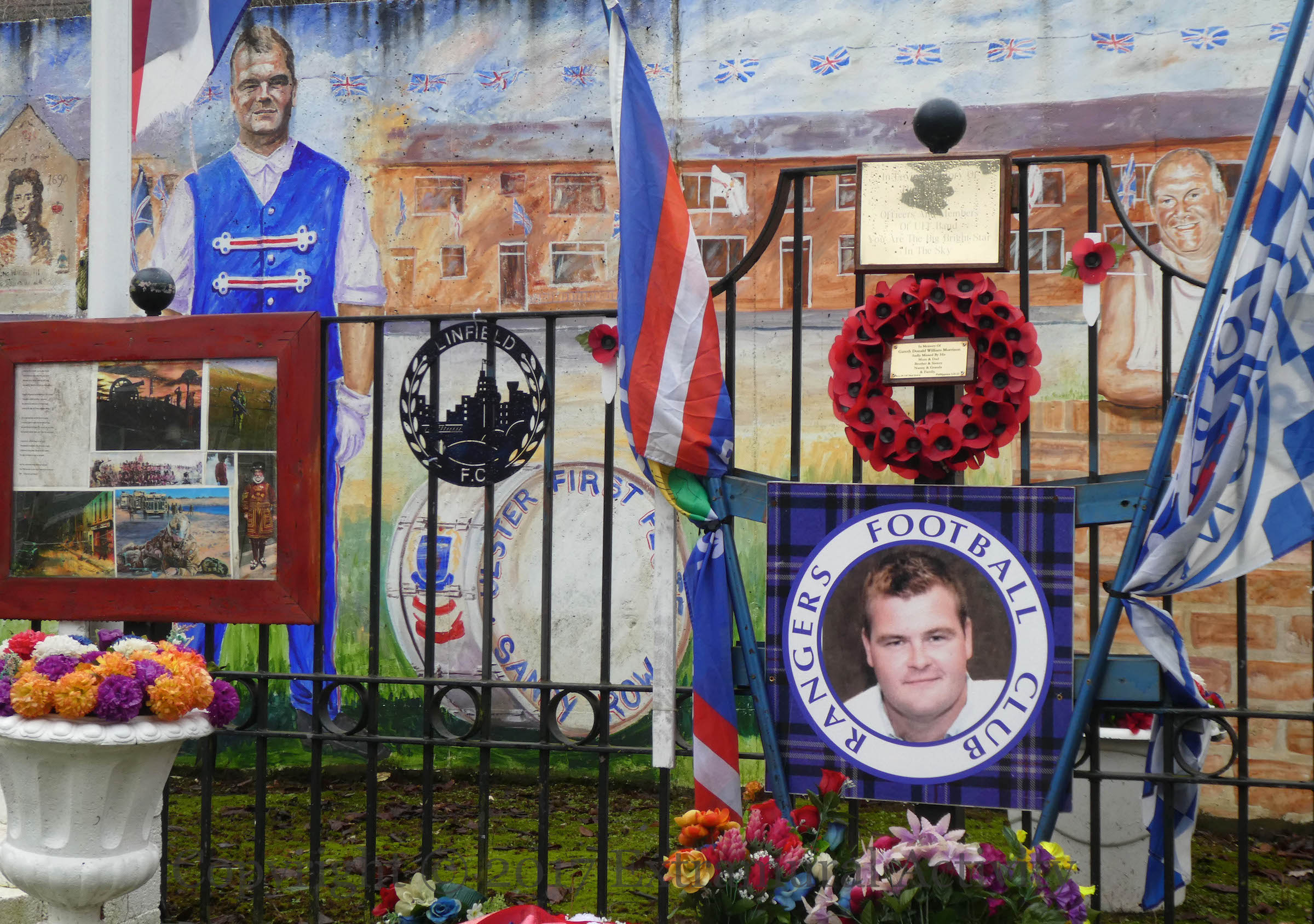
Gareth “Big Henry” Morrison was a drummer in the Ulster First Flute band in Sandy Row and a Rangers supporter. He died at age 26 on June 23rd, 2013 from a dose of PMA (BelTel), one of eight such deaths in Northern Ireland and seven in western Scotland. (1997 image of a UFFB mural in Linfield Road.)
Click image to enlarge
Copyright © 2017 Seosamh Mac Coılle
X04753 egmont gdns

Derry swimmer Liam Ball represented Ireland at the 1968 and 1972 Olympics in Mexico and Munich. He died in 1984 at age 33 and is remembered on the wall of local heroes at Creggan shops. There are five other portraits – of James McLean, Tony O’Doherty, David McAuley, Charlie Nash, and Aileen Reid – painted by Karl Porter and Donal O’Doherty from UV Arts.
Click image to enlarge
Copyright © 2017 Seosamh Mac Coılle
X04295

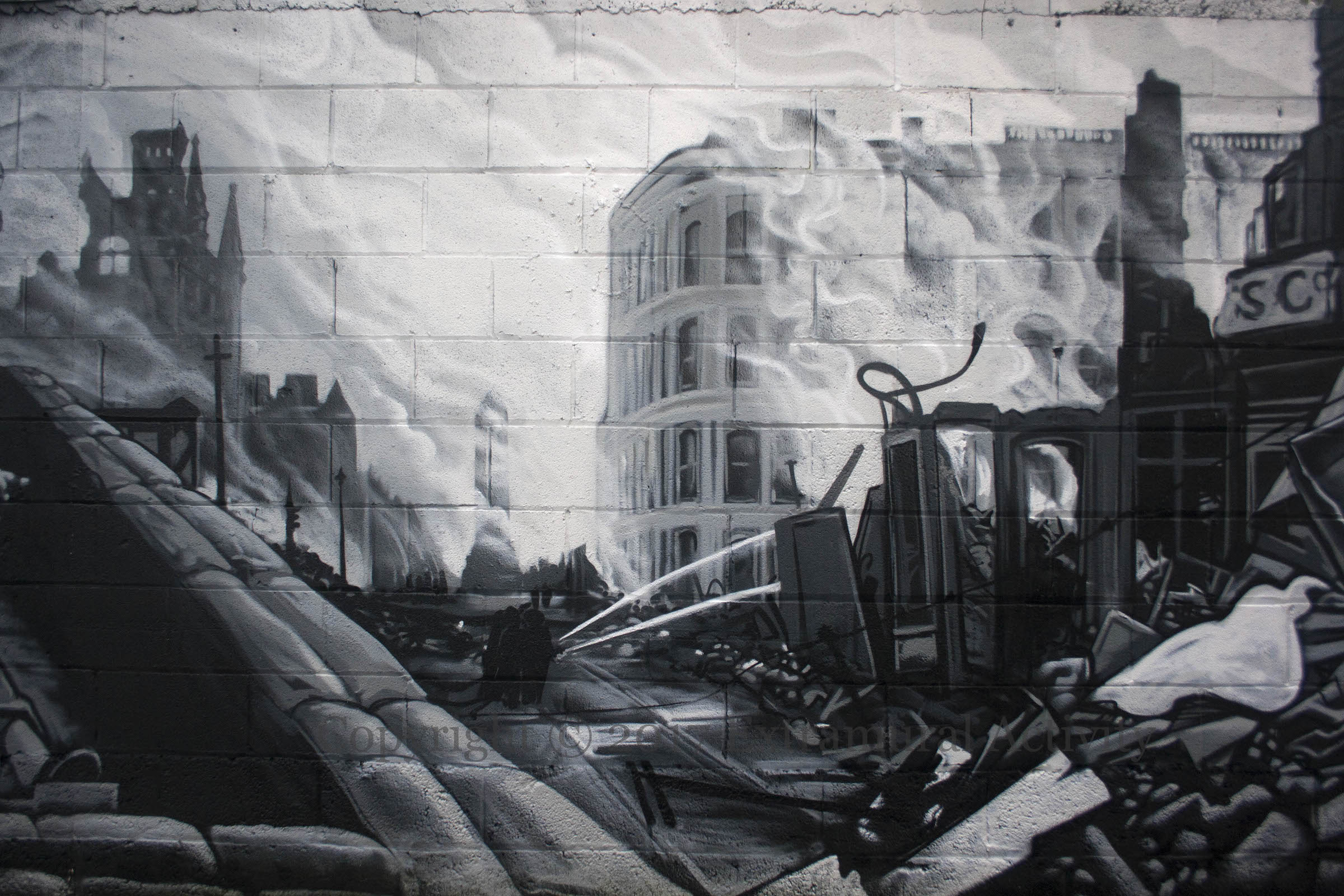
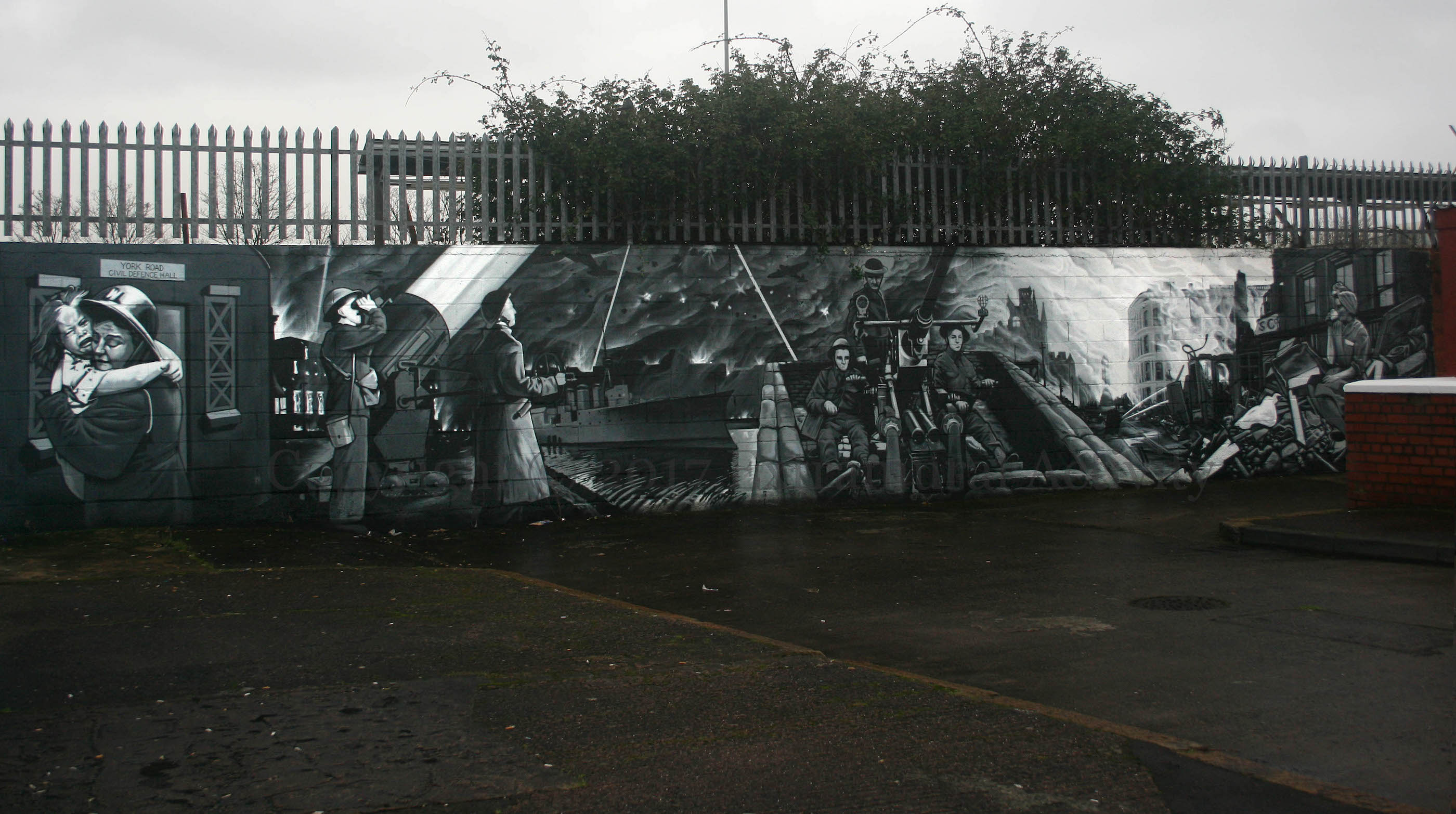
As mentioned in an entry about Dalaradia, the HUBB community centre (web | Fb) in north Belfast has, since 2010, been based in what used to be a World War II Civil Defence air-raid shelter, which it cleaned and renovated (Tele). The original hall is depicted in this mural on the side of the HUBB. Belfast was bombed by the Germans four times in April and May of 1941.
In 1940, Belfast was protected by thirty-eight anti-aircraft guns. The German Luftwaffe flew a reconnaissance flight over Belfast on November 30th, 1940 and a test mission of eight planes on April 7th, 1941 concluded that Belfast’s defences were, “inferior in quality, scanty and insufficient” (Elaine Hogg/Glenravel History). 150 bombers would blitz Belfast the following week, on Easter Tuesday, April 15th, and the seven guns that had been in operation ceased firing, believing, falsely, that RAF planes were also in the sky (WP).
In the blitz of Easter Tuesday, 1941, more than 900 people died, 1,500 were injured, and half the houses in Belfast were damaged (WP). According to Elaine Hogg’s research in the ‘Darker Side Of Belfast’ series, 100,000 people left the city in the remainder of the month, due to shock, fear, and the squalid conditions and unruly behaviour that followed the bombing.


Click image to enlarge
Copyright © 2017 Seosamh Mac Coılle
X04756 X4757 X04758 X04759 X04755
 Extramural Activity