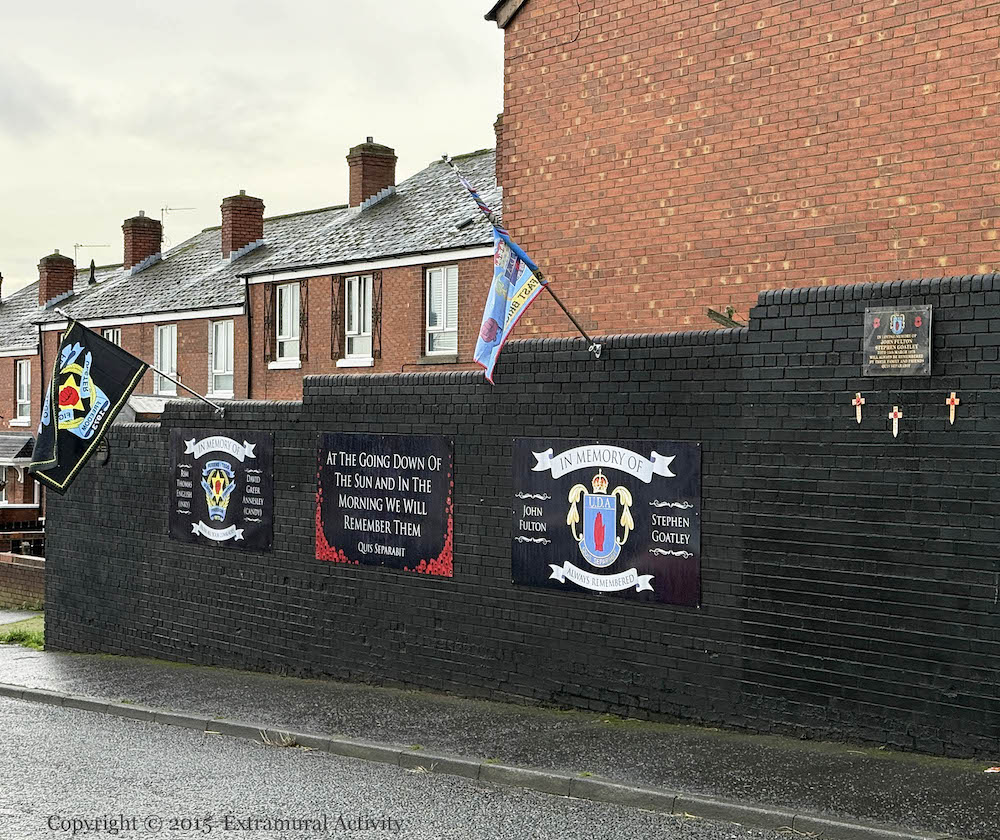
“In loving memory of John Fulton [and] Stephen Goatley, died 15th March 1975. Will always be remembered by their family and friends. Quis separabit.” UDA members John Fulton and were Stephen Goatley were killed together in the Alexandra Bar on York Road (close to the Mervue Street location of this memorial) in revenge for the stabbing of the UVF’s Joe Shaw in the North Star Bar by the UVF as part of the UDA-UVF feud in 1975.
The two men named on the other board were also killed in a feud between the UDA and UVF, in 2000 – see Inky & Candy. “In loving memory Thomas (Inky) English & David (Candy) Greer Annesley. Together in the same old way/would be our dearest wish today./Silent memories true and tender/just to show we still remember.”
Mervue Street, Tiger’s Bay, north Belfast. The small plaque was previously seen in 2017.
Two murals have been added to the exterior of Felons’ Club in Andersonstown to show support for Palestine. Above, on the Lake Glen side of the club, a printed board reading “We stand with Palestine – seas leis an Phalaıstín” and including an Emmalene Blake image (ig) on the right (shown in close-up, below) journalist Alatrash Samia and her niece Masa (as photographed by Mahmoud Bassam); further below, a “Stop the genocide in Gaza” tarp above the entrance.
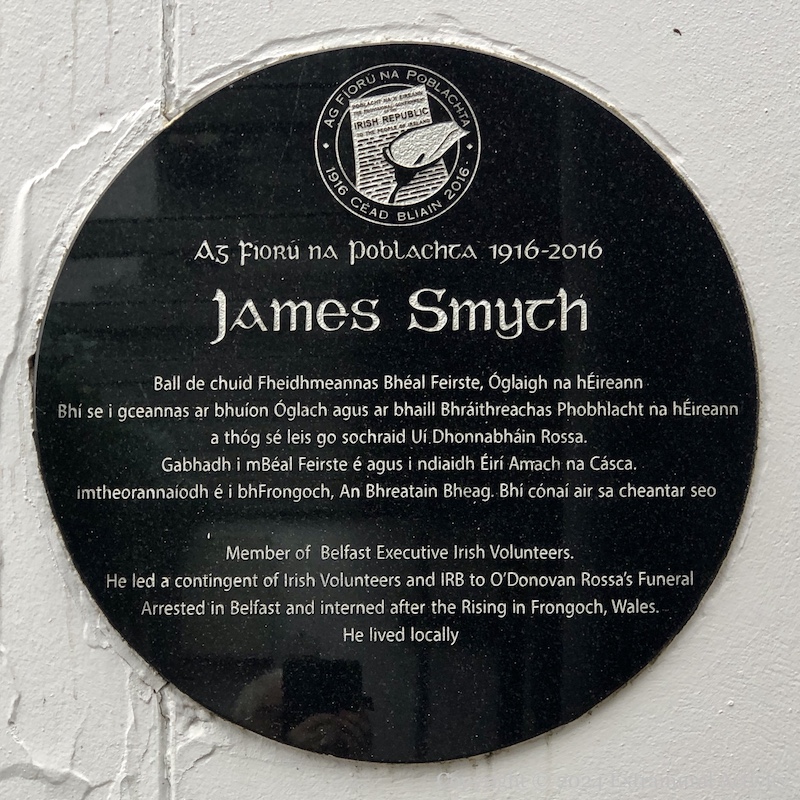
Also included are images of several memorial plaques from the courtyard, to James Smyth, Anraí (Harry) Osborne, and Seosamh Ó Conghaıle (Joseph Connolly); the Roger Casement plaque is on the Kieran Doherty mural in Slemish Way. “County Antrim Memorial: Tógaḋ an leaċt seo mar ċoṁarṫa urraıme, grá agus dílse do na saıġdıúırí uaısle as Contae Aontroma, a martraíoḋ ar son Ṗoblaċt Na hÉıreann. Ṡeas gaċ glúın díoḃ sa ḃearna ḃaoıl, ag troıd go cróga ċun aontaċt agus saoırse a ṫaḃaırt ar aıs do náısıún na nGael. Go spreaga an leaċt cuımhne seo na daoıne feasta ıonas go leana sıad lorg na laoċra dtí go mbéarfar bua uasal na saoırse ar ball. Erected by the Belfast Committee of the National Graves Association with generous co-operation from sub-committees in America and Dublin.”
For a similar style of floral arrangement, see Do You Believe?
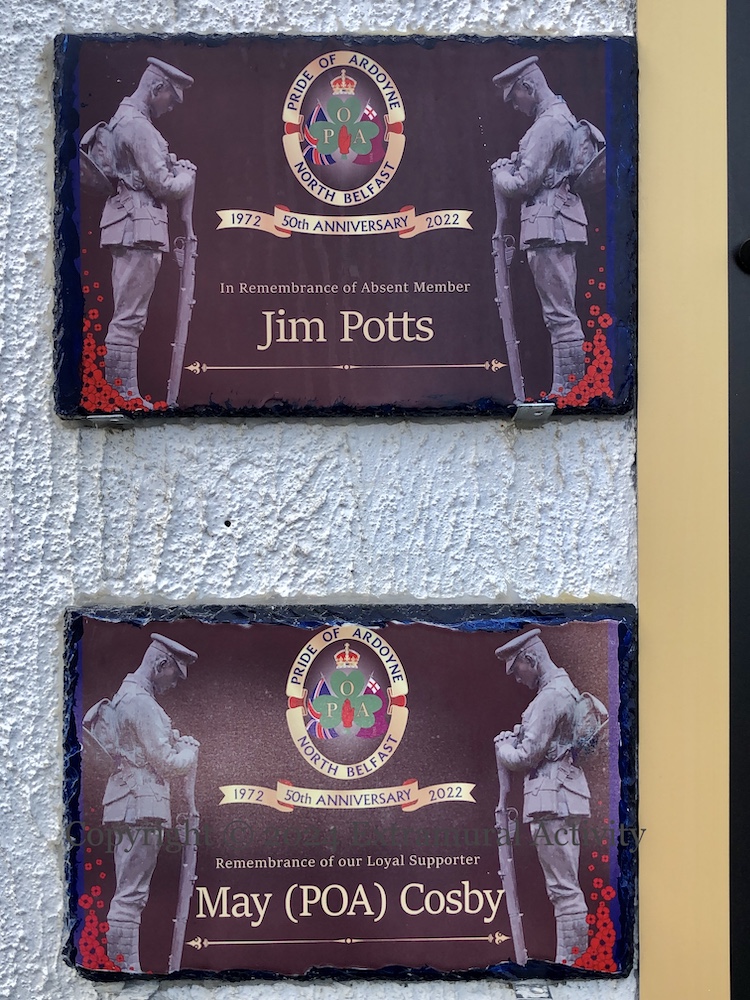
The Pride Of Ardoyne flute band memorial site was overhauled in November. The silhouetted bandsmen (seen in Pride Of Ardoyne) are gone and the cross and wooden plaque at the top (see Billy Hanna) have been joined by two large boards, naming “J. Bailey, W. Hanna, S. Rockett, B. McClure” and, (on the drum) “Charlie Dunn (1957-2021)”, along with 20 small plaques of these five plus 15 more who are an “absent member”, “absent friend”, and “loyal supporter”.
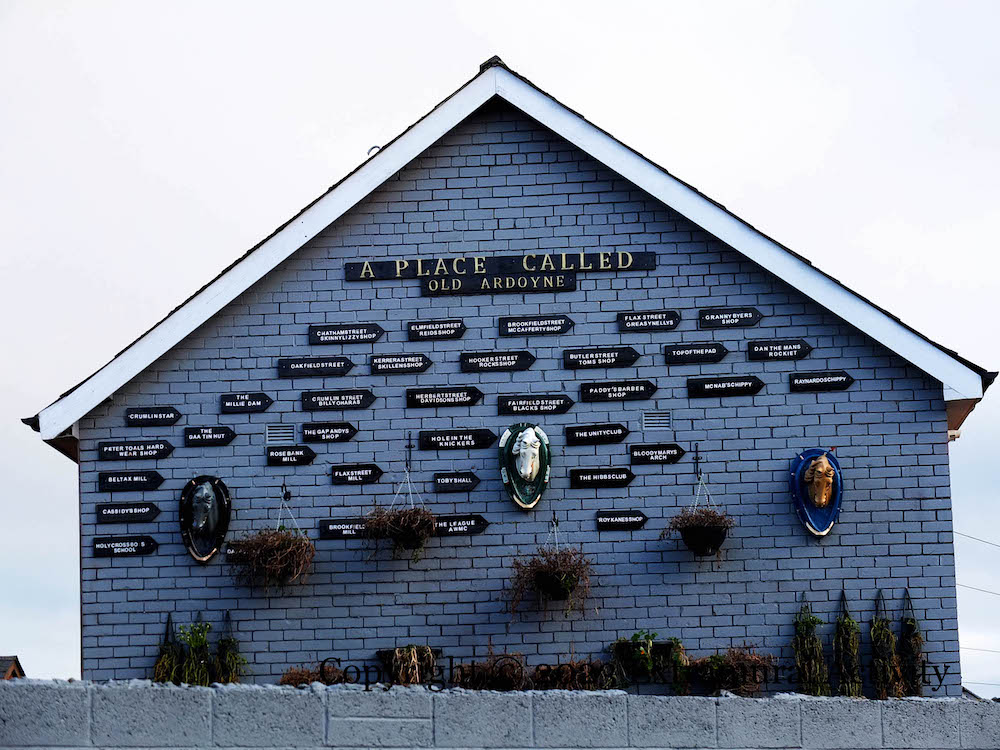
Going by the streets and places mentioned in these plaques – see the list below – “old Ardoyne” would not have included Balholm Drive, where this gable wall is; Brompton Park and the streets above it – built c. 1935 are renamed c. 1939 (after a 1937 rent strike) – were known as Glenard. (See also Belfast Forum one | two.)
According to an entry on Belfast Forum, Skinny Lizzy’s real name was Elizabeth Gilmore. According to another, Greast Nellie’s chip shop and the Crumlin Star was opposite one another.
left side: Crumlin Star, Peter Toal’s hard wear shop, Beltax [Beltex] mill, Cassidy’s shop, Holy Cross Boys school
top row: Chatham Street Skinny Lizzy shop, Elmfield Street Reid’s shop, Brookfield Street McCafferty shop, Flax Street Greasy Nelly’s, Granny Byer’s shop
second: Oakfield Street, Kerrera Street Skillen’s shop, Hocker Street Rock’s shop, Butler Street Tom’s shop, Top Of The Pad, Dan The Man’s Rockiet[?]
third: The Millie Dam, Crumlin Street Billy O’Hara’s, Herbert Street Davidson’s shop, Fairfield Street Black’s shop, Paddy’s barber shop, McNab’s Chippy, Raynardo’s chippy
fourth: The GAA Tin Hut, The Gap Andy’s shop, Hole In The Knickers, The Unity Club
fifth: Rose Bank mill, Flax Street mill, Toby’s Hall, The Hibbs [Hibs] Club [in Herbert St], Bloody Mary’s Arch
sixth: Brookfield mill, The League AWMC [Ardoyne Working Men’s Club (Fb)], Roy Kane’s shop
A service was held yesterday in West Kirk Presbyterian to mark the thirtieth anniversary of the bombing of Frizzell’s fish shop on the Shankill Road. As part of the ceremony, wreaths were laid at the new memorial marking the spot on the Shankill where the bomb exploded, killing nine locals — hence the Arabic “9” among the Roman numerals on the clock face — and one of the bombers (ITv footage). The clock shows the date and time that the bomb went off: 1:06 pm on Saturday October 23rd, 1993.
The new ‘clock’ memorial replaces the three plaques seen in Frizzell’s (though the circular plaque might have been incorporated into this new memorial); the board of portraits served as the cover for the memorial in the days prior to unveiling and was placed over the credit union’s ATM.
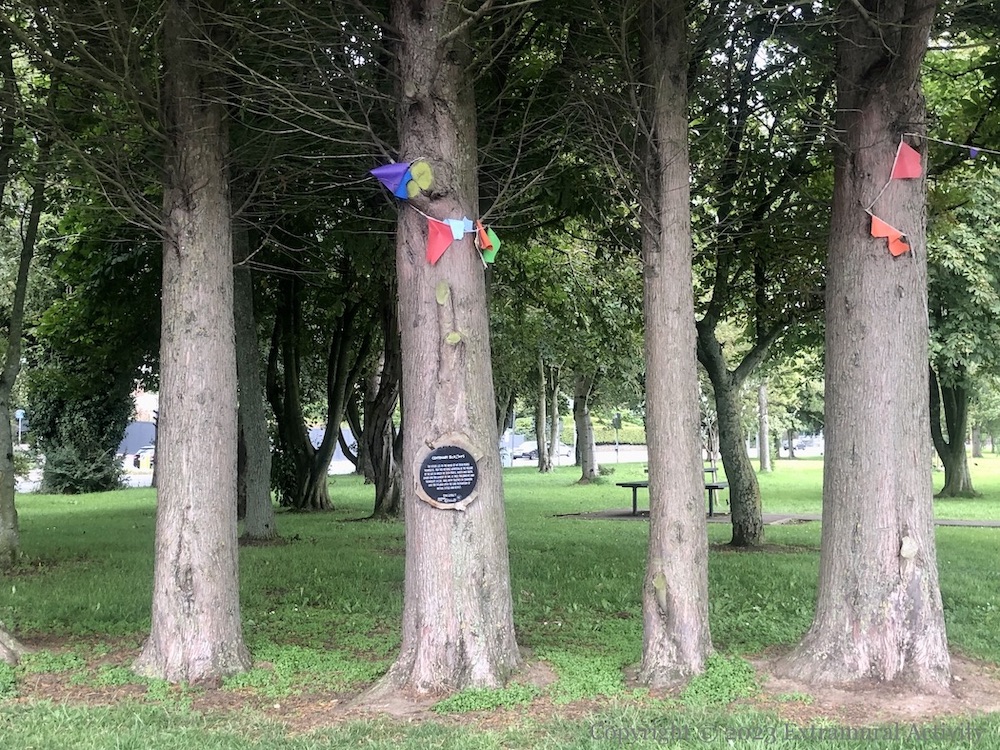
West Kirk also contains a stone and bench to the victims of the Shankill bombing. Nine trees were also planted in their memory: John Frizzell, Sharon McBride Leanne Murray, Michael Morrison, Evelyn Baird, Michelle Baird, George Williamson, Gillian Williamson, Wilma McKee.
“We remember those who were killed, those who survived and those lives changed forever.”
“‘And God shall wipe away all tears from their eyes; and there shall be no more death, neither sorrow, nor crying, neither shall there be any more pain; for the former things are passed away’ Revelations 21 v4”
“Centenary Scripts: “The future lies in the hand of my Irish people themselves. May this historic gathering be the prelude of the day in which the Irish people, north and south, under one parliament or two, as those parliaments may decide, shall work together in common love for Ireland upon the sure foundation of mutual justice and respect. King George V.”
After the Northern Ireland parliament was opened, the debate continued as to whether Ireland would yet have a single parliament with Dominion status. The idea that Ireland, in whole or in part, would leave the empire was unimaginable to Britain – hence “my Irish people”.
“Mutual justice and respect”, it turned out, was generally in short supply. Unionists claimed they had accepted Home Rule (for Northern Ireland) as a sacrifice, preferring to be included in the empire parliament at Westminster, though one doubts the sincerity of this claim given their stance in the subsequent negotiations, which made clear that sharing power with nationalists and republicans would be intolerable. Thus, the sentiment that the future of Ireland lay in the hands of Irish people was understood to have limits.
A united Ireland was desired by nationalists and republicans, but as the negotiations continued throughout 1921 and into 1922 we can perhaps see republicans cut their losses – i.e. Northern Ireland – and instead drive towards independence for the Irish Free State. Departure from the empire and the fixity of partition quickly (in a matter of years, though it formally took a few decades) became a reality for Southern Ireland/Irish Free State/(Republic of) Ireland.
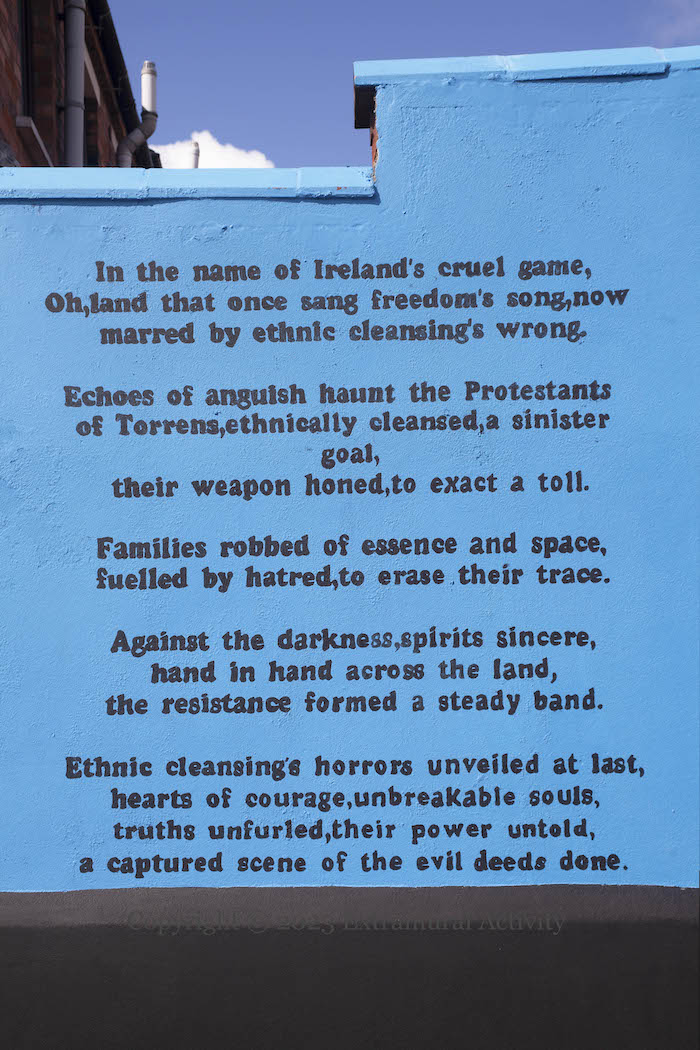
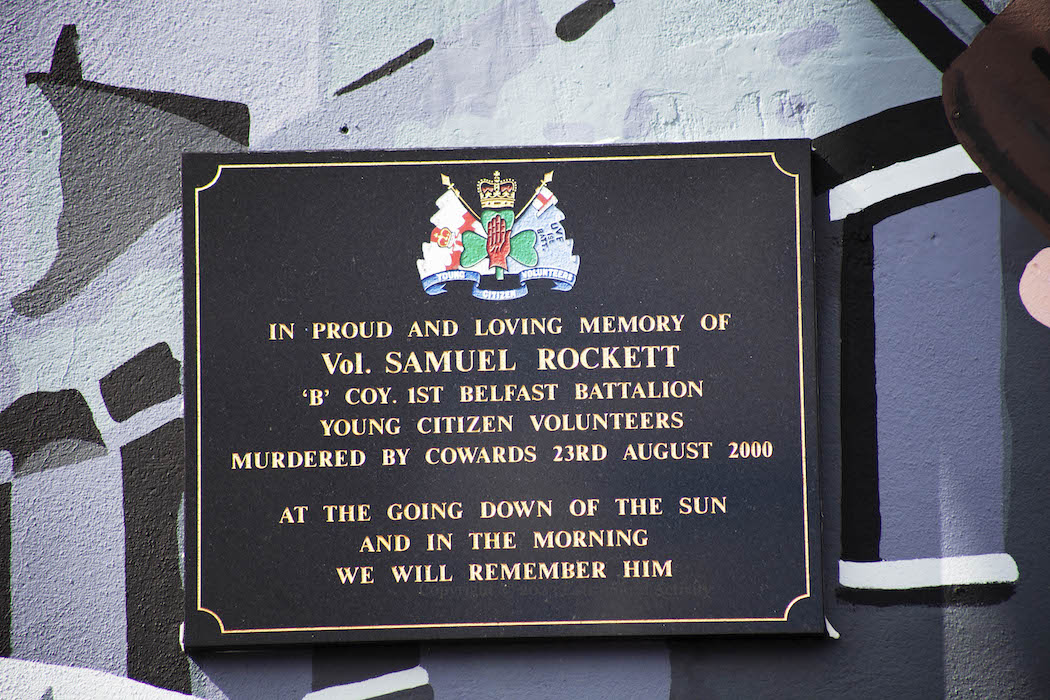
This is the new Sam Rockett mural in the Woodvale, replacing the mural seen in Murdered By Cowards. The old mural just featured Rockett, who died in August, 2000, in the feud between the UVF and lower Shankill UDA. This new mural also features the “ethnic cleansing” of Torrens in 2004.
Torrens sits between Cliftonville, Ardoyne, and the lower Oldpark, and was one of the many historically mixed areas in north Belfast that, with the Troubles, became increasingly segregated and separated from neighbouring areas by “peace” lines. Jarman (1996) provides eye-witness testimony of the dispute in Torrens in 1996 which saw Catholic families leave the area. Its proximity to Ardoyne (and Cliftonville), however, meant that over the next few years the houses were gradually abandoned by Protestants, culminating in 2004 when ten of the remaining Protestant families moved out of the area, alleging persistent intimidation and employing the term term “ethnic cleansing” – a term the poem to the right of the mural uses three times.
The area was eventually redeveloped from 2008-2012, with the Wyndham Street “peace” line coming down and Elmgrove Street being opened to the Oldpark Road.
The line in the poem “the resistance formed a steady band” is unclear – it might refer to loyalists being bussed into Torrens in 1996 (see the testimonies in Jarman); if it refers to B Company it would make a connection to Rockett. As it is, the connection between the two elements of the mural (if any is intended) seems to be that Rockett was from the lower Oldpark, near Torrens.
“In the name of Ireland’s cruel game/Oh, land that once sang freedom’s song/Now marred by ethnic cleansing’s wrong.//Echoes of anguish haunt the Protestants of Torrens,/Ethnically cleansed, a sinister goal,/Their weapon honed, to exact a toll.//Families robbed of essence and space,/fuelled by hated, to erase their trace.//Against the darkness, spirits sincere,/Hand in hand across the land,/the resistance formed a steady band.//Ethnic cleansing’s horrors unveiled at last,/Hearts of courage, unbreakable souls,/Truths unfurled, their power untold,/A captured scene of the evil deeds done.”
The mural was completed for the anniversary of Rockett’s death on August 23rd. The source for the central image (of furniture being loaded into a lorry) is unknown.
Áras Uí Chonghaile has a “James Connolly Heritage Trail”, with a series of plaques and panels that interested parties can walk as members of a guided tour, or by themselves with the aid of an app (Android | Apple). One of the stops is in Corporation Street, site of the Belfast offices of the ITGWU from 1911-1941.
The nearby ITGWU board gives Connolly’s report from 1911: “The Branch has rented extensive premises at 122 Corporation Street and intend having a smoking and reading room in connection therewith; we are considering the organisation of a band and have in contemplation also the launching of many other schemes for the moral, social, and financial uplifting of the members. The Irish Transpost and General Workers’ Union is in the vanguard of that Irish branch of the Army of Labour, and we are honoured when we carry its banner.”
It then goes on to describe the arrest of Winnie Carney and the raiding of the Corporation Street offices in 1922.
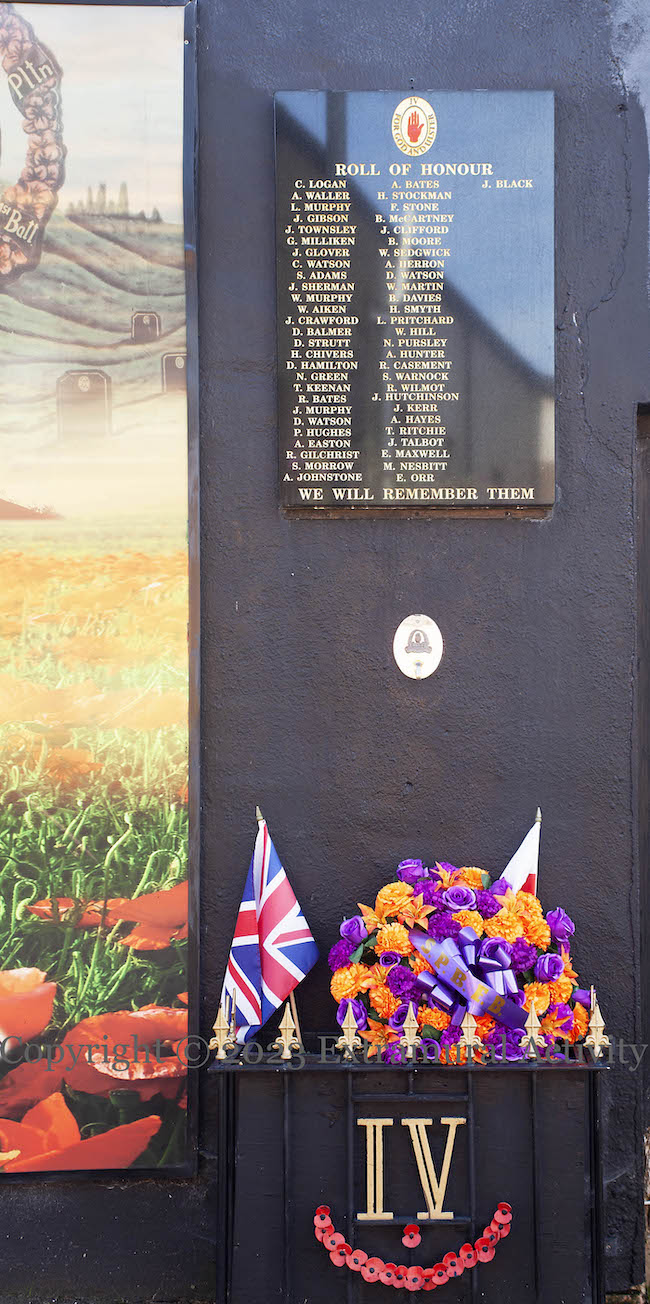
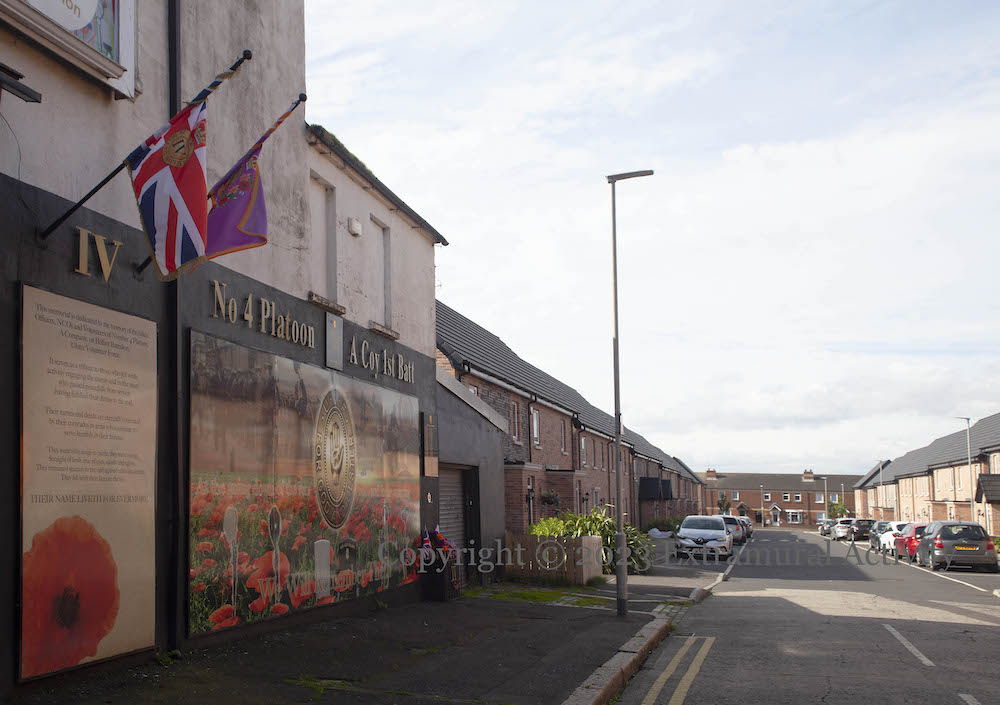
The UVF (A company, 1st battalion, platoon 4) mural in Glenwood Street was in the news last week after Jude Whyte of the Victims And Survivors Forum (web) drew attention to it because of its inclusion of some members of the Shankill Butchers (Irish News). The gang-members included in the plaque are given in a previous post – Platoon IV.
Some outlets (e.g. Sunday World) are reporting that the plaque is new but, while a few names of platoon have volunteers been recently added – Nesbitt, Orr, and Black – the plaque, including the names of various members of the gang, has been on the wall since 2017.
Kelly’s Bar at the top of the Rock was packed with punters watching a World Cup match between England and West Germany when a car bomb went off outside shortly after 5 p.m.. The bombing was followed by two nights of gun-battles, with loyalists firing from Springmartin, republicans (both PIRA and OIRA) from Ballymurphy, and British Army soldiers (the King’s Own and 1 Para) from Henry Taggart and other mobile locations. Within three hours following the explosion, barman Tommy McIlroy was killed in the gunfire from Springmartin as he helped with clean-up from the bomb, Alan Buckley of the King’s Own was killed by IRA fire, Michael Magee of Na Fıanna was killed by friendly fire, and Robert McMullan was killed by British Army fire. The next night (May 14th), John Pedlow was killed by British Army fire and Martha Campbell was shot by UVF fire from Springmartin (see her memorial plaque). (Lost Lives 352, 353, 354, 355, 358, 359 | Battle At Springmartin (WP))
As with the bombing of McGurk’s bar in north Belfast (see most recently Justice Delayed Is Justice Denied), the bombing was initially spun by the UK forces and government as an IRA attempt to stir up loyalists (An Phoblacht | Lost Lives 352). An inquest into Moran’s death (and thus into how the bombing was carried out) has been opened (BeTel | Independent).
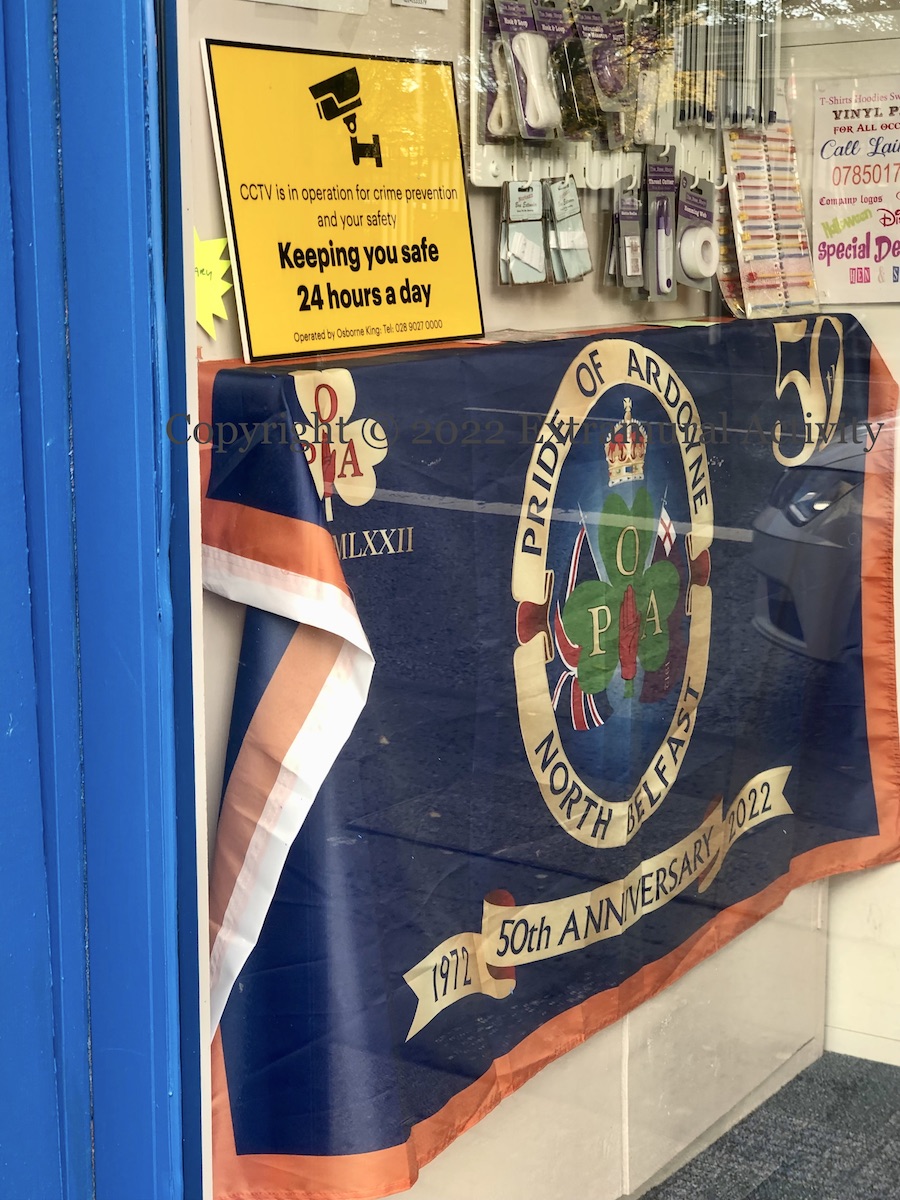
The plaque dates back to 2004 (see M02243); the tarp was added for the 50th anniversary in 2022; the small mural is more recent.














 Extramural Activity