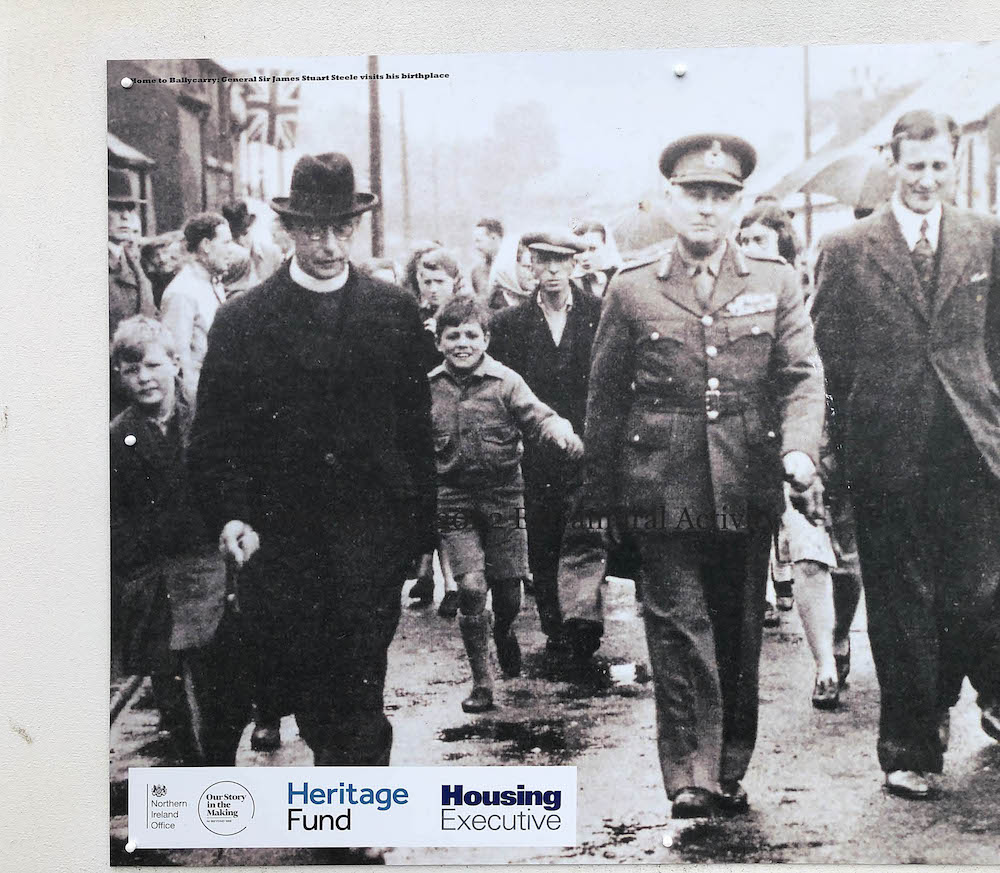
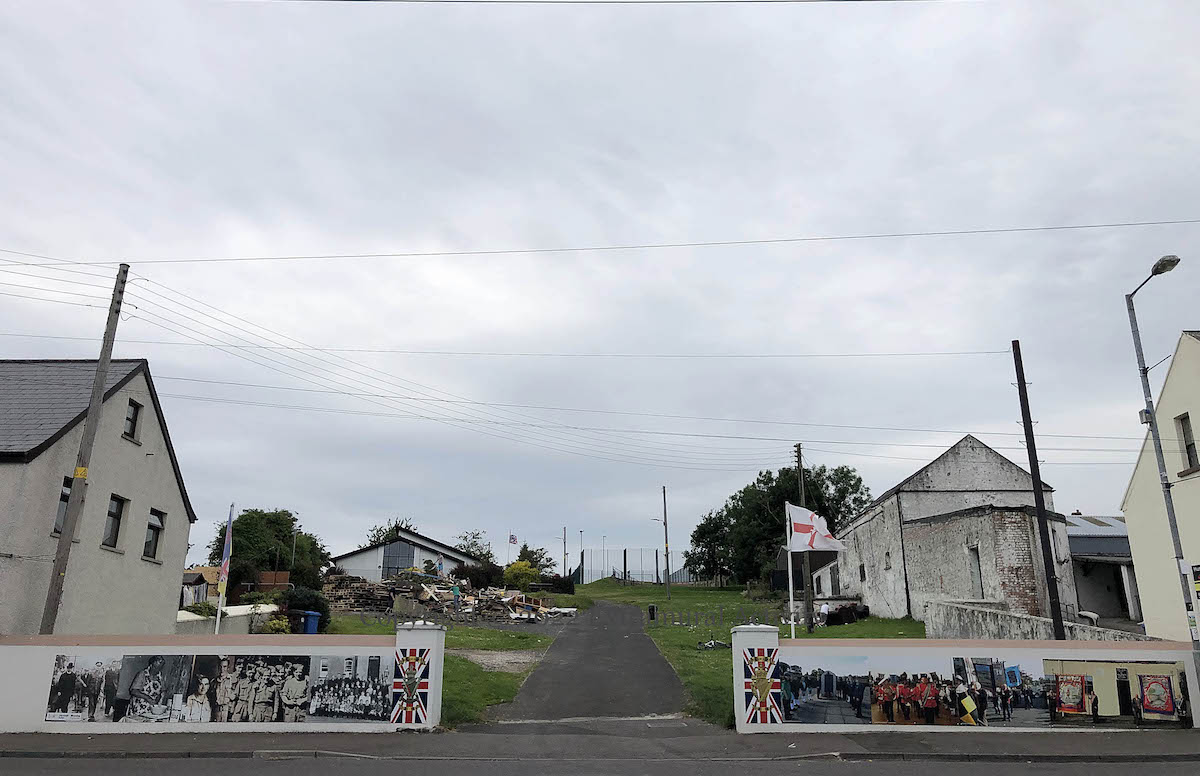
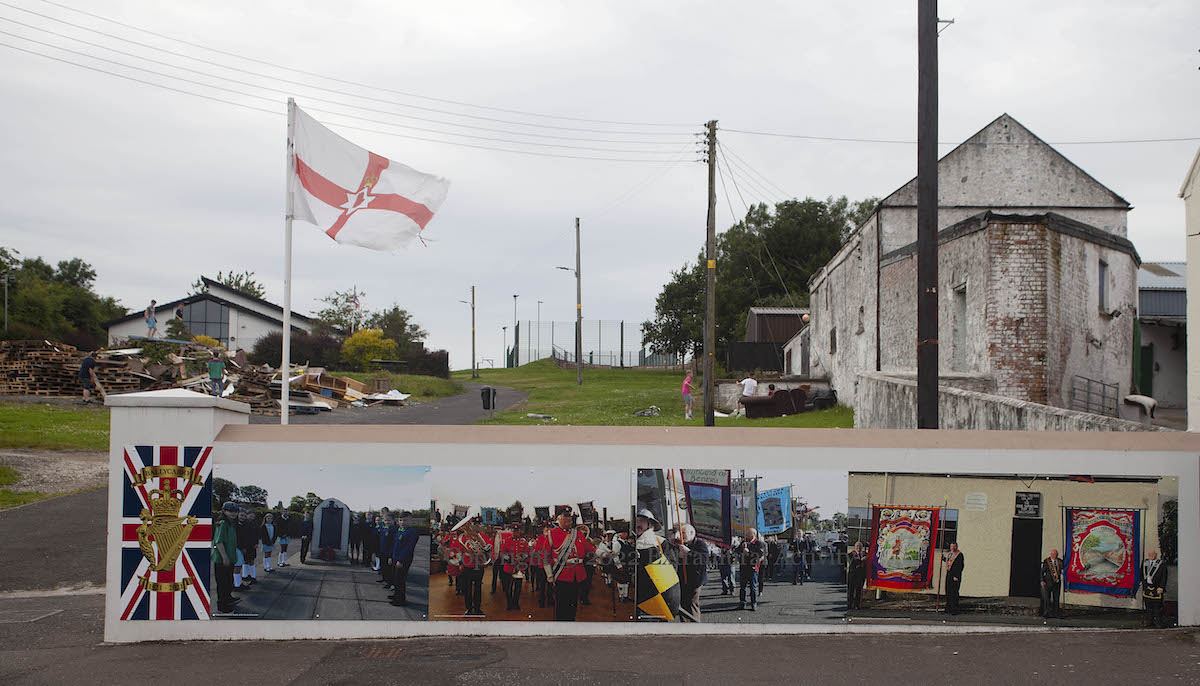
Our Story In The Making – NI Beyond 100 is a NI Office programme collecting stories showcasing Northern Ireland “on the world stage”. It has lent its brand to the Ballycarry centenary boards shown in today’s post, which have black-and-white photographs on the left (beginning with “Home to Ballycarry – General Sir James Stuart Steele visits his birthplace”) and colour photographs on the right (beginning with children visiting the Steele monument).
A ‘Stand With Ukraine’ flag and Ulster Banner fly above the walls; a bonfire is being hastily erected in the background.
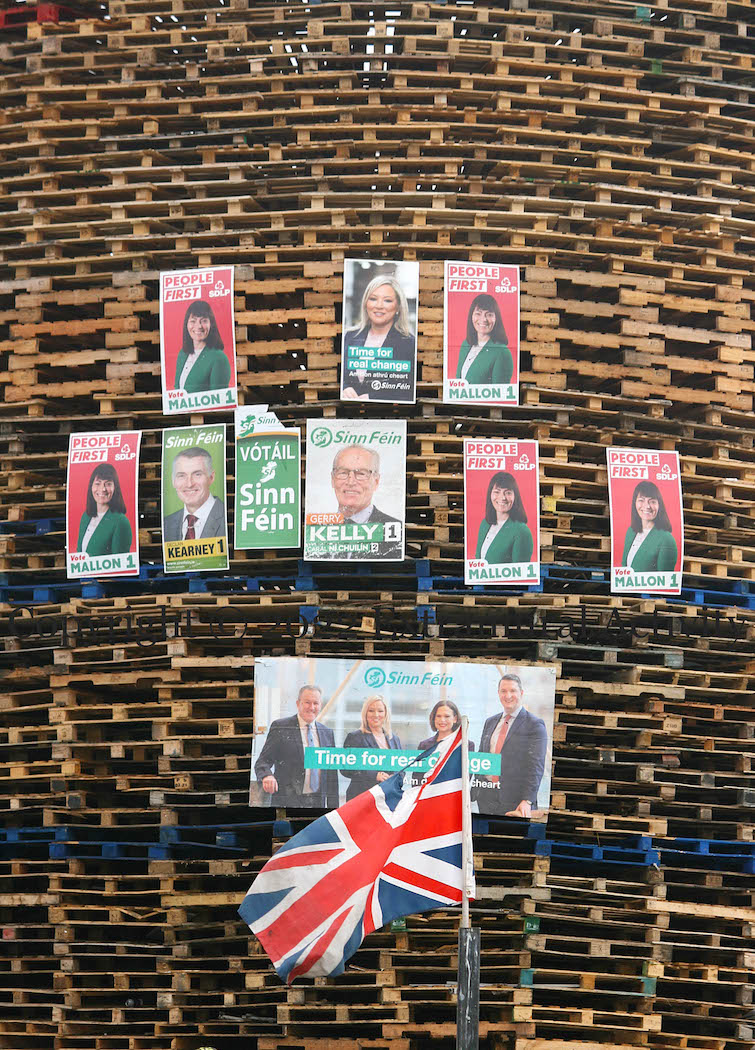
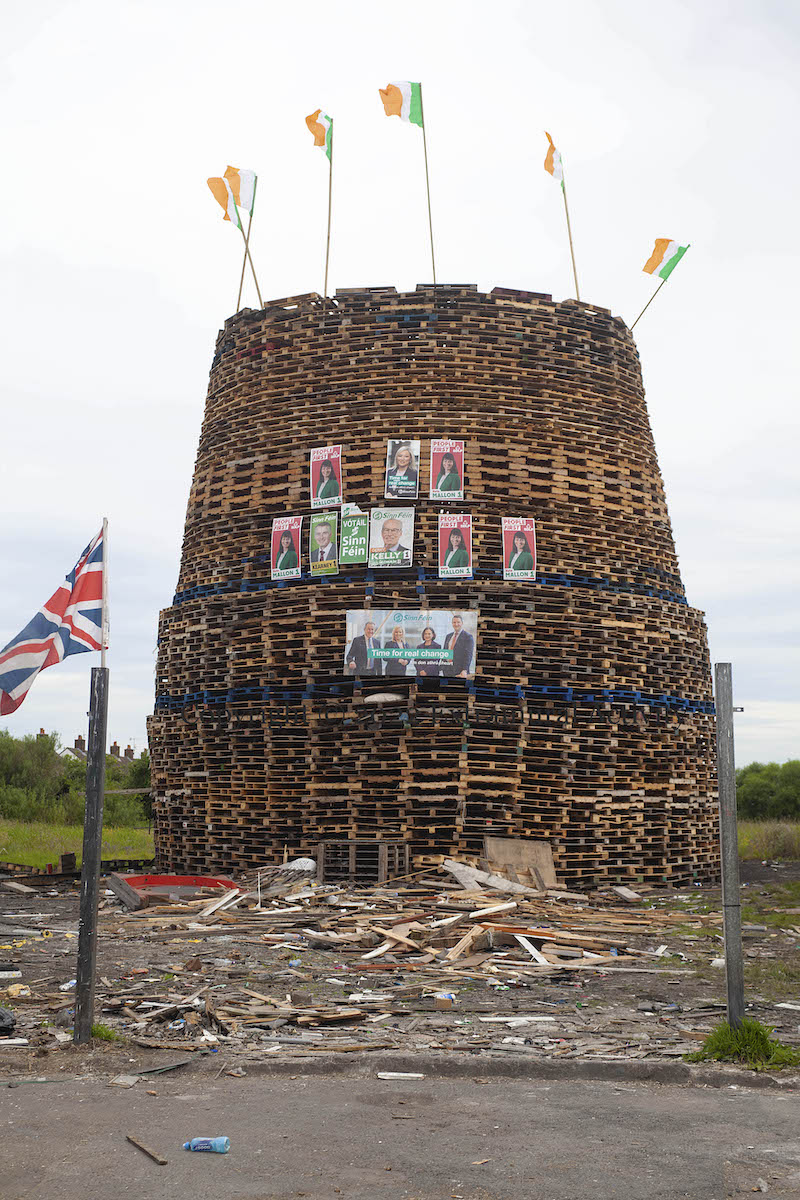
The fourth condition (‘Good Relations’) for funding for bonfires under Mid and East Antrim council’s ‘Cultural Celebrations’ grant scheme asks organisers to discourage “the flying of flags or emblems or the burning of election posters at [the] bonfire site” (MidAndEastAntrim.gov.uk). The Sunylands/Woodburn (Carrickfergus) bonfire shown in today’s post – the images are from July 11th – lacked either funding or sufficient discouragement, as there are six Tricolours flying and ten Sinn Féin and SDLP election placards. The Council notice on the lamp-post, below the red hand – see the final image – is more direct, simply stating “No fly tipping, by order”.
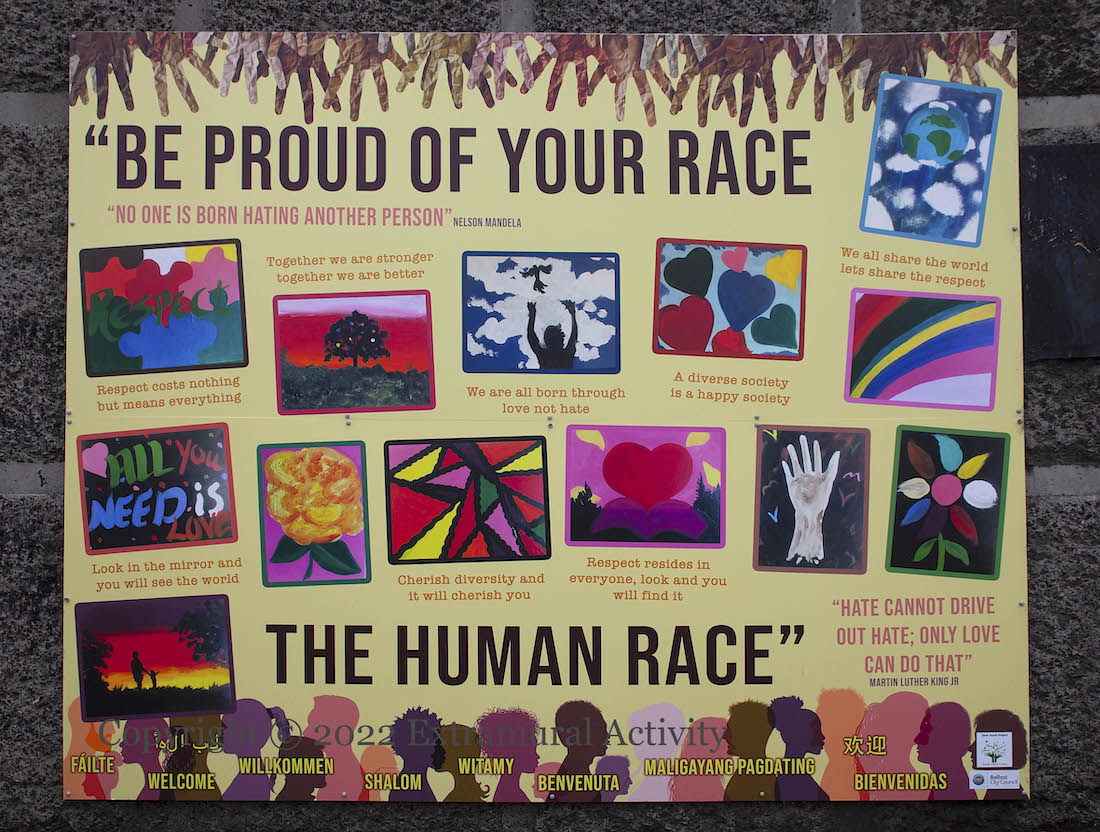
“Be proud of your race – the human race.” Local school-children from the Divis area worked with artist Fra Maher to produce this anti-racism mural – including quotes from Nelson Mandela (“No one is born hating another person”) and Martin Luther King, Jr (“Hate cannot drive out hate; only love can do that”) – that was unveiled on St Patrick’s Day at Divis Tower (Belfast Live has a gallery from the launch.)
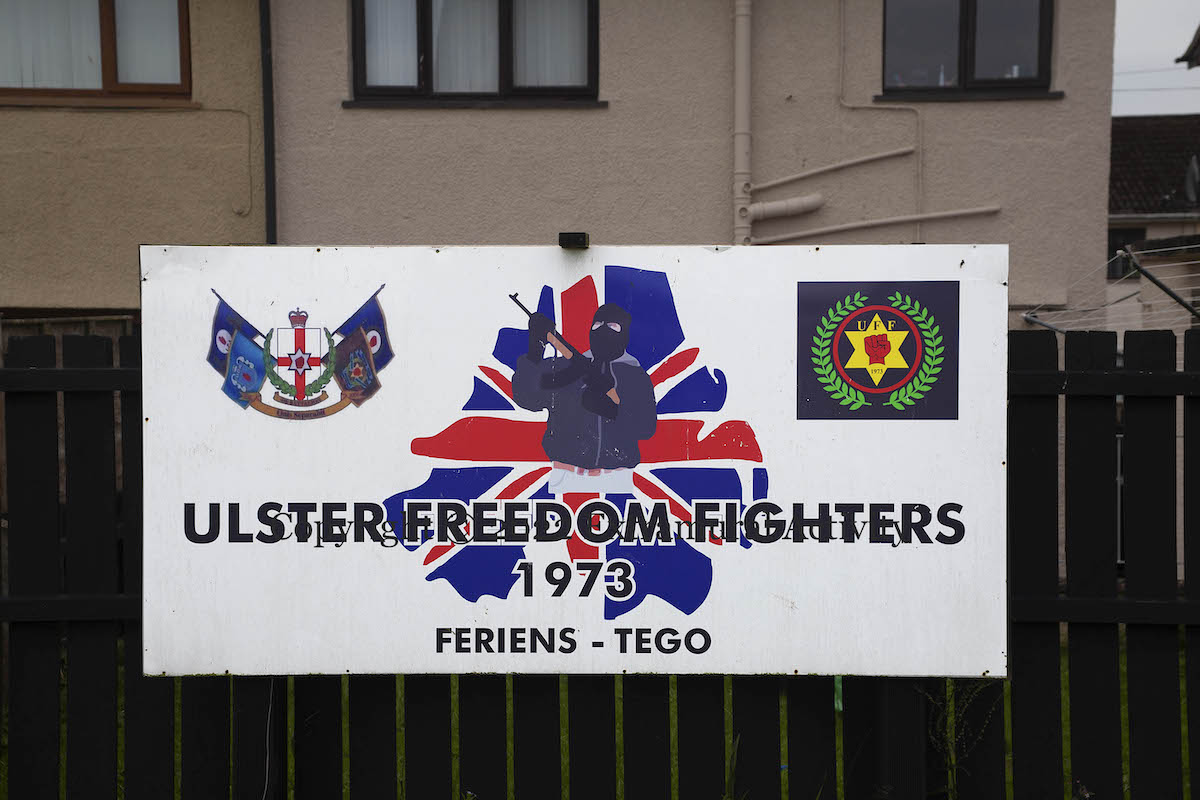
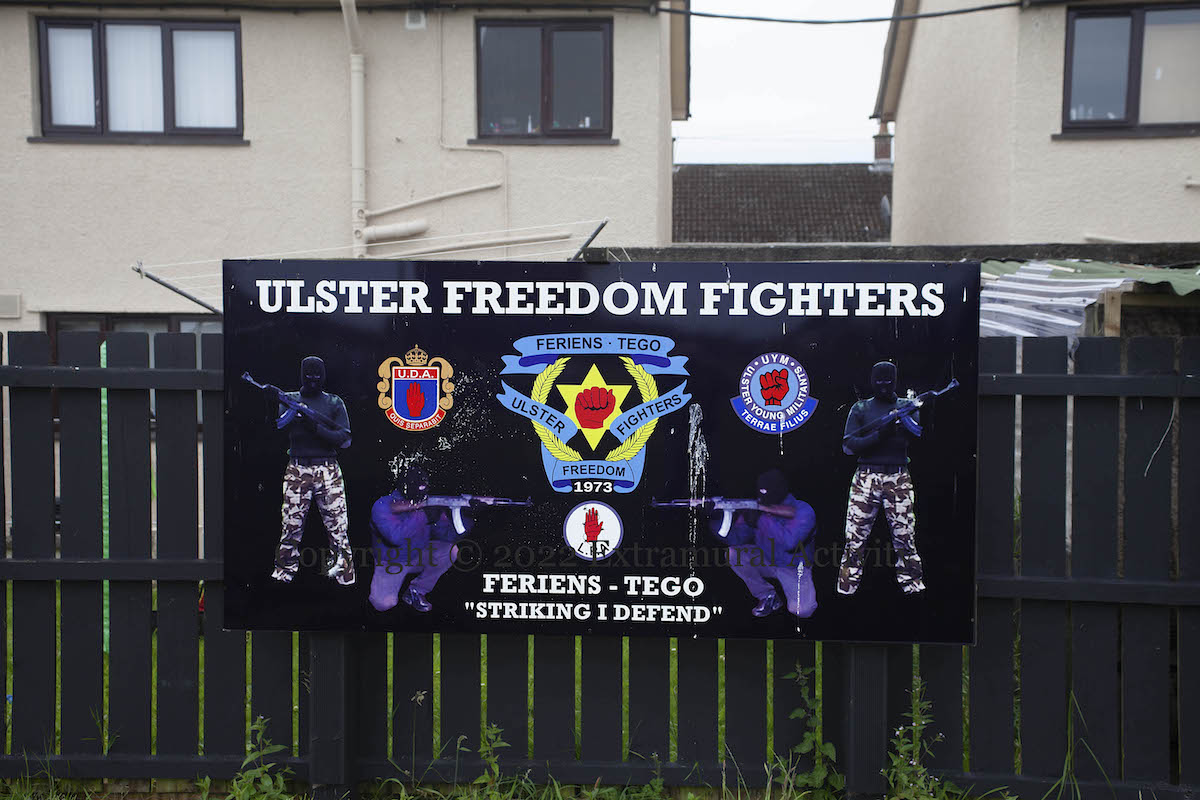
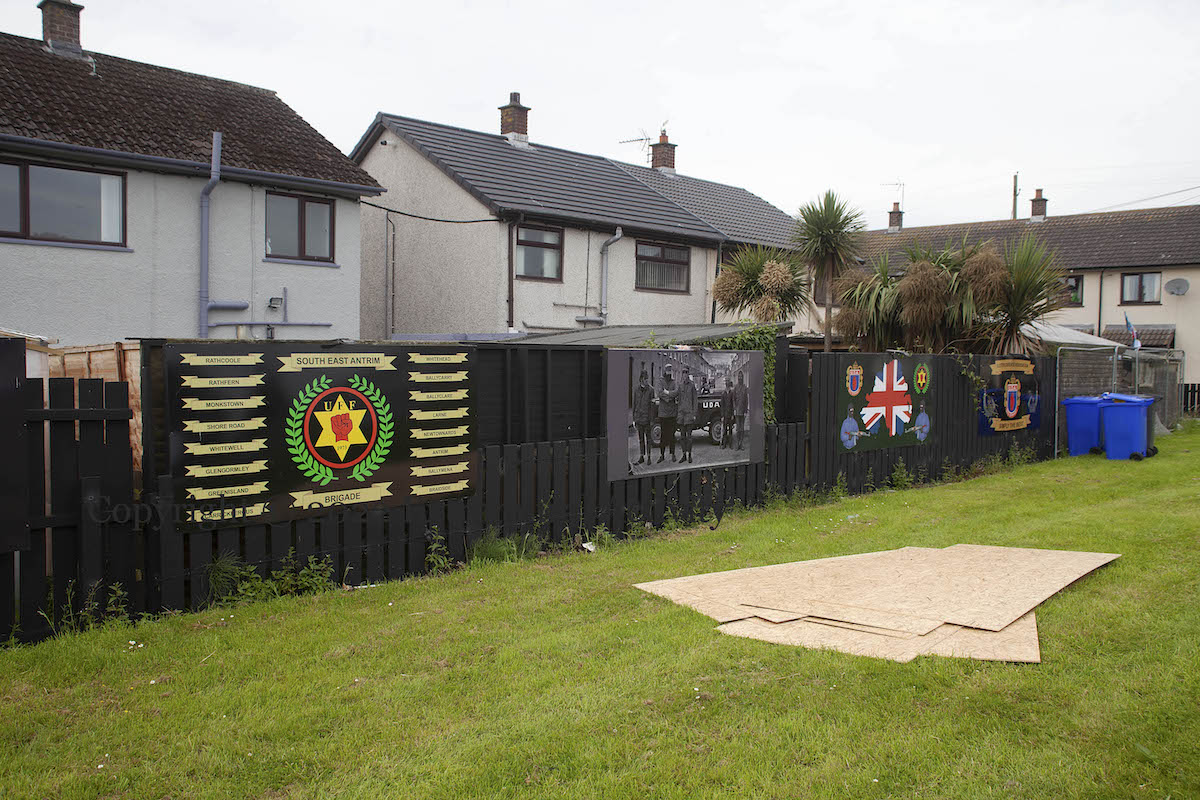
Here are dozen South East Antrim UDA boards along Shanlea Drive in Ballycraigy (Larne). The first four commemorate the massive bonfire built each year (see Commonwealth Handling Equipment) – “We lead, others follow”.
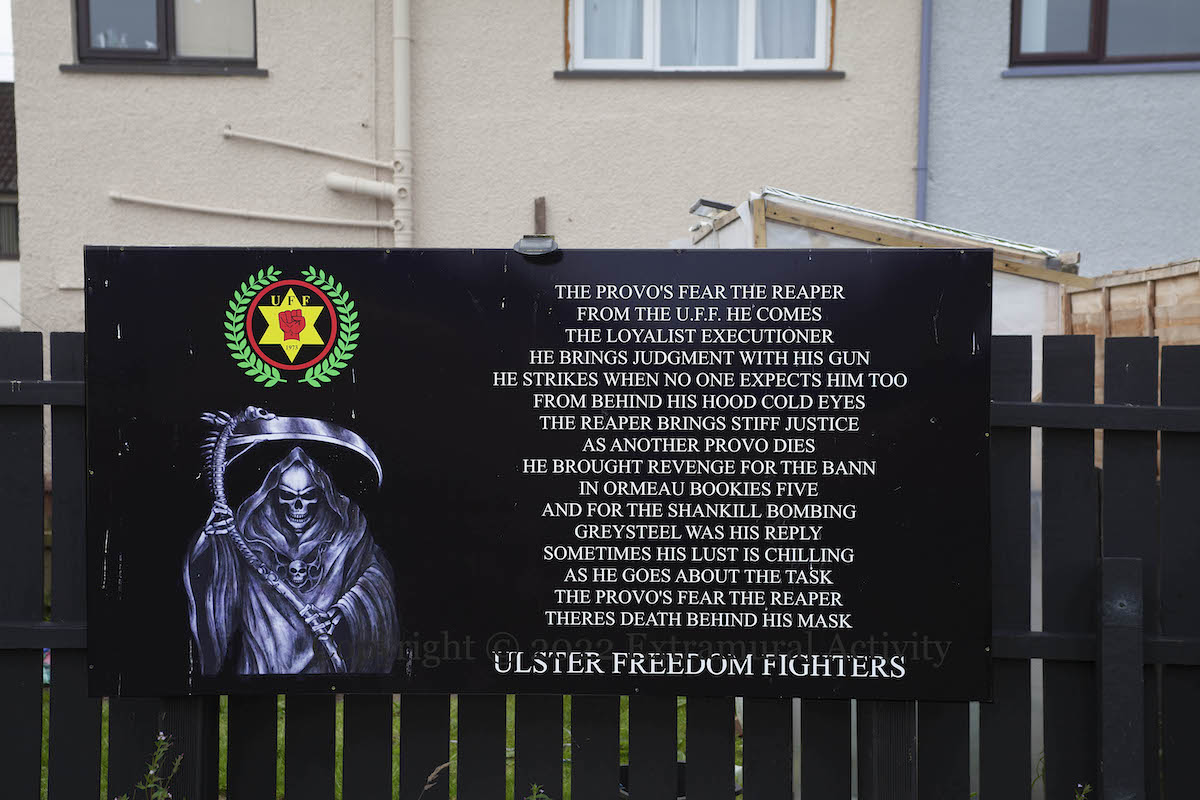
The middle are the most violent, showing volunteers wearing balaclavas and carrying assault rifles, with a poem about killing “Provos” which here seems to mean simply Catholics, as no IRA members were killed in either Ormeau or Greysteel. “The Provo’s fear the reaper/From the UFF he comes/The loyalist executioner/He brings judgment with his gun//He strikes when no one expects him too/From behind his hood cold eyes/The reaper brings stiff justice/As another Provo dies//He brought revenge for the Bann/ In Ormeau bookies five/And for the Shankill bombing/Greysteel was his reply//Sometimes his lust is chilling/As he goes about his task/The Provo’s fear the reaper/There’s death behind his mask.” There was a poem with the same sentiment in south Belfast (see The Reaper Come To Call) next to a mural of Eddie The Trooper.
Of the final four (the right-hand side) the historical photograph was the basis for a mural in south Belfast.
Orange Order Victims day is an annual commemoration (on September 1st) of the 339 members who were killed during the Troubles. The stained glass window reproduced in a board on the Newbuildings memorial garden is in the Museum of Orange Heritage in Schomberg House, south Belfast.
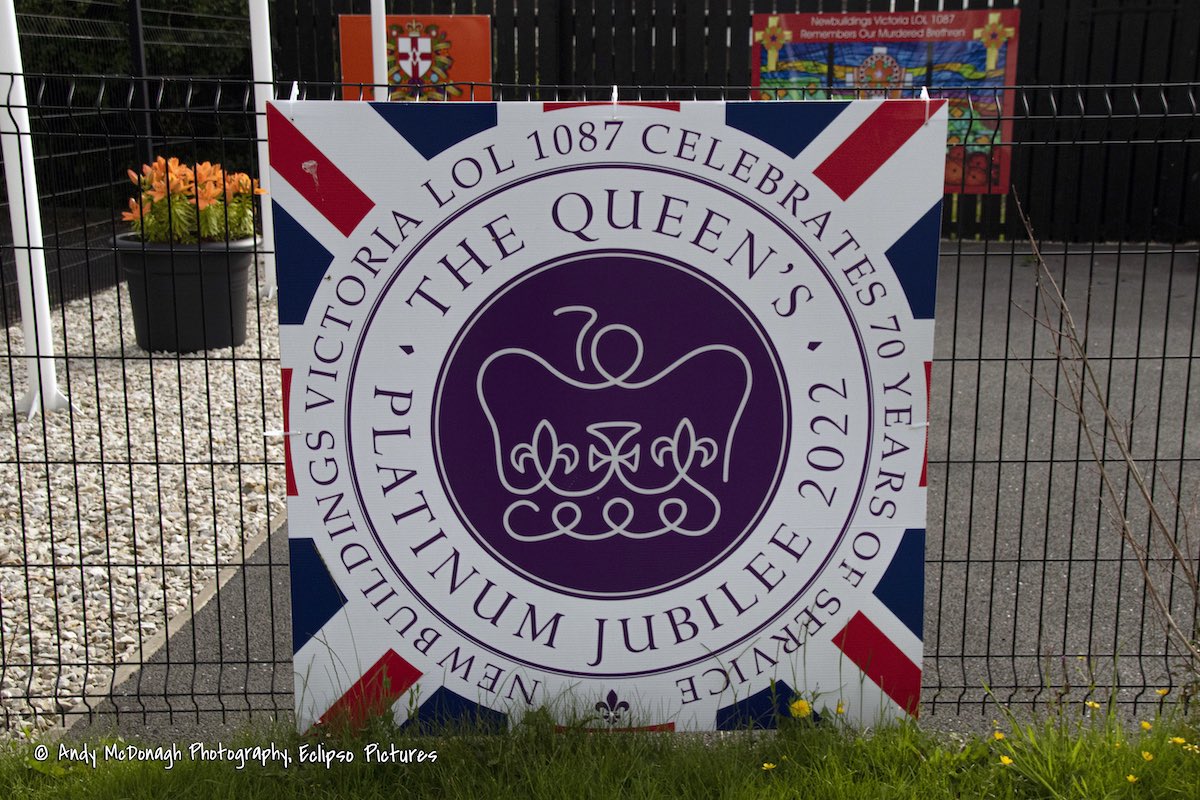
Compared with the garden in 2020 (see Newbuildings Victoria), there is a new NI Centenary board, and on the outside (replacing the tarps giving thanks for the NHS and commemorating the 75th anniversary of VE day) there is a celebration of the platinum jubilee of Queen Elizabeth II. On the electrical box, there is a stencil in support of Bloody Sunday’s “Soldier F”, who continues to face murder charges (for the killings of William McKinney and James Wray) and five attempted murder charges after the PPS’s decision to discontinue prosecution was quashed in March (Guardian); the PPS has appealed (News Letter).
339 Orange Order members killed during the Troubles.
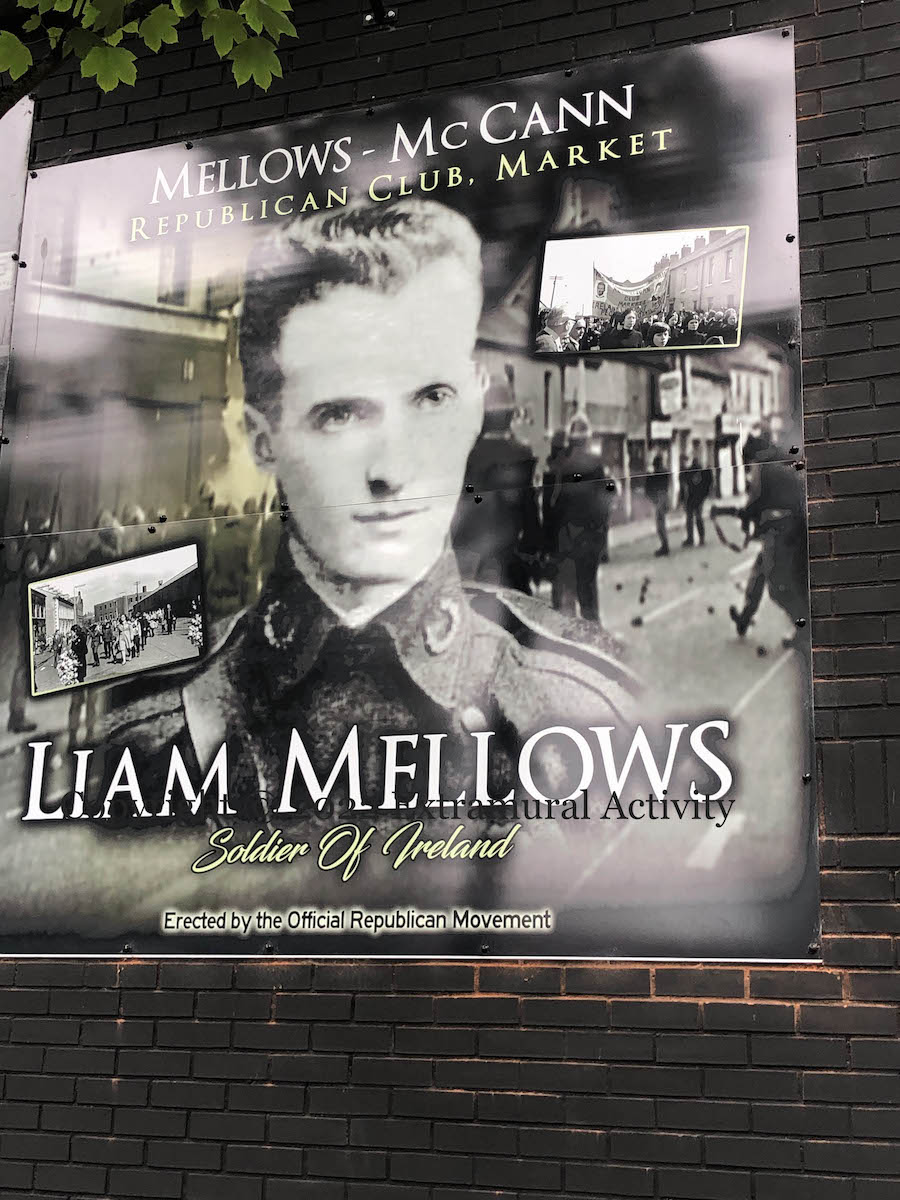
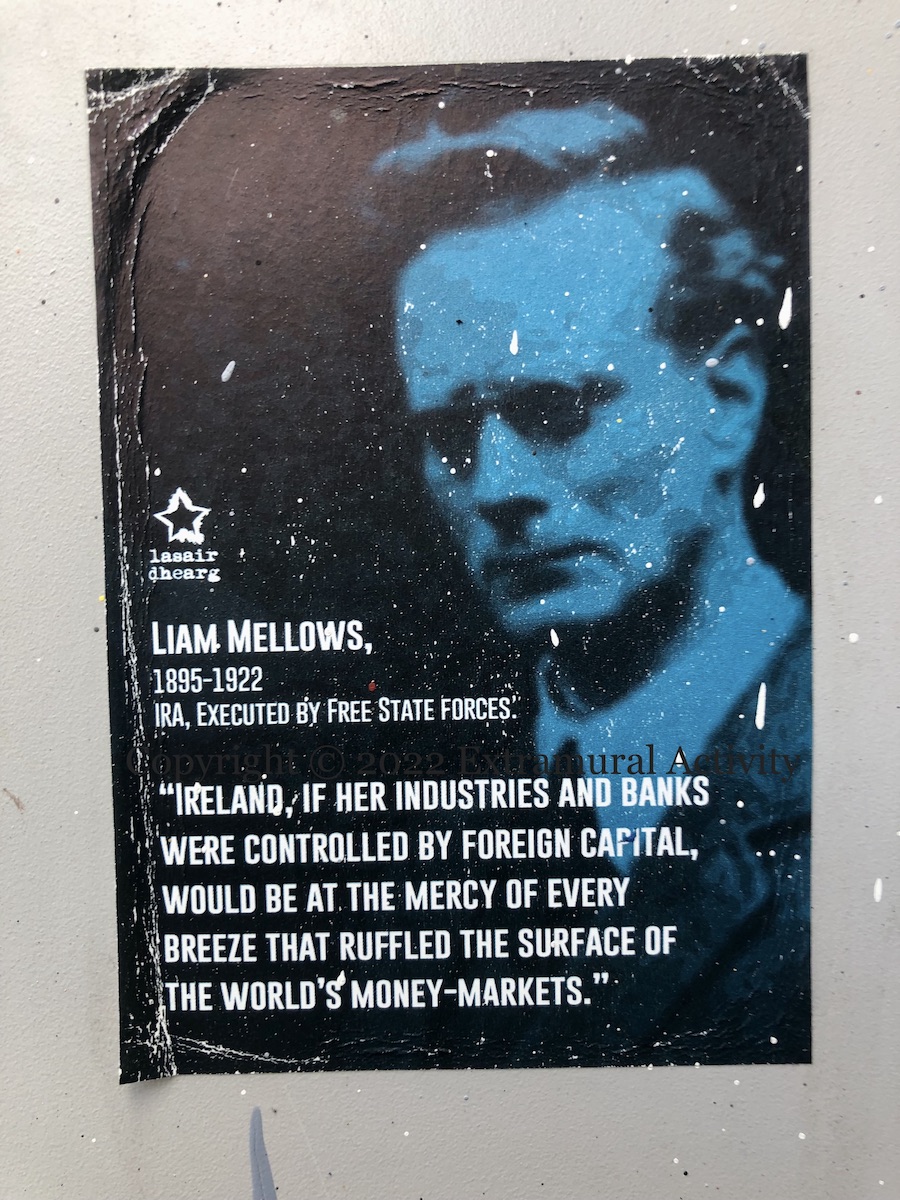
After serving in the IRA in the War Of Independence, Liam Mellows was elected to the First Dáil and as a member of the second Dáil voted against the Treaty in January 1922 (his speech is recorded in Oireachtas.ie under the name “Liam Mellowes”). In the Civil War that followed, he served as IRA quartermaster in the force in the Four Courts that surrendered to Free State forces on June 30th, 1922. He was imprisoned in Mountjoy and executed in December, in reprisal for the killing of Seán Hayes (see Executed). (WP | An Phoblacht) His proposals for government were published posthumously as ‘Mellows Testament’ (NLI) and include state ownership of heavy industry, large estates, the transport system, and the banks. The sticker below quotes from that document: “Ireland, if her industries and banks were controlled by foreign capital, would be at the mercy of every breeze that ruffled the surface of the world’s money-markets.”
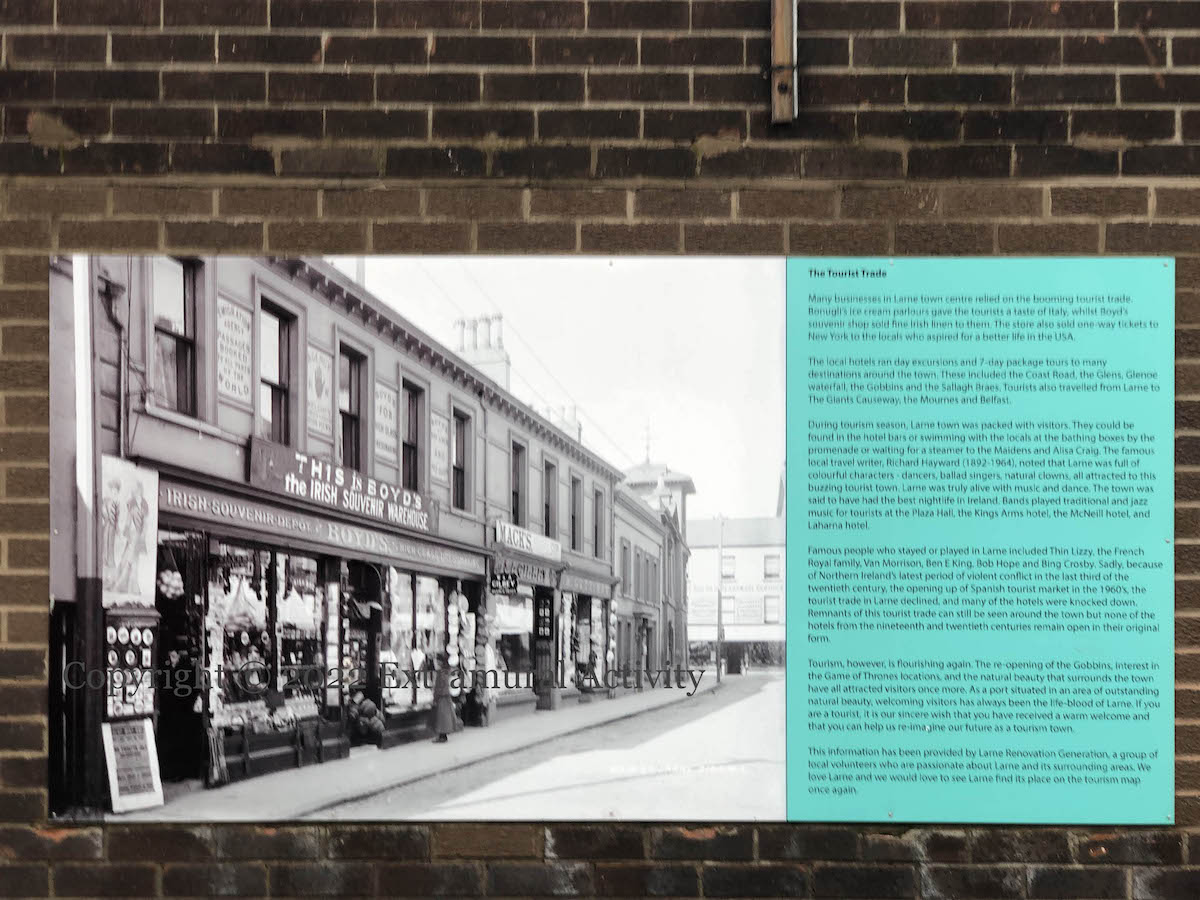
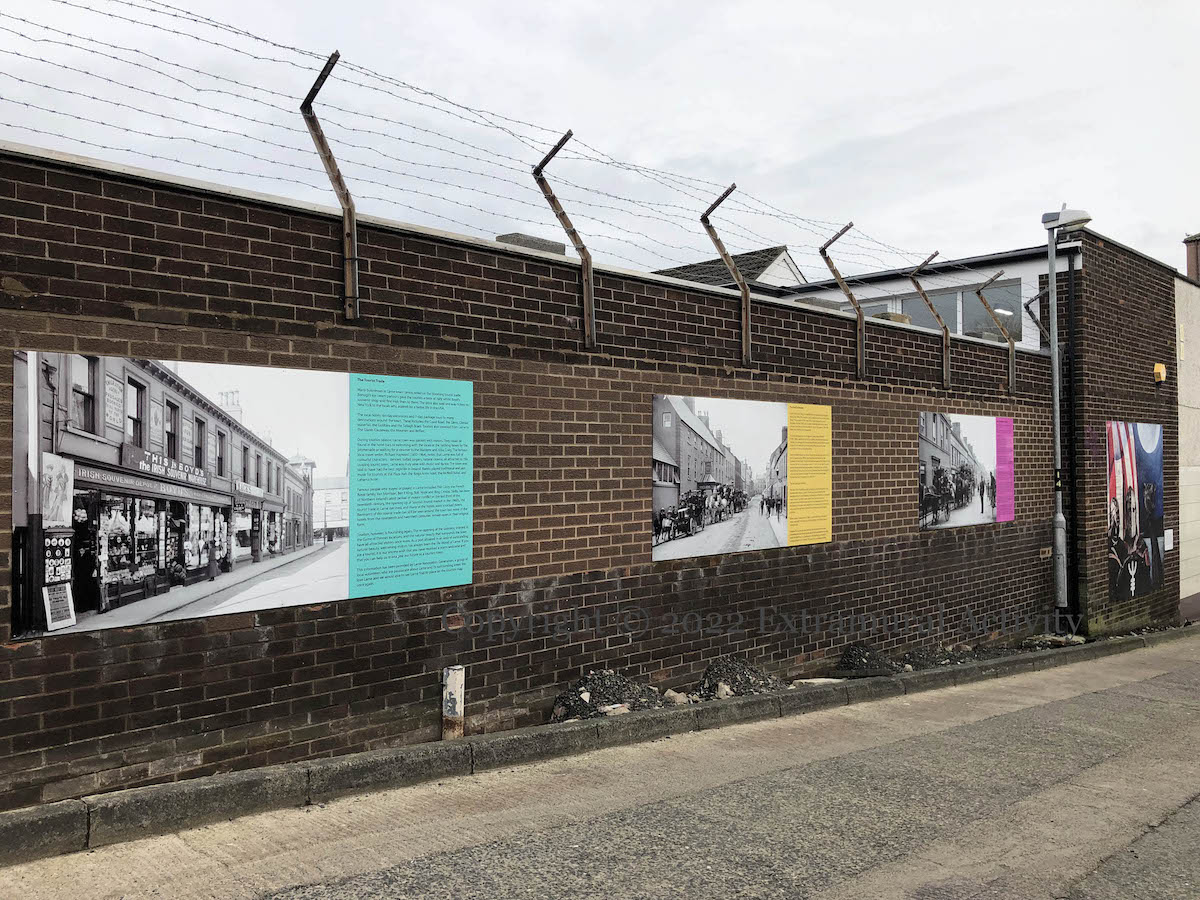
“Larne – the original tourist resort” going back to Larnians, Romans, Christians, vikings, the Scots (Edward The Bruce), the English (Sir Moyses Hill) but most particularly after 1842, when the Coast Road was finished, making Larne the “gateway to the Glens” and inspiring Henry McNeill to create the package holiday (see previously Those Magnificent Men In Their Flying Machines). Ships carrying tourists from America would ferry emigrants on the way back – Boyd’s souvenir shop (shown in the first panel, above) sold Irish linen to tourists and one-way tickets to New York. After a double whammy in the 1960s of the Troubles and easier access to Spain, “tourism is flourishing again” thanks to the Gobbins and Game Of Thrones.
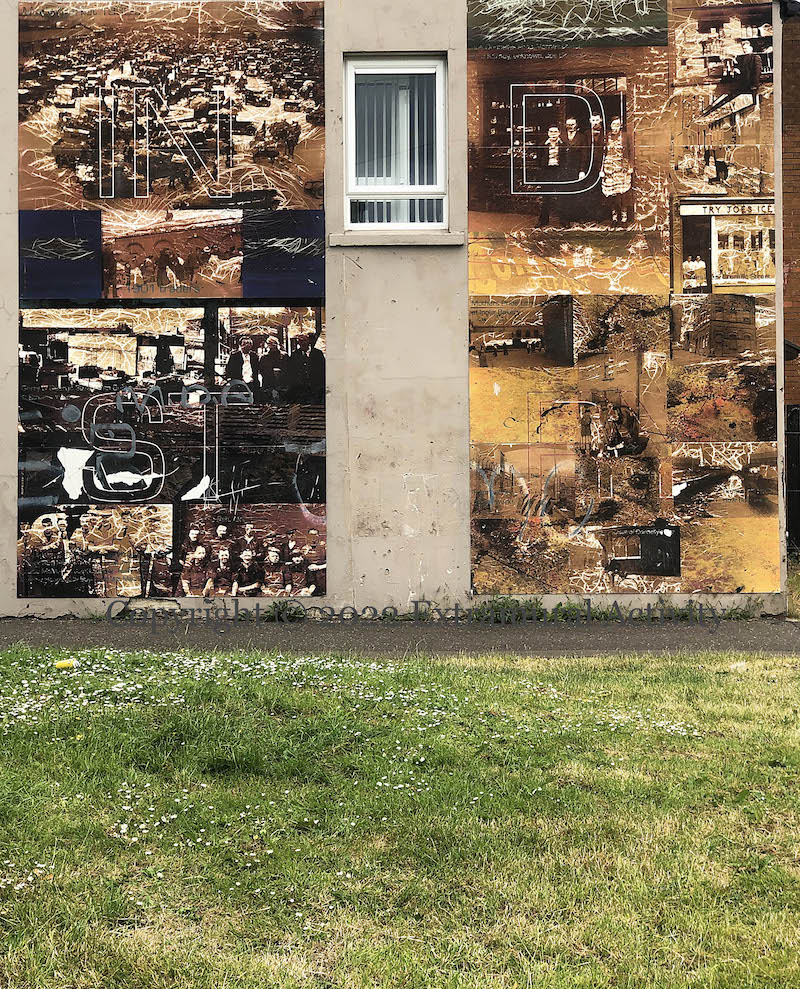
Artist Raymond Henshaw produced a series of Markets-related boards in 2008-2009 with support from the Arts Council and despite being printed on laminates they are not indestructible; there is crazing – as well as human-caused damage – on some of them, the worst of which is the ‘Industry’ board in Upper Stanfield Street.
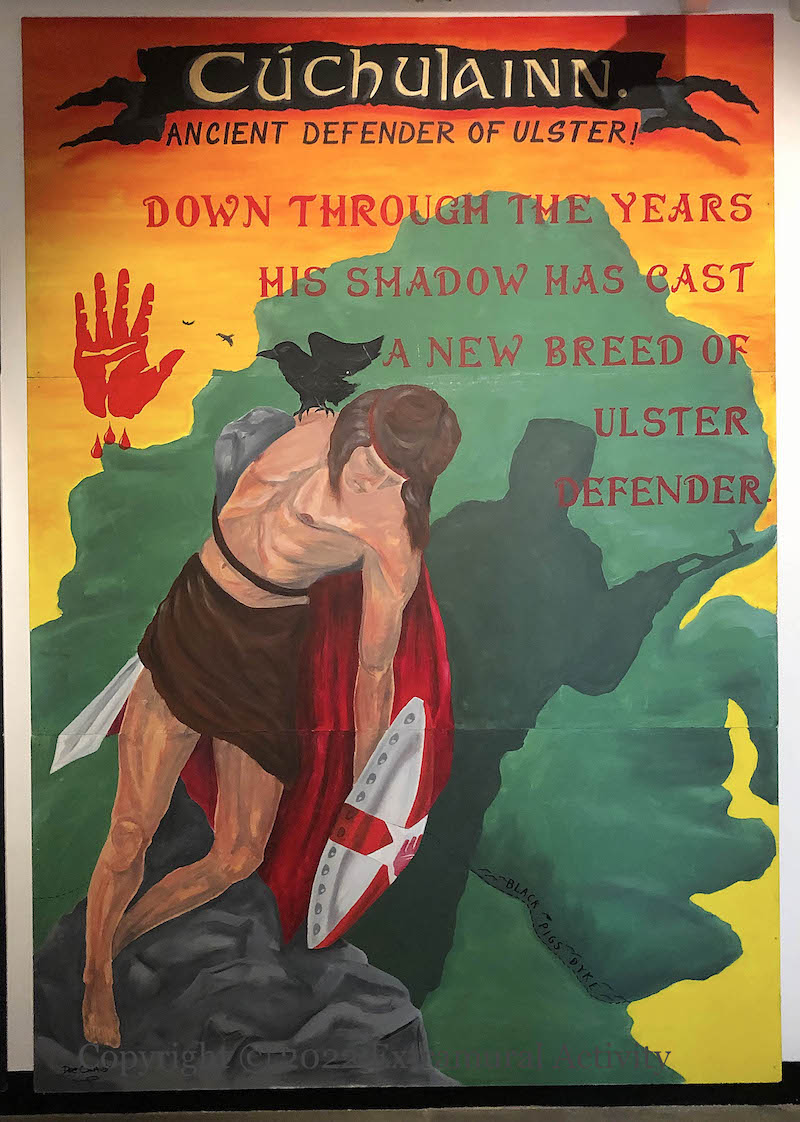
Here are a pair of large boards in the Ulster Museum on the theme of Cú Chulainn, one from each sect.
In the left-hand painting – the CNR piece, by Marty Lyons and a Short Strand artist – Francis Hughes of the IRA – in what we think is a unique break with tradition – takes the place of Cú Chulaınn, who became a symbol of the 1916 Easter Rising when Oliver Sheppard’s statue of Cú Chulaınn’s death was placed in the re-built GPO. Hughes has a tourniquet on his right leg, an assault rifle dangling from his wrist, and instead of the raven that signified Cú Chulaınn’s death there is the symbol of republican political prisoner, the lark, which appears in the apex of many other republican murals.
In the second of the pieces – the PUL piece, painted by Dee Craig – the raven sits on the shoulder of a Cú Chulainn who has a red cloak and carries a Northern Ireland shield. “Down through the years, his shadow has cast a new breed of Ulster defender”: a (loyalist) hooded gunman. Thus while Cú Chulaınn is the (surprising) “Ancient defender of Ulster!”, the UVF and UDA are its modern defenders, now that the B Specials and UDR are gone.
The dripping red hand in the top left is the ‘red hand of Ulster’; one version of the origin-story for the red hand is that the man who avenged Cú Chulaınn’s death made a bloody hand-print to indicate his completion of the deed. Most people, however, will think of the legend that in a race to be first to touch the land of Ulster one contestant (perhaps Érımón Uí Néıll) cut off his hand and threw it ahead of the others. (This legend was depicted in a lower Shankill mural and narrated in an east Belfast mural: The Strangest Victory In All History.)
The Black Pig’s Dyke is the collective name for a number of ditches built around 400 BCE, perhaps to prevent cattle-raiding. They share a common mythology: that they were created by huge black boar; they are on the Ulster-Connacht border, rather than the Ulster-Leinster border as shown in the painting, though there are similar earthworks in Down, Armagh (and Cork) (WP).
“Murdered for their political beliefs: Tom Berry, Robert Elliman, Robert Millen, John Browne”. All four had a connection Markets or Ormeau area of south Belfast. Millen, from the Ormeau area, was shot in 1973 by the UVF; he played on the same soccer team (Bankmore Star) as Thomas Berry, who was shot in a Short Strand GAA club; Elliman was shot in a Markets pub; John Brown (without the “e”) was shot in his Cooke Street home in front of his family. The first three were all Protestants; the latter three were among 11 people who died in the 1975 feud between the Officials and the Provisionals. (Lost Lives)
“The war they wage is not a war of bigotry or greed, their struggle is a workers one, so everyone may lead a life with rights and liberty, in a land where they can say “Up the Army of the people, the Official IRA”.” “Erected by the Official Republican Movement.”















 Extramural Activity