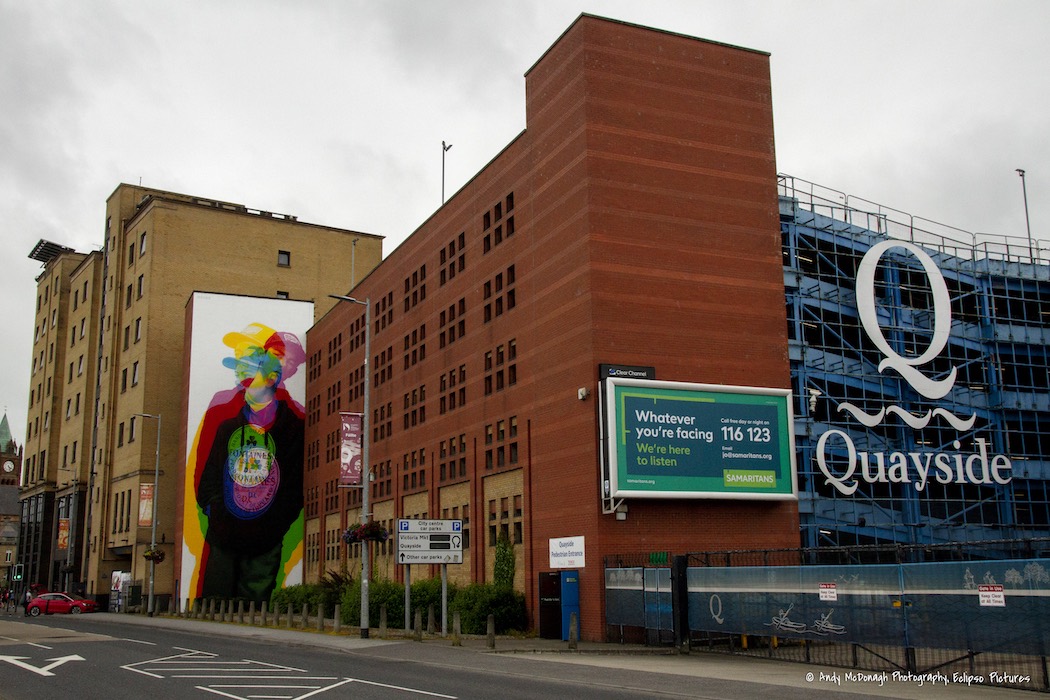
Ireland’s most famous export is not its music – including Fontaines D.C. (web) – or its stout – including Guinness – but its people, about 10 million of them since 1800 (WP). The youngster in this new mural by Dublin artist ACHES (ig) is torn in different directions.
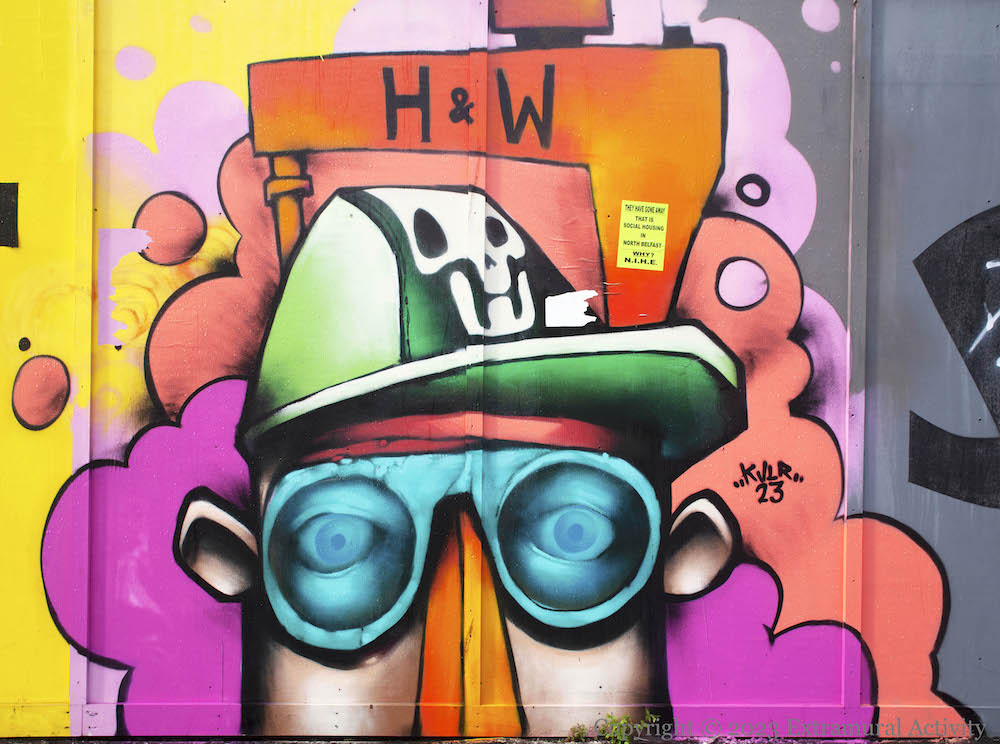
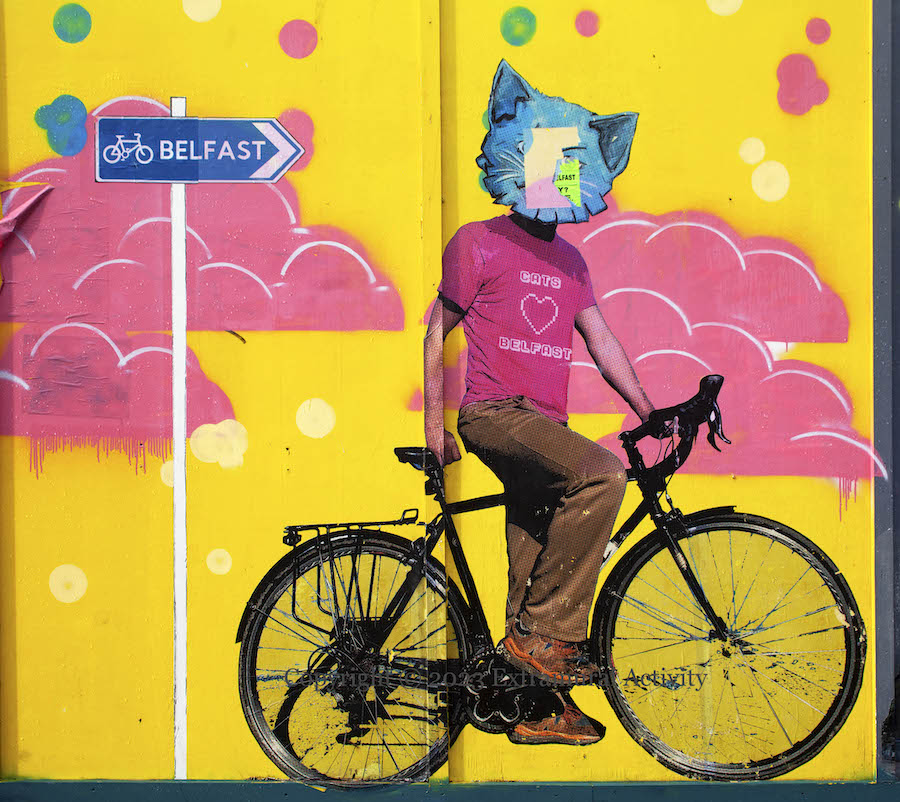
How’s about ye?! FGB (ig), Leo Boyd (ig), and KVLR (ig) added three pieces at the end of April to what is now the “Belfast Stories” construction hoarding. FGB’s piece, shown above, was inspired by the fact that the northern branch of North Street was called “Goose Lane” (tw) at the time of (Chichester’s) Belfast Castle, as herders headed through the north gate (see the map at Lennon Wylie). There is a “Goose Lane” plaque on just the other side of Royal Avenue; it is included below.
“One of the earliest streets in the city, North Street was known as Goose Lane, along which geese were driven to feed on the fields outside the town. That 17th century street consisted of single-storey houses and the old city wall bisected it at what is now Royal Avenue – Belfast City Council.”
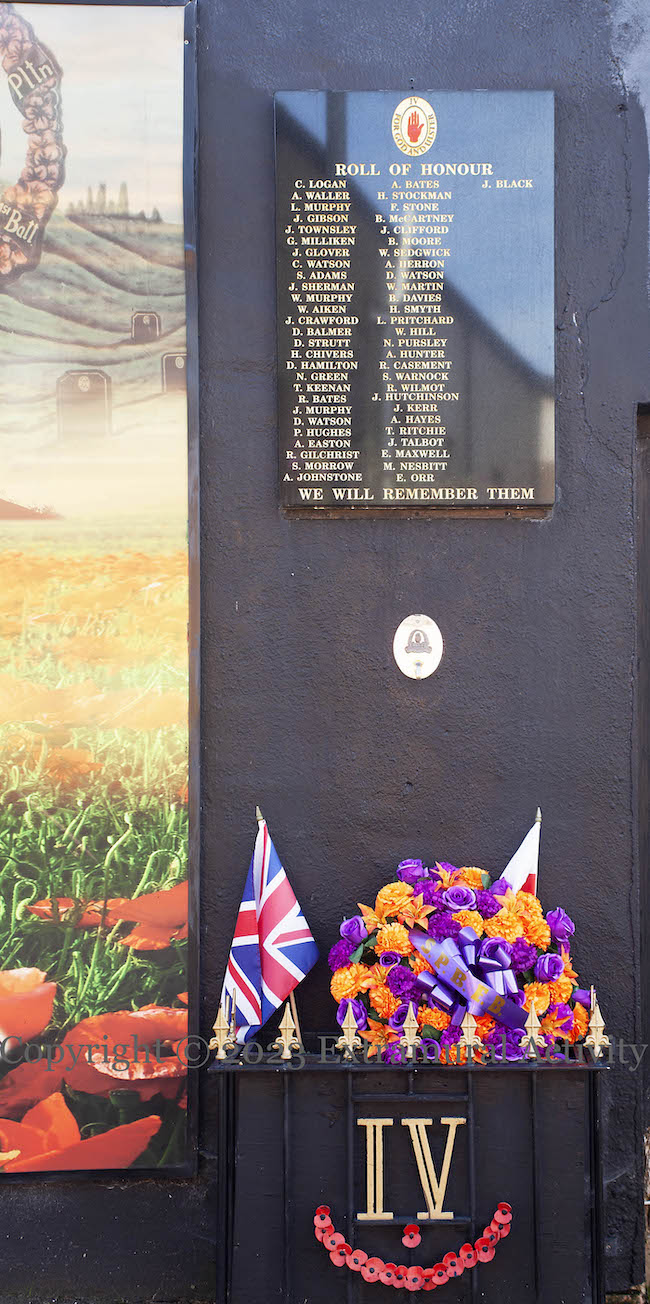
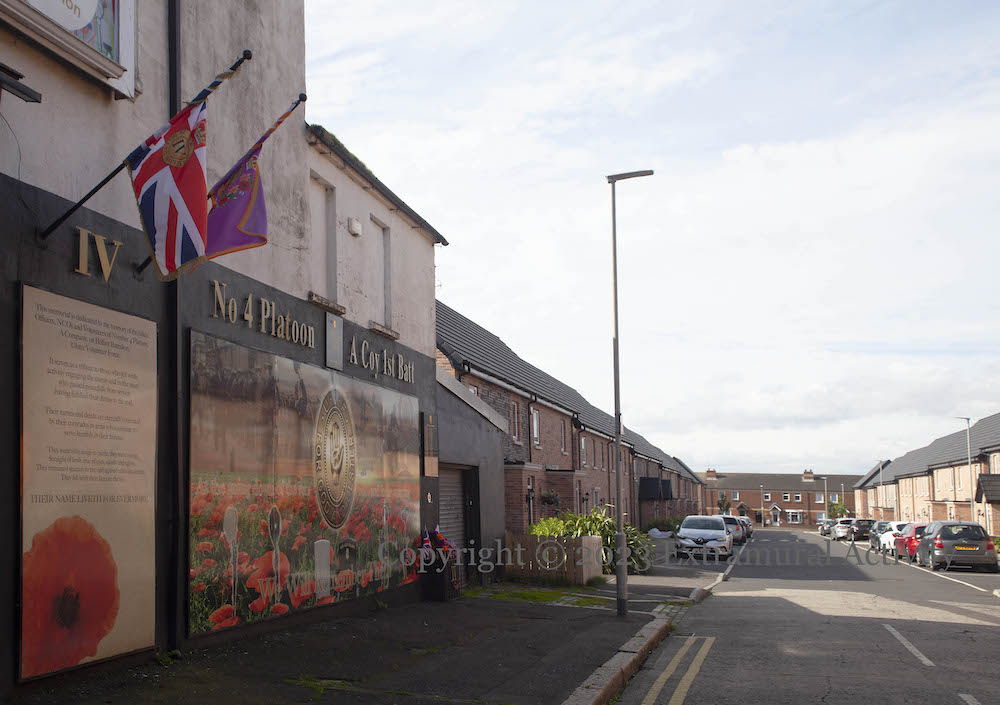
The UVF (A company, 1st battalion, platoon 4) mural in Glenwood Street was in the news last week after Jude Whyte of the Victims And Survivors Forum (web) drew attention to it because of its inclusion of some members of the Shankill Butchers (Irish News). The gang-members included in the plaque are given in a previous post – Platoon IV.
Some outlets (e.g. Sunday World) are reporting that the plaque is new but, while a few names of platoon have volunteers been recently added – Nesbitt, Orr, and Black – the plaque, including the names of various members of the gang, has been on the wall since 2017.
The application form for a dual-language street sign is completely agnostic as to which language (in addition to English) should go on the street sign. Based on news reports (including, recently, one home-owners complaint that such a sign would lower property values – BelTel) and our impression from tramping the streets, Irish (Gaeilge) is by far the most commonly requested language, but there are a few that include Ulster Scots; previously we featured Heichbrea Airt in Castlereagh, and to that can now be added the sign shown above in the Woodvale: “Oregon Gardens” / “Orkan Gairdens”. (Please get in touch if you know of others.)
Ards & North Down council has just approved its own dual-language policy; like the old Belfast policy, one third of householders must sign the initial petition and two-thirds must respond positively to the subsequent survey of the street (News Letter).
In Raimondi’s Adam And Eve, an engraving from c. 1512, Adam offers Eve two small apples while a human-headed serpent looks on (Met). (The town in the background is from Raimondi, but the car in the middle is Boyd’s.)
In Leo Boyd’s reworking, all the heads have been turned into surveillance cameras – including the snake in the tree, the private parts have been covered by “Fig. 1” and “Fig. 2”, and the forbidden fruit is now a heart emoji, which in this instance has literally been cut out of the print. Our surveillance culture (inlcuding “social” media) perhaps makes emotional connection more difficult and more dangerous than ever – we are ashamed to appear naked.
The paste-up is on the hoarding in Donegall Quay, below a ring of surveillance cameras. Belfast is the 100th-most surveilled city in the world, per capita (CEOWorld).
For information about the production of the piece, and images that include the heart that has been torn out, see Leo Boyd Prints.
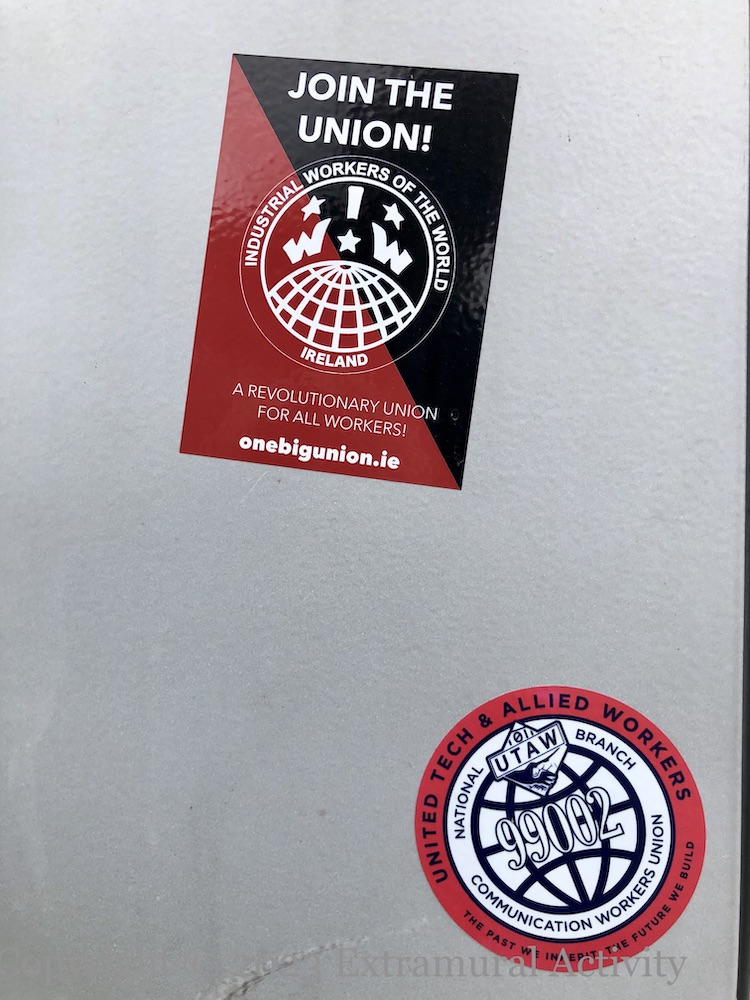
Three stickers of resistance in Belfast’s city centre: above, communistparty.ie confirms Marx’s prediction of capitalism’s inevitable failure; below, under-paid, over-worked, and mis-treated hospitality workers are encouraged to “give the goss on your boss”; next below, an old sticker calling for Northern Ireland to follow the Republic in adopting abortion leglislation (parliament.uk) – “not the church, not the state, we must choose our fate – #thenorthisnow [Image.ie]” (as well as a commercial sticker by the singer A.N.J.A.); finally below, from Sailortown, stickers from the IWW or wobblies (“one big union.ie“) and the United Tech & Allied Workers (“the past we inherit, the future we build”).
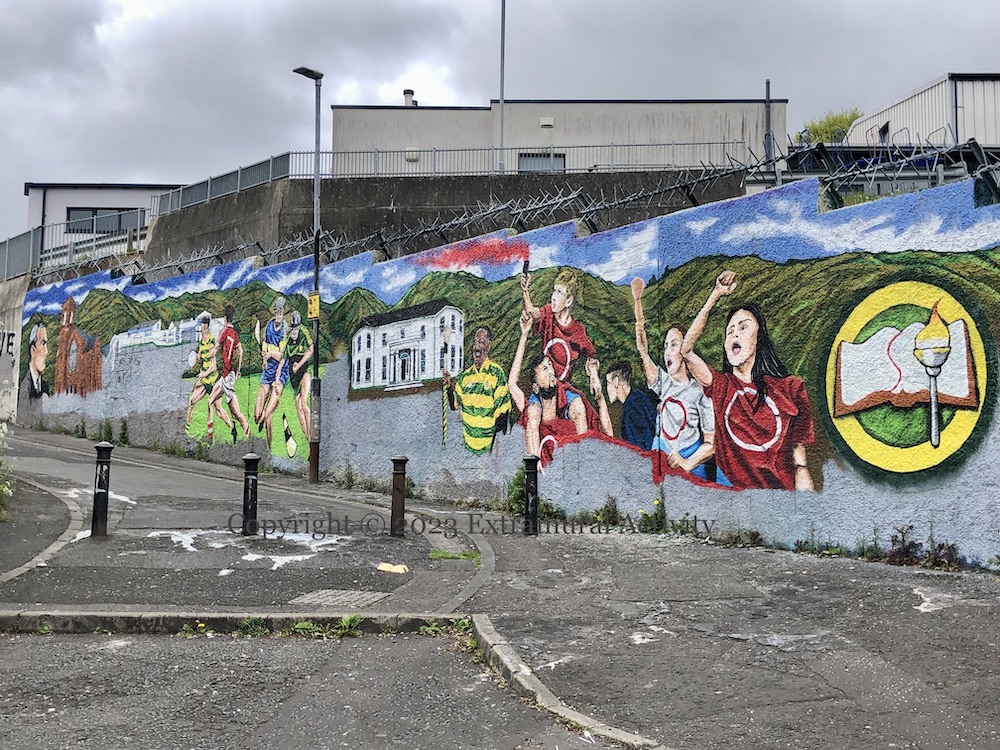
What is now Coláıste Feırste began life as Meánscoıl Feırste in 1991, teaching a group of nine students a curriculum inspired by Patrick Pearse (discussed previously in An Tusa An Chéad Laoch Eıle?) and based in Cultúrlann MacAdam-Ó Fıaıch (Cultúrlann). It moved to Beechmount in 1998 and in 2018 expanded into new buildings that were meant to accommodate 600 pupils (Doherty Architects), which it has now exceeded (BBC) as it enters its thirty-third year in existence.
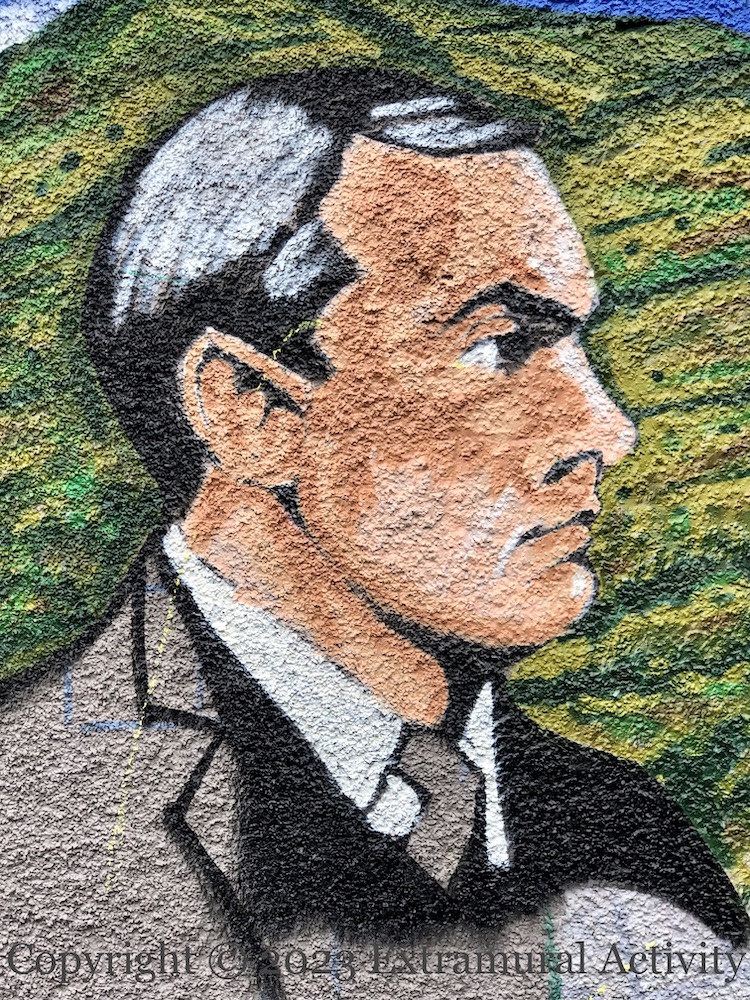
The theme of preserving and promoting the Irish language occurs in several places in the mural: next to Pearse we see his saying, “Máırtín Ó Chadháın ” [a land without a language [is] a land without a soul], in the classroom scene we have “Labhaır í agus maırfıdh sí” [speak it and it will endure], and finally we see the Dream Dearg protesting for an Irish-Language Act (see previously #AchtAnoıs).
The in-progress images included below among completed detailed shots date from May 6th and 20th.
Giant’s Foot/Beechview Park. Replaces the short-lived mural of Olympians, seen in Sporting Giants.
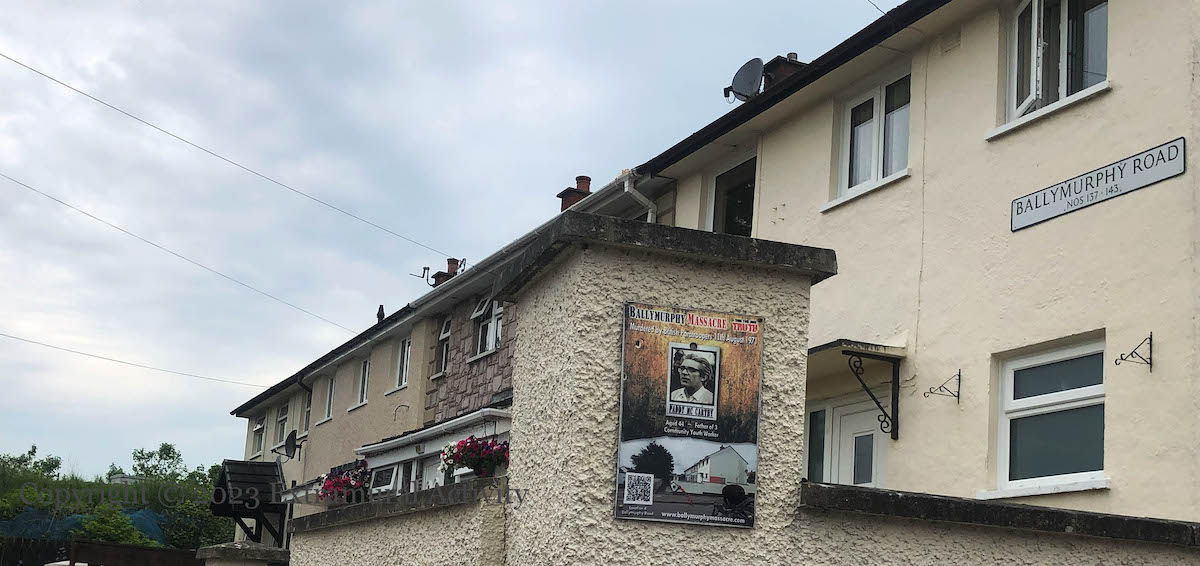
London social-worker Paddy McCarthy took a job at the Ballymurphy Tenants’ Association in west Belfast in 1970. On August 11th, 1971, he tried to broker a ceasefire and evacuation of children from Ballymurphy, where a curfew had been imposed after the introduction of internment. He carried a Red Cross flag but was shot in the hand. He regrouped and then tried to distribute milk to families, but was stopped by two soldiers who either fired over his head or put an unloaded gun in his mouth and pulled the trigger. He died of a heart attack. (Belfast Media | WP | Ballymurphy Massacre | Ballymurphy And The Irish War, written by one of McCarthy’s successors, Ciarán De Baróid, who came to work for the BTA in 1972 – Belfast Media)
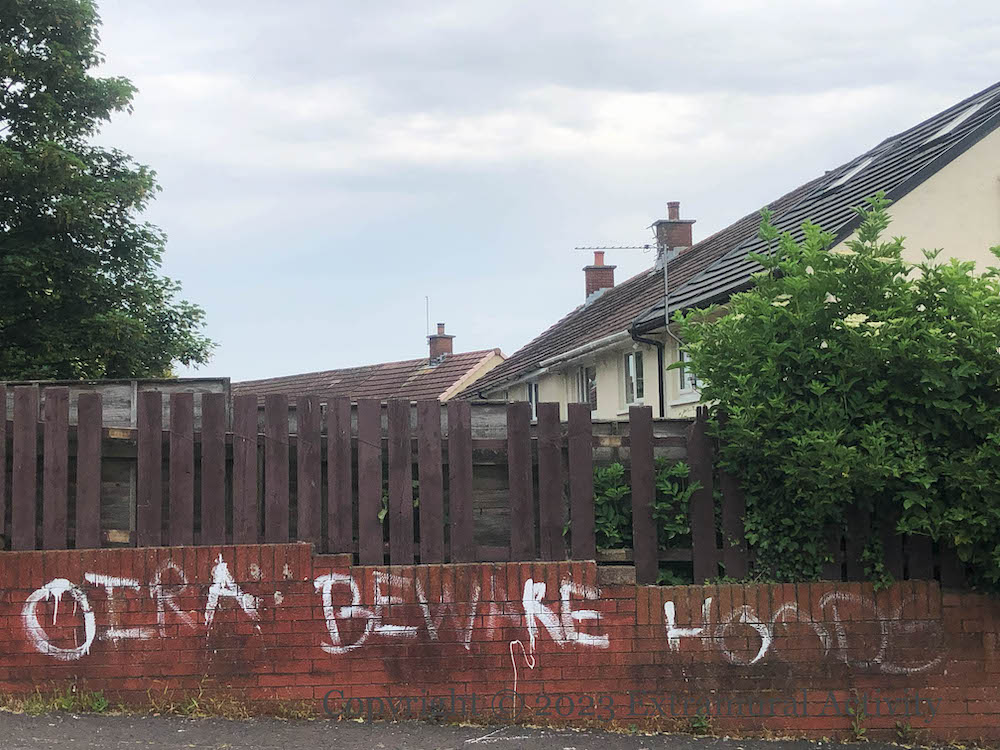
The memorial plaque is in Ballymurphy Road, as is the graffiti below: “OIRA [-] Beware hoods.”
“In commemoration of King William III and his victory at the Battle Of The Boyne, 1st July 1690.” King William and images of Carrickfergus and the Boyne are included on the left of the board: in Ireland, William in person travelled from Carrickfergus to Drogheda and – after the victory at the Boyne – to Dublin, from which he left to pursue the war in Europe; his troops, on the other hand, after landing in Groomsport (1689) and Carrickfergus (1690) and fighting at the Boyne, continued on southward, to Cork and then to Limerick, and westward, to Athlone, Aughrim, and (again) Limerick. The campaign ended in October, 1691, with the signing of the Treaty Of Limerick. The information is available in pdf format from the Schomberg House Museum.
King William’s Corner joins Queen’s Corner and King’s Corner (and first of them all, Conor’s Corner –Conor’s ‘The Twelfth In Wellington Place, Belfast 1918’ is included to the left of the map, under a few lines from The Sash – “It is old but it is beautiful, and its colours they are fine/It was worn at Derry, Aughrim, Enniskillen and the Boyne” – and “The Boyne Standard [a.k.a. the flag of the Orange Order] with the heraldic crest of King William”).















 Extramural Activity