“Askatasuna [freedom]. 700 political prisoners! Political parties banned! Incidents of torture! Civil rights abused! Not Spain, not France. Self-determination for the Basque country.” Also highlighted on the map are Galicia and Catalonia.
This mural on the International Wall commemorates the Manchester martyrs, Philip Allen, Michael O’Brien, Michael Larkin.
The three were publicly hanged on November ?23rd?, 1867, for the killing of a Manchester policeman, Charles Brett. Brett was inside a prison van carrying two IRB leaders when it was set upon by 30 or more people (depicted in the small insert at the top of the mural). The attendant escort fled, leaving Brett inside; he was killed by a bullet fired into the lock. Five people were convicted, one of whom, O’Meagher Condon, shouted “God save Ireland” during the trial; this was turned into an extremely popular song in memory of the three (Wolfe Tones version). Their graves were discovered in 2003 (Irish Times) and a campaign is being waged to repatriate their corpses (Sınn Féın).
“Bring them back to Irish soil. Three Irishmen, one an American citizen, were falsely accused, convicted and hung on the 24th November 1867 in Manchester where their bodies still lie. God save Ireland.”
Picasso’s Guernica (WP) was recreated on The International Wall (Divis Street) in 2007 and now (2009) a reference to the deaths in Gaza has been added on the right, in the form of two bombs — one with a swastika and “Guernica ’37” and the other with a Star Of David and “Gaza 2009” — above and below the information plaque (which can be seen in the Peter Moloney Collection).
“Inspired by two Irishmen to escape from slavery, Frederick Douglass came to Ireland during the famine. Henceforth he championed the abolition of slavery, women’s rights and Irish freedom.”
“Perhaps no class has carried prejudice against colour to a point more dangerous than have the Irish and yet no people have been more relentlessly oppressed on account of race and religion.
(Also by Douglass, and which would have made an apt quote for the mural: “I prayed for twenty years but received no answer until I prayed with my legs.”)
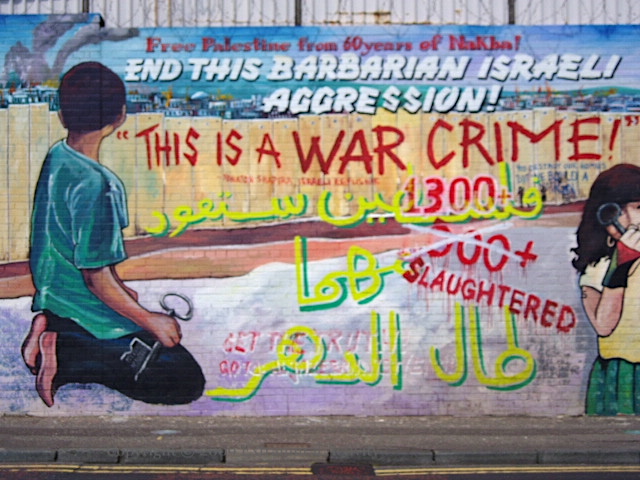
Last year’s pro-Palestine mural on the International Wall (see Free Palestine From 60 Years Of Nakba!) has been augmented with words in red reading “End this barbarian Israeli aggression! “This is a war crime!” – Yonaton Shapira, Israeli refusenik. 1300+ slaughtered. Get the truth! Go to aljazeera.net/english”
The number was originally 700 (Alamy); it was presumably changed to 1000 at some point, though no image has been found of this; in any case, here 1000 has been crossed out and replaced with 1300.
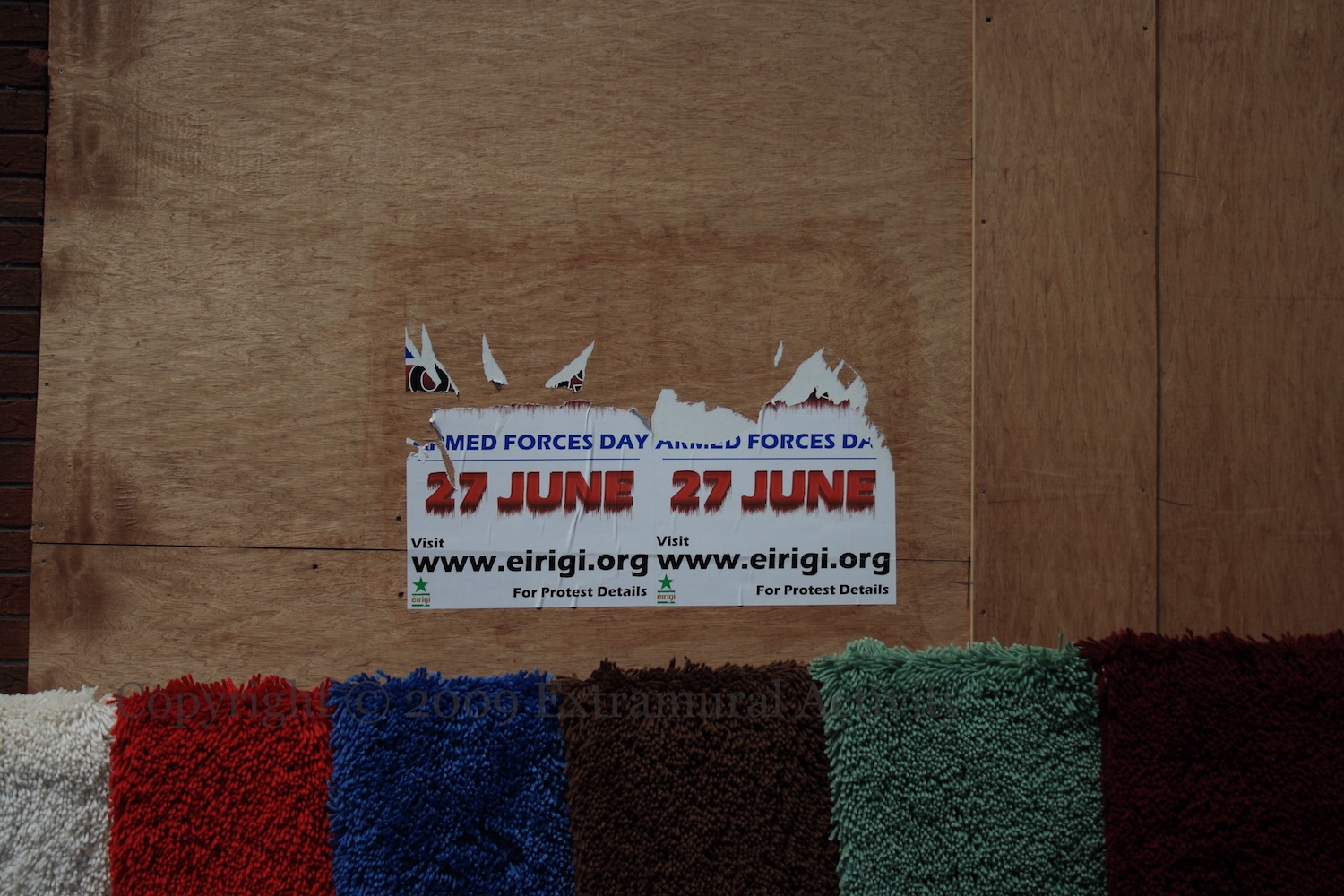
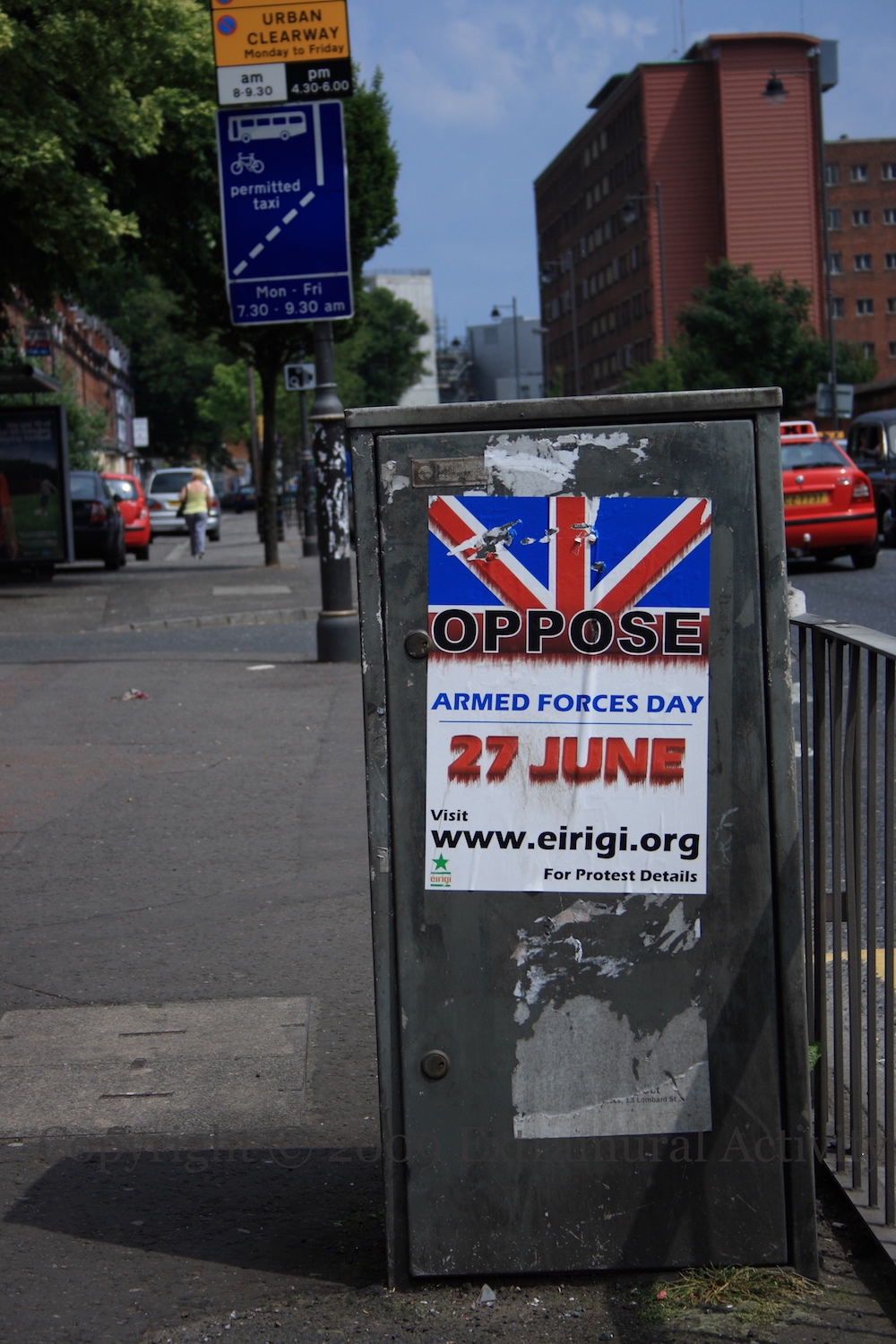
In 2009, the Veterans’ Day holiday (begun in 2006) became Armed Forces Day. The event (and the raising of an MoD flag over Belfast City Hall – An Phoblacht) was opposed by éırígí and Sınn Féın. These posters are on the Falls Road.
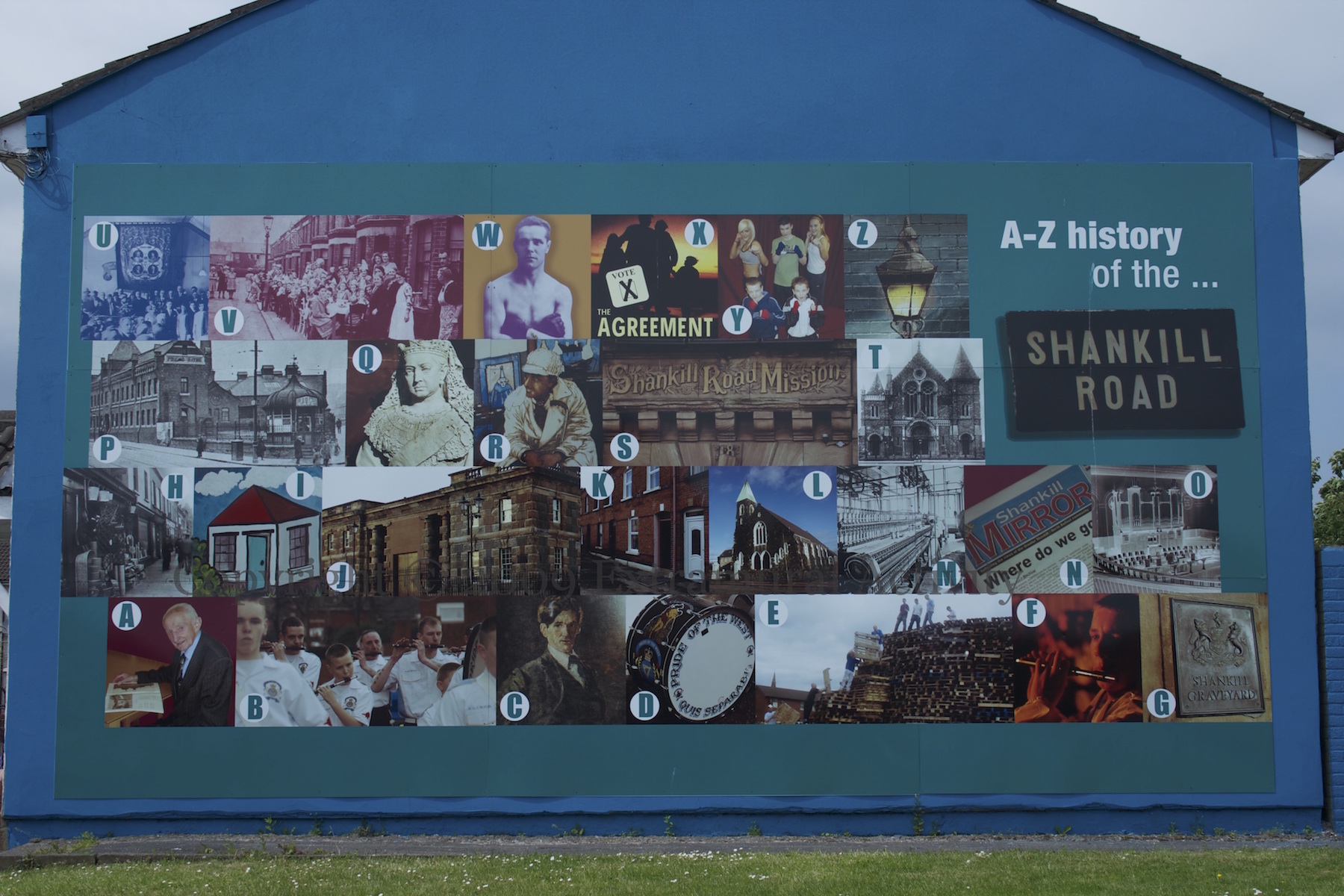
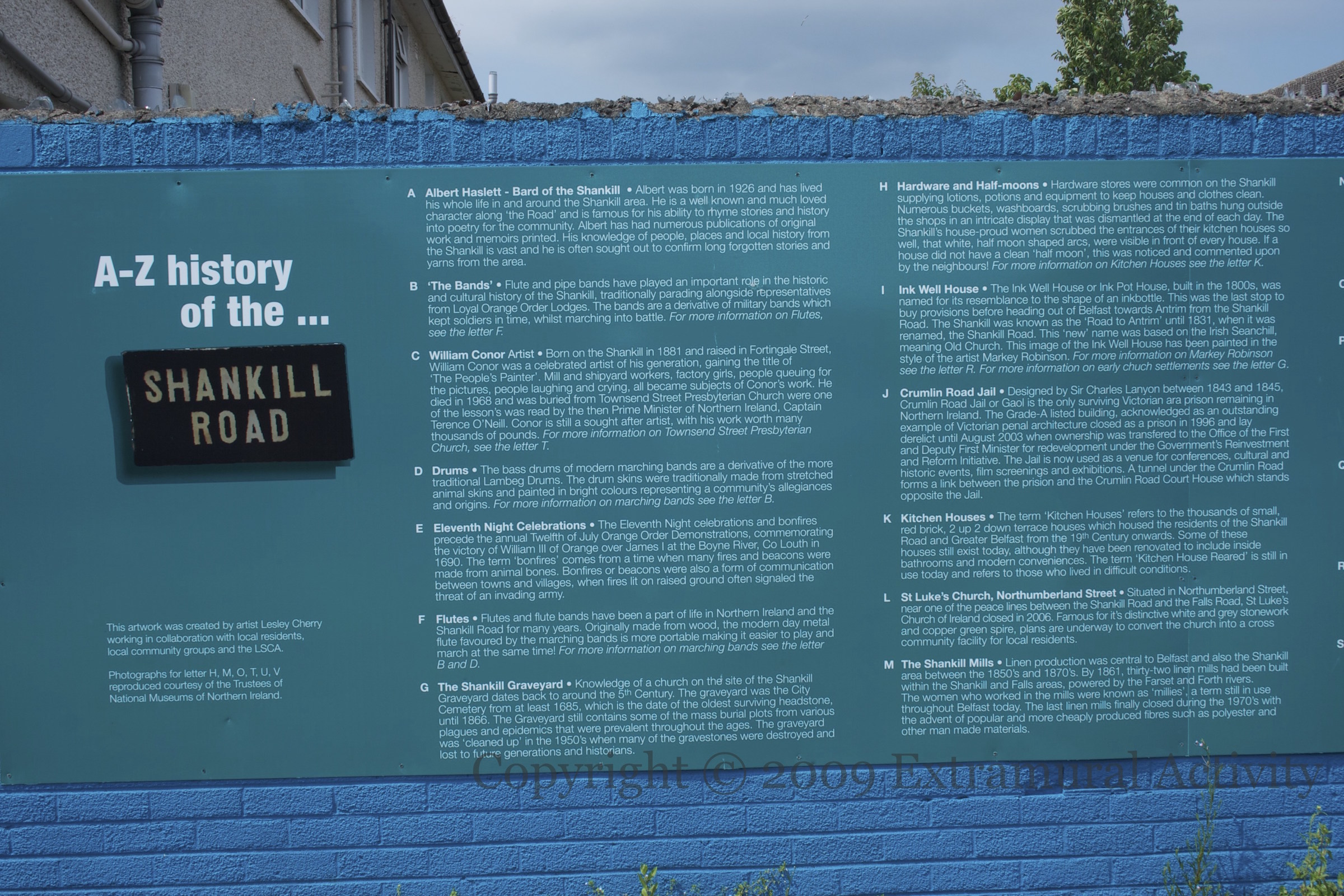
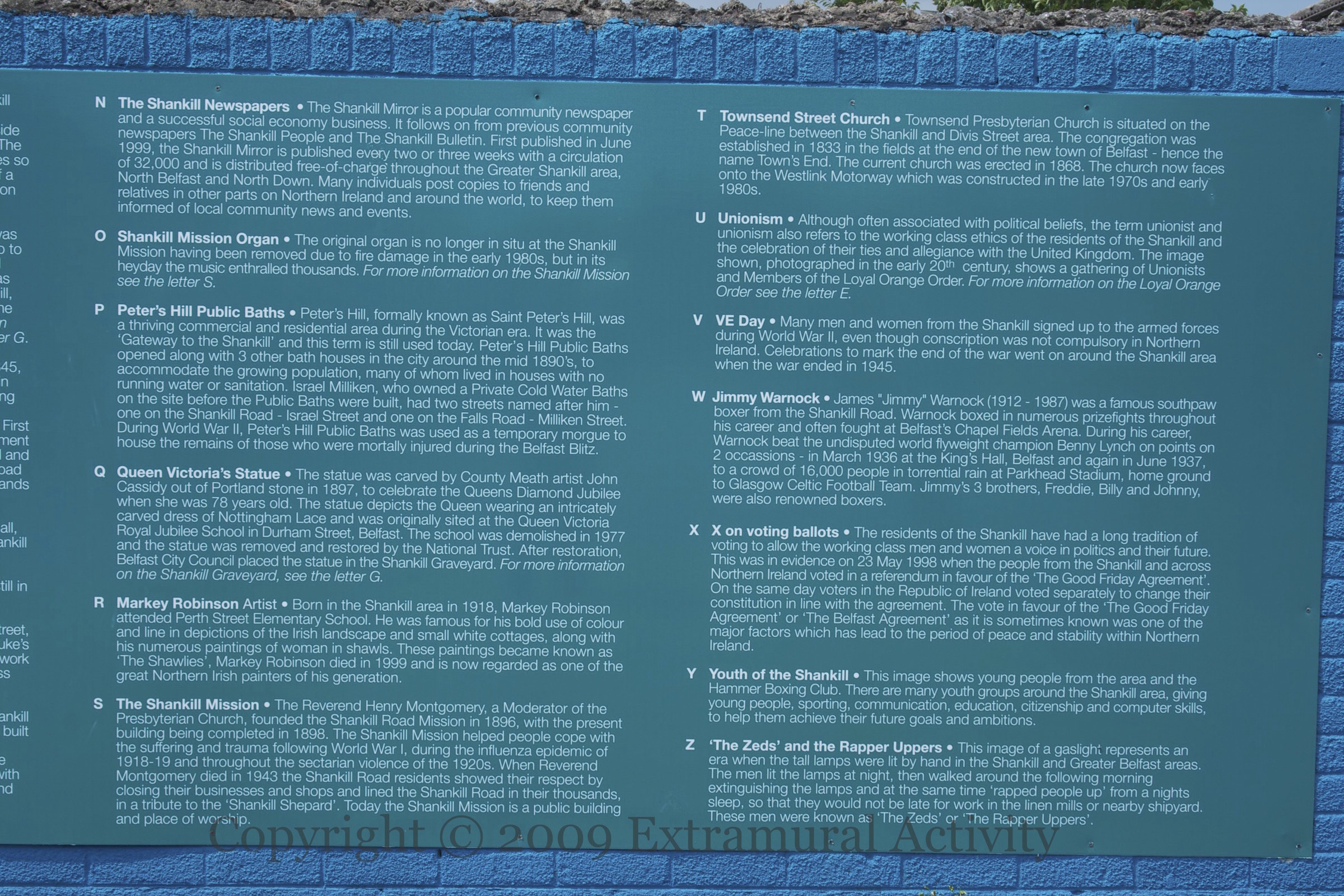
The Drumcree mural (2004 | 2008) is re-imaged in 2009 by this ‘Shankill A-Z’ board, designed by Lesley Cherry.
While bands get mentioned in three letters (“B” for “bands”, “D” for “drums” and “F” for “flutes”), “Unionism” is recast as “working-class ethics” and (perhaps the most striking “re-imaging”) under “X” it is claimed that the people of the lower Shankill voted for the Good Friday Agreement.
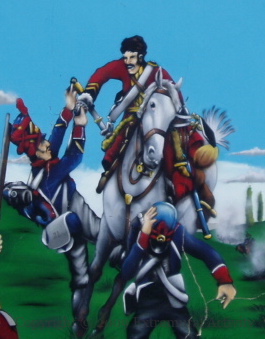
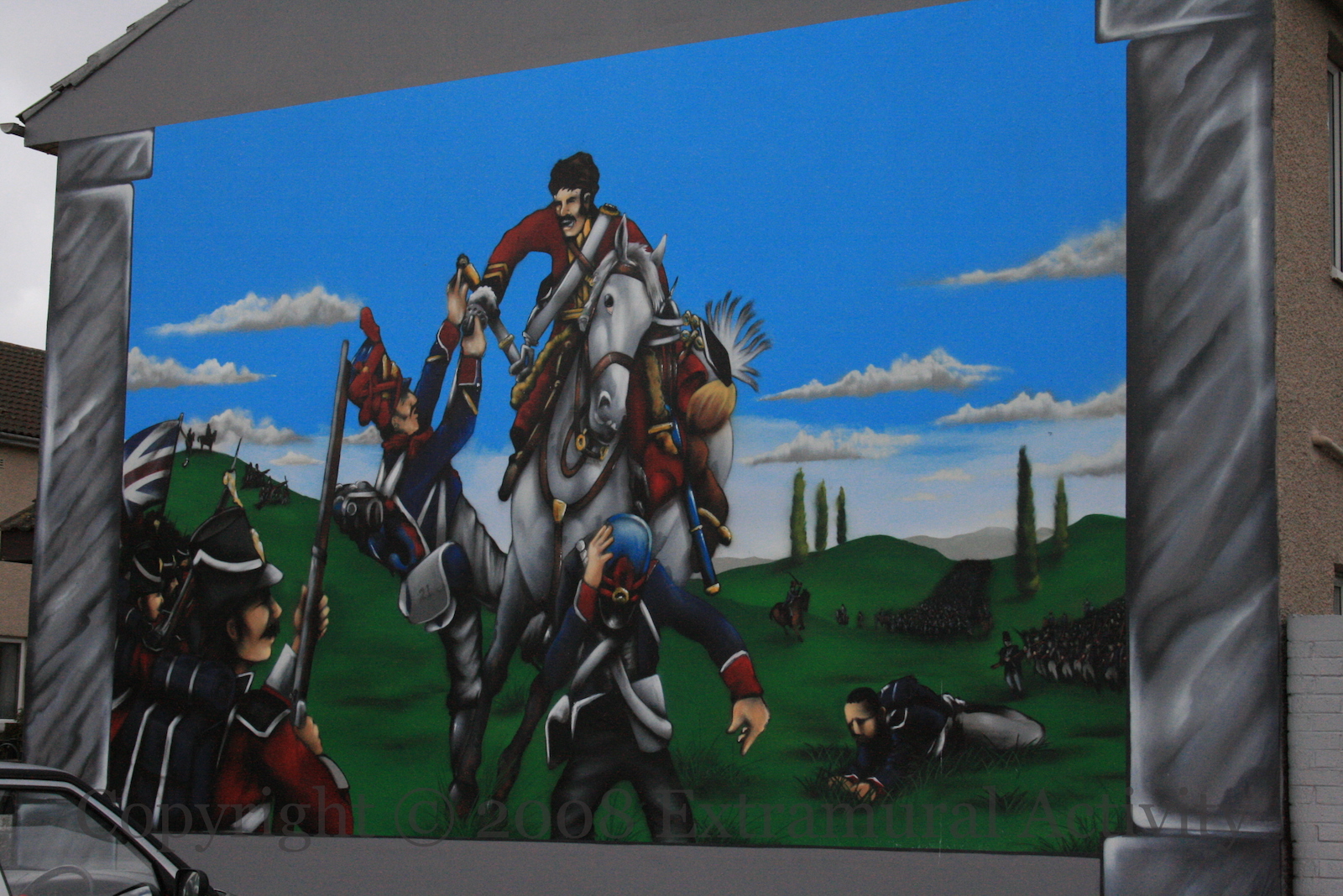
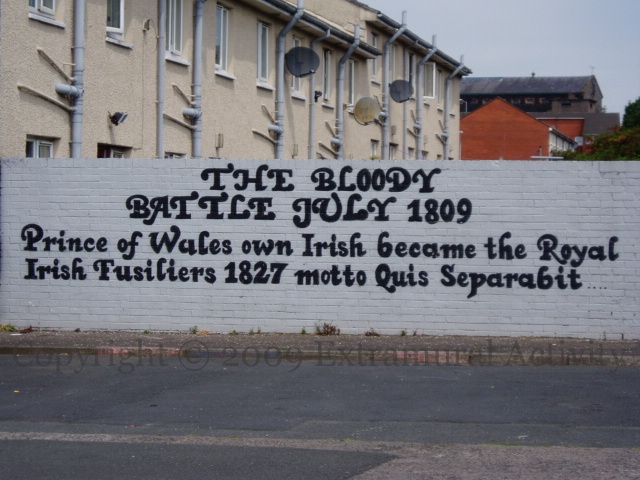
“The Bloody Battle, July 1809. Prince of Wales own Irish became the Royal Irish Fusiliers 1827, motto Quis separabit.”
Talavera de la Reina is southwest of Madrid, Spain. The French, who had invaded Portugal but been driven out by British forces under Wellesley, fought the combined forces of the Spanish (previously allies of the French in the Peninsular War) and British armies. The second battalion of the Prince Of Wales’s Irish fought at Talavera. It then became the Prince Of Wales’s Own Irish, the Prince Of Wales’s Own Irish Fusiliers, and finally the Royal Irish Fusiliers (after the prince had been king for seven years). Its motto seems to have been “Faugh A Ballagh” rather than “quis separabit” but sources are scarce.





 Extramural Activity