The Dividing Wall Of Hostility

This is the Cupar Way “peace” line in 2004. Note that the wall only has two (vertical) parts – a third tier will later be added that almost doubles the height of the barrier. It also has very little art – in 2009 both state-funded agencies and wild-style writers will take to the wall. (See the Visual History page.) The two pieces that can be seen here show a dove in barbed wire with a quote from Ephesians 2:14 (“For He Himself is our peace who has made the two one and destroyed the dividing wall of hostility by abolishing in His flesh the law with its commandments and regulations. His Purpose was to create in Himself one new man out of two, thus making peace and in this one body to reconcile both of them to God through the cross by which He put to death their hostility. He came and preached peace … For through Him we both have access to the Father by one spirit.”) and a mural for New Life church, which is in the no-man’s land between the Northumberland street barricades.

Click image to enlarge
Copyright © 2004 Seosamh Mac Coılle
X00039

UFF 2nd Batt C Coy

C Company of UFF 2nd battalion was the lower Shankill company headed by Johnny Adair until he was expelled from the UDA in September 2002 and his friends and family fled to Scotland in February 2003.

Click image to enlarge
Copyright © 2004 Seosamh Mac Coılle
X00037 X00036

The Protestant Reformation

Three figureheads of the Protestant Reformation – Martin Lurther 1483-1546, John Calvin 1509-1564, and John Wesley 1703-1791 – in Major Street, east Belfast.

Click image to enlarge
Copyright © 2004 Seosamh Mac Coılle
X00009 X00008

Our Family Of “Nations”

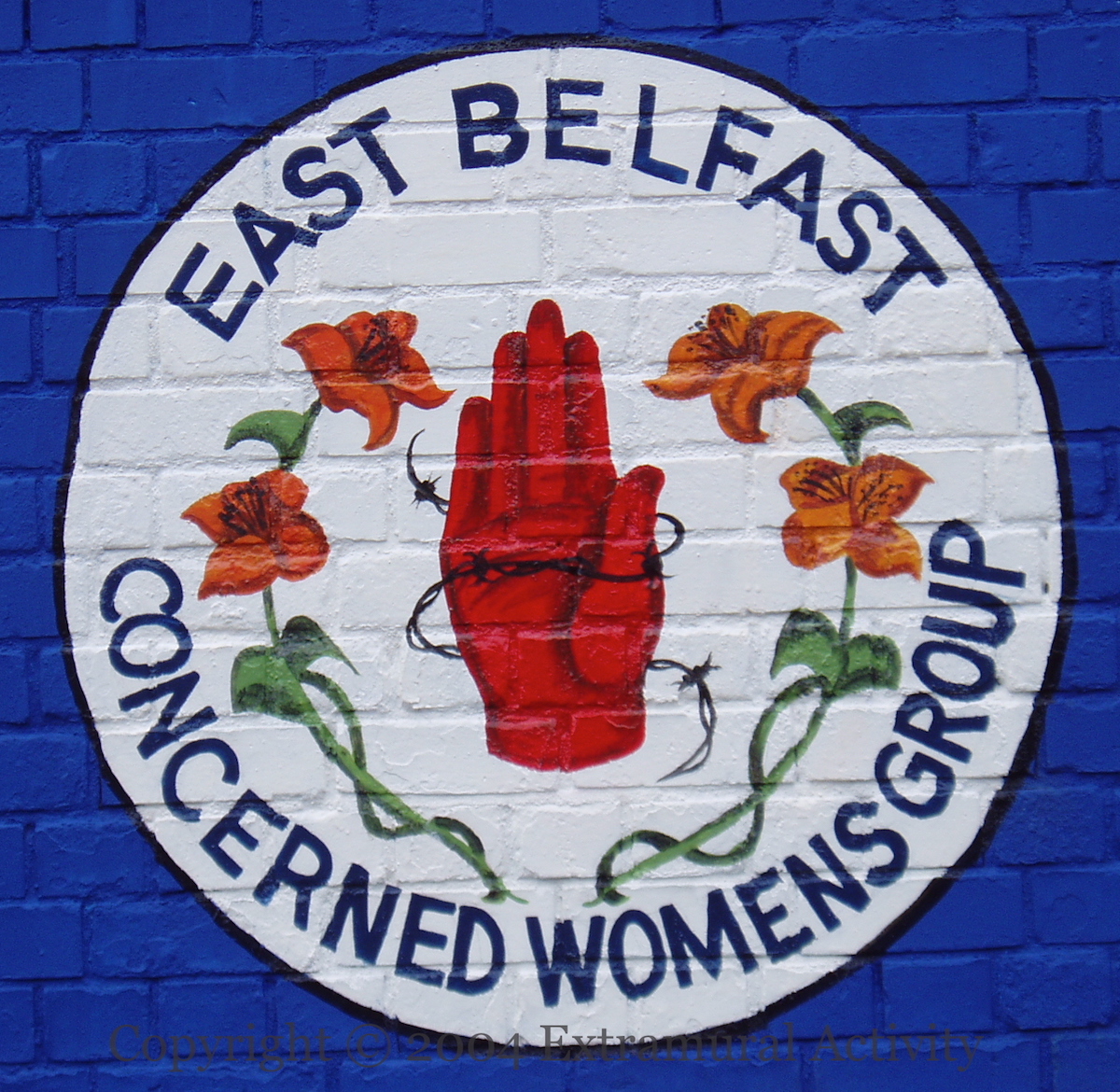
The fourteenth and final panel in Thorndyke Street contains a number of small panels, including the two above, along with emblems of local Orange and Black lodges, John McCrae’s In Flanders Fields, a list of acknowledgements, and a copyright claim.

For a list of entries for each panel, see East Belfast Historical And Cultural Society.

Click image to enlarge
Copyright © 2004 Seosamh Mac Coılle
X00012 X00017 X00033

Brittania

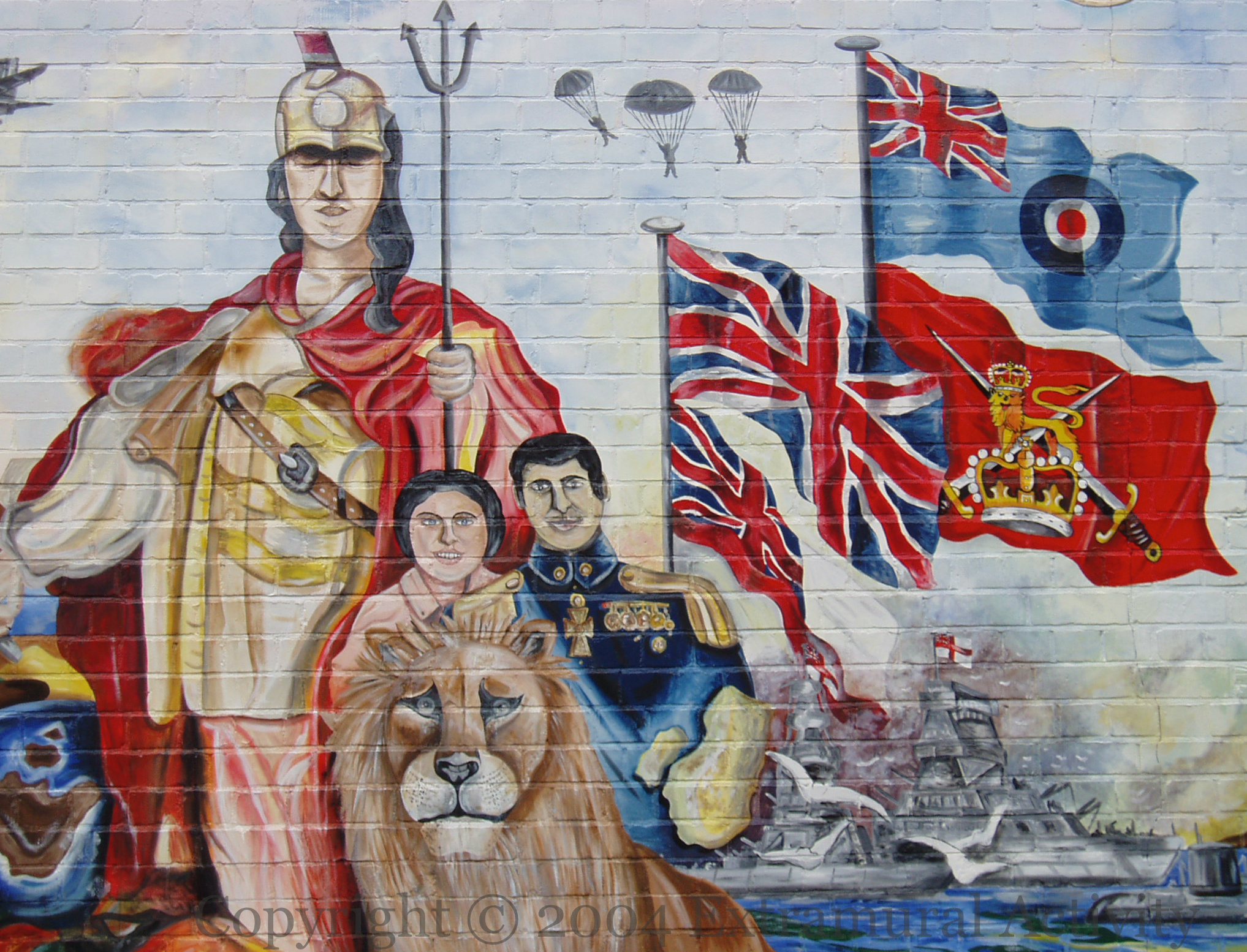
“The Union flag, or Union Jack, is the national flag of the United Kingdom and it is so called because it embodies the emblems of three countries united under one sovereign – the Kingdoms of England and Wales, of Scotland and of Ireland. The flag consists of three heraldic crosses, those of St Patrick, St George and St Andrew. The Welsh dragon does not appear on the Union flag. This is because when the first Union flag was created in 1606, Wales by that time was already united with England and was no longer a separate principality.”

One of fourteen panels in Thorndyke Street, east Belfast. For a list of entries for each panel, see East Belfast Historical And Cultural Society.

Click image to enlarge
Copyright © 2004 Seosamh Mac Coılle
X00029 X00028

Out Of The Ashes

“Peace” lines in east Belfast separate Protestant Cluan Place from Catholic Short Strand from Protestant east Belfast.

One of fourteen panels in Thorndyke Street, east Belfast. For a list of entries for each panel, see East Belfast Historical And Cultural Society.

Click image to enlarge
Copyright © 2004 Seosamh Mac Coılle
X00023 X00022

Their Loyalty Betrayed

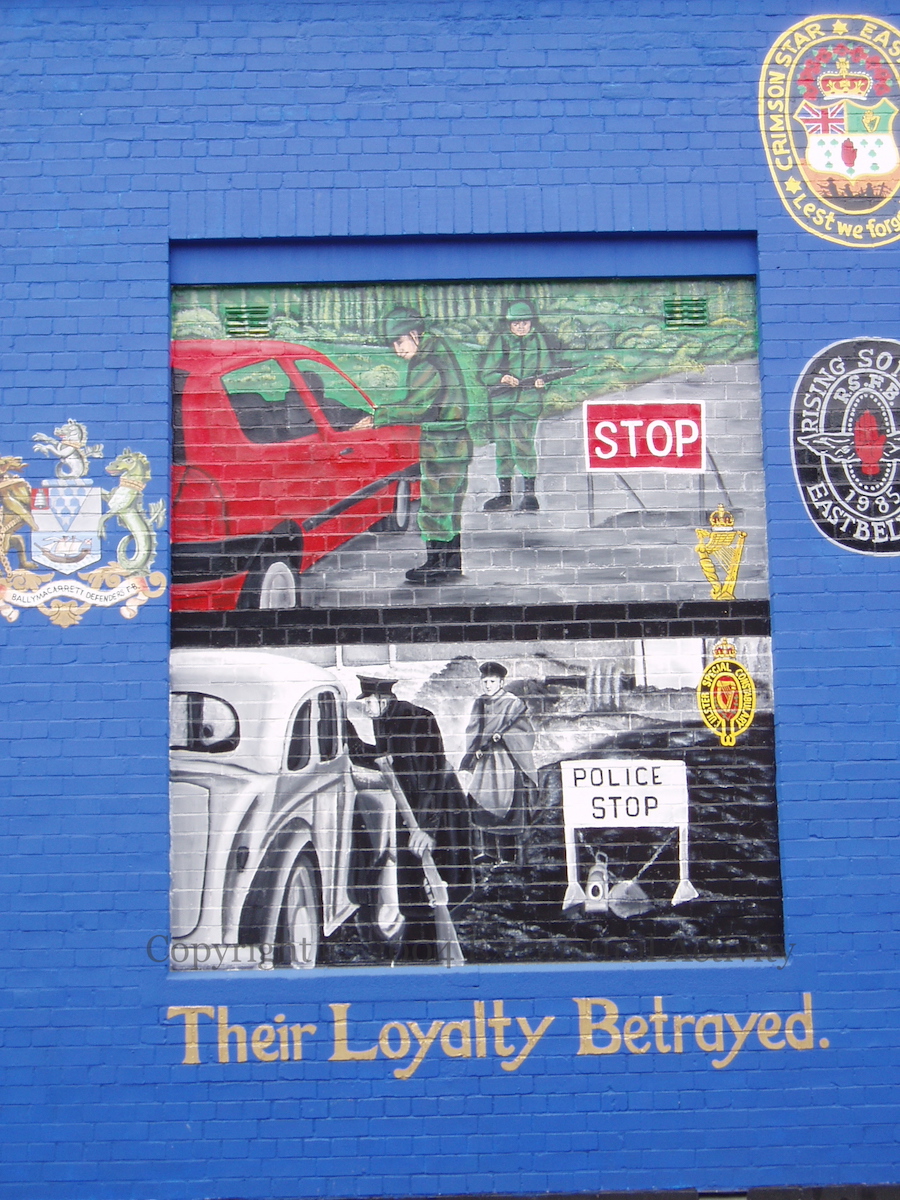
The Ulster Special Constabulary (USC) gave way to the Ulster Defence Regiment (UDR), which was disbanded in 1970.

One of fourteen panels in Thorndyke Street, east Belfast. For a list of entries for each panel, see East Belfast Historical And Cultural Society.

Click image to enlarge
Copyright © 2004 Seosamh Mac Coılle
X00021

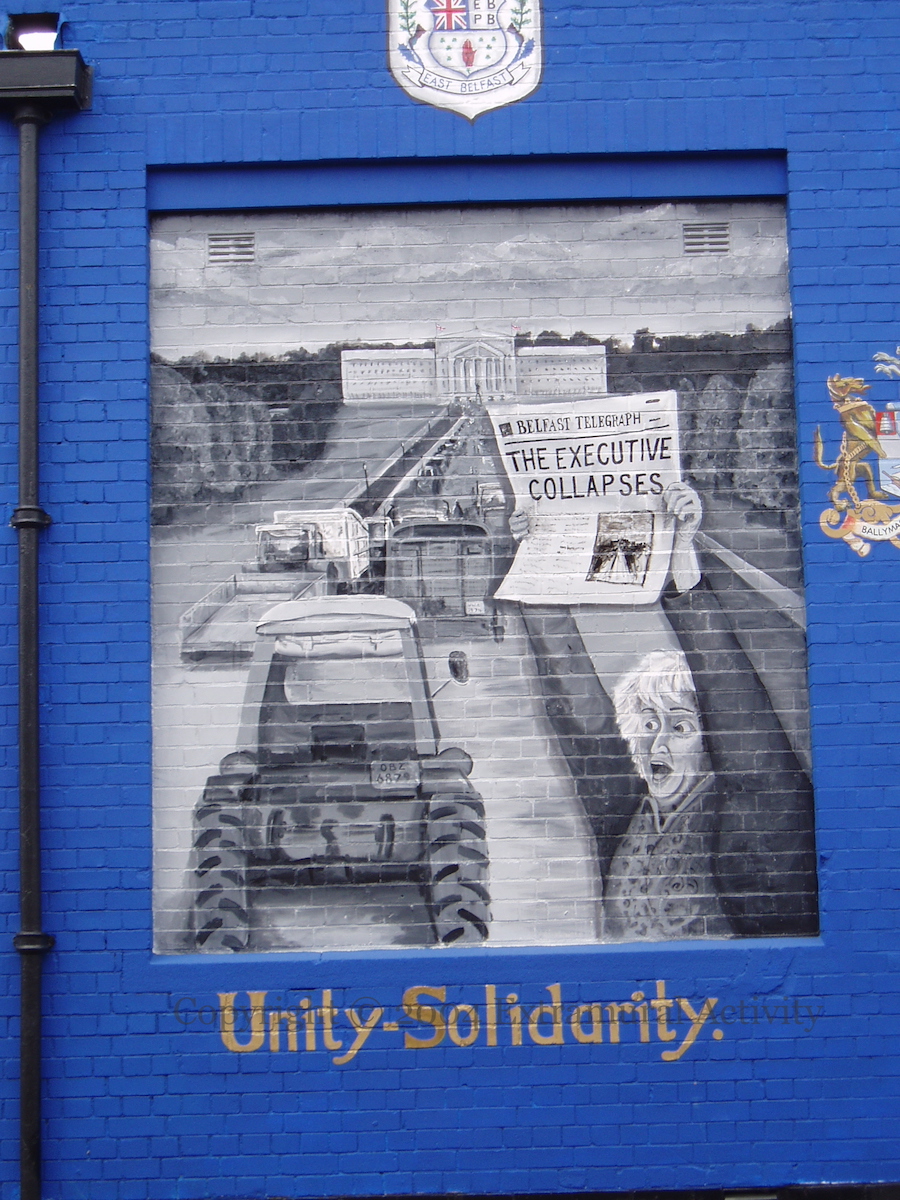
Unity Solidarity

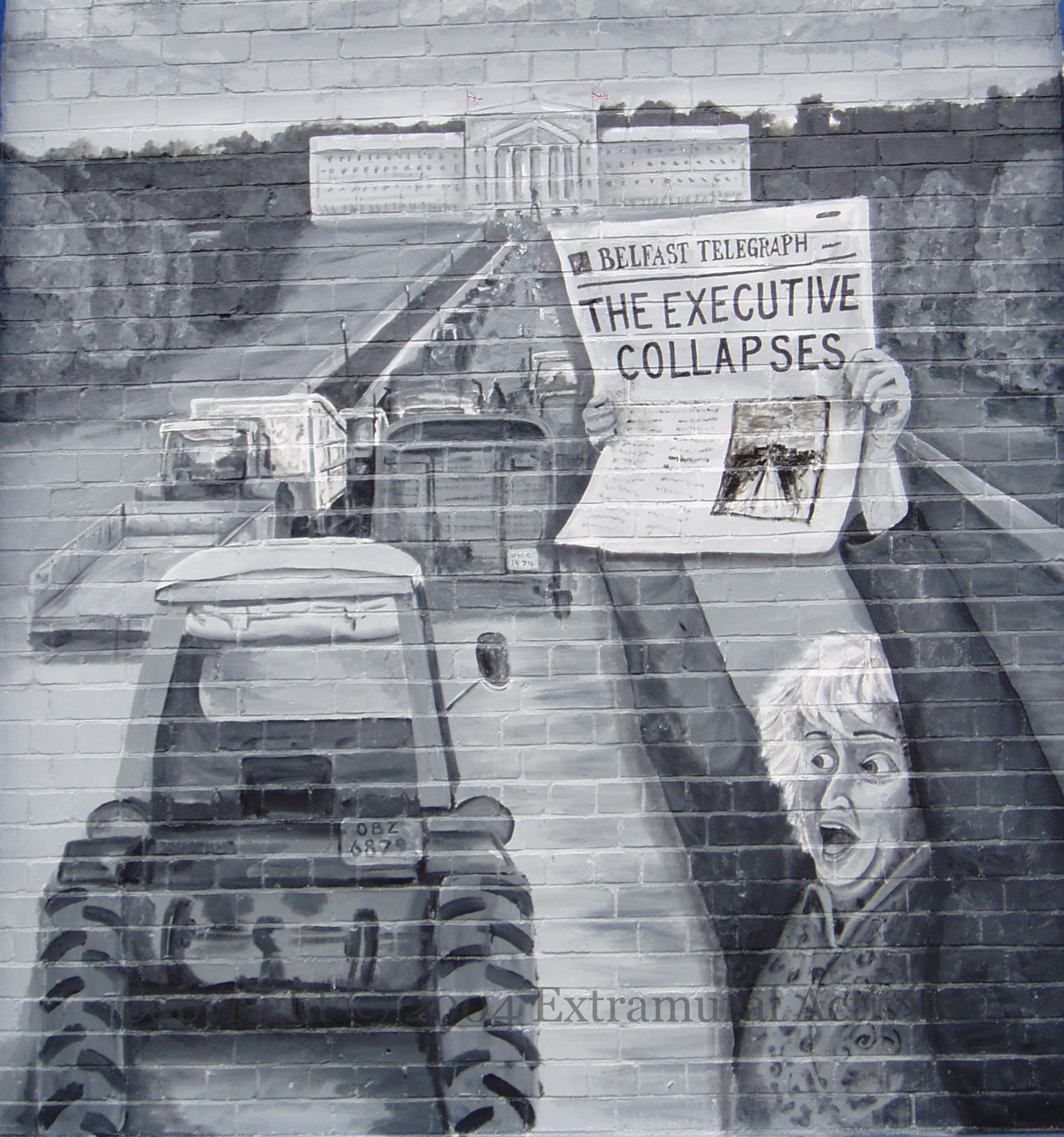
A strike organised by the Ulster Workers Council brought down the power-sharing executive created by the Sunningdale Agreement in May, 1974.

One of fourteen panels in Thorndyke Street, east Belfast. For a list of entries for each panel, see East Belfast Historical And Cultural Society.

Click image to enlarge
Copyright © 2004 Seosamh Mac Coılle
X00032 X00031

Hitler Attacks Belfast

From the info board, added later: In the blitz of 15/16th April 1941, “Across Belfast 745 civilians were killed, 420 were seriously injured and more than 1,000 less seriously. April and May 1941 an estimated 56,000 houses were damaged.”

One of fourteen panels in Thorndyke Street, east Belfast. For a list of entries for each panel, see East Belfast Historical And Cultural Society.

Click image to enlarge
Copyright © 2004 Seosamh Mac Coılle
X00019 X00018

United Kingdom

The central panel in Thorndyke Street, Belfast, reproduces a postcard from during the Home Rule debate: “Ulster to Britain: thou mayest find another daughter with a fairer face than mine, with a gayer voice and sweeter and a softer eye than mine; but thou canst not find another that will love thee half so well!” The Ulster Banner (a flag of Northern Ireland) is used to represent Ireland in the quartet of flags while the shamrock stands alongside daffodil, rose, and thistle. For the Anglo-Norman French around the crown’s coat of arms, see Honi Soit Qui Mal Y Pense.

One of fourteen panels in Thorndyke Street, east Belfast. For a list of entries for each panel, see East Belfast Historical And Cultural Society.

Click image to enlarge
Copyright © 2004 Seosamh Mac Coılle
X00027 [X00030]